

The DOI matches its Crossref record; 151 of the 151 references it cites were found in a registry or an index.
Excretion of biliary compounds during intrauterine life
Abstract
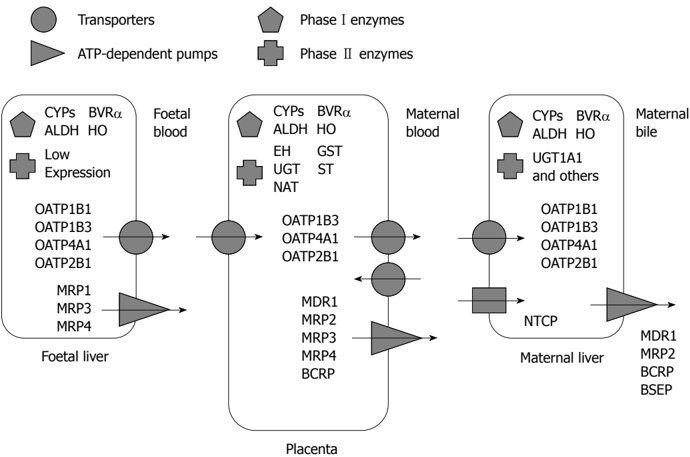
In adults, the hepatobiliary system, together with the kidney, constitute the main routes for the elimination of several endogenous and xenobiotic compounds into bile and urine, respectively. However, during intrauterine life the biliary route of excretion for cholephilic compounds, such as bile acids and biliary pigments, is very poor. Although very early in pregnancy the fetal liver produces bile acids, bilirubin and biliverdin, these compounds cannot be efficiently eliminated by the fetal hepatobiliary system, owing to the immaturity of the excretory machinery in the fetal liver. Therefore, the potentially harmful accumulation of cholephilic compounds in the fetus is prevented by their elimination across the placenta. Owing to the presence of detoxifying enzymes and specific transport systems at different locations of the placental barrier, such as the endothelial cells of chorionic vessels and trophoblast cells, this organ plays an important role in the hepatobiliary-like function during intrauterine life. The relevance of this excretory function in normal fetal physiology is evident in situations where high concentrations of biliary compounds are accumulated in the mother. This may result in oxidative stress and apoptosis, mainly in the placenta and fetal liver, which might affect normal fetal development and challenge the fate of the pregnancy. The present article reviews current knowledge of the mechanisms underlying the hepatobiliary function of the fetal-placental unit and the repercussions of several pathological conditions on this tandem.
Overview
The claims and statistics of this paper haven’t been checked yet.
Run the check — free, no account needed. It reads the open-access text and checks the sources it cites.
Integrity signals
Registry
Cites
Statistics
Figures
Verification
Claims the paper makes
The claims and statistics of this paper haven’t been checked yet.
Run the check — free, no account needed. It reads the open-access text and checks the sources it cites.
Claims other papers make about this one
Each is checked against this paper’s own text: does it say what the citing paper says it does?
In the citing paper
“A reaction specific to mammals is the conversion of biliverdin to the potent antioxidant bilirubin (66, 110).”
From Overcoming the Heme Paradox: Heme Toxicity and Tolerance in Bacterial Pathogens (2010) · cites this paper as [66]
Self-check
Percentages, sums and reported differences re-computed from the paper’s own numbers.
The self-check needs the paper’s full text.
Citations
Cites
Bilirubin Is an Antioxidant of Possible Physiological Importance
Stocker, R., Yamamoto, Y., McDonagh, A. F., Glazer, A. N., & Ames, B. N. (1987) · Science · doi:10.1126/science.3029864 · Cited by 2,948
THE HEME OXYGENASE SYSTEM:A Regulator of Second Messenger Gases
Maines, M. D. (1997) · The Annual Review of Pharmacology and Toxicology · doi:10.1146/annurev.pharmtox.37.1.517 · Cited by 2,501
Heme oxygenase: Function, multiplicity, regulatory mechanisms, and clinical applications
Maines, M. D. (1988) · The FASEB Journal · doi:10.1096/fasebj.2.10.3290025 · Cited by 1,707
Keyse, S. M., & Tyrrell, R. M. (1989) · Proceedings of the National Academy of Sciences · doi:10.1073/pnas.86.1.99 · Cited by 1,264
Ferritin: a cytoprotective antioxidant strategem of endothelium.
Balla, G., Jacob, H. S., Balla, J., Rosenberg, M., Nath, K., Apple, F., Eaton, J. W., & Vercellotti, G. M. (1992) · Journal of Biological Chemistry · doi:10.1016/s0021-9258(19)37165-0 · Cited by 1,097
Biliverdin reductase: A major physiologic cytoprotectant
Barañano, D. E., Rao, M., Ferris, C. D., & Snyder, S. H. (2002) · Proceedings of the National Academy of Sciences · doi:10.1073/pnas.252626999 · Cited by 1,091
Halestrap, A. P., & Meredith, D. (2004) · Pfl�gers Archiv European Journal of Physiology · doi:10.1007/s00424-003-1067-2 · Cited by 1,058
Hagenbuch, B., & Meier, P. J. (2004) · Pfl�gers Archiv European Journal of Physiology · doi:10.1007/s00424-003-1168-y · Cited by 1,019
The Sister of P-glycoprotein Represents the Canalicular Bile Salt Export Pump of Mammalian Liver
Gerloff, T., Stieger, B., Hagenbuch, B., Madon, J., Landmann, L., Roth, J., Hofmann, A. F., & Meier, P. J. (1998) · Journal of Biological Chemistry · doi:10.1074/jbc.273.16.10046 · Cited by 939
The superfamily of organic anion transporting polypeptides
Hagenbuch, B., & Meier, P. J. (2003) · Biochimica et Biophysica Acta (BBA) - Biomembranes · doi:10.1016/s0005-2736(02)00633-8 · Cited by 861
Research works printed but not linked: 1
- Ganapathy V, Leibach FH 1995. Placental biogenic amines and their transporters. editor. Placental Toxicology CRC Press: Boca Raton, FL; 1995;161-174.
Cited by
Overcoming the Heme Paradox: Heme Toxicity and Tolerance in Bacterial Pathogens
Anzaldi, L. L., & Skaar, E. P. (2010) · Infection and Immunity · doi:10.1128/iai.00613-10 · Cited by 295
Metadata
- Authors
- Macias, R. I., Marin, J. J., & Serrano, M. A.
- Venue
- World Journal of Gastroenterology
- Publisher
- Baishideng Publishing Group Inc.
- Published
- 2009
- Volume
- 15
- Issue
- 7
- Pages
- 817
- ISSN
- 1007-9327
- Cited by
- 54
- References
- 151
- Language
- en
About these checks
Registry, retraction, Cites and statistics results are computed, not judged, with one exception: a printed reference that no index lists is read once by a model before it counts as a citation error. Claims are extracted by a model and kept only when their quote appears verbatim in the text; each cited source is then checked, with a model’s help, for whether it says what the claim relies on. Those verdicts can be wrong — read the claim’s quote and the cited source before relying on one.
Statistics and arithmetic are recomputed, not judged.
Confidence bands are shown only for fields calibrated on our annotated test set. None is calibrated yet, so no band is shown.
What counts as a claim ›How we measure confidence ›How we check this ›
Are you an author, or do you see a problem with this page? Request a review
Data sources
Bibliographic data: Semantic Scholar, OpenAlex, Crossref.
Contains information from the Semantic Scholar Academic Graph Datasets, made available under the ODC Attribution License (ODC-BY 1.0).
Semantic Scholar’s data is described in: Kinney, R., et al. (2023). The Semantic Scholar Open Data Platform. arXiv:2301.10140.
