

The DOI matches its Crossref record; 32 of the 32 references it cites were found in a registry or an index.
How to measure working memory capacity in the change detection paradigm
Open accessAbstract
Although the measurement of working memory capacity is crucial to understanding working memory and its interaction with other cognitive faculties, there are inconsistencies in the literature on how to measure capacity. We address the measurement in the change detection paradigm, popularized by Luck and Vogel (Nature, 390, 279-281, 1997). Two measures for this task-from Pashler (Perception & Psychophysics, 44, 369-378, 1988) and Cowan (The Behavioral and Brain Sciences, 24, 87-114, 2001), respectively-have been used interchangeably, even though they may yield qualitatively different conclusions. We show that the choice between these two measures is not arbitrary. Although they are motivated by the same underlying discrete-slots working memory model, each is applicable only to a specific task; the two are never interchangeable. In the course of deriving these measures, we discuss subtle but consequential flaws in the underlying discrete-slots model. These flaws motivate revision in the modal model and capacity measures.
Overview
The claims and statistics of this paper haven’t been checked yet.
Run the check — free, no account needed. It reads the open-access text and checks the sources it cites.
Integrity signals
Registry
Cites
Statistics
Figures
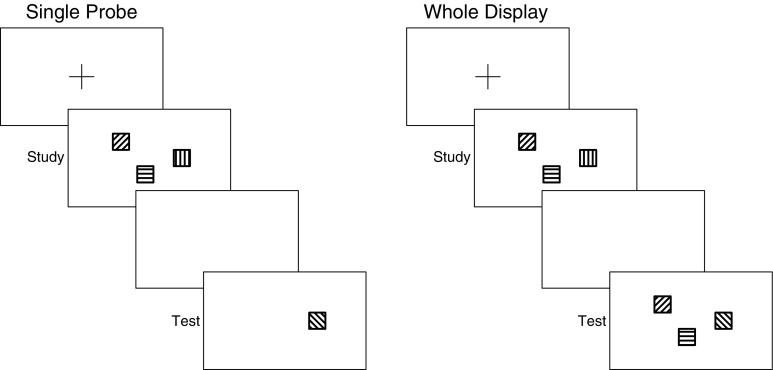
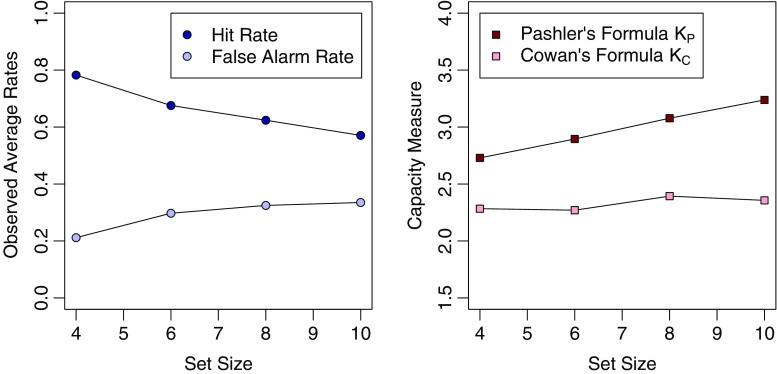
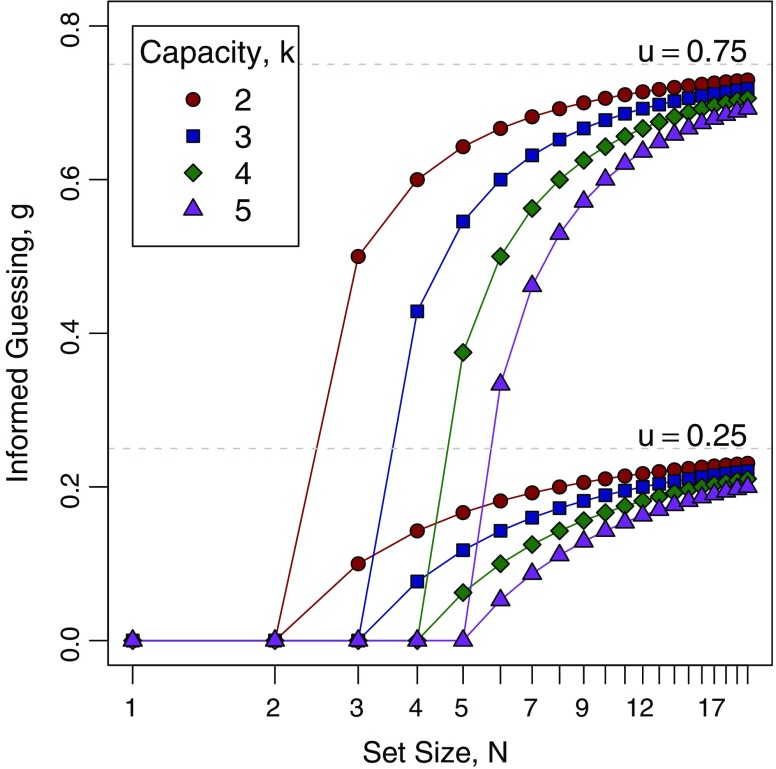
Verification
Claims the paper makes
The claims and statistics of this paper haven’t been checked yet.
Run the check — free, no account needed. It reads the open-access text and checks the sources it cites.
Claims other papers make about this one
Each is checked against this paper’s own text: does it say what the citing paper says it does?
In the citing paper
“Data provided by this task can estimate with a high degree of precision the average number of memory items correctly retained by a participant for each set size, namely, the individual’s VWM capacity.”
From Emotion-related impulsivity moderates the cognitive interference effect of smartphone availability on working memory (2019) · cites this paper as [52]
Self-check
Percentages, sums and reported differences re-computed from the paper’s own numbers.
The self-check needs the paper’s full text.
Citations
Cites
The magical number seven, plus or minus two: Some limits on our capacity for processing information.
Miller, G. A. (1956) · Psychological Review · doi:10.1037/h0043158 · Cited by 17,812
The magical number seven, plus or minus two: Some limits on our capacity for processing information.
Miller, G. A. (1994) · Psychological Review · doi:10.1037/0033-295x.101.2.343 · Cited by 17,563
The magical number 4 in short-term memory: A reconsideration of mental storage capacity
Cowan, N. (2001) · Behavioral and Brain Sciences · doi:10.1017/s0140525x01003922 · Cited by 6,779
Self-citationThe capacity of visual working memory for features and conjunctions
Luck, S. J., & Vogel, E. K. (1997) · Nature · doi:10.1038/36846 · Cited by 4,265
Models of Working Memory: Mechanisms of Active Maintenance and Executive Control
Miyake, A., & Shah, P. (1999) · Cited by 2,404
Signal detection theory and ROC analysis
Egan, J. P. (1975) · Academic Press eBooks · Cited by 1,659
The Cognitive Neuroscience of Working Memory
D'Esposito, M., & Postle, B. R. (2015) · Annual Review of Psychology · doi:10.1146/annurev-psych-010814-015031 · Cited by 1,653
Discrete fixed-resolution representations in visual working memory
Zhang, W., & Luck, S. J. (2008) · Nature · doi:10.1038/nature06860 · Cited by 1,624
Neural measures reveal individual differences in controlling access to working memory
Vogel, E. K., McCollough, A. W., & Machizawa, M. G. (2005) · Nature · doi:10.1038/nature04171 · Cited by 1,367
Dynamic Shifts of Limited Working Memory Resources in Human Vision
Bays, P. M., & Husain, M. (2008) · Science · doi:10.1126/science.1158023 · Cited by 1,177
Cited by
Sorted by citations
Items 101–200 of 336
Object-based grouping benefits without integrated feature representations in visual working memory
Chen, S., Kocsis, A., Liesefeld, H. R., Müller, H. J., & Conci, M. (2020) · Attention Perception & Psychophysics · doi:10.3758/s13414-020-02153-5 · Cited by 23
Is Cortical Theta-Gamma Phase-Amplitude Coupling Memory-Specific?
Papaioannou, O., Crespo, L. P., Clark, K., Ogbuagu, N. N., Alliende, L. M., Silverstein, S. M., & Erickson, M. A. (2022) · Brain Sciences · doi:10.3390/brainsci12091131 · Cited by 24
Trait anxiety is associated with a decreased visual working memory capacity for faces
Yao, N., Chen, S., & Qian, M. (2018) · Psychiatry Research · doi:10.1016/j.psychres.2018.10.018 · Cited by 22
Ye, C., Xu, Q., Liu, X., Astikainen, P., Zhu, Y., Hu, Z., & Liu, Q. (2021) · Scientific Reports · doi:10.1038/s41598-021-86515-5 · Cited by 21
Dysfunctional temporal stages of eye-gaze perception in adults with ADHD: A high-density EEG study
Mauriello, C., Pham, E., Kumar, S., Piguet, C., Deiber, M., Aubry, J., Dayer, A. G., Michel, C. M., Perroud, N. A., & Berchio, C. (2022) · Biological Psychology · doi:10.1016/j.biopsycho.2022.108351 · Cited by 21
Short-term memory conjunctive binding in Alzheimer’s disease: A systematic review and meta-analysis.
Cecchini, M. A., Parra, M. A., Brazzelli, M. G., Logie, R. H., & Sala, S. D. (2022) · Neuropsychology · doi:10.1037/neu0000825 · Cited by 21
Rumination burdens the updating of working memory
Bruning, A. L., Mallya, M. M., & Lewis‐Peacock, J. A. (2023) · Attention Perception & Psychophysics · doi:10.3758/s13414-022-02649-2 · Cited by 24
Morey, C. C., Rhodes, S., & Cowan, N. (2018) · Cortex · doi:10.1016/j.cortex.2018.11.030 · Cited by 21
Self-citationYonelinas, A. P. (2023) · Psychological Review · doi:10.1037/rev0000432 · Cited by 20
Mental Objects in Working Memory
Cowan, N. (2017) · Advances in child development and behavior · doi:10.1016/bs.acdb.2016.12.001 · Cited by 20
Self-citationInvestigating the other‐race effect in working memory
Stelter, M., & Degner, J. (2018) · British Journal of Psychology · doi:10.1111/bjop.12304 · Cited by 22
Yao, Z., Sligte, I. G., & Ridderinkhof, K. R. (2024) · Neuropsychologia · doi:10.1016/j.neuropsychologia.2024.108974 · Cited by 20
Transdiagnostic comparison of visual working memory capacity in bipolar disorder and schizophrenia
Barnes-Scheufler, C. V., Passow, C., Rösler, L., Mayer, J. S., Oertel, V., Kittel‐Schneider, S., Matura, S., Reif, A., & Bittner, R. A. (2021) · International Journal of Bipolar Disorders · doi:10.1186/s40345-020-00217-x · Cited by 20
Affective Modulation of Working Memory Maintenance: The Role of Positive and Negative Emotions
Gökçe, A., Zinchenko, A., Birtwistle, E., Conci, M., & Geyer, T. (2021) · Advances in Cognitive Psychology · doi:10.5709/acp-0321-7 · Cited by 19
Effortfulness of visual working memory: Gauged by physical exertion.
Xie, W., & Zhang, W. (2023) · Journal of Experimental Psychology General · doi:10.1037/xge0001391 · Cited by 21
Simmering, V. R., & Patterson, R. (2012) · Cognitive Development · doi:10.1016/j.cogdev.2012.08.001 · Cited by 19
Hemifield asymmetries differentiate VSTM for single- and multiple-feature objects
Sheremata, S., & Shomstein, S. (2014) · Attention Perception & Psychophysics · doi:10.3758/s13414-014-0689-0 · Cited by 19
Visual working memory capacity is limited by two systems that change across lifespan
Ozimič, A. S., & Repovš, G. (2020) · Journal of Memory and Language · doi:10.1016/j.jml.2020.104090 · Cited by 20
Current directions in visual working memory research: An introduction and emerging insights
Liesefeld, H. R., & Müller, H. J. (2019) · British Journal of Psychology · doi:10.1111/bjop.12377 · Cited by 18
Formica, S., González‐García, C., & Braß, M. (2020) · Cognition · doi:10.1016/j.cognition.2020.104295 · Cited by 18
Object-based encoding in visual working memory: A life span study
Zhang, Q., Shen, M., Tang, N., Zhao, G., & Gao, Z. (2013) · Journal of Vision · doi:10.1167/13.10.11 · Cited by 18
A snapshot is all it takes to encode object locations into spatial memory
Haladjian, H. H., & Mathy, F. (2014) · Vision Research · doi:10.1016/j.visres.2014.12.014 · Cited by 17
Gałecki, P., Talarowska, M. E., Moczulski, D. K., Bobińska, K., Opuchlik, K., Gałecka, E., Florkowski, A., & Lewiñski, A. (2013) · PubMed · Cited by 17
Learning by task repetition enhances object individuation and memorization in the elderly
Tagliabue, C. F., Assecondi, S., Cristoforetti, G., & Mazza, V. (2020) · Scientific Reports · doi:10.1038/s41598-020-75297-x · Cited by 17
Gestalt Effects in Visual Working Memory
Kałamała, P., Sadowska, A., Ordziniak, W., & Chuderski, A. (2017) · Experimental Psychology (formerly Zeitschrift für Experimentelle Psychologie) · doi:10.1027/1618-3169/a000346 · Cited by 17
Informed guessing in change detection.
Rhodes, S., Cowan, N., Hardman, K. O., & Logie, R. H. (2017) · Journal of Experimental Psychology Learning Memory and Cognition · doi:10.1037/xlm0000495 · Cited by 17
Self-citationXin, Z., Gu, S., Lei, Y., Li, H., & Wang, F. (2020) · Frontiers in Psychiatry · doi:10.3389/fpsyt.2020.544540 · Cited by 21
Li, Y., Zhang, D., Liu, X., & Guo, D. (2023) · Computers in Human Behavior · doi:10.1016/j.chb.2023.108106 · Cited by 19
Perceptual encoding benefit of visual memorability on visual memory formation
Ye, C., Guo, L., Wang, N., Liu, Q., & Xie, W. (2024) · Cognition · doi:10.1016/j.cognition.2024.105810 · Cited by 16
An oscillatory model of individual differences in working memory capacity and relational integration
Chuderski, A., Andrelczyk, K., & Smoleń, T. (2013) · Cognitive Systems Research · doi:10.1016/j.cogsys.2012.12.005 · Cited by 16
Shin, E., Lee, H., Yoo, S.-A., & Chong, S. C. (2015) · PLoS ONE · doi:10.1371/journal.pone.0121702 · Cited by 19
Updating schematic emotional facial expressions in working memory: Response bias and sensitivity.
Tamm, G., Kreegipuu, K., Harro, J., & Cowan, N. (2017) · Acta Psychologica · doi:10.1016/j.actpsy.2016.11.002 · Cited by 14
Self-citationKrickel, B. (2019) · Mind & Language · doi:10.1111/mila.12262 · Cited by 16
Berggren, N. (2020) · Anxiety Stress & Coping · doi:10.1080/10615806.2020.1736899 · Cited by 16
Contralateral delay activity tracks the storage of visually presented letters and words
Rajsic, J., Burton, J. A., & Woodman, G. F. (2018) · Psychophysiology · doi:10.1111/psyp.13282 · Cited by 16
The neural basis of precise visual short-term memory for complex recognisable objects
Veldsman, M., Mitchell, D. J., & Cusack, R. (2017) · NeuroImage · doi:10.1016/j.neuroimage.2017.07.033 · Cited by 14
Zhang, L., Qiao, L., Xu, M., Fan, L., Che, X., Diao, L., Yuan, S., Du, X., & Yang, D. (2021) · International Journal of Psychophysiology · doi:10.1016/j.ijpsycho.2021.02.008 · Cited by 15
Binding Costs in Processing Efficiency as Determinants of Cognitive Ability
Goecke, B., Schmitz, F., & Wilhelm, O. (2021) · Journal of Intelligence · doi:10.3390/jintelligence9020018 · Cited by 15
Ross‐Sheehy, S., Reynolds, E., & Eschman, B. (2021) · Frontiers in Psychology · doi:10.3389/fpsyg.2021.692228 · Cited by 15
Visual Attention Modulates Phenomenal Consciousness: Evidence From a Change Detection Study
Simione, L., Pace, E. D., Chiarella, S. G., & Raffone, A. (2019) · Frontiers in Psychology · doi:10.3389/fpsyg.2019.02150 · Cited by 16
The effect of mere presence of smartphone on cognitive functions: A four-level meta-analysis.
Hartanto, A., Lua, V. Y. Q., Kasturiratna, K. T. A. S., Koh, P. S., Tng, G. Y. Q., Kaur, M., Quek, F. Y. X., Chia, J. L., & Majeed, N. M. (2024) · Technology Mind and Behavior · doi:10.1037/tmb0000123 · Cited by 20
Simmering, V. R., & Miller, H. E. (2016) · Attention Perception & Psychophysics · doi:10.3758/s13414-016-1163-y · Cited by 14
Developmental change in the nature of attention allocation in a dual task.
Cowan, N., AuBuchon, A. M., Gilchrist, A. L., Blume, C. L., Boone, A. P., & Saults, J. S. (2020) · Developmental Psychology · doi:10.1037/dev0001134 · Cited by 13
Self-citationEvent-related components are structurally represented by intrinsic event-related potentials
Tsai, C., & Liang, W.-K. (2021) · Scientific Reports · doi:10.1038/s41598-021-85235-0 · Cited by 14
Visual working memory supports perceptual stability across saccadic eye movements.
Cronin, D. A., & Irwin, D. E. (2018) · Journal of Experimental Psychology Human Perception & Performance · doi:10.1037/xhp0000567 · Cited by 14
Feuerstahler, L. M., Luck, S. J., MacDonald, A. W., & Waller, N. G. (2018) · Behavior Research Methods · doi:10.3758/s13428-018-1082-z · Cited by 14
Discrete-Slots Models of Visual Working-Memory Response Times
Donkin, C., Nosofsky, R. M., Shiffrin, R. M., & Gold, J. M. (2013) · PsycEXTRA Dataset · doi:10.1037/e633262013-314 · Cited by 15
Improving Measurement Precision in Experimental Psychopathology Using Item Response Theory
Feuerstahler, L. M., Waller, N. G., & MacDonald, A. W. (2019) · Educational and Psychological Measurement · doi:10.1177/0013164419892049 · Cited by 14
Coffman, B. A., Murphy, T. K., Haas, G. L., Olson, C. R., Cho, R., Ghuman, A. S., & Salisbury, D. F. (2020) · Journal of Psychiatric Research · doi:10.1016/j.jpsychires.2020.07.036 · Cited by 13
The medial olivocochlear reflex strength is modulated during a visual working memory task
Marcenaro, B., Alexis Leiva, C., Dragicevic, C. D., López, V., & Delano, P. H. (2021) · Journal of Neurophysiology · doi:10.1152/jn.00032.2020 · Cited by 13
Short-term memory across eye blinks
Irwin, D. E. (2013) · Memory · doi:10.1080/09658211.2013.847959 · Cited by 13
Machizawa, M. G., Driver, J., & Watanabe, T. (2020) · Cerebral Cortex · doi:10.1093/cercor/bhaa046 · Cited by 13
Chuderski, A., & Andrelczyk, K. (2015) · Cognitive Psychology · doi:10.1016/j.cogpsych.2015.01.001 · Cited by 12
Buss, A. T., Magnotta, V. A., Penny, W. D., Schöner, G., Huppert, T. J., & Spencer, J. P. (2021) · Psychological Review · doi:10.1037/rev0000264 · Cited by 12
Song, J., Chang, L., & Zhou, R. (2021) · Psychophysiology · doi:10.1111/psyp.13965 · Cited by 12
Riddle, J., McPherson, T., Sheikh, A., Shin, H.-W., Hadar, E. J., & Frӧhlich, F. (2024) · Journal of Neuroscience · doi:10.1523/jneurosci.1381-23.2024 · Cited by 15
Are Social Media Notifications Distracting?
Wiradhany, W., Pócs, A., & Baumgartner, S. E. (2024) · Experimental Psychology (formerly Zeitschrift für Experimentelle Psychologie) · doi:10.1027/1618-3169/a000625 · Cited by 13
Liesefeld, H. R., Liesefeld, A. M., & Müller, H. J. (2018) · British Journal of Psychology · doi:10.1111/bjop.12359 · Cited by 11
Long-term high-altitude exposure influences task-related representations in visual working memory
Bao, X., Zhang, D., Li, X., Liu, M., & Ma, H. (2023) · Frontiers in Neurology · doi:10.3389/fneur.2023.1149623 · Cited by 11
Stauffer, C. C., Troche, S. J., SCHWEIZER, K. W., & Rammsayer, T. H. (2014) · Intelligence · doi:10.1016/j.intell.2013.12.003 · Cited by 11
Interaction effects on common measures of sensitivity: choice of measure, type I error, and power
Rhodes, S., Cowan, N., Parra, M., & Logie, R. (2018) · Behavior Research Methods · doi:10.3758/s13428-018-1081-0 · Cited by 12
Self-citationZhang, L., Qiao, L., Xu, M., Che, X., Diao, L., Yuan, S., Du, X., & Yang, D. (2019) · Personality and Individual Differences · doi:10.1016/j.paid.2019.06.007 · Cited by 11
Yu, X., & Lau, E. F. (2025) · Neuroreport · doi:10.1097/wnr.0000000000002132 · Cited by 10
Biological motion is stored independently from bound representation in working memory
Liu, Y., Lu, X., Wu, F., Shen, M., & Gao, Z. (2019) · Visual Cognition · doi:10.1080/13506285.2019.1638479 · Cited by 10
The storage mechanism of dynamic relations in visual working memory
Shen, M., Chen, J., Yang, X., Dong, H., Chen, H., & Zhou, J. (2021) · Cognition · doi:10.1016/j.cognition.2020.104571 · Cited by 10
Shimi, A. G., & Scerif, G. (2021) · Developmental Science · doi:10.1111/desc.13213 · Cited by 10
Inter- and Intra-Hemispheric Age-Related Remodeling in Visuo-Spatial Working Memory
Tagliabue, C. F., Varesio, G., & Mazza, V. (2022) · Frontiers in Aging Neuroscience · doi:10.3389/fnagi.2021.807907 · Cited by 11
Cowan, N., Saults, J. S., & Clark, K. M. (2015) · Journal of Experimental Child Psychology · doi:10.1016/j.jecp.2015.03.002 · Cited by 10
Self-citationWorking Memory Capacity for Gesture-Command Associations in Gestural Interaction
Gao, Q., Ma, Z., Gu, Q., Li, J., & Gao, Z. (2022) · International Journal of Human-Computer Interaction · doi:10.1080/10447318.2022.2091213 · Cited by 9
Social exclusion increases the visual working memory capacity of social stimuli
Du, X., Xu, M., Ding, C., Yuan, S., Zhang, L., & Yang, D. (2019) · Current Psychology · doi:10.1007/s12144-019-00274-1 · Cited by 9
The Nature of Haptic Working Memory Capacity and Its Relation to Visual Working Memory
Morimoto, T. (2020) · Multisensory Research · doi:10.1163/22134808-bja10007 · Cited by 9
Coffman, B. A., Haas, G. L., Olson, C. R., Cho, R., Ghuman, A. S., & Salisbury, D. F. (2020) · Frontiers in Psychiatry · doi:10.3389/fpsyt.2020.00743 · Cited by 9
Calub, C. A., Rapport, M. D., Irurita, C., Eckrich, S. J., & Bohil, C. J. (2022) · Child Neuropsychology · doi:10.1080/09297049.2022.2047913 · Cited by 9
Williams, J. R., Robinson, M. M., Schurgin, M. W., Wixted, J. T., & Brady, T. F. (2022) · Journal of Vision · doi:10.1167/jov.22.14.3742 · Cited by 9
Kuo, C., Zhang, C., Rissman, R. A., & Chiu, A. W. L. (2014) · Journal of Behavioral and Brain Science · doi:10.4236/jbbs.2014.45025 · Cited by 10
Examining the influence of working memory on updating mental models
Valadao, D. F., Anderson, B., & Danckert, J. A. (2014) · Quarterly Journal of Experimental Psychology · doi:10.1080/17470218.2014.989866 · Cited by 10
Load effects in attention: Comparing tasks and age groups
Cochrane, A., Simmering, V., & Green, C. (2020) · Attention, Perception, & Psychophysics · doi:10.3758/s13414-020-02055-6
(2024) · Bilingual processing and acquisition · doi:10.1075/bpa.19.c4 · Cited by 9
Zhao, C. K., & Vogel, E. K. (2023) · Attention Perception & Psychophysics · doi:10.3758/s13414-022-02647-4 · Cited by 8
Reasoning and memory: People make varied use of the information available in working memory.
Hardman, K. O., & Cowan, N. (2015) · Journal of Experimental Psychology Learning Memory and Cognition · doi:10.1037/xlm0000197 · Cited by 8
Self-citationWang, K., & Qian, J. (2020) · Psychological Research · doi:10.1007/s00426-020-01404-2 · Cited by 9
Zerr, P., Gayet, S., van den Esschert, F., Kappen, M., Oláh, Z. A., & der Stigchel, S. V. (2021) · Memory & Cognition · doi:10.3758/s13421-021-01138-5 · Cited by 9
A compressibility account of the color-sharing bonus in working memory
Ramzaoui, H., & Mathy, F. (2021) · Attention Perception & Psychophysics · doi:10.3758/s13414-020-02231-8 · Cited by 8
Schmicker, M., Menze, I., Schneider, C. B., Taubert, M., Zaehle, T., & Mueller, N. G. (2021) · NeuroImage · doi:10.1016/j.neuroimage.2021.118438 · Cited by 9
Erickson, M. A., Hahn, B., Kiat, J. E., Alliende, L. M., Luck, S. J., & Gold, J. M. (2021) · Schizophrenia Research · doi:10.1016/j.schres.2021.07.039 · Cited by 8
Ozimič, A. S., Oblak, A., Kordeš, U., Purg, N., Bon, J., & Repovš, G. (2023) · Cognitive Science · doi:10.1111/cogs.13333 · Cited by 8
WoMMBAT: A user interface for hierarchical Bayesian estimation of working memory capacity
Morey, R. D., & Morey, C. C. (2011) · Behavior Research Methods · doi:10.3758/s13428-011-0114-8 · Cited by 8
Self-citationAre there two visual short-term memory stores? A state-trace analysis
Robinson, M. M., & Irwin, D. E. (2019) · Journal of Mathematical Psychology · doi:10.1016/j.jmp.2019.02.001 · Cited by 8
Perellón‐Alfonso, R., Oblak, A., Kuclar, M., Škrlj, B., Pileckyte, I., Škodlar, B., Pregelj, P., Abellaneda‐Pérez, K., David Bartrés-faz, A., Repovš, G., et al. (2023) · Frontiers in Psychiatry · doi:10.3389/fpsyt.2023.1205119 · Cited by 7
Cognitive Performance in Relation to Systemic and Brain Iron at Perimenopause
Barnett, A. L., Wenger, M. J., Miles, P., Wu, D. H., Isingizwe, Z. R., Benbrook, D. M., & Yuan, H. (2025) · Nutrients · doi:10.3390/nu17050745 · Cited by 7
Bassano, C., Chessa, M., & Solari, F. (2023) · Virtual Reality · doi:10.1007/s10055-023-00822-y · Cited by 7
Yang, H., Guo, J., Yin, W., Deng, Y., Fu, T., Huang, S., Huang, J., Hong, D., Zhu, Z., Yang, C., et al. (2024) · Psychological Medicine · doi:10.1017/s0033291724003076 · Cited by 6
Dissociating the roles of alpha oscillation sub-bands in visual working memory
Zhao, N., & Liu, Q. (2025) · NeuroImage · doi:10.1016/j.neuroimage.2025.121028 · Cited by 7
A critical evaluation of c as a measure of mnemonic resolution.
Morey, R. D., Morey, C. C., Brisson, B., & Tremblay, S. (2012) · Journal of Experimental Psychology Human Perception & Performance · doi:10.1037/a0027335 · Cited by 7
Self-citationVisual Working Memory Resources Are Best Characterized as Dynamic, Quantifiable Mnemonic Traces
Veksler, B. Z., Boyd, R., Myers, C. W., Glenn Gunzelmann, A., Neth, H., & Gray, W. D. (2017) · Topics in Cognitive Science · doi:10.1111/tops.12248 · Cited by 7
Reward‐related distracters and working memory filtering
Ward, R. T., Miskovich, T. A., Stout, D. M., Bennett, K. P., Lotfi, S., & Larson, C. L. (2019) · Psychophysiology · doi:10.1111/psyp.13402 · Cited by 7
Crows control working memory before and after stimulus encoding
Fongaro, E., & Rose, J. (2020) · Scientific Reports · doi:10.1038/s41598-020-59975-4 · Cited by 9
Mayer, J. S., Korinth, S. P., Peters, B., & Fiebach, C. J. (2020) · Frontiers in Psychology · doi:10.3389/fpsyg.2020.00522 · Cited by 7
Miller‐Cotto, D., & Gordon, R. (2024) · Quarterly Journal of Experimental Psychology · doi:10.1177/17470218241301701 · Cited by 9
Morra, S., Patella, P., & Muscella, L. (2024) · Journal of Cognition · doi:10.5334/joc.387 · Cited by 6
Metadata
- Authors
- Rouder, J. N., Morey, R. D., Morey, C. C., & Cowan, N.
- Affiliations
- University of Missouri System (US)
- University of Groningen (NL)
- Corresponding author
- Rouder, Jeffrey N.
- Venue
- Psychonomic Bulletin & Review
- Published
- 2011-02-19
- Volume
- 18
- Issue
- 2
- Pages
- 324-330
- ISSN
- 1069-9384 (ISSN-L)
- 1531-5320
- PMC
- PMC3070885
- OpenAlex
- W1993017443
- Cited by
- 334
- References
- 32
- Citations by year
- 2026: 11 · 2025: 21 · 2024: 44 · 2023: 22 · 2022: 25 · 2021: 25 · 2020: 26 · 2019: 24 · 2018: 20 · 2017: 25 · 2016: 16 · 2015: 18 · 2014: 19 · 2013: 15 · 2012: 20
- FWCI
- 24.30
- Type
- journal article
- Language
- en
- Open access
- hybrid
- doi.org
- Licence
- cc-by-nc
- www.springer.com/tdm (tdm)
- Locations
- Psychonomic Bulletin & Review (publishedVersion, cc-by-nc)
- PubMed Central (publishedVersion, cc-by-nc)
- PubMed (publishedVersion)
- University of Groningen research database (University of Groningen / Centre for Information Technology) (publishedVersion, cc-by-nc)
- ORCA Online Research @Cardiff (Cardiff University) (submittedVersion)
- Edinburgh Research Explorer (University of Edinburgh) (submittedVersion, other-oa)
- University of Groningen research database (University of Groningen / Centre for Information Technology) (submittedVersion, cc-by-nc)
- Funders
- Eunice Kennedy Shriver National Institute of Child Health and Human Development (R01 HD-21338, R01HD021338)
- Topics
- Social Sciences › Psychology › Experimental and Cognitive Psychology › Cognitive Abilities and Testing
- Life Sciences › Neuroscience › Cognitive Neuroscience › Neural and Behavioral Psychology Studies
- Life Sciences › Neuroscience › Cognitive Neuroscience › Visual perception and processing mechanisms
- Keywords
- working memory capacity, change detection, capacity measurement, modal model, visual working memory
- MeSH terms
- Aptitude, Humans, Memory, Short-Term, Models, Psychological, Psychological Tests, Signal Detection, Psychological
About these checks
Registry, retraction, Cites and statistics results are computed, not judged, with one exception: a printed reference that no index lists is read once by a model before it counts as a citation error. Claims are extracted by a model and kept only when their quote appears verbatim in the text; each cited source is then checked, with a model’s help, for whether it says what the claim relies on. Those verdicts can be wrong — read the claim’s quote and the cited source before relying on one.
Statistics and arithmetic are recomputed, not judged.
Confidence bands are shown only for fields calibrated on our annotated test set. None is calibrated yet, so no band is shown.
What counts as a claim ›How we measure confidence ›How we check this ›
Are you an author, or do you see a problem with this page? Request a review
