

The DOI matches its Crossref record; 32 of the 32 references it cites were found in a registry or an index.
How to measure working memory capacity in the change detection paradigm
Open accessAbstract
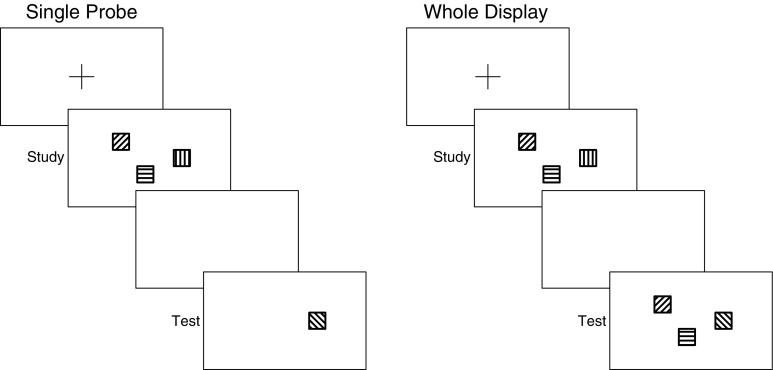
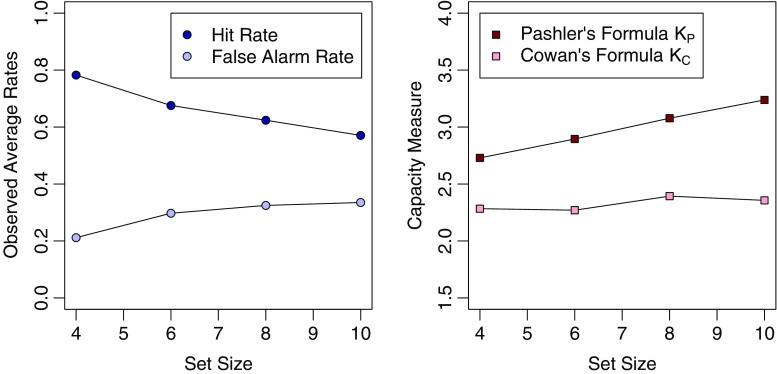
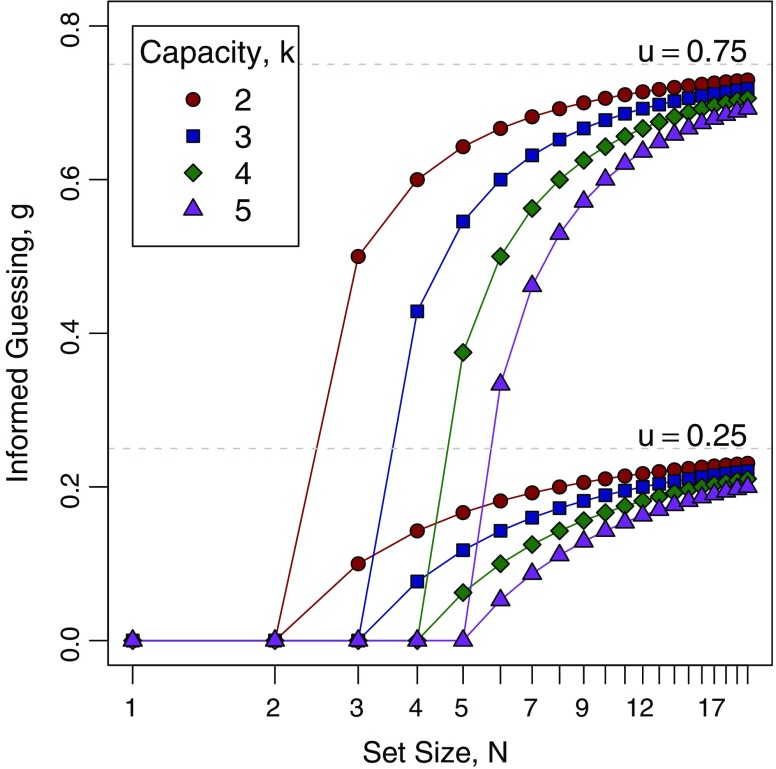
Although the measurement of working memory capacity is crucial to understanding working memory and its interaction with other cognitive faculties, there are inconsistencies in the literature on how to measure capacity. We address the measurement in the change detection paradigm, popularized by Luck and Vogel (Nature, 390, 279-281, 1997). Two measures for this task-from Pashler (Perception & Psychophysics, 44, 369-378, 1988) and Cowan (The Behavioral and Brain Sciences, 24, 87-114, 2001), respectively-have been used interchangeably, even though they may yield qualitatively different conclusions. We show that the choice between these two measures is not arbitrary. Although they are motivated by the same underlying discrete-slots working memory model, each is applicable only to a specific task; the two are never interchangeable. In the course of deriving these measures, we discuss subtle but consequential flaws in the underlying discrete-slots model. These flaws motivate revision in the modal model and capacity measures.
Overview
The claims and statistics of this paper haven’t been checked yet.
Run the check — free, no account needed. It reads the open-access text and checks the sources it cites.
Integrity signals
Registry
Cites
Statistics
Figures
Verification
Claims the paper makes
The claims and statistics of this paper haven’t been checked yet.
Run the check — free, no account needed. It reads the open-access text and checks the sources it cites.
Claims other papers make about this one
Each is checked against this paper’s own text: does it say what the citing paper says it does?
In the citing paper
“Data provided by this task can estimate with a high degree of precision the average number of memory items correctly retained by a participant for each set size, namely, the individual’s VWM capacity.”
From Emotion-related impulsivity moderates the cognitive interference effect of smartphone availability on working memory (2019) · cites this paper as [52]
Self-check
Percentages, sums and reported differences re-computed from the paper’s own numbers.
The self-check needs the paper’s full text.
Citations
Cites
The magical number seven, plus or minus two: Some limits on our capacity for processing information.
Miller, G. A. (1956) · Psychological Review · doi:10.1037/h0043158 · Cited by 17,812
The magical number seven, plus or minus two: Some limits on our capacity for processing information.
Miller, G. A. (1994) · Psychological Review · doi:10.1037/0033-295x.101.2.343 · Cited by 17,563
The magical number 4 in short-term memory: A reconsideration of mental storage capacity
Cowan, N. (2001) · Behavioral and Brain Sciences · doi:10.1017/s0140525x01003922 · Cited by 6,779
Self-citationThe capacity of visual working memory for features and conjunctions
Luck, S. J., & Vogel, E. K. (1997) · Nature · doi:10.1038/36846 · Cited by 4,265
Models of Working Memory: Mechanisms of Active Maintenance and Executive Control
Miyake, A., & Shah, P. (1999) · Cited by 2,404
Signal detection theory and ROC analysis
Egan, J. P. (1975) · Academic Press eBooks · Cited by 1,659
The Cognitive Neuroscience of Working Memory
D'Esposito, M., & Postle, B. R. (2015) · Annual Review of Psychology · doi:10.1146/annurev-psych-010814-015031 · Cited by 1,653
Discrete fixed-resolution representations in visual working memory
Zhang, W., & Luck, S. J. (2008) · Nature · doi:10.1038/nature06860 · Cited by 1,624
Neural measures reveal individual differences in controlling access to working memory
Vogel, E. K., McCollough, A. W., & Machizawa, M. G. (2005) · Nature · doi:10.1038/nature04171 · Cited by 1,367
Dynamic Shifts of Limited Working Memory Resources in Human Vision
Bays, P. M., & Husain, M. (2008) · Science · doi:10.1126/science.1158023 · Cited by 1,177
Cited by
Sorted by citations
Visual working memory capacity: from psychophysics and neurobiology to individual differences
Luck, S. J., & Vogel, E. K. (2013) · Trends in Cognitive Sciences · doi:10.1016/j.tics.2013.06.006 · Cited by 1,167
Anxiety and working memory capacity: A meta-analysis and narrative review.
Moran, T. P. (2016) · Psychological Bulletin · doi:10.1037/bul0000051 · Cited by 776
In search of the focus of attention in working memory: 13 years of the retro-cue effect
Souza, A., & Oberauer, K. (2016) · Attention, perception & psychophysics · doi:10.3758/s13414-016-1108-5 · Cited by 379
The mechanisms of working memory capacity: Primary memory, secondary memory, and attention control
Shipstead, Z., Lindsey, D. R. B., Marshall, R. L., & Engle, R. W. (2014) · Journal of Memory and Language · doi:10.1016/j.jml.2014.01.004 · Cited by 330
Roux, F., Wibral, M., Mohr, H. M., Singer, W., & Uhlhaas, P. J. (2012) · Journal of Neuroscience · doi:10.1523/jneurosci.0421-12.2012 · Cited by 340
Causal Evidence for a Role of Theta and Alpha Oscillations in the Control of Working Memory
Riddle, J., Scimeca, J. M., Cellier, D., Dhanani, S., & D’Esposito, M. (2020) · Current Biology · doi:10.1016/j.cub.2020.02.065 · Cited by 266
Working Memory Capacity and Fluid Intelligence: Maintenance and Disengagement
Shipstead, Z., Harrison, T. L., & Engle, R. W. (2016) · Perspectives on Psychological Science · doi:10.1177/1745691616650647 · Cited by 238
Johnson, M. K., McMahon, R. P., Robinson, B. M., Harvey, A. N., Hahn, B., Leonard, C. J., Luck, S. J., & Gold, J. M. (2013) · Neuropsychology · doi:10.1037/a0032060 · Cited by 200
The Contribution of Attentional Lapses to Individual Differences in Visual Working Memory Capacity
Adam, K. C. S., Mance, I., Fukuda, K., & Vogel, E. K. (2015) · Journal of Cognitive Neuroscience · doi:10.1162/jocn_a_00811 · Cited by 156
Central and peripheral components of working memory storage
Cowan, N., Saults, J. S., & Blume, C. L. (2014) · Journal of Experimental Psychology: General · doi:10.1037/a0036814 · Cited by 156
Self-citationModels of verbal working memory capacity: What does it take to make them work?
Cowan, N., Rouder, J. N., Blume, C. L., & Saults, J. S. (2012) · Psychological Review · doi:10.1037/a0027791 · Cited by 187
Self-citationIndividual Differences and State-Dependent Responses in Transcranial Direct Current Stimulation
Hsu, T., Juan, C.-H., & Tseng, P. H. (2016) · Frontiers in Human Neuroscience · doi:10.3389/fnhum.2016.00643 · Cited by 152
Training brain networks and states
Tang, Y., & Posner, M. I. (2014) · Trends in Cognitive Sciences · doi:10.1016/j.tics.2014.04.002 · Cited by 160
Effects of action video game training on visual working memory.
Blacker, K. J., Curby, K. M., Klobusicky, E., & Chein, J. M. (2014) · Journal of Experimental Psychology Human Perception & Performance · doi:10.1037/a0037556 · Cited by 140
Failure to filter: Anxious individuals show inefficient gating of threat from working memory
Stout, D. M., Shackman, A. J., & Larson, C. L. (2013) · Frontiers in Human Neuroscience · doi:10.3389/fnhum.2013.00058 · Cited by 133
Working memory capacity and the scope and control of attention
Shipstead, Z., Harrison, T. L., & Engle, R. W. (2015) · Attention, Perception, & Psychophysics · doi:10.3758/s13414-015-0899-0 · Cited by 132
Gross, S., & Flombaum, J. (2017) · Mind & Language · doi:10.1111/mila.12144 · Cited by 135
Visual short-term memory always requires general attention
Morey, C. C., & Bieler, M. (2012) · Psychonomic Bulletin & Review · doi:10.3758/s13423-012-0313-z · Cited by 126
Self-citationAttention to attributes and objects in working memory.
Cowan, N., Blume, C. L., & Saults, J. S. (2012) · Journal of Experimental Psychology Learning Memory and Cognition · doi:10.1037/a0029687 · Cited by 124
Self-citationHsu, T., Tseng, P. H., Liang, W., Cheng, S.-K., & Juan, C.-H. (2014) · NeuroImage · doi:10.1016/j.neuroimage.2014.04.069 · Cited by 127
When are fluid intelligence and working memory isomorphic and when are they not?
Chuderski, A. (2013) · Intelligence · doi:10.1016/j.intell.2013.04.003 · Cited by 120
Neural circuitry governing anxious individuals’ mis-allocation of working memory to threat
Stout, D. M., Shackman, A. J., Pedersen, W. S., Miskovich, T. A., & Larson, C. L. (2017) · Scientific Reports · doi:10.1038/s41598-017-08443-7 · Cited by 124
Generalizing parametric models by introducing trial-by-trial parameter variability: The case of TVA
Dyrholm, M., Kyllingsbæk, S., Espeseth, T., & Bundesen, C. (2011) · Journal of Mathematical Psychology · doi:10.1016/j.jmp.2011.08.005 · Cited by 115
Discrete-slots models of visual working-memory response times.
Donkin, C., Nosofsky, R. M., Gold, J. M., & Shiffrin, R. M. (2013) · Psychological Review · doi:10.1037/a0034247 · Cited by 114
The reliability and stability of visual working memory capacity
Xu, Z., Adam, K. C. S., Fang, X., & Vogel, E. K. (2017) · Behavior Research Methods · doi:10.3758/s13428-017-0886-6 · Cited by 107
Contralateral Delay Activity Tracks Fluctuations in Working Memory Performance
Adam, K. C. S., Robison, M. K., & Vogel, E. K. (2018) · Journal of Cognitive Neuroscience · doi:10.1162/jocn_a_01233 · Cited by 107
Neural correlates of shape–color binding in visual working memory
Parra, M. A., Sala, S. D., Logie, R. H., & Morcom, A. M. (2013) · Neuropsychologia · doi:10.1016/j.neuropsychologia.2013.09.036 · Cited by 105
Zhou, Z., Zhu, H., Li, C., & Wang, J. (2014) · Frontiers in Behavioral Neuroscience · doi:10.3389/fnbeh.2014.00288 · Cited by 96
Compositional Inductive Biases in Function Learning
Schulz, E., Tenenbaum, J. B., Duvenaud, D., Speekenbrink, M., & Gershman, S. J. (2016) · Cognitive Psychology · doi:10.1016/j.cogpsych.2017.11.002 · Cited by 94
How do scientific views change? Notes from an extended adversarial collaboration
Cowan, N., Belletier, C., Doherty, J. M., Jaroslawska, A. J., Rhodes, S., Forsberg, A., Naveh-Benjamin, M., Barrouillet, P., Camos, V., & Logie, R. H. (2020) · Perspectives on Psychological Science · doi:10.1177/1745691620906415 · Cited by 89
Self-citationHahn, B., Robinson, B. M., Leonard, C. J., Luck, S. J., & Gold, J. M. (2018) · Journal of Neuroscience · doi:10.1523/jneurosci.0913-18.2018 · Cited by 83
The scope and control of attention as separate aspects of working memory
Shipstead, Z., Redick, T. S., Hicks, K. L., & Engle, R. W. (2012) · Memory · doi:10.1080/09658211.2012.691519 · Cited by 89
Toward the Neural Mechanisms of Reduced Working Memory Capacity in Schizophrenia
Leonard, C. J., Kaiser, S. T., Robinson, B. M., Kappenman, E. S., Hahn, B., Gold, J. M., & Luck, S. J. (2012) · Cerebral Cortex · doi:10.1093/cercor/bhs148 · Cited by 91
Shipstead, Z., & Engle, R. W. (2012) · Journal of Experimental Psychology Learning Memory and Cognition · doi:10.1037/a0028467 · Cited by 87
Ding, X., Gao, Z., & Shen, M. (2017) · Psychological Science · doi:10.1177/0956797617707318 · Cited by 84
Xie, W., & Zhang, W. (2017) · Journal of Cognitive Neuroscience · doi:10.1162/jocn_a_01188 · Cited by 83
Tseng, P. H., Iu, K.-C., & Juan, C.-H. (2018) · Scientific Reports · doi:10.1038/s41598-017-18449-w · Cited by 81
Theta-gamma phase-phase coupling during working memory maintenance in the human hippocampus
Chaieb, L., Leszczyński, M., Axmacher, N., Derner, M., Elger, C. E., & Fell, J. (2015) · Cognitive Neuroscience · doi:10.1080/17588928.2015.1058254 · Cited by 76
Prolonged disengagement from attentional capture in normal aging.
Cashdollar, N. M., Fukuda, K., Bocklage, A., Aurtenetxe, S., Vogel, E. K., & Gazzaley, A. H. (2012) · Psychology and Aging · doi:10.1037/a0029899 · Cited by 69
Brain Modularity Mediates the Relation between Task Complexity and Performance
Yue, Q., Martin, R. C., Fischer‐Baum, S., Ramos-Nuñez, A. I., Ye, F., & Deem, M. W. (2017) · Journal of Cognitive Neuroscience · doi:10.1162/jocn_a_01142 · Cited by 69
Qi, S., Ding, C., & Li, H. (2013) · Cognitive Affective & Behavioral Neuroscience · doi:10.3758/s13415-013-0203-5 · Cited by 69
Estimating working memory capacity for lists of nonverbal sounds
Li, D., Cowan, N., & Saults, J. S. (2012) · Attention Perception & Psychophysics · doi:10.3758/s13414-012-0383-z · Cited by 63
Self-citationLudyga, S., Mücke, M., Leuenberger, R., Bruggisser, F., Pühse, U., Gerber, M., Mori, A. C., Keutler, C., Brotzmann, M., & Weber, P. (2022) · NeuroImage Clinical · doi:10.1016/j.nicl.2022.103156 · Cited by 83
Lin, P.-H., & Luck, S. J. (2012) · Frontiers in Psychology · doi:10.3389/fpsyg.2012.00042 · Cited by 59
The contribution of working memory to fluid reasoning: Capacity, control, or both?
Chuderski, A., & Necka, E. (2012) · Journal of Experimental Psychology: Learning, Memory, and Cognition · doi:10.1037/a0028465 · Cited by 60
An unpleasant emotional state reduces working memory capacity: electrophysiological evidence
Figueira, J. S. B., Oliveira, L., Pereira, M. G., Pacheco, L. B., Lobo, I., Ribeiro, G., & David, I. A. (2017) · Social Cognitive and Affective Neuroscience · doi:10.1093/scan/nsx030 · Cited by 61
Canale, N., Vieno, A., Doro, M., Rosa Mineo, E., Marino, C., & Billieux, J. (2019) · Scientific Reports · doi:10.1038/s41598-019-54911-7 · Cited by 50
Individual Differences in Visual Working Memory Capacity
Fukuda, K., Woodman, G. F., & Vogel, E. K. (2015) · Elsevier eBooks · doi:10.1016/b978-0-12-801371-7.00009-0 · Cited by 53
Frost, A., Moussaoui, S., Kaur, J., Aziz, S., Fukuda, K., & Niemeier, M. (2021) · Acta Psychologica · doi:10.1016/j.actpsy.2021.103398 · Cited by 56
Vissers, M. E., van Driel, J., & Slagter, H. A. (2016) · Journal of Cognitive Neuroscience · doi:10.1162/jocn_a_01017 · Cited by 49
Xie, W., & Zhang, W. (2017) · Memory & Cognition · doi:10.3758/s13421-017-0739-7 · Cited by 52
Jaiswal, S., Tsai, S., Juan, C.-H., Liang, W., & Muggleton, N. G. (2018) · Frontiers in Psychology · doi:10.3389/fpsyg.2018.00627 · Cited by 55
The scope and control of attention: Sources of variance in working memory capacity
Chow, M., & Conway, A. R. A. (2015) · Memory & Cognition · doi:10.3758/s13421-014-0496-9 · Cited by 53
Wasserman, T. H., & Wasserman, L. D. (2012) · Applied Neuropsychology Child · doi:10.1080/21622965.2012.702025 · Cited by 54
A Design Space of Vision Science Methods for Visualization Research
Elliott, M., Nothelfer, C. E., Xiong, C., & Szafir, D. A. (2020) · IEEE Transactions on Visualization and Computer Graphics · doi:10.1109/tvcg.2020.3029413 · Cited by 50
Reassessing the Evidence for Capacity Limits in Neural Signals Related to Working Memory
Bays, P. M. (2017) · Cerebral Cortex · doi:10.1093/cercor/bhx351 · Cited by 50
Working memory capacity of biological movements predicts empathy traits
Gao, Z., Tian, Y., Shen, M., & Perry, A. (2015) · Psychonomic Bulletin & Review · doi:10.3758/s13423-015-0896-2 · Cited by 46
Connectome-based neurofeedback: A pilot study to improve sustained attention
Scheinost, D., Hsu, T. W., Avery, E. W., Hampson, M., Constable, R. T., Chun, M. M., & Rosenberg, M. D. (2020) · NeuroImage · doi:10.1016/j.neuroimage.2020.116684 · Cited by 45
A brain-based general measure of attention
Yoo, K., Rosenberg, M. D., Kwon, Y. H., Lin, Q., Avery, E. W., Scheinost, D., Constable, R. T., & Chun, M. M. (2022) · Nature Human Behaviour · doi:10.1038/s41562-022-01301-1 · Cited by 47
Rehearsing Biological Motion in Working Memory: An EEG Study
Gao, Z., Bentin, S., & Shen, M. (2014) · Journal of Cognitive Neuroscience · doi:10.1162/jocn_a_00687 · Cited by 47
Reduced representations capacity in visual working memory in trait anxiety
Qi, S., Chen, J., Hitchman, G., Zeng, Q., Ding, C., Li, H., & Hu, W. (2014) · Biological Psychology · doi:10.1016/j.biopsycho.2014.08.010 · Cited by 42
Qualitative similarities in the visual short-term memory of pigeons and people
Gibson, B. M., Wasserman, E. A., & Luck, S. J. (2011) · Psychonomic Bulletin & Review · doi:10.3758/s13423-011-0132-7 · Cited by 41
Cochrane, A., Simmering, V. R., & Green, C. S. (2019) · PLoS ONE · doi:10.1371/journal.pone.0221353 · Cited by 46
Social exclusion weakens storage capacity and attentional filtering ability in visual working memory
Xu, M., Qiao, L., Qi, S., Li, Z., Diao, L., Fan, L., Zhang, L., & Yang, D. (2017) · Social Cognitive and Affective Neuroscience · doi:10.1093/scan/nsx139 · Cited by 38
Simple and Complex Working Memory Tasks Allow Similar Benefits of Information Compression
Mathy, F., Chekaf, M., & Cowan, N. (2018) · Journal of Cognition · doi:10.5334/joc.31 · Cited by 39
Self-citationImpaired Contingent Attentional Capture Predicts Reduced Working Memory Capacity in Schizophrenia
Mayer, J. S., Fukuda, K., Vogel, E. K., & Park, S. (2012) · PLoS ONE · doi:10.1371/journal.pone.0048586 · Cited by 39
Holding Biological Motion in Working Memory: An fMRI Study
Lu, X., Huang, J., Yi, Y., Shen, M., Weng, X., & Gao, Z. (2016) · Frontiers in Human Neuroscience · doi:10.3389/fnhum.2016.00251 · Cited by 39
Liang, W., Tseng, P. H., Yeh, J., Huang, N. E., & Juan, C.-H. (2021) · Neuroscience · doi:10.1016/j.neuroscience.2021.02.013 · Cited by 39
Effects of strategy on visual working memory capacity
Bengson, J. J., & Luck, S. J. (2015) · Psychonomic Bulletin & Review · doi:10.3758/s13423-015-0891-7 · Cited by 38
Reed, J. L., Gallagher, N. M., Sullivan, M. E., Callicott, J. H., & Green, A. E. (2017) · Brain and Cognition · doi:10.1016/j.bandc.2017.01.001 · Cited by 38
Grouping and binding in visual short-term memory.
Quinlan, P. T., & Cohen, D. J. (2012) · Journal of Experimental Psychology Learning Memory and Cognition · doi:10.1037/a0027866 · Cited by 36
Visual chunking as a strategy for spatial thinking in STEM
Stieff, M., Werner, S. M., DeSutter, D., Franconeri, S., & Hegarty, M. (2020) · Cognitive Research Principles and Implications · doi:10.1186/s41235-020-00217-6 · Cited by 40
Sense, F., Morey, C. C., Prince, M., Heathcote, A., & Morey, R. D. (2016) · Behavior Research Methods · doi:10.3758/s13428-016-0741-1 · Cited by 35
Self-citationBeyond slots and resources: Grounding cognitive concepts in neural dynamics
Johnson, J. S., Simmering, V. R., & Buss, A. T. (2013) · Attention Perception & Psychophysics · doi:10.3758/s13414-013-0596-9 · Cited by 40
Hu, Z., Barkley, C. M., Marino, S. E., Wang, C., Rajan, A., Bo, K., Samuel, I. B. H., & Ding, M. (2019) · Journal of Cognitive Neuroscience · doi:10.1162/jocn_a_01461 · Cited by 38
Williams, J. R., Robinson, M. M., Schurgin, M. W., Wixted, J. T., & Brady, T. F. (2022) · Journal of Experimental Psychology Human Perception & Performance · doi:10.1037/xhp0001055 · Cited by 34
The reliability of estimating visual working memory capacity
Dai, M., Li, Y., Gan, S., & Du, F. (2019) · Scientific Reports · doi:10.1038/s41598-019-39044-1 · Cited by 33
Wang, S., Rajsic, J., & Woodman, G. F. (2019) · Journal of Cognitive Neuroscience · doi:10.1162/jocn_a_01446 · Cited by 31
Short-term storage capacity for visual objects depends on expertise
Sørensen, T. A., & Kyllingsbæk, S. (2012) · Acta Psychologica · doi:10.1016/j.actpsy.2012.04.004 · Cited by 33
Wang, S., Megla, E. E., & Woodman, G. F. (2020) · Journal of Cognitive Neuroscience · doi:10.1162/jocn_a_01637 · Cited by 30
The visual arrays task: Visual storage capacity or attention control?
Martin, J. D., Tsukahara, J. S., Draheim, C., Shipstead, Z., Mashburn, C. A., Vogel, E. K., & Engle, R. W. (2021) · Journal of Experimental Psychology General · doi:10.1037/xge0001048 · Cited by 33
Broadway, J. M., Frank, M. J., & Cavanagh, J. F. (2018) · Cognitive Affective & Behavioral Neuroscience · doi:10.3758/s13415-018-0584-6 · Cited by 30
Sghirripa, S., Graetz, L. J., Merkin, A., Rogasch, N. C., Semmler, J. G., & Goldsworthy, M. R. (2020) · Psychophysiology · doi:10.1111/psyp.13719 · Cited by 30
Gambarota, F., & Sessa, P. (2019) · Frontiers in Psychology · doi:10.3389/fpsyg.2019.02392 · Cited by 29
Yangüez, M., Bediou, B., Chanal, J. P., & Bavelier, D. (2023) · Psychological Review · doi:10.1037/rev0000434 · Cited by 31
Mall, J. T., Morey, C. C., Wolff, M. J., & Lehnert, F. (2014) · Attention Perception & Psychophysics · doi:10.3758/s13414-013-0610-2 · Cited by 27
Self-citationVisual working memory in early development: a developmental cognitive neuroscience perspective.
Buss, A. T., Ross-Sheehy, S., & Reynolds, G. D. (2018) · Journal of Neurophysiology · doi:10.1152/jn.00087.2018 · Cited by 28
Selection of multiple cued items is possible during visual short-term memory maintenance
Matsukura, M., & Vecera, S. P. (2015) · Attention Perception & Psychophysics · doi:10.3758/s13414-015-0836-2 · Cited by 27
Pailian, H., & Halberda, J. (2014) · Memory & Cognition · doi:10.3758/s13421-014-0492-0 · Cited by 32
Precision requirements do not affect the allocation of visual working memory capacity
He, X., Zhang, W., Li, C., & Guo, C. (2015) · Brain Research · doi:10.1016/j.brainres.2015.01.028 · Cited by 26
Induced negative arousal modulates the speed of visual working memory consolidation.
Xie, W., Sing, J. L. L., Martinez-Flores, A., & Zhang, W. (2022) · Emotion · doi:10.1037/emo0001059 · Cited by 28
A two-stage search of visual working memory: investigating speed in the change-detection paradigm
Gilchrist, A. L., & Cowan, N. (2014) · Attention Perception & Psychophysics · doi:10.3758/s13414-014-0704-5 · Cited by 26
Self-citationBoran, E., Hilfiker, P., Stieglitz, L. H., Grünwald, T., Sarnthein, J., & Klaver, P. (2022) · NeuroImage · doi:10.1016/j.neuroimage.2022.119123 · Cited by 30
Distinct neural substrates for visual short‐term memory of actions
Cai, Y., Urgolites, Z. J., Wood, J. N., Chen, C., Li, S., Chen, A., & Xue, G. (2018) · Human Brain Mapping · doi:10.1002/hbm.24236 · Cited by 24
Ward, R. T., Lotfi, S., Sallmann, H., Lee, H., & Larson, C. L. (2020) · Psychophysiology · doi:10.1111/psyp.13625 · Cited by 29
Ramos-Nuñez, A. I., Fischer‐Baum, S., Martin, R. C., Yue, Q., Ye, F., & Deem, M. W. (2017) · Frontiers in Human Neuroscience · doi:10.3389/fnhum.2017.00420 · Cited by 26
Working Memory: From Neural Activity to the Sentient Mind
Jaffe, R. J., & Constantinidis, C. (2021) · Comprehensive physiology · doi:10.1002/cphy.c210005 · Cited by 33
Short‐Term and Working Memory in Childhood
Cowan, N. (2013) · The Wiley Handbook on the Development of Children's Memory · doi:10.1002/9781118597705.ch10 · Cited by 23
Self-citationDetection of the number of changes in a display in working memory.
Cowan, N., Hardman, K. O., Saults, J. S., Blume, C. L., Clark, K. M., & Sunday, M. A. (2015) · Journal of Experimental Psychology Learning Memory and Cognition · doi:10.1037/xlm0000163 · Cited by 23
Self-citationSchurgin, M. W., & Brady, T. F. (2019) · Journal of Vision · doi:10.1167/19.5.3 · Cited by 23
Metadata
- Authors
- Rouder, J. N., Morey, R. D., Morey, C. C., & Cowan, N.
- Affiliations
- University of Missouri System (US)
- University of Groningen (NL)
- Corresponding author
- Rouder, Jeffrey N.
- Venue
- Psychonomic Bulletin & Review
- Published
- 2011-02-19
- Volume
- 18
- Issue
- 2
- Pages
- 324-330
- ISSN
- 1069-9384 (ISSN-L)
- 1531-5320
- PMC
- PMC3070885
- OpenAlex
- W1993017443
- Cited by
- 334
- References
- 32
- Citations by year
- 2026: 11 · 2025: 21 · 2024: 44 · 2023: 22 · 2022: 25 · 2021: 25 · 2020: 26 · 2019: 24 · 2018: 20 · 2017: 25 · 2016: 16 · 2015: 18 · 2014: 19 · 2013: 15 · 2012: 20
- FWCI
- 24.30
- Type
- journal article
- Language
- en
- Open access
- hybrid
- doi.org
- Licence
- cc-by-nc
- www.springer.com/tdm (tdm)
- Locations
- Psychonomic Bulletin & Review (publishedVersion, cc-by-nc)
- PubMed Central (publishedVersion, cc-by-nc)
- PubMed (publishedVersion)
- University of Groningen research database (University of Groningen / Centre for Information Technology) (publishedVersion, cc-by-nc)
- ORCA Online Research @Cardiff (Cardiff University) (submittedVersion)
- Edinburgh Research Explorer (University of Edinburgh) (submittedVersion, other-oa)
- University of Groningen research database (University of Groningen / Centre for Information Technology) (submittedVersion, cc-by-nc)
- Funders
- Eunice Kennedy Shriver National Institute of Child Health and Human Development (R01 HD-21338, R01HD021338)
- Topics
- Social Sciences › Psychology › Experimental and Cognitive Psychology › Cognitive Abilities and Testing
- Life Sciences › Neuroscience › Cognitive Neuroscience › Neural and Behavioral Psychology Studies
- Life Sciences › Neuroscience › Cognitive Neuroscience › Visual perception and processing mechanisms
- Keywords
- working memory capacity, change detection, capacity measurement, modal model, visual working memory
- MeSH terms
- Aptitude, Humans, Memory, Short-Term, Models, Psychological, Psychological Tests, Signal Detection, Psychological
About these checks
Registry, retraction, Cites and statistics results are computed, not judged, with one exception: a printed reference that no index lists is read once by a model before it counts as a citation error. Claims are extracted by a model and kept only when their quote appears verbatim in the text; each cited source is then checked, with a model’s help, for whether it says what the claim relies on. Those verdicts can be wrong — read the claim’s quote and the cited source before relying on one.
Statistics and arithmetic are recomputed, not judged.
Confidence bands are shown only for fields calibrated on our annotated test set. None is calibrated yet, so no band is shown.
What counts as a claim ›How we measure confidence ›How we check this ›
Are you an author, or do you see a problem with this page? Request a review
