

The cost of perspective switching: Constraints on simultaneous activation
Open accessThe DOI matches its Crossref record; 40 of the 41 references it cites were found in a registry or an index.
Abstract
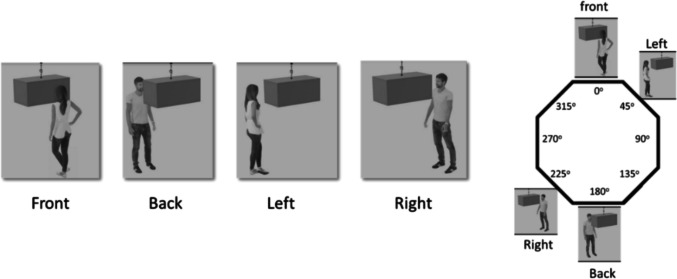
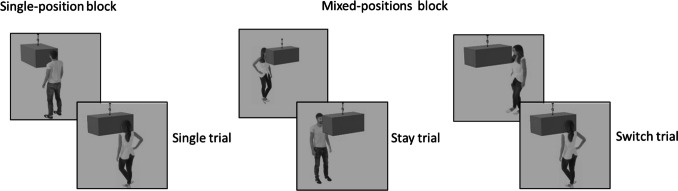
Visual perspective taking often involves transitioning between perspectives, yet the cognitive mechanisms underlying this process remain unclear. The current study draws on insights from task- and language-switching research to address this gap. In Experiment 1, 79 participants judged the perspective of an avatar positioned in various locations, observing either the rectangular or the square side of a rectangular cube hanging from the ceiling. The avatar's perspective was either consistent or inconsistent with the participant’s, and its computation sometimes required mental transformation. The task included both single-position blocks, in which the avatar's location remained fixed across all trials, and mixed-position blocks, in which the avatar's position changed across trials. Performance was compared across trial types and positions. In Experiment 2, 126 participants completed a similar task administered online, with more trials, and performance was compared at various points within the response time distribution (vincentile analysis). Results revealed a robust switching cost. However, mixing costs, which reflect the ability to maintain multiple task sets active in working memory, were absent, even in slower response times. Additionally, responses to the avatar's position varied as a function of consistency with the participants' viewpoint and the angular disparity between them. These findings suggest that perspective switching is costly, people cannot activate multiple perspectives simultaneously, and the computation of other people's visual perspectives varies with cognitive demands.
Overview
The claims and statistics of this paper haven’t been checked yet.
Free: it reads the open-access text and checks the first 5 claims that cite a source we can check. Create a free account to check every claim.
Integrity signals
Registry
Cites
Statistics
Figures

Verification
Claims the paper makes
The claims and statistics of this paper haven’t been checked yet.
Free: it reads the open-access text and checks the first 5 claims that cite a source we can check. Create a free account to check every claim.
Claims other papers make about this one
Each is checked against this paper’s own text: does it say what the citing paper says it does?
The cited source says what the claim attributes to it.
In the citing paper
“Such switching cost has been commonly found in visual perspective taking tasks where change of view is involved (Segal, 2025).”
From Does viewing a top-down map facilitate spatial learning from navigation in a virtual environment? (2026) · cites this paper as Segal, 2025
Self-check
Percentages, sums and reported differences re-computed from the paper’s own numbers.
The self-check needs the paper’s full text.
Citations
Cites
Faul, F., Erdfelder, E., Lang, A.-G., & Buchner, A. (2007) · Behavior Research Methods · doi:10.3758/bf03193146 · Cited by 65,971 · cited 1×
“The G*Power3 program (Faul et al., 2007) served to estimate the necessary sample size for conducting an analysis of variance (ANOVA) involving two within-subject variables.”
Costs of a predictible switch between simple cognitive tasks.
Rogers, R. D., & Monsell, S. (1995) · Journal of Experimental Psychology: General · doi:10.1037/0096-3445.124.2.207 · Cited by 3,170 · cited 2×
“This cost reflects carry-over effects from the previous task as well as the time needed for reconfiguration (Monsell, 2003; Rogers & Monsell, 1995).”
Monsell, S. (2003) · Trends in Cognitive Sciences · doi:10.1016/s1364-6613(03)00028-7 · Cited by 2,984
An application of prefrontal cortex function theory to cognitive aging.
West, R. L. (1996) · Psychological Bulletin · doi:10.1037//0033-2909.120.2.272 · Cited by 2,052 · cited 1×
“This analysis showed that switching costs were less noticeable in slow responses, presumably because these responses reflect task uncertainty, ineffective memory retrieval (Balota et al., 2008; Schmiedek et al. 2007), or lapses of attention (West, 1996; West et al., 2002).”
Generating stimuli for neuroscience using PsychoPy
Peirce, J. W. (2008) · Frontiers in Neuroinformatics · doi:10.3389/neuro.11.010.2008 · Cited by 1,659 · cited 2×
“Then they performed the Visual Perspective Switching task through PsychoPy 2001.1.4 (Peirce, 2009).”
InfluentialBilingual Language Switching in Naming: Asymmetrical Costs of Language Selection
Meuter, R. F. I., & Allport, A. (1999) · Journal of Memory and Language · doi:10.1006/jmla.1998.2602 · Cited by 1,300 · cited 1×
“Task-switching studies have consistently demonstrated that switching between tasks takes longer than repeating a task (e.g., Huff et al., 2015; Meuter & Allport, 1999; Prior & Gollan, 2011).”
The JASP guidelines for conducting and reporting a Bayesian analysis
van Doorn, J., van den Bergh, D., Böhm, U., Dablander, F., Derks, K., Draws, T., Etz, A., Evans, N. J., Gronau, Q. F., Haaf, J. M., et al. (2021) · Psychonomic Bulletin & Review · doi:10.3758/s13423-020-01798-5 · Cited by 1,114 · cited 2×
“All statistical analyses used SPSS 27, except for Bayesian analyses that used JASP (Van Doorn et al., 2021).”
Flavell, J. H., Everett, B. A., Croft, K., & Flavell, E. R. (1981) · Developmental Psychology · doi:10.1037//0012-1649.17.1.99 · Cited by 828 · cited 1×
“Visual perspective taking (VPT) is vital for communication, as it enables us to predict whether other people can see what we see (Level-1 VPT), and how they view objects or scenes (Level-2 VPT; Flavell et al., 1981).”
Domain specificity in conceptual development: Neuropsychological evidence from autism
Leslie, A. M., & Thaiss, L. (1992) · Cognition · doi:10.1016/0010-0277(92)90013-8 · Cited by 801 · cited 1×
“According to some theories, when people adopt another person's perspective, they generate both self and other view-points and then select the relevant one, especially in Level-1 VPT (e.g., Leslie & Thaiss, 1992; Leslie et al., 2005; Ram-sey et al., 2013).”
Seeing it their way: Evidence for rapid and involuntary computation of what other people see.
Samson, D., Apperly, I. A., Braithwaite, J. J., Andrews, B. J., & Bodley Scott, S. E. (2010) · Journal of Experimental Psychology: Human Perception and Performance · doi:10.1037/a0018729 · Cited by 733 · cited 4×
“Many researchers assume that performance on such tasks involves automatic computation of both perspectives, and that interference occurs when perspectives are inconsistent (Samson et al., 2010; Qureshi et al., 2010; Qureshi & Monk, 2018).”
InfluentialThe timing mega-study: comparing a range of experiment generators, both lab-based and online
Bridges, D., Pitiot, A., MacAskill, M. R., & Peirce, J. W. (2020) · PeerJ · doi:10.7717/peerj.9414 · Cited by 546 · cited 1×
“PsychoPy has been demonstrated to be one of the most precise and accurate software options for measuring reaction times in both in-lab and online settings (Bridges et al., 2020).”
Prior, A., & Gollan, T. H. (2011) · Journal of the International Neuropsychological Society · doi:10.1017/s1355617711000580 · Cited by 509 · cited 1×
“Task-switching studies have consistently demonstrated that switching between tasks takes longer than repeating a task (e.g., Huff et al., 2015; Meuter & Allport, 1999; Prior & Gollan, 2011).”
Schmiedek, F., Oberauer, K., Wilhelm, O., Süß, H.-M., & Wittmann, W. W. (2007) · Journal of Experimental Psychology: General · doi:10.1037/0096-3445.136.3.414 · Cited by 496 · cited 1×
“This analysis showed that switching costs were less noticeable in slow responses, presumably because these responses reflect task uncertainty, ineffective memory retrieval (Balota et al., 2008; Schmiedek et al. 2007), or lapses of attention (West, 1996; West et al., 2002).”
West, R., Murphy, K. J., Armilio, M. L., Craik, F. I. M., & Stuss, D. T. (2002) · Brain and Cognition · doi:10.1006/brcg.2001.1507 · Cited by 418 · cited 1×
“This analysis showed that switching costs were less noticeable in slow responses, presumably because these responses reflect task uncertainty, ineffective memory retrieval (Balota et al., 2008; Schmiedek et al. 2007), or lapses of attention (West, 1996; West et al., 2002).”
Belief-desire reasoning as a process of selection
Leslie, A. M., German, T. P., & Polizzi, P. (2005) · Cognitive Psychology · doi:10.1016/j.cogpsych.2004.06.002 · Cited by 334 · cited 1×
“According to some theories, when people adopt another person's perspective, they generate both self and other view-points and then select the relevant one, especially in Level-1 VPT (e.g., Leslie & Thaiss, 1992; Leslie et al., 2005; Ram-sey et al., 2013).”
Kessler, K., & Thomson, L. A. (2010) · Cognition · doi:10.1016/j.cognition.2009.08.015 · Cited by 332 · cited 2×
“Transformation occurs predominantly when orientation disparity exceeds 80° (Kessler & Rutherford, 2010; Kessler & Thomson, 2010).”
Qureshi, A. W., Apperly, I. A., & Samson, D. (2010) · Cognition · doi:10.1016/j.cognition.2010.08.003 · Cited by 325 · cited 2×
“These theories imply that people can activate various perspectives before inhibiting the unintended one (Nilsen & Graham, 2009; Qureshi et al., 2010; Yuan et al., 2023).”
The relations between children’s communicative perspective-taking and executive functioning
NILSEN, E., & GRAHAM, S. (2009) · Cognitive Psychology · doi:10.1016/j.cogpsych.2008.07.002 · Cited by 286 · cited 1×
“These theories imply that people can activate various perspectives before inhibiting the unintended one (Nilsen & Graham, 2009; Qureshi et al., 2010; Yuan et al., 2023).”
Two kinds of visual perspective taking
Michelon, P., & Zacks, J. M. (2006) · Perception & Psychophysics · doi:10.3758/bf03193680 · Cited by 275 · cited 3×
“Studying Level-2 VPT, Michelon and Zacks (2006) manipulated the angular disparity between the participant and the avatar (0º, 90º, 180º, 270º), and showed that increased distance led to slower responses, suggesting that participants mentally transform their position to align it with the avatar's…”
InfluentialParallel language activation and cognitive control during spoken word recognition in bilinguals
Blumenfeld, H. K., & Marian, V. (2013) · Journal of Cognitive Psychology · doi:10.1080/20445911.2013.812093 · Cited by 178 · cited 1×
“Note that Segal et al. (2019) found an increase in switching and in mixing costs across the RT distribution in the language switching task, probably due to dual activation of both languages prior to production (see also Blumenfeld & Marian, 2013; Macizo, 2016).”
Kessler, K. (2010) · Frontiers in Psychology · doi:10.3389/fpsyg.2010.00213 · Cited by 172 · cited 2×
“Transformation occurs predominantly when orientation disparity exceeds 80° (Kessler & Rutherford, 2010; Kessler & Thomson, 2010).”
Beyond mean response latency: Response time distributional analyses of semantic priming
Balota, D. A., Yap, M. J., Cortese, M. J., & Watson, J. M. (2008) · Journal of Memory and Language · doi:10.1016/j.jml.2007.10.004 · Cited by 169 · cited 1×
“This analysis showed that switching costs were less noticeable in slow responses, presumably because these responses reflect task uncertainty, ineffective memory retrieval (Balota et al., 2008; Schmiedek et al. 2007), or lapses of attention (West, 1996; West et al., 2002).”
Similarities and differences in visual and spatial perspective-taking processes
Surtees, A., Apperly, I., & Samson, D. (2013) · Cognition · doi:10.1016/j.cognition.2013.06.008 · Cited by 161 · cited 2×
“Thus, the results show that participants transform their position to match the avatar's position (Surtees et al., 2013; Thirioux et al., 2010).”
The grounded nature of psychological perspective-taking.
Erle, T. M., & Topolinski, S. (2017) · Journal of Personality and Social Psychology · doi:10.1037/pspa0000081 · Cited by 154 · cited 1×
“Taking the left-positioned avatar's perspective required no mental transformation, since it shared the participant's quadrant (Erle & Topolinski, 2017; Kessler & Rutherford, 2010; Kessler & Thomson, 2010), and since participants could observe the avatar's viewpoint.”
Training and transfer effects in task switching
Minear, M. E., & Shah, P. (2008) · Memory & Cognition · doi:10.3758/mc.336.8.1470 · Cited by 139 · cited 1×
“Mixing costs reflect the ability to maintain multiple task-sets accessible, focusing on the relevant task and ignoring the irrelevant one (e.g., Marí-Beffa & Kirkham, 2014; Minear & Shah, 2008; Pettigrew & Martin, 2016).”
Bock, A. M., Gallaway, K. C., & Hund, A. M. (2015) · Journal of Cognition and Development · doi:10.1080/15248372.2014.888350 · Cited by 131 · cited 1×
“The current findings may also explain why previous studies found an association between switching abilities and perspective-taking in various populations (Bock et al., 2015; Champagne-Lavau et al., 2012; Long et al., 2018; Wang et al., 2015).”
Sequential task predictability in task switching
Koch, I. (2005) · Psychonomic Bulletin & Review · doi:10.3758/bf03196354 · Cited by 119 · cited 1×
“Huff et al.'s (2015) findings suggest that the ability to activate multiple task-sets simultaneously affects both switching and mixing costs, particularly when responses are slow and when participants can prepare for subsequent responses (Koch, 2005).”
Ramsey, R., Hansen, P., Apperly, I. A., & Samson, D. (2013) · Journal of Cognitive Neuroscience · doi:10.1162/jocn_a_00345 · Cited by 108
Theory of mind and context processing in schizophrenia: The role of cognitive flexibility
Champagne‐Lavau, M., Charest, A., Anselmo, K., Rodriguez, J.-P., & Blouin, G. (2012) · Psychiatry Research · doi:10.1016/j.psychres.2012.06.011 · Cited by 85 · cited 1×
“The current findings may also explain why previous studies found an association between switching abilities and perspective-taking in various populations (Bock et al., 2015; Champagne-Lavau et al., 2012; Long et al., 2018; Wang et al., 2015).”
Individual differences in switching and inhibition predict perspective-taking across the lifespan
Long, M. R., Horton, W. S., Rohde, H., & Sorace, A. (2017) · Cognition · doi:10.1016/j.cognition.2017.09.004 · Cited by 72 · cited 1×
“The current findings may also explain why previous studies found an association between switching abilities and perspective-taking in various populations (Bock et al., 2015; Champagne-Lavau et al., 2012; Long et al., 2018; Wang et al., 2015).”
Ferguson, H. J., Apperly, I. A., & Cane, J. E. (2017) · Quarterly Journal of Experimental Psychology · doi:10.1080/17470218.2016.1199716 · Cited by 71 · cited 2×
“The findings align with previous reports of a switching cost in VPT tasks (Ferguson et al., 2017; Martin et al., 2019).”
Qureshi, A., & Monk, R. L. (2018) · Psychonomic Bulletin & Review · doi:10.3758/s13423-018-1496-8 · Cited by 69 · cited 1×
“Many researchers assume that performance on such tasks involves automatic computation of both perspectives, and that interference occurs when perspectives are inconsistent (Samson et al., 2010; Qureshi et al., 2010; Qureshi & Monk, 2018).”
Thirioux, B., Mercier, M. R., Jorland, G., Berthoz, A., & Blanke, O. (2010) · The Journal of Neuroscience · doi:10.1523/jneurosci.3403-09.2010 · Cited by 51 · cited 2×
“Thus, the results show that participants transform their position to match the avatar's position (Surtees et al., 2013; Thirioux et al., 2010).”
Visual perspective taking in young and older adults.
Martin, A. K., Perceval, G., Davies, I., Su, P., Huang, J., & Meinzer, M. (2019) · Journal of Experimental Psychology General · doi:10.1037/xge0000584 · Cited by 51 · cited 2×
“The findings align with previous reports of a switching cost in VPT tasks (Ferguson et al., 2017; Martin et al., 2019).”
Huff, M. J., Balota, D. A., Minear, M. E., Aschenbrenner, A. J., & Duchek, J. M. (2015) · Psychology and Aging · doi:10.1037/pag0000057 · Cited by 42 · cited 7×
“Task-switching studies have consistently demonstrated that switching between tasks takes longer than repeating a task (e.g., Huff et al., 2015; Meuter & Allport, 1999; Prior & Gollan, 2011).”
InfluentialSegal, D., Stasenko, A., & Gollan, T. H. (2019) · Journal of Experimental Psychology General · doi:10.1037/xge0000515 · Cited by 39 · cited 5×
“In this analysis, the RTs of each participant on every trial type were ranked from fastest to slowest, independent of position, following methods outlined in Huff et al. (2015) and Segal et al. (2019).”
InfluentialSelf-citationPhonological coactivation in the bilinguals’ two languages: Evidence from the color naming task
Macizo, P. (2015) · Bilingualism Language and Cognition · doi:10.1017/s136672891500005x · Cited by 25 · cited 1×
“Note that Segal et al. (2019) found an increase in switching and in mixing costs across the RT distribution in the language switching task, probably due to dual activation of both languages prior to production (see also Blumenfeld & Marian, 2013; Macizo, 2016).”
The Mixing Cost as a Measure of Cognitive Control
Marı́-Beffa, P., & Kirkham, A. J. (2014) · Oxford University Press eBooks · doi:10.1093/acprof:osobl/9780199921959.003.0004 · Cited by 17 · cited 3×
“This mixing cost is thought to reflect the ability to maintain multiple task sets active in working memory and focus on the relevant one (Huff et al., 2015; Marí-Beffa & Kirkham, 2014).”
Wang, Y.-G., Shi, J.-F., Roberts, D. L., Jiang, X.-Y., Shen, Z.-H., Wang, Y.-Q., & Wang, K. (2015) · Psychiatry Research · doi:10.1016/j.psychres.2015.06.043 · Cited by 13 · cited 1×
“The current findings may also explain why previous studies found an association between switching abilities and perspective-taking in various populations (Bock et al., 2015; Champagne-Lavau et al., 2012; Long et al., 2018; Wang et al., 2015).”
Seeing it both ways: examining the role of inhibitory control in level-2 visual perspective-taking
Yuan, M., Jiang, R., Li, X., & Wu, W. (2022) · Current Psychology · doi:10.1007/s12144-022-03519-8 · Cited by 7 · cited 1×
“These theories imply that people can activate various perspectives before inhibiting the unintended one (Nilsen & Graham, 2009; Qureshi et al., 2010; Yuan et al., 2023).”
Research works printed but not linked: 1
- Pettigrew, C., & Martin, R. C. (2016). The role of working memory capacity and interference resolution mechanisms in task switching. Quarterly Journal of Experimental Psychology, 69 (12), 2431–2451. 10.1080/17470218.2015.1121 PMC4877289 26594895 · doi:10.1080/17470218.2015.1121
Cited by
Wang, W., Shangguan, C., Sun, Z., Yang, K. J., & Zhou, B. (2025) · Psychological Research · doi:10.1007/s00426-025-02219-9 · Cited by 1
“…modification: whereas Experiment 1 intermixed self-perspective and other-perspective trials within blocks, Experiment 2 segregated them into separate blocks to eliminate the cognitive costs associated with frequent perspective switching (Ferguson et al., 2017; Gardner & Thorn, 2025; Segal, 2025).”
Does viewing a top-down map facilitate spatial learning from navigation in a virtual environment?
Ding, J., Chan, H. M., & Saunders, J. A. (2026) · Cognitive Research: Principles and Implications · doi:10.1186/s41235-026-00732-y
“Such switching cost has been commonly found in visual perspective taking tasks where change of view is involved (Segal, 2025).”
Wang, Y., Apperly, I. A., & Krott, A. (2025) · Bilingualism Language and Cognition · doi:10.1017/s1366728925100825
Enhancing Teleoperation Performance for Automated Vehicles Through Bird’s-Eye View Augmentation
Escher, B., Bertram, P., Epple, M., Topcu, S. H., & Riener, A. (2026) · IEEE Intelligent Vehicles Symposium · doi:10.1109/iv66570.2026.11623883
“Furthermore, frequent shifts between different perspectives have been shown to degrade object perception [19].”
Metadata
- Authors
- Segal, D.
- Affiliations
- Open University of Israel (IL)
- Corresponding author
- Segal, Dorit
- ORCID
- Segal, Dorit
- Venue
- Psychonomic Bulletin & Review
- Published
- 2025-01-13
- Volume
- 32
- Issue
- 4
- Pages
- 1521-1530
- ISSN
- 1069-9384 (ISSN-L)
- 1531-5320
- PMC
- PMC12325494
- OpenAlex
- W4406325568
- Cited by
- 4
- References
- 41
- Citations by year
- 2026: 2 · 2025: 2
- FWCI
- 0.97
- Type
- journal article
- Language
- en
- Open access
- hybrid
- doi.org
- Licence
- cc-by
- creativecommons.org/licenses/by/4.0 (tdm)
- creativecommons.org/licenses/by/4.0 (vor)
- Locations
- Psychonomic Bulletin & Review (publishedVersion, cc-by)
- PubMed Central (publishedVersion, cc-by)
- PubMed (publishedVersion)
- Funders
- Open University of Israel (103021)
- Topics
- Social Sciences › Psychology › Experimental and Cognitive Psychology › Spatial Cognition and Navigation
- Social Sciences › Psychology › Developmental and Educational Psychology › Child and Animal Learning Development
- Life Sciences › Neuroscience › Cognitive Neuroscience › Visual perception and processing mechanisms
- Keywords
- perspective taking, perspective shift, switching costs, mixing costs, task switching, language switching, working memory, mental transformation, viewpoint consistency, angular disparity, response time distribution
- MeSH terms
- Adolescent, Adult, Female, Humans, Male, Memory, Short-Term, Psychomotor Performance, Reaction Time, Space Perception, Visual Perception, Young Adult, Executive Function
About these checks
Registry, retraction, Cites and statistics results are computed, not judged, with one exception: a printed reference that no index lists is read once by a model before it counts as a citation error. Claims are extracted by a model and kept only when their quote appears verbatim in the text; each cited source is then checked, with a model’s help, for whether it says what the claim relies on. Those verdicts can be wrong — read the claim’s quote and the cited source before relying on one.
Statistics and arithmetic are recomputed, not judged.
Confidence bands are shown only for fields calibrated on our annotated test set. None is calibrated yet, so no band is shown.
What counts as a claim ›How we measure confidence ›How we check this ›
Are you an author, or do you see a problem with this page? Request a review
Data sources
Bibliographic data: Semantic Scholar, OpenAlex, Crossref.
Contains information from the Semantic Scholar Academic Graph Datasets, made available under the ODC Attribution License (ODC-BY 1.0).
Semantic Scholar’s data is described in: Kinney, R., et al. (2023). The Semantic Scholar Open Data Platform. arXiv:2301.10140.
