

Language proficiency drives listening-related fatigue in those who communicate in English as their second language
Open accessThe DOI matches its Crossref record; 29 of the 30 references it cites were found in a registry or an index, and 1 are not checked yet; none of the 47 sources its claims cite is checked for support yet.
Abstract
Individuals who listen to speech in their second language (‘L2 listeners’) are disproportionately impacted by adverse acoustic conditions; a phenomenon coined the ‘non-native speech-in-noise disadvantage’. Evidence also suggests that L2 listening taxes cognitive resources to a greater extent than in L1 listeners. Very little, however, is known about the longer-term consequences of this sustained cognitive engagement. Listening-related fatigue refers to the daily life subjective experience of extreme tiredness from effortful listening. The current study recruited a large sample of L2-English listeners ( N = 256) to explore factors that predict listening-related fatigue. Approximately half of this sample ( n = 126) reported an Indo-European (IE) language (e.g., Italian) as their first language, whereas the other half ( n = 130) reported a non-Indo-European (non-IE) language (e.g., Vietnamese) as their first language. Non-IE L2 listeners reported higher overall listening-related fatigue than both IE L2 listeners and a group of monolingual English-speakers (L1-English). Self-rated proficiency and objective vocabulary scores were significant predictors of L2 listening-related fatigue and they moderated the effect of L2 use on listening-related fatigue; individuals who reported increased L2 use were more likely to experience increased fatigue, but only if their self-rated proficiency was low or moderate or their vocabulary score was low. Exploratory mediation analysis suggested that the effect of the L2 listener group (IE vs. non-IE) on listening-related fatigue was attributable to lower self-rated proficiency and objective vocabulary in the non-IE L2 group. To conclude, language proficiency appears to be a strong determinant of listening-related fatigue in L2-English listeners. When L2-English proficiency is low, increased L2-English usage is associated with heightened listening-related fatigue.
Checked 2026-11-24 · 1 reference not checked yet
Overview
CoChat Summary
TL;DR
In a large online sample of L2-English listeners, non-Indo-European L1 listeners reported higher listening-related fatigue than Indo-European L1 listeners, but not significantly higher than monolingual English speakers. Lower self-rated and objective English proficiency predicted greater fatigue and moderated the association between more L2 use and higher fatigue, such that the association held only at low/moderate proficiency.
Key findings
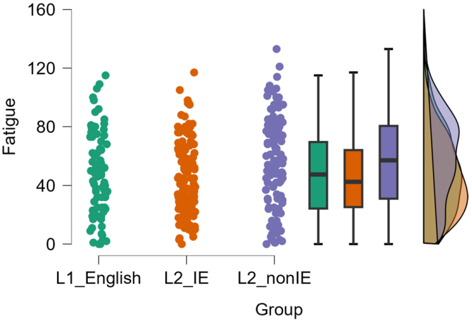
- Group differences: L2_nonIE listeners reported higher fatigue (M = 56.54, SD = 31.02) than L2_IE listeners (M = 44.87, SD = 25.35), t = 3.30, p = .003; the overall ANOVA was F(2, 340) = 5.91, p = .003, partial η² = .03. L1_English monolinguals (M = 44.61, SD = 25.42) did not differ significantly from L2_nonIE (t = 2.32, p = .06) or L2_IE (t = 0.65, p = .79).
- Regression: the model explained 12.8% of variance, F(5, 255) = 8.51, p < .001. LexTALE vocabulary (β = −.22, p < .001) and self-rated L2 proficiency (β = −.27, p < .001) negatively predicted fatigue; L2 use positively predicted fatigue (β = .22, p < .001); dual-language switching and entropy were not significant.
- Moderation: self-rated proficiency moderated the L2 use–fatigue effect (estimate = −4.20, p = .003); the conditional effect was positive at low (13.52, p < .001) and moderate (7.76, p < .001) proficiency but not high (3.01, p = .32). LexTALE vocabulary also moderated (estimate = −73.05, p = .02); the conditional effect was positive at low vocabulary (16.68, p = .002), not moderate (6.45, p = .07) or high (−0.85, p = .87).
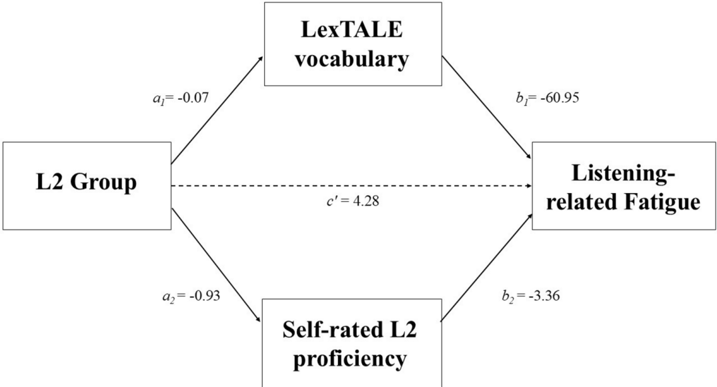
- Mediation: the L2 group effect (IE vs. nonIE) on fatigue was fully mediated by vocabulary (indirect = 4.15, bootstrap CI 1.72–6.98) and self-rated proficiency (indirect = 3.12, CI 0.60–5.52); the direct effect was not significant (c′ = 4.28, CI −3.32 to 12.15).
Methods
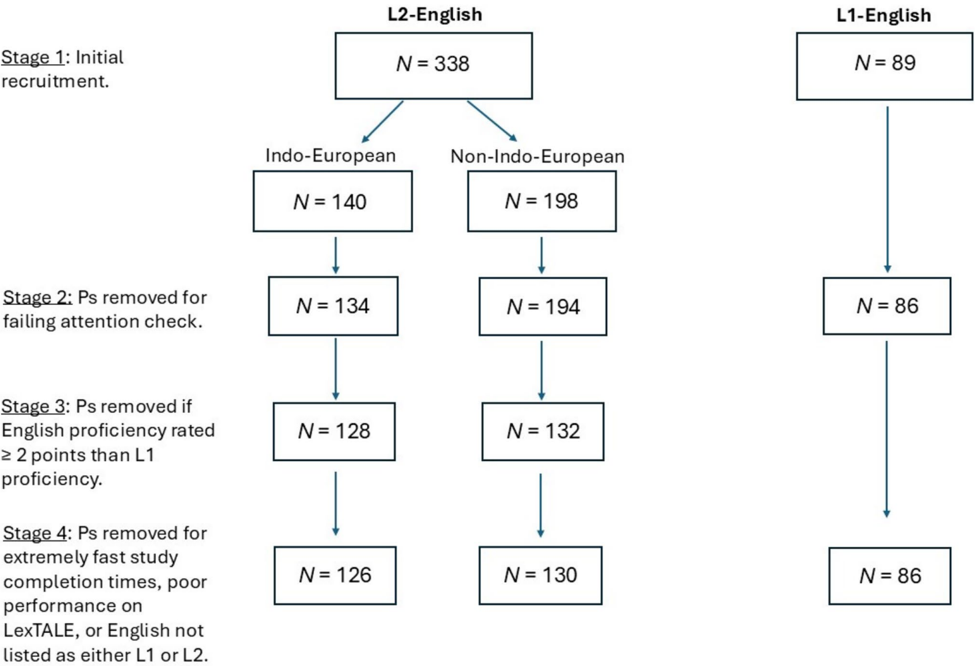
- Pre-registered online study via Prolific and Gorilla; 427 recruited, 342 analyzed: 86 L1-English monolinguals, 126 L2_IE, and 130 L2_nonIE listeners, aged 18–50. Exclusions included failed attention check, English proficiency ≥ 2 points above L1, very fast/uninterpretable responses, and a LexTALE outlier.
- Measures: Vanderbilt Fatigue Scale (40 items, summed 0–160), Language and Social Background Questionnaire (self-rated L2 proficiency, L2 use, language entropy), Interactional Contexts Questionnaire (single-language, dual-language switching, dense code-switching), and LexTALE English vocabulary.
- Analysis: JASP; one-way ANOVA; multiple linear regression with five predictors; moderation and exploratory mediation using the PROCESS macro with 1,000 bootstrap samples.
Limitations
- Stated: online questionnaire data quality and bias were concerns; the authors followed Buchanan and Scofield’s recommendations and removed data from 85 participants in total.
- Stated: the study focused on linguistic factors; cognitive (e.g., attention, memory) and perceptual (e.g., temporal processing) factors were not measured and may also modulate speech-perception outcomes.
- Evident: the design is cross-sectional and fatigue is self-reported, so causal claims are limited; the mediation analysis is described as exploratory. The sample was restricted to Prolific participants aged 18–50 in the UK/US/Canada without hearing loss, language-related disorders, or long-term health conditions, limiting generalizability.
Model-written summary. Check it against the paper before relying on it.
Integrity signals
Registry
Cites
Statistics
Figures
Verification
Claims the paper makes
0 Valid · 0 Not valid · 35 Not checked · 46 Own results and interpretations
A result the paper reports from its own data — it cites no other source for it, so there is none to check. The quote shows it is in the paper.
In the paper
“Non-IE L2 listeners reported higher overall listening-related fatigue than both IE L2 listeners and a group of monolingual English-speakers (L1-English).”
§ Language proficiency drives listening-related fatigue in those who communicate in English as their second language > Abstract
plainstates an associationn = 130- Asserted: passes — The authors put it forward as true.
- Checkable: passes — It can be checked against evidence.
- Load-bearing: passes — The paper’s conclusions depend on it.
- Based: passes — The paper gives a reason why it holds.
A result the paper reports from its own data — it cites no other source for it, so there is none to check. The quote shows it is in the paper.
In the paper
“Exploratory mediation analysis suggested that the effect of the L2 listener group (IE vs. non-IE) on listening-related fatigue was attributable to lower self-rated proficiency and objective vocabulary in the non-IE L2 group.”
§ Language proficiency drives listening-related fatigue in those who communicate in English as their second language > Abstract
hedgedstates a cause- Asserted: passes — The authors put it forward as true.
- Checkable: passes — It can be checked against evidence.
- Load-bearing: passes — The paper’s conclusions depend on it.
- Based: passes — The paper gives a reason why it holds.
A result the paper reports from its own data — it cites no other source for it, so there is none to check. The quote shows it is in the paper.
In the paper
“We found an indirect effect of group on listening-related fatigue via both vocabulary score and self-rated L2 proficiency.”
§ Language proficiency drives listening-related fatigue in those who communicate in English as their second language > Results > Mediation analysis
plainstates a cause- Asserted: passes — The authors put it forward as true.
- Checkable: passes — It can be checked against evidence.
- Load-bearing: passes — The paper’s conclusions depend on it.
- Based: passes — The paper gives a reason why it holds.
A result the paper reports from its own data — it cites no other source for it, so there is none to check. The quote shows it is in the paper.
In the paper
“There was no significant direct effect of group on listening-related fatigue as the bootstrap confidence intervals straddled zero (c′ = 4.28, bootstrap CIs: −3.32 to 12.15).”
§ Language proficiency drives listening-related fatigue in those who communicate in English as their second language > Results > Mediation analysis
plain- Asserted: passes — The authors put it forward as true.
- Checkable: passes — It can be checked against evidence.
- Load-bearing: passes — The paper’s conclusions depend on it.
- Based: passes — The paper gives a reason why it holds.
A result the paper reports from its own data — it cites no other source for it, so there is none to check. The quote shows it is in the paper.
In the paper
“Holding all other model predictors constant, both LexTALE vocabulary score and self-rated L2 proficiency were significant predictors of listening-related fatigue, t(255) = 3.54, β = -.22, p <.001 and t(255) = 4.07, β = -.27, p <.001, respectively.”
- Also stated in: § Discussion · plain
“We found support for our H2; both self-rated L2 proficiency and L2 vocabulary scores were significant negative predictors of listening-related fatigue.”
§ Language proficiency drives listening-related fatigue in those who communicate in English as their second language > Results > Multiple regression examining predictors of listening-related fatigue in L2 listeners (H2 and H3)
plainstates an association- Asserted: passes — The authors put it forward as true.
- Checkable: passes — It can be checked against evidence.
- Load-bearing: passes — The paper’s conclusions depend on it.
- Based: passes — The paper gives a reason why it holds.
- Also stated in: § Discussion · plain
28 more claims
Create a free account to see all 81 claims and to verify the 45 references still open.
- It may state two separate claims as one. 22
- Probably not a substantial claim. 30
Statistics recomputed
Every reported test result, recomputed from its test statistic and degrees of freedom. A result shows as not adding up only once an independent check has confirmed it.
- ConsistentF(2, 340) = 5.91reported p = .003 · recomputed p = .003
“F(2, 340) = 5.91, p = .003”
- ConsistentF(5, 255) = 8.51reported p < .001 · recomputed p < .001
“F(5, 255) = 8.51, p < .001”
Self-check
Percentages, sums and reported differences re-computed from the paper’s own numbers.
Self-check results appear here once an independent check has confirmed them.
Citations
Cites
R: A Language and Environment for Statistical Computing
R Core Team (2025) · doi:10.32614/r.manuals · Cited by 352,181
Statistical power analyses using G∗Power 3.1: tests for correlation and regression analyses
Faul, F., Erdfelder, E., Buchner, A., & Lang, A.-G. (2009) · Behavior Research Methods · doi:10.3758/brm.41.4.1149 · Cited by 37,615
Language control in bilinguals: The adaptive control hypothesis
Green, D. W., & Abutalebi, J. (2013) · Journal of Cognitive Psychology · doi:10.1080/20445911.2013.796377 · Cited by 2,163
Gorilla in our midst: An online behavioral experiment builder
Anwyl-Irvine, A. L., Massonnié, J., Flitton, A., Kirkham, N., & Evershed, J. K. (2020) · Behavior Research Methods · doi:10.3758/s13428-019-01237-x · Cited by 1,862
Introducing LexTALE: A quick and valid Lexical Test for Advanced Learners of English
Lemhöfer, K., & Broersma, M. (2012) · Behavior Research Methods · doi:10.3758/s13428-011-0146-0 · Cited by 1,338
Hearing Impairment and Cognitive Energy: The Framework for Understanding Effortful Listening (FUEL)
Pichora-Fuller, M. K., Kramer, S. E., Eckert, M. A., Edwards, B., Hornsby, B. W. Y., Humes, L. E., Lemke, U., Lunner, T., Matthen, M., Mackersie, C. L., et al. (2016) · Ear & Hearing · doi:10.1097/aud.0000000000000312 · Cited by 1,318
Anderson, J. A. E., Mak, L., Keyvani Chahi, A., & Bialystok, E. (2018) · Behavior Research Methods · doi:10.3758/s13428-017-0867-9 · Cited by 438
Characterizing the social diversity of bilingualism using language entropy
Gullifer, J. W., & Titone, D. (2020) · Bilingualism: Language and Cognition · doi:10.1017/s1366728919000026 · Cited by 330
Non-native speech perception in adverse conditions: A review
Lecumberri, M. L. G., Cooke, M., & Cutler, A. (2010) · Speech Communication · doi:10.1016/j.specom.2010.08.014 · Cited by 304
Methods to detect low quality data and its implication for psychological research
Buchanan, E. M., & Scofield, J. E. (2018) · Behavior Research Methods · doi:10.3758/s13428-018-1035-6 · Cited by 254
Research works printed but not linked: 1
- Hayes, A. F. (2017). Introduction to mediation, moderation, and conditional process analysis: A regression-based approach (Second Edition). Guilford Publications.
Cited by
Still being checked.
Metadata
- Authors
- McGarrigle, R., Havelka, J., & de Bruin, A.
- Affiliations
- University of Leeds (GB)
- University of York (GB)
- Corresponding author
- McGarrigle, Ronan
- Venue
- Psychonomic Bulletin & Review
- Published
- 2026-09-17
- Volume
- 33
- Issue
- 7
- Pages
- 239
- ISSN
- 1069-9384 (ISSN-L)
- 1531-5320
- PMC
- PMC13585771
- OpenAlex
- W7204502463
- Cited by
- 0
- References
- 29
- FWCI
- 0.00
- Type
- journal article
- Language
- en
- Open access
- hybrid
- doi.org
- Licence
- cc-by
- creativecommons.org/licenses/by/4.0 (tdm)
- creativecommons.org/licenses/by/4.0 (vor)
- Locations
- Psychonomic Bulletin & Review (publishedVersion, cc-by)
- PubMed Central (publishedVersion, cc-by)
- PubMed (publishedVersion)
- White Rose Research Online (University of Leeds, The University of Sheffield, University of York) (submittedVersion, cc-by)
- Funders
- University of Leeds
- Topics
- Health Sciences › Health Professions › Speech and Hearing › Hearing Loss and Rehabilitation
- Social Sciences › Psychology › Experimental and Cognitive Psychology › Phonetics and Phonology Research
- Social Sciences › Arts and Humanities › Language and Linguistics › EFL/ESL Teaching and Learning
- Keywords
- second language listening, language proficiency, vocabulary knowledge, listening effort, cognitive load
- MeSH terms
- Adult, Fatigue, Female, Humans, Male, Middle Aged, Speech Perception, Multilingualism, Young Adult
About these checks
Registry, retraction, Cites and statistics results are computed, not judged, with one exception: a printed reference that no index lists is read once by a model before it counts as a citation error. Claims are extracted by a model and kept only when their quote appears verbatim in the text; each cited source is then checked, with a model’s help, for whether it says what the claim relies on. Those verdicts can be wrong — read the claim’s quote and the cited source before relying on one.
A language model drew the claims from the paper on 2026-11-24, under version 3 of the claim definition (model deepseek-v4.1-flash, prompt extract-v3).
A second model labelled each claim on 2026-11-24 (model jev-1.13-20260917, definition revision gold-guideline-v0.2).
Statistics and arithmetic are recomputed, not judged.
Confidence bands are shown only for fields calibrated on our annotated test set. None is calibrated yet, so no band is shown.
What counts as a claim ›How we measure confidence ›How we check this ›
Are you an author, or do you see a problem with this page? Request a review
Data sources
Bibliographic data: Semantic Scholar, OpenAlex, Crossref.
Contains information from the Semantic Scholar Academic Graph Datasets, made available under the ODC Attribution License (ODC-BY 1.0).
Semantic Scholar’s data is described in: Kinney, R., et al. (2023). The Semantic Scholar Open Data Platform. arXiv:2301.10140.
