

The prevalence of statistical reporting errors in psychology (1985–2013)
Open accessThe DOI matches its Crossref record; 45 of the 45 references it cites were found in a registry or an index; 33 of the 54 sources its claims cite were checked for support.
Abstract
This study documents reporting errors in a sample of over 250,000 p-values reported in eight major psychology journals from 1985 until 2013, using the new R package "statcheck." statcheck retrieved null-hypothesis significance testing (NHST) results from over half of the articles from this period. In line with earlier research, we found that half of all published psychology papers that use NHST contained at least one p-value that was inconsistent with its test statistic and degrees of freedom. One in eight papers contained a grossly inconsistent p-value that may have affected the statistical conclusion. In contrast to earlier findings, we found that the average prevalence of inconsistent p-values has been stable over the years or has declined. The prevalence of gross inconsistencies was higher in p-values reported as significant than in p-values reported as nonsignificant. This could indicate a systematic bias in favor of significant results. Possible solutions for the high prevalence of reporting inconsistencies could be to encourage sharing data, to let co-authors check results in a so-called "co-pilot model," and to use statcheck to flag possible inconsistencies in one's own manuscript or during the review process.
Overview
CoChat Summary
TL;DR
Using the R package statcheck, this study analyzed 258,105 NHST results from 30,717 articles in eight psychology journals (1985–2013) and found that 49.6% of articles with NHST results contained at least one inconsistent p-value and 12.9% contained at least one gross inconsistency. Contrary to concerns that reporting errors are increasing, the prevalence of inconsistencies was stable or declined over time, though gross inconsistencies were more common in p-values reported as significant than nonsignificant.
Key findings
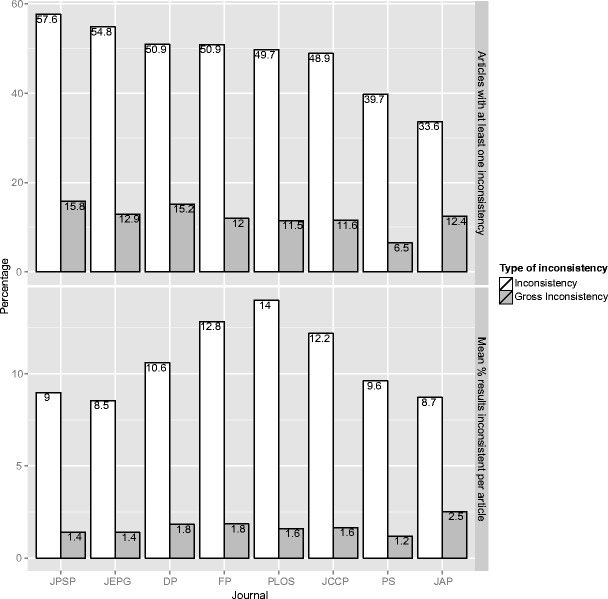
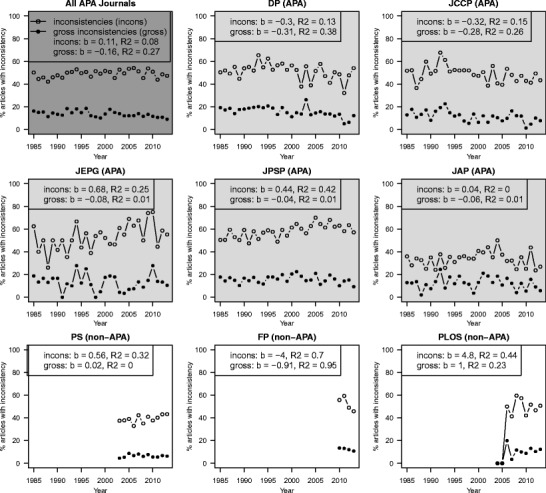
- Across all journals and years, 49.6% (8,273/16,695) of articles with NHST results contained at least one inconsistency, and 12.9% (2,150) contained at least one gross inconsistency. At the p-value level, 9.7% (24,961/258,105) were inconsistent and 1.4% (3,581) were grossly inconsistent; the mean per-article inconsistency rate was 10.6% and the gross inconsistency rate was 1.6%.
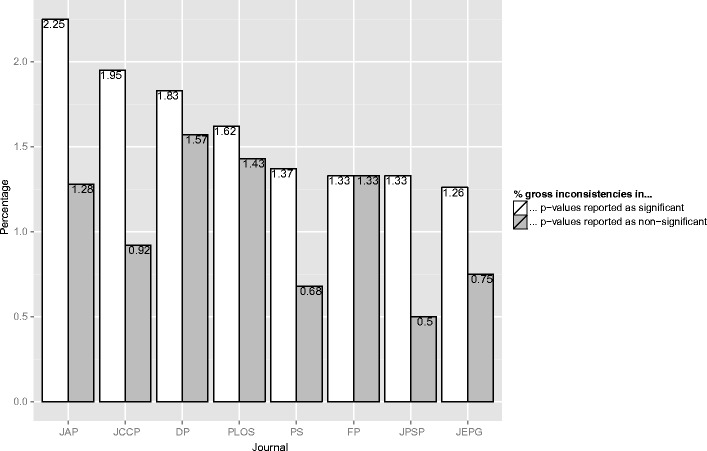
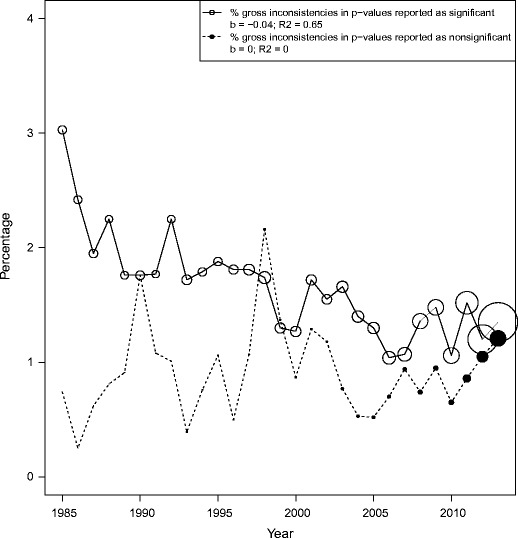
- Gross inconsistencies were more prevalent in p-values reported as significant (1.56%) than in p-values reported as nonsignificant (.97%). Reported p-values were significant 76.6% of the time, whereas computed p-values were significant 74.4% of the time, overestimating significant findings by 2.2 percentage points.
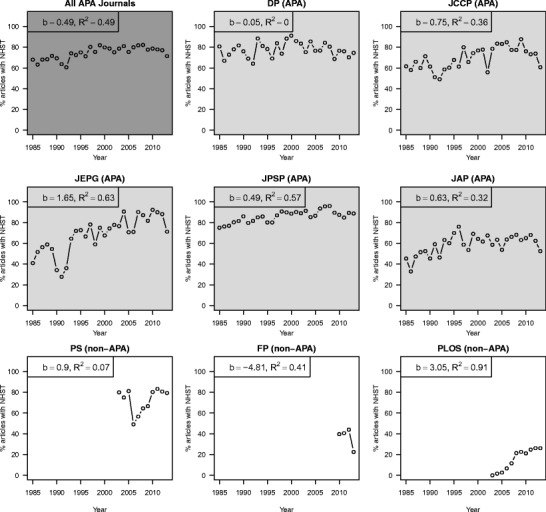
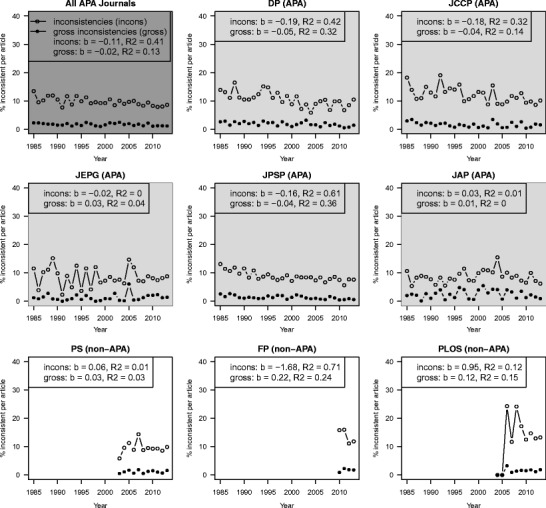
- The prevalence of inconsistencies did not generally increase from 1985 to 2013; inconsistencies decreased or remained stable across APA journals, and articles with gross inconsistencies decreased in all journals except PS and PLOS. JPSP had the highest percentage of articles with at least one inconsistency (57.6%) but one of the lowest p-value inconsistency rates (9.0%); PLoS had the highest p-value inconsistency rate (14.0%).
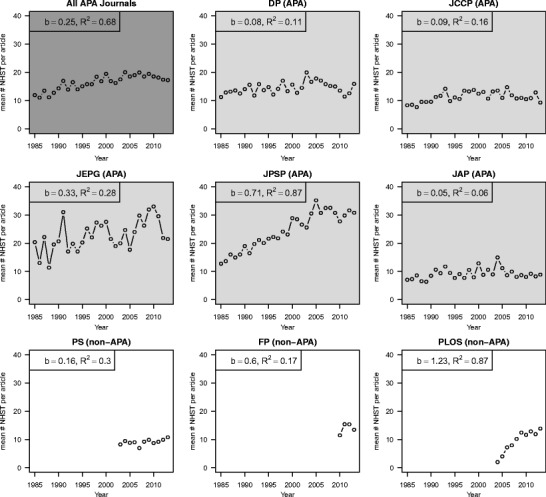
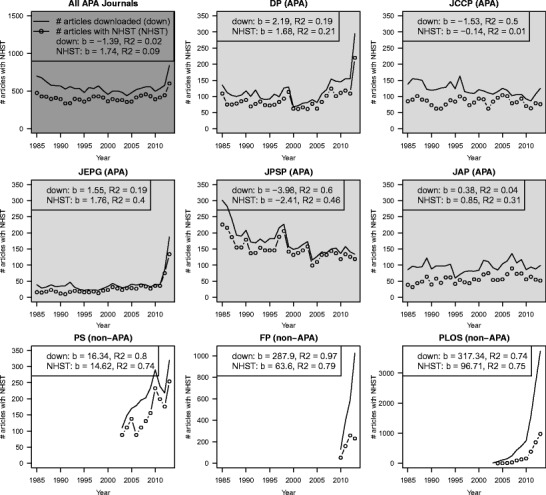
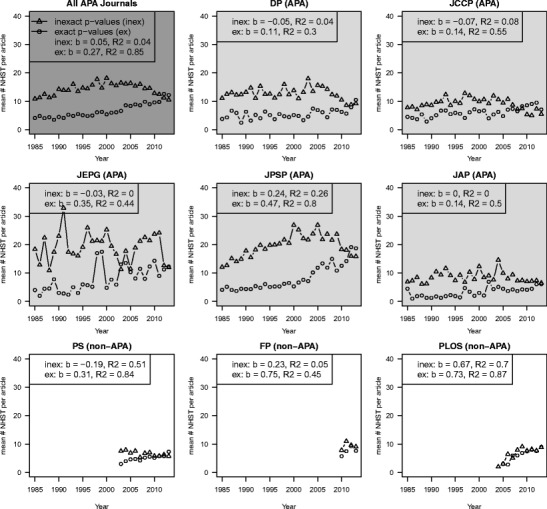
- NHST use increased: statcheck detected NHST results in 54.4% of articles overall, and the number of NHST results per article increased across APA journals (b = .25, R² = .68).
Methods
- Automated statcheck (version 1.0.1) extracted APA-formatted t, F, r, χ², and Z statistics with degrees of freedom and p-values from HTML articles, recalculated p-values, and flagged inconsistencies; a gross inconsistency was one that changed the statistical conclusion at α = .05. One-tailed test detection was used.
- The sample included all HTML articles from eight journals (PLOS, JPSP, JCCP, DP, JAP, PS, FP, JEPG) over years determined by HTML availability (1985–2013 for APA journals; later starts for PS, FP, and PLOS): 30,717 articles downloaded, 16,695 with detectable NHST results, and 258,105 NHST results. Analyses were descriptive only because the selected journals’ APA-reported NHST results were treated as the population.
- A validity check compared statcheck with Wicherts et al. (2011) manual coding of 49 articles: statcheck read 67.5% of manually extracted results; with one-tailed detection it found 56/775 (7.2%) inconsistencies and 8/775 (1.0%) gross inconsistencies, versus manual findings of 49/1,148 (4.3%) and 10/1,148 (.9%). Inter-rater reliability was .76 for inconsistencies and .89 for gross inconsistencies when excluding p = .000.
Limitations
- The paper states that statcheck cannot read results not reported exactly in APA format or results in tables, and cannot account for multiple-testing corrections; it may therefore slightly overestimate inconsistencies. The sample is limited to eight flagship journals and may not represent all psychology; without raw data, it is impossible to determine whether the p-value, test statistic, or degrees of freedom is erroneous; and statcheck cannot distinguish core-hypothesis p-values from manipulation checks.
- Evident from the text: the HTML-only restriction and automated extraction may miss PDF-only or non-APA results, and because no inferential statistics were used, conclusions apply only to APA-reported NHST results in the eight selected journals.
Model-written summary. Check it against the paper before relying on it.
Integrity signals
Registry
Cites
Statistics
Figures
Verification
Claims the paper makes
25 Valid · 2 Not valid · 16 Not checked · 172 Own results and interpretations
The sources with a verdict support this claim; the rest weren’t checked yet, have no full text we could read, or their verdicts aren’t rated yet.
In the paper
“Most conclusions in psychology are based on the results of null hypothesis significance testing (NHST; Cumming et al., 2007; Hubbard & Ryan, 2000; Sterling, 1959; Sterling, Rosenbaum, & Weinkam, 1995).”
§ The prevalence of statistical reporting errors in psychology (1985–2013) > Abstract
What the sources say
- Supportedcites Cumming et al., 2007 matched to “Statistical Reform in Psychology: Is Anything Changing?” (2007) source
The ‘Statistical Practices in Leading Journals’ section reports NHST use in almost all sampled articles (96.9–97.8%). The ‘Change, but Little Reform Yet’ section says NHST dominates overwhelmingly in those journals and is deeply ingrained in psychologists’ thinking, supporting the broad paraphrase. The supplied passages do not provide page numbers. (LLM, conf=0.88)
- Not matchedcites Hubbard & Ryan, 2000
More than one paper fits this citation.
- Not checked — no full text of the sourcecites Sterling, 1959 matched to “Publication Decisions and their Possible Effects on Inferences Drawn from Tests of Significance—or Vice Versa” (1959) source
plain- Asserted: passes — The authors put it forward as true.
- Checkable: passes — It can be checked against evidence.
- Load-bearing: passes — The paper’s conclusions depend on it.
- Based: passes — The paper gives a reason why it holds.
- Supported
Every source the paper cites for this claim was checked and supports it.
In the paper
“However, there is evidence that many reported p-values do not match their accompanying test statistic and degrees of freedom (Bakker & Wicherts, 2011; Bakker & Wicherts, 2014; Berle & Starcevic, 2007; Caperos & Pardo, 2013; Garcia-Berthou & Alcaraz, 2004; Veldkamp, Nuijten, Dominguez-Alvarez, Van Assen, & Wicherts, 2014; Wicherts, Bakker, & Molenaar, 2011).”
§ The prevalence of statistical reporting errors in psychology (1985–2013) > Abstract
What the sources say
- Supportedcites Bakker & Wicherts, 2011 matched to “The (mis)reporting of statistical results in psychology journals” (2011) source
Study 1’s Method describes recalculating reported p-values from the accompanying test statistic and degrees of freedom to identify mismatches. Study 2’s Results report errors in 17.1% of exactly reported results in Study 1 and at least one error in 35% of the articles examined in Study 2. The copy does not provide page numbers for these passages. (LLM, conf=0.93)
- Supportedcites Bakker & Wicherts, 2014 matched to “Outlier Removal and the Relation with Reporting Errors and Quality of Psychological Research” (2014) source
The Method section (Calculation of variables; page unavailable) defines reporting errors as p-values inconsistent with values recalculated from the reported test statistic and degrees of freedom. The Results section (Errors in the reporting of statistical results; page unavailable) reports that 45% of articles had at least one such error. This supports the claim without implying that 45% of individual p-values were incorrect. (LLM, conf=0.91)
- Supportedcites Berle & Starcevic, 2007 matched to “Inconsistencies between reported test statistics and p‐values in two psychiatry journals” (2007) source
The Discussion reports that p-value inconsistencies were common in the two psychiatry journals surveyed and that many papers contained at least one. The Method explains that the authors checked reported p-values against those calculated from the accompanying test statistic and degrees of freedom. (LLM, conf=0.92)
plain- Asserted: passes — The authors put it forward as true.
- Checkable: passes — It can be checked against evidence.
- Load-bearing: passes — The paper’s conclusions depend on it.
- Based: passes — The paper gives a reason why it holds.
- Supported
The cited sources support only part of this claim — read each source’s verdict below.
In the paper
“To avoid bias in the prevalence of reporting errors, we performed a validity study of statcheck, in which we compared statcheck’s results with the results of Wicherts, Bakker, and Molenaar (2011), who performed a manual search for and verification of reporting errors in a sample of 49 articles.”
§ The prevalence of statistical reporting errors in psychology (1985–2013) > Method > “statcheck”
What the sources say
- Partly supportedcites Wicherts, Bakker, and Molenaar (2011) matched to “Willingness to Share Research Data Is Related to the Strength of the Evidence and the Quality of Reporting of Statistical Results” (2011) sourceExperimental — accuracy not yet measured
Methods > Data Retrieval describes extracting statistical results from the papers, and Results > Errors in the Reporting of Statistical Results reports findings from 49 papers. Methods > Detecting Reporting Errors says the authors independently verified all 49 inconsistencies, but says the inconsistencies were initially detected automatically in Excel, not by a manual search for errors. No page numbers are available in our copy. (LLM, conf=0.85)
plain- Asserted: passes — The authors put it forward as true.
- Checkable: passes — It can be checked against evidence.
- Load-bearing: passes — The paper’s conclusions depend on it.
- Based: passes — The paper gives a reason why it holds.
- Partly supported
The cited sources that could be checked couldn’t confirm or dispute this claim.
In the paper
“we conclude that there does not seem to be a difference in the prevalence of reporting inconsistencies between results in APA format and results that are not exactly in APA format (see Appendix A).”
§ The prevalence of statistical reporting errors in psychology (1985–2013) > Discussion
What the sources say
- Could not verifycites Bakker & Wicherts, 2011 matched to “The (mis)reporting of statistical results in psychology journals” (2011) sourceExperimental — accuracy not yet measured
The General discussion reports different inconsistency rates for exactly and inexactly reported statistical results (17–19% versus 7–8%). Those categories concern how p values were reported, not whether results followed APA format. Our copy does not compare inconsistency rates for APA-formatted and non-APA-formatted results, so it cannot verify the claimed lack of a difference. (LLM, conf=0.75)
hedged- Asserted: passes — The authors put it forward as true.
- Checkable: passes — It can be checked against evidence.
- Load-bearing: passes — The paper’s conclusions depend on it.
- Based: passes — The paper gives a reason why it holds.
- Could not verify
Every source the paper cites for this claim was checked and supports it.
In the paper
“Bakker and Wicherts (2011) included only t, F, and χ 2 values”
§ The prevalence of statistical reporting errors in psychology (1985–2013) > Results > Prevalence of inconsistencies as found by other studies
What the sources say
- Supportedcites Bakker and Wicherts (2011) matched to “The (mis)reporting of statistical results in psychology journals” (2011) source
The Study 1 Method says the authors checked only χ², t, and F tests. The Study 2 Results likewise describe selecting articles with those tests and counting results from those three types. The restriction concerns the tests included in their analysis, not every value reported in the articles. (LLM, conf=0.94)
plain- Asserted: passes — The authors put it forward as true.
- Checkable: passes — It can be checked against evidence.
- Load-bearing: unclear — It is unclear whether the paper’s conclusions depend on it.
- Based: passes — The paper gives a reason why it holds.
- Supported
113 more claims · 6 with their cited sources checked
Create a free account to see all 215 claims and every source verdict.
- It may state two separate claims as one. 61
- Probably not a substantial claim. 41
Claims other papers make about this one
Each is checked against this paper’s own text: does it say what the citing paper says it does?
The source backs part of the claim, not all of it — or backs it for a different population, condition or comparison.
In the citing paper
“involve questionable research practices, or even outright misconduct (e.g. Horbach and Halffman 2017b; Nuijten et al. 2016)”
From The ability of different peer review procedures to flag problematic publications (2019) · cites this paper as Nuijten et al. 2016
Experimental — accuracy not yet measuredThe source backs part of the claim, not all of it — or backs it for a different population, condition or comparison.
In the citing paper
“From this perspective, it is not surprising that analysis pipelines are peppered with errors, ranging from the mundane to the serious [53–55].”
From Data availability, reusability, and analytic reproducibility: evaluating the impact of a mandatory open data policy at the journal Cognition (2018) · cites this paper as [54]
Experimental — accuracy not yet measuredThe cited source says what the claim attributes to it.
In the citing paper
“Furthermore, as S&B combines the measurement of text similarity [9] and fact-checking of reagent identities, it can either be applied independently or used in parallel with other tools, such as those that detect duplicated images [10], and/or incorrect statistical results [12, 13].”
From Semi-automated fact-checking of nucleotide sequence reagents in biomedical research publications: The Seek & Blastn tool (2019) · cites this paper as [12]
The cited source says what the claim attributes to it.
In the citing paper
“nor has the rate of statistical errors made in mainstream psychological journals (29, 30).”
From Is science really facing a reproducibility crisis, and do we need it to? (2018) · cites this paper as [30]
The cited source says what the claim attributes to it.
In the citing paper
“Errata and corrections have also not increased”
From Is science really facing a reproducibility crisis, and do we need it to? (2018) · cites this paper as [30]
7 more claims about this paper
Create a free account to see every claim other papers make about this one.
Statistics recomputed
Every reported test result, recomputed from its test statistic and degrees of freedom. A result shows as not adding up only once an independent check has confirmed it.
- Not confirmedF(2, 56) = 1.203reported p < .001 · recomputed p = .308
“F(2,56) = 1.203, p < .001”
- Consistentt(37) = -4.93reported p < .001 · recomputed p < .001
“t(37) = −4.93, p < .001”
- Consistentt(28) = 2reported p < .05 · recomputed p = .055
“t(28) = 2.0, p < .05”
- ConsistentF(2, 56) = 12.03reported p < .001 · recomputed p < .001
“F(2,56) = 12.03, p < .001”
- ConsistentF(1, 76) = 23.95reported p < .001 · recomputed p < .001
“F(l, 76) = 23.95, p < .001”
1 more recomputed test
Create a free account to see every test the Stats check recomputed.
Self-check
Percentages, sums and reported differences re-computed from the paper’s own numbers.
Each contradiction between two passages listed here was confirmed by an independent check.
Rated major: it would touch a result — a value a result rests on, reported and recomputed p-values on opposite sides of the significance level, two passages that conflict with no sign which is right, or a cited work retracted before this paper was published.
In the paper
§ The prevalence of statistical reporting errors in psychology (1985–2013) > Method > “statcheck”
“If we do not include these 11 inconsistencies due to p = .000, statcheck finds an inconsistency percentage of 5.8 % (45 of 775 results)”
§ The prevalence of statistical reporting errors in psychology (1985–2013) > Author note > Appendix A: Results validity check statcheck
“Secondly, seven of the results that statcheck classified as an error, but Wicherts et al. did not, were results in which the p-value was reported to be zero (p = .000).”
Rated minor: it would not touch a result — a value no result rests on, a p-value that stays on the same side of the significance level, or a conflict that is clerical, resolved elsewhere in the paper, or outside its own findings.
In the paper
“| No. of gross inconsistencies | 10 (0.9 %) | 17 (2.3 %) | 8 (1.0 %) |”
§ The prevalence of statistical reporting errors in psychology (1985–2013) > Author note > Appendix A: Results validity check statcheck
Reported 2.3 · recomputed 2.193548
Citations
Cites
R: A Language and Environment for Statistical Computing
R Core Team (2025) · doi:10.32614/r.manuals · Cited by 352,181
Journal of The American Statistical Association
Fienberg, S. E. (2005) · Encyclopedia of Statistical Sciences · doi:10.1002/0471667196.ess1317 · Cited by 6,125
Cohen, J. (1994) · American Psychologist · doi:10.1037/0003-066x.49.12.997 · Cited by 4,003 · cited 1×
“Considering that the ubiquitous significance level of .05 is arbitrary, and that there is a vast amount of critique on NHST in general (see e.g., Cohen, 1994; Fidler & Cumming, 2005; Krueger, 2001; Rozeboom, 1960; Wagenmakers, 2007), it should be clear that it is more important that p -values are…”
Publication Manual of the American Psychological Association
DeCleene, K. E., & Fogo, J. (2012) · Occupational Therapy In Health Care · doi:10.3109/07380577.2011.629024 · Cited by 3,167
A practical solution to the pervasive problems ofp values
Wagenmakers, E.-J. (2007) · Psychonomic Bulletin & Review · doi:10.3758/bf03194105 · Cited by 2,490 · cited 2×
“…of .05 is arbitrary, and that there is a vast amount of critique on NHST in general (see e.g., Cohen, 1994; Fidler & Cumming, 2005; Krueger, 2001; Rozeboom, 1960; Wagenmakers, 2007), it should be clear that it is more important that p -values are accurately reported than that they are below .05.”
Measuring the Prevalence of Questionable Research Practices With Incentives for Truth Telling
John, L. K., Loewenstein, G., & Prelec, D. (2012) · Psychological Science · doi:10.1177/0956797611430953 · Cited by 2,239 · cited 3×
“This is in line with the finding of John et al. (2012) that social psychologists admit to more QRPs, find them more applicable to their field, and find them more defensible as compared to other subgroups in psychology (but see also Fiedler & Schwarz, 2015, on this issue).”
P-curve: A key to the file-drawer.
Simonsohn, U., Nelson, L. D., & Simmons, J. P. (2014) · Journal of Experimental Psychology: General · doi:10.1037/a0033242 · Cited by 1,500 · cited 2×
“Checking articles with statcheck can also prevent such inconsistencies from distorting meta-analyses or analyses of p -value distributions (Simonsohn et al., 2014; Van Assen et al., 2014).”
Publication Manual of the American Psychological Association: BOOK REVIEW
Yao, R. (2011) · Family and Consumer Sciences Research Journal · doi:10.1111/j.1552-3934.2011.02081.x · Cited by 1,451
Nosek (2012) · doi:10.1177/1745691612459058 · Cited by 1,301 · cited 2×
“Even though this can be a legitimate concern for some studies with particularly sensitive data, these are exceptions; the data of most psychology studies could be published without risks (Nosek et al., 2012).”
Negative results are disappearing from most disciplines and countries
Fanelli, D. (2012) · Scientometrics · doi:10.1007/s11192-011-0494-7 · Cited by 1,248
Research works printed but not linked: 1
- 2. American Psychological Association. Publication Manual of the American Psychological Association. 3. Washington, DC: American Psychological Association; 1983.
Cited by
Items 201–300 of 533
White, C. N., & Brennan, M. L. (2018) · Veterinary Sciences · doi:10.3390/vetsci5030075 · Cited by 24
“Finally, open sharing of raw data eases data extraction for meta-analysis, allows re-analysis by others with secondary hypotheses, and may reduce statistical inconsistencies and errors [58,59].”
The State of Play of Reproducibility in Statistics: An Empirical Analysis
Xiong, X., & Cribben, I. (2022) · The American Statistician · doi:10.1080/00031305.2022.2131625 · Cited by 23
Australian and Italian Psychologists’ View of Replication
Agnoli, F., Fraser, H. S., Thorn, F. S., & Fidler, F. M. (2021) · Advances in Methods and Practices in Psychological Science · doi:10.1177/25152459211039218 · Cited by 13
Promoting replicable sexual science: A methodological review and call for metascience
Sakaluk, J. K. (2016) · The Canadian Journal of Human Sexuality · doi:10.3138/cjhs.251-co1 · Cited by 13
“…– myself included – have therefore proposed that routinely incorporating checks for misreporting into the peerreview process could be one way to dramatically reduce rates of misreported statistical values in the scientific literature (Nuijten et al., 2015; Sakaluk, Williams, & Biernat, 2014).”
BackgroundInfluentialOpportunities for increased reproducibility and replicability of developmental neuroimagingPreprint
Klapwijk, E. T., van den Bos, W., Tamnes, C. K., et al. (2019) · doi:10.31234/osf.io/fxjzt · Cited by 14
Psychology’s Replication Crisis and Clinical Psychological SciencePreprint
Tackett, J. L., Brandes, C. M., King, K. M., & Markon, K. E. (2018) · PsyArXiv (OSF Preprints) · doi:10.31234/osf.io/kc8xt · Cited by 16
Tracing the Adoption and Effects of Open Science in Communication ResearchPreprint
Markowitz, D. M., Song, H., & Taylor, S. H. (2021) · PsyArXiv (OSF Preprints) · doi:10.31234/osf.io/dsf67 · Cited by 16
Questionable Research Practices and Open Science in Quantitative CriminologyPreprint
Chin, J. M., Pickett, J. T., Vazire, S., & Holcombe, A. O. (2021) · SocArXiv (OSF Preprints) · doi:10.31235/osf.io/bwm7s · Cited by 12
Zhu, F., Pi, Z., & Yang, J. (2024) · Educational Psychology Review · doi:10.1007/s10648-024-09859-0 · Cited by 18
“In meta-analysis, publication bias refers to a common issue that studies that report significant results are more likely to be published, compared to those that report insignificant results (Nuijten et al., 2016; Rosenthal, 1979).”
The value of statistical tools to detect data fabrication
Hartgerink, C. H. J., Wicherts, J. M., & van Assen, M. A. L. M. (2016) · Research Ideas and Outcomes · doi:10.3897/rio.2.e8860 · Cited by 14
Self-citation688, 112 Statistical Results: Content Mining Psychology Articles for Statistical Test Results
Hartgerink, C. (2016) · International Conference on Data Technologies and Applications · doi:10.3390/data1030014 · Cited by 10
Self-citationPreregistration and Registered Reports in Sociology: Strengths, Weaknesses, and Other Considerations
Manago, B. N. (2023) · The American Sociologist · doi:10.1007/s12108-023-09563-6 · Cited by 18
Research Methods for Education With Technology: Four Concerns, Examples, and Recommendations
Wright, D. B. (2019) · Frontiers in Education · doi:10.3389/feduc.2019.00147 · Cited by 17
“While packages like statcheck (Nuijten et al., 2016) can catch some errors, they will not catch all errors.”
BackgroundMethodResultInfluentialWilkinson, J., Heal, C., Antoniou, G. A., Flemyng, E., Avenell, A., Barbour, V., Bordewijk, E. M., Brown, N. J. L., Clarke, M., Dumville, J., et al. (2024) · Journal of Clinical Epidemiology · doi:10.1016/j.jclinepi.2024.111512 · Cited by 11
Open Access, Scholarly Communication, and Open Science in Psychology: An Overview for Researchers
Mullen, L. B. (2024) · SAGE Open · doi:10.1177/21582440231205390 · Cited by 23
Towards automating Numerical Consistency Checks in Financial Reports
Hillebrand, L., Deußer, T., Dilmaghani, T., Kliem, B., Loitz, R., Bauckhage, C., & Sifa, R. (2022) · IEEE International Conference on Big Data (BigData) · doi:10.1109/bigdata55660.2022.10020308 · Cited by 14
Sakaluk, J. K., & Graham, C. A. (2017) · The Journal of Sex Research · doi:10.1080/00224499.2017.1395387 · Cited by 13
“For example, making simple reporting mistakes (Nuijten, Hartgerink, Van Assen, Epskamp, & Wicherts, 2016), running chronically underpowered studies (Maxwell, 2004; Schimmack, 2012), refusing to let others verify one’s findings (Wicherts, Bakker, & Molenaar, 2011; Wicherts, Borsboom, Kats, &…”
BackgroundReporting in Experimental Philosophy: Current Standards and Recommendations for Future Practice
Polonioli, A., Vega‐Mendoza, M., Blankinship, B., & Carmel, D. (2018) · Review of Philosophy and Psychology · doi:10.1007/s13164-018-0414-3 · Cited by 12
Rigor, Replication, and Reproducibility: Increasing the Relevance of Behavioral Disorders Research
Gage, N. A., & Stevens, R. N. (2018) · Education and Treatment of Children · doi:10.1353/etc.2018.0029 · Cited by 13
Open Up – the Mission Statement of the Control of Impulsive Action (Ctrl-ImpAct) Lab on Open Science
Reimer, C. B., Chen, Z., Bundt, C., Eben, C., London, R. E., & Vardanian, S. (2019) · Psychologica Belgica · doi:10.5334/pb.494 · Cited by 11
Nuijten, M. B., Bakker, M., Maassen, E., & Wicherts, J. M. (2018) · PsyArXiv (OSF Preprints) · doi:10.31234/osf.io/fuzkh · Cited by 12
Self-citationFernández, L. M., Hardwicke, T. E., & Vadillo, M. A. (2019) · PsyArXiv (OSF Preprints) · doi:10.31234/osf.io/cszpy · Cited by 15
Cognitive Modeling Using Artificial Intelligence
Frank, M. C., & Goodman, N. D. (2025) · Annual Review of Psychology · doi:10.1146/annurev-psych-030625-040748 · Cited by 55
The Prevalence of Errors in Machine Learning Experiments
Shepperd, M., Guo, Y., Li, N., Arzoky, M., Capiluppi, A., Counsell, S., Destefanis, G., Swift, S., Tucker, A., & Yousefi, L. (2019) · Lecture notes in computer science · doi:10.1007/978-3-030-33607-3_12 · Cited by 16
“ted inconsistency of means (GRIM) and found that of 71 testable articles around half (36/71) appeared to contain at least one inconsistent mean. An alternative approach is presented by Nuijten et al. [15] who provide an R package to assist in the checking of inferential statistics such as ˜2, ANOVA and t-tests. Howeve…”
MethodResultTen Points for High-Quality Statistical Reporting and Data Presentation
Nieminen, P. A. (2020) · Applied Sciences · doi:10.3390/app10113885 · Cited by 12
“Software algorithms and scanners have been developed to assess internal consistency and validity of statistical tests in academic writing [57].”
BackgroundReplicability in Empirical Legal Research
Chin, J. M., & Zeiler, K. (2021) · Annual Review of Law and Social Science · doi:10.1146/annurev-lawsocsci-121620-085055 · Cited by 21
Open Science in Developmental Science
Gennetian, L. A., Frank, M. C., & Tamis‐LeMonda, C. S. (2022) · Annual Review of Developmental Psychology · doi:10.1146/annurev-devpsych-120920-042335 · Cited by 13
Assessing and improving robustness of psychological research findings in four steps.Preprint
Nuijten, M. B. (2021) · doi:10.31234/osf.io/a4bu2 · Cited by 11
Self-citationStatcheck does not work: All the numbers. Reply to Nuijten et al. (2017)Preprint
Schmidt, T. (2017) · doi:10.31234/osf.io/hr6qy · Cited by 12
Progress toward openness, transparency, and reproducibility in cognitive neurosciencePreprint
Gilmore, R. O., Diaz, M. T., Wyble, B., & Yarkoni, T. (2017) · OSF Preprints (OSF Preprints) · doi:10.31219/osf.io/5veew · Cited by 11
Hesselmann, F. (2023) · Minerva · doi:10.1007/s11024-022-09484-7 · Cited by 10
“…aim to detect violations of research integrity such as plagiarism (e.g. Turnitin, Zhang 2010), others target more benign issues such as inadvertent statistical mistakes (e.g. Statcheck, Nuijten et al. 2016), or poor or intransparent reporting of research protocols (SciScore, Menke et al. 2020).”
BackgroundSchneck, A. (2023) · PLoS ONE · doi:10.1371/journal.pone.0292717 · Cited by 16
“Questionable research practices, such as erroneous rounding of results [4–6] and selective reporting of results that confirm the expectations [publication selection bias 6, 7], may pose a larger problem for validity because of the very low prevalence of wholly fabricated datasets [8].”
BackgroundTHREATS TO OBJECTIVITY IN THE SOCIAL SCIENCE RESEARCH
Vuković, M., Urošević, S., & Dašić, D. (2023) · SPORTS MEDIA AND BUSINESS · doi:10.58984/smb2302143v · Cited by 16
Making the scientific literature fail-safe
Casadevall, A., & Fang, F. C. (2018) · Journal of Clinical Investigation · doi:10.1172/jci123884 · Cited by 10
“Jour-nals can use software to identify plagia-rism, image manipulation, or data anomalies (11–13).”
Accumulating Knowledge in the Organizational Sciences
Bosco, F. A. (2021) · Annual Review of Organizational Psychology and Organizational Behavior · doi:10.1146/annurev-orgpsych-012420-090657 · Cited by 14
Thou Shalt Be Reproducible! A Technology Perspective
Mair, P. (2016) · Frontiers in Psychology · doi:10.3389/fpsyg.2016.01079 · Cited by 12
“The issue associated with reporting errors such as inconsistent p -values (see Nuijten et al., 2015) is minimized.”
BackgroundThe Impact of P -hacking on “Redefine Statistical Significance”
Crane, H. (2018) · Basic and Applied Social Psychology · doi:10.1080/01973533.2018.1474111 · Cited by 15
Bringing the review process into the 21st century: Post-publication peer review
Harms, P. D., & Credé, M. (2020) · Industrial and Organizational Psychology · doi:10.1017/iop.2020.13 · Cited by 10
Research practices and assessment of research misconduct
Hartgerink, C. H. J., & Wicherts, J. M. (2016) · ScienceOpen Research · doi:10.14293/s2199-1006.1.sor-socsci.arysbi.v1 · Cited by 11
“Large-scale research in psychology has indicated that 12.5–20% of sampled articles include at least one such gross error, with approximately 1% of all reported test results being affected by such gross errors (Bakker & Wicherts, 2011; Nuijten et al., 2015; Veldkamp et al., 2014).”
BackgroundInfluentialSelf-citationScientific self-correction: the Bayesian way
Romero, F., & Sprenger, J. (2020) · Synthese · doi:10.1007/s11229-020-02697-x · Cited by 18
Minimizing Mistakes In Psychological SciencePreprint
Rouder, J. N., Haaf, J. M., & Snyder, H. K. (2018) · PsyArXiv (OSF Preprints) · doi:10.31234/osf.io/gxcy5 · Cited by 10
Inaccuracy in the Scientific Record and Open Postpublication Critique
Brewin, C. R. (2023) · Perspectives on Psychological Science · doi:10.1177/17456916221141357 · Cited by 14
Linear regression reporting practices for health researchers, a cross-sectional meta-research study
Jones, L. V., Barnett, A. G., & Vagenas, D. (2025) · PLoS ONE · doi:10.1371/journal.pone.0305150 · Cited by 28
Keener, S. K., Kepes, S., & Torka, A. (2023) · Acta Psychologica · doi:10.1016/j.actpsy.2023.104005 · Cited by 14
Learning from the past to develop data analysis curricula for the future
Weissgerber, T. L. (2021) · PLoS Biology · doi:10.1371/journal.pbio.3001343 · Cited by 9
“Half of psychology papers that perform null hypothesis significance testing include at least 1 misreported p-value, and these errors may alter conclusions in 13% of papers [7].”
BackgroundAnderson, R. B., Crawford, J. C., & Bailey, M. H. (2021) · Behavior Research Methods · doi:10.3758/s13428-021-01618-1 · Cited by 11
Neoh, M. J. Y., Carollo, A., Lee, A., & Esposito, G. (2023) · Royal Society Open Science · doi:10.1098/rsos.230677 · Cited by 18
“From the citing articles, the scope of the articles in this cluster appears to be the prevalence of QRPs in behavioural and social sciences such as psychiatry [61], psychology [62,63] and management [1].”
BackgroundSmart software spots statistical errors in psychology papers
Baker, M. (2015) · Nature · doi:10.1038/nature.2015.18657 · Cited by 9
Cios, K. J., Krawczyk, B., Cios, J., & Staley, K. J. (2019) · arXiv · doi:10.48550/arxiv.1905.09203 · Cited by 9
“A web-based algorithm called statcheck checks validity of statistical testing used in papers; it reads both pdf and HTML formats of papers and recalculates p-values and other measurements [85].”
MethodError Tight: Exercises for Lab Groups to Prevent Research MistakesPreprint
Strand, J. F. (2021) · doi:10.31234/osf.io/rsn5y · Cited by 9
The Reliability of Replications: A Study in Computational ReproductionsPreprint
Breznau, N., Rinke, E. M., Wuttke, A., Nguyen, H. H. V., Adem, M., Adriaans, J., Akdenız, E., Álvarez-Benjumea, A., Andersen, H. K., Auer, D., et al. (2021) · SocArXiv (OSF Preprints) · doi:10.31235/osf.io/j7qta · Cited by 9
Changing the logic of replication: A case from infant studies.Preprint
Margoni, F., & Shepperd, M. (2019) · Infant Behavior and Development · doi:10.31234/osf.io/xw6qt · Cited by 13
Nuijten, M. B., & Wicherts, J. M. (2023) · doi:10.31234/osf.io/bxau9 · Cited by 9
Self-citationSkubera, M., Korbmacher, M., Evans, T. R., Azevedo, F., & Pennington, C. R. (2025) · Royal Society Open Science · doi:10.1098/rsos.241726 · Cited by 18
Claesen, A., Vanpaemel, W., Maerten, A.-S., Verliefde, T., Tuerlinckx, F., & Heyman, T. (2023) · PLoS ONE · doi:10.1371/journal.pone.0284243 · Cited by 9
“[12] warned about the interpretation of statcheck results, due to the overestimation of consistency errors, but they argued that statcheck is suitable to give an overall indication of the prevalence of consistency errors in a large body of literature, and that individual results should be checked by hand.”
BackgroundResultInfluentialWriting statistical methods for ecologists
Davis, A. J., & Kay, S. L. (2023) · Ecosphere · doi:10.1002/ecs2.4539 · Cited by 17
Shaw, S. D., & Nave, G. (2023) · Journal of Business Research · doi:10.1016/j.jbusres.2023.114129 · Cited by 8
Immunotherapy and Cannabis: A Harmful Drug Interaction or Reefer Madness?
Piper, B. J., Tian, M. Y., Saini, P., Higazy, A., Graham, J., Carbe, C., & Bordonaro, M. (2024) · Cancers · doi:10.3390/cancers16071245 · Cited by 8
“Some experimental psychology journals use software to identify statistical irregularities [37].”
BackgroundThe poor availability of syntaxes of structural equation modeling
Wicherts, J. M., & Crompvoets, E. A. V. (2017) · Accountability in Research · doi:10.1080/08989621.2017.1396214 · Cited by 6
Self-citationSakaluk, J. K. (2020) · Archives of Sexual Behavior · doi:10.1007/s10508-020-01795-8 · Cited by 8
Lukács, G. (2021) · The Quantitative Methods for Psychology · doi:10.20982/tqmp.17.1.p007 · Cited by 9
Lindsay, D. S. (2023) · Meta-Psychology · doi:10.15626/mp.2023.4020 · Cited by 9
Hankenson, F. C., Prager, E. M., & Berridge, B. R. (2024) · Annual Review of Animal Biosciences · doi:10.1146/annurev-animal-021022-043531 · Cited by 10
Baethge, C., Deckert, M., & Stang, A. (2018) · International Journal of Methods in Psychiatric Research · doi:10.1002/mpr.1735 · Cited by 8
Fidelity of Statistical Reporting in 10 Years of Cyber Security User Studies
Groß, T. (2021) · Lecture notes in computer science · doi:10.1007/978-3-030-55958-8_1 · Cited by 8
Endogeneity and Entrepreneurship ResearchPreprint
Anderson, B. S. (2018) · OSF Preprints (OSF Preprints) · doi:10.31219/osf.io/75tn8 · Cited by 12
Ten quick tips for getting the most scientific value out of numerical data
Schwen, L. O., & Rueschenbaum, S. (2018) · PLoS Computational Biology · doi:10.1371/journal.pcbi.1006141 · Cited by 6
Errors in Reporting Significant Figures in Surgical and Medical Journals in 2017
Leaphart, D. M., Cronley, A. C., & Brothers, T. E. (2019) · Journal of Surgical Research · doi:10.1016/j.jss.2019.07.006 · Cited by 7
Lester, G. V. (2019) · Journal of Management Inquiry · doi:10.1177/1056492619882508 · Cited by 7
EEG-Based Emotion Recognition Using Convolutional Neural Networks
Mamica, M., Kapłon, P., & Jemioło, P. (2021) · Lecture notes in computer science · doi:10.1007/978-3-030-77977-1_7 · Cited by 7
“Studies that have been considered credible for decades have been criticized as they contained methodological flaws [3, 14].”
BackgroundEvaluating Multinomial Order Restrictions with Bridge SamplingPreprint
Sarafoglou, A., Haaf, J. M., Ly, A., et al. (2020) · doi:10.31234/osf.io/bux7p · Cited by 7
Basic statistical considerations for physiology: The journal Temperature toolboxPreprint
Caldwell, A. R., & Cheuvront, S. N. (2020) · SportRxiv (OSF Preprints) · doi:10.31236/osf.io/rt4bp · Cited by 7
Reproducibility and Replicability in a Fast-paced Methodological WorldPreprint
Epskamp, S. (2018) · PsyArXiv (OSF Preprints) · doi:10.31234/osf.io/cnq4d · Cited by 8
Self-citationHéroux, M. E., Diong, J. H. L., Bye, E., Fisher, G., Robertson, L. J., Butler, A. A., & Gandevia, S. C. (2023) · F1000Research · doi:10.12688/f1000research.142841.1 · Cited by 8
Algorithmically outsourcing the detection of statistical errors and other problems.
Wren, J. D. (2018) · The EMBO Journal · doi:10.15252/embj.201899651 · Cited by 6
“Our study also found that only 1.44% of recalculated P -values would flip the significance at P ≤ 0.05, which is similar to the 1.56% reported by Nuijten et al (2016).”
InfluentialLabbé, C., Cabanac, G., West, R. A., Gautier, T., Favier, B., & Byrne, J. A. (2020) · Scientometrics · doi:10.1007/s11192-020-03463-z · Cited by 6
“These automated approaches include the detection of plagiarism (Citron and Ginsparg 2015), p-value hacking (Nuijten et al. 2016), and discrepancies between the claims presented and current knowledge on the topic (Labbé et al.”
MethodThe reliability of replications: a study in computational reproductions
Breznau, N., Rinke, E. M., Wuttke, A., Adem, M., Adriaans, J., Akdeniz, E., Álvarez-Benjumea, A., Andersen, H. K., Auer, D., Azevedo, F., et al. (2025) · Royal Society Open Science · doi:10.1098/rsos.241038 · Cited by 12
“Moreover, we know that researchers might report false numerical results [50,51], which is a case where any replication attempt without also having the code is essentially a new study.”
An audit of machine learning experiments on software defect prediction
Destefanis, G., Yousefi, L., Shepperd, M., Tucker, A., Swift, S., Counsell, S., & Arzoky, M. (2026) · Empirical Software Engineering · doi:10.1007/s10664-025-10797-w · Cited by 15
“Subsequent studies have lent some support to this viewpoint, e.g., [19,47,29].”
How to Identify and How to Conduct Research that Is Informative and Reproducible
Zickfeld, J., & Schubert, T. W. (2019) · Theory and history in the human and social sciences · doi:10.1007/978-3-030-33099-6_9 · Cited by 5
THE (NON‐)SIGNIFICANCE OF REPORTING ERRORS IN ECONOMICS: EVIDENCE FROM THREE TOP JOURNALS
Pütz, P., & Bruns, S. B. (2020) · Journal of Economic Surveys · doi:10.1111/joes.12397 · Cited by 8
A Narrative on The Fabrication of Results in Science
Freitas, J., Esteves, D., & Neiva, H. P. (2021) · Current Science · doi:10.18520/cs/v121/i2/205-209 · Cited by 8
Böschen, I. (2021) · Scientific Reports · doi:10.1038/s41598-021-98782-3 · Cited by 12
“Nuijten et al. 20 validated statcheck on the manually coded analysis of errors in all reports of statistically significant t -, F - and χ 2 -test results in 48 articles, published by the Journal of Personality and Social Psychology and Journal of Experimental Psychology: Learning, Memory, and Cognition. statcheck extr…”
BackgroundInfluentialBöschen, I. (2021) · Scientometrics · doi:10.1007/s11192-021-04162-z · Cited by 6
Distrust: Big Data, Data-Torturing, and the Assault on Science
Smith, G. (2023) · doi:10.1093/oso/9780192868459.001.0001 · Cited by 12
Segerstrom, S. C., Diefenbach, M. A., Hamilton, K., O'Connor, D. B., Tomiyama, A. J., Bacon, S., Bennett, G. G., Brondolo, E. N., Czajkowski, S. M., Davidson, K. W., et al. (2023) · Annals of Behavioral Medicine · doi:10.1093/abm/kaac044 · Cited by 14
Segerstrom, S. C., Diefenbach, M. A., Hamilton, K., O'Connor, D. B., & Tomiyama, A. J. (2023) · Health Psychology · doi:10.1037/hea0001236 · Cited by 9
van Aert, R. C. M., Nuijten, M. B., Olsson-Collentine, A., Stoevenbelt, A. H., van den Akker, O. R., Klein, R. A., & Wicherts, J. M. (2023) · Royal Society Open Science · doi:10.1098/rsos.202326 · Cited by 6
“10% of statistics is inconsistent; [22]), so we have no immediate reason to suspect that reporting inconsistencies increased during the pandemic.”
BackgroundResultSelf-citationDoes the privacy paradox exist? Comment on Yu et al.’s (2020) meta-analysis
Dienlin, T., & Sun, Y. (2021) · Meta-Psychology · doi:10.15626/mp.2020.2711 · Cited by 9
Fanelli, D. (2022) · Oxford University Press eBooks · doi:10.1093/oso/9780190938550.003.0004 · Cited by 7
Measuring transparency in the social sciences: political science and international relations
Scoggins, B., & Robertson, M. P. (2024) · Royal Society Open Science · doi:10.1098/rsos.240313 · Cited by 12
“Reporting errors in regression coefficients or test statistics occur frequently [27].”
BackgroundExamining the Reproducibility of 6 Published Studies in Public Health Services and Systems Research
Harris, J. K., Wondmeneh, S. B., Zhao, Y., & Leider, J. P. (2018) · Journal of Public Health Management and Practice · doi:10.1097/phh.0000000000000694 · Cited by 8
688,112 Statistical Results: Content Mining Psychology Articles for Statistical Test ResultsPreprint
Hartgerink, C. H. J. (2016) · Preprints.org · doi:10.20944/preprints201608.0191.v1 · Cited by 6
Self-citationda Silva, J. T. (2020) · Preprints.org · doi:10.20944/preprints201708.0029.v2 · Cited by 6
Smaldino, P. E., Turner, M. A., & Kallens, P. C. (2019) · Royal Society Open Science · doi:10.1098/rsos.191249 · Cited by 6
Reproducible Research in R: A Tutorial on how to Do the Same Thing More Than OncePreprint
Peikert, A., Lissa, C. J. V., & Brandmaier, A. M. (2021) · doi:10.31234/osf.io/fwxs4 · Cited by 6
“Results are then (manually) copied and pasted from one program to another, a process that often produces inconsistencies [10].”
BackgroundSegerstrom, S. C., Diefenbach, M. A., Hamilton, K., O'Connor, D. B., & Tomiyama, A. J. (2022) · doi:10.31234/osf.io/dj3xe · Cited by 6
Lanier, M., Waddell, T. F., Elson, M., Tamul, D., Ivory, J., & Przybylski, A. K. (2019) · PsyArXiv (OSF Preprints) · doi:10.31234/osf.io/6hk89 · Cited by 7
Dougherty, M. R. P., & Horne, Z. (2019) · doi:10.31234/osf.io/9g5wk · Cited by 6
Embedding Data Skills in Research Methods Education: Preparing Students for Reproducible ResearchPreprint
McAleer, P., Stack, N., Woods, H. C., DeBruine, L. M., Paterson, H., Nordmann, E., Kuepper-Tetzel, C. E., & Barr, D. J. (2022) · PsyArXiv (OSF Preprints) · doi:10.31234/osf.io/hq68s · Cited by 7
van den Akker, O. R., van Assen, M. A. L. M., Bakker, M., et al. (2023) · doi:10.31222/osf.io/fhdbs · Cited by 6
Self-citation
Metadata
- Authors
- Nuijten, M. B., Hartgerink, C. H. J., van Assen, M. A. L. M., Epskamp, S., & Wicherts, J. M.
- Affiliations
- Tilburg University (NL)
- University of Amsterdam (NL)
- Corresponding author
- Nuijten, Michèle B.
- Venue
- Behavior Research Methods
- Published
- 2015-10-23
- Volume
- 48
- Issue
- 4
- Pages
- 1205-1226
- ISSN
- 1554-351X (ISSN-L)
- 1554-3528
- PMC
- PMC5101263
- OpenAlex
- W1910875068
- Cited by
- 510
- References
- 45
- Citations by year
- 2026: 19 · 2025: 36 · 2024: 25 · 2023: 85 · 2022: 43 · 2021: 59 · 2020: 35 · 2019: 60 · 2018: 57 · 2017: 55 · 2016: 33 · 2015: 2
- FWCI
- 44.63
- Type
- journal article
- Language
- en
- Open access
- hybrid
- doi.org
- Locations
- Behavior Research Methods (publishedVersion, cc-by)
- PubMed Central (publishedVersion, cc-by)
- Research portal (Tilburg University) (publishedVersion, cc-by)
- PubMed (publishedVersion)
- UvA-DARE (University of Amsterdam) (acceptedVersion, cc-by)
- Data Archiving and Networked Services (DANS) (submittedVersion, cc-by)
- OSF Preprints (OSF Preprints) (submittedVersion, cc-by)
- Data Archiving and Networked Services (DANS) (submittedVersion, other-oa)
- Topics
- Social Sciences › Decision Sciences › Statistics, Probability and Uncertainty › Meta-analysis and systematic reviews
- Social Sciences › Psychology › Experimental and Cognitive Psychology › Psychology Research and Bibliometrics
- Social Sciences › Education › Academic integrity and plagiarism
- Keywords
- statistical reporting errors, p-values, null hypothesis significance testing, statcheck, psychology journals, data sharing, peer review
- MeSH terms
- Humans, Bias, Prevalence, Behavioral Research
About these checks
Registry, retraction, Cites and statistics results are computed, not judged, with one exception: a printed reference that no index lists is read once by a model before it counts as a citation error. Claims are extracted by a model and kept only when their quote appears verbatim in the text; each cited source is then checked, with a model’s help, for whether it says what the claim relies on. Those verdicts can be wrong — read the claim’s quote and the cited source before relying on one.
The claim verdicts this report counts are experimental: their accuracy is not yet measured.
A language model drew the claims from the paper on 2026-09-30, under version 3 of the claim definition (model deepseek-v4.1-flash, prompt extract-v3).
A second model labelled each claim on 2026-09-30 (model jev-1.13-20260917, definition revision gold-guideline-v0.2).
Cited sources are checked with a language model’s help (gpt-6-sol).
Statistics and arithmetic are recomputed, not judged.
Confidence bands are shown only for fields calibrated on our annotated test set. None is calibrated yet, so no band is shown.
What counts as a claim ›How we measure confidence ›How we check this ›
Are you an author, or do you see a problem with this page? Request a review
Data sources
Bibliographic data: Semantic Scholar, OpenAlex, Crossref.
Contains information from the Semantic Scholar Academic Graph Datasets, made available under the ODC Attribution License (ODC-BY 1.0).
Semantic Scholar’s data is described in: Kinney, R., et al. (2023). The Semantic Scholar Open Data Platform. arXiv:2301.10140.
