

Rating norms should be calculated from cumulative link mixed effects models
Open accessPublished version of a preprint
The DOI matches its Crossref record; 42 of the 42 references it cites were found in a registry or an index; 11 of the 19 sources its claims cite were checked for support.
Abstract
Studies which provide norms of Likert ratings typically report per-item summary statistics. Traditionally, these summary statistics comprise the mean and the standard deviation (SD) of the ratings, and the number of observations. Such summary statistics can preserve the rank order of items, but provide distorted estimates of the relative distances between items because of the ordinal nature of Likert ratings. Inter-item relations in such ordinal scales can be more appropriately modelled by cumulative link mixed effects models (CLMMs). In a series of simulations, and with a reanalysis of an existing rating norms dataset, we show that CLMMs can be used to more accurately norm items, and can provide summary statistics analogous to the traditionally reported means and SDs, but which are disentangled from participants' response biases. CLMMs can be applied to solve important statistical issues that exist for more traditional analyses of rating norms.
Overview
CoChat Summary
TL;DR
The paper argues that Likert rating norms should be computed from cumulative link mixed models (CLMMs), because raw means and SDs distort inter-item distances when ordinal responses are treated as continuous. Across simulations and a reanalysis of character-similarity ratings, CLMM random effects recovered latent item means and SDs more accurately and were less affected by response patterns.
Key findings
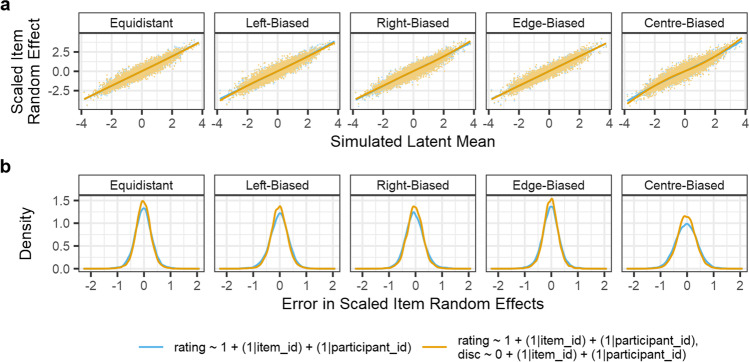
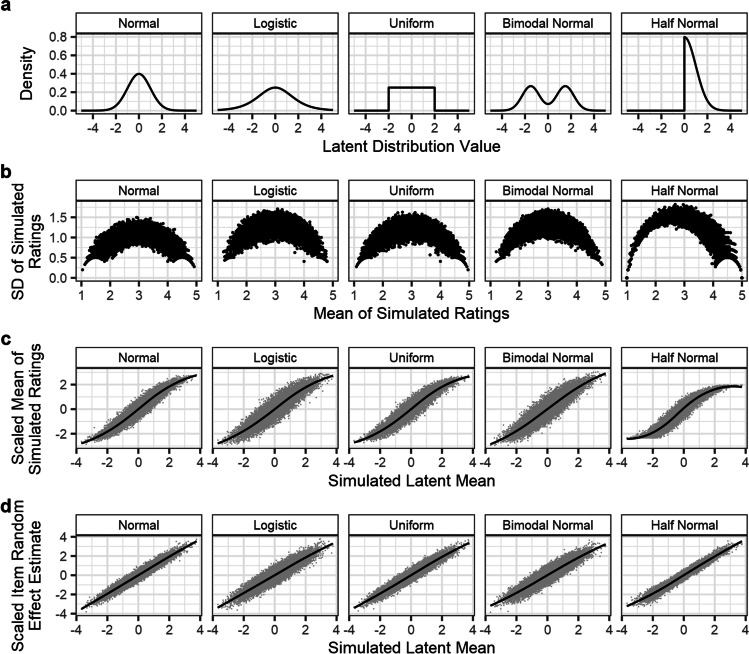
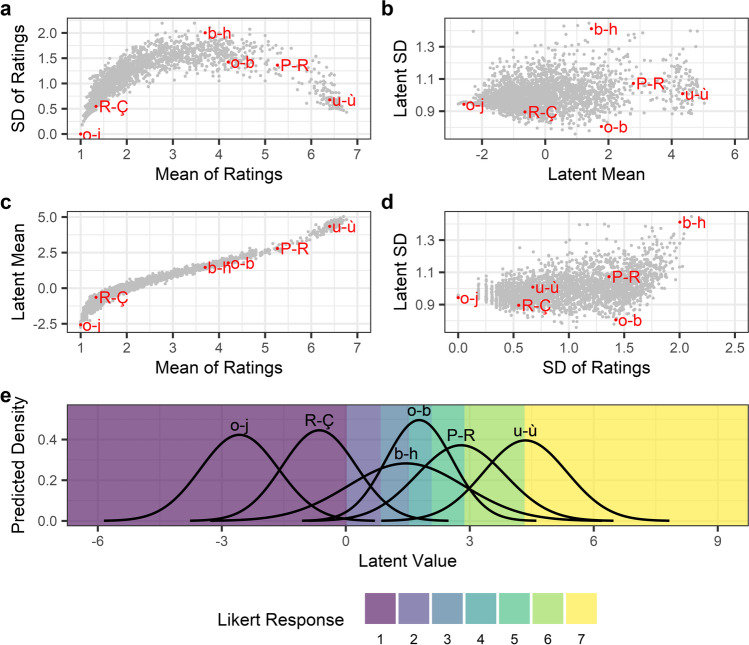
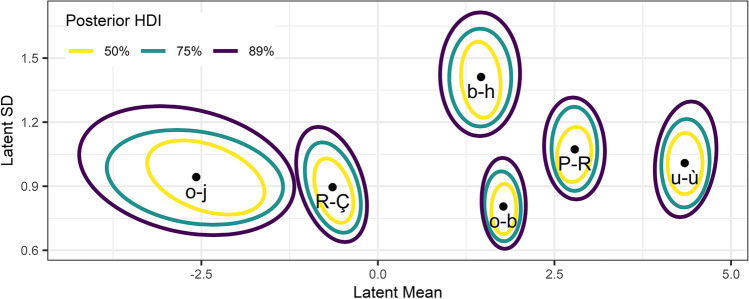
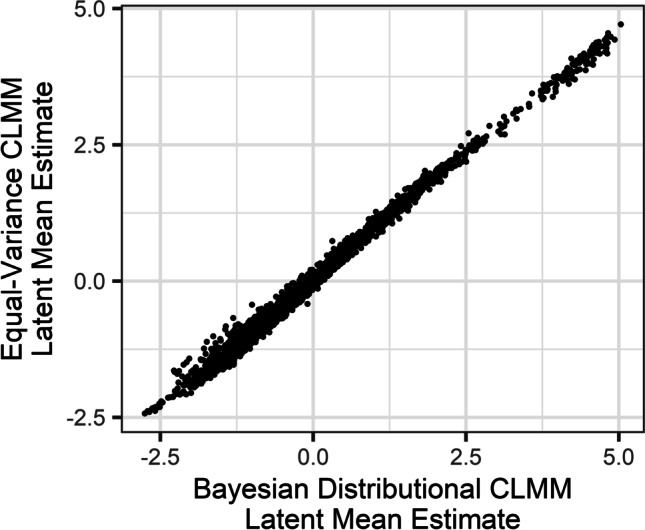
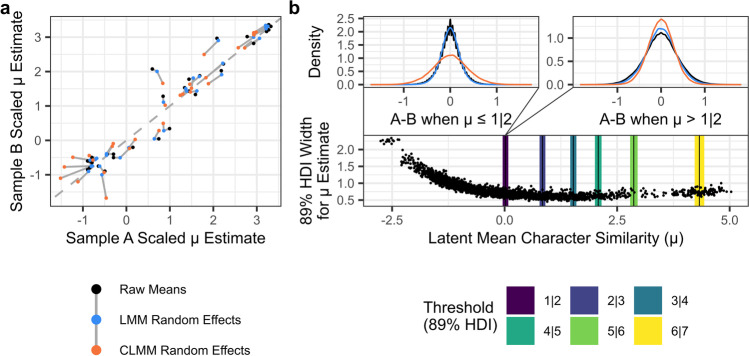
CLMMs recovered item latent means more accurately than raw Likert means across five simulated response patterns (equidistant, left-biased, right-biased, edge-biased, centre-biased), while raw means were distorted by nonlinear response mappings. In Simulation 2, adding participant random effects improved item random-effect accuracy, especially when participants were more variable than items; when items were more variable, there was no gain but also no loss. In Simulation 3, distributional CLMMs recovered latent SDs better than raw SDs; raw SDs underestimated large latent SDs, with items simulated at SD = 8 estimated at only about 1.5–2. In the real character-similarity data, the Bayesian distributional CLMM’s latent mean estimates correlated r = .997 with an equal-variance maximum-likelihood CLMM, and CLMM-derived norms were generally more consistent across split-half samples except at the floor of the scale.
Methods
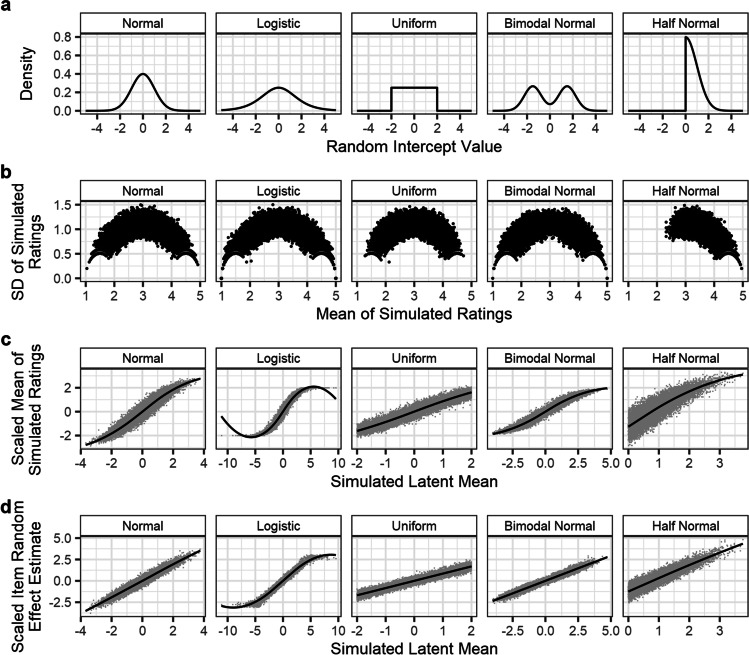
The paper reports four simulation studies: Simulation 1 simulated 100 items with 25 observations per item; Simulation 2 added 100 participants each rating 25 items; Simulation 2b varied item and participant random-effect SDs from .25 to 5 in steps of .25; Simulation 3 simulated 100 datasets with item and participant random effects for latent mean and SD; Simulation 4 varied the latent distribution or item random effects across normal, logistic, uniform, bimodal, and half-normal distributions. Models were fit in R with the ordinal package or brms/Stan, using probit-link CLMMs; distributional models estimated a discrimination parameter as the inverse latent SD. The real-data application reanalysed Simpson et al. (2013): 2704 character pairs, 677 participants, 81,199 trials, 108–120 trials per participant, and 29–31 ratings per item on a 1–7 similarity scale, using a Bayesian distributional CLMM with six chains of 6000 iterations and thin = 2.
Limitations
The paper states that all simulations and analyses assumed a single response pattern across observations, though it notes that participants or items may show distinct response patterns and that modelling per-participant or per-item thresholds was not evaluated. It also states that Bayesian distributional CLMMs are computationally complex and can take substantially longer to fit, potentially becoming unfeasible for very large datasets; if latent variance is not of interest, simpler equal-variance models may suffice. The paper further notes that subjective judgements remain subjective even after disentangling response patterns, and that floor/ceiling effects can increase uncertainty in latent estimates. Evident from the text: the empirical validation is limited to one reanalysed dataset, and the simulation findings depend on the specified generative models and response-pattern scenarios.
Model-written summary. Check it against the paper before relying on it.
Integrity signals
Registry
Cites
Statistics
Figures
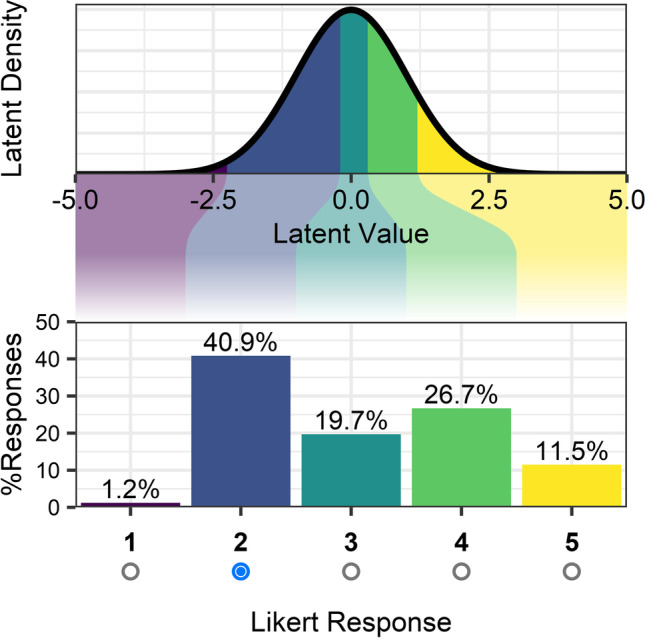
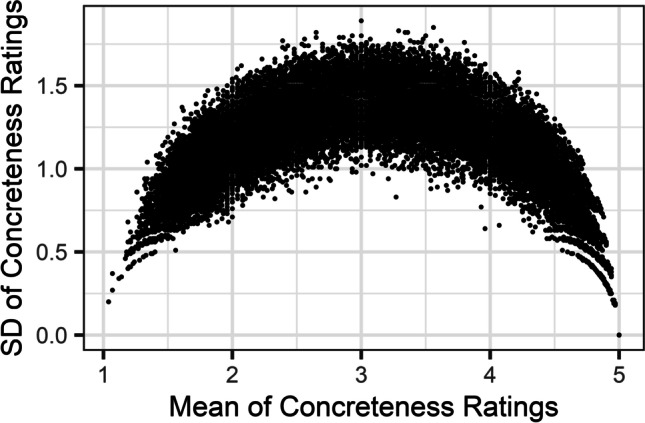
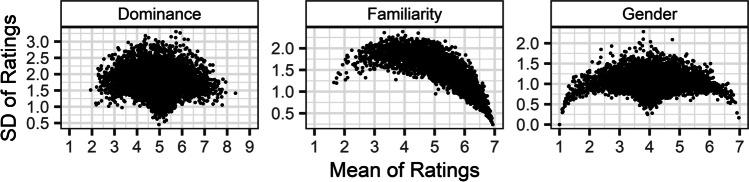
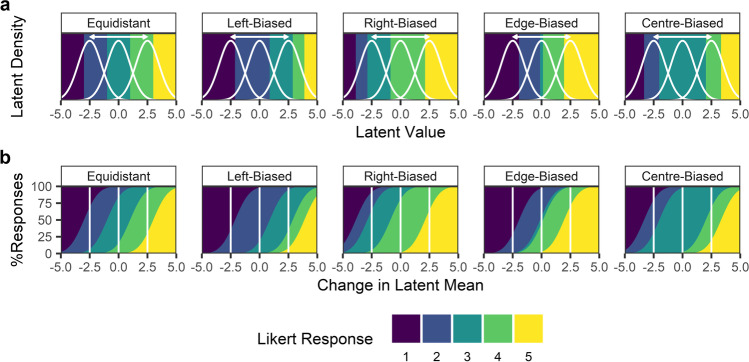
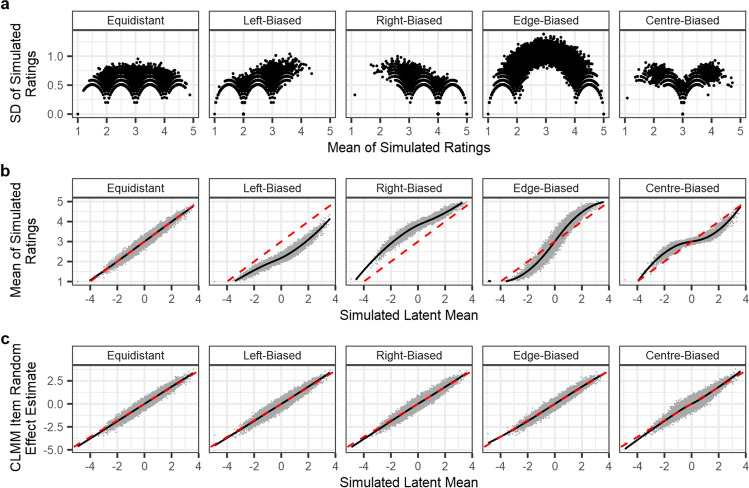
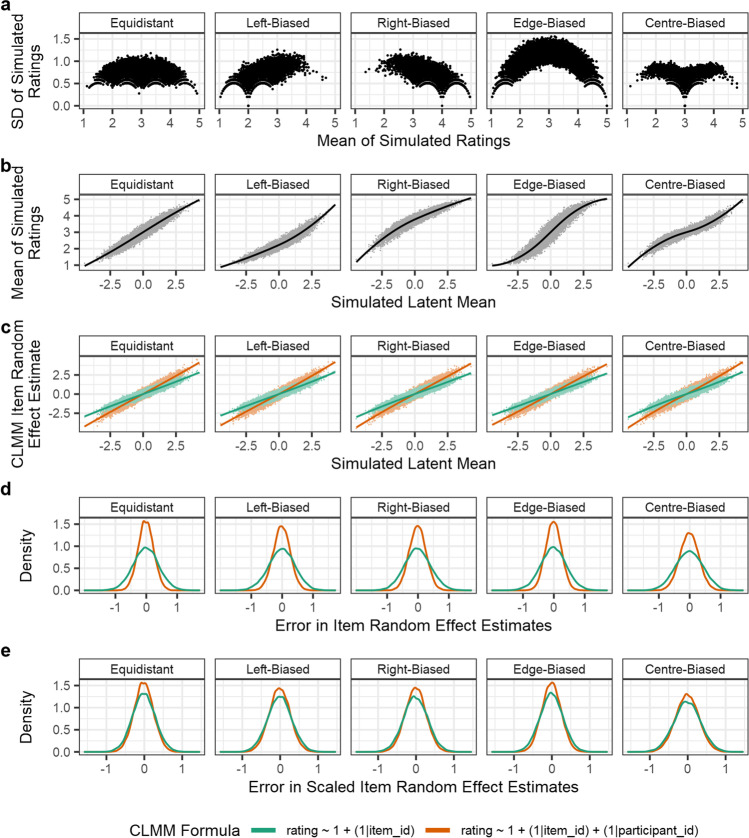
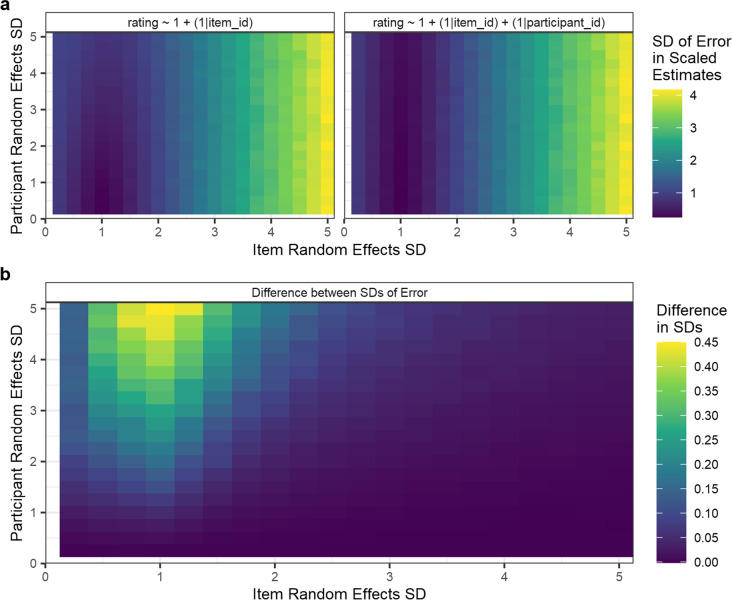
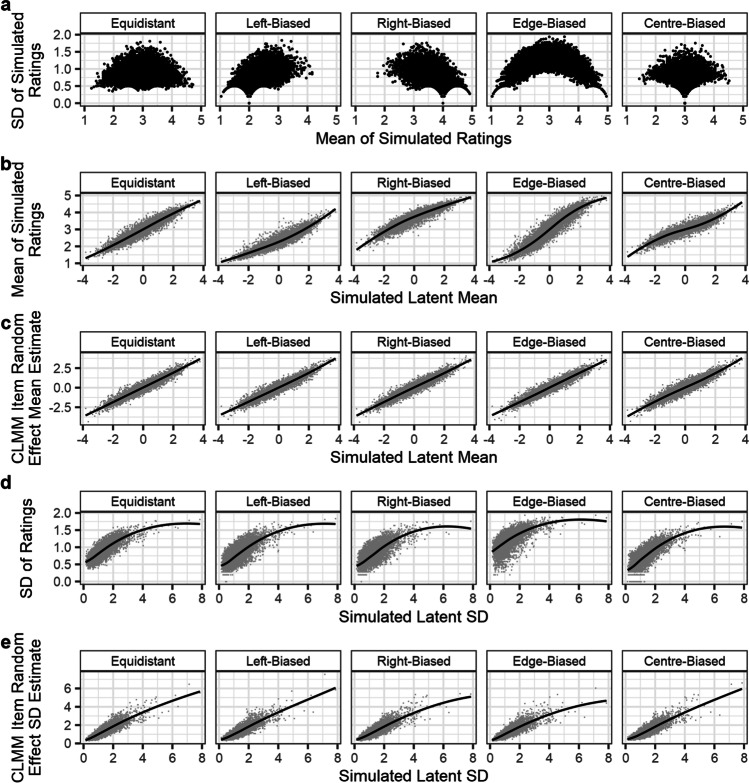
Verification
Claims the paper makes
11 Valid · 0 Not valid · 7 Not checked · 109 Own results and interpretations
Every source the paper cites for this claim was checked and supports it.
In the paper
“We note that when distributional CLMMs are used to disentangle meaningful and artefactual contributions to items’ SDs, the striking mean–SD relationships identified as problematic by Pollock (2018) are no longer observed.”
§ Rating norms should be calculated from cumulative link mixed effects models > Discussion
What the sources say
- Supportedcites Pollock (2018) matched to “Statistical and methodological problems with concreteness and other semantic variables: A list memory experiment case study” (2018) source
The Brysbaert et al. (2013) concreteness norms section describes a striking relationship between item means and standard deviations: variability rises in the middle of the rating scale. The General discussion calls the recurring distribution problematic. The statement about what happens after distributional CLMMs are applied is the citing authors’ own observation, not a finding attributed to Pollock. (LLM, conf=0.93)
plain- Asserted: passes — The authors put it forward as true.
- Checkable: passes — It can be checked against evidence.
- Load-bearing: passes — The paper’s conclusions depend on it.
- Based: passes — The paper gives a reason why it holds.
- Supported
Every source the paper cites for this claim was checked and supports it.
In the paper
“However, Pollock showed that although it was common for participants to agree on ratings at the extremes of the scale (1 and 5), such inter-rater reliability was exceedingly rare for ratings at midpoints in the scale.”
§ Rating norms should be calculated from cumulative link mixed effects models > Introduction
What the sources say
- Supportedcites Pollock (2018) matched to “Statistical and methodological problems with concreteness and other semantic variables: A list memory experiment case study” (2018) source
In the Brysbaert et al. (2013) concreteness norms section, the discussion of Fig. 2 reports relatively low rating variability at both ends of the 1–5 scale, indicating substantial agreement. It says variability rises in the middle and only a handful of words near 3 have a standard deviation even slightly below 1. (LLM, conf=0.93)
boostedstates an association- Asserted: passes — The authors put it forward as true.
- Checkable: passes — It can be checked against evidence.
- Load-bearing: passes — The paper’s conclusions depend on it.
- Based: passes — The paper gives a reason why it holds.
- Supported
Every source the paper cites for this claim was checked and supports it.
In the paper
“The brms package (Bürkner, 2018) for R, an interface to STAN (STAN Development Team, 2021), provides an accessible solution to fit such models.”
§ Rating norms should be calculated from cumulative link mixed effects models > Introduction
What the sources say
- Supportedcites Bürkner, 2018 matched to “Advanced Bayesian Multilevel Modeling with the R Package brms” (2018) source
The Introduction describes brms as an accessible interface to Stan and explains that distributional models can predict the mean and other response-distribution parameters simultaneously. Example 2 fits a brms model in which both the location and scale parameters vary. The paper calls this a response distribution rather than a latent distribution, but supports the modeling capability attributed to brms. (LLM, conf=0.90)
plainstates a cause- Asserted: passes — The authors put it forward as true.
- Checkable: passes — It can be checked against evidence.
- Load-bearing: passes — The paper’s conclusions depend on it.
- Based: passes — The paper gives a reason why it holds.
- Supported
The sources with a verdict support this claim; the rest weren’t checked yet, have no full text we could read, or their verdicts aren’t rated yet.
In the paper
“However, such dichotomisation will result in an unnecessary loss of statistical power and precision if continuous alternatives are available (MacCallum et al., 2002; Royston et al., 2006).”
§ Rating norms should be calculated from cumulative link mixed effects models > Introduction
What the sources say
- Supportedcites MacCallum et al., 2002 matched to “On the practice of dichotomization of quantitative variables.” (2002) source
The Summary and Conclusions (p. 20) identify loss of information, effect size, power, and measurement reliability as consequences of dichotomization in most circumstances. They also say these consequences can be avoided by analyzing the original, undichotomized measures, supporting the claim when continuous alternatives are available. (LLM, conf=0.90)
- Not checked — no full text of the sourcecites Royston et al., 2006 matched to “Dichotomizing continuous predictors in multiple regression: a bad idea” (2006) source
plainstates a cause- Asserted: passes — The authors put it forward as true.
- Checkable: passes — It can be checked against evidence.
- Load-bearing: passes — The paper’s conclusions depend on it.
- Based: passes — The paper gives a reason why it holds.
- Supported
Every source the paper cites for this claim was checked and supports it.
In the paper
“We note, however, that modelling data in such cases may be made more tractable with statistical approaches like that outlined by Selker et al. (2019), which allows an arbitrary number of thresholds to be estimated via just two parameters per participant.”
§ Rating norms should be calculated from cumulative link mixed effects models > Discussion
What the sources say
- Supportedcites Selker et al. (2019) matched to “Parsimonious estimation of signal detection models from confidence ratings” (2019) source
The Abstract says the model estimates any number of thresholds using two parameters. The Thresholds and Hierarchical extension sections describe individual differences in threshold placement and fitting the model to individual observers. The thresholds are constrained by a linear transformation, rather than freely placed. (LLM, conf=0.92)
hedgedstates a possible cause- Asserted: passes — The authors put it forward as true.
- Checkable: passes — It can be checked against evidence.
- Load-bearing: passes — The paper’s conclusions depend on it.
- Based: passes — The paper gives a reason why it holds.
- Supported
69 more claims · 3 with their cited sources checked
Create a free account to see all 127 claims and to verify the 4 references still open.
- Probably not a substantial claim. 26
- It may state two separate claims as one. 34
- The quote only partly states this claim. 1
Citations
Cites
R: A Language and Environment for Statistical Computing
R Core Team (2025) · doi:10.32614/r.manuals · Cited by 352,181
Fitting Linear Mixed-Effects Models Using lme4
Bates, D., Mächler, M., Bolker, B., & Walker, S. (2015) · Journal of Statistical Software · doi:10.18637/jss.v067.i01 · Cited by 86,835 · cited 1×
“The LMMs were fit via the lme4 package for R (Bates et al., 2015), with a Gaussian identity link for comparability to the raw means.”
MethodRegression Models for Ordinal Data
McCullagh, P. (1980) · Journal of the Royal Statistical Society Series B: Statistical Methodology · doi:10.1111/j.2517-6161.1980.tb01109.x · Cited by 4,453 · cited 2×
“This is the approach implemented in cumulative link models (CLMs), where ordinal dependent variables are mapped onto ordered regions of a latent distribution (Bürkner & Vuorre, 2019; McCullagh, 1980).”
MethodOn the practice of dichotomization of quantitative variables.
MacCallum, R. C., Zhang, S., Preacher, K. J., & Rucker, D. D. (2002) · Psychological Methods · doi:10.1037/1082-989x.7.1.19 · Cited by 3,538 · cited 1×
“However, such dichotomisation will result in an unnecessary loss of statistical power and precision if continuous alternatives are available (MacCallum et al., 2002; Royston et al., 2006).”
BackgroundAdvanced Bayesian Multilevel Modeling with the R Package brms
Bürkner, P.-C. (2018) · The R Journal · doi:10.32614/rj-2018-017 · Cited by 3,015
Dichotomizing continuous predictors in multiple regression: a bad idea
Royston, P., Altman, D. G., & Sauerbrei, W. (2006) · Statistics in Medicine · doi:10.1002/sim.2331 · Cited by 2,312
Norms of valence, arousal, and dominance for 13,915 English lemmas
Warriner, A. B., Kuperman, V., & Brysbaert, M. (2013) · Behavior Research Methods · doi:10.3758/s13428-012-0314-x · Cited by 1,959
Concreteness ratings for 40 thousand generally known English word lemmas
Brysbaert, M., Warriner, A. B., & Kuperman, V. (2014) · Behavior Research Methods · doi:10.3758/s13428-013-0403-5 · Cited by 1,821
The Chicago face database: a free stimulus set of faces and norming data
Ma, D. S., Correll, J., & Wittenbrink, B. (2015) · Behavior Research Methods · doi:10.3758/s13428-014-0532-5 · Cited by 1,788 · cited 1×
“, 2014) or faces (Ma et al., 2015), and melodies (Belfi & Kacirek, 2021).”
Response Styles in Marketing Research: A Cross-National Investigation
Baumgartner, H., & Steenkamp, J.-B. E. M. (2001) · Journal of Marketing Research · doi:10.1509/jmkr.38.2.143.18840 · Cited by 1,255
Cited by
Waisman, T., Williams, Z. J., Cage, E., Santhanam, S. P., Magiati, I., Dwyer, P. S. R., Stockwell, K. M., Kofner, B., Brown, H. M., Davidson, D. Z., et al. (2022) · Autism · doi:10.1177/13623613221097207 · Cited by 91
Rousselet, G. A., Pernet, C. R., & Wilcox, R. R. (2023) · Meta-Psychology · doi:10.15626/mp.2019.2058 · Cited by 134
“…not require the bootstrap: for instance diffusion models of reaction times (Matzke & Wagenmakers, 2009; Voss et al., 2013), beta-binomial models of accuracy scores (Kr-uschke, 2014), and ordinal models of Likert scale results (Bürkner & Vuorre, 2019; Liddell & Kruschke, 2018; Taylor et al., 2022).”
MethodSelf-citationConcreteness ratings for 62,000 English multiword expressions
Muraki, E. J., Abdalla, S., Brysbaert, M., & Pexman, P. M. (2022) · Behavior Research Methods · doi:10.3758/s13428-022-01912-6 · Cited by 64
Emoji Alter the Perception of Emotion in Affectively Neutral Text messages
Neel, L. A. G., McKechnie, J. G., Robus, C. M., & Hand, C. J. (2023) · Journal of Nonverbal Behavior · doi:10.1007/s10919-022-00421-6 · Cited by 61
“, 2018) and individual stimulus items (Taylor et al., 2021).”
BackgroundInfluentialA solution to the pervasive problem of response bias in self-reports
Grimmond, J., Brown, S. D., & Hawkins, G. E. (2025) · Proceedings of the National Academy of Sciences · doi:10.1073/pnas.2412807122 · Cited by 53
A Cross-Cultural Comparison on Implicit and Explicit Attitudes Towards Artificial Agents
Diana, F., Kawahara, M., Saccardi, I., Hortensius, R., Tanaka, A., & Kret, M. E. (2022) · International Journal of Social Robotics · doi:10.1007/s12369-022-00917-7 · Cited by 33
Hand, C. J., Kennedy, A., Filik, R., Pitchford, M., & Robus, C. M. (2022) · Journal of Autism and Developmental Disorders · doi:10.1007/s10803-022-05557-4 · Cited by 31
Light-based gamma entrainment with novel invisible spectral flicker stimuli
Hansen, L. S., Carstensen, M. S., Henney, M. A., Nguyen, N. M., Thorning‐Schmidt, M. W., Broeng, J., Petersen, P. M., & Andersen, T. (2024) · Scientific Reports · doi:10.1038/s41598-024-75448-4 · Cited by 20
Quesada, R. C., & Demiris, Y. (2024) · ACM Transactions on Human-Robot Interaction · doi:10.1145/3660649 · Cited by 17
Hand, C. J. (2023) · Journal of Applied Research in Higher Education · doi:10.1108/jarhe-03-2022-0106 · Cited by 21
Understanding contextual expectations for sharing wearables' data: Insights from a vignette study
Bourgeus, A., Vandercruysse, L., & Verhulst, N. (2024) · Computers in Human Behavior Reports · doi:10.1016/j.chbr.2024.100443 · Cited by 16
Concreteness ratings for 62 thousand English multiword expressionsPreprint
Muraki, E. J., Abdalla, S., Brysbaert, M., & Pexman, P. M. (2022) · doi:10.31234/osf.io/m397u · Cited by 10
Paisios, D., Huet, N., & Labeye, É. (2023) · Collabra Psychology · doi:10.1525/collabra.84564 · Cited by 11
Pattemore, A., Fernández, B. C., de Artola, M. L., & Michel, M. C. (2024) · Innovation in Language Learning and Teaching · doi:10.1080/17501229.2024.2366254 · Cited by 9
Mendes, P., Goyette, J., Cottet, M., Cimon-Morin, J., Pellerin, S., & Poulin, M. (2024) · Urban forestry & urban greening · doi:10.1016/j.ufug.2024.128388 · Cited by 12
Concreteness ratings for 36,000 Estonian words
Proos, M., & Aigro, M. (2023) · Behavior Research Methods · doi:10.3758/s13428-023-02257-4 · Cited by 11
Silva, F. M. D. N., de Resende, M. L. V., Ferreira, L. C., Adesina, O., & Xavier, K. V. (2024) · Journal of Fungi · doi:10.3390/jof10110742 · Cited by 11
“This approach appropriately models ordinal data [60,61].”
Hierarchical and dynamic relationships between body part ownership and full-body ownership
O’Kane, S. H., Chancel, M., & Ehrsson, H. H. (2024) · Cognition · doi:10.1016/j.cognition.2023.105697 · Cited by 9
“Next, a linear mixed effects model was created using the clmm2 function of the ordinal package for R (Chris-tensen, 2019; Taylor et al., 2022) to determine whether the number of Fig.”
Goubard, C., & Demiris, Y. (2024) · Proceedings - IEEE International Conference on Robotics and Automation/Proceedings · doi:10.1109/icra57147.2024.10611445 · Cited by 7
The aesthetics at a pencil tip: The effects of drawing on learning poems
Xie, H., Lin, D., He, W., & Chen, Q. (2024) · Learning and Instruction · doi:10.1016/j.learninstruc.2024.101881 · Cited by 8
Michelotti, A., Baroncini, I., & Engemann, H. (2025) · Language and Cognition · doi:10.1017/langcog.2024.74 · Cited by 7
“According to Taylor et al. (2023), item random effect estimates of CLMM are better suited for calculating norms from Likert scale responses than means and SD s, given that Likert scale ratings are ordinal and not numerical.”
Zhang, Y., Du, Q., Mao, Y., Wu, L., Shuai, C., & Zhao, B. (2024) · International Journal of Sustainable Development & World Ecology · doi:10.1080/13504509.2024.2424477 · Cited by 5
An Integrated 3D Eye-Gaze Tracking Framework for Assessing Trust in Human–Robot Interaction
Quesada, R. C., Casado, F. E., & Demiris, Y. (2025) · ACM Transactions on Human-Robot Interaction · doi:10.1145/3725861 · Cited by 11
Chen, R., Gao, Q., Wu, D.-W., Hao, J., Zhao, J., Wang, X., He, J.-H., Yuan, F., Kang, X., Wang, L., et al. (2025) · Neurotherapeutics · doi:10.1016/j.neurot.2025.e00635 · Cited by 7
“…effects: sequence, period, time since injury, etiology, and age; random effects: subjects for repeated measurements) and added baseline “ ABCD ” EEG patterns as fixed effects, was used to analyze the between-group differences in “ ABCD ” EEG patterns after the first and fifth treatments [39,40].”
Characterizing the Force-Motion Tradeoff in Body-Powered Transmission Design
Abbott, M. E., & Stuart, H. S. (2023) · IEEE Transactions on Neural Systems and Rehabilitation Engineering · doi:10.1109/tnsre.2023.3297549 · Cited by 6
The influence of accent on the evaluation of trust-building efforts during conflict
Grant, L. H., Shahwan, A., Maoz, I., & Keysar, B. (2024) · PLoS ONE · doi:10.1371/journal.pone.0311373 · Cited by 5
Complexity, frequency, and acceptability
Christensen, K. R., & Nyvad, A. M. (2024) · Glossa a journal of general linguistics · doi:10.16995/glossa.10618 · Cited by 12
MacRitchie, J., Christensen, J., Fishwick, E., et al. (2024) · Arts & Health · doi:10.1080/17533015.2024.2335378 · Cited by 4
“The mixed effects models can also better take into account individual responses that are different from the population average (Taylor et al., 2022).”
Allegretti, E., D’Innocenzo, G., & Coco, M. I. (2025) · Behavior Research Methods · doi:10.3758/s13428-024-02535-9 · Cited by 6
“We provide this information in Supplementary File 6 as alternative information to select items of interest from the dataset (Taylor et al., 2023).”
Brodie, Z. P., Shirlaw, K., & Hand, C. J. (2023) · Sexual Abuse · doi:10.1177/10790632231159072 · Cited by 5
“There is clear evidence of the problems in using general linear modelling/ANOVA to evaluate ordinal data sets (Taylor et al., 2021), and the need for CLMM approaches has been successfully argued by, for example, Liddell and Kruschke (2018).”
BackgroundMethodButterworth, B., Hand, C. J., Lorimer, K., & Gawrylowicz, J. (2023) · Frontiers in Psychology · doi:10.3389/fpsyg.2023.1007477 · Cited by 3
Civilian Mindsets and Attitudes toward Peace in Wartime: Evidence from Ukraine
Knuppe, A. J., Pechenkina, A., & Silverman, D. M. (2025) · International Studies Quarterly · doi:10.1093/isq/sqaf019 · Cited by 6
Zhou, L., Woodman, R., Su, Z., & Debattista, K. (2026) · Transportation Research Part F Traffic Psychology and Behaviour · doi:10.1016/j.trf.2026.103532 · Cited by 5
Passi, T., Närväinen, J., Lukander, K., Laarni, J., Lindholm, M., Pettersson, K., Mauno, S., & Pakarinen, S. (2026) · Cognitive Research Principles and Implications · doi:10.1186/s41235-026-00730-0 · Cited by 5
“Considering the ordinal scale of the KSS and emotional valence data, a cumulative link mixed-effects model was used for the analysis, in accordance with the recommendations (Taylor et al., 2023).”
A comparison of word humor ratings across speakers of North American, British, and Singapore English
Siew, C. S. Q. (2024) · Memory & Cognition · doi:10.3758/s13421-024-01587-8 · Cited by 8
“Although item norms are commonly computed by simply taking the average of the humor rating for each word, Taylor et al. (2022) showed that the use of cumulative link mixed-effects models (CLMM) to compute item norms has several advantages, including taking into account the ordinal nature of Likert…”
InfluentialFeng, Y., Stenger, B., & Zhang, S. (2024) · Journal of Medical Internet Research · doi:10.2196/57309 · Cited by 6
“We followed the best practices outlined in Taylor et al [47] to report and interpret our model results.”
Pelica, S., Aguiar, T. R., Frade, S., Guerra, R., & Prada, M. (2024) · Telematics and Informatics · doi:10.1016/j.tele.2024.102207 · Cited by 7
Differential Physiological Responses to Proxemic and Facial Threats in Virtual Avatar Interactions
Nierula, B., Lafci, M. T., Melnik, A., Akgül, M., Siewe, F. T., & Bosse, S. (2025) · IEEE International Symposium on Mixed and Augmented Reality Adjunct (ISMAR-Adjunct) · doi:10.1109/ismar-adjunct68609.2025.00036 · Cited by 5
“For the analysis of questionnaire data, we chose a Cumulative Link Mixed Effects Model (CLMM) to appropriately handle the ordinal nature of our Likert scale data while accounting for the 2-factorial repeated measures design [36].”
A Multi-Method Approach to Capture Quality of Collaborative Group Engagement
Paneth, L., Jeitziner, L. T., Rack, O., & Zahn, C. (2023) · Computer-supported collaborative learning/The Computer-Supported Collaborative Learning Conference · doi:10.22318/cscl2023.134087 · Cited by 8
Emoji alter the perception of emotion in affectively neutral text messagesPreprint
Neel, L. A. G., McKechnie, J. G., Robus, C. M., et al. (2022) · doi:10.31234/osf.io/epxsu · Cited by 3
Agency-preserving robotic assistance for grasp slip recovery in body-powered prostheses
Davis, B., Abbott, M. E., & Stuart, H. S. (2025) · Frontiers in Robotics and AI · doi:10.3389/frobt.2025.1675955 · Cited by 3
Buthelezi, L., Maseko, M. S. T., Magoso, S., & Downs, C. T. (2025) · Journal of Ethnobiology and Ethnomedicine · doi:10.1186/s13002-025-00826-9 · Cited by 5
“We analysed our data using ordinal regression models, which are widely used in ethnobiology for examining the relationship between predictor variables and ordinal response variables [61].”
Siew, C. S. Q., Chang, F., & Wong, J. J. H. (2025) · Journal of Cognition · doi:10.5334/joc.470 · Cited by 4
Sengupta, P., Adhikari, A., & Singh, S. P. (2026) · Journal of the Operational Research Society · doi:10.1080/01605682.2026.2640139 · Cited by 2
“Also, the selection of CLMM is supported by extant literature (Taylor et al., 2023), as it assumes that the ordinal response is a manifestation of a latent variable and is categorised into different levels based on cut-offs.”
Kessler, R., & Perevozchikova, T. (2024) · International Journal of Bilingualism · doi:10.1177/13670069231216293 · Cited by 2
Effects of emotional ambiguity and emotional intensity on true and false memory
Chang, M., & Brainerd, C. J. (2024) · Memory & Cognition · doi:10.3758/s13421-024-01559-y · Cited by 3
“In the psycholinguistic literature, this is sometimes referred to as the midscale disagreement phenomenon (Paisios et al., 2023; Pollock, 2018; Taylor et al., 2022).”
Dietrich, S., Seibold, V. C., & Rolke, B. (2024) · Language and Cognition · doi:10.1017/langcog.2024.45 · Cited by 2
“Coherence judgments were analyzed by means of cumulative link mixed models (CLMMs) with a logistic linking function – a method appropriate for repeated measures data resulting from a Likert scale (Stroup, 2012, Taylor et al., 2023).”
Brand, J., Preininger, M., Kříž, A., & Ceháková, M. (2025) · Language and Cognition · doi:10.1017/langcog.2025.3 · Cited by 5
“To obtain estimates of the normative ratings for each item, we ran cumulative mixed-effects models on the raw data using the ordinal packages in R (Christensen, 2018), see Taylor et al. (2023).”
Scholman, M., & Laparle, S. (2025) · Discourse Processes · doi:10.1080/0163853x.2025.2499414 · Cited by 5
“This approach preserves the ordinal nature of the data and avoids the distortions that can result from treating ordinal outcomes as interval-scaled, making CLMMs more appropriate than linear models for this type of analysis (Taylor et al., 2023).”
Kang, G., de Sousa, K., Manners, R., van Etten, J., Backes, G., Rukundo, P., Nduwumuremyi, A., Ellison, J., Tuyishime, E., Mendes, T., et al. (2025) · Experimental Agriculture · doi:10.1017/s0014479725100100 · Cited by 3
“CLMM leverages the inherent cumulative probabilities of ordinal data, with a specific emphasis on the delineation thresholds that demarcate the ordinal categories (Christensen 2018; Ning et al. 2021; Taylor et al. 2022).”
Testing Sentence-in-Noise Recognition With Synthetic Speech and Automatic Speech Recognition
Calandruccio, L., Weidman, D., Leatherwood, A., & Buss, E. (2025) · Journal of Speech Language and Hearing Research · doi:10.1044/2025_jslhr-24-00893 · Cited by 3
A cross-cultural comparison on implicit and explicit attitudes towards artificial agentsPreprint
Diana, F., Kawahara, M., Saccardi, I., et al. (2022) · doi:10.31234/osf.io/zu3pe · Cited by 2
Hadavi, S., Kuroda, J., Shimozono, T., Leongómez, J. D., & Savage, P. E. (2023) · PsyArXiv (OSF Preprints) · doi:10.31234/osf.io/26yg5 · Cited by 4
A comparison of word humor ratings across speakers of North American, British, and Singapore EnglishPreprint
Siew, C. S. Q. (2024) · doi:10.31234/osf.io/sz8pa · Cited by 2
Zhang, L., Alain, C., & Buchsbaum, B. R. (2025) · bioRxiv (Cold Spring Harbor Laboratory) · doi:10.1101/2025.06.16.659408 · Cited by 2
“To test whether more robust sensory reinstatement correlates with increased memory vividness during learning, we used a cumulative link mixed model 27 to assess the trial-wise relationship between sensory reinstatement and memory vividness.”
Kim, H., & Hwang, H. (2025) · Language and Cognition · doi:10.1017/langcog.2024.65 · Cited by 1
“For a detailed comparison between the two groups, we conducted cumulative link mixed-effects regression, a statistical approach recommended for analyzing ordinal data (Taylor, Rousselet, Scheepers, & Sereno, 2023).”
What norming reveals about idioms: Making the case for a presuppositional account
Griffen, N., & Noveck, I. A. (2025) · Memory & Cognition · doi:10.3758/s13421-025-01719-8 · Cited by 1
Pin, S. H. D., & Amirshahi, S. A. (2025) · IEEE Access · doi:10.1109/access.2025.3579016 · Cited by 4
“Our work is further supported by the findings of Taylor et al. [33], who also emphasize the importance of accounting for individual variability and bias in subjective ratings.”
Stockner, M., Mazzoni, G. A. L., & Ianì, F. (2025) · Cognitive Research Principles and Implications · doi:10.1186/s41235-025-00651-4 · Cited by 2
Karakale, Ö., Nelson, N. L., Gredelj, A., Ryan, K. J., & Bayindir, A. (2025) · Scientific Reports · doi:10.1038/s41598-025-13507-0 · Cited by 2
From Sci-Fi to reality: exploring teenagers’ perceptions and ideas of AI robots
Kang, H., Freitas, T., Moussa, M. B., & Magnenat‐Thalmann, N. (2025) · The Visual Computer · doi:10.1007/s00371-025-04123-0 · Cited by 1
“Overall To examine the effects of gender and prior experience with AI and robots on participants’ emotional responses andtechnologyacceptance(PU,PEOU,andBI),weemployed Cumulative Link Mixed Models (CLMMs) [36].”
Does criticism in a foreign accent hurt less?
Domínguez-Arriola, M. E., Bazzi, L., Mauchand, M., Foucart, A., & Pell, M. D. (2025) · Language Cognition and Neuroscience · doi:10.1080/23273798.2025.2547350 · Cited by 6
Hadjadj, O., Kehoe, M., Maistre, S., & Delage, H. (2025) · Journal of Speech Language and Hearing Research · doi:10.1044/2025_jslhr-24-00348 · Cited by 1
Under my umbrella: Rating scales obscure statistical power and effect size heterogeneity
Fuenderich, J., Beinhauer, L. J., & Renkewitz, F. (2025) · Behavior Research Methods · doi:10.3758/s13428-025-02879-w · Cited by 1
“Means and standard deviations based on rating scale data are systematically restricted, as umbrella plots demonstrate (e.g., Heathers et al., 2018; Taylor et al., 2023).”
Preininger, M., Brand, J., Kříž, A., & Ceháková, M. (2025) · Behavior Research Methods · doi:10.3758/s13428-025-02907-9 · Cited by 2
“Therefore, we followed the guidance of Taylor et al. (2023) and modelled the participant responses using cumulative link mixed-effects models with the ordinal package (Christensen, 2023) in R.”
Sikora, D., Wawrzynowicz, M., & Rzymski, P. (2026) · British Food Journal · doi:10.1108/bfj-10-2025-1388 · Cited by 1
Tomás, C. M., Guasch, M., Ferré, P., Lázaro, M., & Hinojosa, J. A. (2026) · Behavior Research Methods · doi:10.3758/s13428-026-02976-4 · Cited by 3
Testing L1 effects in L2 interface acquisition: Typological similarity versus structural overlap
Kim, H., & Park, S. H. (2026) · Linguistic Approaches to Bilingualism · doi:10.1075/lab.25083.kim · Cited by 1
Are 7-point Likert scales preferable to 5-point scales in language research?
Brysbaert, M. (2026) · Behavior Research Methods · doi:10.3758/s13428-026-03101-1 · Cited by 1
“Taylor et al. (2023) proposed an interesting analysis to determine the origin of higher entropy scores on the 7-point scale compared to the 5-point scale.”
Hohaus, P. (2026) · Open Praxis · doi:10.55982/openpraxis.18.3.1056 · Cited by 1
Quesada, R. C., Casado, F. E., & Demiris, Y. (2024) · IEEE RO-MAN · doi:10.1109/ro-man60168.2024.10731396 · Cited by 2
Santiago, A., & Kim, H. (2024) · Language Acquisition · doi:10.1080/10489223.2024.2430953 · Cited by 1
“Given that our dependent measure involved acceptability ratings, we employed a cumulative link mixed-effects model, a statistical approach well-suited for handling ordinal data (Christensen & Brockhoff 2013, Taylor et al. 2022).”
Han, M., & Zhang, Y. (2025) · Brain and Language · doi:10.1016/j.bandl.2025.105538 · Cited by 1
Bohadana, A., Jarjoui, A., Jarjoui, A., et al. (2025) · Journal of Aerosol Medicine and Pulmonary Drug Delivery · doi:10.1089/jamp.2025.0002 · Cited by 1
“13,14 Uni-variable analysis was performed to evaluate the independent associations between predictors (age group, class, category, and number of inhalers) on outcomes.”
Yang, J., & Kita, S. (2024) · PsyArXiv (OSF Preprints) · doi:10.31234/osf.io/rqtp4 · Cited by 1
Xu, Y., Zhu, Y., Wang, H., Wu, Y. G., Ouyang, Y., Li, H., Zhou, W., Liu, X., Jiang, C., & Li, Q. (2026) · CHI Conference on Human Factors in Computing Systems · doi:10.1145/3772318.3790835 · Cited by 5
Hartwig, K., Biselli, T., Schneider, F. B., Lamp, I., & Reuter, C. (2026) · CHI Conference on Human Factors in Computing Systems · doi:10.1145/3772318.3790630
When a Robot Communicates Through Air: Contextual Interpretations of Wind and Olfactory Cues
Noh, C., & Kim, J. (2026) · CHI Conference on Human Factors in Computing Systems · doi:10.1145/3772318.3791164 · Cited by 2
The Person Case Constraint, Person Ordering Constraint and Pronominal Clusters in Polish
Witkoś, J., & Łęska, P. (2023) · Glossa a journal of general linguistics · doi:10.16995/glossa.10122
Hierarchical and dynamic relationships between body part ownership and full-body ownershipPreprint
O’Kane, S. H., Chancel, M., & Ehrsson, H. H. (2023) · PsyArXiv (OSF Preprints) · doi:10.31234/osf.io/9sm4k
The Relationship between GMA and Counterproductive Work Behaviors
Gunnesch‐Luca, G., & Iliescu, D. (2023) · Psihologia Resurselor Umane · doi:10.24837/pru.v21i2.540 · Cited by 1
Kerman, K., & Başar, B. (2024) · SSRN Electronic Journal · doi:10.2139/ssrn.4879457
Pelica, S., Aguiar, T. R., Frade, S., et al. (2024) · SSRN Electronic Journal · doi:10.2139/ssrn.4885412
Cross-linguistic effects of the speech-to-song illusion in speakers of Bangla and English
Akter, R., & MacIntyre, A. D. (2024) · Quarterly Journal of Experimental Psychology · doi:10.1177/17470218241293627
“CLMMs are a class of regression models that can incorporate random effects (e.g., Participant; Stimulus) and were developed for ordered categorical data such as Likert-type scale responses (Christensen & Brockhoff, 2013; Taylor et al., 2023).”
Negativity bias in attending to visual artPreprint
Scheepers, C., & Gao, Y. (2025) · PsyArXiv (OSF Preprints) · doi:10.31234/osf.io/ja5wz_v1
Self-citationBonnet, G., Nielsen, M. J., Foss, A. M., et al. (2025) · SSRN Electronic Journal · doi:10.2139/ssrn.5252666
Introduction to the special issue
Wiley, J., Wolfe, M. B. W., & Britt, M. A. (2025) · Discourse Processes · doi:10.1080/0163853x.2025.2518733
Jithin, V., & Naniwadekar, R. (2025) · bioRxiv (Cold Spring Harbor Laboratory) · doi:10.1101/2025.08.05.664756
How Population Structure and Nest Membership Shape Pathogen Patterns in Bumble Bees
Dobelmann, J., & Wilfert, L. (2025) · Molecular Ecology · doi:10.1111/mec.70146 · Cited by 1
When Chinese verb transitivity meets wrong syntactic category
Zhang, Y., Piao, Q., Yang, Y., et al. (2026) · Brain and Language · doi:10.1016/j.bandl.2026.105820
Goubard, C., & Demiris, Y. (2025) · IEEE RO-MAN · doi:10.1109/ro-man63969.2025.11217581 · Cited by 2
“Third , Bayesian Analysis allows us to use Cumulative Link Mixture Model (CLMM), which are better suited to model Likert scales [27].”
Mair, S., Mostajeran, F., Llobera, J., Slater, M., & Steinicke, F. (2025) · Proceedings - International Symposium on Mixed and Augmented Reality, ISMAR · doi:10.1109/ismar67309.2025.00152
Falcinelli, I., Fini, C., Mazzuca, C., Alessandri, G., Alivernini, F., Baiocco, R., Chirico, A., Filosa, L., Palombi, T., Pistella, J., et al. (2025) · Cognitive Research Principles and Implications · doi:10.1186/s41235-025-00689-4 · Cited by 1
Huang, R., Cecil, J., Freedman, M., & Chattopadhyay, S. (2026) · Journal of Medical Internet Research · doi:10.2196/88126 · Cited by 1
Oh, S., & Kwon, H. (2025) · Phonetics and Speech Sciences · doi:10.13064/ksss.2025.17.4.045
Post-fragmentation recovery in the soft coral Sinularia flexibilis is enhanced by suspension culturePreprint
Cunha, L. K. (2026) · Research Square · doi:10.21203/rs.3.rs-8552529/v1
Cassani, G., & Colombo, M. (2026) · Cognitive Science · doi:10.1111/cogs.70180 · Cited by 1
(张磊), L. Z., Alain, C., & Buchsbaum, B. R. (2026) · Journal of Neuroscience · doi:10.1523/jneurosci.1576-25.2026 · Cited by 3
Modulation of sensory attenuation by intensive meditation practice: an active inference perspective
Poublan‐Couzardot, A., Foncelle, A., Koun, É., Rossetti, Y., Abdoun, O., Pagnoni, G., & Lutz, A. (2026) · Neuroscience of Consciousness · doi:10.1093/nc/niaf051 · Cited by 1
“…evidence suggests that the original ordinal nature of the data should be accounted for by assuming that they belong to an underlying thresholded cumulative normal distribution, and thus better modeled with cumulative link (mixed) effects models (Liddell and Kruschke, 2018, Taylor et al., 2022).”
Moyna, M. I., Loureiro-Rodríguez, V., & Acar, E. F. (2026) · International Journal of the Sociology of Language · doi:10.1515/ijsl-2025-0058
“…analysis for this study is based on cumulative link mixed-e ff ects models (Christensen and Brockho ff 2013), a regression framework well-suited for ordinal (Likert scale) responses that are repeatedly measured from the same participants (Loureiro-Rodríguez and Acar 2022; Taylor et al. 2022).”
Metadata
- Authors
- Taylor, J. E., Rousselet, G. A., Scheepers, C., & Sereno, S. C.
- Affiliations
- University of Glasgow (GB)
- Corresponding author
- Taylor, Jack E.
- Venue
- Behavior Research Methods
- Published
- 2022-09-14
- Volume
- 55
- Issue
- 5
- Pages
- 2175-2196
- ISSN
- 1554-351X (ISSN-L)
- 1554-3528
- PMC
- PMC10439063
- OpenAlex
- W4295681625
- Cited by
- 126
- References
- 42
- Citations by year
- 2026: 44 · 2025: 37 · 2024: 26 · 2023: 13 · 2022: 6
- FWCI
- 12.55
- Type
- journal article
- Language
- en
- Open access
- hybrid
- doi.org
- Licence
- cc-by
- creativecommons.org/licenses/by/4.0 (tdm)
- creativecommons.org/licenses/by/4.0 (vor)
- Locations
- Behavior Research Methods (publishedVersion, cc-by)
- PubMed Central (publishedVersion, cc-by)
- PubMed (publishedVersion)
- ENLIGHTEN (Jurnal Bimbingan dan Konseling Islam) (submittedVersion, cc-by-sa)
- OSF Preprints (OSF Preprints) (submittedVersion)
- PsyArXiv (OSF Preprints) (submittedVersion, cc-by)
- PsyArXiv (OSF Preprints) (submittedVersion)
- Funders
- Economic and Social Research Council
- Topics
- Social Sciences › Decision Sciences › Management Science and Operations Research › Psychometric Methodologies and Testing
- Physical Sciences › Mathematics › Statistics and Probability › Statistical Methods and Bayesian Inference
- Social Sciences › Decision Sciences › Statistics, Probability and Uncertainty › Reliability and Agreement in Measurement
- Keywords
- Likert scale, ordinal data, response bias, summary statistics
About these checks
Registry, retraction, Cites and statistics results are computed, not judged, with one exception: a printed reference that no index lists is read once by a model before it counts as a citation error. Claims are extracted by a model and kept only when their quote appears verbatim in the text; each cited source is then checked, with a model’s help, for whether it says what the claim relies on. Those verdicts can be wrong — read the claim’s quote and the cited source before relying on one.
The claim verdicts this report counts are experimental: their accuracy is not yet measured.
A language model drew the claims from the paper on 2026-10-10, under version 3 of the claim definition (model deepseek-v4.1-flash, prompt extract-v3).
A second model labelled each claim on 2026-10-10 (model jev-1.13-20260917, definition revision gold-guideline-v0.2).
Cited sources are checked with a language model’s help (gpt-6-sol).
Statistics and arithmetic are recomputed, not judged.
Confidence bands are shown only for fields calibrated on our annotated test set. None is calibrated yet, so no band is shown.
What counts as a claim ›How we measure confidence ›How we check this ›
Are you an author, or do you see a problem with this page? Request a review
Data sources
Bibliographic data: Semantic Scholar, OpenAlex, Crossref.
Contains information from the Semantic Scholar Academic Graph Datasets, made available under the ODC Attribution License (ODC-BY 1.0).
Semantic Scholar’s data is described in: Kinney, R., et al. (2023). The Semantic Scholar Open Data Platform. arXiv:2301.10140.
