

A standardized framework to test event-based experiments
Open accessThe DOI matches its Crossref record; 41 of the 41 references it cites were found in a registry or an index.
Abstract
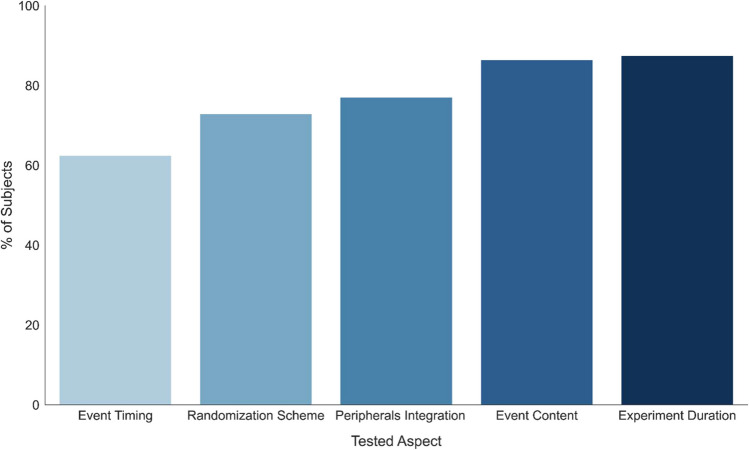
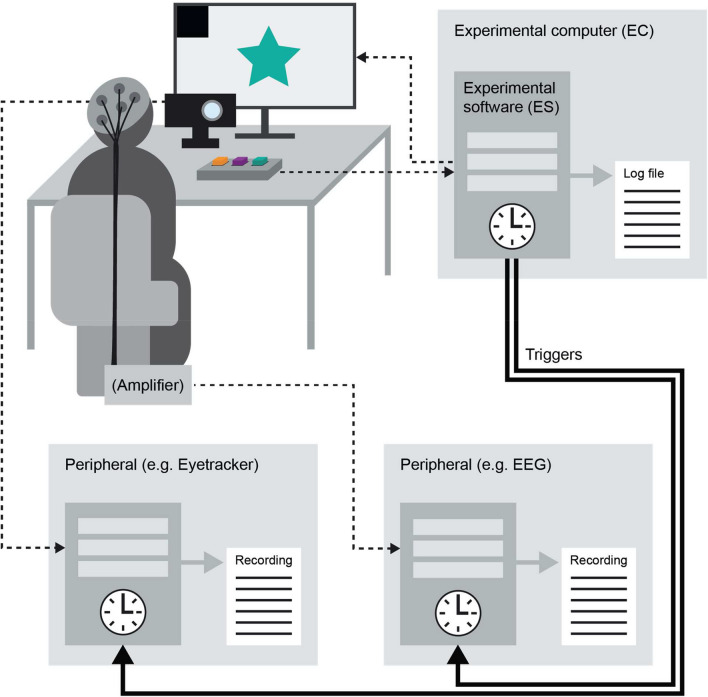
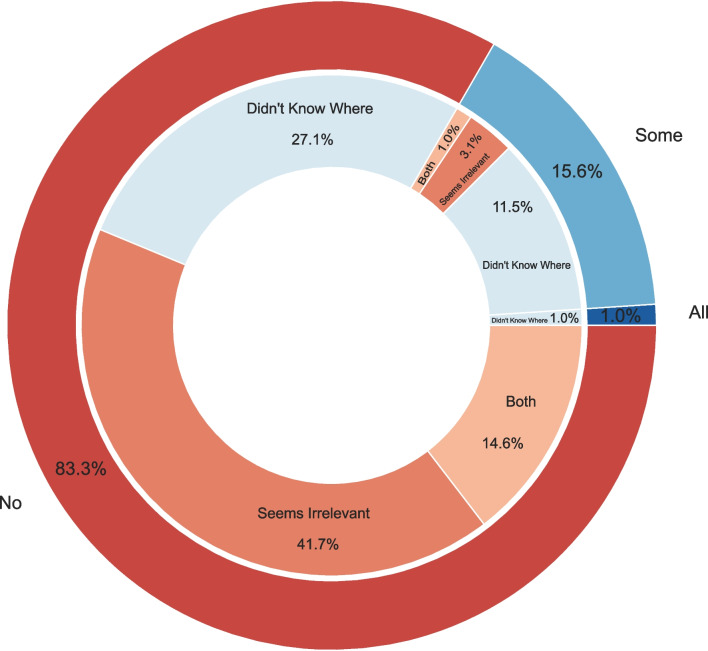
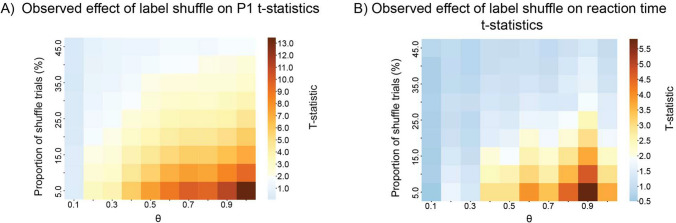
The replication crisis in experimental psychology and neuroscience has received much attention recently. This has led to wide acceptance of measures to improve scientific practices, such as preregistration and registered reports. Less effort has been devoted to performing and reporting the results of systematic tests of the functioning of the experimental setup itself. Yet, inaccuracies in the performance of the experimental setup may affect the results of a study, lead to replication failures, and importantly, impede the ability to integrate results across studies. Prompted by challenges we experienced when deploying studies across six laboratories collecting electroencephalography (EEG)/magnetoencephalography (MEG), functional magnetic resonance imaging (fMRI), and intracranial EEG (iEEG), here we describe a framework for both testing and reporting the performance of the experimental setup. In addition, 100 researchers were surveyed to provide a snapshot of current common practices and community standards concerning testing in published experiments’ setups. Most researchers reported testing their experimental setups. Almost none, however, published the tests performed or their results. Tests were diverse, targeting different aspects of the setup. Through simulations, we clearly demonstrate how even slight inaccuracies can impact the final results. We end with a standardized, open-source, step-by-step protocol for testing (visual) event-related experiments, shared via protocols.io. The protocol aims to provide researchers with a benchmark for future replications and insights into the research quality to help improve the reproducibility of results, accelerate multicenter studies, increase robustness, and enable integration across studies.
Overview
The claims and statistics of this paper haven’t been checked yet.
Free: it reads the open-access text and checks the first 5 claims that cite a source we can check. Create a free account to check every claim.
Integrity signals
Registry
Cites
Statistics
Figures
Verification
Claims the paper makes
The claims and statistics of this paper haven’t been checked yet.
Free: it reads the open-access text and checks the first 5 claims that cite a source we can check. Create a free account to check every claim.
Claims other papers make about this one
Each is checked against this paper’s own text: does it say what the citing paper says it does?
The source backs part of the claim, not all of it — or backs it for a different population, condition or comparison.
In the citing paper
“followed standardized32 and preregistered protocols12 to reduce setup differences and confirmatory bias22”
From Adversarial testing of global neuronal workspace and integrated information theories of consciousness (2025) · cites this paper as [32]
Experimental — accuracy not yet measured
Self-check
Percentages, sums and reported differences re-computed from the paper’s own numbers.
The self-check needs the paper’s full text.
Citations
Cites
2 retracted
RETRACTED ARTICLE: High replicability of newly discovered social-behavioural findings is achievable
Protzko, J., Krosnick, J. A., Nelson, L. D., Nosek, B. A., Axt, J. R., Berent, M., Buttrick, N. R., DeBell, M., Ebersole, C. R., Lundmark, S., et al. (2023) · Nature Human Behaviour · doi:10.1038/s41562-023-01749-9 · Cited by 97
RetractedGrave, J., Soares, S. C., Morais, S., Rodrigues, P., & Madeira, N. G. G. F. (2021) · Psychiatry Research · doi:10.1016/j.psychres.2021.114077 · Cited by 2
RetractedBrainard, D. H. (1997) · Spatial Vision · doi:10.1163/156856897x00357 · Cited by 19,702
Why Most Published Research Findings Are False
Ioannidis, J. P. A. (2005) · PLoS Medicine · doi:10.1371/journal.pmed.0020124 · Cited by 10,505
Estimating the reproducibility of psychological science
Open Science Collaboration (2015) · Science · doi:10.1126/science.aac4716 · Cited by 8,515 · cited 1×
“Replication failures may stem from a number of factors (Open Science Collaboration, 2015), for instance, low standards of power calculations (Button et al., 2013; Ioannidis, 2005), the use of questionable statistical methods (e.g., Cumming, 2014; Wicherts et al., 2016), publication biases in favor…”
MethodPower failure: why small sample size undermines the reliability of neuroscience
Button, K. S., Ioannidis, J. P. A., Mokrysz, C., Nosek, B. A., Flint, J., Robinson, E. S. J., & Munafò, M. R. (2013) · Nature Reviews Neuroscience · doi:10.1038/nrn3475 · Cited by 7,641 · cited 1×
“Replication failures may stem from a number of factors (Open Science Collaboration, 2015), for instance, low standards of power calculations (Button et al., 2013; Ioannidis, 2005), the use of questionable statistical methods (e.g., Cumming, 2014; Wicherts et al., 2016), publication biases in favor…”
MethodSimmons, J. P., Nelson, L. D., & Simonsohn, U. (2011) · Psychological Science · doi:10.1177/0956797611417632 · Cited by 6,567 · cited 1×
“…power calculations (Button et al., 2013; Ioannidis, 2005), the use of questionable statistical methods (e.g., Cumming, 2014; Wicherts et al., 2016), publication biases in favor of positive findings (Fanelli, 2012), or scarce description of the methods (Poldrack et al., 2008; Simmons et al., 2011).”
Method(2005) · Cited by 5,977
PsychoPy—Psychophysics software in Python
Peirce, J. W. (2007) · Journal of Neuroscience Methods · doi:10.1016/j.jneumeth.2006.11.017 · Cited by 4,603
A manifesto for reproducible science
Munafò, M. R., Nosek, B. A., Bishop, D. V. M., Button, K. S., Chambers, C. D., Percie du Sert, N., Simonsohn, U., Wagenmakers, E.-J., Ware, J. J., & Ioannidis, J. P. A. (2017) · Nature Human Behaviour · doi:10.1038/s41562-016-0021 · Cited by 3,397
The New Statistics: Why and How
Cumming, G. (2014) · Psychological Science · doi:10.1177/0956797613504966 · Cited by 3,200
Negative results are disappearing from most disciplines and countries
Fanelli, D. (2012) · Scientometrics · doi:10.1007/s11192-011-0494-7 · Cited by 1,248 · cited 1×
“…power calculations (Button et al., 2013; Ioannidis, 2005), the use of questionable statistical methods (e.g., Cumming, 2014; Wicherts et al., 2016), publication biases in favor of positive findings (Fanelli, 2012), or scarce description of the methods (Poldrack et al., 2008; Simmons et al., 2011).”
MethodWicherts, J. M., Veldkamp, C. L. S., Augusteijn, H. E. M., Bakker, M., van Aert, R. C. M., & van Assen, M. A. L. M. (2016) · Frontiers in Psychology · doi:10.3389/fpsyg.2016.01832 · Cited by 754
Guidelines for reporting an fMRI study
Poldrack, R. A., Fletcher, P. C., Henson, R. N., Worsley, K. J., Brett, M., & Nichols, T. E. (2008) · NeuroImage · doi:10.1016/j.neuroimage.2007.11.048 · Cited by 550 · cited 1×
“…power calculations (Button et al., 2013; Ioannidis, 2005), the use of questionable statistical methods (e.g., Cumming, 2014; Wicherts et al., 2016), publication biases in favor of positive findings (Fanelli, 2012), or scarce description of the methods (Poldrack et al., 2008; Simmons et al., 2011).”
MethodThe timing mega-study: comparing a range of experiment generators, both lab-based and online
Bridges, D., Pitiot, A., MacAskill, M. R., & Peirce, J. W. (2020) · PeerJ · doi:10.7717/peerj.9414 · Cited by 546
On the Plurality of (Methodological) Worlds: Estimating the Analytic Flexibility of fMRI Experiments
Carp, J. (2012) · Frontiers in Neuroscience · doi:10.3389/fnins.2012.00149 · Cited by 381
Frank, M. C., Bergelson, E., Bergmann, C., Cristia, A., Floccia, C., Gervain, J., Hamlin, J. K., Hannon, E. E., Kline, M., Levelt, C., et al. (2017) · Infancy · doi:10.1111/infa.12182 · Cited by 335
Putting big data to good use in neuroscience
Sejnowski, T. J., Churchland, P. S., & Movshon, J. A. (2014) · Nature Neuroscience · doi:10.1038/nn.3839 · Cited by 304
Unconscious Activation of the Prefrontal No-Go Network
van Gaal, S., Ridderinkhof, K. R., Scholte, H. S., & Lamme, V. A. F. (2010) · The Journal of Neuroscience · doi:10.1523/jneurosci.2992-09.2010 · Cited by 276
Mumford, J. A., & Nichols, T. E. (2008) · NeuroImage · doi:10.1016/j.neuroimage.2007.07.061 · Cited by 252 · cited 1×
“By now, determining sample sizes based on power analysis has become a common practice (e.g., Mumford & Nichols, 2008), journals also more routinely publish negative or null results (e.g., Baxter & Burwell, 2017), and preregistering the planned design and analyses is on the rise (e.g., AsPredicted,…”
BackgroundThe lab streaming layer for synchronized multimodal recording
Kothe, C., Shirazi, S. Y., Stenner, T., Medine, D., Boulay, C., Grivich, M. I., Artoni, F., Mullen, T., Delorme, A., & Makeig, S. (2025) · Imaging Neuroscience · doi:10.1162/imag.a.136 · Cited by 195
Making the hard problem of consciousness easier
Melloni, L., Mudrik, L., Pitts, M., & Koch, C. (2021) · Science · doi:10.1126/science.abj3259 · Cited by 190 · cited 1×
“Standardized procedure s are becoming more relevant given the increased number of multi-lab studies (e.g., Frank et al., 2017; Melloni et al., 2021; Pavlov et al., 2021) and the increased availability of openly shared data.”
BackgroundSelf-citationStandardized and reproducible measurement of decision-making in mice
Laboratory, T. I. B., Aguillon-Rodriguez, V., Angelaki, D., Bayer, H., Bonacchi, N., Carandini, M., Cazettes, F., Chapuis, G., Churchland, A. K., Dan, Y., et al. (2021) · eLife · doi:10.7554/elife.63711 · Cited by 189
#EEGManyLabs: Investigating the replicability of influential EEG experiments
Pavlov, Y. G., Adamian, N., Appelhoff, S., Arvaneh, M., Benwell, C. S. Y., Beste, C., Bland, A. R., Bradford, D. E., Bublatzky, F., Busch, N. A., et al. (2021) · Cortex · doi:10.1016/j.cortex.2021.03.013 · Cited by 127
Self-citationThe Lab Streaming Layer for Synchronized Multimodal RecordingPreprint
Kothe, C., Shirazi, S. Y., Stenner, T., et al. (2024) · bioRxiv (Cold Spring Harbor Laboratory) · doi:10.1101/2024.02.13.580071 · Cited by 103
Signing at the beginning versus at the end does not decrease dishonesty
Kristal, A. S., Whillans, A. V., Bazerman, M. H., Gino, F., Shu, L. L., Mažar, N., & Ariely, D. (2020) · Proceedings of the National Academy of Sciences · doi:10.1073/pnas.1911695117 · Cited by 97
Pre-registration: Weighing costs and benefits for researchers
Logg, J. M., & Dorison, C. A. (2021) · Organizational Behavior and Human Decision Processes · doi:10.1016/j.obhdp.2021.05.006 · Cited by 91
An adversarial collaboration to critically evaluate theories of consciousness
Cogitate Consortium, Ferrante, O., Gorska-Klimowska, U., Henin, S., Hirschhorn, R., Khalaf, A., Lepauvre, A., Liu, L., Richter, D., Vidal, Y., et al. (2023) · doi:10.1101/2023.06.23.546249 · Cited by 86 · cited 2×
“Recent replication challenges in neuroscience and psychology (e.g., Kristal et al., 2020) highlight the need for quality assurance in experimental environments, especially when multiple labs collaborate (e.g., COGITATE: COGITATE Consortium et al., 2023; eegManyLabs: Pavlov et al., 2021; The International Brain Laborat…”
BackgroundSelf-citationGood scientific practice in EEG and MEG research: Progress and perspectives
Niso, G., Krol, L. R., Combrisson, E., Dubarry, A., Elliott, M., Clément, F., Héjja‐Brichard, Y., Herbst, S. K., Jerbi, K., Ković, V., et al. (2022) · NeuroImage · doi:10.1016/j.neuroimage.2022.119056 · Cited by 76
Schlossmacher, I., Dellert, T., Pitts, M., Bruchmann, M., & Straube, T. (2020) · The Journal of Neuroscience · doi:10.1523/jneurosci.2077-19.2020 · Cited by 74
Plant, R. R. (2015) · Behavior Research Methods · doi:10.3758/s13428-015-0577-0 · Cited by 59
Best Practices in Data Analysis and Sharing in Neuroimaging using MEEGPreprint
Pernet, C. R., Garrido, M. I., Gramfort, A., Maurits, N. M., Michel, C. M., Pang, E. W., Salmelin, R. H., Schoffelen, J., Valdes-Sosa, P. A., & Puce, A. (2018) · OSF Preprints (OSF Preprints) · doi:10.31219/osf.io/a8dhx · Cited by 59
Farzan, F., Atluri, S., Frehlich, M., Dhami, P., Kleffner, K., Price, R., Lam, R. W., Frey, B. N., Milev, R., Ravindran, A., et al. (2017) · Scientific Reports · doi:10.1038/s41598-017-07613-x · Cited by 54
Survey on Open Science Practices in Functional Neuroimaging
Paret, C., Unverhau, N., Feingold, F. W., Poldrack, R. A., Stirner, M., Schmahl, C. G., & Sicorello, M. (2022) · NeuroImage · doi:10.1016/j.neuroimage.2022.119306 · Cited by 54
Sharing neurophysiology data from the Allen Brain Observatory
de Vries, S. E. J., Siegle, J. H., & Koch, C. (2023) · eLife · doi:10.7554/elife.85550 · Cited by 52
The case for preregistering all region of interest (ROI) analyses in neuroimaging research
Gentili, C., Cecchetti, L., Handjaras, G., Lettieri, G., & Cristea, I. A. (2020) · European Journal of Neuroscience · doi:10.1111/ejn.14954 · Cited by 47
Managing EEG studies: How to prepare and what to do once data collection has begun
Boudewyn, M. A., Erickson, M. A., Winsler, K., Ragland, J. D., Yonelinas, A. P., Frank, M. J., Silverstein, S. M., Gold, J., MacDonald, A. W., Carter, C. S., et al. (2023) · Psychophysiology · doi:10.1111/psyp.14365 · Cited by 29
Baxter, M. G., & Burwell, R. D. (2017) · Behavioral Neuroscience · doi:10.1037/bne0000207 · Cited by 19
The Accuracy and Precision of Measurement: Tools for Validating Reaction Time Stimuli
Calcagnotto, L., Huskey, R., & Kosicki, G. M. (2021) · Computational Communication Research · doi:10.5117/ccr2021.2.001.calc · Cited by 13
Sharing Neurophysiology Data from the Allen Brain Observatory: Lessons LearnedPreprint
de Vries, S. E. J., Siegle, J. H., & Koch, C. (2022) · arXiv (Cornell University) · doi:10.48550/arxiv.2212.08638 · Cited by 6
Hirschhorn, R., & Schönberg, T. (2023) · Elsevier eBooks · doi:10.1016/b978-0-12-820480-1.00014-0 · Cited by 1
Self-citation
Cited by
Cogitate Consortium, Ferrante, O., Gorska-Klimowska, U., Henin, S., Hirschhorn, R., Khalaf, A., Lepauvre, A., Liu, L., Richter, D., Vidal, Y., et al. (2025) · Nature · doi:10.1038/s41586-025-08888-1 · Cited by 136
“…a stringent and comprehensive tests of the theories in humans, (3) predefined large samples to increase statistical power, (4) followed standardized 32 and preregistered protocols 12 to reduce setup differences and confirmatory bias 22 (see sections 1 and 2 in Supplementary Information), and (5)…”
Self-citationConstant, M., Mandal, A., Asanowicz, D., Panek, B., Kotlewska, I., Yamaguchi, M., Gillmeister, H., Kerzel, D., Luque, D., Molinero, S., et al. (2025) · Cortex · doi:10.1016/j.cortex.2025.05.014 · Cited by 6
Seedat, A., Lepauvre, A., Jeschke, J., Górska, U., Armendáriz, M., Bendtz, K., Henin, S. E., Hirschhorn, R., Brown, T., Jensen, E., et al. (2025) · Scientific Data · doi:10.1038/s41597-025-04833-z · Cited by 9
“Before data collection, a procedure similar to that described in Lepauvre et al .”
Self-citationLepauvre, A. (2025) · Radboud University Press eBooks · doi:10.54195/9789465150550
Self-citationStockart, F. (2024) · theses.fr (ABES) · doi:10.70675/c4f62883zfadez4797z9c4ezc049226f96a4 · Cited by 1
Metadata
- Authors
- Lepauvre, A., Hirschhorn, R., Bendtz, K., Mudrik, L., & Melloni, L.
- Affiliations
- Radboud University Nijmegen (NL)
- Tel Aviv University (IL)
- Boston Children's Hospital (US)
- Canadian Institute for Advanced Research (CA)
- Venue
- Behavior Research Methods
- Published
- 2024-09-16
- Volume
- 56
- Issue
- 8
- Pages
- 8852-8868
- ISSN
- 1554-351X (ISSN-L)
- 1554-3528
- PMC
- PMC11525435
- OpenAlex
- W4402581411
- Cited by
- 9
- References
- 39
- Citations by year
- 2026: 4 · 2025: 4 · 2024: 1
- FWCI
- 3.36
- Type
- journal article
- Language
- en
- Open access
- hybrid
- doi.org
- Licence
- cc-by
- creativecommons.org/licenses/by/4.0 (tdm)
- creativecommons.org/licenses/by/4.0 (vor)
- Locations
- Behavior Research Methods (publishedVersion, cc-by)
- PubMed Central (publishedVersion, cc-by)
- PubMed (publishedVersion)
- Radboud Repository (Radboud University) (submittedVersion, cc-by)
- PsyArXiv (OSF Preprints) (submittedVersion, public-domain)
- Funders
- Templeton World Charity Foundation (TWCF0389)
- Max Planck Institute for Empirical Aesthetics
- Topics
- Social Sciences › Decision Sciences › Information Systems and Management › Scientific Computing and Data Management
- Physical Sciences › Computer Science › Information Systems › Research Data Management Practices
- Social Sciences › Decision Sciences › Statistics, Probability and Uncertainty › Meta-analysis and systematic reviews
- Keywords
- replication crisis, reproducibility, preregistration, EEG/MEG, functional MRI, intracranial EEG, multicenter study, research quality, benchmarking, simulation study, reporting practices
- MeSH terms
- Electroencephalography, Humans, Magnetic Resonance Imaging, Neurosciences, Psychology, Experimental, Research Design, Reproducibility of Results, Magnetoencephalography
About these checks
Registry, retraction, Cites and statistics results are computed, not judged, with one exception: a printed reference that no index lists is read once by a model before it counts as a citation error. Claims are extracted by a model and kept only when their quote appears verbatim in the text; each cited source is then checked, with a model’s help, for whether it says what the claim relies on. Those verdicts can be wrong — read the claim’s quote and the cited source before relying on one.
Statistics and arithmetic are recomputed, not judged.
Confidence bands are shown only for fields calibrated on our annotated test set. None is calibrated yet, so no band is shown.
What counts as a claim ›How we measure confidence ›How we check this ›
Are you an author, or do you see a problem with this page? Request a review
Data sources
Bibliographic data: Semantic Scholar, OpenAlex, Crossref.
Contains information from the Semantic Scholar Academic Graph Datasets, made available under the ODC Attribution License (ODC-BY 1.0).
Semantic Scholar’s data is described in: Kinney, R., et al. (2023). The Semantic Scholar Open Data Platform. arXiv:2301.10140.
