

New Constraints on DMS and DMDS in the Atmosphere of K2-18 b from JWST MIRI
Open accessThe DOI matches its Crossref record; 138 of the 138 references it cites were found in a registry or an index; none of the 117 sources its claims cite is checked for support yet.
Abstract
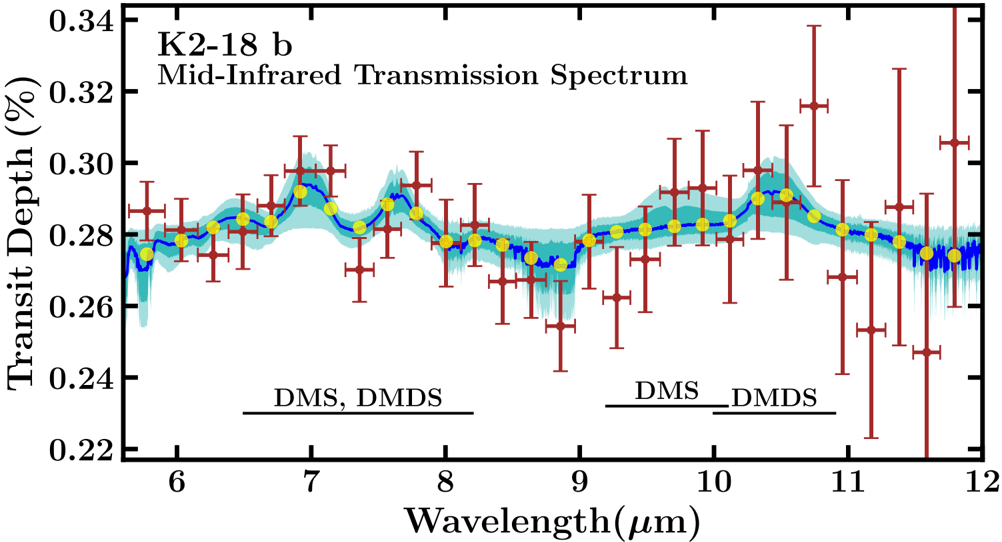
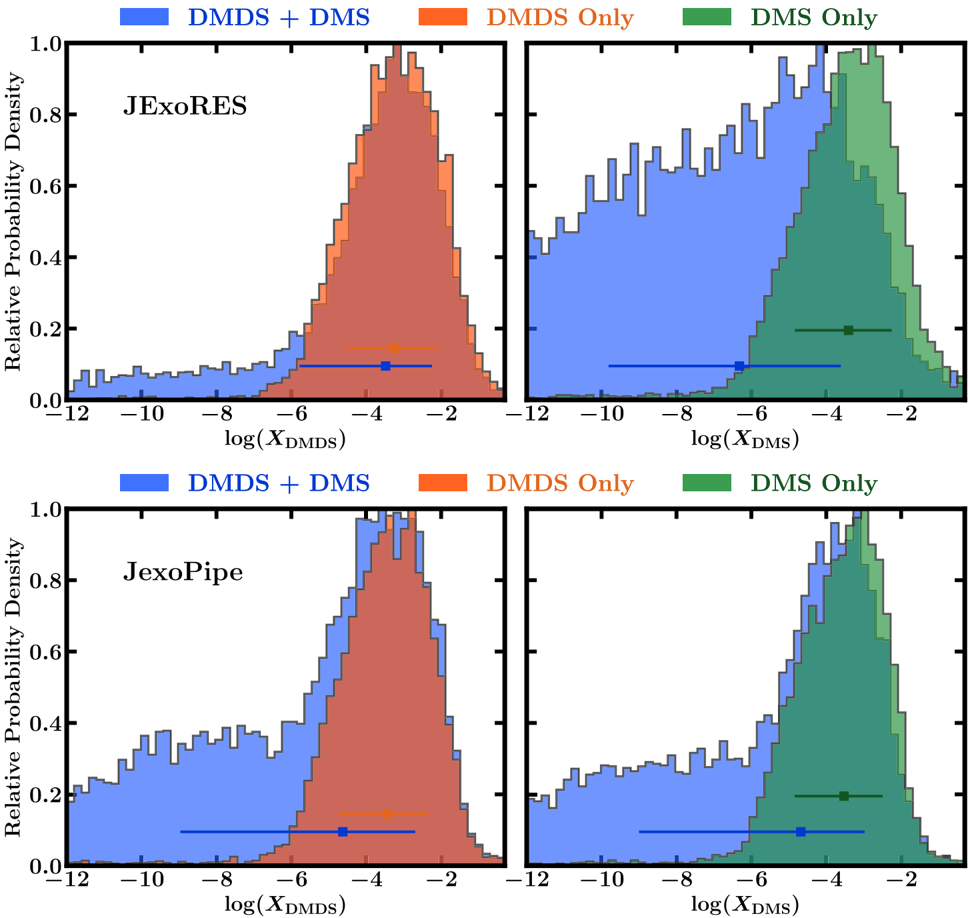
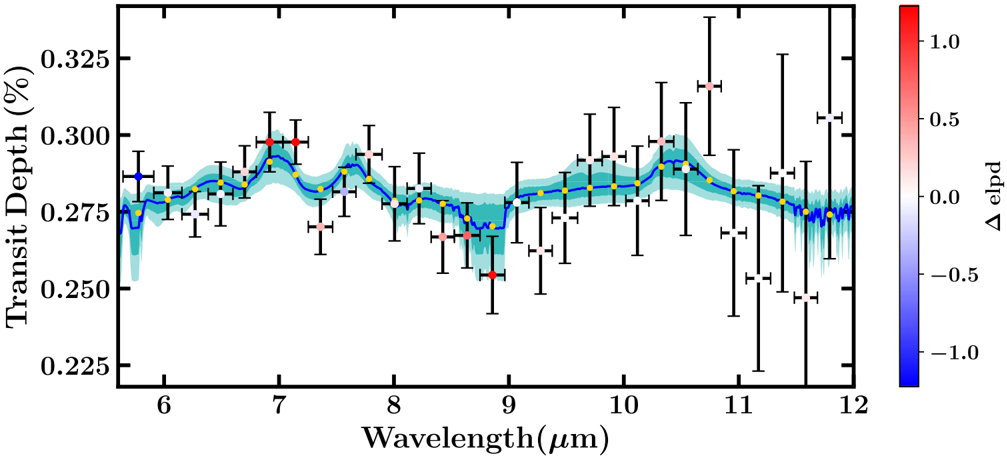
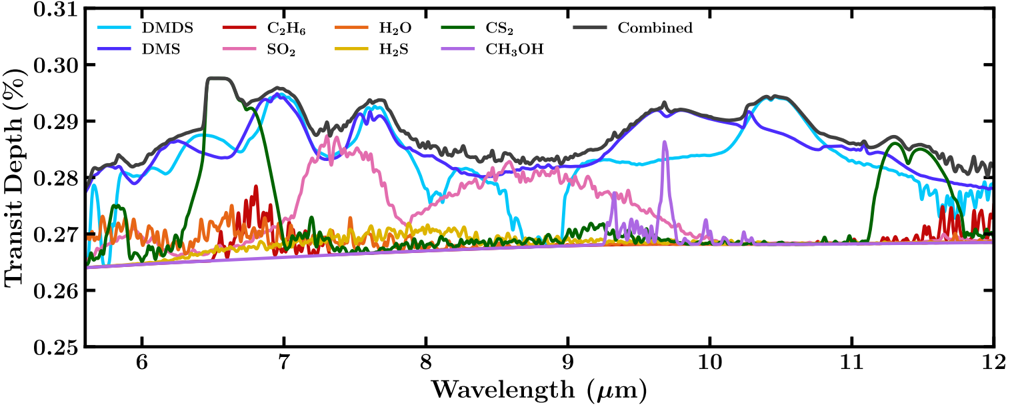
The sub-Neptune frontier has opened a new window into the rich diversity of planetary environments beyond the solar system. The possibility of hycean worlds, with planet-wide oceans and H 2 -rich atmospheres, significantly expands and accelerates the search for habitable environments elsewhere. Recent JWST transmission spectroscopy of the candidate hycean world K2-18 b in the near-infrared led to the first detections of the carbon-bearing molecules CH 4 and CO 2 in its atmosphere, with a composition consistent with predictions for hycean conditions. The observations also provided a tentative hint of dimethyl sulfide (DMS), a possible biosignature gas, but the inference was of low statistical significance. We report a mid-infrared transmission spectrum of K2-18 b obtained using the JWST MIRI LRS instrument in the ∼6–12 μ m range. The spectrum shows distinct features and is inconsistent with a featureless spectrum at 3.4 σ significance compared to our canonical model. We find that the spectrum cannot be explained by most molecules predicted for K2-18 b, with the exception of DMS and dimethyl disulfide (DMDS), also a potential biosignature gas. We report new independent evidence for DMS and/or DMDS in the atmosphere at 3 σ significance, with high abundance (≳10 ppmv) of at least one of the two molecules. More observations are needed to increase the robustness of the findings and resolve the degeneracy between DMS and DMDS. The results also highlight the need for additional experimental and theoretical work to determine accurate cross sections of important biosignature gases and identify potential abiotic sources. We discuss the implications of the present findings for the possibility of biological activity on K2-18 b.
Overview
CoChat Summary
TL;DR
JWST MIRI LRS mid-infrared transmission spectroscopy of K2-18 b shows spectral features best explained by DMS and/or DMDS, with combined evidence at ~3σ and abundances of ~10⁻⁵–10⁻³. The authors interpret this as independent, tentative support for possible biological activity on the candidate hycean world, while stressing degeneracy and the need for more data.
Key findings
- The MIRI spectrum is inconsistent with a featureless spectrum at 3.4σ significance compared to the canonical model; the canonical model is preferred over a flat line at 3.4σ–3.8σ depending on the prior width.
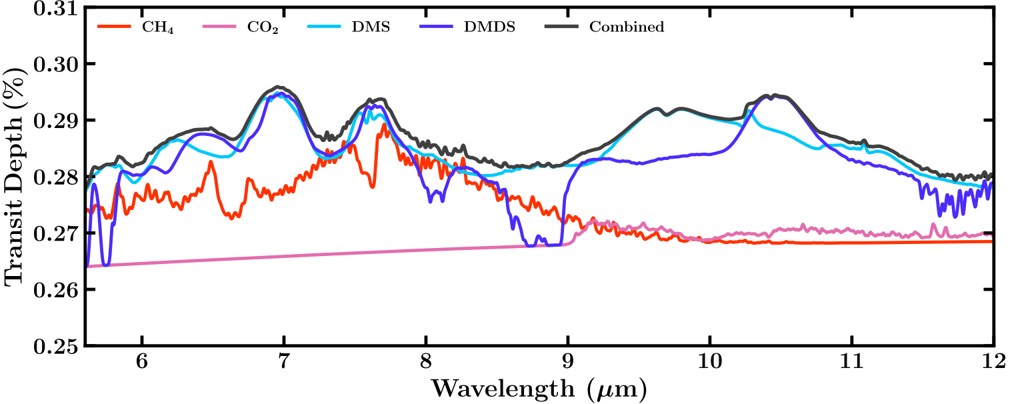
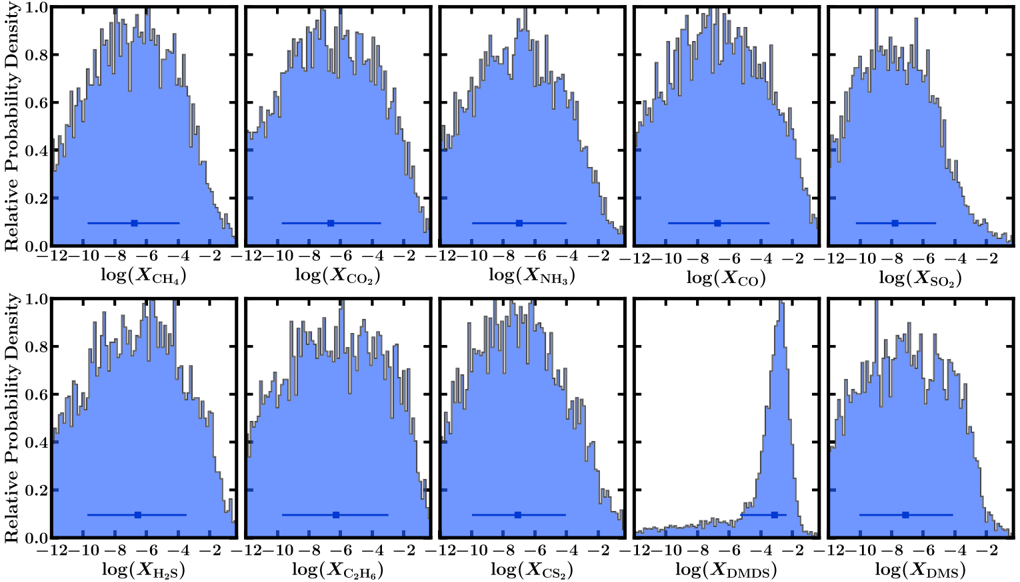
- DMS and/or DMDS are detected at 2.9σ–3.2σ across canonical retrievals: combined DMS+DMDS at 3.2σ, DMS-only at 2.9σ–3.0σ, and DMDS-only at 3.0σ–3.2σ. Retrieved abundances include log X_DMDS = −3.48⁺²·²⁷₋₁.₂₄ when both are included, log X_DMDS = −3.25⁺¹·³⁰₋₁.₁₇ for DMDS-only, and log X_DMS = −3.42⁺¹·⁴⁴₋₁.₁₆ for DMS-only (JExoRES), corresponding to mixing ratios of ~10⁻⁵–10⁻³ and at least one molecule at ~10 ppmv.
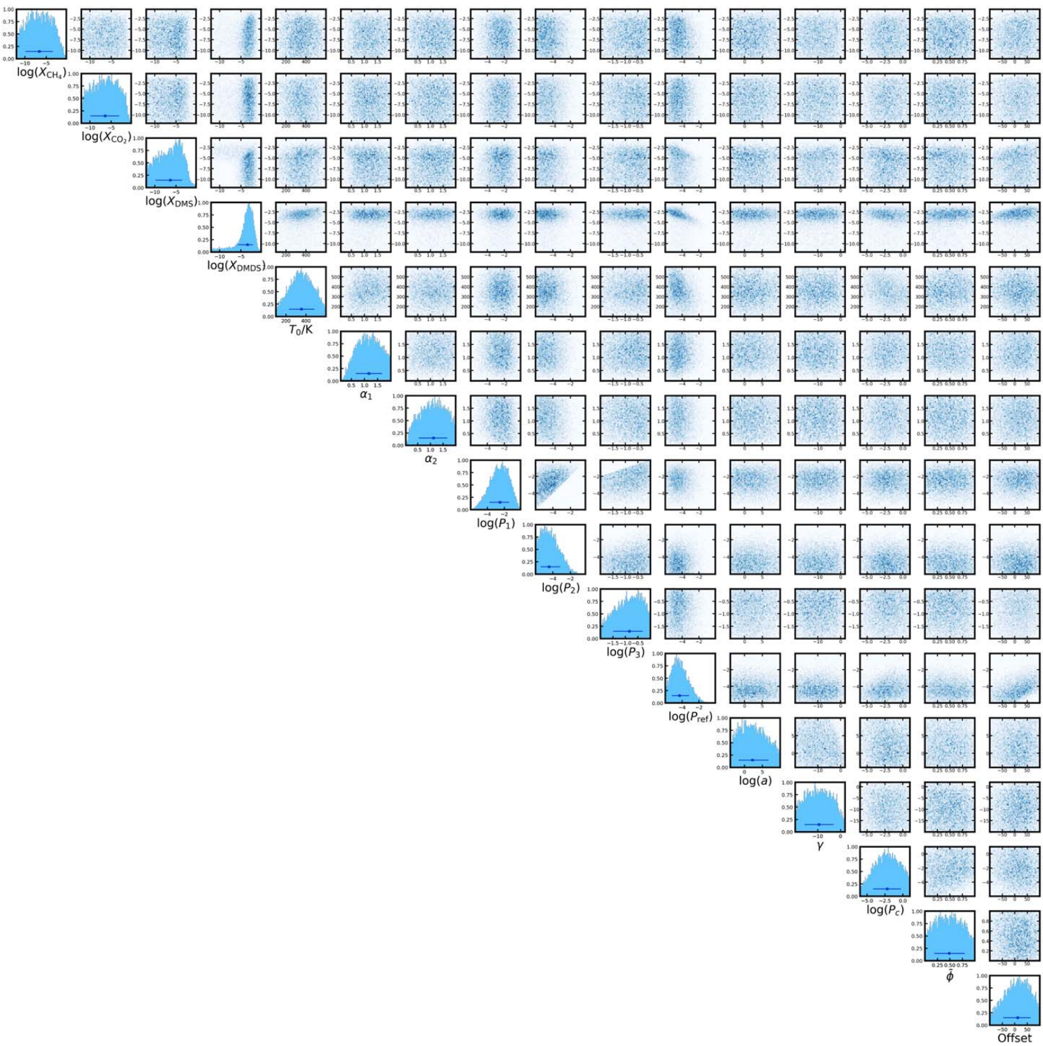
- Of 20 molecules considered, only DMDS and DMS have notable evidence; CH₄ and CO₂ are not detectable in the MIRI band, and their previously reported ~1% abundances are insufficient to explain the data. The photospheric temperature at 1 mbar is weakly constrained to 422⁺¹³³₋₁₄₁ K.
- Leave-one-out analysis indicates the DMS/DMDS detection is driven by multiple data points rather than localized systematics or individual outliers.
Methods
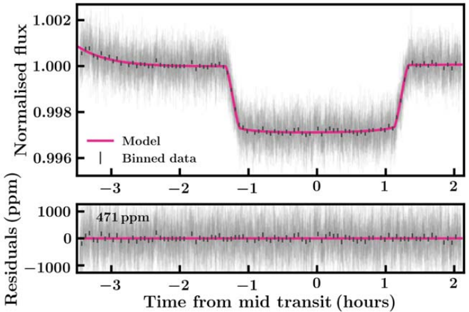
- JWST MIRI LRS slitless prism observations with F560W and FASTR1 were taken on 2024 April 25–26 for 5.85 hr, with 2.68 hr in transit, 5095 integrations, 25 groups per integration, maximum saturation 51%, and average native resolution R ~ 100 over ~5–12 μm.
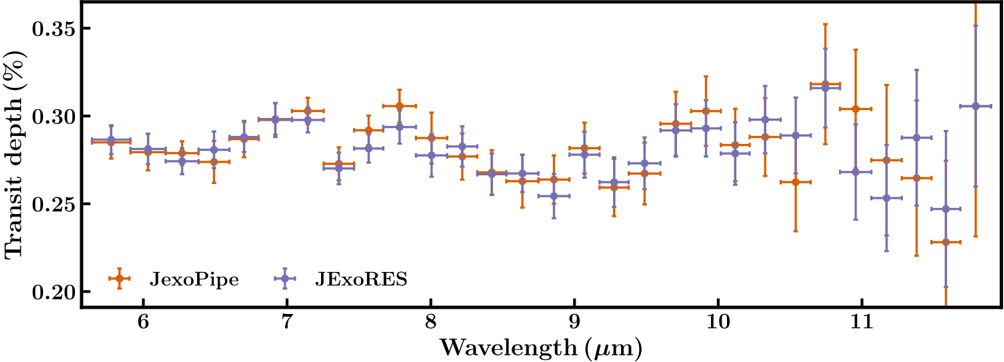
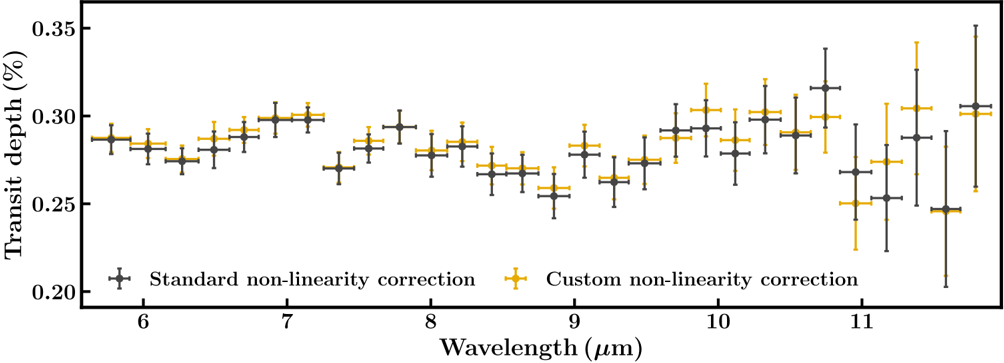
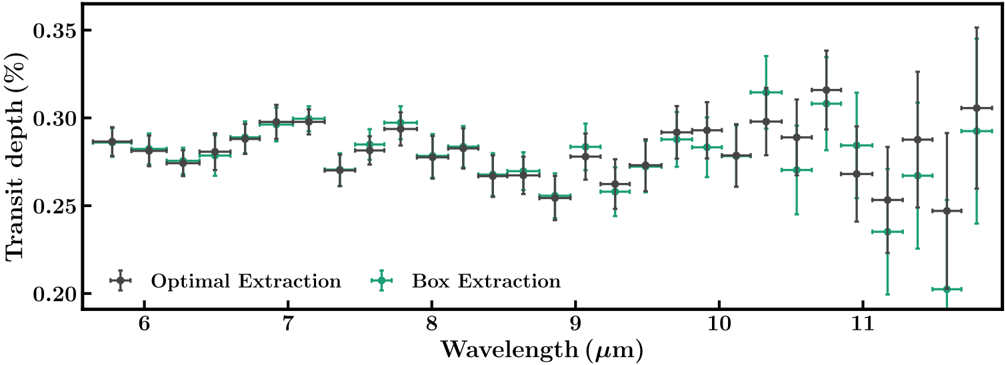
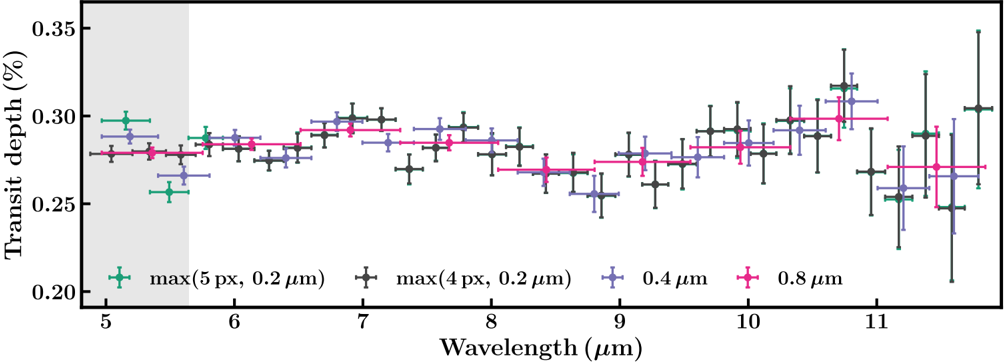
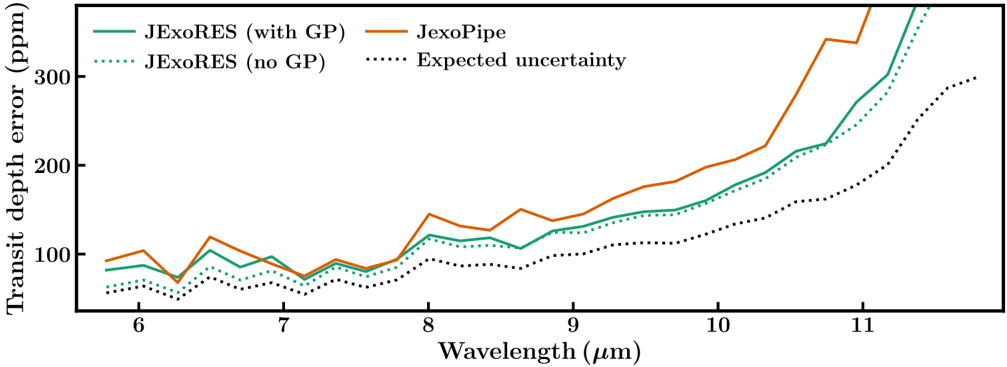
- Two independent reduction pipelines, JExoRES and JexoPipe, produced transmission spectra agreeing within 1σ; white-light curves used 4.8–10 μm, spectral bins were nominally 0.2 μm or 5 pixels, data below 5.6 μm were excluded, and fits included transit models, systematic trends, limb darkening, and correlated-noise treatments.
- Atmospheric retrievals used the AURA/VIRA framework with a plane-parallel hydrostatic terminator, parametric P–T profile, clouds/hazes, H₂–H₂ and H₂–He collision-induced absorption, and up to 20 molecules; the canonical model included DMS, DMDS, CH₄, and CO₂ with 16 free parameters, and Bayesian evidence was computed with MultiNest and checked with UltraNest.
Limitations
- The paper states the combined DMS/DMDS detection significance is ~3σ, at the lower end of robustness, and that DMS and DMDS are strongly degenerate in the MIRI band; more JWST transits (1–3 additional MIRI transits, ~8–24 hr) are needed to reach 4σ–5σ and rule out unaccounted-for instrumental systematics.
- The paper states retrieved abundances and temperatures depend strongly on limited DMS/DMDS cross sections from HITRAN at 1 bar and 298 K with an N₂ broadener, which may differ in an H₂-rich lower-pressure atmosphere; the 20-molecule search may not be exhaustive, and DMDS could condense depending on tropopause temperatures.
- Evident from the text: no significant constraints are obtained on other molecules or cloud/haze parameters, data below 5.6 μm are excluded due to binning instability, time-correlated noise is present and modeled, and detection significances carry a typical ~0.1σ uncertainty from MultiNest.
Model-written summary. Check it against the paper before relying on it.
Integrity signals
Registry
Cites
Statistics
Figures
Verification
Claims the paper makes
0 Valid · 2 Not valid · 60 Not checked · 165 Own results and interpretations
A result the paper reports from its own data — it cites no other source for it, so there is none to check. The quote shows it is in the paper.
In the paper
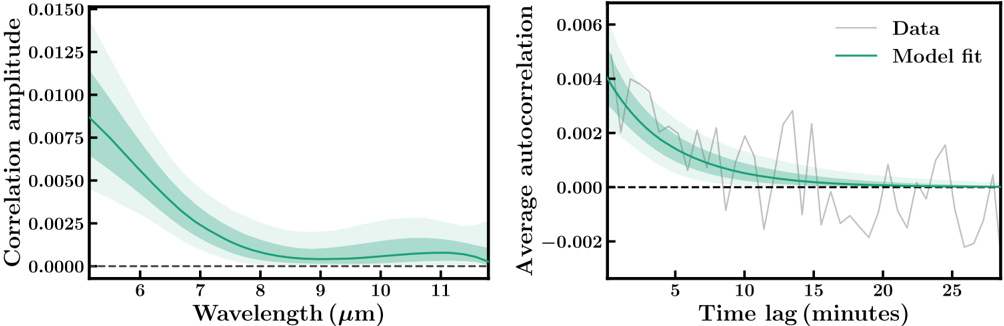
“Furthermore, we find evidence for timecorrelated noise on the timescale of minutes, with increasing amplitude toward shorter wavelengths.”
§ New Constraints on DMS and DMDS in the Atmosphere of K2-18 b from JWST MIRI > 2.1. JExoRES Pipeline
plainstates an association- Asserted: passes — The authors put it forward as true.
- Checkable: passes — It can be checked against evidence.
- Load-bearing: passes — The paper’s conclusions depend on it.
- Based: passes — The paper gives a reason why it holds.
A result the paper reports from its own data — it cites no other source for it, so there is none to check. The quote shows it is in the paper.
In the paper
“We find that the spectrum cannot be explained by most molecules predicted for K2-18 b, with the exception of DMS and dimethyl disulfide (DMDS), also a potential biosignature gas.”
§ New Constraints on DMS and DMDS in the Atmosphere of K2-18 b from JWST MIRI > Abstract
plain- Asserted: passes — The authors put it forward as true.
- Checkable: passes — It can be checked against evidence.
- Load-bearing: passes — The paper’s conclusions depend on it.
- Based: passes — The paper gives a reason why it holds.
- Rests on 2 assumptions not shown here.
A result the paper reports from its own data — it cites no other source for it, so there is none to check. The quote shows it is in the paper.
In the paper
“We present a mid-infrared transmission spectrum of K2-18 b with JWST, the first for a habitable-zone exoplanet.”
§ New Constraints on DMS and DMDS in the Atmosphere of K2-18 b from JWST MIRI > 1. Introduction
plainSingle case- Asserted: passes — The authors put it forward as true.
- Checkable: passes — It can be checked against evidence.
- Load-bearing: passes — The paper’s conclusions depend on it.
- Based: passes — The paper gives a reason why it holds.
In the paper
“Additionally, the amplitudes of the observed spectral features, of ∼300-400 ppm, in the present MIRI data are significantly larger compared to the ∼200 ppm amplitudes seen in previous nearinfrared (∼1-5 μm) observations with the NIRISS and NIRSpec instruments (N.Madhusudhan et al. 2023b).”
§ New Constraints on DMS and DMDS in the Atmosphere of K2-18 b from JWST MIRI > 3.2. Atmospheric Constraints
What the sources say
- Not checked yetcites N.Madhusudhan et al. 2023b matched to “Carbon-bearing Molecules in a Possible Hycean Atmosphere” (2023) source
plainstates an association- Asserted: passes — The authors put it forward as true.
- Checkable: passes — It can be checked against evidence.
- Load-bearing: unclear — It is unclear whether the paper’s conclusions depend on it.
- Based: passes — The paper gives a reason why it holds.
A result the paper reports from its own data — it cites no other source for it, so there is none to check. The quote shows it is in the paper.
In the paper
“In retrievals with only one of the two molecules present, the posterior of that molecule shows a single wellconstrained peak with no low-abundance tail.”
§ New Constraints on DMS and DMDS in the Atmosphere of K2-18 b from JWST MIRI > 3.2. Atmospheric Constraints
plain- Asserted: passes — The authors put it forward as true.
- Checkable: passes — It can be checked against evidence.
- Load-bearing: passes — The paper’s conclusions depend on it.
- Based: passes — The paper gives a reason why it holds.
114 more claims
Create a free account to see all 227 claims and to verify the 115 references still open.
- It may state two separate claims as one. 64
- Probably not a substantial claim. 49
- The quote only partly states this claim. 6
Claims other papers make about this one
Each is checked against this paper’s own text: does it say what the citing paper says it does?
In the citing paper
“While the MIRI binning scheme adopted by Madhusudhan et al. (2025) favors the presence of DMS/DMDS in K2-18b”
From K2-18b Does Not Meet The Standards of Evidence For Life (2025) · cites this paper as Madhusudhan et al. (2025)
Citations
Cites
<tt>emcee</tt>: The MCMC Hammer
Foreman-Mackey, D., Hogg, D. W., Lang, D., & Goodman, J. (2013) · Publications of the Astronomical Society of the Pacific · doi:10.1086/670067 · Cited by 12,414 · cited 1×
“We use emcee (Foreman-Mackey et al. 2013) to perform a Markov Chain Monte Carlo parameter estimation of the white light curve, fitting for a transit model with quadratic limb-darkening generated by pylightcurve (Tsiaras et al. 2016) multiplied by a systematic trend consisting of an exponential term…”
The HITRAN2016 molecular spectroscopic database
Gordon, I. E., Rothman, L. S., Hill, C., Kochanov, R. V., Tan, Y., Bernath, P. F., Birk, M., Boudon, V., Campargue, A., Chance, K. V., et al. (2017) · Journal of Quantitative Spectroscopy and Radiative Transfer · doi:10.1016/j.jqsrt.2017.06.038 · Cited by 7,721
(2015) · doi:10.1007/s11222-016-9696-4 · Cited by 5,611
MultiNest: an efficient and robust Bayesian inference tool for cosmology and particle physics
Feroz, F., Hobson, M. P., & Bridges, M. (2009) · Monthly Notices of the Royal Astronomical Society · doi:10.1111/j.1365-2966.2009.14548.x · Cited by 2,958 · cited 4×
“The Bayesian inference and parameter estimation is conducted using the nested sampling algorithm (Skilling 2004) through the MultiNest implementation (Feroz et al. 2009; Buchner et al. 2014).”
InfluentialThe HITRAN2020 molecular spectroscopic database
Gordon, I. E., Rothman, L. S., Hargreaves, R. J., Hashemi, R., Karlovets, E. V., Skinner, F. M., Conway, E. K., Hill, C., Kochanov, R. V., Tan, Y., et al. (2022) · Journal of Quantitative Spectroscopy and Radiative Transfer · doi:10.1016/j.jqsrt.2021.107949 · Cited by 2,600
HITEMP, the high-temperature molecular spectroscopic database
Rothman, L. S., Gordon, I. E., Barber, R. J., Dothe, H., Gamache, R. R., Goldman, A., Perevalov, V. I., Tashkun, S. A., & Tennyson, J. (2010) · Journal of Quantitative Spectroscopy and Radiative Transfer · doi:10.1016/j.jqsrt.2010.05.001 · Cited by 2,285 · cited 1×
“…Gandhi & Madhusudhan (2017) and Gandhi et al. (2020), for CH 4 (Yurchenko & Tennyson 2014), CO 2 (Tashkun et al. 2015), H 2 O (Barber et al. 2006; Rothman et al. 2010), NH 3 (Yurchenko et al. 2011), CO (Li et al. 2015), SO 2 (Underwood et al. 2016), HCN (Barber et al. 2014), H 2 S (Azzam et al.…”
Müller, H. S. P., Schlöder, F., Stutzki, J., & Winnewisser, G. (2005) · Journal of Molecular Structure · doi:10.1016/j.molstruc.2005.01.027 · Cited by 2,003 · cited 1×
“When DMDS is removed from the model a peak in the posterior is found for DMS. (Bouanich et al. 1986; Golebiowski et al. 2014; Müller et al. 2005; Auwera & Fayt 2006; Sung et al. 2009; Toth et al. 2010; Régalia-Jarlot et al. 2002), N 2 O (Daumont et al. 2001) and PH 3 (Gordon et al. 2022).”
The James Webb Space Telescope
Gardner, J. P., Mather, J. C., Clampin, M., Doyon, R., Greenhouse, M. A., Hammel, H. B., Hutchings, J. B., Jakobsen, P., Lilly, S. J., Long, K. S., et al. (2006) · Space Science Reviews · doi:10.1007/s11214-006-8315-7 · Cited by 1,978 · cited 1×
“The discoveries of temperate exoplanets orbiting nearby stars and the advent of the James Webb Space Telescope (JWST; Gardner et al. 2006) are opening the possibility of detecting biosignatures in habitable exo-planets.”
An optimal extraction algorithm for CCD spectroscopy
Horne, K. (1986) · Publications of the Astronomical Society of the Pacific · doi:10.1086/131801 · Cited by 1,923
Buchner, J., Georgakakis, A., Nandra, K., Hsu, L., Rangel, C., Brightman, M., Merloni, A., Salvato, M., Donley, J., & Kocevski, D. (2014) · Astronomy & Astrophysics · doi:10.1051/0004-6361/201322971 · Cited by 1,644 · cited 1×
“The Bayesian inference and parameter estimation is conducted using the nested sampling algorithm (Skilling 2004) through the MultiNest implementation (Feroz et al. 2009; Buchner et al. 2014).”
<tt>batman</tt>: BAsic Transit Model cAlculatioN in Python
Kreidberg, L. (2015) · Publications of the Astronomical Society of the Pacific · doi:10.1086/683602 · Cited by 1,075 · cited 1×
“Next, we fit the light curves using the batman transit model (Kreidberg 2015) and nested sampling with MultiNest (Feroz et al. 2009), assuming a circular orbit with a period from Benneke et al. (2019a).”
Fast and Scalable Gaussian Process Modeling with Applications to Astronomical Time Series
Foreman-Mackey, D., Agol, E., Ambikasaran, S., & Angus, R. (2017) · The Astronomical Journal · doi:10.3847/1538-3881/aa9332 · Cited by 1,000
Gas-Phase Databases for Quantitative Infrared Spectroscopy
Sharpe, S. W., Johnson, T. J., Sams, R. L., Chu, P. M., Rhoderick, G. C., & Johnson, P. A. (2004) · Applied Spectroscopy · doi:10.1366/0003702042641281 · Cited by 948 · cited 1×
“For DMS, DMDS, CH 3 SH and CS 2 , we consider the HITRAN (Sharpe et al. 2004; Gordon et al. 2017; Kochanov et al. 2019) absorption cross-sections at 1 bar and 298 K, similarly to Madhusudhan et al. (2021).”
Skilling, J. (2004) · AIP Conference Proceedings · doi:10.1063/1.1835238 · Cited by 925
Efficient, uninformative sampling of limb darkening coefficients for two-parameter laws
Kipping, D. M. (2013) · Monthly Notices of the Royal Astronomical Society · doi:10.1093/mnras/stt1435 · Cited by 895 · cited 2×
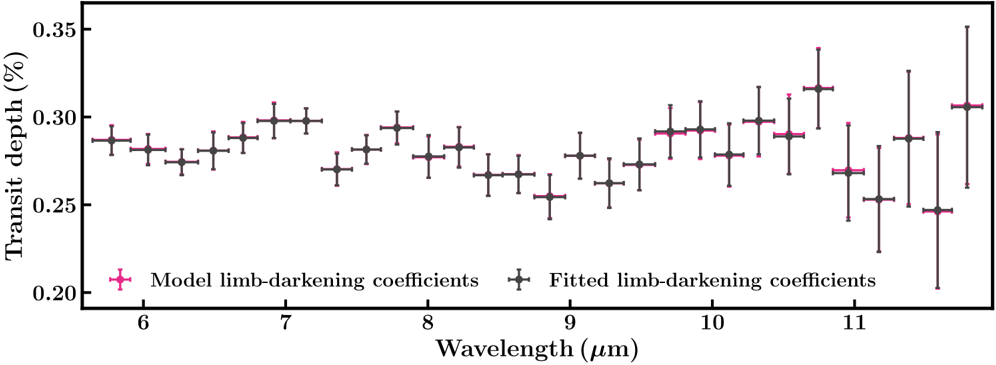
“For the limb darkening, we use the quadratic law with the parameterisation and priors by Kipping (2013).”
A high-accuracy computed water line list
Barber, R. J., Tennyson, J., Harris, G. J., & Tolchenov, R. N. (2006) · Monthly Notices of the Royal Astronomical Society · doi:10.1111/j.1365-2966.2006.10184.x · Cited by 709 · cited 1×
“…list data, following Gandhi & Madhusudhan (2017) and Gandhi et al. (2020), for CH 4 (Yurchenko & Tennyson 2014), CO 2 (Tashkun et al. 2015), H 2 O (Barber et al. 2006; Rothman et al. 2010), NH 3 (Yurchenko et al. 2011), CO (Li et al. 2015), SO 2 (Underwood et al. 2016), HCN (Barber et al. 2014),…”
A TEMPERATURE AND ABUNDANCE RETRIEVAL METHOD FOR EXOPLANET ATMOSPHERES
Madhusudhan, N., & Seager, S. (2009) · The Astrophysical Journal · doi:10.1088/0004-637x/707/1/24 · Cited by 603
Self-citationLi, G., Gordon, I. E., Rothman, L. S., Tan, Y., Hu, S.-M., Kassi, S., Campargue, A., & Medvedev, E. S. (2015) · The Astrophysical Journal Supplement Series · doi:10.1088/0067-0049/216/1/15 · Cited by 541 · cited 1×
“…for CH 4 (Yurchenko & Tennyson 2014), CO 2 (Tashkun et al. 2015), H 2 O (Barber et al. 2006; Rothman et al. 2010), NH 3 (Yurchenko et al. 2011), CO (Li et al. 2015), SO 2 (Underwood et al. 2016), HCN (Barber et al. 2014), H 2 S (Azzam et al. 2016; Chubb et al. 2018), CH 3 OH (Harrison et al.…”
Exoplanet Biosignatures: A Review of Remotely Detectable Signs of Life
Schwieterman, E. W., Kiang, N. Y., Parenteau, M. N., Harman, C. E., DasSarma, S., Fisher, T. M., Arney, G. N., Hartnett, H. E., Reinhard, C. T., Olson, S. L., et al. (2018) · Astrobiology · doi:10.1089/ast.2017.1729 · Cited by 527 · cited 4×
“…addition to providing a complementary spectral window ( ∼ 5-12 µm) to previous observations, this wavelength range also encompasses strong spectral features of DMS and several other biosignature gases (Domagal-Goldman et al. 2011a; Sea-ger et al. 2013b; Schwieterman et al. 2018; Tsai et al. 2024).”
InfluentialBiosignatures from Earth-Like Planets Around M Dwarfs
Segura, A., Kasting, J. F., Meadows, V., Cohen, M., Scalo, J., Crisp, D., Butler, R. A. H., & Tinetti, G. (2005) · Astrobiology · doi:10.1089/ast.2005.5.706 · Cited by 524 · cited 1×
“…models under high surface-flux emission conditions: (1) because of the favorable ultraviolet spectral energy distribution of M-dwarf stars (see also Segura et al. 2005; Domagal-Goldman et al. 2011a; Seager et al. 2013a), (2) because DMS and DMDS can eventually self-shield, as well as shield…”
New Grids of ATLAS9 Model Atmospheres
Castelli, F., & Kurucz, R. L. (2004) · arXiv (Cornell University) · doi:10.48550/arxiv.astro-ph/0405087 · Cited by 495
UltraNest - a robust, general purpose Bayesian inference engine
Buchner, J. (2021) · Journal of Open Source Software · doi:10.21105/joss.03001 · Cited by 494 · cited 1×
“For robustness, we also perform several of the canonical retrievals discussed below using the UltraNest implementation (Buchner 2021), as used in the VIRA retrieval framework, the most recent variant of AURA (Constantinou & Madhusudhan 2024).”
ExoMol line lists – IV. The rotation–vibration spectrum of methane up to 1500 K
Yurchenko, S. N., & Tennyson, J. (2014) · Monthly Notices of the Royal Astronomical Society · doi:10.1093/mnras/stu326 · Cited by 430 · cited 1×
“We compute the absorption cross sections from line list data, following Gandhi & Madhusudhan (2017) and Gandhi et al. (2020), for CH 4 (Yurchenko & Tennyson 2014), CO 2 (Tashkun et al. 2015), H 2 O (Barber et al. 2006; Rothman et al. 2010), NH 3 (Yurchenko et al. 2011), CO (Li et al. 2015), SO 2…”
New section of the HITRAN database: Collision-induced absorption (CIA)
Richard, C., Gordon, I. E., Rothman, L. S., Abel, M., Frommhold, L., Gustafsson, M., Hartmann, J.-M., Hermans, C., Lafferty, W. J., Orton, G. S., et al. (2012) · Journal of Quantitative Spectroscopy and Radiative Transfer · doi:10.1016/j.jqsrt.2011.11.004 · Cited by 400 · cited 1×
“He (Borysow et al. 1988; Orton et al. 2007; Abel et al. 2011; Richard et al. 2012).”
A variationally computed line list for hot NH3: Hot line list for Ammonia
Yurchenko, S. N., Barber, R. J., & Tennyson, J. (2011) · Monthly Notices of the Royal Astronomical Society · doi:10.1111/j.1365-2966.2011.18261.x · Cited by 367 · cited 1×
“…and Gandhi et al. (2020), for CH 4 (Yurchenko & Tennyson 2014), CO 2 (Tashkun et al. 2015), H 2 O (Barber et al. 2006; Rothman et al. 2010), NH 3 (Yurchenko et al. 2011), CO (Li et al. 2015), SO 2 (Underwood et al. 2016), HCN (Barber et al. 2014), H 2 S (Azzam et al. 2016; Chubb et al. 2018), CH…”
ExoMol line lists – III. An improved hot rotation-vibration line list for HCN and HNC
Barber, R. J., Strange, J. K., Hill, C., Polyansky, O. L., Mellau, G. C., Yurchenko, S. N., & Tennyson, J. (2014) · Monthly Notices of the Royal Astronomical Society · doi:10.1093/mnras/stt2011 · Cited by 323
Abundant molecular oxygen in the coma of comet 67P/Churyumov–Gerasimenko
Bieler, A., Altwegg, K., Balsiger, H., Bar-Nun, A., Berthelier, J.-J., Bochsler, P., Briois, C., Calmonte, U., Combi, M., De Keyser, J., et al. (2015) · Nature · doi:10.1038/nature15707 · Cited by 312 · cited 1×
“Comets are also known to contain other ices and sublimated gases that might be considered biosignatures if present in an exoplanet atmosphere, including O 2 , CH 4 , and CH 3 Cl (Bieler et al. 2015; Fayolle et al. 2017; Rubin et al. 2019).”
Water Vapor and Clouds on the Habitable-zone Sub-Neptune Exoplanet K2-18b
Benneke, B., Wong, I., Piaulet, C., Knutson, H. A., Lothringer, J., Morley, C. V., Crossfield, I. J. M., Gao, P., Greene, T. P., Dressing, C., et al. (2019) · The Astrophysical Journal Letters · doi:10.3847/2041-8213/ab59dc · Cited by 297 · cited 7×
“We fix the period to 32.940045 days (Benneke et al. 2019a), the argument of periastron to 90 o and the eccentricity to 0.”
InfluentialWater vapour in the atmosphere of the habitable-zone eight-Earth-mass planet K2-18 b
Tsiaras, A., Waldmann, I. P., Tinetti, G., Tennyson, J., & Yurchenko, S. N. (2019) · Nature Astronomy · doi:10.1038/s41550-019-0878-9 · Cited by 283 · cited 2×
“A transmission spectrum of K2-18 b obtained with the Hubble Space Telescope WFC3/G141 spectrograph (1.1-1.7 µ m) was initially used to infer the presence of water vapour (H 2 O) in its atmosphere (Benneke et al. 2019b; Tsiaras et al. 2019; Madhusudhan et al. 2020).”
InfluentialCarbon-bearing Molecules in a Possible Hycean Atmosphere
Madhusudhan, N., Sarkar, S., Constantinou, S., Holmberg, M., Piette, A. A. A., & Moses, J. I. (2023) · The Astrophysical Journal Letters · doi:10.3847/2041-8213/acf577 · Cited by 277 · cited 20×
“The CH 4 on K2-18 b may be contributed, partly or predominantly, from biogenic sources, similar to CH 4 from methanogenic bacteria in the Earth’s atmosphere (Madhusudhan et al. 2023a,b; Wogan et al. 2024; Cooke & Madhusudhan 2024).”
InfluentialSelf-citationBorysow, J., Frommhold, L., & Birnbaum, G. (1988) · The Astrophysical Journal · doi:10.1086/166112 · Cited by 270 · cited 1×
“He (Borysow et al. 1988; Orton et al. 2007; Abel et al. 2011; Richard et al. 2012).”
Benneke, B., Roy, P.-A., Coulombe, L.-P., Radica, M., Piaulet, C., Ahrer, E.-M., Pierrehumbert, R. T., Krissansen‐Totton, J., Schlichting, H. E., Hu, R., et al. (2024) · arXiv · doi:10.3929/ethz-b-000710932 · Cited by 265
Thermal emission from the Earth-sized exoplanet TRAPPIST-1 b using JWST
Greene, T. P., Bell, T. J., Ducrot, E., Dyrek, A., Lagage, P.-O., & Fortney, J. J. (2023) · Nature · doi:10.1038/s41586-023-05951-7 · Cited by 242 · cited 2×
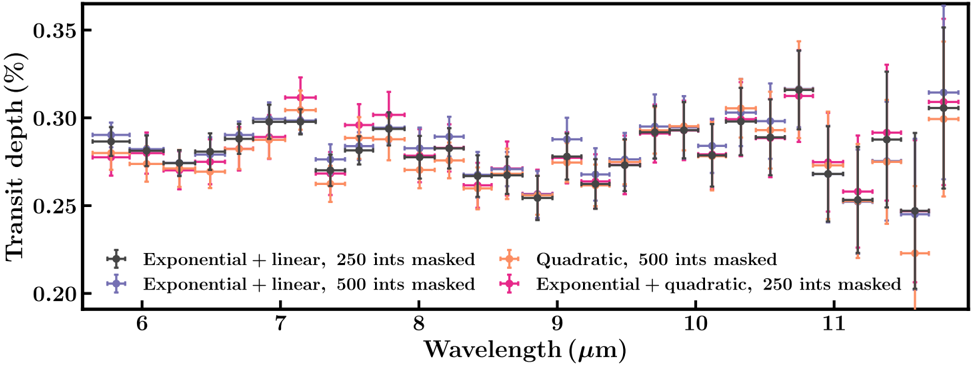
“…of integrations at the start of the observation and/or to account for the detector settling when fitting the light curves (e.g., Bouwman et al. 2023; Greene et al. 2023; Kempton et al. 2023; Grant et al. 2023; Dyrek et al. 2024; Bell et al. 2024), for example, by including an exponential trend.”
ExoMol molecular line lists – XVI. The rotation–vibration spectrum of hot H2S
Azzam, A. A. A., Tennyson, J., Yurchenko, S. N., & Naumenko, O. V. (2016) · Monthly Notices of the Royal Astronomical Society · doi:10.1093/mnras/stw1133 · Cited by 234 · cited 1×
“…et al. 2006; Rothman et al. 2010), NH 3 (Yurchenko et al. 2011), CO (Li et al. 2015), SO 2 (Underwood et al. 2016), HCN (Barber et al. 2014), H 2 S (Azzam et al. 2016; Chubb et al. 2018), CH 3 OH (Harrison et al. 2012), C 2 H 2 (Gomez et al. 2010; Gordon et al. 2022), C 2 H 4 (Auwera et al. 2007;…”
Exoplanet Biosignatures: A Framework for Their Assessment
Catling, D. C., Krissansen-Totton, J., Kiang, N. Y., Crisp, D., Robinson, T. D., DasSarma, S., Rushby, A. J., Del Genio, A., Bains, W., & Domagal-Goldman, S. (2018) · Astrobiology · doi:10.1089/ast.2017.1737 · Cited by 225 · cited 3×
“The robustness of DMS as a biosignature in H 2 -rich environments has been proposed extensively in the literature both for rocky planets (Domagal-Goldman et al. 2011a; Seager et al. 2013a; Catling et al. 2018; Schwi-eterman et al. 2018) and hycean worlds (Madhusudhan et al. 2021).”
H2O abundances and cloud properties in ten hot giant exoplanets
Pinhas, A., Madhusudhan, N., Gandhi, S., & MacDonald, R. (2019) · Monthly Notices of the Royal Astronomical Society · doi:10.1093/mnras/sty2544 · Cited by 214
Self-citationExoMol molecular line lists – XIV. The rotation–vibration spectrum of hot SO2
Underwood, D. S., Tennyson, J., Yurchenko, S. N., Huang, X., Schwenke, D. W., Lee, T. J., Clausen, S., & Fateev, A. (2016) · Monthly Notices of the Royal Astronomical Society · doi:10.1093/mnras/stw849 · Cited by 198 · cited 1×
“…2014), CO 2 (Tashkun et al. 2015), H 2 O (Barber et al. 2006; Rothman et al. 2010), NH 3 (Yurchenko et al. 2011), CO (Li et al. 2015), SO 2 (Underwood et al. 2016), HCN (Barber et al. 2014), H 2 S (Azzam et al. 2016; Chubb et al. 2018), CH 3 OH (Harrison et al. 2012), C 2 H 2 (Gomez et al.…”
Elemental and molecular abundances in comet 67P/Churyumov-Gerasimenko
Rubin, M., Altwegg, K., Balsiger, H., Berthelier, J.-J., Combi, M. R., De Keyser, J., Drozdovskaya, M., Fiethe, B., Fuselier, S. A., Gasc, S., et al. (2019) · Monthly Notices of the Royal Astronomical Society · doi:10.1093/mnras/stz2086 · Cited by 195 · cited 1×
“Comets are also known to contain other ices and sublimated gases that might be considered biosignatures if present in an exoplanet atmosphere, including O 2 , CH 4 , and CH 3 Cl (Bieler et al. 2015; Fayolle et al. 2017; Rubin et al. 2019).”
Collision-Induced Absorption by H2 Pairs: From Hundreds to Thousands of Kelvin
Abel, M., Frommhold, L., Li, X., & Hunt, K. L. C. (2011) · The Journal of Physical Chemistry A · doi:10.1021/jp109441f · Cited by 194 · cited 1×
“He (Borysow et al. 1988; Orton et al. 2007; Abel et al. 2011; Richard et al. 2012).”
Using Biogenic Sulfur Gases as Remotely Detectable Biosignatures on Anoxic Planets
Domagal-Goldman, S. D., Meadows, V. S., Claire, M. W., & Kasting, J. F. (2011) · Astrobiology · doi:10.1089/ast.2010.0509 · Cited by 191 · cited 5×
“…emission conditions: (1) because of the favorable ultraviolet spectral energy distribution of M-dwarf stars (see also Segura et al. 2005; Domagal-Goldman et al. 2011a; Seager et al. 2013a), (2) because DMS and DMDS can eventually self-shield, as well as shield molecules such as CO 2…”
InfluentialMontet, B. T., Morton, T. D., Foreman-Mackey, D., Johnson, J. A., Hogg, D. W., Bowler, B. P., Latham, D. W., Bieryla, A., & Mann, A. W. (2015) · The Astrophysical Journal · doi:10.1088/0004-637x/809/1/25 · Cited by 188
Moran, S. E., Stevenson, K. B., Sing, D. K., MacDonald, R. J., Kirk, J., Lustig-Yaeger, J., Peacock, S., Mayorga, L. C., Bennett, K. A., López-Morales, M., et al. (2023) · The Astrophysical Journal Letters · doi:10.3847/2041-8213/accb9c · Cited by 182 · cited 1×
“…their diversity and both the challenges and opportunities in characterizing their atmo-spheres with JWST (e.g. Madhusudhan et al. 2023b; Moran et al. 2023; May et al. 2023; Lim et al. 2023; Alderson et al. 2024; Holmberg & Madhusudhan 2024; Benneke et al. 2024; Damiano et al. 2024;…”
Disequilibrium biosignatures over Earth history and implications for detecting exoplanet life
Krissansen-Totton, J., Olson, S., & Catling, D. C. (2018) · Science Advances · doi:10.1126/sciadv.aao5747 · Cited by 177 · cited 13×
“The CH 4 on K2-18 b may be contributed, partly or predominantly, from biogenic sources, similar to CH 4 from methanogenic bacteria in the Earth’s atmosphere (Madhusudhan et al. 2023a,b; Wogan et al. 2024; Cooke & Madhusudhan 2024).”
InfluentialLim, O., Benneke, B., Doyon, R., MacDonald, R. J., Piaulet, C., Artigau, É., Coulombe, L.-P., Radica, M., L’Heureux, A., Albert, L., et al. (2023) · The Astrophysical Journal Letters · doi:10.3847/2041-8213/acf7c4 · Cited by 175 · cited 1×
“…the challenges and opportunities in characterizing their atmo-spheres with JWST (e.g. Madhusudhan et al. 2023b; Moran et al. 2023; May et al. 2023; Lim et al. 2023; Alderson et al. 2024; Holmberg & Madhusudhan 2024; Benneke et al. 2024; Damiano et al. 2024; Scarsdale et al. 2024; Wallack et al.…”
A reflective, metal-rich atmosphere for GJ 1214b from its JWST phase curve
Kempton, E. M.-R., Zhang, M., Bean, J. L., Steinrueck, M. E., Piette, A. A. A., Parmentier, V., Malsky, I., Roman, M. T., Rauscher, E., Gao, P., et al. (2023) · Nature · doi:10.1038/s41586-023-06159-5 · Cited by 171 · cited 2×
“…of integrations at the start of the observation and/or to account for the detector settling when fitting the light curves (e.g., Bouwman et al. 2023; Greene et al. 2023; Kempton et al. 2023; Grant et al. 2023; Dyrek et al. 2024; Bell et al. 2024), for example, by including an exponential trend.”
InfluentialSelf-citationThe Mid-Infrared Instrument for theJames Webb Space Telescope, IV: The Low-Resolution Spectrometer
Kendrew, S., Scheithauer, S., Bouchet, P., Amiaux, J., Azzollini, R., Bouwman, J., Chen, C., Dubreuil, D., Fischer, S., Glasse, A. C. H., et al. (2015) · Publications of the Astronomical Society of the Pacific · doi:10.1086/682255 · Cited by 166 · cited 8×
“3 We do not find a strong discontinuity in the detector behaviour past 10.6 µm, called the shadow region, sometimes found in MIRI LRS data (Bell et al. 2024).”
InfluentialHabitability and Biosignatures of Hycean Worlds
Madhusudhan, N., Piette, A. A. A., & Constantinou, S. (2021) · The Astrophysical Journal · doi:10.3847/1538-4357/abfd9c · Cited by 164 · cited 5×
“Similarly, their wider habitable zone compared to that of Earth-like planets also makes them more abundant, with over a dozen hycean candidates already identified (e.g. Madhusudhan et al. 2021; Fukui et al. 2022; Kawauchi et al. 2022; Mikal-Evans et al. 2023; Piaulet et al. 2023).”
InfluentialSelf-citationSO2, silicate clouds, but no CH4 detected in a warm Neptune
Dyrek, A., Min, M., Decin, L., Bouwman, J., Crouzet, N., Mollière, P., Lagage, P.-O., Konings, T., Tremblin, P., Güdel, M., et al. (2023) · Nature · doi:10.1038/s41586-023-06849-0 · Cited by 164
A high internal heat flux and large core in a warm Neptune exoplanet
Welbanks, L., Bell, T. J., Beatty, T. G., Line, M., Ohno, K., Fortney, J. J., Schlawin, E. A., Greene, T. P., Rauscher, E., McGill, P., et al. (2024) · Nature · doi:10.1038/s41586-024-07514-w · Cited by 161 · cited 1×
“Therefore, recent works have adopted wide bins with typical widths of 0.15-0.5 µm (e.g., Bell et al. 2024; Powell et al. 2024; Welbanks et al. 2024; Schlawin et al. 2024).”
InfluentialPossible Hycean conditions in the sub-Neptune TOI-270 d
Holmberg, M., & Madhusudhan, N. (2024) · Astronomy and Astrophysics · doi:10.1051/0004-6361/202348238 · Cited by 160 · cited 1×
“…in characterizing their atmo-spheres with JWST (e.g. Madhusudhan et al. 2023b; Moran et al. 2023; May et al. 2023; Lim et al. 2023; Alderson et al. 2024; Holmberg & Madhusudhan 2024; Benneke et al. 2024; Damiano et al. 2024; Scarsdale et al. 2024; Wallack et al. 2024; Alam et al. 2025).”
Self-citationBIOSIGNATURE GASES IN H2-DOMINATED ATMOSPHERES ON ROCKY EXOPLANETS
Seager, S., Bains, W., & Hu, R. (2013) · The Astrophysical Journal · doi:10.1088/0004-637x/777/2/95 · Cited by 156
ON CORRELATED-NOISE ANALYSES APPLIED TO EXOPLANET LIGHT CURVES
Cubillos, P. E., Harrington, J., Loredo, T. J., Lust, N. B., Blecic, J., & Stemm, M. (2016) · The Astronomical Journal · doi:10.3847/1538-3881/153/1/3 · Cited by 142
Double Trouble: Two Transits of the Super-Earth GJ 1132 b Observed with JWST NIRSpec G395H
May, E., MacDonald, R. J., Bennett, K. A., Moran, S. E., Wakeford, H. R., Peacock, S., Lustig‐Yaeger, J., Highland, A. N., Stevenson, K. B., Sing, D. K., et al. (2023) · The Astrophysical Journal Letters · doi:10.3847/2041-8213/ad054f · Cited by 139
The Interior and Atmosphere of the Habitable-zone Exoplanet K2-18b
Madhusudhan, N., Nixon, M. C., Welbanks, L., Piette, A. A. A., & Booth, R. A. (2020) · The Astrophysical Journal Letters · doi:10.3847/2041-8213/ab7229 · Cited by 133 · cited 2×
“A transmission spectrum of K2-18 b obtained with the Hubble Space Telescope WFC3/G141 spectrograph (1.1-1.7 µ m) was initially used to infer the presence of water vapour (H 2 O) in its atmosphere (Benneke et al. 2019b; Tsiaras et al. 2019; Madhusudhan et al. 2020).”
InfluentialSelf-citationPhosphine as a Biosignature Gas in Exoplanet Atmospheres
Sousa-Silva, C., Seager, S., Ranjan, S., Petkowski, J. J., Zhan, Z., Hu, R., & Bains, W. (2020) · Astrobiology · doi:10.1089/ast.2018.1954 · Cited by 128
genesis: new self-consistent models of exoplanetary spectra
Gandhi, S., & Madhusudhan, N. (2017) · Monthly Notices of the Royal Astronomical Society · doi:10.1093/mnras/stx1601 · Cited by 122 · cited 1×
“We compute the absorption cross sections from line list data, following Gandhi & Madhusudhan (2017) and Gandhi et al. (2020), for CH 4 (Yurchenko & Tennyson 2014), CO 2 (Tashkun et al. 2015), H 2 O (Barber et al. 2006; Rothman et al. 2010), NH 3 (Yurchenko et al. 2011), CO (Li et al. 2015), SO 2…”
Self-citationProtostellar and cometary detections of organohalogens
Fayolle, E. C., Öberg, K. I., Jørgensen, J. K., Altwegg, K., Calcutt, H., Müller, H. S. P., Rubin, M., van der Wiel, M. H. D., Bjerkeli, P., Bourke, T. L., et al. (2017) · Nature Astronomy · doi:10.1038/s41550-017-0237-7 · Cited by 120 · cited 1×
“Comets are also known to contain other ices and sublimated gases that might be considered biosignatures if present in an exoplanet atmosphere, including O 2 , CH 4 , and CH 3 Cl (Bieler et al. 2015; Fayolle et al. 2017; Rubin et al. 2019).”
The Transit Light Curve Project. VII. The Not-So-Bloated Exoplanet HAT-P-1b
Winn, J. N., Holman, M. J., Bakos, G. Á., Pál, A., Johnson, J. A., Williams, P. K. G., Shporer, A., Mazeh, T., Fernández, J. M., Latham, D. W., et al. (2007) · The Astronomical Journal · doi:10.1086/521599 · Cited by 116 · cited 2×
“As an additional robustness check, we also account for time-correlated noise using a different method in the JexoPipe pipeline, applying the ‘time-averaging’ method (Winn et al. 2007; Cubillos et al. 2017).”
Sulfur dioxide in the mid-infrared transmission spectrum of WASP-39b
Powell, D., Feinstein, A. D., Lee, E. K. H., Zhang, M., Tsai, S.-M., Taylor, J., Kirk, J., Bell, T., Barstow, J. K., Gao, P., et al. (2024) · Nature · doi:10.1038/s41586-024-07040-9 · Cited by 116 · cited 1×
“Therefore, recent works have adopted wide bins with typical widths of 0.15-0.5 µm (e.g., Bell et al. 2024; Powell et al. 2024; Welbanks et al. 2024; Schlawin et al. 2024).”
InfluentialSelf-citationA BIOMASS-BASED MODEL TO ESTIMATE THE PLAUSIBILITY OF EXOPLANET BIOSIGNATURE GASES
Seager, S., Bains, W., & Hu, R. (2013) · The Astrophysical Journal · doi:10.1088/0004-637x/775/2/104 · Cited by 114
JWST Observations of K2-18b Can Be Explained by a Gas-rich Mini-Neptune with No Habitable Surface
Wogan, N. F., Batalha, N. E., Zahnle, K. J., Krissansen-Totton, J., Tsai, S.-M., & Hu, R. (2024) · The Astrophysical Journal Letters · doi:10.3847/2041-8213/ad2616 · Cited by 113
Tashkun, S. A., Perevalov, V. I., Gamache, R. R., & Lamouroux, J. (2014) · Journal of Quantitative Spectroscopy and Radiative Transfer · doi:10.1016/j.jqsrt.2014.10.017 · Cited by 109 · cited 1×
“…cross sections from line list data, following Gandhi & Madhusudhan (2017) and Gandhi et al. (2020), for CH 4 (Yurchenko & Tennyson 2014), CO 2 (Tashkun et al. 2015), H 2 O (Barber et al. 2006; Rothman et al. 2010), NH 3 (Yurchenko et al. 2011), CO (Li et al. 2015), SO 2 (Underwood et al.…”
JWST-TST DREAMS: Quartz Clouds in the Atmosphere of WASP-17b
Grant, D., Lewis, N. K., Wakeford, H. R., Batalha, N. E., Glidden, A., Goyal, J., Mullens, E., MacDonald, R. J., May, E. M., Seager, S., et al. (2023) · The Astrophysical Journal Letters · doi:10.3847/2041-8213/acfc3b · Cited by 101 · cited 3×
“…of integrations at the start of the observation and/or to account for the detector settling when fitting the light curves (e.g., Bouwman et al. 2023; Greene et al. 2023; Kempton et al. 2023; Grant et al. 2023; Dyrek et al. 2024; Bell et al. 2024), for example, by including an exponential trend.”
InfluentialCloutier, R., Astudillo-Defru, N., Doyon, R., Bonfils, X., Almenara, J.-M., Benneke, B., Bouchy, F., Delfosse, X., Ehrenreich, D., Forveille, T., et al. (2017) · Astronomy & Astrophysics · doi:10.1051/0004-6361/201731558 · Cited by 97 · cited 2×
“5V dwarf star with J mag of 9.763 (Cloutier et al. 2017).”
InfluentialDistinguishing Oceans of Water from Magma on Mini-Neptune K2-18b
Shorttle, O., Jordan, S., Nicholls, H., Lichtenberg, T., & Bower, D. J. (2024) · The Astrophysical Journal Letters · doi:10.3847/2041-8213/ad206e · Cited by 97 · cited 1×
“Similarly, models considering NH 3 depletion due to magma oceans (Shorttle et al. 2024) in the gas dwarf scenario were found to be inconsistent with mass and density constraints, among other factors, while also being inconsistent with the retrieved composition (Rigby et al. 2024).”
1D atmospheric study of the temperate sub-Neptune K2-18b
Blain, D., Charnay, B., & Bézard, B. (2021) · Astronomy & Astrophysics · doi:10.1051/0004-6361/202039072 · Cited by 88 · cited 1×
“However, significant degeneracies were found between potential absorption due to H 2 O and that due to methane (CH 4 ) (Blain et al. 2021; Bézard et al. 2020) or contributions from stellar heterogeneities (Barclay et al. 2021).”
JWST COMPASS: A NIRSpec/G395H Transmission Spectrum of the Sub-Neptune TOI-836c
Wallack, N. L., Batalha, N. E., Alderson, L., Scarsdale, N., Redai, J. A., Aguichine, A., Alam, M. K., Gao, P., Wolfgang, A., Batalha, N. M., et al. (2024) · The Astronomical Journal · doi:10.3847/1538-3881/ad3917 · Cited by 87 · cited 1×
“…in characterizing their atmo-spheres with JWST (e.g. Madhusudhan et al. 2023b; Moran et al. 2023; May et al. 2023; Lim et al. 2023; Alderson et al. 2024; Holmberg & Madhusudhan 2024; Benneke et al. 2024; Damiano et al. 2024; Scarsdale et al. 2024; Wallack et al. 2024; Alam et al. 2025).”
Nightside clouds and disequilibrium chemistry on the hot Jupiter WASP-43b
Bell, T. J., Crouzet, N., Cubillos, P. E., Kreidberg, L., Piette, A. A. A., Roman, M. T., Barstow, J. K., Blecic, J., Carone, L., Coulombe, L.-P., et al. (2024) · Nature Astronomy · doi:10.1038/s41550-024-02230-x · Cited by 83 · cited 6×
“A minimum bin width of 0.2 µm is in line with the bin widths used in previous works, ranging between 0.15-0.5 µm (e.g. Bouwman et al. 2023; Grant et al. 2023; Bell et al. 2024; Pow-ell et al. 2024).”
InfluentialSelf-citationConfirmation of the radial velocity super-Earth K2-18c with HARPS and CARMENES
Cloutier, R., Astudillo-Defru, N., Doyon, R., Bonfils, X., Almenara, J.-M., Bouchy, F., Delfosse, X., Forveille, T., Lovis, C., Mayor, M., et al. (2019) · Astronomy & Astrophysics · doi:10.1051/0004-6361/201833995 · Cited by 82 · cited 1×
“The planet has a mass of 8.63 ± 1.35 M ⊕ and a radius of 2.61 ± 0.09 R ⊕ (Cloutier et al. 2019; Benneke et al. 2019a), and orbits in the habitable-zone of an M2.”
InfluentialThe Runaway Greenhouse Effect on Hycean Worlds
Innes, H., Tsai, S., & Pierrehumbert, R. T. (2023) · The Astrophysical Journal · doi:10.3847/1538-4357/ace346 · Cited by 81 · cited 1×
“A cloud/haze-free atmosphere would render the surface too hot to be hab-itable and/or have water in a supercritical state (Mad-husudhan et al. 2020; Piette & Madhusudhan 2020; Scheucher et al. 2020; Innes et al. 2023; Pierrehumbert 2023; Leconte et al. 2024).”
Gandhi, S., Brogi, M., Yurchenko, S. N., Tennyson, J., Coles, P. A., Webb, R. K., Birkby, J., Guilluy, G., Hawker, G. A., Madhusudhan, N., et al. (2020) · Monthly Notices of the Royal Astronomical Society · doi:10.1093/mnras/staa981 · Cited by 80 · cited 1×
“We compute the absorption cross sections from line list data, following Gandhi & Madhusudhan (2017) and Gandhi et al. (2020), for CH 4 (Yurchenko & Tennyson 2014), CO 2 (Tashkun et al. 2015), H 2 O (Barber et al. 2006; Rothman et al. 2010), NH 3 (Yurchenko et al. 2011), CO (Li et al. 2015), SO 2…”
Self-citationEvidence for the volatile-rich composition of a 1.5-Earth-radius planet
Piaulet, C., Benneke, B., Almenara, J. M., Dragomir, D., Knutson, H. A., Thorngren, D., Peterson, M. S., Crossfield, I. J. M., Kempton, E. M.-R., Kubyshkina, D. I., et al. (2022) · Nature Astronomy · doi:10.1038/s41550-022-01835-4 · Cited by 78
The Exoplanet Characterization Toolkit (ExoCTK)
Bourque, M. K., Espinoza, N., Filippazzo, J., Fix, M., King, T., Martlin, C., Medina, J., Batalha, N., Fox, M., Fowler, J., et al. (2021) · Zenodo (CERN European Organization for Nuclear Research) · doi:10.5281/zenodo.4556062 · Cited by 77
Marvel analysis of the measured high-resolution rovibrational spectra of H232S
Chubb, K. L., Naumenko, O. V., Keely, S., Bartolotto, S., Macdonald, S., Mukhtar, M., Grachov, A., White, J., Coleman, E., Liu, A. W., et al. (2018) · Journal of Quantitative Spectroscopy and Radiative Transfer · doi:10.1016/j.jqsrt.2018.07.012 · Cited by 74 · cited 1×
“…et al. 2010), NH 3 (Yurchenko et al. 2011), CO (Li et al. 2015), SO 2 (Underwood et al. 2016), HCN (Barber et al. 2014), H 2 S (Azzam et al. 2016; Chubb et al. 2018), CH 3 OH (Harrison et al. 2012), C 2 H 2 (Gomez et al. 2010; Gordon et al. 2022), C 2 H 4 (Auwera et al. 2007; Gordon et al. 2022)…”
How to Identify Exoplanet Surfaces Using Atmospheric Trace Species in Hydrogen-dominated Atmospheres
Yu 余馨, X. 婷., Moses, J. I., Fortney, J. J., & Zhang, X. (2021) · The Astrophysical Journal · doi:10.3847/1538-4357/abfdc7 · Cited by 71
Self-citationInferring Shallow Surfaces on Sub-Neptune Exoplanets with JWST
Tsai, S.-M., Innes, H., Lichtenberg, T., Taylor, J., Malik, M., Chubb, K., & Pierrehumbert, R. (2021) · The Astrophysical Journal Letters · doi:10.3847/2041-8213/ac399a · Cited by 70 · cited 1×
“The detections of CH 4 and CO 2 at significant abundances, along with the nondetections of ammonia (NH 3 ) and carbon monoxide (CO) and the overall high CO 2 /CO ratio, are consistent with prior predictions for a hycean atmosphere (Hu 2021; Tsai et al. 2021; Mad-husudhan et al. 2023a).”
Kochanov, R., Gordon, I., Rothman, L., Shine, K., Sharpe, S., Johnson, T., Wallington, T., Harrison, J., Bernath, P., Birk, M., et al. (2019) · Journal of Quantitative Spectroscopy and Radiative Transfer · doi:10.1016/j.jqsrt.2019.04.001 · Cited by 64 · cited 1×
“For DMS, DMDS, CH 3 SH and CS 2 , we consider the HITRAN (Sharpe et al. 2004; Gordon et al. 2017; Kochanov et al. 2019) absorption cross-sections at 1 bar and 298 K, similarly to Madhusudhan et al. (2021).”
Sulfur-driven haze formation in warm CO2-rich exoplanet atmospheres
He, C., Hörst, S. M., Lewis, N. K., Yu, X., Moses, J. I., McGuiggan, P., Marley, M. S., Kempton, E. M.-R., Moran, S. E., Morley, C. V., et al. (2020) · Nature Astronomy · doi:10.1038/s41550-020-1072-9 · Cited by 64 · cited 1×
“Experimental studies have demonstrated the feasibility of forming several organosulfur compounds abioti-cally using ultraviolet irradiation or electric discharges of gaseous mixtures containing H 2 S and CH 4 (e.g., Raulin & Toupance 1975; He et al. 2020; Vuitton et al. 2021; Reed et al. 2024).”
Self-citationJWST COMPASS: NIRSpec/G395H Transmission Observations of the Super-Earth TOI-836b
Alderson, L., Batalha, N. E., Wakeford, H. R., Wallack, N. L., Aguichine, A., Teske, J. K., Redai, J. A., Alam, M. K., Batalha, N. M., Gao, P., et al. (2024) · The Astronomical Journal · doi:10.3847/1538-3881/ad32c9 · Cited by 64 · cited 1×
“…opportunities in characterizing their atmo-spheres with JWST (e.g. Madhusudhan et al. 2023b; Moran et al. 2023; May et al. 2023; Lim et al. 2023; Alderson et al. 2024; Holmberg & Madhusudhan 2024; Benneke et al. 2024; Damiano et al. 2024; Scarsdale et al. 2024; Wallack et al. 2024; Alam et al.…”
Early Insights for Atmospheric Retrievals of Exoplanets Using JWST Transit Spectroscopy
Constantinou, S., Madhusudhan, N., & Gandhi, S. (2023) · The Astrophysical Journal Letters · doi:10.3847/2041-8213/acaead · Cited by 61 · cited 1×
“We perform atmospheric retrieval us-ing the AURA retrieval framework (Pinhas et al. 2019), as implemented in recent works (Constantinou et al. 2023; Madhusudhan et al. 2023b; Constantinou & Mad-husudhan 2024).”
Self-citationToward an Accurate Database for the 12 μm Region of the Ethane Spectrum
Vander Auwera, J., Moazzen‐Ahmadi, N., & Flaud, J. ‐. (2007) · The Astrophysical Journal · doi:10.1086/515567 · Cited by 59
LHS 1140 b Is a Potentially Habitable Water World
Damiano, M., Bello-Arufe, A., Yang, J., & Hu, R. (2024) · The Astrophysical Journal Letters · doi:10.3847/2041-8213/ad5204 · Cited by 59 · cited 1×
“…in characterizing their atmo-spheres with JWST (e.g. Madhusudhan et al. 2023b; Moran et al. 2023; May et al. 2023; Lim et al. 2023; Alderson et al. 2024; Holmberg & Madhusudhan 2024; Benneke et al. 2024; Damiano et al. 2024; Scarsdale et al. 2024; Wallack et al. 2024; Alam et al. 2025).”
Sarkis, P., Henning, T., Kürster, M., Trifonov, T., Zechmeister, M., Tal-Or, L., Anglada-Escud'e, G., Hatzes, A., Lafarga, M., Dreizler, S., et al. (2018) · Astronomical Journal · doi:10.3847/1538-3881/aac108 · Cited by 56 · cited 1×
“5V star (Montet et al. 2015; Cloutier et al. 2017; Sarkis et al. 2018).”
On the Temperature Profiles and Emission Spectra of Mini-Neptune Atmospheres
Piette, A. A. A., & Madhusudhan, N. (2020) · The Astrophysical Journal · doi:10.3847/1538-4357/abbfb1 · Cited by 56 · cited 2×
“A habitable liquid water ocean requires an adequate albedo (A B ) due to clouds/hazes (Piette & Madhusudhan 2020; Madhusud-han et al. 2021), with the latest theoretical estimate of the required albedo being A B > 0.5-0.6 (Leconte et al. 2024), similar to that assumed for candidate hycean worlds…”
InfluentialSelf-citationDaumont, L., Auwera, J. V., Teffo, J.-L., Perevalov, V. I., & Tashkun, S. A. (2001) · Journal of Molecular Spectroscopy · doi:10.1006/jmsp.2001.8400 · Cited by 55 · cited 1×
“When DMDS is removed from the model a peak in the posterior is found for DMS. (Bouanich et al. 1986; Golebiowski et al. 2014; Müller et al. 2005; Auwera & Fayt 2006; Sung et al. 2009; Toth et al. 2010; Régalia-Jarlot et al. 2002), N 2 O (Daumont et al. 2001) and PH 3 (Gordon et al. 2022).”
Exoplanet spectroscopy with JWST NIRISS: diagnostics and case studies
Holmberg, M., & Madhusudhan, N. (2023) · Monthly Notices of the Royal Astronomical Society · doi:10.1093/mnras/stad1580 · Cited by 55 · cited 1×
“We employ a modified version of the JExoRES pipeline (Holmberg & Madhusudhan 2023; Madhusudhan et al. 2023b) Table 1.”
Self-citationBarclay, T., Kostov, V. B., Colón, K. D., Quintana, E. V., Schlieder, J. E., Louie, D. R., Gilbert, E. A., & Mullally, S. E. (2021) · The Astronomical Journal · doi:10.3847/1538-3881/ac2824 · Cited by 55 · cited 1×
“However, significant degeneracies were found between potential absorption due to H 2 O and that due to methane (CH 4 ) (Blain et al. 2021; Bézard et al. 2020) or contributions from stellar heterogeneities (Barclay et al. 2021).”
On the Application of Bayesian Leave-one-out Cross-validation to Exoplanet Atmospheric Analysis
Welbanks, L., McGill, P., Line, M. R., & Madhusudhan, N. (2023) · The Astronomical Journal · doi:10.3847/1538-3881/acab67 · Cited by 55
Self-citationJWST MIRI Flight Performance: Detector Effects and Data Reduction Algorithms
Morrison, J. E., Dicken, D., Argyriou, I., Ressler, M. E., Gordon, K. D., Regan, M. W., Cracraft, M., Rieke, G. H., Engesser, M., Alberts, S. L., et al. (2023) · Publications of the Astronomical Society of the Pacific · doi:10.1088/1538-3873/acdea6 · Cited by 55 · cited 1×
“Here, p 1 corresponds to an overall offset/bias, p 2 is the linear part of the signal which we use to represent the true flux (Morrison et al. 2023), p 3 is the quadratic non-linear component representing the change in response as charge accumulates, p 4 is the strength of the RSCD signal, and p 5…”
Revised ab initio models for H2–H2 collision-induced absorption at low temperatures
Orton, G. S., Gustafsson, M., Burgdorf, M. J., & Meadows, V. (2007) · Icarus · doi:10.1016/j.icarus.2007.02.003 · Cited by 54 · cited 1×
“He (Borysow et al. 1988; Orton et al. 2007; Abel et al. 2011; Richard et al. 2012).”
Photochemistry and Spectral Characterization of Temperate and Gas-rich Exoplanets
Hu, R. (2021) · The Astrophysical Journal · doi:10.3847/1538-4357/ac1789 · Cited by 54 · cited 1×
“The detections of CH 4 and CO 2 at significant abundances, along with the nondetections of ammonia (NH 3 ) and carbon monoxide (CO) and the overall high CO 2 /CO ratio, are consistent with prior predictions for a hycean atmosphere (Hu 2021; Tsai et al. 2021; Mad-husudhan et al. 2023a).”
ExoTiC-LD: thirty seconds to stellar limb-darkening coefficients
Grant, D., & Wakeford, H. (2024) · Journal of Open Source Software · doi:10.21105/joss.06816 · Cited by 53
Evans, T. M., Madhusudhan, N., Dittmann, J., Günther, M. N., Welbanks, L., Eylen, V. V., Crossfield, I. J. M., Daylan, T., & Kreidberg, L. (2023) · The Astronomical Journal · doi:10.3847/1538-3881/aca90b · Cited by 52 · cited 1×
“Similarly, their wider habitable zone compared to that of Earth-like planets also makes them more abundant, with over a dozen hycean candidates already identified (e.g. Madhusudhan et al. 2021; Fukui et al. 2022; Kawauchi et al. 2022; Mikal-Evans et al. 2023; Piaulet et al. 2023).”
Self-citationSpectroscopic Time Series Performance of the Mid-infrared Instrument on the JWST
Bouwman, J., Kendrew, S., Greene, T. P., Bell, T. J., Lagage, P.-O., Schreiber, J., Dicken, D., Sloan, G. C., Espinoza, N., Scheithauer, S., et al. (2023) · Publications of the Astronomical Society of the Pacific · doi:10.1088/1538-3873/acbc49 · Cited by 52 · cited 5×
“A minimum bin width of 0.2 µm is in line with the bin widths used in previous works, ranging between 0.15-0.5 µm (e.g. Bouwman et al. 2023; Grant et al. 2023; Bell et al. 2024; Pow-ell et al. 2024).”
InfluentialBouanich, J. ‐., Blanquet, G., Walrand, J., & Courtoy, C. P. (1986) · Journal of Quantitative Spectroscopy and Radiative Transfer · doi:10.1016/0022-4073(86)90053-1 · Cited by 51 · cited 8×
“The only species with notable evidence are DMDS and DMS.”
InfluentialA 3D picture of moist-convection inhibition in hydrogen-rich atmospheres: Implications for K2-18 b
Leconte, J., Spiga, A., Clément, N., Guerlet, S., Selsis, F., Milcareck, G., Cavalié, T., Moreno, R., Lellouch, E., Carrión-González, Ó., et al. (2024) · Astronomy & Astrophysics · doi:10.1051/0004-6361/202348928 · Cited by 49 · cited 2×
“…ocean requires an adequate albedo (A B ) due to clouds/hazes (Piette & Madhusudhan 2020; Madhusud-han et al. 2021), with the latest theoretical estimate of the required albedo being A B > 0.5-0.6 (Leconte et al. 2024), similar to that assumed for candidate hycean worlds (Madhusudhan et al. 2021).”
InfluentialThe Runaway Greenhouse on Sub-Neptune Waterworlds
Pierrehumbert, R. T. (2023) · The Astrophysical Journal · doi:10.3847/1538-4357/acafdf · Cited by 48 · cited 1×
“A cloud/haze-free atmosphere would render the surface too hot to be hab-itable and/or have water in a supercritical state (Mad-husudhan et al. 2020; Piette & Madhusudhan 2020; Scheucher et al. 2020; Innes et al. 2023; Pierrehumbert 2023; Leconte et al. 2024).”
Experimental Jovian Photochemistry: Initial Results
Sagan, C., & Khare, B. N. (1971) · The Astrophysical Journal · doi:10.1086/151109 · Cited by 48 · cited 2×
“We note however, that DMDS could potentially condense on K2-18 b (see Sagan & Khare 1971; Khare et al. 1978; VonNiederhausern et al. 2006), depending on tropopause temperatures, restricting its gas-phase abundance in the stratospheric region that is probed in the transit observations.”
JWST COMPASS: The 3–5 μm Transmission Spectrum of the Super-Earth L 98-59 c
Scarsdale, N., Wogan, N. F., Wakeford, H. R., Wallack, N. L., Batalha, N. E., Alderson, L., Aguichine, A., Wolfgang, A., Teske, J. K., Moran, S. E., et al. (2024) · The Astronomical Journal · doi:10.3847/1538-3881/ad73cf · Cited by 45 · cited 1×
“…in characterizing their atmo-spheres with JWST (e.g. Madhusudhan et al. 2023b; Moran et al. 2023; May et al. 2023; Lim et al. 2023; Alderson et al. 2024; Holmberg & Madhusudhan 2024; Benneke et al. 2024; Damiano et al. 2024; Scarsdale et al. 2024; Wallack et al. 2024; Alam et al. 2025).”
Infrared absorption cross sections for methanol
Harrison, J. J., Allen, N. D. C., & Bernath, P. F. (2012) · Journal of Quantitative Spectroscopy and Radiative Transfer · doi:10.1016/j.jqsrt.2012.07.021 · Cited by 44 · cited 1×
“…et al. 2011), CO (Li et al. 2015), SO 2 (Underwood et al. 2016), HCN (Barber et al. 2014), H 2 S (Azzam et al. 2016; Chubb et al. 2018), CH 3 OH (Harrison et al. 2012), C 2 H 2 (Gomez et al. 2010; Gordon et al. 2022), C 2 H 4 (Auwera et al. 2007; Gordon et al. 2022) Posterior probability…”
Scheucher, M., Wunderlich, F., Grenfell, J. L., Godolt, M., Schreier, F., Kappel, D., Haus, R., Herbst, K., & Rauer, H. (2020) · The Astrophysical Journal · doi:10.3847/1538-4357/ab9084 · Cited by 43 · cited 1×
“A cloud/haze-free atmosphere would render the surface too hot to be hab-itable and/or have water in a supercritical state (Mad-husudhan et al. 2020; Piette & Madhusudhan 2020; Scheucher et al. 2020; Innes et al. 2023; Pierrehumbert 2023; Leconte et al. 2024).”
The ν1, ν4 and 3ν6 bands of methyl chloride in the 3.4-μm region: Line positions and intensities
Bray, C., Perrin, A. M., Jacquemart, D., & Lacome, N. (2011) · Journal of Quantitative Spectroscopy and Radiative Transfer · doi:10.1016/j.jqsrt.2011.06.018 · Cited by 42
Critical Point and Vapor Pressure Measurements for 17 Compounds by a Low Residence Time Flow Method
VonNiederhausern, D. M., Wilson, G. M., & Giles, N. F. (2006) · Journal of Chemical & Engineering Data · doi:10.1021/je060269j · Cited by 42 · cited 1×
“We note however, that DMDS could potentially condense on K2-18 b (see Sagan & Khare 1971; Khare et al. 1978; VonNiederhausern et al. 2006), depending on tropopause temperatures, restricting its gas-phase abundance in the stratospheric region that is probed in the transit observations.”
Chemical conditions on Hycean worlds
Madhusudhan, N., Moses, J. I., Rigby, F., & Barrier, E. (2023) · Faraday Discussions · doi:10.1039/d3fd00075c · Cited by 41
Self-citationJWST COMPASS: The First Near- to Mid-infrared Transmission Spectrum of the Hot Super-Earth L 168-9 b
Alam, M. K., Gao, P., Redai, J. A., Wallack, N. L., Wogan, N. F., Aguichine, A., Dattilo, A., Alderson, L., Batalha, N. E., Batalha, N. M., et al. (2024) · The Astronomical Journal · doi:10.3847/1538-3881/ad8eb5 · Cited by 41
Methane as a dominant absorber in the habitable-zone sub-Neptune K2-18 b
Bézard, B., Charnay, B., & Blain, D. (2022) · Nature Astronomy · doi:10.1038/s41550-022-01678-z · Cited by 41
Schlawin, E., Mukherjee, S., Ohno, K., Bell, T. J., Beatty, T. G., Greene, T. P., Line, M., Challener, R. C., Parmentier, V., Fortney, J. J., et al. (2024) · The Astronomical Journal · doi:10.3847/1538-3881/ad58e0 · Cited by 38 · cited 1×
“Therefore, recent works have adopted wide bins with typical widths of 0.15-0.5 µm (e.g., Bell et al. 2024; Powell et al. 2024; Welbanks et al. 2024; Schlawin et al. 2024).”
InfluentialBiogenic Sulfur Gases as Biosignatures on Temperate Sub-Neptune Waterworlds
Tsai, S.-M., Innes, H., Wogan, N. F., & Schwieterman, E. W. (2024) · The Astrophysical Journal Letters · doi:10.3847/2041-8213/ad3801 · Cited by 34 · cited 20×
“The CH 4 on K2-18 b may be contributed, partly or predominantly, from biogenic sources, similar to CH 4 from methanogenic bacteria in the Earth’s atmosphere (Madhusudhan et al. 2023a,b; Wogan et al. 2024; Cooke & Madhusudhan 2024).”
InfluentialKhare, B. N., Sagan, C., Bandurski, E. L., & Nagy, B. (1978) · Science · doi:10.1126/science.199.4334.1199 · Cited by 33 · cited 2×
“…some of these studies have demonstrated the production of both DMS (Raulin & Toupance 1975; Reed et al. 2024) and DMDS (Sagan & Khare 1971; Khare et al. 1978) in gas mixtures containing both CH 4 and H 2 S, arguing in favor of their possible abiotic production in reduced planetary…”
Yang, J., & Hu, R. (2024) · The Astrophysical Journal Letters · doi:10.3847/2041-8213/ad6b25 · Cited by 33 · cited 1×
“While the atmospheric composition is consistent with predictions for hycean conditions (Madhusudhan et al. 2023b) and a large water inventory in the interior (Yang & Hu 2024; Luu et al. 2024), the nature of the possible ocean beneath the H 2 -rich atmosphere is unknown.”
pylightcurve: Exoplanet lightcurve model
Tsiaras, A., Waldmann, I. P., Rocchetto, M., Varley, R., Morello, G., Damiano, M., & Tinetti, G. (2016) · Astrophysics Source Code Library · Cited by 33
An Overview of Exoplanet Biosignatures
Schwieterman, E. W., & Leung, M. (2024) · Reviews in Mineralogy and Geochemistry · doi:10.2138/rmg.2024.90.13 · Cited by 30
Toward a Self-consistent Evaluation of Gas Dwarf Scenarios for Temperate Sub-Neptunes
Rigby, F. E., Pica-Ciamarra, L., Holmberg, M., Madhusudhan, N., Constantinou, S., Schaefer, L., Deng, J., Lee, K. K. M., & Moses, J. I. (2024) · The Astrophysical Journal · doi:10.3847/1538-4357/ad6c38 · Cited by 30 · cited 2×
“…in Section 1, the detection of carbon-bearing molecules, CH 4 and CO 2 , and nondetections of NH 3 and CO (Mad-husudhan et al. 2023b), are consistent with prior predictions for a hycean world and inconsistent with mini-Neptune or gas-dwarf scenarios (Cooke & Madhusud-han 2024; Rigby et al. 2024).”
Self-citationLine intensities of the: ν3, 4ν2, ν1+ν3, 3ν1 and 2ν1+2ν2 bands of 16O12C32S molecule
Régalia, L., Hamdouni, A., Thomas, X., der Heyden, P. V., & Barbe, A. (2002) · Journal of Quantitative Spectroscopy and Radiative Transfer · doi:10.1016/s0022-4073(01)00267-9 · Cited by 29
Vuitton, V., Moran, S. E., He, C., Wolters, C., Flandinet, L., Orthous-Daunay, F.-R., Moses, J. I., Valenti, J. A., Lewis, N. K., & Hörst, S. M. (2021) · The Planetary Science Journal · doi:10.3847/psj/abc558 · Cited by 29
Self-citationLine strength measurements of carbonyl sulfide (16O12C32S) in the 2v3, v1+2v2+v3, and 4v2+v3 bands
Sung, K., Toth, R. A., Brown, L. R., & Crawford, T. J. (2009) · Journal of Quantitative Spectroscopy and Radiative Transfer · doi:10.1016/j.jqsrt.2009.05.013 · Cited by 28 · cited 1×
“When DMDS is removed from the model a peak in the posterior is found for DMS. (Bouanich et al. 1986; Golebiowski et al. 2014; Müller et al. 2005; Auwera & Fayt 2006; Sung et al. 2009; Toth et al. 2010; Régalia-Jarlot et al. 2002), N 2 O (Daumont et al. 2001) and PH 3 (Gordon et al. 2022).”
Evidence for Abiotic Dimethyl Sulfide in Cometary Matter
Hänni, N., Altwegg, K., Combi, M., Fuselier, S. A., De Keyser, J., Ligterink, N. F. W., Rubin, M., & Wampfler, S. F. (2024) · The Astrophysical Journal · doi:10.3847/1538-4357/ad8565 · Cited by 26 · cited 1×
“Another recent study has reported evidence for the presence of DMS on the comet 67P/Churyumov-New –Gerasimenko (Hänni et al. 2024), motivating the possibility of a potential abiotic source through cometary delivery to the exoplanet’s atmosphere.”
Absolute line intensities for carbonyl sulfide from 827 to 2939cm−1
Auwera, J. V., & Fayt, A. (2005) · Journal of Molecular Structure · doi:10.1016/j.molstruc.2005.04.052 · Cited by 24
Considerations for Photochemical Modeling of Possible Hycean Worlds
Cooke, G. J., & Madhusudhan, N. (2024) · The Astrophysical Journal · doi:10.3847/1538-4357/ad8cda · Cited by 24 · cited 4×
“The CH 4 on K2-18 b may be contributed, partly or predominantly, from biogenic sources, similar to CH 4 from methanogenic bacteria in the Earth’s atmosphere (Madhusudhan et al. 2023a,b; Wogan et al. 2024; Cooke & Madhusudhan 2024).”
InfluentialSelf-citationSarkar, S., Madhusudhan, N., Constantinou, S., & Holmberg, M. (2024) · Monthly Notices of the Royal Astronomical Society · doi:10.1093/mnras/stae1230 · Cited by 24 · cited 3×
“We use a second pipeline, JexoPipe , a JWST data reduction framework previously applied to NIRSpec Prism and G395H data (Sarkar et al. 2024) and adapted here for MIRI LRS. Starting with the .uncal files, in stage 1 we utilise the official JWST Science Calibration Pipeline steps in the following…”
InfluentialSelf-citationValidation and atmospheric exploration of the sub-Neptune TOI-2136b around a nearby M3 dwarf
Kawauchi, K., Murgas, F., Πάλλη, Ε., Narita, N., Fukui, A., Hirano, T., Parviainen, H., Ishikawa, H. T., Watanabe, N., Esparza-Borges, E., et al. (2022) · Astronomy and Astrophysics · doi:10.1051/0004-6361/202243381 · Cited by 22 · cited 1×
“Similarly, their wider habitable zone compared to that of Earth-like planets also makes them more abundant, with over a dozen hycean candidates already identified (e.g. Madhusudhan et al. 2021; Fukui et al. 2022; Kawauchi et al. 2022; Mikal-Evans et al. 2023; Piaulet et al. 2023).”
Line positions and strengths of 41 bands including 10 OCS isotopologues in the 3850–4200cm−1 region
Toth, R. A., Sung, K., Brown, L. R., & Crawford, T. J. (2009) · Journal of Quantitative Spectroscopy and Radiative Transfer · doi:10.1016/j.jqsrt.2009.10.014 · Cited by 22 · cited 1×
“When DMDS is removed from the model a peak in the posterior is found for DMS. (Bouanich et al. 1986; Golebiowski et al. 2014; Müller et al. 2005; Auwera & Fayt 2006; Sung et al. 2009; Toth et al. 2010; Régalia-Jarlot et al. 2002), N 2 O (Daumont et al. 2001) and PH 3 (Gordon et al. 2022).”
Alternative Methylated Biosignatures. I. Methyl Bromide, a Capstone Biosignature
Leung, M., Schwieterman, E. W., Parenteau, M. N., & Fauchez, T. J. (2022) · The Astrophysical Journal · doi:10.3847/1538-4357/ac8799 · Cited by 20 · cited 1×
“…cometary delivery is implausible to explain such molecules in planetary atmospheres due to the insufficient contribution that trace species within a comparatively small comet would add to the much more massive planetary atmosphere (e.g. Leung et al. 2022; Court & Sephton 2012; Felton et al. 2022).”
New line intensity measurements for 12C2H2 around 7.7μm and HITRAN format line list for applications
Gomez, L., Jacquemart, D., Lacome, N., & Mandin, J.-Y. (2010) · Journal of Quantitative Spectroscopy and Radiative Transfer · doi:10.1016/j.jqsrt.2010.01.031 · Cited by 19 · cited 1×
“…SO 2 (Underwood et al. 2016), HCN (Barber et al. 2014), H 2 S (Azzam et al. 2016; Chubb et al. 2018), CH 3 OH (Harrison et al. 2012), C 2 H 2 (Gomez et al. 2010; Gordon et al. 2022), C 2 H 4 (Auwera et al. 2007; Gordon et al. 2022) Posterior probability distributions for a number of…”
Reed, N. W., Shearer, R. L., McGlynn, S. E., Wing, B. A., Tolbert, M. A., & Browne, E. C. (2024) · The Astrophysical Journal Letters · doi:10.3847/2041-8213/ad74da · Cited by 19 · cited 3×
“…requires an even greater abundance of H 2 S as the ultimate source of sulfur — a molecule that we do not detect — and requires relatively low levels of CO 2 to curb DMS destruction (Reed et al. 2024), contrary to the high re-ported abundance of CO 2 on K2-18 b (Madhusudhan et al. 2023b).”
The Geochemical Potential for Metabolic Processes on the Sub-Neptune Exoplanet K2-18b
Glein, C. R. (2024) · The Astrophysical Journal Letters · doi:10.3847/2041-8213/ad3079 · Cited by 18 · cited 1×
“For example, a mini-Neptune scenario (e.g., Wogan et al. 2024) is incompatible with most of the retrieved abundances, especially the low NH 3 and high CO 2 /CO ratio (Glein 2024; Cooke & Madhusudhan 2024).”
TOI-2285b: A 1.7 Earth-radius planet near the habitable zone around a nearby M dwarf
Fukui, A., Kimura, T., Hirano, T., Narita, N., Kodama, T., Hori, Y., Ikoma, M., Πάλλη, Ε., Murgas, F., Parviainen, H., et al. (2021) · Publications of the Astronomical Society of Japan · doi:10.1093/pasj/psab106 · Cited by 18
Golebiowski, D., Vaernewijck, X. D. G. D., Herman, M., Auwera, J. V., & Fayt, A. (2014) · Journal of Quantitative Spectroscopy and Radiative Transfer · doi:10.1016/j.jqsrt.2014.07.005 · Cited by 16 · cited 1×
“When DMDS is removed from the model a peak in the posterior is found for DMS. (Bouanich et al. 1986; Golebiowski et al. 2014; Müller et al. 2005; Auwera & Fayt 2006; Sung et al. 2009; Toth et al. 2010; Régalia-Jarlot et al. 2002), N 2 O (Daumont et al. 2001) and PH 3 (Gordon et al. 2022).”
Volatile-rich Sub-Neptunes as Hydrothermal Worlds: The Case of K2-18 b
Luu, C. N., Yu 余, X. 馨., Glein, C. R., Innes, H., Aguichine, A., Krissansen-Totton, J., Moses, J. I., Tsai, S.-M., Zhang, X., Truong, N., et al. (2024) · The Astrophysical Journal Letters · doi:10.3847/2041-8213/ad9eb1 · Cited by 16 · cited 1×
“While the atmospheric composition is consistent with predictions for hycean conditions (Madhusudhan et al. 2023b) and a large water inventory in the interior (Yang & Hu 2024; Luu et al. 2024), the nature of the possible ocean beneath the H 2 -rich atmosphere is unknown.”
Self-citationImproved spectroscopic line list of methyl chloride in the 1900–2600 cm−1 spectral region
Nikitin, A. V., Dmitrieva, T. A., & Gordon, I. E. (2016) · Journal of Quantitative Spectroscopy and Radiative Transfer · doi:10.1016/j.jqsrt.2016.03.007 · Cited by 15
VIRA: an exoplanet atmospheric retrieval framework for JWST transmission spectroscopy
Constantinou, S., & Madhusudhan, N. (2024) · Monthly Notices of the Royal Astronomical Society · doi:10.1093/mnras/stae633 · Cited by 15 · cited 2×
“We perform atmospheric retrieval us-ing the AURA retrieval framework (Pinhas et al. 2019), as implemented in recent works (Constantinou et al. 2023; Madhusudhan et al. 2023b; Constantinou & Mad-husudhan 2024).”
Self-citationRaulin, F., & Toupance, G. (1975) · Origins of Life · doi:10.1007/bf01372393 · Cited by 14
Reed, Z., & Hodges, J. T. (2015) · Journal of Quantitative Spectroscopy and Radiative Transfer · doi:10.1016/j.jqsrt.2015.03.010 · Cited by 12
Extrasolar planets and false atmospheric biosignatures: The role of micrometeoroids
Court, R. W., & Sephton, M. A. (2012) · Planetary and Space Science · doi:10.1016/j.pss.2012.08.026 · Cited by 11 · cited 1×
“…cometary delivery is implausible to explain such molecules in planetary atmospheres due to the insufficient contribution that trace species within a comparatively small comet would add to the much more massive planetary atmosphere (e.g. Leung et al. 2022; Court & Sephton 2012; Felton et al. 2022).”
The Role of Atmospheric Exchange in False‐Positive Biosignature Detection
Felton, R. C., Bastelberger, S. T., Mandt, K. E., Luspay‐Kuti, A., Fauchez, T. J., & Domagal‐Goldman, S. D. (2022) · Journal of Geophysical Research: Planets · doi:10.1029/2021je006853 · Cited by 8
Community Report from the Biosignatures Standards of Evidence Workshop
Meadows, V., Graham, H., Abrahamsson, V., Adam, Z., Amador-French, E., Arney, G., Barge, L., Barlow, E., Berea, A., Bose, M., et al. (2022) · arXiv · doi:10.48550/arxiv.2210.14293
The Exoplanet Characterization Toolkit (ExoCTK)
Bourque, M., Filippazzo, J., Fix, M., King, T., Martlin, C., Medina, J., Batalha, N., Fox, M., Fowler, J., Fraine, J., et al. (2021) · Zenodo · doi:10.5281/zenodo.4556063
Benneke, B., Roy, P.-A., Coulombe, L.-P., Radica, M., Piaulet, C., Ahrer, E.-M., Pierrehumbert, R., Krissansen-Totton, J., Schlichting, H. E., Hu, R., et al. (2024) · arXiv · doi:10.48550/arxiv.2403.03325 · cited 1×
“…in characterizing their atmo-spheres with JWST (e.g. Madhusudhan et al. 2023b; Moran et al. 2023; May et al. 2023; Lim et al. 2023; Alderson et al. 2024; Holmberg & Madhusudhan 2024; Benneke et al. 2024; Damiano et al. 2024; Scarsdale et al. 2024; Wallack et al. 2024; Alam et al. 2025).”
Research works printed but not linked: 3
- Bushouse, H. 2020, in ASP Conf. Ser. 527, Astronomical Data Analysis Software and Systems XXIX, ed. R. Pizzo et al. (San Francisco, CA: ASP), 583
- Skilling, J. 2004, in AIP Conf. Ser. 735, Bayesian Inference and Maximum Entropy Methods in Science and Engineering: 24th International Workshop on Bayesian Inference and Maximum Entropy Methods in Science and Engineering, ed. R. Fischer, R. Preuss, & U. V. Toussaint (Melville, NY: AIP), 395
- Zahnle, K. 1996, in IAU Colloq. 156: The Collision of Comet Shoemaker- Levy 9 and Jupiter, ed. K. S. Noll, H. A. Weaver, & P. D. Feldman (Cambridge: Cambridge Univ. Press), 183
Cited by
Processes in Microbial Ecology
Kirchman, D. L., & Shade, A. L. (2011) · doi:10.1093/9780197831632.001.0001 · Cited by 184
A Comprehensive Reanalysis of K2-18 b’s JWST NIRISS+NIRSpec Transmission Spectrum
Schmidt, S. P., MacDonald, R. J., Tsai, S., Radica, M., Wang, L., Ahrer, E.-M., Bell, T. J., Fisher, C., Thorngren, D., Wogan, N. F., et al. (2025) · The Astronomical Journal · doi:10.3847/1538-3881/ae019a · Cited by 99
“However, the same is not true when extrapolating the transmission spectrum corresponding to the median retrieved atmospheric properties reported by Madhusudhan et al. (2025) backward to the near-infrared.”
InfluentialBayesian Model Comparison and Significance: Widespread Errors and How to Correct Them
Thorngren, D., Sing, D. K., & Mukherjee, S. (2026) · The Astrophysical Journal Supplement Series · doi:10.3847/1538-4365/ae0e71 · Cited by 63
“Likewise, papers which use the formula to determine non-significance or tentative detections are fine Mikal-Evans et al. (2021 2020), though the detection of an atmosphere containing water were statistically significant in other works (e.g. Benneke et al. 2019; Madhusudhan et al. 2025).”
Sub-Neptunes Are Drier than They Seem: Rethinking the Origins of Water-rich Worlds
Werlen, A., Dorn, C., Burn, R., Schlichting, H. E., Grimm, S. L., & Young, E. (2025) · The Astrophysical Journal Letters · doi:10.3847/2041-8213/adff73 · Cited by 41
“The idea of water-rich ‘Hycean’ exoplanets has gained significant attention following JWST observations of the sub-Neptune K2-18b, which suggests potential biosig-natures (Madhusudhan et al. 2021, 2023, 2025).”
InfluentialBower, D. J., Thompson, M., Hakim, K., Tian, M., & Sossi, P. A. (2025) · The Astrophysical Journal · doi:10.3847/1538-4357/ae1479 · Cited by 33
“Although these transmission spectroscopy measurements probe the upper atmosphere (near 10 − 2 –10 − 4 bar, Benneke et al. 2024; Madhusudhan et al. 2025) and the speciation cannot therefore be directly compared with that predicted in our models, they provide first-order constraints on the chemical…”
Metadata
- Authors
- Madhusudhan, N., Constantinou, S., Holmberg, M., Sarkar, S., Piette, A. A. A., & Moses, J. I.
- Affiliations
- University of Cambridge (GB)
- Space Telescope Science Institute (US)
- Cardiff University (GB)
- University of Birmingham (GB)
- Space Science Institute (US)
- ORCID
- Venue
- The Astrophysical Journal Letters
- Publisher
- American Astronomical Society
- Published
- 2025-04-17
- Volume
- 983
- Issue
- 2
- Pages
- L40
- ISSN
- 2041-8205 (ISSN-L)
- 2041-8213
- OpenAlex
- W4409554365
- Cited by
- 140
- References
- 136
- Citations by year
- 2026: 77 · 2025: 58
- FWCI
- 22.09
- Type
- journal article
- Language
- en
- Open access
- gold
- doi.org
- Licence
- cc-by
- creativecommons.org/licenses/by/4.0/ (vor)
- iopscience.iop.org/info/page/text-and-data-mining (tdm)
- Locations
- The Astrophysical Journal Letters (publishedVersion, cc-by)
- University of Birmingham Research Portal (University of Birmingham) (publishedVersion, cc-by)
- ORCA Online Research @Cardiff (Cardiff University) (acceptedVersion)
- arXiv (submittedVersion, cc-by)
- Apollo (University of Cambridge) (submittedVersion, cc-by)
- DOAJ (DOAJ: Directory of Open Access Journals) (submittedVersion)
- Funders
- UKRI Frontier Research Grant (EP/X025179/1)
- NASA (NAS 5-031)
- Topics
- Physical Sciences › Physics and Astronomy › Astronomy and Astrophysics › Stellar, planetary, and galactic studies
- Physical Sciences › Physics and Astronomy › Astronomy and Astrophysics › Space Science and Extraterrestrial Life
- Physical Sciences › Earth and Planetary Sciences › Space and Planetary Science › Astro and Planetary Science
- Keywords
- K2-18b, dimethyl sulfide, dimethyl disulfide, exoplanet atmospheres, biosignature gases, transmission spectroscopy, sub-Neptunes, JWST MIRI, mid-infrared spectrum, exoplanet habitability
About these checks
Registry, retraction, Cites and statistics results are computed, not judged, with one exception: a printed reference that no index lists is read once by a model before it counts as a citation error. Claims are extracted by a model and kept only when their quote appears verbatim in the text; each cited source is then checked, with a model’s help, for whether it says what the claim relies on. Those verdicts can be wrong — read the claim’s quote and the cited source before relying on one.
A language model drew the claims from the paper on 2026-11-28, under version 3 of the claim definition (model deepseek-v4.1-flash, prompt extract-v3).
A second model labelled each claim on 2026-11-28 (model jev-1.13-20260917, definition revision gold-guideline-v0.2).
Statistics and arithmetic are recomputed, not judged.
Confidence bands are shown only for fields calibrated on our annotated test set. None is calibrated yet, so no band is shown.
What counts as a claim ›How we measure confidence ›How we check this ›
Are you an author, or do you see a problem with this page? Request a review
Data sources
Bibliographic data: Semantic Scholar, OpenAlex, Crossref.
Contains information from the Semantic Scholar Academic Graph Datasets, made available under the ODC Attribution License (ODC-BY 1.0).
Semantic Scholar’s data is described in: Kinney, R., et al. (2023). The Semantic Scholar Open Data Platform. arXiv:2301.10140.
