

Discovery and Preliminary Characterization of a Third Interstellar Object: 3I/ATLAS
Open accessThe DOI matches its Crossref record; 83 of the 83 references it cites were found in a registry or an index; none of the 25 sources its claims cite is checked for support yet.
Abstract
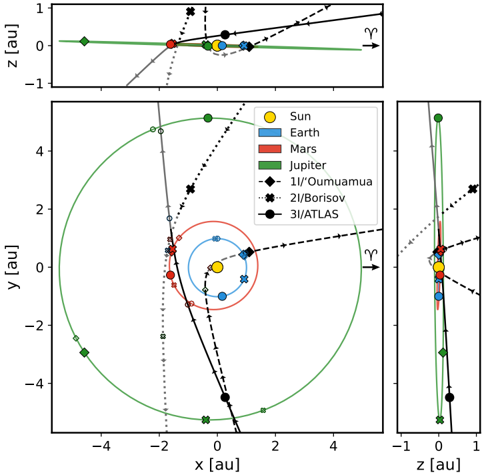
We report initial observations aimed at the characterization of a third interstellar object. This object, 3I/ATLAS or C/2025 N1 (ATLAS), was discovered on 2025 July 1 UT and has an orbital eccentricity of e ∼ 6.1, perihelion of q ∼ 1.36 au, inclination of ∼175°, and hyperbolic velocity of V ∞ ∼ 58 km s −1 . We report deep stacked images obtained using the Canada–France–Hawaii Telescope and the Very Large Telescope that resolve a compact coma. Using images obtained from several smaller ground-based telescopes, we find minimal light-curve variation for the object over a ∼4 day time span. The visible/near-infrared spectral slope of the object is 17.1% ± 0.2%/100 nm, comparable to other interstellar objects and primitive solar system small bodies (comets and D-type asteroids). Moreover, 3I/ATLAS will be observable through early 2025 September, then unobservable by Earth-based observatories near perihelion due to low solar elongation. It will be observable again from the ground in late 2025 November. Although this limitation unfortunately prohibits detailed Earth-based observations at perihelion when the activity of 3I/ATLAS is likely to peak, spacecraft at Mars could be used to make valuable observations at this time.
Overview
CoChat Summary
TL;DR
3I/ATLAS is the third interstellar object discovered, with a strongly hyperbolic orbit (e ≈ 6.1, q ≈ 1.36 au, i ≈ 175°, v∞ ≈ 58 km s⁻¹) and a compact coma resolved by CFHT and VLT imaging. Preliminary photometry and spectroscopy show minimal light-curve variation over ~4 days and a moderately red spectral slope of 17.1% ± 0.2%/100 nm, similar to primitive solar system small bodies and other interstellar objects.
Key findings
- Discovery and orbit: 3I/ATLAS was discovered on 2025 July 1 UT by ATLAS Chile; an orbit fit using astrometry from 2025 May 22 to July 6 gives e = 6.1329072 ± 0.0162018, q = 1.3558541 ± 0.0019855 au, i = 175.11239 ± 0.00089°, and incoming v∞ = 57.942 ± 0.049 km s⁻¹, with barycentric e_b = 6.144 ± 0.016 and q_b = 1.3611 ± 0.0020 au.
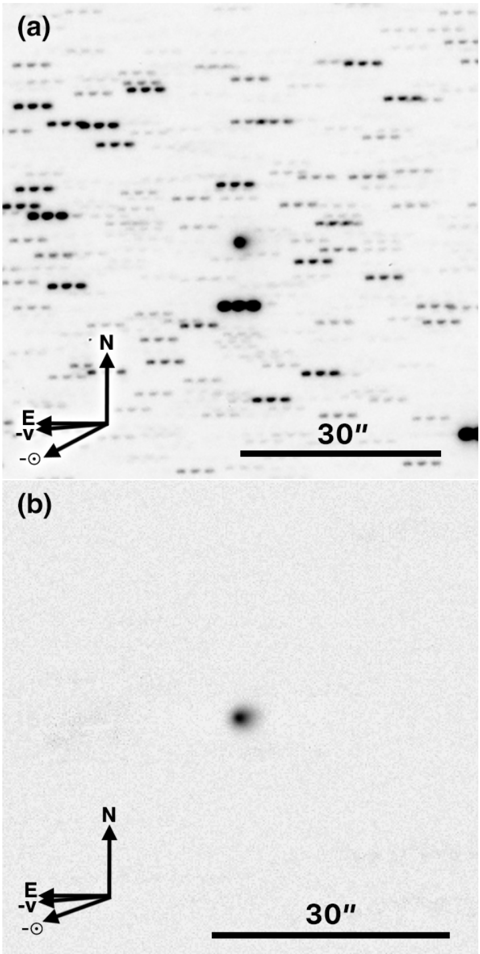
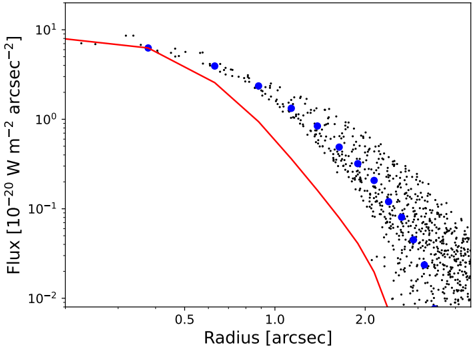
- Activity: CFHT and VLT stacked images resolve a compact coma; the VLT photometric profile shows a brightness excess extending over 4.0″ compared to field stars, with object FWHM 1.49 × 1.29 and elongation at PA 277°, coma out to 3.5″; CFHT object FWHM was 1.29 ± 0.02 versus stellar 0.72 ± 0.05.
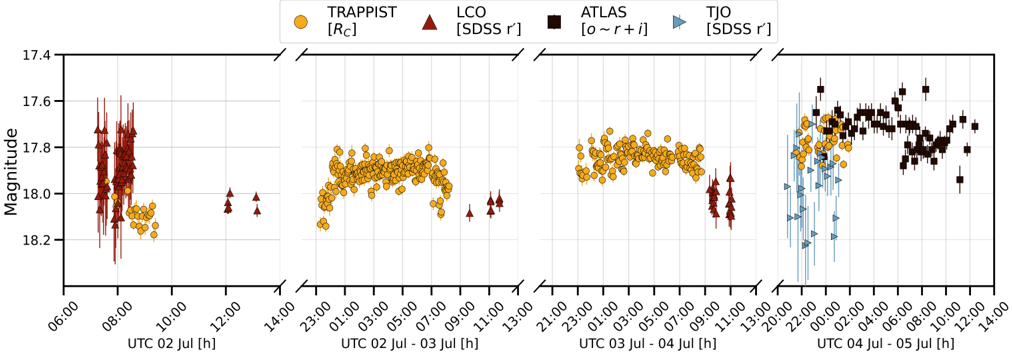
- Light curve: no periodicity is immediately apparent, with little brightness variation ≲0.2 mag over ~4 days, in contrast to 1I/‘Oumuamua’s ~3.5 mag; a 13 hr continuous ATLAS light curve agrees with a tentative 16.79 hr period and 0.08 mag amplitude reported by de la Fuente Marcos et al. (2025).
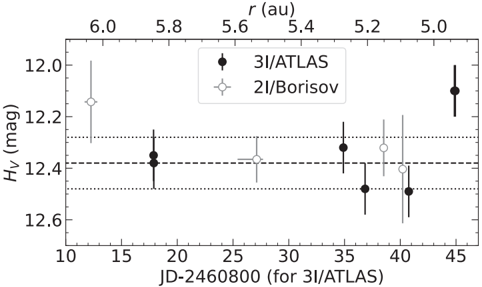
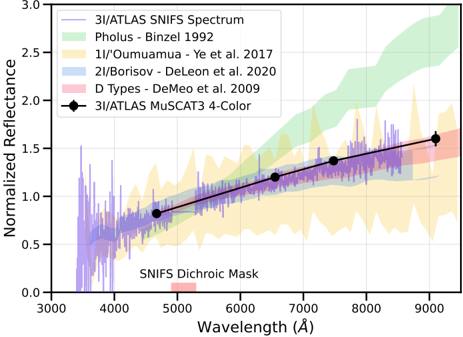
- Colors and spectrum: the SNIFS reflectance spectrum yields 17.1% ± 0.2%/100 nm; MuSCAT3 colors are g−r = 0.85 ± 0.03, r−i = 0.25 ± 0.03, and i−z = 0.20 ± 0.08, giving ~18%/100 nm, similar to 1I/‘Oumuamua (10% ± 6%/100 nm), 2I/Borisov (12% ± 1%/100 nm), and D-type asteroids. ZTF precovery photometry gives median H_V ~12.4 ± 0.1, with 2025 June 18 H_V = 12.1 ± 0.1 and LCO r-band data corresponding to H_V = 11.9, suggesting about 0.5 mag of excess brightening since early June; H_V = 12.4 ± 0.1 corresponds to a radius of ~10 ± 1 km for p_V = 0.05, as an upper limit.
Methods
- Discovery and follow-up observations used ATLAS Chile/Hawai‘i/Sutherland/Canary Islands, CFHT/MegaCam, VLT/FORS2, LCO 0.35 m telescopes, FTN/FTS, TRAPPIST-North/South, TJO, and the ATLAS network; spectroscopy used SNIFS on the UH 2.2 m telescope, and colors used MuSCAT3 on FTN.
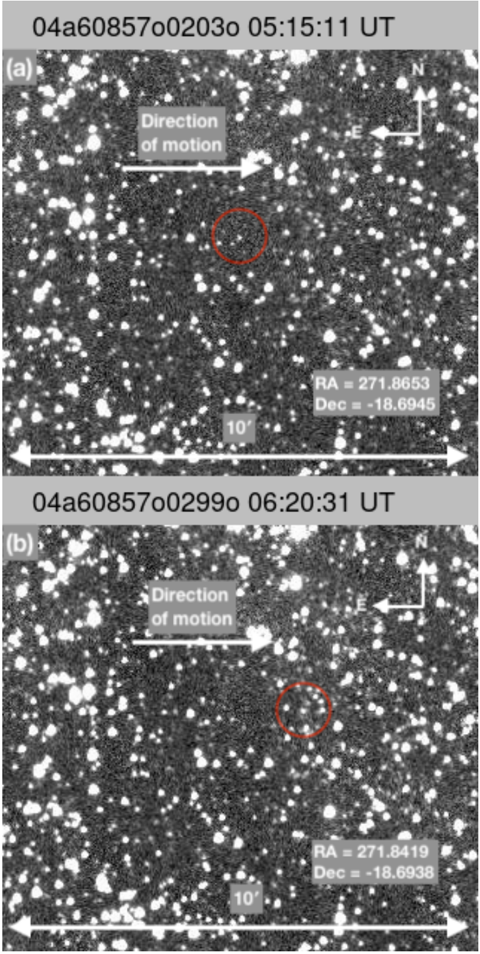
- Orbit fitting used astrometry from 2025 May 22 to 2025 July 6, including VLT astrometry better than ±0.1 and LCO/FTN/FTS astrometry better than ±0.25, with Gaia DR3 as the reference catalog.
- Light-curve and color analysis used time-series photometry from 2025 July 2–5, ZTF precovery photometry from 2025 May 22 to June 18, aperture photometry and PSF-based forced photometry, and spectral slope measurements from SNIFS and MuSCAT3 colors.
Limitations
- Stated: ZTF precovery data had no reported uncertainties, so the standard deviation of points from May 22 to June 14 was adopted as an approximate uncertainty; the CFHT magnitude was considered unreliable due to a crowded field; PSF-based forced photometry may underreport the brightness of extended sources; the G = 0.15 phase function may be inappropriate for an object with unknown coma and surface scattering, potentially making the density estimate significantly incorrect; H_V was measured when active, so the limiting search volume corresponds to the inert nucleus; perihelion will not be easily observable from Earth-based observatories due to low solar elongation and the object being on the opposite side of the Sun.
- Evident from the text: the characterization is preliminary, based on a short arc and limited time span; activity and coma can suppress rotational light-curve variations and contaminate colors, and the later, redder colors may be heavily affected by ejected dust; more detailed light-curve analysis is deferred to future work.
Model-written summary. Check it against the paper before relying on it.
Integrity signals
Registry
Cites
Statistics
Figures
Verification
Claims the paper makes
0 Valid · 2 Not valid · 14 Not checked · 50 Own results and interpretations
A result the paper states — it cites no source for it, so there is none to check. The quote shows it is in the paper.
In the paper
“hyperbolic velocity of V ∞ ∼ 58 km s -1”
- Also stated in: § Note. · plain
“results in an incoming velocity v ∞ = (57.942± 0.049) km s -1”
§ Discovery and Preliminary Characterization of a Third Interstellar Object: 3I/ATLAS > Abstract
plain- Asserted: passes — The authors put it forward as true.
- Checkable: passes — It can be checked against evidence.
- Load-bearing: passes — The paper’s conclusions depend on it.
- Based: passes — The paper gives a reason why it holds.
- Also stated in: § Note. · plain
A result the paper reports from its own data — it cites no other source for it, so there is none to check. The quote shows it is in the paper.
In the paper
“This value, together with an incoming pericenter distance of q b = (1.3611± 0.0020) au”
§ Discovery and Preliminary Characterization of a Third Interstellar Object: 3I/ATLAS > Note.
plain- Asserted: passes — The authors put it forward as true.
- Checkable: passes — It can be checked against evidence.
- Load-bearing: passes — The paper’s conclusions depend on it.
- Based: passes — The paper gives a reason why it holds.
A result the paper reports from its own data — it cites no other source for it, so there is none to check. The quote shows it is in the paper.
In the paper
“Prediscovery detections from 2025 June 28 to 29 were identified in Zwicky Transient Facility (ZTF; E. C. Bellm et al. 2019; M. J. Graham et al. 2019) survey data 6 hr after the initial detection by ATLAS on 2025 July 1, extending the orbital arc from 3.3 hr to 3 days.”
§ Discovery and Preliminary Characterization of a Third Interstellar Object: 3I/ATLAS > 2.1. Discovery
plainstates a cause- Asserted: passes — The authors put it forward as true.
- Checkable: passes — It can be checked against evidence.
- Load-bearing: passes — The paper’s conclusions depend on it.
- Based: passes — The paper gives a reason why it holds.
A result the paper reports from its own data — it cites no other source for it, so there is none to check. The quote shows it is in the paper.
In the paper
“perihelion of q ∼ 1.36 au”
§ Discovery and Preliminary Characterization of a Third Interstellar Object: 3I/ATLAS > Abstract
plain- Asserted: passes — The authors put it forward as true.
- Checkable: passes — It can be checked against evidence.
- Load-bearing: unclear — It is unclear whether the paper’s conclusions depend on it.
- Based: passes — The paper gives a reason why it holds.
A result the paper reports from its own data — it cites no other source for it, so there is none to check. The quote shows it is in the paper.
In the paper
“Figure 3(a) shows the stacked composite image of these data in which faint activity is visible.”
§ Discovery and Preliminary Characterization of a Third Interstellar Object: 3I/ATLAS > 3.1. Activity
plain- Asserted: passes — The authors put it forward as true.
- Checkable: passes — It can be checked against evidence.
- Load-bearing: passes — The paper’s conclusions depend on it.
- Based: passes — The paper gives a reason why it holds.
31 more claims
Create a free account to see all 66 claims and to verify the 23 references still open.
- It may state two separate claims as one. 25
- Probably not a substantial claim. 8
- The quote only partly states this claim. 1
Self-check
Percentages, sums and reported differences re-computed from the paper’s own numbers.
Each contradiction between two passages listed here was confirmed by an independent check.
Rated minor: it would not touch a result — a value no result rests on, a p-value that stays on the same side of the significance level, or a conflict that is clerical, resolved elsewhere in the paper, or outside its own findings.
In the paper
§ Discovery and Preliminary Characterization of a Third Interstellar Object: 3I/ATLAS > 4. Discussion
“Figure 4. Photometric profile of the VLT image (Figure 3(a)).”
§ Discovery and Preliminary Characterization of a Third Interstellar Object: 3I/ATLAS > 4. Discussion
“(a) Stacked gri-band image cut out from CFHT on 2025 July 2 and (b) R-band composite image from VLT on 2025 July 4, both showing faint activity.”
Rated minor: it would not touch a result — a value no result rests on, a p-value that stays on the same side of the significance level, or a conflict that is clerical, resolved elsewhere in the paper, or outside its own findings.
In the paper
§ Discovery and Preliminary Characterization of a Third Interstellar Object: 3I/ATLAS > 4. Discussion
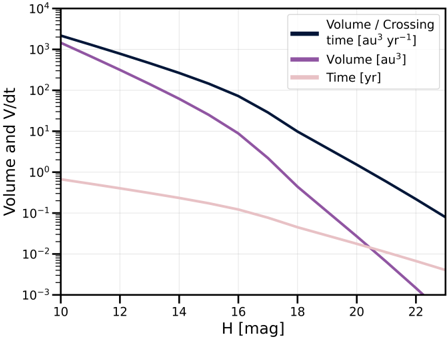
“In this case since H V of 3I/ATLAS was measured when active, this limiting search volume corresponds to the absolute brightness of the inert nucleus.”
§ Discovery and Preliminary Characterization of a Third Interstellar Object: 3I/ATLAS > 3.1. Activity
“For reference, H V = 12.4 ± 0.1 corresponds to a radius of ∼(10 ± 1) km for a geometric albedo of p V = 0.05 typical of comets, but this is an upper limit, given that the object was active during the observations used to derive this result.”
Citations
Cites
Gaia Data Release 3: Summary of the content and survey properties
Gaia Collaboration, Vallenari, A., Brown, A. G. A., Prusti, T., de Bruijne, J. H. J., Arenou, F., Babusiaux, C., Biermann, M., Creevey, O. L., Ducourant, C., et al. (2023) · Astronomy & Astrophysics · doi:10.1051/0004-6361/202243940 · Cited by 4,181
The Zwicky Transient Facility: System Overview, Performance, and First Results
Bellm, E. C., Kulkarni, S. R., Graham, M. J., Dekany, R., Smith, R. M., Riddle, R., Masci, F. J., Helou, G., Prince, T. A., Adams, S. M., et al. (2019) · Publications of the Astronomical Society of the Pacific · doi:10.1088/1538-3873/aaecbe · Cited by 2,065 · cited 2×
“Prediscovery detections from 2025 June 28 to 29 were identified in Zwicky Transient Facility ( ZTF; E. C. Bellm et al. 2019; M. J. Graham et al. 2019 ) survey data 6 hr after the initial detection by ATLAS on 2025 July 1, extending the orbital arc from 3.3 hr to 3 days.”
InfluentialSelf-citationATLAS: A High-cadence All-sky Survey System
Tonry, J. L., Denneau, L., Heinze, A. N., Stalder, B., Smith, K. W., Smartt, S. J., Stubbs, C. W., Weiland, H. J., & Rest, A. (2018) · Publications of the Astronomical Society of the Pacific · doi:10.1088/1538-3873/aabadf · Cited by 1,229 · cited 4×
“Therefore we adopt this standard deviation as an approximate uncertainty level for all ZTF photometry reported here for 3I / ATLAS based on the scatter in the available photometric points between 2025 May 22 and June 14.”
InfluentialSelf-citationAn extension of the Bus asteroid taxonomy into the near-infrared
DeMeo, F. E., Binzel, R. P., Slivan, S. M., & Bus, S. J. (2009) · Icarus · doi:10.1016/j.icarus.2009.02.005 · Cited by 941 · cited 2×
“It is similar, though somewhat redder, to that retrieved for 1I / “Oumuamua ( 10% ± 6% / 100 nm, Q.-Z. Ye et al. 2017 ) and 2I / Borisov ( 12% ± 1% / 100 nm J. de León et al. 2020 ) , both of which are slightly redder than the D-type asteroids ( F. E. DeMeo et al. 2009 ) .”
The Zwicky Transient Facility: Science Objectives
Graham, M. J., Kulkarni, S. R., Bellm, E. C., Adams, S. M., Barbarino, C., Blagorodnova, N., Bodewits, D., Bolin, B., Brady, P. R., Cenko, S. B., et al. (2019) · Publications of the Astronomical Society of the Pacific · doi:10.1088/1538-3873/ab006c · Cited by 832 · cited 2×
“Prediscovery detections from 2025 June 28 to 29 were identified in Zwicky Transient Facility ( ZTF; E. C. Bellm et al. 2019; M. J. Graham et al. 2019 ) survey data 6 hr after the initial detection by ATLAS on 2025 July 1, extending the orbital arc from 3.3 hr to 3 days.”
InfluentialSelf-citationThe Pan-STARRS1 Database and Data Products
Flewelling, H. A., Magnier, E. A., Chambers, K. C., Heasley, J. N., Holmberg, C., Huber, M. E., Sweeney, W., Waters, C. Z., Calamida, A., Casertano, S., et al. (2020) · The Astrophysical Journal Supplement Series · doi:10.3847/1538-4365/abb82d · Cited by 646 · cited 2×
“TRAPPIST-North ( TN; MPC code Z53 ) is located at the Oukaimeden observatory in Morocco, and TRAPPIST-South ( TS; MPC code I40 ) is located at the ESO La Silla Observatory in Chile.”
InfluentialSelf-citationEmpirical color transformations between SDSS photometry and other photometric systems
Jordi, K., Grebel, E. K., & Ammon, K. (2006) · Astronomy & Astrophysics · doi:10.1051/0004-6361:20066082 · Cited by 581 · cited 1×
“We compute inferred V -band absolute magnitude from these data assuming a standard asteroidal phase function ( E. Bowell et al. 1989 ) assuming G = 0.15 and solar colors ( J. Holmberg et al. 2006; K. Jordi et al. 2006 ) .”
InfluentialA brief visit from a red and extremely elongated interstellar asteroid
Meech, K. J., Weryk, R., Micheli, M., Kleyna, J. T., Hainaut, O. R., Jedicke, R., Wainscoat, R. J., Chambers, K. C., Keane, J. V., Petric, A., et al. (2017) · Nature · doi:10.1038/nature25020 · Cited by 424
Self-citationDesign and Operation of the ATLAS Transient Science Server
Smith, K. W., Smartt, S. J., Young, D. R., Tonry, J. L., Denneau, L., Flewelling, H., Heinze, A. N., Weiland, H. J., Stalder, B., Rest, A., et al. (2020) · Publications of the Astronomical Society of the Pacific · doi:10.1088/1538-3873/ab936e · Cited by 357 · cited 2×
“Therefore we adopt this standard deviation as an approximate uncertainty level for all ZTF photometry reported here for 3I / ATLAS based on the scatter in the available photometric points between 2025 May 22 and June 14.”
Self-citationMegaCam: the new Canada-France-Hawaii Telescope wide-field imaging camera
Boulade, O., Charlot, X., Abbon, P., Aune, S., Borgeaud, P., Carton, P.-H., Carty, M., Da Costa, J., Deschamps, H., Desforge, D., et al. (2003) · SPIE Proceedings · doi:10.1117/12.459890 · Cited by 280
Research works printed but not linked: 10
- Alarcon, M. R., Serra-Ricart, M., Licandro, J., et al. 2025, ATel, 17264, 1A
- Biver, N., Dello Russo, N., Opitom, C., & Rubin, M. 2024, in Comets III, ed. K. J. Meech et al. (University of Arizona Press), 459
- Borisov, G., Durig, D. T., Sato, H., et al. 2019, Comet C/2019 Q4 (Borisov), Central Bureau Electronic Telegrams, 4666, 1
- Bowell, E., Hapke, B., Domingue, D., et al. 1989, in Asteroids II (Tucson, AZ: Univ. of Arizona Press), 524
- de la Fuente Marcos, R., Licandro, J., Alarcon, M. R., et al. 2025, arXiv:2507. 12922
- Fitzsimmons, A., Meech, K., Matrà, L., & Pfalzner, S. 2024, in Comets III, ed. K. J. Meech et al. (Tucson, AZ: Univ. of Arizona Press), 731
- Jehin, E., Gillon, M., Queloz, D., et al. 2011, Msngr, 145, 2
- Jewitt, D., & Luu, J. 2025, ATel, 17263, 1J
- Kolokolova, L., Kelley, M. S. P., Kimura, H., & Hoang, T. 2024, in Comets III, ed. K. J. Meech et al. (Tucson, AZ: Univ. of Arizona Press), 621
- Yang, B., Meech, K. J., Connelley, M., & Keane, J. V. 2025, arXiv:2507. 14916
Cited by
Items 101–123 of 123
Solar System TechnosignaturesPreprint
Lazio, T. J. W. (2026) · arXiv · doi:10.48550/arxiv.2606.13797 · Cited by 1
A High-Likelihood Polar Interstellar Meteor CandidatePreprint
Cloete, R., & Loeb, A. (2026) · arXiv · doi:10.48550/arxiv.2606.04379 · Cited by 1
Multi-Wavelength Post-Perihelion Polarimetry of Interstellar Comet 3I/ATLASPreprint
Gray, Z., Borisov, G., Kolokolova, L., Markkanen, J., Kwon, Y. G., Bagnulo, S., Cellino, A., Dorsey, R. C., Fedorets, G., Granvik, M., et al. (2026) · arXiv · doi:10.48550/arxiv.2609.04932 · Cited by 1
Self-citationMultiband Color Monitoring of 3I/ATLAS through Ground-Based Relay ObservationsPreprint
Graykowski, A., Bolin, B., Abron, L.-M., Marchis, F., Mašek, M., Romanov, F. D., Abdelaziz, A. M., Athanasopoulos, D., Belyakov, M., Buzzi, L., et al. (2026) · arXiv · doi:10.48550/arxiv.2609.22021 · Cited by 1
Sky-plane velocity distributions of interstellar objects and implications for their detection
Walker, C., & Seligman, D. Z. (2026) · Monthly Notices of the Royal Astronomical Society · doi:10.1093/mnras/stag1866
Self-citation1I/'Oumuamua-like objects's SFDs with older, current and future surveysPreprint
Albornoz-Montenegro, R., & Fuentes, C. (2026) · arXiv · doi:10.48550/arxiv.2609.25488
Gerard, D. (2026) · arXiv · doi:10.48550/arxiv.2607.25007
“…objects (ISOs) passing through the Solar System: 1I/’Oumuamua was discovered on 19 October 2017 [Williams et al., 2017, Meech et al., 2017], 2I/Borisov on 30 August 2019 [Borisov et al., 2019, Guzik et al., 2020], and 3I/ATLAS on 1 July 2025 [Denneau et al., 2025, Seligman et al., 2025].”
The Trajectory of 3I/ATLAS Through the Inner Solar System: Close Encounters and Possible Collisions
Pomazan, A. V., Guo, Y., Maigurova, N., Feng, F., Tang, Z., & Mao, Y. D. (2026) · The Astronomical Journal · doi:10.3847/1538-3881/ae2ea6
A New Mechanics That Is Symmetrical to the Present Classical MechanicsPreprint
Wang, H. (2025) · Preprints.org · doi:10.20944/preprints202512.0639.v2
A browser based three dimensional simulator for comet dust tail modeling
Balodis, M., Jasmonts, G., Arshad, A., & Slavinskis, A. (2026) · Astronomy and Computing · doi:10.1016/j.ascom.2026.101200
The Jupiter ICy moons Explorer (JUICE) Mission: Post-Launch Status and Mission Overview
Witasse, O. G., Sarri, G., Erd, C., Garé, P., Altobelli, N., Vallat, C., Martínez, S., Lorente, R., Dietz, A., Boutonnet, A., et al. (2026) · Space Science Reviews · doi:10.1007/s11214-026-01336-0
“The interstellar object 3I/ATLAS passed through our solar system in 2025 (Seligman et al. 2025; Eubanks et al. 2025), and due to its exceptional nature, a dedicated observation campaign was conducted in November 2025 immediately after perihelion, yielding a unique dataset.”
Candidate Captured Interstellar Objects in the Solar SystemPreprint
Marquardt-Demen, R., Li, G., & Wray, J. J. (2025) · arXiv · doi:10.48550/arxiv.2509.05905
Self-citationDynamical Constraints on a Population of Massive Interstellar ObjectsPreprint
Trivedi, O., & Loeb, A. (2025) · arXiv · doi:10.48550/arxiv.2509.06300
Closing the Technosignature Gap: A Policy Framework for Rebalancing Astrobiology InvestmentPreprint
Eldadi, O., Tenenbaum, G., & Loeb, A. (2026) · SSRN Electronic Journal · doi:10.2139/ssrn.6444296
Inbound evolution of 21 long period comets
Bertini, I., Fulle, M., Epifani, E. M., Fiscale, S., Inno, L., Rotundi, A., Tubiana, C., Corte, V. D., Ferrigno, F., Magliano, C., et al. (2026) · Monthly Notices of the Royal Astronomical Society · doi:10.1093/mnras/stag550
Netchitailo, V. S. (2026) · Journal of High Energy Physics Gravitation and Cosmology · doi:10.4236/jhepgc.2026.124106
Dust activity of interstellar comet 3I/ATLAS (C/2025 N1) at 4.3–4.5 au from VLT/FORS2 imaging
Pratik, P. (2026) · Monthly Notices of the Royal Astronomical Society · doi:10.1093/mnras/stag867
Calibration of CNEOS fireball velocities and the robustness of nominally hyperbolic events
Duran, V., & Loeb, A. (2026) · New Astronomy · doi:10.1016/j.newast.2026.102688
“We use the size-distribution families assembled by Peña-Asensio & Seligman (2025) as a prior-predictive consistency calculation, not as a source of definitive event-level posterior probabilities.”
Polarimetric and Photometric Characteristics of the Interstellar Comet 3I/ATLAS: Main Features
Kiselev, N., Shcherbina, M. P., Petrov, D., Zhuzhulina, E., Chazov, M., Karpov, N., Shein, A., Salakhotdinova, A., Sokolov, I., Andreev, D., et al. (2026) · Solar System Research · doi:10.1134/s0038094626600678
“Early observations of 3I/ATLAS revealed that the object has a compact coma, low short-term photometric variability, and a moderately red spectrum, generally similar to the spectra of primitive small Solar System bodies and previously discovered interstellar objects (Seligman et al., 2025).”
Tadjimuratov, P. (2026) · The Planetary Science Journal · doi:10.3847/psj/aeac2c
“Early observations established a strongly hyperbolic orbit and resolved a compact coma, while several days of near-discovery photometry showed only modest variability ( D. Z. Seligman 2025 ) .”
A Survivor from the Margins: Hypatia Stone and the Hidden Diversity of Solar System Solids
Bindi, L., Morelli, M., & Andreoli, M. A. G. (2026) · Space Science Reviews · doi:10.1007/s11214-026-01333-3
“…et al. 2017), the CO-rich cometary planetesimal 2I/Borisov (Bodewits et al. 2020; Cordiner et al. 2020), the C-rich volatile-rich object 3I/ATLAS (Seligman et al. 2025; Cordiner et al. 2025), and the high-strength candidate interstellar meteor CNEOS 2014-01-08 (Siraj and Loeb 2022)—sample…”
Gravitational Capture of Large Interstellar Planetesimals by Collapsing Prestellar CoresPreprint
Anderson, R., & Silsbee, K. (2026) · arXiv · doi:10.48550/arxiv.2611.00537
“So far, there have been detections of three such interstellar objects (which we term “planetesimals” in the context of this paper), each a few hundred meters in size, passing through our solar system (K. J. Meech et al. 2017; P. Guzik et al. 2020; D. Z. Seligman et al. 2025).”
Hydrogen cyanide volatile in comet 3I/ATLAS
Wang, Z. (2026) · Monthly Notices of the Royal Astronomical Society · doi:10.1093/mnras/stag2258
Metadata
- Authors
- Seligman, D. Z., Micheli, M., Farnocchia, D., Denneau, L., Noonan, J. W., Hsieh, H. H., Santana-Ros, T., Tonry, J., Auchettl, K., Conversi, L., Devogèle, M., Faggioli, L., Feinstein, A. D., Fenucci, M., Ferrais, M., Frincke, T., Gillon, M., Hainaut, O. R., Hart, K., Hoffman, A., Holt, C. E., Hoogendam, W. B., Huber, M. E., Jehin, E., Kareta, T., Keane, J. V., Kelley, M. S. P., Lister, T., Mandt, K., Manfroid, J., Marčeta, D., Meech, K. J., Amine Miftah, M., Morgan, M., Ocaña, F., Peña-Asensio, E., Shappee, B. J., Siverd, R. J., Taylor, A. G., Tucker, M. A., Wainscoat, R., Weryk, R., Wray, J. J., Yaginuma, A., Yang, B., Ye 叶, Q. 泉., & Zhang, Q.
- Affiliations
- Michigan State University (US)
- Jet Propulsion Laboratory (US)
- University of Hawaiʻi at Mānoa (US)
- Auburn University (US)
- Planetary Science Institute (US)
- University of Alicante (ES)
- The University of Melbourne (AU)
- University of Central Florida (US)
- University of Liège (BE)
- European Southern Observatory (DE)
- Las Cumbres Observatory Global Telescope Network (US)
- Lowell Observatory (US)
- U.S. National Science Foundation (US)
- University of Maryland, College Park (US)
- Goddard Space Flight Center (US)
- University of Belgrade (RS)
- University of California, Santa Barbara (US)
- University of Michigan (US)
- The Ohio State University (US)
- Western University (CA)
- Georgia Institute of Technology (US)
- Universidad Diego Portales (CL)
- ORCID
- Seligman, Darryl Z.
- Micheli, Marco
- Farnocchia, Davide
- Denneau, Larry
- Noonan, John W.
- Hsieh, Henry H.
- Santana-Ros, Toni
- Tonry, John
- Auchettl, Katie
- Conversi, Luca
- Devogèle, Maxime
- Faggioli, Laura
- Feinstein, Adina D.
- Fenucci, Marco
- Ferrais, Marin
- Frincke, Tessa
- Gillon, Michael
- Hainaut, Olivier R.
- Hart, Kyle
- Hoffman, Andrew
- Holt, Carrie E.
- Hoogendam, Willem B.
- Huber, Mark E.
- Jehin, Emmanuel
- Kareta, Theodore
- Keane, Jacqueline V.
- Kelley, Michael S. P.
- Lister, Tim
- Mandt, Kathleen
- Manfroid, Jean
- Marčeta, Dušan
- Meech, Karen J.
- Amine Miftah, Mohamed
- Morgan, Marvin
- Ocaña, Francisco
- Peña-Asensio, Eloy
- Shappee, Benjamin J.
- Siverd, Robert J.
- Taylor, Aster G.
- Tucker, Michael A.
- Wainscoat, Richard
- Weryk, Robert
- Wray, James J.
- Yaginuma, Atsuhiro
- Yang, Bin
- Ye 叶, Quanzhi 泉志
- Zhang, Qicheng
- Venue
- The Astrophysical Journal Letters
- Publisher
- American Astronomical Society
- Published
- 2025-08-13
- Volume
- 989
- Issue
- 2
- Pages
- L36
- ISSN
- 2041-8205 (ISSN-L)
- 2041-8213
- OpenAlex
- W6947763008
- Cited by
- 123
- References
- 73
- Citations by year
- 2026: 88 · 2025: 35
- FWCI
- 56.49
- Type
- journal article
- Language
- en
- Open access
- gold
- doi.org
- Licence
- cc-by
- creativecommons.org/licenses/by/4.0/ (vor)
- iopscience.iop.org/info/page/text-and-data-mining (tdm)
- Locations
- The Astrophysical Journal Letters (publishedVersion, cc-by)
- ORBi (University of Liège) (acceptedVersion, other-oa)
- DOAJ (DOAJ: Directory of Open Access Journals) (submittedVersion)
- Funders
- National Science Foundation (AST-2303553, AST-2407205, 1842402 and 2236415)
- National Aeronautics and Space Administration (80NM0018D0004, HST-HF2-51530.001-A, HST-GO-17087, NN12AR55G)
- Ministerio de Ciencia e Innovación (PGC2021)
- Simons Foundation (SFI-PD-Pivot Mentor-00009672)
- Hertz Foundation (NA)
- Science Fund of the Republic of Serbia (7453)
- Topics
- Physical Sciences › Earth and Planetary Sciences › Space and Planetary Science › Astro and Planetary Science
- Physical Sciences › Physics and Astronomy › Astronomy and Astrophysics › Stellar, planetary, and galactic studies
- Physical Sciences › Engineering › Aerospace Engineering › Space Satellite Systems and Control
- Keywords
- 3I/ATLAS, interstellar objects, comet discovery, light curves, spectral slope, orbital elements, solar elongation
About these checks
Registry, retraction, Cites and statistics results are computed, not judged, with one exception: a printed reference that no index lists is read once by a model before it counts as a citation error. Claims are extracted by a model and kept only when their quote appears verbatim in the text; each cited source is then checked, with a model’s help, for whether it says what the claim relies on. Those verdicts can be wrong — read the claim’s quote and the cited source before relying on one.
A language model drew the claims from the paper on 2026-11-28, under version 3 of the claim definition (model deepseek-v4.1-flash, prompt extract-v3).
A second model labelled each claim on 2026-11-28 (model jev-1.13-20260917, definition revision gold-guideline-v0.2).
Statistics and arithmetic are recomputed, not judged.
Confidence bands are shown only for fields calibrated on our annotated test set. None is calibrated yet, so no band is shown.
What counts as a claim ›How we measure confidence ›How we check this ›
Are you an author, or do you see a problem with this page? Request a review
Data sources
Bibliographic data: Semantic Scholar, OpenAlex, Crossref.
Contains information from the Semantic Scholar Academic Graph Datasets, made available under the ODC Attribution License (ODC-BY 1.0).
Semantic Scholar’s data is described in: Kinney, R., et al. (2023). The Semantic Scholar Open Data Platform. arXiv:2301.10140.
