

The DOI matches its Crossref record; 113 of the 114 references it cites were found in a registry or an index.
Genomic Basis for Methicillin Resistance in Staphylococcus aureus
Open accessAbstract
Since the discovery of the first strain in 1961 in England, MRSA, the most notorious multidrug-resistant hospital pathogen, has spread all over the world. MRSA repeatedly turned down the challenges by number of chemotherapeutics, the fruits of modern organic chemistry. Now, we are in short of effective therapeutic agents against MRSA prevailing among immuno-compromised patients in the hospital. On top of this, we recently became aware of the rise of diverse clones of MRSA, some of which have increased pathogenic potential compared to the classical hospital-associated MRSA, and the others from veterinary sources. They increased rapidly in the community, and started menacing otherwise healthy individuals by causing unexpected acute infection. This review is intended to provide a whole picture of MRSA based on its genetic makeup as a versatile pathogen and our tenacious colonizer.
Overview
The claims and statistics of this paper haven’t been checked yet.
Run the check — free, no account needed. It reads the open-access text and checks the sources it cites.
Integrity signals
Registry
Cites
Statistics
Figures
Verification
Claims the paper makes
The claims and statistics of this paper haven’t been checked yet.
Run the check — free, no account needed. It reads the open-access text and checks the sources it cites.
Claims other papers make about this one
Each is checked against this paper’s own text: does it say what the citing paper says it does?
In the citing paper
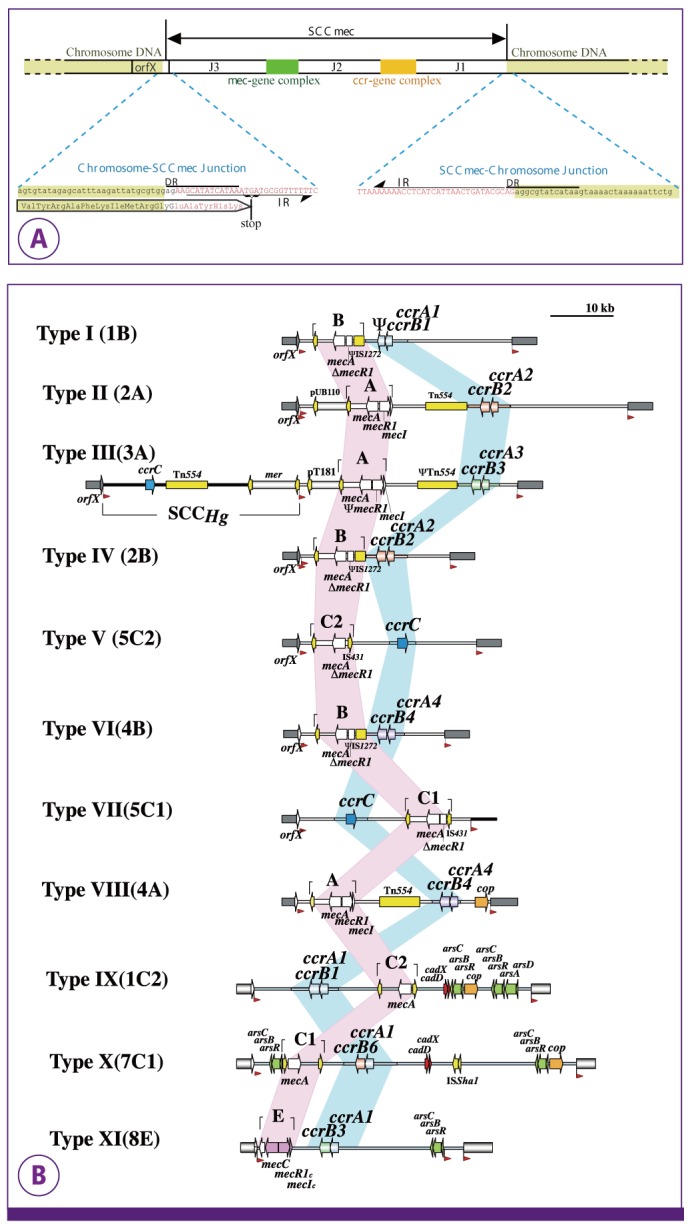
“To date, 11 different SCCmec allotypes have been described with varying degrees of genetic homology and different sizes, insertion sequences and accompanying resistance genes (68, 69).”
From Mechanisms of Antibiotic Resistance (2016) · cites this paper as [68]
Self-check
Percentages, sums and reported differences re-computed from the paper’s own numbers.
The self-check needs the paper’s full text.
Citations
Cites
Methicillin-resistant Staphylococcus aureus clinical strain with reduced vancomycin susceptibility
Hiramatsu, K. (1997) · Journal of Antimicrobial Chemotherapy · doi:10.1093/jac/40.1.135 · Cited by 1,984
Self-citationWhole genome sequencing of meticillin-resistant Staphylococcus aureus
Kuroda, M., Ohta, T., Uchiyama, I., Baba, T., Yuzawa, H., Kobayashi, I., Cui, L., Oguchi, A., Aoki, K.-I., Nagai, Y., et al. (2001) · The Lancet · doi:10.1016/s0140-6736(00)04403-2 · Cited by 1,950
Self-citation"Celbenin" - resistant Staphylococci
Jevons, M. P. (1961) · BMJ · doi:10.1136/bmj.1.5219.124-a · Cited by 1,730
Diep, B. A., Gill, S. R., Chang, R. F., Phan, T. H., Chen, J. H., Davidson, M. G., Lin, F., Lin, J., Carleton, H. A., Mongodin, E. F., et al. (2006) · The Lancet · doi:10.1016/s0140-6736(06)68231-7 · Cited by 1,633
The evolutionary history of methicillin-resistant Staphylococcus aureus (MRSA)
Enright, M. C., Robinson, D. A., Randle, G. A., Feil, E. J., Grundmann, H., & Spratt, B. G. (2002) · Proceedings of the National Academy of Sciences · doi:10.1073/pnas.122108599 · Cited by 1,591
The Changing Epidemiology of Staphylococcus aureus ?
Chambers, H. F. “. (2001) · Emerging infectious diseases · doi:10.3201/eid0702.010204 · Cited by 1,419
Genome and virulence determinants of high virulence community-acquired MRSA
Baba, T., Takeuchi, F., Kuroda, M., Yuzawa, H., Aoki, K.-I., Oguchi, A., Nagai, Y., Iwama, N., Asano, K., Naimi, T. S., et al. (2002) · The Lancet · doi:10.1016/s0140-6736(02)08713-5 · Cited by 1,356
Self-citationInfection with Vancomycin-Resistant Staphylococcus aureus Containing the vanA Resistance Gene
Chang, S., Sievert, D. M., Hageman, J. C., Boulton, M. L., Tenover, F. C., Downes, F. P., Shah, S., Rudrik, J. T., Pupp, G. R., Brown, W. J., et al. (2003) · New England Journal of Medicine · doi:10.1056/nejmoa025025 · Cited by 1,095
Katayama, Y., Ito, T., & Hiramatsu, K. (2000) · Antimicrobial Agents and Chemotherapy · doi:10.1128/aac.44.6.1549-1555.2000 · Cited by 1,042
Self-citationGill, S. R., Fouts, D. E., Archer, G. L., Mongodin, E. F., DeBoy, R. T., Ravel, J., Paulsen, I. T., Kolonay, J. F., Brinkac, L. M., Beanan, M., et al. (2005) · Journal of Bacteriology · doi:10.1128/jb.187.7.2426-2438.2005 · Cited by 1,026
Research works printed but not linked: 4
- Baba, 2004, Molecular and Clinical Aspects, 66
- Hiramatsu, Molecular Evolution of MRSA 2010, 11
- Williamson, 1985, J Gen Microbiol, 131, 1933
- Aiba, Antimicrob Agents Chemother
Cited by
Sorted by citations
Mechanisms of Antibiotic Resistance
Munita, J. M., & Arias, C. A. (2016) · Microbiology Spectrum · doi:10.1128/microbiolspec.vmbf-0016-2015 · Cited by 2,782
What is a resistance gene? Ranking risk in resistomes
Martínez, J. L., Coque, T. M., & Baquero, F. (2014) · Nature Reviews Microbiology · doi:10.1038/nrmicro3399 · Cited by 1,033
Antimicrobial Resistance in Bacteria: Mechanisms, Evolution, and Persistence
Christaki, E., Marcou, M., & Tofarides, A. G. (2019) · Journal of Molecular Evolution · doi:10.1007/s00239-019-09914-3 · Cited by 875
Antibiotic Resistance and the MRSA Problem
Vestergaard, M. R., Frees, D., & Ingmer, H. (2019) · Microbiology Spectrum · doi:10.1128/microbiolspec.gpp3-0057-2018 · Cited by 540
Mechanisms of antibiotic resistance
Munita, J. M., & Arias, C. A. (2016) · Virulence Mechanisms of Bacterial Pathogens · doi:10.1128/9781555819286.ch17 · Cited by 421
Metadata
- Authors
- Hiramatsu, K., Ito, T., Tsubakishita, S., Sasaki, T., Takeuchi, F., Morimoto, Y., Katayama, Y., Matsuo, M., Kuwahara-Arai, K., Hishinuma, T., & Baba, T.
- Affiliations
- Juntendo University (JP)
- Rakuno Gakuen University (JP)
- National Institute of Infectious Diseases (JP)
- Department of Bacteriology, Juntendo University, Tokyo, Japan.
- Corresponding author
- Hiramatsu, Keiichi
- ORCID
- Venue
- Infection & Chemotherapy
- Publisher
- XMLink
- Published
- 2013
- Volume
- 45
- Issue
- 2
- Pages
- 117
- ISSN
- 1598-8112 (ISSN-L)
- 2093-2340
- 2092-6448
- PMC
- PMC3780952
- OpenAlex
- W1969730343
- Cited by
- 189
- References
- 114
- Citations by year
- 2026: 6 · 2025: 14 · 2024: 14 · 2023: 17 · 2022: 16 · 2021: 17 · 2020: 20 · 2019: 25 · 2018: 16 · 2017: 9 · 2016: 15 · 2015: 12 · 2014: 8
- FWCI
- 1.48
- Type
- journal article
- Language
- en
- Open access
- gold
- doi.org
- Licence
- Locations
- Infection and Chemotherapy (publishedVersion, cc-by-nc)
- Europe PMC (PubMed Central) (publishedVersion, cc-by-nc)
- PubMed Central (publishedVersion, cc-by-nc)
- PubMed (publishedVersion)
- Institutional Repositories DataBase (IRDB) (publishedVersion, other-oa)
- Funders
- Ministry of Education, Culture, Sports, Science and Technology (S1201013)
- Japan Society for the Promotion of Science (24780298)
- Topics
- Health Sciences › Medicine › Infectious Diseases › Antimicrobial Resistance in Staphylococcus
- Health Sciences › Medicine › Microbiology (medical) › Antibiotic Resistance in Bacteria
- Life Sciences › Biochemistry, Genetics and Molecular Biology › Genetics › Bacterial Genetics and Biotechnology
- Keywords
- methicillin resistance, Staphylococcus aureus, methicillin-resistant Staphylococcus aureus, multidrug resistance, antimicrobial resistance, MRSA clones, community-acquired MRSA, hospital-acquired MRSA, bacterial genomics, pathogenicity, immunocompromised patients
About these checks
Registry, retraction, Cites and statistics results are computed, not judged, with one exception: a printed reference that no index lists is read once by a model before it counts as a citation error. Claims are extracted by a model and kept only when their quote appears verbatim in the text; each cited source is then checked, with a model’s help, for whether it says what the claim relies on. Those verdicts can be wrong — read the claim’s quote and the cited source before relying on one.
Statistics and arithmetic are recomputed, not judged.
Confidence bands are shown only for fields calibrated on our annotated test set. None is calibrated yet, so no band is shown.
What counts as a claim ›How we measure confidence ›How we check this ›
Are you an author, or do you see a problem with this page? Request a review
