

Population age structure only partially explains the large number of COVID-19 deaths at the oldest ages
Published version of a preprint
The DOI matches its Crossref record; 3 of the 3 references it cites were found in a registry or an index.
Abstract
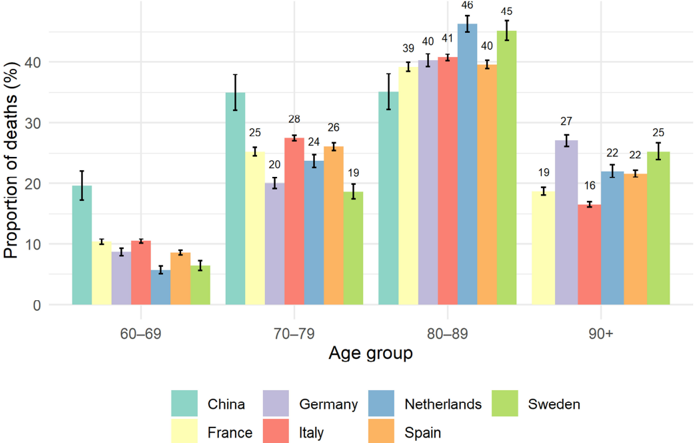
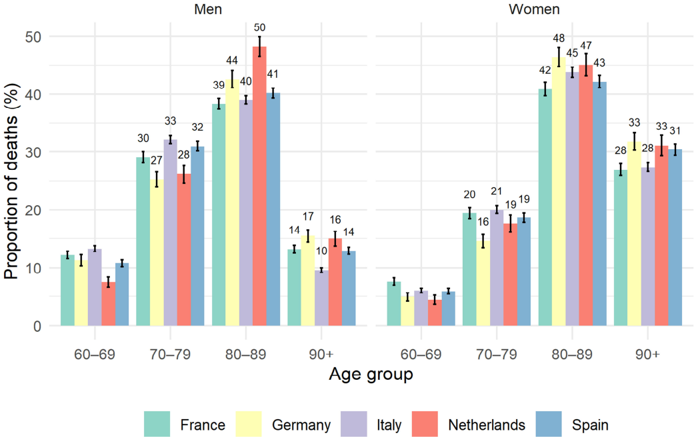
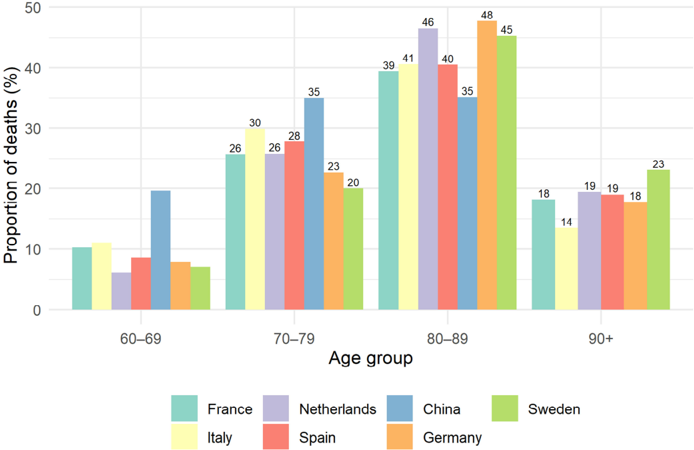
BACKGROUNDTo date, any attention paid to the age shape of COVID-19 deaths has been mostly in relation to understanding the differences in case fatality rates between countries. OBJECTIVEWe explore differences in the age distribution of deaths from COVID-19 among six European countries which have old age structures.We do this by way of a crosscountry comparison and put forward some reasons for potential differences. METHODSWe estimate the distribution of deaths by 10-year age groups and the counterfactual age distribution under the assumption that all populations had the age structure of Italy.For this, we use 10-year age-grouped COVID-19 death counts and the corresponding population exposures for France, Italy, the Netherlands, Germany, Sweden, Spain, and China. RESULTSAll included European countries experienced a high proportion of deaths at older ages.The relative proportion of deaths at ages above 90 years is lowest in Italy when compared to the other countries in the study despite Italy having the oldest population in Europe. CONTRIBUTIONPopulation age structure seems essential for understanding COVID-19-related mortality, but other factors may play an important role, particularly at older ages in European populations.
Overview
The claims and statistics of this paper haven’t been checked yet.
Free: it reads the open-access text and checks the first 5 claims that cite a source we can check. Create a free account to check every claim.
Integrity signals
Registry
Cites
Statistics
Figures
Verification
Claims the paper makes
The claims and statistics of this paper haven’t been checked yet.
Free: it reads the open-access text and checks the first 5 claims that cite a source we can check. Create a free account to check every claim.
Claims other papers make about this one
Each is checked against this paper’s own text: does it say what the citing paper says it does?
The source backs part of the claim, not all of it — or backs it for a different population, condition or comparison.
In the citing paper
“The missing and unidentified cases or infections warps the mortality estimates of COVID-19 disease [17, 48–53].”
From Impact of COVID-19 on life expectancy at birth in India: a decomposition analysis (2021) · cites this paper as [49]
Experimental — accuracy not yet measured
Self-check
Percentages, sums and reported differences re-computed from the paper’s own numbers.
The self-check needs the paper’s full text.
Citations
Cites
Yang, J., Zheng, Y., Gou, X., Pu, K., Chen, Z., Guo, Q., Ji, R., Wang, H., Wang, Y., & Zhou, Y. (2020) · International Journal of Infectious Diseases · doi:10.1016/j.ijid.2020.03.017 · Cited by 4,206
Case-fatality rate and characteristics of patients dying in relation to COVID-19 in Italy
Onder, G., Rezza, G., & Brusaferro, S. (2020) · JAMA · doi:10.1001/jama.2020.4683 · Cited by 4,171
Demographic science aids in understanding the spread and fatality rates of COVID-19
Dowd, J. B., Andriano, L., Brazel, D. M., Rotondi, V., Block, P., Ding, X., Liu, Y., & Mills, M. C. (2020) · Proceedings of the National Academy of Sciences · doi:10.1073/pnas.2004911117 · Cited by 905
Research works printed but not linked: 5
- Preston, S.H., Heuveline, P., and Guillot, M. (2001). Demography: Measuring and modelling population process. Oxford: Blackwell.
- Riffe, T., Acosta, E. et al. (2020). COVerAGE-DB: A database of COVID-19 cases and deaths by age. doi:10.17605/OSF.IO/MPWJQ. · DOI
- Valderas, J.M., Starfield, B., Sibbald, B., Salisbury, C., and Roland, M. (2009). Defining comorbidity: Implications for understanding health and health services. The Annals of Family Medicine 7(4): 357-363. doi:10.1370/afm.983. · DOI · Paper page
- Dudel, C., Riffe, T., Acosta, E., van Raalte, A., Strozza, C., and Myrskylä, M. (2020). Monitoring trends and differences in COVID-19 case fatality rates using decomposition methods: Contributions of age structure and age-specific fatality. MedRxiv [Internet]. [cited 30 May 2020]. doi:10.1101/2020.03.31.20048397. Eurostat (2017). Over 27 million people aged 80 and over in the EU [Internet]. [cited 31 Mar 2020]. Available from: https://ec.europa.eu/eurostat/web/products-eurostat- news/-/EDN-20170930-1. Eurostat. Online. Accessed 22 April 2020. https://ec.europa.eu/eurostat/databrowser/ view/tps00010/default/table?lang=en. Human Mortality Database (2020). University of California, Berkeley (USA), and Max Planck Institute for Demographic Research (Germany). Available at www.mortality.org or www.humanmortality.de (downloaded on 24 April 2020). · doi:10.1101/2020.03.31.20048397
- Phelan, A.L., Katz, R., and Gostin, L.O. (2020). The novel coronavirus originating in Wuhan, China: Challenges for global health governance. Jama 323(8): 709-710. doi:10.1001/jama.2020.1097. · DOI · Paper page
Cited by
Sannigrahi, S., Pilla, F., Basu, B., Basu, A. S., & Molter, A. (2020) · Sustainable Cities and Society · doi:10.1016/j.scs.2020.102418 · Cited by 317
Data resource profile: COVerAGE-DB: a global demographic database of COVID-19 cases and deaths
Riffe, T., Acosta, E., the COVerAGE-DB team, Acosta, E. J., Manuel Aburto, D., Alburez-Gutierrez, A., Altová, A., Alustiza, U., Basellini, S., Bignami, D., et al. (2021) · International Journal of Epidemiology · doi:10.1093/ije/dyab027 · Cited by 110
Impact of COVID-19 on life expectancy at birth in India: a decomposition analysis
Yadav, S., Yadav, P. K., & Yadav, N. (2021) · BMC Public Health · doi:10.1186/s12889-021-11690-z · Cited by 32
Metadata
- Authors
- Medford, A., & Trias-Llimós, S.
- Venue
- Demographic Research
- Published
- 2020-08-21
- Volume
- 43
- Pages
- 533-544
- ISSN
- 1435-9871
- Cited by
- 25
- References
- 3
- Language
- en
About these checks
Registry, retraction, Cites and statistics results are computed, not judged, with one exception: a printed reference that no index lists is read once by a model before it counts as a citation error. Claims are extracted by a model and kept only when their quote appears verbatim in the text; each cited source is then checked, with a model’s help, for whether it says what the claim relies on. Those verdicts can be wrong — read the claim’s quote and the cited source before relying on one.
Statistics and arithmetic are recomputed, not judged.
Confidence bands are shown only for fields calibrated on our annotated test set. None is calibrated yet, so no band is shown.
What counts as a claim ›How we measure confidence ›How we check this ›
Are you an author, or do you see a problem with this page? Request a review
How to cite
Cite CoChat for the checks on this page, and the paper for its own findings.
- This page
- CoChat. (2026). Citation check: Population age structure only partially explains the large number of COVID-19 deaths at the oldest ages. https://app.cochat.ai/papers/10.4054/demres.2020.43.19
- The paper
- Medford, A., & Trias-Llimós, S. (2020). Population age structure only partially explains the large number of COVID-19 deaths at the oldest ages. Demographic Research. https://doi.org/10.4054/demres.2020.43.19
Data sources
Bibliographic data: Semantic Scholar, OpenAlex, Crossref.
Contains information from the Semantic Scholar Academic Graph Datasets, made available under the ODC Attribution License (ODC-BY 1.0).
Semantic Scholar’s data is described in: Kinney, R., et al. (2023). The Semantic Scholar Open Data Platform. arXiv:2301.10140.
