

The DOI matches its Crossref record; 16 of the 16 references it cites were found in a registry or an index.
Prevalence of risk factors for non-communicable diseases in Bangladesh: Results from STEPS survey 2010
Open accessAbstract
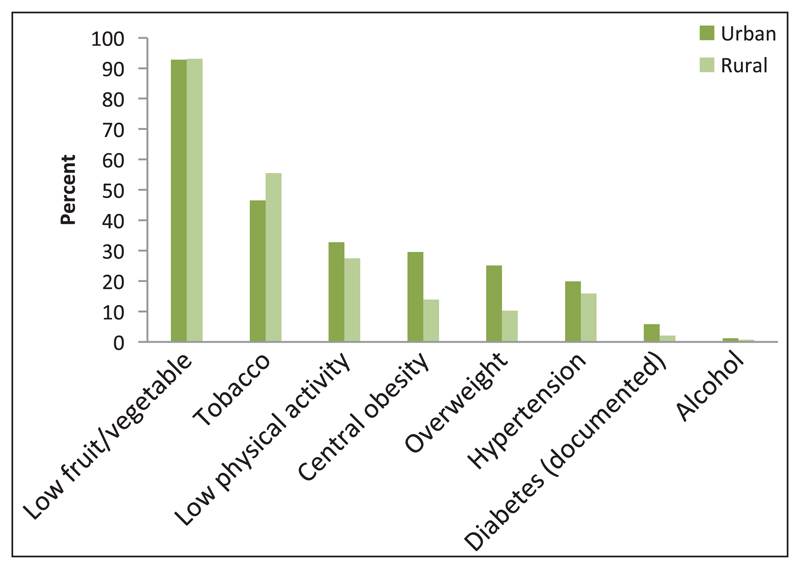
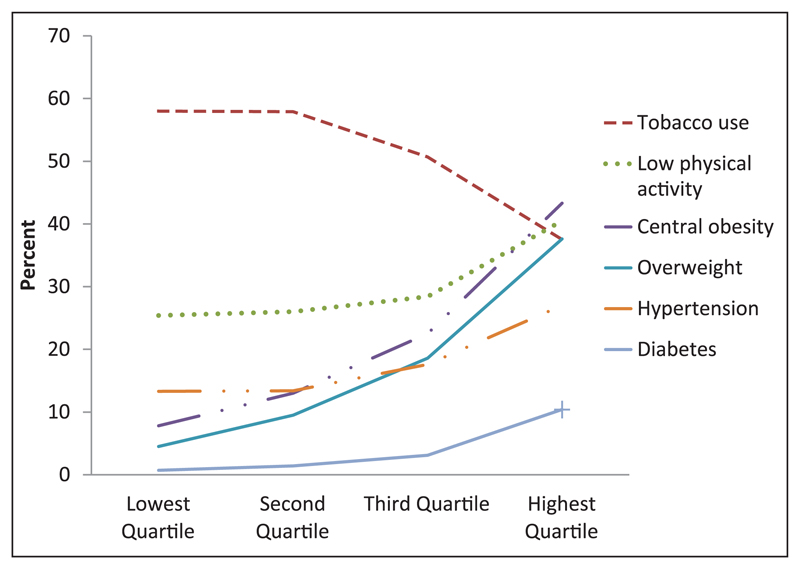
BACKGROUND: Nationally representative data on noncommunicable disease (NCD) risk factors are lacking in Bangladesh. This study was done to determine the prevalence of common risk factors for major NCDs among men and women of rural and urban areas of Bangladesh. MATERIALS AND METHODS: This survey was done with 9,275 individuals aged 25 years or older randomly drawn from all over the country. Information on diet, physical activity, tobacco and alcohol, and treatment history for hypertension and diabetes were collected. Height, weight, waist circumference, and blood pressure (BP) were measured. RESULTS: There were 4,312 men and 4,963 women with the mean age of 42 years (standard deviation 13 years). Half of them (54%) used tobacco in some form, <1% consumed alcohol within the past 30 days, 92% did not consume adequate fruit and vegetables (five servings or more), and 35% had low physical activity level [<600 metabolic equivalent (MET) min per week]. Documented diabetes was found in 4% of the participants. Seventeen percent were overweight [body mass index (BMI) ≥25 kg/m 2 and 21% had abdominal obesity (men ≥94, women ≥80 cm). Overall, 21% people had hypertension (blood pressure ≥140/90 mmHg or medication). Physical inactivity, alcohol intake, hypertension, obesity, and diabetes were more prevalent in urban areas, as opposed to tobacco. Tobacco intake showed a decreasing gradient, but hypertension, obesity, diabetes, and low physical activity showed an increasing gradient across the wealth quartiles. CONCLUSION: Risk factors are widely prevalent in Bangladeshi people across sexes and across both rural and urban areas of residences. NCD prevention through risk factor control, and early detection and treatment of hypertension and diabetes are warranted.
Overview
The claims and statistics of this paper haven’t been checked yet.
Run the check — free, no account needed. It reads the open-access text and checks the sources it cites.
Integrity signals
Registry
Cites
Statistics
Figures
Verification
Claims the paper makes
The claims and statistics of this paper haven’t been checked yet.
Run the check — free, no account needed. It reads the open-access text and checks the sources it cites.
Claims other papers make about this one
Each is checked against this paper’s own text: does it say what the citing paper says it does?
In the citing paper
“Despite the increasing prevalence of HTN, a substantial proportion of the population remains undiagnosed due to lack of awareness to seek medical care and high treatment costs [7,11,14].”
In the citing paper
“The World Health Organization recommends salt intake of 5 g/day for adults in order to reduce blood pressure (BP) and risk of cardiovascular diseases [11]”
Self-check
Percentages, sums and reported differences re-computed from the paper’s own numbers.
The self-check needs the paper’s full text.
Citations
Cites
(2004) · The Lancet · doi:10.1016/s0140-6736(03)15268-3 · Cited by 12,717
Zhang, Q., Wang, C., Zheng, M., Li, Y., Li, J., Zhang, L., Shang, X., & Yan, C. (2014) · Cerebrovascular Diseases · doi:10.1159/000369778 · Cited by 11,609
Projections of Global Mortality and Burden of Disease from 2002 to 2030
Mathers, C. D., & Loncar, D. (2006) · PLoS Medicine · doi:10.1371/journal.pmed.0030442 · Cited by 11,386
The World Health Report 2002 - Reducing Risks, Promoting Healthy Life
Available, N. A. N. (2003) · Education for Health · doi:10.1080/1357628031000116808 · Cited by 6,078
Diet, Nutrition, and the Prevention of Chronic Diseases
Leong, A. (1992) · Pathology · doi:10.1016/s0031-3025(16)36541-2 · Cited by 1,633
Yajnik, C. S., & Yudkin, J. S. (2004) · The Lancet · doi:10.1016/s0140-6736(03)15269-5 · Cited by 267
Chakravarthy, M. V., Joyner, M. J., & Booth, F. W. (2002) · Mayo Clinic Proceedings · doi:10.4065/77.2.165 · Cited by 217
United Nations General Assembly Resolution 40/61
(1986) · American Journal of International Law · doi:10.2307/2202005 · Cited by 182
Hussain, A., Rahim, M. A., Khan, A. K. A., Ali, S. M. K., & Vaaler, S. (2005) · Diabetic Medicine · doi:10.1111/j.1464-5491.2005.01558.x · Cited by 165
Rising prevalence of type 2 diabetes in rural Bangladesh: A population based study
Rahim, M. A., Hussain, A., Khan, A. K. A., Sayeed, M. A., Ali, S. M. K., & Vaaler, S. (2006) · Diabetes Research and Clinical Practice · doi:10.1016/j.diabres.2006.11.010 · Cited by 119
Research works printed but not linked: 1
- Zaman MM. Trends in non-communicable diseases (paper presented to the National Public Health Conference, 2013) Available from: http://www.iedcr.org/pdf/files/NPHC%20WEB/UPLOAD-4/Dr.Zaman.pdf. [Last accessed on 2013 Dec 29].
Cited by
Sorted by citations
Ahmed, S. A. K. S., Ajisola, M., Azeem, K., Bakibinga, P., Chen, Y.-F., Choudhury, N. N., Fayehun, O., Griffiths, F., Harris, B., Kibe, P., et al. (2020) · BMJ Global Health · doi:10.1136/bmjgh-2020-003042 · Cited by 357
Chowdhury, M. Z. I., Rahman, M. M., Akter, T., Akhter, T., Ahmed, A., Shovon, M. A., Farhana, Z., Chowdhury, N. A., & Turin, T. C. (2020) · Clinical Hypertension · doi:10.1186/s40885-020-00143-1 · Cited by 143
Self-citationPrevalence of diabetes and pre-diabetes in Bangladesh: a systematic review and meta-analysis
Akhtar, S., Nasir, J. A., Sarwar, A., Nasr, N., Javed, A., Majeed, R., Salam, M. A., & Billah, B. (2020) · BMJ Open · doi:10.1136/bmjopen-2019-036086 · Cited by 138
Zaman, M. M., Bhuiyan, M. R., Karim, M. N., Moniruzzaman Khan, M., Rahman, M. M., Akanda, A. W., & Fernando, T. (2015) · BMC Public Health · doi:10.1186/s12889-015-1938-4 · Cited by 132
Self-citationRahman, M. M., Zaman, M. M., Islam, J. Y., Chowdhury, M. J., Ahasan, H. N., Rahman, R., Hassan, M., Hossain, Z., Alam, B., & Yasmin, R. (2017) · Journal of Human Hypertension · doi:10.1038/s41371-017-0018-x · Cited by 108
Self-citation
Metadata
- Authors
- Zaman, M., Rahman, M. M., Rahman, M. R., Bhuiyan, M., Karim, M. N., & Chowdhury, M. A.
- Affiliations
- Shaheed Suhrawardy Medical College (BD)
- World Health Organization - Bangladesh (BD)
- Venue
- Indian Journal of Public Health
- Published
- 2016
- Volume
- 60
- Issue
- 1
- Pages
- 17
- ISSN
- 0019-557X (ISSN-L)
- PMC
- PMC6349138
- OpenAlex
- W2275371446
- Cited by
- 95
- References
- 16
- Citations by year
- 2026: 3 · 2025: 2 · 2024: 8 · 2023: 8 · 2022: 14 · 2021: 15 · 2020: 18 · 2019: 7 · 2018: 4 · 2017: 10 · 2016: 5
- FWCI
- 7.14
- Type
- journal article
- Language
- en
- Open access
- gold
- doi.org
- Licence
- cc-by-nc-sa
- Locations
- Indian Journal of Public Health (publishedVersion, cc-by-nc-sa)
- PubMed (publishedVersion)
- Europe PMC (PubMed Central) (acceptedVersion, cc-by)
- PubMed Central (acceptedVersion, cc-by)
- DOAJ (DOAJ: Directory of Open Access Journals) (submittedVersion)
- Funders
- World Health Organization
- Topics
- Health Sciences › Medicine › Cardiology and Cardiovascular Medicine › Cardiovascular Health and Risk Factors
- Health Sciences › Medicine › Endocrinology, Diabetes and Metabolism › Diabetes, Cardiovascular Risks, and Lipoproteins
- Health Sciences › Medicine › Public Health, Environmental and Occupational Health › Global Health and Epidemiology
- Keywords
- non-communicable diseases, NCD risk factors, prevalence, Bangladesh, tobacco use, alcohol consumption, physical inactivity, hypertension, diabetes mellitus, obesity, abdominal obesity, fruit and vegetable intake, urban-rural differences, socioeconomic status, STEPS survey
- MeSH terms
- Noncommunicable Diseases, Adult, Bangladesh, Cross-Sectional Studies, Female, Humans, Hypertension, India, Male, Obesity, Surveys and Questionnaires, Risk Factors, Smoking, Prevalence
About these checks
Registry, retraction, Cites and statistics results are computed, not judged, with one exception: a printed reference that no index lists is read once by a model before it counts as a citation error. Claims are extracted by a model and kept only when their quote appears verbatim in the text; each cited source is then checked, with a model’s help, for whether it says what the claim relies on. Those verdicts can be wrong — read the claim’s quote and the cited source before relying on one.
Statistics and arithmetic are recomputed, not judged.
Confidence bands are shown only for fields calibrated on our annotated test set. None is calibrated yet, so no band is shown.
What counts as a claim ›How we measure confidence ›How we check this ›
Are you an author, or do you see a problem with this page? Request a review
