

The DOI matches its Crossref record; 15 of the 15 references it cites were found in a registry or an index.
The 1 μg cosyntropin test in normal individuals: A reappraisal
Open accessAbstract
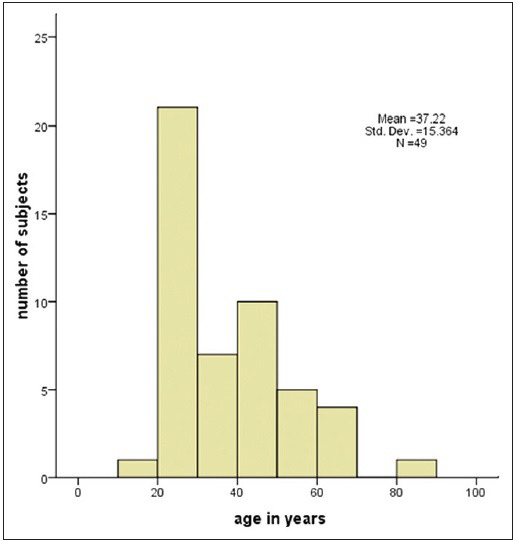
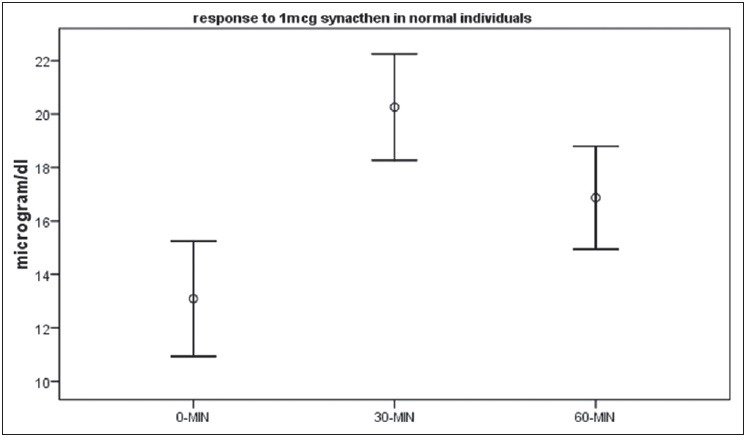
BACKGROUND: The 1μg cosyntropin test has some advantages over the 250μg test as a test of adrenal function. One of the concerns regarding the 1 μg test includes stability of the cosyntropin when reconstituted and stored. Classically the 5(th) percentile responses to cosyntropin in normal individuals have been used to define a normal response. Recent studies have shown that these normative values should be determined for individual assays. MATERIALS AND METHODS: We performed a 1μg cosyntropin test using reconstituted and refrigerated (4-8(°) C) cosyntropin in saline solution in 49 non pregnant adults who were apparently healthy and had no exposure to exogenous glucocorticoids. The cosyntropin solution was stored for up to 60 days following reconstitution. We analysed the data for any association between duration of cosyntropin solution storage and the cortisol responses to cosyntropin administration. RESULTS: The mean ± SD cortisol level at baseline, 30 and 60 min were-12.19 ± 3 μg/dl, 20.72 ± 2.63 μg/dl, 16.86 ± 3.33 μg/dl. The 5(th) percentile cortisol response at 30 min was 16.5 μg/dl (16.33 μg/dl rounded off). The correlation coefficients between number of days of cosyntropin solution storage and the cortisol responses at 30 and 60 min were (Spear mans rho = 0.06,-0.24 respectively) (P = 0.69 and 0.41). There were no differences in cortisol values whether the storage was for less than 30 days or more than 30 days (mean difference 0.25 μg/dl P = 0.44). CONCLUSION: The 5(th) percentile normative values determined for our assay is lower than what is currently being used clinically and in research publications. Prolonged refrigerated storage of cosyntropin solution does not affect the validity of the 1 μg cosyntropin test.
Overview
The claims and statistics of this paper haven’t been checked yet.
Run the check — free, no account needed. It reads the open-access text and checks the sources it cites.
Integrity signals
Registry
Cites
Statistics
Figures
Verification
Claims the paper makes
The claims and statistics of this paper haven’t been checked yet.
Run the check — free, no account needed. It reads the open-access text and checks the sources it cites.
Claims other papers make about this one
Each is checked against this paper’s own text: does it say what the citing paper says it does?
The source backs part of the claim, not all of it — or backs it for a different population, condition or comparison.
In the citing paper
“Although dilution and storage of the lower concentrated solution may be regarded as critical, it is worth noting that diluted tetracosactide (in 0.9% saline at 1 g/mL) has been reported to be stable at 2-8°C for up to 60 days (60).”
From Diagnosis and Treatment of Primary Adrenal Insufficiency: An Endocrine Society Clinical Practice Guideline (2016) · cites this paper as [60]
Experimental — accuracy not yet measured
Self-check
Percentages, sums and reported differences re-computed from the paper’s own numbers.
The self-check needs the paper’s full text.
Citations
Cites
DICKSTEIN, G., SHECHNER, C., NICHOLSON, W. E., ROSNER, I., SHEN-ORR, Z., ADAWI, F., & LAHAV, M. (1991) · The Journal of Clinical Endocrinology & Metabolism · doi:10.1210/jcem-72-4-773 · Cited by 457
Corticotropin tests for hypothalamic-pituitary- adrenal insufficiency: a metaanalysis
Kazlauskaite, R., Evans, A. T., Villabona, C. V., Abdu, T. A. M., Ambrosi, B., Atkinson, A. B., Choi, C. H., Clayton, R. N., Courtney, C. H., Gonc, E. N., et al. (2008) · The Journal of Clinical Endocrinology & Metabolism · doi:10.1210/jc.2008-0710 · Cited by 385 · cited 4×
“[17] But this method has been disputed by some investigators who feel that the cut point for cortisol value in a stimulation test has to be derived by comparison with a gold standard – usually the ITT and doing a ROC analysis.[5,6] Unfortunately in the most common clinical situation where stimulation testing is necess…”
MethodInfluentialClark, Neylon, Raggatt, Sheppard, & Stewart (1998) · Clinical Endocrinology · doi:10.1046/j.1365-2265.1998.00555.x · Cited by 207
Comparison of low and high dose corticotropin stimulation tests in patients with pituitary disease
Mayenknecht, J., Diederich, S., Bähr, V., Plöckinger, U., & Oelkers, W. (1998) · The Journal of Clinical Endocrinology & Metabolism · doi:10.1210/jcem.83.5.4831 · Cited by 142
Agha, A., Tomlinson, J. W., Clark, P. M., Holder, G., & Stewart, P. M. (2006) · The Journal of Clinical Endocrinology & Metabolism · doi:10.1210/jc.2005-1131 · Cited by 141
Meltzer, E. O., Berger, W. E., Berkowitz, R. B., Bronsky, E. A., Dvorin, D. J., Finn, A. F., Galant, S. P., Grossman, J., Hampel, F. C., Ratner, P. H., et al. (1999) · Journal of Allergy and Clinical Immunology · doi:10.1016/s0091-6749(99)70121-1 · Cited by 68
Nye, E. J. (1999) · The Journal of Clinical Endocrinology & Metabolism · doi:10.1210/jc.84.10.3648 · Cited by 62
The Low Dose ACTH Test--A Further Word of Caution
Murphy, H. R. (1998) · The Journal of Clinical Endocrinology & Metabolism · doi:10.1210/jc.83.2.712-a · Cited by 55
Poomthavorn, P., Isaradisaikul, B., Chuansumrit, A., Khlairit, P., Sriphrapradang, A., & Mahachoklertwattana, P. (2010) · The Journal of Clinical Endocrinology & Metabolism · doi:10.1210/jc.2010-0205 · Cited by 30
Grebe, S. K. G., Feek, C. M., Durham, J. A., Kljakovic, M., & Cooke, R. R. (1997) · Clinical Endocrinology · doi:10.1046/j.1365-2265.1997.2391059.x · Cited by 24
Pk, S., & Shashikala, G. V. (2012) · Indian Journal of Endocrinology and Metabolism · doi:10.4103/2230-8210.95680 · Cited by 22
The adrenal response to trauma, operation and cosyntropin stimulation.
Harris, M. J., Rt, B., McRoberts, J. W., & Mohler, J. L. (1990) · PubMed · Cited by 20
SCHTEINGART, D. E. (2008) · Yearbook of Endocrinology · doi:10.1016/s0084-3741(08)79160-1 · Cited by 6
(2001) · PubMed · Cited by 5
Response to Dr. Oelkers: There Is Enough Evidence in Favor of Low Dose ACTH Test--Authors' Response
Abdu, T. A. M. (1999) · The Journal of Clinical Endocrinology & Metabolism · doi:10.1210/jc.84.8.2973-a · Cited by 2
Research works printed but not linked: 2
- Nyunt, 2010, Normal Cortisol Response on Low-Dose Synacthen (1 μg) Test in Children with Prader Willi Syndrome, J Clin Endocrinol Metab, E464
- Gonzalbez, 2000, Establishment of reference values for standard dose short synacthen test (250 microgram), low dose short synacthen test (1 microgram) and insulin tolerance test for assessment of the hypothalamo-pituitary-adrenal axis in normal subjects, Clin Endocrinol (Oxf), 199
Cited by
Bornstein, S. R., Allolio, B., Arlt, W., Barthel, A., Don-Wauchope, A., Hammer, G. D., Husebye, E. S., Merke, D. P., Murad, M. H., Stratakis, C. A., et al. (2016) · The Journal of Clinical Endocrinology & Metabolism · doi:10.1210/jc.2015-1710 · Cited by 1,769
Cortisol Concentrations in Well-Regulated Dogs with Hyperadrenocorticism Treated with Trilostane
Midence, J. N., Drobatz, K. J., & Hess, R. S. (2015) · Journal of Veterinary Internal Medicine · doi:10.1111/jvim.13615 · Cited by 19
Wagmode, N., Mathew, V., Bantwal, G., Ayyar, V. S., George, B., Patanjali, C., & Michael, J. (2018) · Indian Journal of Endocrinology and Metabolism · doi:10.4103/ijem.ijem_114_18 · Cited by 13
Hypothalamic-Pituitary Adrenal Axis Status 3 Months After Recovery From COVID-19 Infection
Rashmi, K. G., Perumal, N. L., Cherian, A., Wyawahare, M., Prasad, A., Sahoo, J., Kamalanathan, S., Anusuya, R., & Naik, D. (2023) · Endocrine Research · doi:10.1080/07435800.2023.2245907 · Cited by 10
M., S. S. C., & Ramesh, J. (2023) · Archives of Endocrinology and Metabolism · doi:10.20945/2359-4292-2022-0207 · Cited by 5
Metadata
- Authors
- Anantharaman, R., Menezes, G., Yusuf, R., Ganapathi, B., Ayyar, S., & Srinivasan, R.
- Affiliations
- St.John's Medical College Hospital (IN)
- Corresponding author
- Anantharaman, R
- Venue
- Indian Journal of Endocrinology and Metabolism
- Published
- 2013
- Volume
- 17
- Issue
- 4
- Pages
- 693
- ISSN
- 2230-8210 (ISSN-L)
- PMC
- PMC3743372
- OpenAlex
- W2090670539
- Cited by
- 12
- References
- 15
- Citations by year
- 2024: 3 · 2023: 2 · 2022: 1 · 2020: 2 · 2018: 1 · 2016: 1 · 2015: 2
- FWCI
- 0.79
- Type
- journal article
- Language
- en
- Open access
- diamond
- doi.org
- Licence
- cc-by-nc-sa
- Locations
- Indian Journal of Endocrinology and Metabolism (publishedVersion, cc-by-nc-sa)
- Europe PMC (PubMed Central) (publishedVersion, cc-by-nc-sa)
- PubMed Central (publishedVersion, cc-by-nc-sa)
- PubMed (publishedVersion)
- DOAJ (DOAJ: Directory of Open Access Journals) (submittedVersion, cc-by-sa)
- Topics
- Health Sciences › Medicine › Endocrinology, Diabetes and Metabolism › Adrenal Hormones and Disorders
- Health Sciences › Health Professions › Medical Laboratory Technology › Clinical Laboratory Practices and Quality Control
- Life Sciences › Neuroscience › Behavioral Neuroscience › Stress Responses and Cortisol
- Keywords
- cortisol response, adrenal function testing, reference values, cold storage, healthy adults
About these checks
Registry, retraction, Cites and statistics results are computed, not judged, with one exception: a printed reference that no index lists is read once by a model before it counts as a citation error. Claims are extracted by a model and kept only when their quote appears verbatim in the text; each cited source is then checked, with a model’s help, for whether it says what the claim relies on. Those verdicts can be wrong — read the claim’s quote and the cited source before relying on one.
Statistics and arithmetic are recomputed, not judged.
Confidence bands are shown only for fields calibrated on our annotated test set. None is calibrated yet, so no band is shown.
What counts as a claim ›How we measure confidence ›How we check this ›
Are you an author, or do you see a problem with this page? Request a review
