

The DOI matches its Crossref record; 95 of the 95 references it cites were found in a registry or an index.
Epidemiology, pathogenesis, genetics & management of polycystic ovary syndrome in India
Open accessAbstract
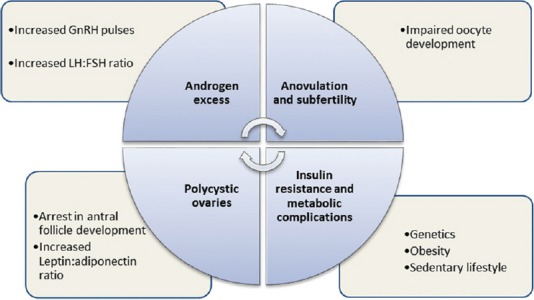
Polycystic ovary syndrome (PCOS) is a common endocrine disorder predominantly affecting women of reproductive age. Clinical manifestations are diverse including hyperandrogenism, anovulation, infertility and increased risk of metabolic diseases besides psychosocial dysfunction. This review provides information on the problem of PCOS in India, its pathophysiology, genetics and an overview of current management options to instigate further research in this field. Prevalence of PCOS in India ranges from 3.7 to 22.5 per cent depending on the population studied and the criteria used for diagnosis. Abnormalities in leptin-adiponectin (adipocyte biology), oxidative stress and autoimmunity are among the mechanisms studied regarding pathogenesis of PCOS. Many candidate gene studies have shown associations with PCOS in various studies. Studies have consistently demonstrated the relationship between the well-known manifestation of hyperandrogenism among Indian PCOS women and the metabolic morbidities including insulin resistance, glucose intolerance and cardiovascular risk. Management of individual components of PCOS can be achieved by medications or surgical methods, though further clarification regarding pathogenesis of PCOS is needed to sharpen our therapeutic armamentarium.
Overview
The claims and statistics of this paper haven’t been checked yet.
Run the check — free, no account needed. It reads the open-access text and checks the sources it cites.
Integrity signals
Registry
Cites
Statistics
Figures
Verification
Claims the paper makes
The claims and statistics of this paper haven’t been checked yet.
Run the check — free, no account needed. It reads the open-access text and checks the sources it cites.
Claims other papers make about this one
Each is checked against this paper’s own text: does it say what the citing paper says it does?
In the citing paper
“In general, obese phenotypes have more severe clinical forms of PCOS than their lean equivalent.”
From PCOS and nutritional approaches: Differences between lean and obese phenotype (2021) · cites this paper as [4]
In the citing paper
“However, both share many central pathophysiological processes (hyperandrogenemia, IR, oxidative stress, chronic inflammation) [4].”
From PCOS and nutritional approaches: Differences between lean and obese phenotype (2021) · cites this paper as [4]
Self-check
Percentages, sums and reported differences re-computed from the paper’s own numbers.
The self-check needs the paper’s full text.
Citations
Cites
(2004) · Fertility and Sterility · doi:10.1016/j.fertnstert.2003.10.004 · Cited by 9,050
The Prevalence and Features of the Polycystic Ovary Syndrome in an Unselected Population
Azziz, R., Woods, K. S., Reyna, R., Key, T. J., Knochenhauer, E. S., & Yıldız, B. O. (2004) · The Journal of Clinical Endocrinology & Metabolism · doi:10.1210/jc.2003-032046 · Cited by 2,715
Azziz, R., Carmina, E., Dewailly, D., Diamanti-Kandarakis, E., Escobar-Morreale, H. F., Futterweit, W., Janssen, O. E., Legro, R. S., Norman, R. J., Taylor, A. E., et al. (2006) · The Journal of Clinical Endocrinology & Metabolism · doi:10.1210/jc.2006-0178 · Cited by 2,143
Amenorrhea associated with bilateral polycystic ovaries
Stein, I. F., & Leventhal, M. L. (1935) · American Journal of Obstetrics and Gynecology · doi:10.1016/s0002-9378(15)30642-6 · Cited by 2,121
Diamanti-Kandarakis, E., & Dunaif, A. (2012) · Endocrine Reviews · doi:10.1210/er.2011-1034 · Cited by 1,947
Polycystic ovary syndrome: etiology, pathogenesis and diagnosis
Goodarzi, M. O., Dumesic, D. A., Chazenbalk, G., & Azziz, R. (2011) · Nature Reviews Endocrinology · doi:10.1038/nrendo.2010.217 · Cited by 1,488
Chen, Z.-J., Zhao, H., He, L., Shi, Y., Qin, Y., Shi, Y., Li, Z., You, L., Zhao, J., Liu, J., et al. (2011) · Nature Genetics · doi:10.1038/ng.732 · Cited by 782
Granulosa Cell Production of Anti-Müllerian Hormone Is Increased in Polycystic Ovaries
Pellatt, L. J., Hanna, L., Brincat, M., Galea, R., Brain, H., Whitehead, S. A., & Mason, H. D. (2006) · The Journal of Clinical Endocrinology & Metabolism · doi:10.1210/jc.2006-1582 · Cited by 518
Hayes, M. G., Urbanek, M., Ehrmann, D. A., Armstrong, L. L., Lee, J. Y., Sisk, R., Karaderi, T., Barber, T. M., McCarthy, M. I., Franks, S., et al. (2015) · Nature Communications · doi:10.1038/ncomms8502 · Cited by 478
Prevalence of Polycystic Ovarian Syndrome in Indian Adolescents
Nidhi, R., Padmalatha, V., Nagarathna, R., & Ram, A. (2011) · Journal of Pediatric and Adolescent Gynecology · doi:10.1016/j.jpag.2011.03.002 · Cited by 320
Cited by
Sorted by citations
The Prevalence of Polycystic Ovary Syndrome: A Brief Systematic Review
Pundir, C., Deswal, R., Narwal, V., & Dang, A. (2020) · Journal of Human Reproductive Sciences · doi:10.4103/jhrs.jhrs_95_18 · Cited by 657
Polycystic Ovary Syndrome: A Comprehensive Review of Pathogenesis, Management, and Drug Repurposing
Sadeghi, H. M., Adeli, I., Calina, D., Docea, A. O., Mousavi, T., Daniali, M., Nikfar, S., Tsatsakis, A., & Abdollahi, M. (2022) · International Journal of Molecular Sciences · doi:10.3390/ijms23020583 · Cited by 445
Autophagy in ovary and polycystic ovary syndrome: role, dispute and future perspective
Kumariya, S., Ubba, V., Jha, R. K., & Gayen, J. R. (2021) · Autophagy · doi:10.1080/15548627.2021.1938914 · Cited by 306
Mancini, A., Bruno, C., Vergani, E., d’Abate, C., Giacchi, E., & Silvestrini, A. (2021) · International Journal of Molecular Sciences · doi:10.3390/ijms22041667 · Cited by 194
Lorenzo, M. D., Cacciapuoti, N., Lonardo, M. S., Nasti, G., Gautiero, C., Belfiore, A., Guida, B., & Chiurazzi, M. (2023) · Current Nutrition Reports · doi:10.1007/s13668-023-00479-8 · Cited by 149
Metadata
- Authors
- Ganie, M. A., Vasudevan, V., Wani, I. A., Baba, M. S., Arif, T., & Rashid, A.
- Affiliations
- Sher-i-Kashmir Institute of Medical Sciences (IN)
- Corresponding author
- Ganie, Mohammad Ashraf
- Venue
- Indian Journal of Medical Research
- Publisher
- Scientific Scholar
- Published
- 2019-10
- Volume
- 150
- Issue
- 4
- Pages
- 333-344
- ISSN
- 0971-5916 (ISSN-L)
- PMC
- PMC6902362
- OpenAlex
- W2989778925
- Cited by
- 232
- References
- 95
- Citations by year
- 2026: 28 · 2025: 46 · 2024: 55 · 2023: 45 · 2022: 31 · 2021: 21 · 2020: 6
- FWCI
- 2.04
- Type
- journal article
- Language
- en
- Open access
- diamond
- doi.org
- Locations
- The Indian Journal of Medical Research (publishedVersion)
- Europe PMC (PubMed Central) (publishedVersion, cc-by-nc-sa)
- PubMed Central (publishedVersion, cc-by-nc-sa)
- PubMed (publishedVersion)
- DOAJ (DOAJ: Directory of Open Access Journals) (submittedVersion)
- Topics
- Health Sciences › Medicine › Reproductive Medicine › Ovarian function and disorders
- Health Sciences › Medicine › Reproductive Medicine › Endometriosis Research and Treatment
- Life Sciences › Biochemistry, Genetics and Molecular Biology › Genetics › Genetic and Kidney Cyst Diseases
- Keywords
- polycystic ovary syndrome, PCOS pathogenesis, hyperandrogenism, insulin resistance, impaired glucose tolerance, cardiovascular risk, oxidative stress, autoimmunity, candidate gene association, PCOS management, infertility, anovulation, metabolic comorbidities
- MeSH terms
- Female, Humans, India, Polycystic Ovary Syndrome
About these checks
Registry, retraction, Cites and statistics results are computed, not judged, with one exception: a printed reference that no index lists is read once by a model before it counts as a citation error. Claims are extracted by a model and kept only when their quote appears verbatim in the text; each cited source is then checked, with a model’s help, for whether it says what the claim relies on. Those verdicts can be wrong — read the claim’s quote and the cited source before relying on one.
Statistics and arithmetic are recomputed, not judged.
Confidence bands are shown only for fields calibrated on our annotated test set. None is calibrated yet, so no band is shown.
What counts as a claim ›How we measure confidence ›How we check this ›
Are you an author, or do you see a problem with this page? Request a review
