

Current estimates of the economic burden of blindness and visual impairment in India: A cost of illness study
Open accessThe DOI matches its Crossref record; 15 of the 15 references it cites were found in a registry or an index.
Abstract
Purpose: Currently, there are an estimated 4.95 million blind persons and 70 million vision impaired persons in India, out of which 0.24 million are blind children. Early detection and treatment of the leading causes of blindness such as cataract are important in reducing the prevalence of blindness and vision impairment. There are significant developments in the field of blindness prevention, management, and control since the “Vision 2020: The right to sight” initiative. Very few studies have analyzed the cost of blindness at the population level. This study was undertaken to update the information on the economic burden of blindness and visual impairment in India based on the prevalence of blindness in India. We used secondary and publicly available data and a few assumptions for our estimations. Methods: We used gross national income (GNI), disability weights, and loss of productivity metrics to calculate the economic burden of blindness and vision impairment based on the “cost of illness” methodology. Results: The estimated net loss of GNI due to blindness in India is INR 845 billion (Int$ 38.4 billion), with a per capita loss of GNI per blind person of INR 170,624 (Int$ 7,756). The cumulative loss of GNI due to avoidable blindness in India is INR 11,778.6 billion (Int$ 535 billion). The cumulative loss of GNI due to blindness increased almost three times in the past two decades. The potential loss of productivity due to vision impairment is INR 646 billion (Int$ 29.4 billion). Conclusion: These estimates provide adequate information for budgetary allocation and will help advocate the need for accelerated adoption of all four strategies of integrated people-centered eye care (IPCEC). Early detection and treatment of blindness, especially among children, is very important in reducing the economic burden; thus, there is a need for integrating primary eye care horizontally with all levels of primary healthcare.
Overview
The claims and statistics of this paper haven’t been checked yet.
Free: it reads the open-access text and checks the first 5 claims that cite a source we can check. Create a free account to check every claim.
Integrity signals
Registry
Cites
Statistics
Figures
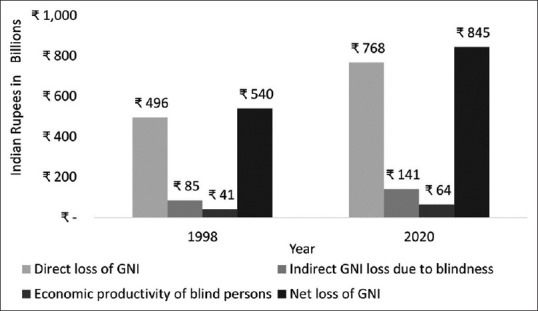
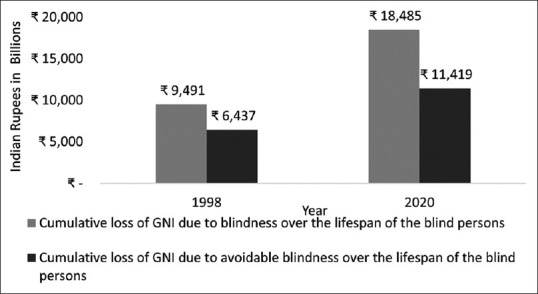
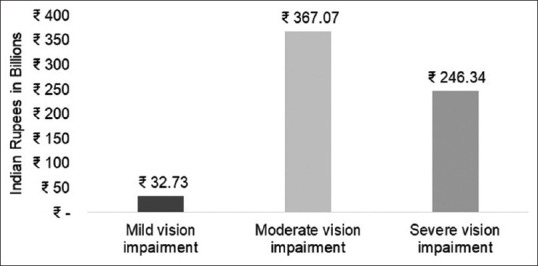
Verification
Claims the paper makes
The claims and statistics of this paper haven’t been checked yet.
Free: it reads the open-access text and checks the first 5 claims that cite a source we can check. Create a free account to check every claim.
Claims other papers make about this one
Each is checked against this paper’s own text: does it say what the citing paper says it does?
The source backs part of the claim, not all of it — or backs it for a different population, condition or comparison.
In the citing paper
“The subsequent economic burden associated with blindness can be substantial, particularly in LMICs, where it can be up to over US$ 4000 per blind person per year22–24.”
From Economic evaluation for medical artificial intelligence: accuracy vs. cost-effectiveness in a diabetic retinopathy screening case (2024) · cites this paper as [24]
Experimental — accuracy not yet measured
Self-check
Percentages, sums and reported differences re-computed from the paper’s own numbers.
The self-check needs the paper’s full text.
Citations
Cites
Bourne, R. R. A., Flaxman, S. R., Braithwaite, T., Cicinelli, M. V., Das, A., Jonas, J. B., Keeffe, J., Kempen, J. H., Leasher, J., Limburg, H., et al. (2017) · The Lancet Global Health · doi:10.1016/s2214-109x(17)30293-0 · Cited by 2,213
Potential Lost Productivity Resulting from the Global Burden of Myopia
Naidoo, K. S., Fricke, T. R., Frick, K. D., Jong, M., Naduvilath, T. J., Resnikoff, S., & Sankaridurg, P. (2019) · Ophthalmology · doi:10.1016/j.ophtha.2018.10.029 · Cited by 480
Adjusting for Inflation and Currency Changes Within Health Economic Studies
Turner, H. C., Lauer, J. A., Tran, B. X., Teerawattananon, Y., & Jit, M. (2019) · Value in Health · doi:10.1016/j.jval.2019.03.021 · Cited by 339
Economic Note: Cost of illness studies
Byford, S. (2000) · BMJ · doi:10.1136/bmj.320.7245.1335 · Cited by 318
The magnitude and cost of global blindness: an increasing problem that can be alleviated
Frick, K. D., & Foster, A. (2003) · American Journal of Ophthalmology · doi:10.1016/s0002-9394(02)02110-4 · Cited by 316 · cited 3×
“Estimates and their limitations As recommended in earlier studies,[9,13] we used the GNI per capita over minimum wage to calculate the cost of blindness[6,13] to compare consistently.”
BackgroundMethodGlobal economic productivity losses from vision impairment and blindness
Marques, A. P., Ramke, J., Cairns, J., Butt, T., Zhang, J. H., Muirhead, D., Jones, I., Tong, B. A. M. A., Swenor, B. K., Faal, H., et al. (2021) · EClinicalMedicine · doi:10.1016/j.eclinm.2021.100852 · Cited by 236
Eckert, K. A., Carter, M. J., Lansingh, V. C., Wilson, D. A., Furtado, J. M., Frick, K. D., & Resnikoff, S. (2015) · Ophthalmic Epidemiology · doi:10.3109/09286586.2015.1066394 · Cited by 132
Prevalence and causes of childhood blindness in India: A systematic review
Vashist, P., Wadhwani, M., Singh, S. S., Gupta, V., Gupta, N., & Saxena, R. (2020) · Indian Journal of Ophthalmology · doi:10.4103/ijo.ijo_2076_18 · Cited by 102 · cited 3×
“[11] Data on the prevalence of blindness and vision impairment for the overall population and in children were obtained from the published literature.[1,2,12] Blindness is defined as “presenting visual acuity worse than 3/60 in the better eye”[1] in this study to compare the estimates previously estimated in 1998.”
BackgroundResultEconomic burden of blindness in India.
Shamanna, B., Dandona, L., & Rao, G. N. (1998) · PubMed · Cited by 96
Self-citationMagnitude and Temporal Trends in Avoidable Blindness in Children (ABC) in India
Gudlavalleti, V. S. M. (2017) · The Indian Journal of Pediatrics · doi:10.1007/s12098-017-2405-2 · Cited by 41 · cited 1×
“[11] Data on the prevalence of blindness and vision impairment for the overall population and in children were obtained from the published literature.[1,2,12] Blindness is defined as “presenting visual acuity worse than 3/60 in the better eye”[1] in this study to compare the estimates previously estimated in 1998.”
Result
Research works printed but not linked: 2
- Rao GN Vision 2020:The Right to Sight Community Eye Heal [Internet] 2000 cited 2018 Apr 8 13 35 42 Available from: https://www.cehjournal.org/wp-content/uploads/download/ceh_13_35_042.pdf
- Rahi JS Gilbert CE Epidemiology and world-wide impact of visual impairment in children Pediatr Ophthalmol strabismus 4th ed Elsevier 2012 1 8
Cited by
Wang, Y., Liu, C., Hu, W., Luo, L., Shi, D., Zhang, J., Yin, Q., Zhang, L., Han, X., & He, M. (2024) · npj Digital Medicine · doi:10.1038/s41746-024-01032-9 · Cited by 76
The economic and social costs of visual impairment and blindness in India
Wong, B. A., Singh, K., Khanna, R., Ravilla, T., Sabherwal, S., Sil, A. K., Dole, K. S., Jain, E., & Chase, H. (2022) · Indian Journal of Ophthalmology · doi:10.4103/ijo.ijo_502_22 · Cited by 23
“A study estimating the economic cost of visual impairment in 2020 was published while this paper was undergoing peer review.[6] Our study differs from this most recent analysis on several dimensions.”
ResultRetinopathy of prematurity in India – what can we learn from the polio legacy?
Athikarisamy, S. E., Vinekar, A. S., & Patole, S. (2023) · The Lancet Regional Health - Southeast Asia · doi:10.1016/j.lansea.2023.100210 · Cited by 14
Zhao, C., Ding, Q., & Yang, Z. (2024) · European Journal of Ophthalmology · doi:10.1177/11206721241238878 · Cited by 14
Artificial intelligence-powered smart vision glasses for the visually impaired
Udayakumar, D., Gopalakrishnan, S., Raghuram, A., Kartha, A., Krishnan, A. K., Ramamirtham, R., Muthangi, R., & Raju, R. (2025) · Indian Journal of Ophthalmology · doi:10.4103/ijo.ijo_1621_24 · Cited by 13
“[10] The costs of low vision and blindness in India in 2019 are estimated at INR 1158 billion.”
Tripathi, V., & Thakkar, A. (2025) · Communications in computer and information science · doi:10.1007/978-3-032-14583-3_11 · Cited by 8
Marmamula, S., Saha, R., & Khanna, R. (2024) · Ophthalmic Epidemiology · doi:10.1080/09286586.2024.2336498 · Cited by 8
Masthi, N. R. R., Srivatsav, R. P., Aryan, R., Nagesh, P., Chikgouda, S. A., Vyshak, B. N., Thammaiah, R. R., Shashank, N., & Lavanya, R. (2025) · Journal of Family Medicine and Primary Care · doi:10.4103/jfmpc.jfmpc_1088_24 · Cited by 8
“[4] determine the presence of vision impairment.”
Navarro, P. A., López, W. O. C., Tello, A., Cárdenas, P. L., Vargas, M. D., Malo, L. C. M., & Yepes-Núñez, J. J. (2023) · Neuro-Ophthalmology · doi:10.1080/01658107.2023.2279092 · Cited by 8
Vision Assist Glasses for Visually Impaired People
Mehta, A. S., Singh, A., Pankaj, P., & Sagar, A. K. (2024) · International Conference on Networking and Communications (ICNWC) · doi:10.1109/icnwc60771.2024.10537459 · Cited by 8
“On a per capita basis, this loss equates to INR 9,192 [3].”
BackgroundBihani, S., & Sharma, S. (2025) · International Conference on Intelligent Sustainable Systems (ICISS) · doi:10.1109/iciss63372.2025.11076511 · Cited by 5
“[1] Finding objects and navigating an unfamiliar environment is one of the major challenges they face in their day-to-day lives.”
Marmamula, S., Alladi, S., Umapathy, K., Chan, V. F., MacKenzie, G. E., Lohfeld, L. H., Mettla, A. L., Rayasam, S., Gothwal, V. K., Narayanan, R., et al. (2025) · Trials · doi:10.1186/s13063-025-08813-x · Cited by 5
“Moreover, it results in substantial economic productivity loss [13].”
Zhou, J., Yao, Z., Xu, S., Long, Y., Zeng, Z., Qin, J., Ding, N., & Su, Y. (2025) · Nutrition and Diabetes · doi:10.1038/s41387-025-00405-7 · Cited by 4
“Meanwhile, region-speci fi c evaluations of intervention effectiveness should be conducted using real-world data, delivering low-cost, high-ef fi ciency, and readily implementable solutions that provide robust, evidence-based guidance tailored to the economic realities of each area.”
Barriers and Enablers to Seeking Eye Care Among the Adult Indian Population: A Systematic Review
Yelagondula, V. K., Marmamula, S., Subramanian, A., & Lawrenson, J. G. (2026) · Ophthalmic and Physiological Optics · doi:10.1007/s44402-026-00027-1 · Cited by 4
Mowar, P., Gupta, M., & Jain, M. (2024) · International ACM SIGACCESS Conference on Computers and Accessibility (ASSETS) · doi:10.1145/3663548.3675608 · Cited by 4
A Smart Assistive System with Face Recognition, Emotion Detection, Age and Gender Identification
Manikandan, V. M., & Sastry, N. P. (2024) · International Conference on Computing, Communication and Networking Technologies (ICCCNT) · doi:10.1109/icccnt61001.2024.10726216 · Cited by 4
“This significant visually impaired population affects the nation’s economy [2].”
BackgroundMethodInfluentialAnnadanam, A., Hicks, P. M., Lu, M.-C., Pawar, M. D., Kochar, P., Selvaraj, S., Kuppuraj, D., Rathod, C. D., Muppala, R. S., Gaur, S., et al. (2023) · Indian Journal of Ophthalmology · doi:10.4103/ijo.ijo_331_23 · Cited by 4
Integrated Intelligent Assistant for Visually ImpairedPreprint
Syed Ameer Abbas, S., Hareharan, M., & Sivakumar, I. (2024) · Research Square · doi:10.21203/rs.3.rs-4283447/v1 · Cited by 4
Marmamula, S., Kumbham, T. R., Ehrlich, J. R., Alladi, S., Bloom, D. E., & Friedman, D. S. (2024) · BMJ Open · doi:10.1136/bmjopen-2024-084348 · Cited by 3
Zhou, F., Feng, T., Bai, G., Linghu, C., Zhang, X., Dong, H., Zhou, Y., Zhao, Y., Zeng, J., & Zhang, L. (2025) · Scientific Reports · doi:10.1038/s41598-025-07364-0 · Cited by 3
“Globally, at least 2.2 billion individuals are affected by visual impairment 3 , contributing to substantial economic burdens 4 .”
InfluentialPrevalence of Visual Impairment and Availability of Eye Care Providers in Florida
Patel, A. J., Vanner, E. A., Chou, B. G., & Sridhar, J. S. (2023) · American Journal of Ophthalmology · doi:10.1016/j.ajo.2023.05.019 · Cited by 3
Real-Time Object Recognition with Voice Feedback for Visually Impaired Based on Raspberry Pi
Kumar, D. V., Kammampati, V. R., Tapasvi, B., Priyadarsini, K. I., Konakalla, E. P., & Killamsetti, H. (2024) · International Conference on Device Intelligence, Computing and Communication Technologies (DICCT) · doi:10.1109/dicct61038.2024.10533162 · Cited by 3
“There are an estimated 4.95 million blind people and 70 million people with vision impairment living in India, according to [1].”
BackgroundInfluentialAgarwal, S., Sukhija, S., & Gupta, Y. (2023) · IEEE/ACIS International Conference on Big Data, Cloud Computing, and Data Science (BCD) · doi:10.1109/bcd57833.2023.10466316 · Cited by 2
“With an estimated 4.95 million people blind and another 35 million visually impaired, the economic burden weighs about $38.4 billion [8].”
BackgroundInfluentialFujma: a fuzzy-based user judgement model for accessibility
Sarita, K., Kaur, P., & Kaur, S. (2025) · Universal Access in the Information Society · doi:10.1007/s10209-025-01230-6 · Cited by 2
“The scope of sample selection is limited to low-vision-impaired users only, as more than 70 million people are living with vision impairments in India, while a count of 1.1 billion people are found with vision loss at the global level [60].”
InfluentialBabu, A., Sudarmani, R., & Akshaya, K. R. (2024) · doi:10.1109/icstem61137.2024.10560673 · Cited by 2
“There are currently 70 million vision impaired people and 4.95 million blind people in India, of which 0.24 million are blind children [1].”
BackgroundInfluentialPatricia E. Bath: A Luminary in Ophthalmology
Anumula, V., Kanyadan, P., & Kanyadan, C. (2024) · Cureus · doi:10.7759/cureus.65781 · Cited by 2
“One of the most notable programs for the prevention of blindness is in India, where, as of 2022, there are an estimated 4.95 million people who are blind [11,15,16].”
BackgroundInfluentialSabherwal, S., Allen, L. N., Javed, M., Mazumdar, A., Thaker, N., Tlhajoane, M., Rathore, D., Singh, A., Sood, I., & Bastawrous, A. (2025) · BMJ Open · doi:10.1136/bmjopen-2025-108422 · Cited by 2
Actualización sobre discapacidad visual en Chile: causas, prevalencia y realidad nacional.
Pinuer Alvarado, E. J. (2024) · UVaDOC UVaDOC University of Valladolid Documentary Repository (University of Valladolid) · Cited by 2
(2023) · Journal of Psychology and Neuroscience · doi:10.47485/2693-2490.1076 · Cited by 1
Measuring utility values of eye conditions among children in India using the EQ-5D-Y instrument
Mannava, S., Borah, R. R., & Shamanna, B. (2024) · Health Economics Review · doi:10.1186/s13561-024-00552-0 · Cited by 1
“However, the burden of blindness and vision impairment remains a major public health issue, especially in low-and middle-income countries such as India, where access to eye care services is often limited [5, 6].”
BackgroundSelf-citationThakkar, H., Marisport, A., & Saha, N. (2024) · British Journal of Visual Impairment · doi:10.1177/02646196241294209 · Cited by 1
“The overall number of visually challenged people in India remains at around 62 million, containing 54 million with low vision and 8 million totally visually challenged (Mannava et al., 2022).”
Sobana, R. M., & Deva, B. J. (2025) · Health and population. Perspectives and issues · doi:10.5005/hppi-11041-0005 · Cited by 1
Validity and Reliability of WHOeyes Application in Community-based Visual Acuity Screening Program
Selvamurthy, S., Gouroumourty, R., Subramaniyan, S., & Kandasamy, P. (2025) · Indian Journal of Community Medicine · doi:10.4103/ijcm.ijcm_696_24 · Cited by 1
Tactile Graphic Identification Across Participants with Varying Visual Abilities
Mallick, C. (2025) · International Conference of Human-Computer Interaction Design & Research · doi:10.1145/3768633.3770444 · Cited by 1
Meghana, D., Havaldar, K. S., Sathyaprasad, S., & Antony, A. (2025) · Journal of South Asian Association of Pediatric Dentistry · doi:10.5005/jp-journals-10077-3388 · Cited by 1
ŞAHİN, F. T., & İşlek, Ö. (2026) · İnönü Üniversitesi Sağlık Hizmetleri Meslek Yüksek Okulu Dergisi · doi:10.33715/inonusaglik.1686265 · Cited by 1
Visual impairment and economic well-being among older adults in India
Singh, R. R., Maurya, P., & Mohanty, S. K. (2026) · Discover Public Health · doi:10.1186/s12982-026-02002-0 · Cited by 1
Are We There Yet? Exploring the Capabilities of MLLMs in Assistive AI Applications
Dasgupta, S., Dasgupta, A., & Jawahar, C. V. (2025) · Indian Conference on Computer Vision, Graphics and Image Processing · doi:10.1145/3774521.3774575 · Cited by 1
Kumar, P., & Sharma, M. K. (2024) · Advances in medical diagnosis, treatment, and care (AMDTC) book series · doi:10.4018/979-8-3693-3218-4.ch008 · Cited by 1
Protecting the Right to Read: Analysing the Implementation of the Marrakesh treaty in India
Marisport, A., Gaur, G., & Anuram, S. (2024) · GLS KALP: Journal of Multidisciplinary Studies. · doi:10.69974/glskalp.03.04.16 · Cited by 1
Bhattacharjee, H., Deori, N., & Grover, S. (2022) · Delhi Journal of Ophthalmology · doi:10.4103/dljo.dljo_51_23 · Cited by 1
Current Estimates of the Economic Burden of Hearing Loss in India: A Societal Cost-of-Illness StudyPreprint
Mannava, S., Ramkumar, V., & Murthy, G. (2026) · medRxiv · doi:10.64898/2026.09.01.26361987 · Cited by 1
Self-citationSixth Sense: A Techno-Solution for Visually Impaired Person
Harshal, T., Srinivasa, A. R., Gautam, A., Pai, K. N., & Sundaram, S. S. (2022) · IEEE North Karnataka Subsection Flagship International Conference (NKCon) · doi:10.1109/nkcon56289.2022.10126533
“H, N. Manzar, Pavithra, and M. Kumar, “Artificial intelligence vision for visually impaired,” International Conference on Design Innovations for 3Cs Compute Communicate Control (ICDI3C), Bangalore, India, June 2021.”
InfluentialPrevention of avoidable blindness is a social imperative: Facile economic models do not help
Singh, M. K., Bhardwaj, D., Singh, T., Kaushik, T., & Puliyel, J. M. (2023) · Indian Journal of Ophthalmology · doi:10.4103/ijo.ijo_3142_22
“The article on evaluation of the economic burden of blindness in India by Mannava et al.[1] unfairly deprecates the value of people with visual disability and makes an incorrect inference.”
BackgroundSujana, H., Meghana, C., Naik, K. R., & Aravind, M. (2023) · Advances in engineering research/Advances in Engineering Research · doi:10.2991/978-94-6463-252-1_4
IoT based Wearable Glasses for Visually Impaired Users
Boppana, L., Keerthi Kiran, A., Pranay Teja, B., & Laxmi Priya, P. (2023) · IEEE International Conference on Advanced Networks and Telecommunications Systems · doi:10.1109/ants59832.2023.10469277
Rawate, Y., Hota, K. K., & Dulani, S. (2024) · Indian Journal of Clinical and Experimental Ophthalmology · doi:10.18231/j.ijceo.2024.031
Ghosh, D., Sinha, P. N., & Saha, A. (2023) · doi:10.62715/trp.2024.book.978-93-6076-131-8.pp01-109
Aagalya, A., Vishalakshi, B., & Krishna, S. (2024) · Asian Journal of Medical Sciences · doi:10.71152/ajms.v15i8.4145
Shukla, S., Pandey, B., Pandey, D. K., & Khamparia, A. (2024) · Advances in Science, Technology & Innovation/Advances in science, technology & innovation · doi:10.1007/978-3-031-63103-0_23
Swaminathan, K., Sopnajothi, S., Nidharshana, K., & Prakash, G. (2024) · Journal of Diabetology · doi:10.4103/jod.jod_122_24
Design of Smart Assistive Headgear for The Blind
Manu, R., Nair, S. S., Biju, M., Devika, K. M., & Sadique, A. (2025) · SAE technical papers on CD-ROM/SAE technical paper series · doi:10.4271/2025-28-0096
Neha, D., Dubey, D., Vyas, D. V. J., Parbatani, D. R., & Pandey, D. (2025) · Student s Journal of Health Research Africa · doi:10.51168/sjhrafrica.v6i3.1518
Shah, S. (2025) · Journal of Ophthalmology and Advance Research · doi:10.46889/joar.2025.6108
“Interventions costing more than this threshold may not be cost-effective [8,21-23].”
Jariwala, N. B., & Popat, K. A. (2025) · Communications in computer and information science · doi:10.1007/978-3-031-86302-8_16
Clinico-Mycological Analysis of Ocular Infections in Immunocompetent vs. Immunocompromised Patients
Natarajan, V., Akhila, K. A., Dhanapal, N., Selvan, P., & Venkatesan, B. (2025) · Research Journal of Biotechnology · doi:10.25303/206rjbt1470151
Dots: A Frugal Refreshable Tactile Dot Grid for Students with Visual Impairments
Tripathi, V. (2025) · Communications in computer and information science · doi:10.1007/978-3-031-94156-6_21
Ji, S., Jia, W., Zhang, J., Cai, C., Mao, X., Chen, X., Wu, L., Chen, B., & Li, X. (2025) · Research Square · doi:10.21203/rs.3.rs-6582843/v1
The morphological type of senile cataract and its effect on uptake of cataract surgery
Nokwal, A. S., Loomba, A., & Rewri, P. (2025) · Global Journal of Cataract Surgery and Research in Ophthalmology · doi:10.25259/gjcsro_29_2024
ViziAssist: Visual Assistance for Visually Impaired Drivers
Arya, K., Arya, M. S., Deshmukh, V., & Dabade, K. (2025) · Communications in computer and information science · doi:10.1007/978-3-031-93688-3_6
Economic Cost of Vision Loss for Inclusive Development: The Direct and Indirect Perspectives
Maji, I. K., Muhammad, S., Dambo, H., Muhammad, L., Yusuf, M. F. R. H., Rabiu, M. M., Waziri, S. I., Isah, H. A., & Alkali, U. I. (2025) · RA Journal Of Applied Research · doi:10.47191/rajar/v11i8.07
Shah, M., Shah, S., Rajoria, V., Vador, R., Balani, N., & Shah, R. (2025) · IHOPE Journal of Ophthalmology · doi:10.25259/ihopejo_2_2025
Chandur, V. K., Pai, P., Pinto, C. M., Shabaraya, A. R., Sakira, F., & Bappanad, D. T. (2025) · International Journal of Pharmacy and Pharmaceutical Research · doi:10.25166/ijppr.2025.31.9.8
Synen på svenskar - Den ekonomiska bördan av synnedsättning och blindhet i Sverige
Gustafson, E. (2023) · Lund University Publications Student Papers (Lund University)
Leah, K., Martis, M., Gupta, R., & Priyanka (2025) · Nursing Journal of India · doi:10.48029/nji.2025.cxvi507
“Mannava et al (2022) estimated the economic burden of blindness in India and recommended that early detection and treatment of avoidable blindness, especially among children, is very important at all levels of primary health care.”
The psychosocial impact of and access to mental health care for individuals with visual impairments
Goturu, S., & Jagadesh Chander, R. (2025) · Disability and Rehabilitation · doi:10.1080/09638288.2025.2605624
“The prevalence rates of visual impairment ranged between 1.96 and 13.76% depending on the severity level [2].”
InfluentialEfficient Image Enhancement Model for Retinal Fundus Images Using Identric Mean With Wavelet
Sakthivel, G., & Manavalan, R. (2026) · Lecture notes in networks and systems · doi:10.1007/978-981-95-3671-9_27
GOGATE, P., Mannava, S., Phadke, S., Gogate, B., & Das, T. (2026) · Indian Journal of Ophthalmology · doi:10.4103/ijo.ijo_3388_23
“[4] Vision Centre‑Based Community Eye Health Programs (VBCEHP) present a promising model to address this challenge by integrating decentralized vision care with community outreach.”
Self-citationShaik, T. B., Mal, R., Chaudhury, S., & Purwar, A. (2026) · Arabian Journal for Science and Engineering · doi:10.1007/s13369-026-11110-7
Cost-benefit analysis for universal cataract surgical coverage in India
Arora, A., Vuddemarry, M., Reddy, C. D., Iyer, H., Nimkar, P., & Zadey, S. (2025) · Journal of Global Health Economics and Policy · doi:10.7189/001c.147762
Lightweight Visual Question Answering system for assistive vision on edge device
Upadhyay, S., Panda, S., & Tripathy, S. S. (2026) · Image and Vision Computing · doi:10.1016/j.imavis.2026.105962
Agnes, P. S. P., & Singh, M. K. (2026) · Advances in Social Science, Education and Humanities Research/Advances in social science, education and humanities research · doi:10.2991/978-2-38476-561-4_23
Fundus Image Analysis for Age Related Retinal Disease Detection Using Deep Learning and XAI Methods
Venkatappa, U., Mukherjee, S., Dinde, S. S., Hathi, S., Sinchana, & Singh, S. (2026) · International Conference on Computing for Sustainable Global Development · doi:10.23919/indiacom70271.2026.11525785
“World Health Organization reports, more than 2.2 billion people globally experience near or distance-vision impairment [1], and India alone contributes over 70 million people with such conditions [2].”
InfluentialMandal, R., Ghosh, C., Chowdhury, A., Mandal, H., Ranjan, P., & Dutta, H. S. (2026) · Disability and Rehabilitation: Assistive Technology · doi:10.1080/17483107.2026.2681148
A study of the ocular profile of visually impaired children in Schools for the blind in Ludhiana
Katumalla, I. I., Batra, N., & Rajpal, S. (2026) · International Journal of Ophthalmology Research · doi:10.33545/26181495.2026.v8.i1b.59
Yelagondula, V. K., Marmamula, S., Subramanian, A., & Lawrenson, J. G. (2026) · Research Square · doi:10.21203/rs.3.rs-9709946/v1
Sheeladevi, S., Sharma, B., Sabherwal, S., Shroff, K., Saini, S., Tyagi, P., Ganesh, S., & Borah, R. R. (2026) · Indian Journal of Ophthalmology · doi:10.4103/ijo.ijo_3076_25
“[2] Unlike adult‑onset conditions, vision loss beginning in childhood leads to a disproportionately higher number of “blind years,” making pediatric eye health a recognized global priority under initiatives such as VISION 2020: The Right to Sight.”
Self-citationInternet of things in assistive technology for people with visual impairment: A scoping review
Chauhan, P., Senjam, S. S., Rana, S., Singh, R., & Singh, S. (2026) · Indian Journal of Ophthalmology · doi:10.4103/ijo.ijo_1486_25
“[2] These individuals with vision loss need one or more vision assistive technologies (ATs) to enhance performing daily living tasks and improve social inclusion and participation and the economy.”
Paediatric Ophthalmology Fellowships in India: Past, Present and Future
Kapoor, S., Prabu, R., & Udayakumar, S. (2026) · TNOA Journal of Ophthalmic Science and Research · doi:10.4103/tjosr.tjosr_59_26
To Evaluate the Outcome of the Hospital Cornea Retrieval Program in a Medical College in Uttarakhand
Bhatt, H., Shakeel, T., & Gupta, P. (2024) · Journal of ophthalmology clinics and research. · doi:10.4103/jocr.jocr_24_26
Cost analysis of low vision care rehabilitative services from the perspectives of patients in India
Paramasivan, G., Gopalakrishnan, S., & Narayanan, A. (2026) · Clinical and Experimental Optometry · doi:10.1080/08164622.2026.2718216
Enhancing Clinical Mobility for the Visually Impaired
Agarwal, M., Sinha, A., & Patil, K. P. (2026) · Wiley eBooks · doi:10.1002/9781394399222.ch10
Phadke, S., Gogate, P. M., Khandekar, R. B., Pardeshi, G. S., Sane, S., Radhakrishnan, O., & Bhoosnurmath, K. (2026) · Nepalese Journal of Ophthalmology · doi:10.3126/nepjoph.v18i35.86246
Metadata
- Authors
- Mannava, S., Borah, R. R., & Shamanna, B. R.
- Affiliations
- University of Hyderabad (IN)
- Corresponding author
- Shamanna, B R
- ORCID
- Mannava, Sunny
- Venue
- Indian Journal of Ophthalmology
- Published
- 2022-05-31
- Volume
- 70
- Issue
- 6
- Pages
- 2141-2145
- ISSN
- 0301-4738 (ISSN-L)
- 1998-3689
- PMC
- PMC9359234
- OpenAlex
- W4282936352
- Cited by
- 67
- References
- 15
- Citations by year
- 2026: 12 · 2025: 23 · 2024: 19 · 2023: 10 · 2022: 3
- FWCI
- 9.93
- Type
- journal article
- Language
- en
- Open access
- diamond
- doi.org
- Licence
- cc-by-nc-sa
- Locations
- Indian Journal of Ophthalmology (publishedVersion, cc-by-nc-sa)
- PubMed Central (publishedVersion, cc-by-nc-sa)
- PubMed (publishedVersion)
- DOAJ (DOAJ: Directory of Open Access Journals) (submittedVersion, cc-by-sa)
- Topics
- Health Sciences › Medicine › Ophthalmology › Ophthalmology and Visual Impairment Studies
- Social Sciences › Economics, Econometrics and Finance › Economics and Econometrics › Health Systems, Economic Evaluations, Quality of Life
- Health Sciences › Medicine › Ophthalmology › Glaucoma and retinal disorders
- Keywords
- blindness, visual impairment, economic burden, productivity loss, avoidable blindness, cataract, blindness prevention, India
- MeSH terms
- Financial Stress, Blindness, Child, Humans, India, Vision, Low, Cost of Illness
About these checks
Registry, retraction, Cites and statistics results are computed, not judged, with one exception: a printed reference that no index lists is read once by a model before it counts as a citation error. Claims are extracted by a model and kept only when their quote appears verbatim in the text; each cited source is then checked, with a model’s help, for whether it says what the claim relies on. Those verdicts can be wrong — read the claim’s quote and the cited source before relying on one.
Statistics and arithmetic are recomputed, not judged.
Confidence bands are shown only for fields calibrated on our annotated test set. None is calibrated yet, so no band is shown.
What counts as a claim ›How we measure confidence ›How we check this ›
Are you an author, or do you see a problem with this page? Request a review
Data sources
Bibliographic data: Semantic Scholar, OpenAlex, Crossref.
Contains information from the Semantic Scholar Academic Graph Datasets, made available under the ODC Attribution License (ODC-BY 1.0).
Semantic Scholar’s data is described in: Kinney, R., et al. (2023). The Semantic Scholar Open Data Platform. arXiv:2301.10140.
