

Current estimates of the economic burden of blindness and visual impairment in India: A cost of illness study
Open accessThe DOI matches its Crossref record; 15 of the 15 references it cites were found in a registry or an index.
Abstract
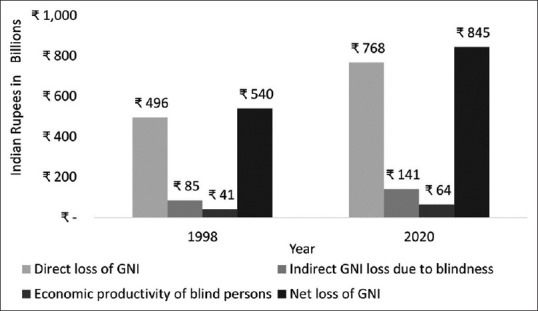
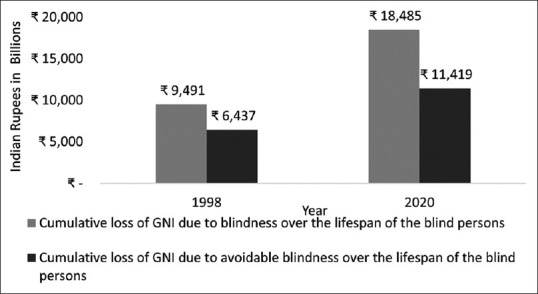
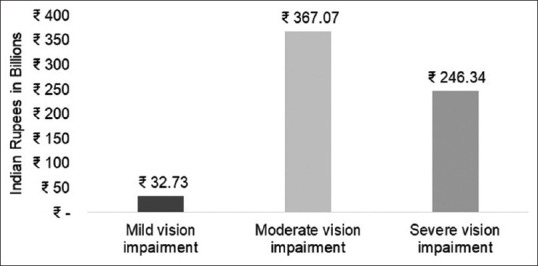
Purpose: Currently, there are an estimated 4.95 million blind persons and 70 million vision impaired persons in India, out of which 0.24 million are blind children. Early detection and treatment of the leading causes of blindness such as cataract are important in reducing the prevalence of blindness and vision impairment. There are significant developments in the field of blindness prevention, management, and control since the “Vision 2020: The right to sight” initiative. Very few studies have analyzed the cost of blindness at the population level. This study was undertaken to update the information on the economic burden of blindness and visual impairment in India based on the prevalence of blindness in India. We used secondary and publicly available data and a few assumptions for our estimations. Methods: We used gross national income (GNI), disability weights, and loss of productivity metrics to calculate the economic burden of blindness and vision impairment based on the “cost of illness” methodology. Results: The estimated net loss of GNI due to blindness in India is INR 845 billion (Int$ 38.4 billion), with a per capita loss of GNI per blind person of INR 170,624 (Int$ 7,756). The cumulative loss of GNI due to avoidable blindness in India is INR 11,778.6 billion (Int$ 535 billion). The cumulative loss of GNI due to blindness increased almost three times in the past two decades. The potential loss of productivity due to vision impairment is INR 646 billion (Int$ 29.4 billion). Conclusion: These estimates provide adequate information for budgetary allocation and will help advocate the need for accelerated adoption of all four strategies of integrated people-centered eye care (IPCEC). Early detection and treatment of blindness, especially among children, is very important in reducing the economic burden; thus, there is a need for integrating primary eye care horizontally with all levels of primary healthcare.
Overview
The claims and statistics of this paper haven’t been checked yet.
Free: it reads the open-access text and checks the first 5 claims that cite a source we can check. Create a free account to check every claim.
Integrity signals
Registry
Cites
Statistics
Figures
Verification
Claims the paper makes
The claims and statistics of this paper haven’t been checked yet.
Free: it reads the open-access text and checks the first 5 claims that cite a source we can check. Create a free account to check every claim.
Claims other papers make about this one
Each is checked against this paper’s own text: does it say what the citing paper says it does?
The source backs part of the claim, not all of it — or backs it for a different population, condition or comparison.
In the citing paper
“The subsequent economic burden associated with blindness can be substantial, particularly in LMICs, where it can be up to over US$ 4000 per blind person per year22–24.”
From Economic evaluation for medical artificial intelligence: accuracy vs. cost-effectiveness in a diabetic retinopathy screening case (2024) · cites this paper as [24]
Experimental — accuracy not yet measured
Self-check
Percentages, sums and reported differences re-computed from the paper’s own numbers.
The self-check needs the paper’s full text.
Citations
Cites
Bourne, R. R. A., Flaxman, S. R., Braithwaite, T., Cicinelli, M. V., Das, A., Jonas, J. B., Keeffe, J., Kempen, J. H., Leasher, J., Limburg, H., et al. (2017) · The Lancet Global Health · doi:10.1016/s2214-109x(17)30293-0 · Cited by 2,213
Potential Lost Productivity Resulting from the Global Burden of Myopia
Naidoo, K. S., Fricke, T. R., Frick, K. D., Jong, M., Naduvilath, T. J., Resnikoff, S., & Sankaridurg, P. (2019) · Ophthalmology · doi:10.1016/j.ophtha.2018.10.029 · Cited by 480
Adjusting for Inflation and Currency Changes Within Health Economic Studies
Turner, H. C., Lauer, J. A., Tran, B. X., Teerawattananon, Y., & Jit, M. (2019) · Value in Health · doi:10.1016/j.jval.2019.03.021 · Cited by 339
Economic Note: Cost of illness studies
Byford, S. (2000) · BMJ · doi:10.1136/bmj.320.7245.1335 · Cited by 318
The magnitude and cost of global blindness: an increasing problem that can be alleviated
Frick, K. D., & Foster, A. (2003) · American Journal of Ophthalmology · doi:10.1016/s0002-9394(02)02110-4 · Cited by 316 · cited 3×
“Estimates and their limitations As recommended in earlier studies,[9,13] we used the GNI per capita over minimum wage to calculate the cost of blindness[6,13] to compare consistently.”
BackgroundMethodGlobal economic productivity losses from vision impairment and blindness
Marques, A. P., Ramke, J., Cairns, J., Butt, T., Zhang, J. H., Muirhead, D., Jones, I., Tong, B. A. M. A., Swenor, B. K., Faal, H., et al. (2021) · EClinicalMedicine · doi:10.1016/j.eclinm.2021.100852 · Cited by 236
Eckert, K. A., Carter, M. J., Lansingh, V. C., Wilson, D. A., Furtado, J. M., Frick, K. D., & Resnikoff, S. (2015) · Ophthalmic Epidemiology · doi:10.3109/09286586.2015.1066394 · Cited by 132
Prevalence and causes of childhood blindness in India: A systematic review
Vashist, P., Wadhwani, M., Singh, S. S., Gupta, V., Gupta, N., & Saxena, R. (2020) · Indian Journal of Ophthalmology · doi:10.4103/ijo.ijo_2076_18 · Cited by 102 · cited 3×
“[11] Data on the prevalence of blindness and vision impairment for the overall population and in children were obtained from the published literature.[1,2,12] Blindness is defined as “presenting visual acuity worse than 3/60 in the better eye”[1] in this study to compare the estimates previously estimated in 1998.”
BackgroundResultEconomic burden of blindness in India.
Shamanna, B., Dandona, L., & Rao, G. N. (1998) · PubMed · Cited by 96
Self-citationMagnitude and Temporal Trends in Avoidable Blindness in Children (ABC) in India
Gudlavalleti, V. S. M. (2017) · The Indian Journal of Pediatrics · doi:10.1007/s12098-017-2405-2 · Cited by 41 · cited 1×
“[11] Data on the prevalence of blindness and vision impairment for the overall population and in children were obtained from the published literature.[1,2,12] Blindness is defined as “presenting visual acuity worse than 3/60 in the better eye”[1] in this study to compare the estimates previously estimated in 1998.”
Result
Research works printed but not linked: 2
- Rao GN Vision 2020:The Right to Sight Community Eye Heal [Internet] 2000 cited 2018 Apr 8 13 35 42 Available from: https://www.cehjournal.org/wp-content/uploads/download/ceh_13_35_042.pdf
- Rahi JS Gilbert CE Epidemiology and world-wide impact of visual impairment in children Pediatr Ophthalmol strabismus 4th ed Elsevier 2012 1 8
Cited by
Wang, Y., Liu, C., Hu, W., Luo, L., Shi, D., Zhang, J., Yin, Q., Zhang, L., Han, X., & He, M. (2024) · npj Digital Medicine · doi:10.1038/s41746-024-01032-9 · Cited by 76
The economic and social costs of visual impairment and blindness in India
Wong, B. A., Singh, K., Khanna, R., Ravilla, T., Sabherwal, S., Sil, A. K., Dole, K. S., Jain, E., & Chase, H. (2022) · Indian Journal of Ophthalmology · doi:10.4103/ijo.ijo_502_22 · Cited by 23
“A study estimating the economic cost of visual impairment in 2020 was published while this paper was undergoing peer review.[6] Our study differs from this most recent analysis on several dimensions.”
ResultRetinopathy of prematurity in India – what can we learn from the polio legacy?
Athikarisamy, S. E., Vinekar, A. S., & Patole, S. (2023) · The Lancet Regional Health - Southeast Asia · doi:10.1016/j.lansea.2023.100210 · Cited by 14
Zhao, C., Ding, Q., & Yang, Z. (2024) · European Journal of Ophthalmology · doi:10.1177/11206721241238878 · Cited by 14
Artificial intelligence-powered smart vision glasses for the visually impaired
Udayakumar, D., Gopalakrishnan, S., Raghuram, A., Kartha, A., Krishnan, A. K., Ramamirtham, R., Muthangi, R., & Raju, R. (2025) · Indian Journal of Ophthalmology · doi:10.4103/ijo.ijo_1621_24 · Cited by 13
“[10] The costs of low vision and blindness in India in 2019 are estimated at INR 1158 billion.”
Metadata
- Authors
- Mannava, S., Borah, R. R., & Shamanna, B. R.
- Affiliations
- University of Hyderabad (IN)
- Corresponding author
- Shamanna, B R
- ORCID
- Mannava, Sunny
- Venue
- Indian Journal of Ophthalmology
- Published
- 2022-05-31
- Volume
- 70
- Issue
- 6
- Pages
- 2141-2145
- ISSN
- 0301-4738 (ISSN-L)
- 1998-3689
- PMC
- PMC9359234
- OpenAlex
- W4282936352
- Cited by
- 67
- References
- 15
- Citations by year
- 2026: 12 · 2025: 23 · 2024: 19 · 2023: 10 · 2022: 3
- FWCI
- 9.93
- Type
- journal article
- Language
- en
- Open access
- diamond
- doi.org
- Licence
- cc-by-nc-sa
- Locations
- Indian Journal of Ophthalmology (publishedVersion, cc-by-nc-sa)
- PubMed Central (publishedVersion, cc-by-nc-sa)
- PubMed (publishedVersion)
- DOAJ (DOAJ: Directory of Open Access Journals) (submittedVersion, cc-by-sa)
- Topics
- Health Sciences › Medicine › Ophthalmology › Ophthalmology and Visual Impairment Studies
- Social Sciences › Economics, Econometrics and Finance › Economics and Econometrics › Health Systems, Economic Evaluations, Quality of Life
- Health Sciences › Medicine › Ophthalmology › Glaucoma and retinal disorders
- Keywords
- blindness, visual impairment, economic burden, productivity loss, avoidable blindness, cataract, blindness prevention, India
- MeSH terms
- Financial Stress, Blindness, Child, Humans, India, Vision, Low, Cost of Illness
About these checks
Registry, retraction, Cites and statistics results are computed, not judged, with one exception: a printed reference that no index lists is read once by a model before it counts as a citation error. Claims are extracted by a model and kept only when their quote appears verbatim in the text; each cited source is then checked, with a model’s help, for whether it says what the claim relies on. Those verdicts can be wrong — read the claim’s quote and the cited source before relying on one.
Statistics and arithmetic are recomputed, not judged.
Confidence bands are shown only for fields calibrated on our annotated test set. None is calibrated yet, so no band is shown.
What counts as a claim ›How we measure confidence ›How we check this ›
Are you an author, or do you see a problem with this page? Request a review
Data sources
Bibliographic data: Semantic Scholar, OpenAlex, Crossref.
Contains information from the Semantic Scholar Academic Graph Datasets, made available under the ODC Attribution License (ODC-BY 1.0).
Semantic Scholar’s data is described in: Kinney, R., et al. (2023). The Semantic Scholar Open Data Platform. arXiv:2301.10140.
