

The DOI matches its Crossref record; 38 of the 38 references it cites were found in a registry or an index; none of the 10 sources its claims cite is checked for support yet.
The Effects of Calcium and Glutamine Co-supplementation on Body Composition and Bone Mineral Density in Young Female Athletes: A Randomized Clinical Trial
Open accessAbstract
Background: Female athletes who experience menstrual disorders have an energy imbalance due to dietary restrictions and training. A significant problem arising from the daily training of such athletes is the imbalance between energy intake and energy expenditure, leading to fractures due to osteoporosis, amenorrhea, diabetes, and cardiovascular disease. The purpose of this study was to investigate and compare the complementary effect of calcium (Ca), Glutamine (Gln), and Ca+Gln supplements on bone mineral density (BMD), body composition, and physiological and biochemical symptoms of young female athletes with menstrual disorders during 90 days of the training program. Methods: In this randomized clinical trial (RCT), participants were classified into four groups: Ca supplementation group (Ca), Gln supplementation group (Gln), Ca+Gln supplementation group, and placebo group. Ca supplement containing 500 mg elemental Ca was given to the recipient groups daily. Gln supplement was given at the dose of 10,000 mg. The control group received maltodextrin (similar to Gln powder) as a placebo. BMD, serum Ca and vitamin D 3 , mid-arm upper circumference (MUAC), weight, and body mass index (BMI) were recorded in the four groups pre and post intervention. Results: Our study found that BMD differences in the three intervention groups were significant ( P < 0.05). Results showed that Ca+Gln and Ca supplementation significantly improved BMD. This effect was observed in the Gln supplementation group too; however, it was lower than that of the Ca and Ca+Gln groups. Serum Ca was significantly elevated in the Ca group ( P < 0.05). Conclusions: Ca+Glu supplement improves BMD in female athletes.
Overview
CoChat Summary
TL;DR
In a 90-day randomized clinical trial of 40 young female athletes with menstrual disorders, calcium and calcium+glutamine supplementation significantly improved bone mineral density (BMD) and serum calcium, while body composition measures did not differ significantly. Calcium+glutamine appeared most effective for BMD, and the paper reports that Ca and Ca+Gln groups shifted from oligomenorrhea to normal menstrual cycles.
Key findings
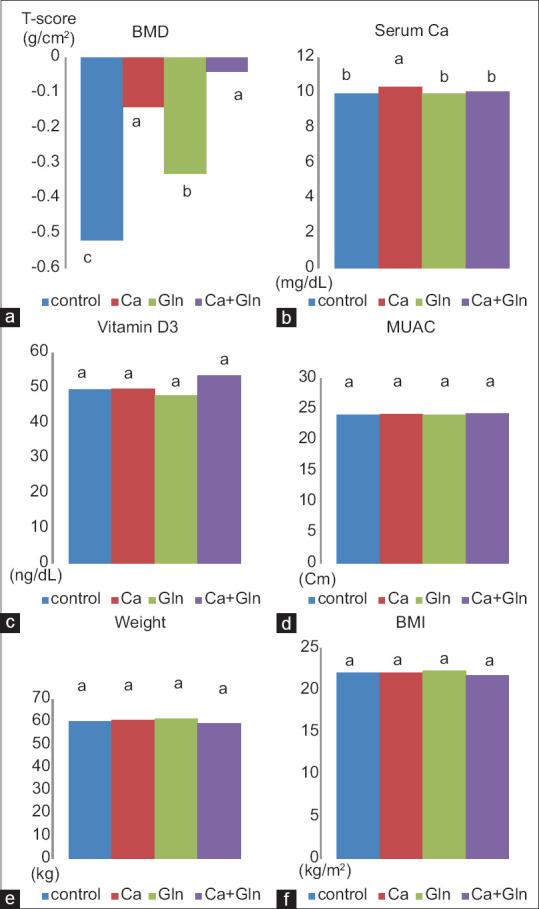
- BMD changed significantly pre- to post-intervention in the Ca group (t = −2.641, P = 0.02687) and Ca+Gln group (t = −2.9088, P = 0.01735), but not in the control or Gln groups (P > 0.05); ANOVA showed a significant treatment effect for BMD (P < 0.01).
- Serum calcium increased significantly in the Ca group (t = −3.7204, P = 0.004768) and Ca+Gln group (t = −2.2953, P = 0.04736); ANOVA showed a significant treatment effect for serum calcium (P < 0.05).
- No significant differences were found among groups for vitamin D3, MUAC, body weight, or BMI (all non-significant in Tables 2 and 3).
- The paper reports that 100% of participants had a history of oligomenorrhea in the preceding 6 months, and that athletes in the Ca and Ca+Gln groups significantly changed from oligomenorrhea to normal menstrual cycles.
Methods
- Randomized clinical trial with 40 female athletes aged 18–24, recruited from Balewadi’s Shri Shiv Chhatrapati Athletics Stadium in Pune, India; inclusion required at least 2 years of athletics, participation in at least two international games, and gynecologist-diagnosed menstrual disorder (amenorrhea or oligomenorrhea); 10 participants per group.
- Four groups: Ca (500 mg elemental calcium daily), Gln (10,000 mg/day, divided into 5,000 mg twice daily after physical activity), Ca+Gln, and placebo (maltodextrin); intervention lasted 90 days with follow-up every 2 weeks.
- Outcomes measured pre- and post-intervention included BMD by DEXA, serum calcium, vitamin D3, MUAC, weight, BMI, general health/medical questionnaires, and a 3-day food recall; analysis used R 3.6.2 with paired t-tests, ANOVA, and Duncan test at P < 0.05.
Limitations
- The paper does not include a dedicated limitations section. It states that studies on Gln and BMD were scarce and that sample size was based on muscle mass because no prior data existed on Gln’s effect on BMD.
- Limitations evident from the text: small sample (n = 40, 10 per group), single site, and short 90-day intervention; no blinding or allocation concealment is described, and compliance/adverse events are not reported.
- Body composition outcomes (MUAC, weight, BMI) showed no significant differences, so the study’s conclusions about body composition are limited; the abstract/conclusion also uses “Ca+Glu” while the intervention is described as Ca+Gln.
Model-written summary. Check it against the paper before relying on it.
Integrity signals
Registry
Cites
Statistics
Figures
Verification
Claims the paper makes
0 Valid · 0 Not valid · 10 Not checked · 19 Own results and interpretations
A result the paper reports from its own data — it cites no other source for it, so there is none to check. The quote shows it is in the paper.
In the paper
“The Ca (t = −3.7204, P = 0.004768) and Ca+Gln (t = −2.2953, P = 0.04736) intake significantly increased the serum calcium levels [Table 2].”
- Also stated in: § Results: · plain
“Serum Ca was significantly elevated in the Ca group (P < 0.05).”
§ The Effects of Calcium and Glutamine Co-supplementation on Body Composition and Bone Mineral Density in Young Female Athletes: A Randomized Clinical Trial > Results
plainstates a cause- Asserted: passes — The authors put it forward as true.
- Checkable: passes — It can be checked against evidence.
- Load-bearing: passes — The paper’s conclusions depend on it.
- Based: passes — The paper gives a reason why it holds.
- Also stated in: § Results: · plain
A result the paper reports from its own data — it cites no other source for it, so there is none to check. The quote shows it is in the paper.
In the paper
“Our study found that BMD differences in the three intervention groups were significant (P < 0.05).”
- Also stated in: § Results · boosted
“The analysis of variance for BMD, serum Ca, vitamin D3, MUAC, weight, and BMI in the four groups and their changes pre and post intervention, which is given in Table 3, demonstrates the significant F value in BMD (P < 0.01) and serum calcium (P < 0.05).”
§ The Effects of Calcium and Glutamine Co-supplementation on Body Composition and Bone Mineral Density in Young Female Athletes: A Randomized Clinical Trial > Abstract > Results:
boosted- Asserted: passes — The authors put it forward as true.
- Checkable: passes — It can be checked against evidence.
- Load-bearing: passes — The paper’s conclusions depend on it.
- Based: passes — The paper gives a reason why it holds.
- Also stated in: § Results · boosted
A result the paper reports from its own data — it cites no other source for it, so there is none to check. The quote shows it is in the paper.
In the paper
“Compared with the lowest impacts on BMD in the Ca and Gln groups, BMD had more significant changes in Ca+Gln co-supplementation (P < 0.05) [Figure 1].”
§ The Effects of Calcium and Glutamine Co-supplementation on Body Composition and Bone Mineral Density in Young Female Athletes: A Randomized Clinical Trial > Results
plainstates a cause- Asserted: passes — The authors put it forward as true.
- Checkable: passes — It can be checked against evidence.
- Load-bearing: passes — The paper’s conclusions depend on it.
- Based: passes — The paper gives a reason why it holds.
A result the paper reports from its own data — it cites no other source for it, so there is none to check. The quote shows it is in the paper.
In the paper
“The Ca (t = −3.7204, P = 0.004768) and Ca+Gln (t = −2.2953, P = 0.04736) intake significantly increased the serum calcium levels [Table 2].”
§ The Effects of Calcium and Glutamine Co-supplementation on Body Composition and Bone Mineral Density in Young Female Athletes: A Randomized Clinical Trial > Results
plainstates a cause- Asserted: passes — The authors put it forward as true.
- Checkable: passes — It can be checked against evidence.
- Load-bearing: passes — The paper’s conclusions depend on it.
- Based: passes — The paper gives a reason why it holds.
A result the paper reports from its own data — it cites no other source for it, so there is none to check. The quote shows it is in the paper.
In the paper
“In the present study, 100% of the participants had a history of oligomenorrhea during the last 6 months preceding the survey.”
§ The Effects of Calcium and Glutamine Co-supplementation on Body Composition and Bone Mineral Density in Young Female Athletes: A Randomized Clinical Trial > Discussion
plain- Asserted: passes — The authors put it forward as true.
- Checkable: passes — It can be checked against evidence.
- Load-bearing: passes — The paper’s conclusions depend on it.
- Based: passes — The paper gives a reason why it holds.
8 more claims
Create a free account to see all 29 claims and to verify the 9 references still open.
- It may state two separate claims as one. 8
- Probably not a substantial claim. 9
Self-check
Percentages, sums and reported differences re-computed from the paper’s own numbers.
Each contradiction between two passages listed here was confirmed by an independent check.
Rated major: it would touch a result — a value a result rests on, reported and recomputed p-values on opposite sides of the significance level, two passages that conflict with no sign which is right, or a cited work retracted before this paper was published.
In the paper
§ The Effects of Calcium and Glutamine Co-supplementation on Body Composition and Bone Mineral Density in Young Female Athletes: A Randomized Clinical Trial > Abstract > Methods:
“Ca supplement containing 500 mg elemental Ca was given to the recipient groups daily.”
§ The Effects of Calcium and Glutamine Co-supplementation on Body Composition and Bone Mineral Density in Young Female Athletes: A Randomized Clinical Trial > Methods > Supplementation procedure
“Ca supplement contained 500 mg of Ca carbonate (Branson, USA).”
Rated major: it would touch a result — a value a result rests on, reported and recomputed p-values on opposite sides of the significance level, two passages that conflict with no sign which is right, or a cited work retracted before this paper was published.
In the paper
§ The Effects of Calcium and Glutamine Co-supplementation on Body Composition and Bone Mineral Density in Young Female Athletes: A Randomized Clinical Trial > Abstract > Results:
“This effect was observed in the Gln supplementation group too; however, it was lower than that of the Ca and Ca+Gln groups.”
§ The Effects of Calcium and Glutamine Co-supplementation on Body Composition and Bone Mineral Density in Young Female Athletes: A Randomized Clinical Trial > Results
“There were no significant differences among BMD levels in the control and Gln groups before and after the intervention (P > 0.05) [Table 2].”
Rated minor: it would not touch a result — a value no result rests on, a p-value that stays on the same side of the significance level, or a conflict that is clerical, resolved elsewhere in the paper, or outside its own findings.
In the paper
§ The Effects of Calcium and Glutamine Co-supplementation on Body Composition and Bone Mineral Density in Young Female Athletes: A Randomized Clinical Trial > Introduction
“The prevalence of eating disorders in athletes is estimated to be between 0.5% and 1.4%”
§ The Effects of Calcium and Glutamine Co-supplementation on Body Composition and Bone Mineral Density in Young Female Athletes: A Randomized Clinical Trial > Introduction
“which is estimated at 0.5%–1% for anorexia and 1%–4% for overeating.”
Rated minor: it would not touch a result — a value no result rests on, a p-value that stays on the same side of the significance level, or a conflict that is clerical, resolved elsewhere in the paper, or outside its own findings.
In the paper
§ The Effects of Calcium and Glutamine Co-supplementation on Body Composition and Bone Mineral Density in Young Female Athletes: A Randomized Clinical Trial > Methods > Study design
“The study period was 90 days.”
§ The Effects of Calcium and Glutamine Co-supplementation on Body Composition and Bone Mineral Density in Young Female Athletes: A Randomized Clinical Trial > Results
“Table: Table 1 Descriptive statistics of BMD, serum Ca, vitamin D3, MUAC, body weight, and BMI after 12 weeks of intervention among four groups of young female athletes”
Citations
Cites
(2007) · Medicine & Science in Sports & Exercise · doi:10.1249/mss.0b013e318149f111 · Cited by 1,554
A Controlled Trial of the Effect of Calcium Supplementation on Bone Density in Postmenopausal Women
Dawson-Hughes, B., Dallal, G. E., Krall, E. A., Sadowski, L., Sahyoun, N., & Tannenbaum, S. (1990) · New England Journal of Medicine · doi:10.1056/nejm199009273231305 · Cited by 947
Osteoblast–osteoclast interactions
Chen, X., Wang, Z., Duan, N., Zhu, G., Schwarz, E. M., & Xie, C. (2018) · Connective Tissue Research · doi:10.1080/03008207.2017.1290085 · Cited by 873
Effects of air pollution on human health and practical measures for prevention in Iran
Ghorani-Azam, A., Riahi-Zanjani, B., & Balali-Mood, M. (2016) · Journal of Research in Medical Sciences · doi:10.4103/1735-1995.189646 · Cited by 723
Glutamate. Its applications in food and contribution to health
Jinap, S., & Hajeb, P. (2010) · Appetite · doi:10.1016/j.appet.2010.05.002 · Cited by 300
Wnt signaling and cellular metabolism in osteoblasts
Karner, C. M., & Long, F. (2017) · Cellular and Molecular Life Sciences · doi:10.1007/s00018-016-2425-5 · Cited by 295
Dietary calcium intake and risk of fracture and osteoporosis: prospective longitudinal cohort study
Warensjö, E., Byberg, L., Melhus, H., Gedeborg, R., Mallmin, H., Wolk, A., & Michaëlsson, K. (2011) · BMJ · doi:10.1136/bmj.d1473 · Cited by 231
Osteoclast-Derived Complement Component 3a Stimulates Osteoblast Differentiation
Matsuoka, K., Park, K.-A., Ito, M., Ikeda, K., & Takeshita, S. (2014) · Journal of Bone and Mineral Research · doi:10.1002/jbmr.2187 · Cited by 225
The Hypothalamic-Pituitary-Adrenal Axis: What can it Tell us About Stressors?
Armario, A. (2006) · CNS & Neurological Disorders - Drug Targets · doi:10.2174/187152706778559336 · Cited by 221
Zhu, K., & Prince, R. L. (2012) · Clinical Biochemistry · doi:10.1016/j.clinbiochem.2012.05.006 · Cited by 193
Vitamin D and calcium dysregulation in the polycystic ovarian syndrome
Thys‐Jacobs, S., Donovan, D., Papadopoulos, A., Sarrel, P. M., & Bilezikian, J. P. (1999) · Steroids · doi:10.1016/s0039-128x(99)00012-4 · Cited by 193
Physical Activity Plays an Important Role in Body Weight Regulation
Chaput, J., Klingenberg, L., Rosenkilde, M., Gilbert, J., Tremblay, A., & Sjödin, A. M. (2010) · Journal of Obesity · doi:10.1155/2011/360257 · Cited by 191
Eating Disorders in Female Athletes
Sundgot‐Borgen, J. (1994) · Sports Medicine · doi:10.2165/00007256-199417030-00004 · Cited by 157
Turocy, P. S., DePalma, B., Horswill, C. A., Laquale, K. M., Martin, T. J., PERRY, A. C., Somova, M. J., & Utter, A. C. (2011) · Journal of Athletic Training · doi:10.4085/1062-6050-46.3.322 · Cited by 157
The Effects of Calcium-Vitamin D and Metformin on Polycystic Ovary Syndrome: A Pilot Study
Rashidi, B. H., Haghollahi, F., Shariat, M., & Zayerii, F. (2009) · Taiwanese Journal of Obstetrics and Gynecology · doi:10.1016/s1028-4559(09)60275-8 · Cited by 151
Insulin stimulates osteoblast proliferation and differentiation through ERK and PI3K in MG‐63 cells
Yang, J., Zhang, X., Wang, W., & Liu, J. (2010) · Cell Biochemistry and Function · doi:10.1002/cbf.1668 · Cited by 144
Voulgaridou, G., Papadopoulou, S. K., Detopoulou, P., Tsoumana, D., Giaginis, C., Kondyli, F. S., Lymperaki, E., & Pritsa, A. (2023) · Diseases · doi:10.3390/diseases11010029 · Cited by 135
Therapeutic effects of calcium & vitamin D supplementation in women with PCOS
Firouzabadi, R. D., D, A. A. M., Modarresi, S. Z., Sekhavat, L., & MohammadTaheri, S. (2012) · Complementary Therapies in Clinical Practice · doi:10.1016/j.ctcp.2012.01.005 · Cited by 115
Zuhl, M., Dokładny, K., Mermier, C. M., Schneider, S. M., Salgado, R. M., & Moseley, P. L. (2014) · Cell Stress and Chaperones · doi:10.1007/s12192-014-0528-1 · Cited by 112
Effect of glutamine supplementation combined with resistance training in young adults
Candow, D. G., Chilibeck, P. D., Burke, D., Davison, S. K., & Smith‐Palmer, T. (2001) · European Journal of Applied Physiology · doi:10.1007/s00421-001-0523-y · Cited by 93
Liu, Z., Jeppesen, P. B., Gregersen, S., Chen, X., & Hermansen, K. (2008) · The Review of Diabetic Studies · doi:10.1900/rds.2008.5.232 · Cited by 86
The effect of diet components on the level of cortisol
Stachowicz, M., & Lebiedzińska, A. (2016) · European Food Research and Technology · doi:10.1007/s00217-016-2772-3 · Cited by 84
Alghadir, A. H., Gabr, S. A., & Al-Eisa, E. S. (2015) · Journal of Physical Therapy Science · doi:10.1589/jpts.27.2261 · Cited by 81
Kim, K. M., Choi, S. H., Lim, S. K., Moon, J. H., Kim, J. H., Kim, S. W., Jang, H. C., & Shin, C. S. (2014) · The Journal of Clinical Endocrinology & Metabolism · doi:10.1210/jc.2014-1006 · Cited by 79
Zhou, T., Yang, Y., Chen, Q., & Xie, L. (2019) · Stem Cells International · doi:10.1155/2019/8928934 · Cited by 73
The female athlete and menstrual function
Goodman, L. R., & Warren, M. P. (2005) · Current Opinion in Obstetrics & Gynecology · doi:10.1097/01.gco.0000179262.07720.ae · Cited by 55
Crescioli, C. (2020) · International Journal of Molecular Sciences · doi:10.3390/ijms21031010 · Cited by 49
Dietary supplement intake in national-level Sri Lankan athletes
de Silva, A., Samarasinghe, Y., Senanayake, D., & Lanerolle, P. (2010) · International Journal of Sport Nutrition and Exercise Metabolism · doi:10.1123/ijsnem.20.1.15 · Cited by 44
Sørensen, M. G., Henriksen, K., Dziegiel, M. H., Tankó, L. B., & Karsdal, M. A. (2006) · DNA and Cell Biology · doi:10.1089/dna.2006.25.475 · Cited by 43
Hitz, M. F., Jensen, J. B., & Eskildsen, P. C. (2007) · American Journal of Clinical Nutrition · doi:10.1093/ajcn/86.1.251 · Cited by 42
Hoffman, J. R., Ratamess, N. A., Kang, J., Rashti, S. L., Kelly, N., Gonzalez, A. M., Stec, M., Anderson, S., Bailey, B. L., Yamamoto, L. M., et al. (2010) · Journal of the International Society of Sports Nutrition · doi:10.1186/1550-2783-7-8 · Cited by 41
Supplement consumption in body builder athletes.
Karimian, J., & Shekarchizadeh, P. (2011) · PubMed Central · Cited by 41
Sherman, R. T., & Thompson, R. A. (2006) · International Journal of Eating Disorders · doi:10.1002/eat.20232 · Cited by 40
Ellis, A. C., Hunter, G. R., Goss, A. M., & Gower, B. A. (2018) · Journal of Dietary Supplements · doi:10.1080/19390211.2018.1454568 · Cited by 35
Nakamura, K., Saito, T., Kobayashi, R., Oshiki, R., Kitamura, K., Oyama, M., Narisawa, S., Nashimoto, M., Takahashi, S., & Takachi, R. (2012) · Journal of Bone and Mineral Research · doi:10.1002/jbmr.1676 · Cited by 29
Beshgetoor, D., Nichols, J. F., & Rego, I. (2000) · International Journal of Sport Nutrition and Exercise Metabolism · doi:10.1123/ijsnem.10.3.290 · Cited by 27
Coqueiro, A. Y., Raizel, R., Hypólito, T. M., & Tirapegui, J. (2017) · Revista Brasileira de Ciências do Esporte · doi:10.1016/j.rbce.2017.06.003 · Cited by 17
Monosodium Glutamate Supplementation Improves Bone Status in Mice Under Moderate Protein Restriction
Blais, A., Rochefort, G. Y., Moreau, M., Calvez, J., Wu, X., Matsumoto, H., & Blachier, F. (2019) · JBMR Plus · doi:10.1002/jbm4.10224 · Cited by 12
Research works printed but not linked: 2
- Hanaa, 2009, Potential role of arginine, glutamine and taurine in ameliorating osteoporotic biomarkers in ovariectomized rats, Rep Opin, 1, 24
- Rashidi, 2009, The effects of calcium-vitamin D and metformin on polycystic ovary syndrome: A pilot study, Taiwan J Obstet Gynecol, 48, 142, 10.1016/s1028-4559(09)60275-8 · DOI
Cited by
Still being checked.
Metadata
- Authors
- Goodarzizadeh, N., Shahrjerdi, A., Begum, K., & Amani, R.
- Affiliations
- Ahvaz Jundishapur University of Medical Sciences (IR)
- Razi Vaccine and Serum Research Institute (IR)
- University of Mysore (IN)
- Isfahan University of Medical Sciences (IR)
- Corresponding author
- Amani, Reza
- Venue
- International Journal of Preventive Medicine
- Published
- 2026-02
- Volume
- 17
- Pages
- 11-11
- ISSN
- 2008-7802 (ISSN-L)
- 2008-8213
- PMC
- PMC13038277
- OpenAlex
- W7131351132
- Semantic Scholar
- f2e2034d33f98a052d361b2516f3a9c36a7ccd96
- Cited by
- 0
- References
- 38
- FWCI
- 0.00
- Type
- journal article
- Language
- en
- Open access
- gold
- doi.org
- Licence
- cc-by-nc-sa
- Locations
- International Journal of Preventive Medicine (publishedVersion, cc-by-nc-sa)
- PubMed Central (publishedVersion, cc-by-nc-nd)
- PubMed (publishedVersion)
- DOAJ (DOAJ: Directory of Open Access Journals) (submittedVersion)
- Topics
- Health Sciences › Medicine › Orthopedics and Sports Medicine › Bone health and osteoporosis research
- Health Sciences › Nursing › Nutrition and Dietetics › Muscle metabolism and nutrition
- Health Sciences › Medicine › Public Health, Environmental and Occupational Health › Nutrition and Health Studies
- Keywords
- calcium supplementation, glutamine supplementation, bone mineral density, body composition, female athletes, menstrual disorders, energy imbalance, osteoporosis, serum calcium, vitamin D3, mid-upper arm circumference, body mass index
About these checks
Registry, retraction, Cites and statistics results are computed, not judged, with one exception: a printed reference that no index lists is read once by a model before it counts as a citation error. Claims are extracted by a model and kept only when their quote appears verbatim in the text; each cited source is then checked, with a model’s help, for whether it says what the claim relies on. Those verdicts can be wrong — read the claim’s quote and the cited source before relying on one.
A language model drew the claims from the paper on 2026-11-14, under version 3 of the claim definition (model deepseek-v4.1-flash, prompt extract-v3).
A second model labelled each claim on 2026-11-14 (model jev-1.13-20260917, definition revision gold-guideline-v0.2).
Statistics and arithmetic are recomputed, not judged.
Confidence bands are shown only for fields calibrated on our annotated test set. None is calibrated yet, so no band is shown.
What counts as a claim ›How we measure confidence ›How we check this ›
Are you an author, or do you see a problem with this page? Request a review
Data sources
Bibliographic data: Semantic Scholar, OpenAlex, Crossref.
Contains information from the Semantic Scholar Academic Graph Datasets, made available under the ODC Attribution License (ODC-BY 1.0).
Semantic Scholar’s data is described in: Kinney, R., et al. (2023). The Semantic Scholar Open Data Platform. arXiv:2301.10140.
