

Management of Psychiatric Disorders in Patients with Hepatic and Gastrointestinal Diseases
Open accessThe DOI matches its Crossref record; 78 of the 78 references it cites were found in a registry or an index.
Abstract
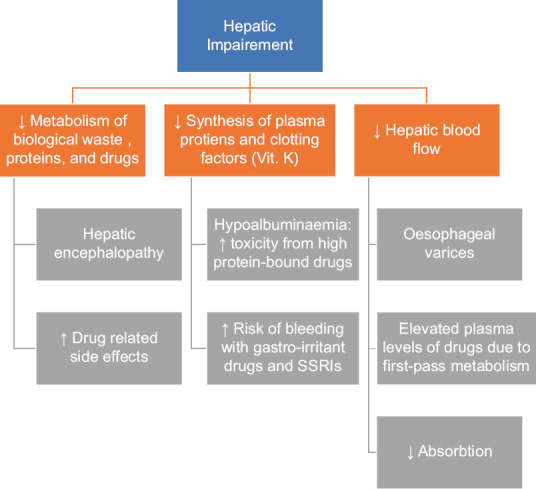
INTRODUCTION Psychiatric disorders and general medical conditions share a bidirectional relationship. Patients with severe mental illness have a higher prevalence of concurrent medical conditions, and chronic medical illness also increases the risk of developing mental illness. Psychotropic agents are commonly used in the management of psychiatric disorders in the medically ill. Comorbid medical illness poses many challenges when prescribing psychotropic drugs; important considerations include disease-induced changes in pharmacokinetics and pharmacodynamics while one must also consider drug–drug interactions and increased vulnerability to adverse effects. Most drugs and substances that we ingest are metabolized by the liver. Impaired hepatic function can critically alter many aspects of pharmacokinetics. Knowledge of these processes and changes are essential to understanding changes in systemic drug concentrations and prescribing appropriately to avoid drug toxicity. Similarly, the use of psychotropic medications in gastrointestinal (GI) conditions is complicated by issues such as interaction between GI medications and psychotropic drugs, risk of gastric bleed, and alteration in pharmacokinetics produced by conditions such as short bowel syndrome. The present article will review the considerations when prescribing psychotropic drugs to patients with hepatic and GI disorders. We summarize the pharmacokinetic changes and provide evidence-based dosing suggestions whenever available for individual agents of concern. The guideline first covers prescribing in hepatic disease, followed by GI disorders. PHARMACOKINETIC CHANGES IN HEPATIC DISEASE Hepatic impairment affects many critical aspects of pharmacokinetics (e.g., absorption, first-pass metabolism, hepatic biotransformation, the synthesis of drug-binding proteins, and fluid balance which determines the volume available for drug distribution).[1] The reduced first-pass metabolism and hepatic biotransformation lead to an increase in oral bioavailability and prolonged drug effects. If serum albumin is reduced, then it will affect the highly protein-bound drugs.[2] In presence of ascites, the increased volume of distribution will affect the water-soluble drugs. Figure 1 depicts the pharmacokinetic changes in liver disease.Figure 1: Pharmacokinetic changes in hepatic diseaseThere are two phases of drug metabolism in the liver; phase I reactions constitute hydrolysis, reduction, or oxidation and usually reduce the pharmacological activity of the molecule (except in cases where drugs are converted to their active metabolites). Phase II reactions involve drug conjugation with endogenous compounds such as glucuronic acid, amino acids, glutathione, and sulfate. This further reduces the pharmacological activity of the agent and makes it more water soluble. In chronic liver disease (CLD), more of the drug passes into the systemic circulation bypassing the liver; this is through the portosystemic shunts in these patients. Resultantly, there is a rise in drug levels which is more pronounced for drugs that undergo extensive first-pass metabolism. On the other hand, this is not seen for drugs that are mainly metabolized by phase II biotransformation reactions which are largely preserved in liver disease (such as lorazepam), and those with relatively little affinity for liver enzymes (such as paroxetine). Normally, phase II reactions are preserved in aging and liver disease. Hence, it is advisable to prefer agents that do not need phase I reactions in end-stage liver disease; examples of such agents are lorazepam and oxazepam. Further, the free (unbound) fractions of drugs that are extensively protein bound undergoes a change because of decreased synthesis of albumin and glycoproteins in end-stage liver disease. Many psychotropic drugs are highly protein bound; this includes tricyclic antidepressants (TCAs), fluoxetine, sertraline, aripiprazole, and diazepam. A rise in serum levels of the free fractions of these agents may imply an increased risk of adverse drug reactions. Most of the psychotropic agents that are currently used are lipophilic, implying that they need to be metabolized in the liver and made more soluble for them to get excreted in the urine or bile. Only a few drugs such as lithium and topiramate are hydrophilic, which are directly eliminated through the urine or bile. PREVALENCE OF LIVER DISEASE IN PSYCHIATRIC DISORDERS Growing literature suggests that prevalence of hepatitis B and C is higher among psychiatric populations compared to the general public. In a recent meta-analysis, the pooled prevalence of hepatitis B in severe mental illness varied from 2.2% in South America to 9.7% in Asia; the same authors also reported pooled prevalence rates of hepatitis C that ranged from 3.0% in South America to 17.4% in North America.[3] More specifically, population-based cohort studies have shown that patients with schizophrenia had a higher prevalence (7.0%) of CLD
Overview
The claims and statistics of this paper haven’t been checked yet.
Free: it reads the open-access text and checks the first 5 claims that cite a source we can check. Create a free account to check every claim.
Integrity signals
Registry
Cites
Statistics
Figures
Verification
Claims the paper makes
The claims and statistics of this paper haven’t been checked yet.
Free: it reads the open-access text and checks the first 5 claims that cite a source we can check. Create a free account to check every claim.
Claims other papers make about this one
Each is checked against this paper’s own text: does it say what the citing paper says it does?
The source backs part of the claim, not all of it — or backs it for a different population, condition or comparison.
In the citing paper
“For patients with CTP-B, a reduction of 50%–75% in the normal starting dose may be appropriate.”
From Management of depression/anxiety in patients with chronic liver disease (2024) · cites this paper as [16]
Experimental — accuracy not yet measuredThe cited source says what the claim attributes to it.
In the citing paper
“Drug dosing recommendations are guided by the Child-Turcotte-Pugh (CTP) (Table 2).16,17”
From Management of depression/anxiety in patients with chronic liver disease (2024) · cites this paper as [16]
Experimental — accuracy not yet measuredThe check wasn’t confident either way, so it gives no verdict — never disputed.
In the citing paper
“Most patients rated as having CTP-A can tolerate 75%–100% of a standard initial dose.”
From Management of depression/anxiety in patients with chronic liver disease (2024) · cites this paper as [16]
Experimental — accuracy not yet measured
Self-check
Percentages, sums and reported differences re-computed from the paper’s own numbers.
The self-check needs the paper’s full text.
Citations
Cites
Jacobi, J., Fraser, G. L., Coursin, D. B., Riker, R. R., Fontaine, D., Wittbrodt, E. T., Chalfin, D. B., Masica, M. F., Bjerke, H. S., Coplin, W. M., et al. (2002) · Critical Care Medicine · doi:10.1097/00003246-200201000-00020 · Cited by 1,895 · cited 1×
“[41] Close monitoring is warranted and those who are showing signs of deteriorating liver function should be assessed for symptoms of opioid toxicity, and necessary dose reduction should be undertaken.”
Al-Toma, A., Volta, U., Auricchio, R., Castillejo, G., Sanders, D. S., Cellier, C., Mulder, C. J., & Lundin, K. E. A. (2019) · United European Gastroenterology Journal · doi:10.1177/2050640619844125 · Cited by 1,012 · cited 2×
“[74] There is evidence to suggest that drug absorption may be increased (e.g. propranolol), delayed, reduced, or normal in CeD; this includes psychotropic medications too.”
Jonas, D. E., Amick, H. R., Feltner, C., Bobashev, G., Thomas, K., Wines, R., Kim, M. M., Shanahan, E., Gass, C. E., Rowe, C. J., et al. (2014) · JAMA · doi:10.1001/jama.2014.3628 · Cited by 923 · cited 1×
“[33] Naltrexone has an FDA “black box” warning against use in patients with liver disease; therefore, it must be avoided in such cases.”
Psychosocial Aspects of the Functional Gastrointestinal Disorders
Levy, R. L., Olden, K. W., Naliboff, B. D., Bradley, L. A., Francisconi, C., Drossman, D. A., & Creed, F. (2006) · Gastroenterology · doi:10.1053/j.gastro.2005.11.057 · Cited by 776
Patrick, D. L., Drossman, D. A., Frederick, I. O., Dicesare, J., & Puder, K. L. (1998) · Digestive Diseases and Sciences · doi:10.1023/a:1018831127942 · Cited by 761 · cited 1×
“…(Visceral Sensitivity Index or Cognitive Strategies Questionnaire) (3) impact of illness and health-associated quality of life (irritable bowel syndrome [IBS]-Quality of Life) [62] and (4) assessment of the sequential psychosocial factors as well as periods of symptom exacerbations and remissions.”
Pharmacokinetics and dosage adjustment in patients with renal dysfunction
Verbeeck, R. K., & Musuamba, F. T. (2009) · European Journal of Clinical Pharmacology · doi:10.1007/s00228-009-0678-8 · Cited by 717
Evidence-based clinical practice guidelines for inflammatory bowel disease
Matsuoka, K., Kobayashi, T., Ueno, F., Matsui, T., Hirai, F., Inoue, N., Kato, J., Kobayashi, K., Kobayashi, K., Koganei, K., et al. (2018) · Journal of Gastroenterology · doi:10.1007/s00535-018-1439-1 · Cited by 698
Pharmacokinetics and dosage adjustment in patients with hepatic dysfunction
Verbeeck, R. K. (2008) · European Journal of Clinical Pharmacology · doi:10.1007/s00228-008-0553-z · Cited by 652 · cited 1×
“[22] ; CLD – Chronic liver disease butyrophenones.”
Evidence-based clinical practice guidelines for inflammatory bowel disease 2020
Nakase, H., Uchino, M., Shinzaki, S., Matsuura, M., Matsuoka, K., Kobayashi, T., Saruta, M., Hirai, F., Hata, K., Hiraoka, S., et al. (2021) · Journal of Gastroenterology · doi:10.1007/s00535-021-01784-1 · Cited by 505 · cited 1×
“…benzodiazepines [2,64] Inflammatory bowel disease: Crohn’s disease and ulcerative colitis Antidepressants (paroxetine, bupropion, phenelzine) [64,71] IBS – Irritable bowel syndrome; TCAs – Tricyclic antidepressants; SSRIs – Serotonin reuptake inhibitors; SNRIs – Serotonin norepinephrine…”
Why Drugs Fail - A Study on Side Effects in New Chemical Entities
Schuster, D., Laggner, C., & Langer, T. (2005) · Current Pharmaceutical Design · doi:10.2174/138161205774414510 · Cited by 417 · cited 1×
“[31] Lamotrigine and topiramate are infrequently associated with liver enzyme elevation and idiosyncratic hepatotoxicity.”
Research works printed but not linked: 1
- Taylor DM Barnes TR Young AH The Maudsley Prescribing Guidelines in Psychiatry New York, NY John Wiley &Sons 2021
Cited by
Sahoo, S., Mishra, E., & Premkumar, M. (2024) · Journal of Clinical and Experimental Hepatology · doi:10.1016/j.jceh.2024.101390 · Cited by 13
Management of depression/anxiety in patients with chronic liver disease
Garcia-Altieri, M., Carrera-Mejias, K., & Hernaez, R. (2024) · Clinical Liver Disease · doi:10.1097/cld.0000000000000179 · Cited by 11
Clinical Implications of Antidepressants and Associated Risk of Bleeding: A Narrative Review
Kaye, A. D., Cooper, H. D., Mashaw, S. A., Anwar, A. I., Hollander, A. V., Thomassen, A. S., Singh, A., & Shekoohi, S. (2025) · Current Pain and Headache Reports · doi:10.1007/s11916-025-01412-0 · Cited by 9
Current vision on diagnosis and comprehensive care in hepatic encephalopathy
Higuera-de-la-Tijera, F., Velasco, J. A. V.-R., Raña-Garibay, R. H., Castro‐Narro, G., Abdo-Francis, J. M., Moreno-Alcantar, R., Pérez-Hernández, J. L., Torre, A., Contreras-Omaña, R., Cano-Contreras, A. D., et al. (2023) · Revista de Gastroenterología de México (English Edition) · doi:10.1016/j.rgmxen.2023.04.006 · Cited by 15
Treatment of Alcohol Use Disorder
Tareen, K., Clifton, E. G., Perumalswami, P., Mellinger, J. L., & Winder, G. S. (2024) · Clinics in Liver Disease · doi:10.1016/j.cld.2024.06.011 · Cited by 11
Metadata
- Authors
- Menon, V., Ransing, R., & Praharaj, S. K.
- Affiliations
- Jawaharlal Institute of Post Graduate Medical Education and Research (IN)
- Manipal Academy of Higher Education (IN)
- Venue
- Indian Journal of Psychiatry
- Published
- 2022-03
- Volume
- 64
- Issue
- Suppl 2
- Pages
- S379-S393
- ISSN
- 0019-5545 (ISSN-L)
- 1998-3794
- PMC
- PMC9122174
- OpenAlex
- W4226079944
- Cited by
- 19
- References
- 77
- Citations by year
- 2026: 5 · 2025: 8 · 2024: 4 · 2023: 2
- FWCI
- 3.20
- Type
- journal article
- Language
- en
- Open access
- diamond
- doi.org
- Licence
- cc-by-nc-sa
- Locations
- Indian Journal of Psychiatry (publishedVersion, cc-by-nc-sa)
- PubMed Central (publishedVersion, cc-by-nc-sa)
- PubMed (publishedVersion)
- DOAJ (DOAJ: Directory of Open Access Journals) (submittedVersion)
- Topics
- Life Sciences › Pharmacology, Toxicology and Pharmaceutics › Pharmacology › Pharmacogenetics and Drug Metabolism
- Health Sciences › Medicine › Geriatrics and Gerontology › Pharmaceutical Practices and Patient Outcomes
- Health Sciences › Medicine › Pharmacology (medical) › Treatment of Major Depression
- Keywords
- mental illness, psychotropic drugs, liver dysfunction, chronic liver disease, gastrointestinal diseases, pharmacokinetics, drug-drug interactions, drug toxicity, short bowel syndrome, gastric bleeding, dose adjustment, chronic disease, drug metabolism, portosystemic shunt, serum albumin, antipsychotic drugs, antidepressants, antiepileptic drugs, antipsychotic adverse effects, psychiatric comorbidity
About these checks
Registry, retraction, Cites and statistics results are computed, not judged, with one exception: a printed reference that no index lists is read once by a model before it counts as a citation error. Claims are extracted by a model and kept only when their quote appears verbatim in the text; each cited source is then checked, with a model’s help, for whether it says what the claim relies on. Those verdicts can be wrong — read the claim’s quote and the cited source before relying on one.
Statistics and arithmetic are recomputed, not judged.
Confidence bands are shown only for fields calibrated on our annotated test set. None is calibrated yet, so no band is shown.
What counts as a claim ›How we measure confidence ›How we check this ›
Are you an author, or do you see a problem with this page? Request a review
How to cite
Cite CoChat for the checks on this page, and the paper for its own findings.
- This page
- CoChat. (2026). Citation check: Management of Psychiatric Disorders in Patients with Hepatic and Gastrointestinal Diseases. https://app.cochat.ai/papers/10.4103/indianjpsychiatry.indianjpsychiatry_18_22
- The paper
- Menon, V., Ransing, R., & Praharaj, S. K. (2022). Management of Psychiatric Disorders in Patients with Hepatic and Gastrointestinal Diseases. Indian Journal of Psychiatry. https://doi.org/10.4103/indianjpsychiatry.indianjpsychiatry_18_22
Data sources
Bibliographic data: Semantic Scholar, OpenAlex, Crossref.
Contains information from the Semantic Scholar Academic Graph Datasets, made available under the ODC Attribution License (ODC-BY 1.0).
Semantic Scholar’s data is described in: Kinney, R., et al. (2023). The Semantic Scholar Open Data Platform. arXiv:2301.10140.
