

Steroidogenesis and VEGF production doesn't alter in leydig cells within the homeostatic range of testicular temperature
Open accessThe DOI matches its Crossref record; 13 of the 13 references it cites were found in a registry or an index; none of the 16 sources its claims cite is checked for support yet.
Abstract
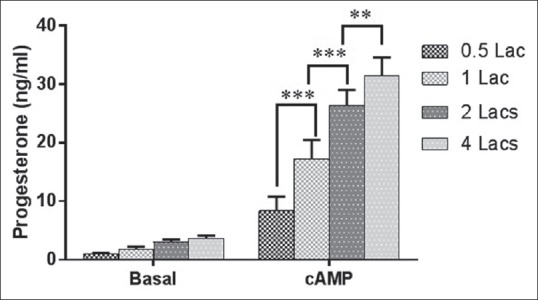
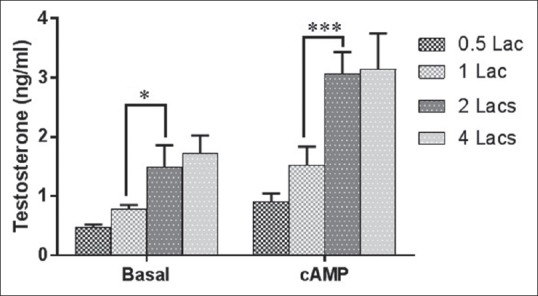
CONTEXT: Physiologically defined homeostatic temperature range for human testis falls within 32°C-37°C and any deviation outside that range can result in impaired steroidogenesis. However, whether temperature deviation within the homeostatic range can affect the steroidogenesis, is still a question of the investigation. AIM: In the present study, we investigated the production of progesterone, testosterone, and vascular endothelial growth factor (VEGF) within the homeostatic temperature range of testis, i.e., 32°C-37°C. SETTING AND DESIGN: We used mouse Leydig tumor cells-1 (MLTC-1) cell line as a model in the present study. MATERIALS AND METHODS: Progesterone and testosterone production by MLTC-1 cells was measured by radioimmunoassay and VEGF production was measured using ELISA. STATISTICAL ANALYSIS USED: Data were analyzed using GraphPad Prism software version 7.04. Student's t-test and ANOVA were used to calculate the P value. P < 0.05 was considered statistically significant. RESULTS AND CONCLUSIONS: Results of our study indicate that there is no significant difference in production of progesterone, testosterone, and VEGF within the homeostatic range of the testicular temperature. Thus, we concluded that testicular cells are able to regulate the steroidogenesis and VEGF production under the homeostatic range of the testicular temperature.
Overview
CoChat Summary
TL;DR
In MLTC-1 mouse Leydig tumor cells, progesterone, testosterone, and VEGF production did not differ significantly between 32°C and 37°C under basal or 8-Br-cAMP–stimulated conditions. The authors conclude that Leydig cells can regulate steroidogenesis and VEGF production within the homeostatic testicular temperature range.
Key findings
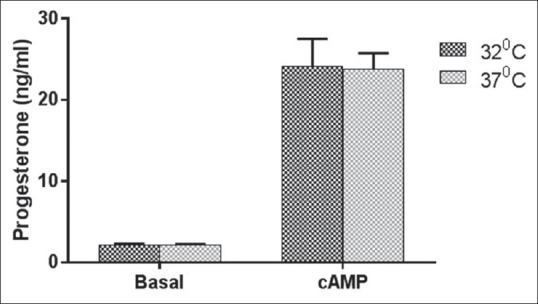
- Progesterone production showed no significant difference between 32°C and 37°C in basal conditions (mean difference 0 ± 0.1155, P < 0.5340) or after cAMP stimulation (mean difference 0.375 ± 1.978, P < 0.4154).
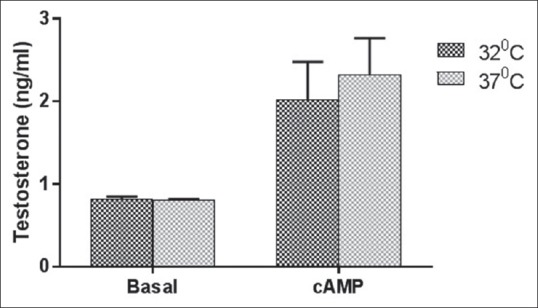
- Testosterone production showed no significant difference between 32°C and 37°C in basal conditions (mean difference 0.01 ± 0.01904, P < 0.1976) or after cAMP stimulation (mean difference −0.3 ± 0.3182, P < 0.9581).
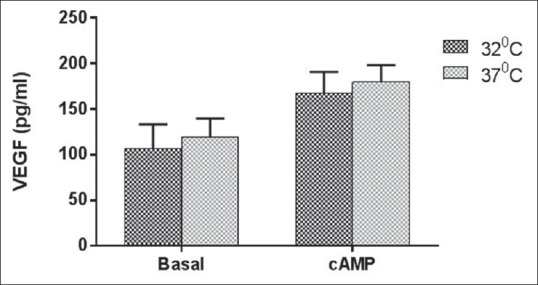
- VEGF production showed no significant difference between 32°C and 37°C in basal conditions (mean difference 13.37 ± 16.57, P < 0.6227) or after cAMP stimulation (mean difference 12.03 ± 14.69, P < 0.7100).
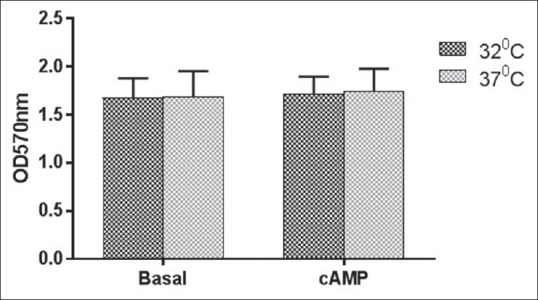
- Cell viability by MTT assay also did not differ significantly between 32°C and 37°C in basal conditions (mean difference 0.01 ± 0.1675, P < 0.6645) or cAMP conditions (mean difference 0.025 ± 0.1491, P < 0.6502).
Methods
- Mouse Leydig tumor cells-1 (MLTC-1) were cultured and used between passages 10 and 30; experiments seeded 2 × 10^5 cells/ml/well after standardizing cell number.
- Cells were incubated at 32°C or 37°C for 6 h in basal medium or with 1 mM 8-Br-cAMP; progesterone and testosterone were measured by radioimmunoassay, and VEGF was measured by ELISA specific for mouse VEGF164.
- Data were analyzed with GraphPad Prism version 7.04 using Student’s t-test and ANOVA; P < 0.05 was considered statistically significant. Experiments were carried out at least in two replicates and performed at least twice.
Limitations
- The paper does not state a dedicated limitations section; it notes that the results did not match the authors’ hypothesis and that the study is the first to investigate this within the homeostatic range.
- Evident from the text: findings are based only on the MLTC-1 mouse Leydig tumor cell line, not primary Leydig cells or human tissue, and only two temperatures (32°C and 37°C) with a 6-h incubation were tested.
- Evident from the text: VEGF was measured with a kit that specifically detects mouse VEGF164, and the study is in vitro with no in vivo testicular or fertility outcomes.
Model-written summary. Check it against the paper before relying on it.
Integrity signals
Registry
Cites
Statistics
Figures
Verification
Claims the paper makes
0 Valid · 0 Not valid · 16 Not checked · 17 Own results and interpretations
A result the paper reports from its own data — it cites no other source for it, so there is none to check. The quote shows it is in the paper.
In the paper
“The mean difference in cell viability in the basal group at 32°C and 37°C was 0.01 ± 0.1675 which is nonsignificant (P < 0.6645).”
§ Steroidogenesis and VEGF Production Doesn't Alter in Leydig Cells within the Homeostatic Range of Testicular Temperature > RESULTS > Cell viability analysis
plain- Asserted: passes — The authors put it forward as true.
- Checkable: passes — It can be checked against evidence.
- Load-bearing: passes — The paper’s conclusions depend on it.
- Based: passes — The paper gives a reason why it holds.
A result the paper reports from its own data — it cites no other source for it, so there is none to check. The quote shows it is in the paper.
In the paper
“Similarly, the mean difference in the cAMP group was 12.03 ± 14.69, which was also nonsignificant (P < 0.7100).”
§ Steroidogenesis and VEGF Production Doesn't Alter in Leydig Cells within the Homeostatic Range of Testicular Temperature > RESULTS > Measurement of VEGF
plain- Asserted: passes — The authors put it forward as true.
- Checkable: passes — It can be checked against evidence.
- Load-bearing: passes — The paper’s conclusions depend on it.
- Based: passes — The paper gives a reason why it holds.
A result the paper reports from its own data — it cites no other source for it, so there is none to check. The quote shows it is in the paper.
In the paper
“Similarly, the mean difference in the cAMP group was −0.3 ± 0.3182 which was also nonsignificant (P < 0.9581).”
§ Steroidogenesis and VEGF Production Doesn't Alter in Leydig Cells within the Homeostatic Range of Testicular Temperature > RESULTS > Testosterone production
plain- Asserted: passes — The authors put it forward as true.
- Checkable: passes — It can be checked against evidence.
- Load-bearing: passes — The paper’s conclusions depend on it.
- Based: passes — The paper gives a reason why it holds.
A result the paper reports from its own data — it cites no other source for it, so there is none to check. The quote shows it is in the paper.
In the paper
“The mean difference in VEGF production in the basal group at 32°C and 37°C was 13.37 ± 16.57 which is nonsignificant (P < 0.6227).”
§ Steroidogenesis and VEGF Production Doesn't Alter in Leydig Cells within the Homeostatic Range of Testicular Temperature > RESULTS > Measurement of VEGF
plain- Asserted: passes — The authors put it forward as true.
- Checkable: passes — It can be checked against evidence.
- Load-bearing: passes — The paper’s conclusions depend on it.
- Based: passes — The paper gives a reason why it holds.
A result the paper reports from its own data — it cites no other source for it, so there is none to check. The quote shows it is in the paper.
In the paper
“Similarly, the mean difference in the cAMP group was 0.375 ± 1.978 which was also nonsignificant (P < 0.4154).”
§ Steroidogenesis and VEGF Production Doesn't Alter in Leydig Cells within the Homeostatic Range of Testicular Temperature > RESULTS > Progesterone production
plain- Asserted: passes — The authors put it forward as true.
- Checkable: passes — It can be checked against evidence.
- Load-bearing: passes — The paper’s conclusions depend on it.
- Based: passes — The paper gives a reason why it holds.
10 more claims
Create a free account to see all 33 claims and to verify the 15 references still open.
- The quote only partly states this claim. 1
- It may state two separate claims as one. 7
- Probably not a substantial claim. 14
Self-check
Percentages, sums and reported differences re-computed from the paper’s own numbers.
Each contradiction between two passages listed here was confirmed by an independent check.
Rated minor: it would not touch a result — a value no result rests on, a p-value that stays on the same side of the significance level, or a conflict that is clerical, resolved elsewhere in the paper, or outside its own findings.
In the paper
§ Steroidogenesis and VEGF Production Doesn't Alter in Leydig Cells within the Homeostatic Range of Testicular Temperature > RESULTS > Testosterone production
“Table: Table 4 Mean progesterone (ng/ml) produced by MLTC- 1 in basal and cAMP group at 32°C and 37°C”
§ Steroidogenesis and VEGF Production Doesn't Alter in Leydig Cells within the Homeostatic Range of Testicular Temperature > RESULTS > Testosterone production
“Figure: Figure 5 Mean testosterone (ng/ml) production by MLTC-1 cells in basal and cAMP group at 32°C and 37°C”
Citations
Cites
Early steps in steroidogenesis: intracellular cholesterol trafficking
Miller, W. L., & Bose, H. S. (2011) · Journal of Lipid Research · doi:10.1194/jlr.r016675 · Cited by 554
Paul, C., Murray, A. A., Spears, N., & Saunders, P. T. K. (2008) · Reproduction · doi:10.1530/rep-08-0036 · Cited by 298
Occupational heat exposure and male fertility: a review
Thonneau, P., Bujan, L., Multigner, L., & Mieusset, R. (1998) · Human Reproduction · doi:10.1093/humrep/13.8.2122 · Cited by 266
Seminal and molecular evidence that sauna exposure affects human spermatogenesis
Garolla, A., Torino, M., Sartini, B., Cosci, I., Patassini, C., Carraro, U., & Foresta, C. (2013) · Human Reproduction · doi:10.1093/humrep/det020 · Cited by 163
The effects of heat on the testes of mammals
Setchell, B. P. (2006) · Adelaide Research & Scholarship (AR&S) (University of Adelaide) · Cited by 163
Decreased Expression of Mouse Rbm3, a Cold-Shock Protein, in Sertoli Cells of Cryptorchid Testis
Danno, S., Itoh, K., Matsuda, T., & Fujita, J. (2000) · The American Journal of Pathology · doi:10.1016/s0002-9440(10)65039-0 · Cited by 91
Hwang, G.-S., Wang, S.-W., Tseng, W.-M., Yu, C.-H., & Wang, P. S. (2007) · American Journal of Physiology-Endocrinology and Metabolism · doi:10.1152/ajpendo.00611.2006 · Cited by 43
Li, Z., Tian, J., Cui, G., Wang, M., & Yu, D. (2016) · Reproduction, Fertility and Development · doi:10.1071/rd14370 · Cited by 41
Temperature Sensitivity of Human Spermatogonia and Spermatocytes in Vitro
Nakamura, M., Namiki, M., Okuyama, A., Matsui, T., Doi, Y., Takeyama, M., Fujioka, H., Nishimune, Y., Matsumoto, K., & Sonoda, T. (1987) · Archives of Andrology · doi:10.3109/01485018708986808 · Cited by 34
Anand, R. J. K., Paust, H.-J., Altenpohl, K., & Mukhopadhyay, A. K. (2003) · Biology of Reproduction · doi:10.1095/biolreprod.102.009795 · Cited by 32
Research works printed but not linked: 1
- Last accessed on 2018 May 02 Available from: http://www.hrea.ca/Ethics-Review-Required.aspx
Cited by
Crafting Contours: A Comprehensive Guide to Scrotal Reconstruction
Suda, S., & Hayashida, K. (2024) · Life · doi:10.3390/life14020223 · Cited by 10
Ogawa, K., & Isaji, O. (2023) · Reproductive Biology · doi:10.1016/j.repbio.2023.100767 · Cited by 6
Kotula‐Balak, M., Duliban, M., Gurgul, A., Krakowska, I., Grzmil, P., Bilińska, B., & Wolski, J. K. (2021) · Andrologia · doi:10.1111/and.14222 · Cited by 5
Kotula‐Balak, M., Uyar, R., Morańska, E., Lonc, G., Boztepe, Ü. G., & Łopuszyński, W. (2026) · Animals · doi:10.3390/ani16132005
Metadata
- Authors
- Goyal, A., & Saini, J.
- Affiliations
- National Institute of Pharmaceutical Education and Research (IN)
- ORCID
- Saini, Jyoti
- Venue
- Journal of Human Reproductive Sciences
- Published
- 2018
- Volume
- 11
- Issue
- 3
- Pages
- 291
- ISSN
- 1998-4766 (ISSN-L)
- 0974-1208
- PMC
- PMC6262675
- OpenAlex
- W2901797949
- Cited by
- 4
- References
- 13
- Citations by year
- 2026: 1 · 2024: 1 · 2023: 1 · 2021: 1
- FWCI
- 0.17
- Type
- journal article
- Language
- en
- Open access
- diamond
- doi.org
- Licence
- cc-by-nc-sa
- Locations
- Journal of Human Reproductive Sciences (publishedVersion, cc-by-nc-sa)
- PubMed Central (publishedVersion, cc-by-nc-sa)
- Europe PMC (PubMed Central) (publishedVersion, cc-by-nc-sa)
- PubMed (publishedVersion)
- DOAJ (DOAJ: Directory of Open Access Journals) (submittedVersion)
- Funders
- Indian Council of Medical Research (3/13/JRF -2015/HRD)
- Topics
- Health Sciences › Medicine › Reproductive Medicine › Sperm and Testicular Function
- Health Sciences › Medicine › Endocrinology, Diabetes and Metabolism › Hormonal and reproductive studies
- Health Sciences › Medicine › Surgery › Testicular diseases and treatments
- Keywords
- testicular temperature, Leydig cells, steroidogenesis, vascular endothelial growth factor, progesterone, testosterone, temperature homeostasis, testis
About these checks
Registry, retraction, Cites and statistics results are computed, not judged, with one exception: a printed reference that no index lists is read once by a model before it counts as a citation error. Claims are extracted by a model and kept only when their quote appears verbatim in the text; each cited source is then checked, with a model’s help, for whether it says what the claim relies on. Those verdicts can be wrong — read the claim’s quote and the cited source before relying on one.
A language model drew the claims from the paper on 2026-11-27, under version 3 of the claim definition (model deepseek-v4.1-flash, prompt extract-v3).
A second model labelled each claim on 2026-11-27 (model jev-1.13-20260917, definition revision gold-guideline-v0.2).
Statistics and arithmetic are recomputed, not judged.
Confidence bands are shown only for fields calibrated on our annotated test set. None is calibrated yet, so no band is shown.
What counts as a claim ›How we measure confidence ›How we check this ›
Are you an author, or do you see a problem with this page? Request a review
How to cite
Cite CoChat for the checks on this page, and the paper for its own findings.
- This page
- CoChat. (2026). Citation check: Steroidogenesis and VEGF production doesn't alter in leydig cells within the homeostatic range of testicular temperature. https://app.cochat.ai/papers/10.4103/jhrs.jhrs_63_18
- The paper
- Goyal, A., & Saini, J. (2018). Steroidogenesis and VEGF production doesn't alter in leydig cells within the homeostatic range of testicular temperature. Journal of Human Reproductive Sciences. https://doi.org/10.4103/jhrs.jhrs_63_18
Data sources
Bibliographic data: Semantic Scholar, OpenAlex, Crossref.
Contains information from the Semantic Scholar Academic Graph Datasets, made available under the ODC Attribution License (ODC-BY 1.0).
Semantic Scholar’s data is described in: Kinney, R., et al. (2023). The Semantic Scholar Open Data Platform. arXiv:2301.10140.
