

Psychiatric disorders and obesity: A review of association studies
Open accessThe DOI matches its Crossref record, with a small difference in title or year; 71 of the 71 references it cites were found in a registry or an index.
Abstract
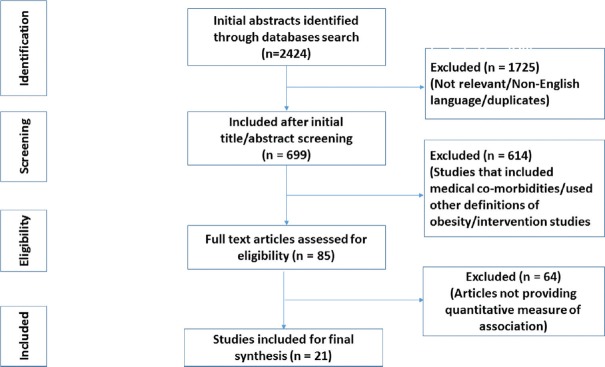
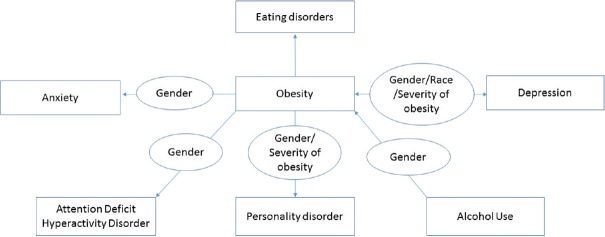
Background: Inconsistent evidence exists regarding the strength, direction, and moderators in the relationship between obesity and psychiatric disorders. Aim: This study aims to summarize the evidence on the association between psychiatric illness and obesity with particular attention to the strength and direction of association and also the possible moderators in each postulated link. Materials and Methods: Systematic electronic searches of MEDLINE through PubMed, ScienceDirect, PsycINFO, and Google Scholar were carried out from inception till October 2016. Generated abstracts were screened for eligibility to be included in the review. Study designs that evaluated the strength of relationship between obesity and psychiatric disorders were included in the study. Quality assessment of included studies was done using the Newcastle–Ottawa checklist tool. Results: From a total of 2424 search results, 21 eligible articles were identified and reviewed. These included studies on obesity and depression ( n = 15), obesity and anxiety (four) and one each on obesity and personality disorders, eating disorder (ED), attention deficit hyperactivity disorder, and alcohol use. Maximal evidence existed for the association between depression and obesity with longitudinal studies demonstrating a bidirectional link between the two conditions. The odds ratios (ORs) were similar for developing depression in obesity (OR: 1.21–5.8) and vice versa (OR: 1.18–3.76) with a stronger association observed in women. For anxiety disorders, evidence was mostly cross-sectional, and associations were of modest magnitude (OR: 1.27–1.40). Among other disorders, obesity, and EDs appear to have a close link (OR: 4.5). Alcohol use appears to be a risk factor for obesity and not vice versa but only among women (OR: 3.84). Conclusion: Obesity and depression have a significant and bidirectional association. Evidence is modest for anxiety disorders and inadequate for other psychiatric conditions. Gender appears to be an important mediator in these relationships.
Overview
The claims and statistics of this paper haven’t been checked yet.
Free: it reads the open-access text and checks the first 5 claims that cite a source we can check. Create a free account to check every claim.
Integrity signals
Registry
Cites
Statistics
Figures
Verification
Claims the paper makes
The claims and statistics of this paper haven’t been checked yet.
Free: it reads the open-access text and checks the first 5 claims that cite a source we can check. Create a free account to check every claim.
Claims other papers make about this one
Each is checked against this paper’s own text: does it say what the citing paper says it does?
The cited source says what the claim attributes to it.
In the citing paper
“existing data showed that obesity is linked to several mental health problems, especially depression (6–8).”
From Efficacy of eHealth interventions to reduce depression symptoms in individuals with obesity: a systematic review of randomized controlled trials (2024) · cites this paper as [8]
Self-check
Percentages, sums and reported differences re-computed from the paper’s own numbers.
The self-check needs the paper’s full text.
Citations
Cites
(2014) · Medical Entomology and Zoology · Cited by 17,633
‘Small Changes' to Diet and Physical Activity Behaviors for Weight Management
Hills, A. P., Byrne, N. M., Lindstrom, R., & Hill, J. O. (2013) · Obesity Facts · doi:10.1159/000345030 · Cited by 9,493
Child abuse: Adolescent records vs. adult recall
Femina, D. D., Yeager, C. A., & Lewis, D. O. (1990) · Child Abuse & Neglect · doi:10.1016/0145-2134(90)90033-p · Cited by 8,820
The Disease Burden Associated With Overweight and Obesity
Must, A. (1999) · JAMA · doi:10.1001/jama.282.16.1523 · Cited by 4,780
Overweight, Obesity, and Depression: A Systematic Review and Meta-analysis of Longitudinal Studies
Luppino, F. S., de Wit, L. M., Bouvy, P. F., Stijnen, T., Cuijpers, P., Penninx, B. W. J. H., & Zitman, F. G. (2010) · Archives of General Psychiatry · doi:10.1001/archgenpsychiatry.2010.2 · Cited by 4,322 · cited 4×
“26, 28 , 31, 32 The role of gender as a moderator in this relationship was evident in a handful of studies that showed greater effect sizes in females, [22,25,28] and specifically, in adolescent females.”
InfluentialPrevalence of High Body Mass Index in US Children and Adolescents, 2007-2008
Ogden, C. L. (2010) · JAMA · doi:10.1001/jama.2009.2012 · Cited by 3,200
Worldwide trends in childhood overweight and obesity
Wang, Y., & Lobstein, T. (2006) · International Journal of Pediatric Obesity · doi:10.1080/17477160600586747 · Cited by 2,669
The Hazards of Scoring the Quality of Clinical Trials for Meta-analysis
Jüni, P. (1999) · JAMA · doi:10.1001/jama.282.11.1054 · Cited by 1,981 · cited 1×
“[18] A response rate of 60% was considered adequate, based on prior systematic reviews of observational studies.”
Association between obesity and psychiatric disorders in the US adult population
Simon, G. E., Von Korff, M., Saunders, K., Miglioretti, D. L., Crane, P. K., van Belle, G., & Kessler, R. C. (2006) · Archives of General Psychiatry · doi:10.1001/archpsyc.63.7.824 · Cited by 1,338
Depression and obesity: A meta-analysis of community-based studies
de Wit, L., Luppino, F., van Straten, A., Penninx, B., Zitman, F., & Cuijpers, P. (2010) · Psychiatry Research · doi:10.1016/j.psychres.2009.04.015 · Cited by 807
Cited by
Firth, J., Siddiqi, N., Koyanagi, A., Siskind, D., Rosenbaum, S., Galletly, C., Allan, S., Caneo, C., Carney, R., Carvalho, A. F., et al. (2019) · The Lancet Psychiatry · doi:10.1016/s2215-0366(19)30132-4 · Cited by 1,531
Handbook of Religion and Health
Koenig, H. G., VanderWeele, T., & Peteet, J. R. (2024) · doi:10.1093/oso/9780190088859.001.0001 · Cited by 1,139
Obesity as a multisystem disease: Trends in obesity rates and obesity‐related complications
Sarma, S., Sockalingam, S., & Dash, S. (2021) · Diabetes, Obesity and Metabolism · doi:10.1111/dom.14290 · Cited by 435
Lingvay, I., Cohen, R. V., Roux, C. W. L., & Sumithran, P. (2024) · The Lancet · doi:10.1016/s0140-6736(24)01210-8 · Cited by 433
Lopez-Jimenez, F., Almahmeed, W., Bays, H., Cuevas, A., Di Angelantonio, E., le Roux, C. W., Sattar, N., Sun, M. C., Wittert, G., Pinto, F. J., et al. (2022) · European Journal of Preventive Cardiology · doi:10.1093/eurjpc/zwac187 · Cited by 362
Metadata
- Authors
- Rajan, T., & Menon, V
- Affiliations
- Jawaharlal Institute of Post Graduate Medical Education and Research (IN)
- Corresponding author
- Menon, V
- ORCID
- Menon, V
- Venue
- Journal of Postgraduate Medicine
- Published
- 2017
- Volume
- 63
- Issue
- 3
- Pages
- 182-190
- ISSN
- 0022-3859 (ISSN-L)
- PMC
- PMC5525483
- OpenAlex
- W2734771437
- Cited by
- 346
- References
- 71
- Citations by year
- 2026: 19 · 2025: 46 · 2024: 53 · 2023: 40 · 2022: 59 · 2021: 54 · 2020: 31 · 2019: 27 · 2018: 12 · 2017: 4
- FWCI
- 3.09
- Type
- journal article
- Language
- en
- Open access
- diamond
- doi.org
- Locations
- Journal of Postgraduate Medicine (publishedVersion)
- Europe PMC (PubMed Central) (publishedVersion, cc-by-nc-sa)
- PubMed Central (publishedVersion, cc-by-nc-sa)
- PubMed (publishedVersion)
- DOAJ (DOAJ: Directory of Open Access Journals) (submittedVersion, cc-by-sa)
- Topics
- Social Sciences › Psychology › Clinical Psychology › Eating Disorders and Behaviors
- Health Sciences › Medicine › Public Health, Environmental and Occupational Health › Obesity, Physical Activity, Diet
- Health Sciences › Medicine › Public Health, Environmental and Occupational Health › Obesity and Health Practices
- Keywords
- obesity, mental illness, depression, anxiety disorders, eating disorders, alcohol consumption, bidirectional relationship, gender differences, personality disorders, attention deficit hyperactivity disorder
- MeSH terms
- Anxiety, Anxiety Disorders, Depression, Humans, Obesity, Personality Disorders
About these checks
Registry, retraction, Cites and statistics results are computed, not judged, with one exception: a printed reference that no index lists is read once by a model before it counts as a citation error. Claims are extracted by a model and kept only when their quote appears verbatim in the text; each cited source is then checked, with a model’s help, for whether it says what the claim relies on. Those verdicts can be wrong — read the claim’s quote and the cited source before relying on one.
Statistics and arithmetic are recomputed, not judged.
Confidence bands are shown only for fields calibrated on our annotated test set. None is calibrated yet, so no band is shown.
What counts as a claim ›How we measure confidence ›How we check this ›
Are you an author, or do you see a problem with this page? Request a review
How to cite
Cite CoChat for the checks on this page, and the paper for its own findings.
- This page
- CoChat. (2026). Citation check: Psychiatric disorders and obesity: A review of association studies. https://app.cochat.ai/papers/10.4103/jpgm.jpgm_712_16
- The paper
- Rajan, T., & Menon, V. (2017). Psychiatric disorders and obesity: A review of association studies. Journal of Postgraduate Medicine. https://doi.org/10.4103/jpgm.jpgm_712_16
Data sources
Bibliographic data: Semantic Scholar, OpenAlex, Crossref.
Contains information from the Semantic Scholar Academic Graph Datasets, made available under the ODC Attribution License (ODC-BY 1.0).
Semantic Scholar’s data is described in: Kinney, R., et al. (2023). The Semantic Scholar Open Data Platform. arXiv:2301.10140.
