

Hepatitis C virus infection and risk of osteoporosis: A meta-analysis
Open accessThe DOI matches its Crossref record; 29 of the 29 references it cites were found in a registry or an index.
Abstract
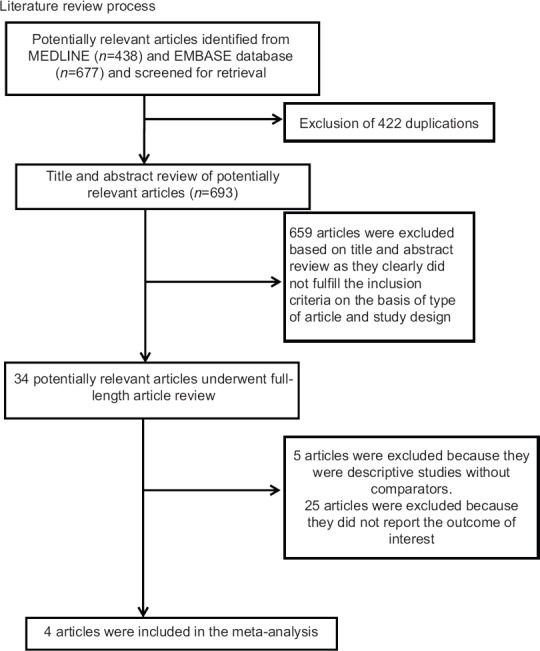
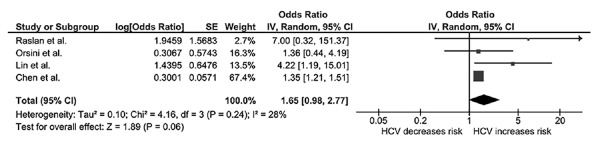
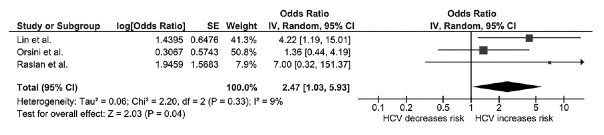
BACKGROUND/AIMS: Hepatitis C virus (HCV) infection is one of the most common infections worldwide. Several epidemiologic studies have suggested that patients with HCV infection might be at an increased risk of osteoporosis. However, the data on this relationship remains inconclusive. This meta-analysis was conducted with the aim to summarize all available evidence. MATERIALS AND METHODS: A literature search was performed using MEDLINE and EMBASE databases from inception to June 2016. Studies that reported relative risks, odd ratios (OR), or hazard ratios comparing the risk of osteoporosis among HCV-infected patients versus those without HCV infection were included. Pooled OR and 95% confidence interval (CI) were calculated using a random-effect, generic inverse variance method. RESULTS: Four studies met our eligibility criteria and were included in the analysis. We found a higher risk of osteoporosis among patients with chronic HCV with OR of 1.65 (95% CI: 0.98-2.77). Sensitivity analysis including only studies with higher quality yielded a higher OR, and the result was statistically significant (OR: 2.47; 95% CI: 1.03-5.93). CONCLUSIONS: Our study demonstrated a higher risk of osteoporosis among HCV-infected patients. Further studies are required to clarify how this risk should be addressed in clinical practice.
Overview
The claims and statistics of this paper haven’t been checked yet.
Free: it reads the open-access text and checks the first 5 claims that cite a source we can check. Create a free account to check every claim.
Integrity signals
Registry
Cites
Statistics
Figures
Verification
Claims the paper makes
The claims and statistics of this paper haven’t been checked yet.
Free: it reads the open-access text and checks the first 5 claims that cite a source we can check. Create a free account to check every claim.
Claims other papers make about this one
Each is checked against this paper’s own text: does it say what the citing paper says it does?
The source backs part of the claim, not all of it — or backs it for a different population, condition or comparison.
In the citing paper
“With long-term infections of HBV and HCV, bone loss is frequently reported in these individuals [[106], [107], [108], [109], [110]].”
From Emerging role of liver-bone axis in osteoporosis (2024) · cites this paper as [108]
Experimental — accuracy not yet measured
Self-check
Percentages, sums and reported differences re-computed from the paper’s own numbers.
The self-check needs the paper’s full text.
Citations
Cites
Measuring inconsistency in meta-analyses
Higgins, J. P. T., Thompson, S. G., Deeks, J. J., & Altman, D. G. (2003) · BMJ · doi:10.1136/bmj.327.7414.557 · Cited by 63,139 · cited 1×
“A value of I2 of 0–25% represents insignificant heterogeneity, greater than 25% but less than or equal to 50% represents low heterogeneity, greater than 50% but less than or equal to 75% represents moderate heterogeneity, and greater than 75% represents high heterogeneity.[17]”
BackgroundMeta-analysis in clinical trials
DerSimonian, R., & Laird, N. (1986) · Controlled Clinical Trials · doi:10.1016/0197-2456(86)90046-2 · Cited by 39,552 · cited 1×
“Adjusted point estimates and standard errors from individual study were combined by the generic inverse variance method of DerSimonian and Laird, which assigned the weight of each study based on its variance.[16] Because the outcome of interest was relatively uncommon, we used RR of cohort study as an estimate for OR…”
MethodStang, A. (2010) · European Journal of Epidemiology · doi:10.1007/s10654-010-9491-z · Cited by 17,396 · cited 1×
“The quality of each study was also independently evaluated by each investigator using the validated Newcastle–Ottawa quality assessment scale.[14] This scale evaluated each study in three domains including the selection of the participants; the comparability between the groups, as well as ascertainment of the exposure…”
MethodAn estimate of the worldwide prevalence and disability associated with osteoporotic fractures
Johnell, O., & Kanis, J. A. (2006) · Osteoporosis International · doi:10.1007/s00198-006-0172-4 · Cited by 4,704 · cited 1×
“[3] It has been estimated that 9 million osteoporotic fractures occur every year worldwide.[4]”
BackgroundProfessor Kanis, J. A., Melton, L. J., Christiansen, C., Johnston, C. C., & Khaltaev, N. (1994) · Journal of Bone and Mineral Research · doi:10.1002/jbmr.5650090802 · Cited by 3,849
Mohd Hanafiah, K., Groeger, J., Flaxman, A. D., & Wiersma, S. T. (2013) · Hepatology · doi:10.1002/hep.26141 · Cited by 2,515 · cited 1×
“Hepatitis C virus (HCV) infection is one of the leading causes of cirrhosis affecting approximately 180 million patients worldwide.[5] Interestingly, a recent meta-analysis has demonstrated a lower bone mineral density (BMD) and increased risk of fracture among patients with human immunodeficiency virus (HIV) and HCV…”
BackgroundHerzog, R., Álvarez-Pasquin, M. J., Díaz, C., Del Barrio, J. L., Estrada, J. M., & Gil, Á. (2013) · BMC Public Health · doi:10.1186/1471-2458-13-154 · Cited by 1,652 · cited 1×
“, was used for the cross-sectional study.[15]”
Hofbauer, L. C., Khosla, S., Dunstan, C. R., Lacey, D. L., Boyle, W. J., & Riggs, B. L. (2000) · Journal of Bone and Mineral Research · doi:10.1359/jbmr.2000.15.1.2 · Cited by 1,173 · cited 1×
“It has been demonstrated that patients with cirrhosis have an increase in receptor-activator ratio of nuclear factor kappa ligand (RANKL) and osteoprotegerin (OPG), resulting in increased bone resorption, and, ultimately, bone loss.[18,19] Bilirubin is known to inhibit osteoblast proliferation.”
BackgroundOsteoporosis: A still increasing prevalence
Reginster, J.-Y., & Burlet, N. (2006) · Bone · doi:10.1016/j.bone.2005.11.024 · Cited by 1,013 · cited 1×
“[2] Osteoporosis affects more than 200 million patients globally.[3] It has been estimated that 9 million osteoporotic fractures occur every year worldwide.”
BackgroundGlobal surveillance and control of hepatitis C
(1999) · Journal of Viral Hepatitis · doi:10.1046/j.1365-2893.1999.6120139.x · Cited by 904
Cited by
Ebeling, P. R., Nguyen, H. H., Aleksova, J., Vincent, A. J., Wong, P., & Milat, F. (2022) · Endocrine Reviews · doi:10.1210/endrev/bnab028 · Cited by 338
Osteoporosis in chronic liver disease
Guañabens, N., & Parés, A. (2018) · Liver International · doi:10.1111/liv.13730 · Cited by 128
Bone Health in Patients With Liver Diseases
Danford, C. J., Trivedi, H. D., & Bonder, A. (2019) · Journal of Clinical Densitometry · doi:10.1016/j.jocd.2019.01.004 · Cited by 70
Gerresheim, G. K., Roeb, E., Michel, A. M., & Niepmann, M. (2019) · Cells · doi:10.3390/cells8111410 · Cited by 49
Emerging role of liver-bone axis in osteoporosis
Gao, H., Peng, X., Li, N., Gou, L., Xu, T., Wang, Y., Qin, J., Liang, H., Ma, P., Li, S., et al. (2024) · Journal of Orthopaedic Translation · doi:10.1016/j.jot.2024.07.008 · Cited by 36
Bone mineral density loss in patients with cirrhosis
Alsohaibani, F., Muhsen, I., AlFreihi, O., Abaalkhail, F. A., Alkhenizan, A. H., Khan, M. Q., & Eldali, A. (2018) · Saudi Journal of Gastroenterology · doi:10.4103/sjg.sjg_74_18 · Cited by 20
“A recent meta‐analysis for three case‐controlled and one cohort study showed an increased risk of osteoporosis in hepatitis C patients.[18] In our study, no significant difference was noticed in the ratio of osteopenia or osteoporosis between controls and hepatitis C patients, which supports the findings of two of the…”
ResultBone disease and liver transplantation: a review
Rodríguez-Aguilar, E. F., Pérez-Escobar, J., Sánchez Herrera, D., García-Alanis, M., Toapanta-Yanchapaxi, L., Gonzalez-Flores, E., & García-Juárez, I. (2021) · Transplantation Proceedings · doi:10.1016/j.transproceed.2021.07.049 · Cited by 19
Bone Disease in HIV: Need for Early Diagnosis and Prevention
Schinas, G., Schinas, I., Ntampanlis, G., Polyzou, E., Gogos, C. A., & Akinosoglou, K. (2024) · Life · doi:10.3390/life14040522 · Cited by 22
“Infection with HCV has been associated with reduced BMD and an increased fracture risk, both in the presence and absence of HIV infection [42,84,85].”
BackgroundAssociation of chronic liver disease with bone diseases and muscle weakness
Saeki, C., Saito, M., & Tsubota, A. (2024) · Journal of Bone and Mineral Metabolism · doi:10.1007/s00774-023-01488-x · Cited by 21
“A meta-analysis of four studies reported a higher risk of osteoporosis in patients with CHC than in those without CHC (OR, 1.65) [54].”
InfluentialTao, J., Yan, Z.-J., Huang, W.-M., & Feng, T. (2023) · Frontiers in Medicine · doi:10.3389/fmed.2023.1120083 · Cited by 10
Risk factors for fractures following liver transplantation: a population-based cohort study
Chang, J.-W., Yang, H.-H., Lin, N.-C., Kuo, F.-C., Lin, T.-C., & Tsai, H.-L. (2023) · Annals of Medicine · doi:10.1080/07853890.2023.2230871 · Cited by 9
“apart from liver diseases, both hBV and hcV infections have been shown to increase the risk of osteoporosis in non-cirrhotic patients [12,13].”
BackgroundHepatitis C and Thalassemia: A Story with (Almost) a Happy Ending
Origa, R. (2023) · Pathogens · doi:10.3390/pathogens12050683 · Cited by 9
“Finally, although the exact cellular and molecular mechanisms behind this association are not completely understood, chronic HCV infection might increase the risk of osteoporosis in patients with thalassemia as already shown in the general population [104,105].”
Olmos-Martínez, J. M., Hernández, J. L., Fábrega, E., Olmos, J. M., Crespo, J., & González-Macías, J. (2020) · Archives of Osteoporosis · doi:10.1007/s11657-020-00752-1 · Cited by 8
“Whether chronic HCV infection in the absence of cirrhosis or viral treatment represents a risk factor for the development of the bone disease is a matter of debate, and negative [17] or positive [15, 16, 18, 19, 31]”
BackgroundLin, M., Chen, P., Wang, P., Lin, H.-S., Huang, T., Chang, S., Chiu, W., & Chen, M. (2019) · BMJ Open · doi:10.1136/bmjopen-2018-021990 · Cited by 10
“HDL, mg/dL 54 (17) 53 (16) 55 (17) 52 (18) 0.”
Wu, D., & Shen, S. (2023) · BMC Musculoskeletal Disorders · doi:10.1186/s12891-023-06795-y · Cited by 8
“Osteoporosis is a known complication in patients with chronic liver disease [21].”
BackgroundLoosen, S. H., Killer, A., Bock, H. H., Luedde, T., Roderburg, C., & Kostev, K. (2024) · Journal of Clinical Medicine · doi:10.3390/jcm13206152 · Cited by 6
“We know about associations between HBV and HCV and developing osteoporosis and fractures [21–25], but there are varying results in terms of the strength of association.”
BackgroundBone status and HCV infection in thalassemia major patients
Meloni, A., Pistoia, L., Maffei, S., Ricchi, P., Casini, T., Corigliano, E., Putti, M. C., Cuccia, L., Argento, C., Positano, V., et al. (2023) · Bone · doi:10.1016/j.bone.2023.116671 · Cited by 6
Weinstein, E. J., Carbonari, D. M., Newcomb, C. W., Torgersen, J., Smith, S. M., Brecker, K. L., Liu, X. S., Kostman, J. R., Trooskin, S. B., Hubbard, R. A., et al. (2025) · Open Forum Infectious Diseases · doi:10.1093/ofid/ofaf102 · Cited by 4
“However, the majority of studies examining chronic HCV infection and bone health have focused on BMD as measured by DXA [25], which is a 2-dimensional method that summarizes total trabecular and cortical bone mass within the projected area.”
Bioinformatics Analysis of Quantitative PCR and Reverse Transcription PCR in Detecting HCV RNA
Liu, W., Jiang, X., Liu, Y., & Qing-song, M. (2018) · Current Bioinformatics · doi:10.2174/1574893613666180703103328 · Cited by 4
Impact of HCV cure on systemic inflammation and bone density, quality, and turnover
Psomas, C. K., Lellouche-Slama, E., Langan, S. J., Sulkowski, M., Moseley, K. F., Dias, J. P., Khati, S., Sun, J., Abraham, A. G., & Brown, T. (2025) · Frontiers in Immunology · doi:10.3389/fimmu.2025.1626875 · Cited by 3
Ponomarjova, E., Jakovicka, D., & Studers, P. (2023) · Journal of Orthopaedic Case Reports · doi:10.13107/jocr.2023.v13.i02.3542 · Cited by 2
“Furthermore, the previously reported diagnosis of C hepatitis should be considered, as there is a higher risk of osteoporosis among hepatitis C virus-infected patients [8], and these patients may have a higher risk of surgical complications and a revision rate [9].”
BackgroundYu, Z., Hu, G., Wang, J., & Li, Z. (2024) · Sao Paulo Medical Journal · doi:10.1590/1516-3180.2023.0266.r1.08022024 · Cited by 2
“19 Clements and Rhodes reported a case of a 41-year-old female patient with chronic active hepatitis who had a high rate of bone loss, in the context of increased incidence of osteoporosis in patients with chronic liver disease.”
BackgroundYadav, E., Kaur, R. D., Sasan, A., & Garg, S. (2022) · Tzu Chi Medical Journal · doi:10.4103/tcmj.tcmj_27_22 · Cited by 1
“In dissonance with the results of the present survey, a few surveys showed a high risk of low BMD in hepatitis C patients [37], hepatitis B patients [38], and patients with NASH etiology [12].”
ResultLi, X., Jiao, G., & Chen, Y. (2025) · BMC Medicine · doi:10.1186/s12916-025-03909-2 · Cited by 1
“Viruses such as HIV, hepatitis B virus, hepatitis C virus, and severe acute respiratory syndrome coronavirus 2 have been found to be associated with OP [40–44].”
Tenório, J. R. (2019) · Digital Library of Theses and Dissertations (Universidade de São Paulo) · doi:10.11606/t.23.2019.tde-08072020-132813
Prevalence and predictors of post-liver transplantation metabolic bone diseases
Elsabaawy, M., Afify, S. A. M., El-Azab, G., Gomaa, A. I., Omar, N., Hashim, M. S., Elsabaawy, D. M., & Elshazly, H. (2021) · Clinical and Experimental Hepatology · doi:10.5114/ceh.2021.109412
“In a metanalytic study, HCV was postulated to augment C-terminal cross-linking telopeptide of type I collagen (CTX), with subsequent boosted bone resorption endeavors [20].”
BackgroundProgress in research of non-cirrhotic chronic viral hepatitis with osteoporosis
Wang, P., Gao, X., Zhang, Y.-N., & Duan, X. (2022) · World Chinese Journal of Digestology · doi:10.11569/wcjd.v30.i11.491
Azoz, N. M. A., ElZohny, R. A., Allam, M. T., & Dahpy, M. A. (2025) · The Egyptian Journal of Internal Medicine · doi:10.1186/s43162-025-00557-z
“Regarding the implication of HCV infection itself, it has been reported that patients with chronic HCV infection, even without cirrhosis, have an increased serum level of C-terminal cross-linking telopeptide of type I collagen (CTX), which suggests an increased bone resorption activity [19].”
Si, Z., Hu, K., Wang, H., & Zheng, X. (2026) · Frontiers in Medicine · doi:10.3389/fmed.2026.1869681
“Patients with HCV infection might be at an increased risk of osteoporosis (32).reduced BMD is common in this population of chronic HCV-infected patients (33).”
Metadata
- Authors
- Wijarnpreecha, K., Thongprayoon, C., Panjawatanan, P., Phatharacharukul, P., & Ungprasert, P.
- Affiliations
- Bassett Medical Center (US)
- University of Minnesota (US)
- Mayo Clinic (US)
- Corresponding author
- Wijarnpreecha, Karn
- ORCID
- Venue
- Saudi Journal of Gastroenterology
- Published
- 2017
- Volume
- 23
- Issue
- 4
- Pages
- 216
- ISSN
- 1319-3767 (ISSN-L)
- PMC
- PMC5539674
- OpenAlex
- W2749133881
- Cited by
- 29
- References
- 28
- Citations by year
- 2026: 1 · 2025: 4 · 2024: 5 · 2023: 6 · 2022: 2 · 2021: 3 · 2020: 1 · 2019: 4 · 2018: 3
- FWCI
- 1.35
- Type
- journal article
- Language
- en
- Open access
- diamond
- doi.org
- Licence
- cc-by-nc-sa
- Locations
- Saudi Journal of Gastroenterology (publishedVersion, cc-by-nc-sa)
- PubMed Central (publishedVersion, cc-by-nc-sa)
- PubMed (publishedVersion)
- DOAJ (DOAJ: Directory of Open Access Journals) (submittedVersion, cc-by-sa)
- Topics
- Health Sciences › Medicine › Hepatology › Hepatitis C virus research
- Health Sciences › Medicine › Hepatology › Liver Disease Diagnosis and Treatment
- Health Sciences › Medicine › Orthopedics and Sports Medicine › Bone health and osteoporosis research
- Keywords
- hepatitis C virus, osteoporosis, chronic hepatitis C, bone mineral density, osteoporosis risk, HCV infection
- MeSH terms
- Adult, Female, Fibrosis, Hepatitis C, Humans, Hyperbilirubinemia, Insulin-Like Growth Factor I, Interleukins, Male, Middle Aged, Osteoporosis, Bone Density, Incidence, Case-Control Studies, Hepacivirus, Risk Assessment, Insulin-Like Growth Factor Binding Protein 3, Tumor Necrosis Factors, Osteoprotegerin, RANK Ligand
About these checks
Registry, retraction, Cites and statistics results are computed, not judged, with one exception: a printed reference that no index lists is read once by a model before it counts as a citation error. Claims are extracted by a model and kept only when their quote appears verbatim in the text; each cited source is then checked, with a model’s help, for whether it says what the claim relies on. Those verdicts can be wrong — read the claim’s quote and the cited source before relying on one.
Statistics and arithmetic are recomputed, not judged.
Confidence bands are shown only for fields calibrated on our annotated test set. None is calibrated yet, so no band is shown.
What counts as a claim ›How we measure confidence ›How we check this ›
Are you an author, or do you see a problem with this page? Request a review
Data sources
Bibliographic data: Semantic Scholar, OpenAlex, Crossref.
Contains information from the Semantic Scholar Academic Graph Datasets, made available under the ODC Attribution License (ODC-BY 1.0).
Semantic Scholar’s data is described in: Kinney, R., et al. (2023). The Semantic Scholar Open Data Platform. arXiv:2301.10140.
