

Hepatitis C virus infection and risk of osteoporosis: A meta-analysis
Open accessThe DOI matches its Crossref record; 29 of the 29 references it cites were found in a registry or an index.
Abstract
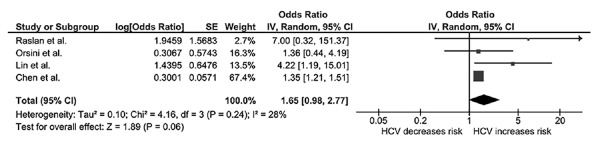
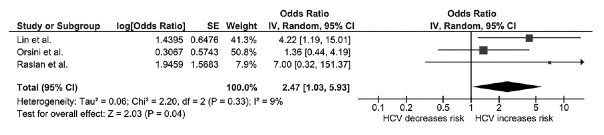
BACKGROUND/AIMS: Hepatitis C virus (HCV) infection is one of the most common infections worldwide. Several epidemiologic studies have suggested that patients with HCV infection might be at an increased risk of osteoporosis. However, the data on this relationship remains inconclusive. This meta-analysis was conducted with the aim to summarize all available evidence. MATERIALS AND METHODS: A literature search was performed using MEDLINE and EMBASE databases from inception to June 2016. Studies that reported relative risks, odd ratios (OR), or hazard ratios comparing the risk of osteoporosis among HCV-infected patients versus those without HCV infection were included. Pooled OR and 95% confidence interval (CI) were calculated using a random-effect, generic inverse variance method. RESULTS: Four studies met our eligibility criteria and were included in the analysis. We found a higher risk of osteoporosis among patients with chronic HCV with OR of 1.65 (95% CI: 0.98-2.77). Sensitivity analysis including only studies with higher quality yielded a higher OR, and the result was statistically significant (OR: 2.47; 95% CI: 1.03-5.93). CONCLUSIONS: Our study demonstrated a higher risk of osteoporosis among HCV-infected patients. Further studies are required to clarify how this risk should be addressed in clinical practice.
Overview
The claims and statistics of this paper haven’t been checked yet.
Free: it reads the open-access text and checks the first 5 claims that cite a source we can check. Create a free account to check every claim.
Integrity signals
Registry
Cites
Statistics
Figures
Verification
Claims the paper makes
The claims and statistics of this paper haven’t been checked yet.
Free: it reads the open-access text and checks the first 5 claims that cite a source we can check. Create a free account to check every claim.
Claims other papers make about this one
Each is checked against this paper’s own text: does it say what the citing paper says it does?
The source backs part of the claim, not all of it — or backs it for a different population, condition or comparison.
In the citing paper
“With long-term infections of HBV and HCV, bone loss is frequently reported in these individuals [[106], [107], [108], [109], [110]].”
From Emerging role of liver-bone axis in osteoporosis (2024) · cites this paper as [108]
Experimental — accuracy not yet measured
Self-check
Percentages, sums and reported differences re-computed from the paper’s own numbers.
The self-check needs the paper’s full text.
Citations
Cites
Measuring inconsistency in meta-analyses
Higgins, J. P. T., Thompson, S. G., Deeks, J. J., & Altman, D. G. (2003) · BMJ · doi:10.1136/bmj.327.7414.557 · Cited by 63,139 · cited 1×
“A value of I2 of 0–25% represents insignificant heterogeneity, greater than 25% but less than or equal to 50% represents low heterogeneity, greater than 50% but less than or equal to 75% represents moderate heterogeneity, and greater than 75% represents high heterogeneity.[17]”
BackgroundMeta-analysis in clinical trials
DerSimonian, R., & Laird, N. (1986) · Controlled Clinical Trials · doi:10.1016/0197-2456(86)90046-2 · Cited by 39,552 · cited 1×
“Adjusted point estimates and standard errors from individual study were combined by the generic inverse variance method of DerSimonian and Laird, which assigned the weight of each study based on its variance.[16] Because the outcome of interest was relatively uncommon, we used RR of cohort study as an estimate for OR…”
MethodStang, A. (2010) · European Journal of Epidemiology · doi:10.1007/s10654-010-9491-z · Cited by 17,396 · cited 1×
“The quality of each study was also independently evaluated by each investigator using the validated Newcastle–Ottawa quality assessment scale.[14] This scale evaluated each study in three domains including the selection of the participants; the comparability between the groups, as well as ascertainment of the exposure…”
MethodAn estimate of the worldwide prevalence and disability associated with osteoporotic fractures
Johnell, O., & Kanis, J. A. (2006) · Osteoporosis International · doi:10.1007/s00198-006-0172-4 · Cited by 4,704 · cited 1×
“[3] It has been estimated that 9 million osteoporotic fractures occur every year worldwide.[4]”
BackgroundProfessor Kanis, J. A., Melton, L. J., Christiansen, C., Johnston, C. C., & Khaltaev, N. (1994) · Journal of Bone and Mineral Research · doi:10.1002/jbmr.5650090802 · Cited by 3,849
Mohd Hanafiah, K., Groeger, J., Flaxman, A. D., & Wiersma, S. T. (2013) · Hepatology · doi:10.1002/hep.26141 · Cited by 2,515 · cited 1×
“Hepatitis C virus (HCV) infection is one of the leading causes of cirrhosis affecting approximately 180 million patients worldwide.[5] Interestingly, a recent meta-analysis has demonstrated a lower bone mineral density (BMD) and increased risk of fracture among patients with human immunodeficiency virus (HIV) and HCV…”
BackgroundHerzog, R., Álvarez-Pasquin, M. J., Díaz, C., Del Barrio, J. L., Estrada, J. M., & Gil, Á. (2013) · BMC Public Health · doi:10.1186/1471-2458-13-154 · Cited by 1,652 · cited 1×
“, was used for the cross-sectional study.[15]”
Hofbauer, L. C., Khosla, S., Dunstan, C. R., Lacey, D. L., Boyle, W. J., & Riggs, B. L. (2000) · Journal of Bone and Mineral Research · doi:10.1359/jbmr.2000.15.1.2 · Cited by 1,173 · cited 1×
“It has been demonstrated that patients with cirrhosis have an increase in receptor-activator ratio of nuclear factor kappa ligand (RANKL) and osteoprotegerin (OPG), resulting in increased bone resorption, and, ultimately, bone loss.[18,19] Bilirubin is known to inhibit osteoblast proliferation.”
BackgroundOsteoporosis: A still increasing prevalence
Reginster, J.-Y., & Burlet, N. (2006) · Bone · doi:10.1016/j.bone.2005.11.024 · Cited by 1,013 · cited 1×
“[2] Osteoporosis affects more than 200 million patients globally.[3] It has been estimated that 9 million osteoporotic fractures occur every year worldwide.”
BackgroundGlobal surveillance and control of hepatitis C
(1999) · Journal of Viral Hepatitis · doi:10.1046/j.1365-2893.1999.6120139.x · Cited by 904
Lavanchy, D. (1999) · PubMed · Cited by 374
Raisz, L. G. (2005) · New England Journal of Medicine · doi:10.1056/nejmcp042092 · Cited by 262 · cited 1×
“Osteoporosis is a common medical condition in older adults characterized by reduced bone mass and increased risk of fragility fracture.[1] Well-established risk factors of osteoporosis include immobility, aging, menopause, diabetes, chronic use of glucocorticoid, vitamin D deficiency, and inadequate calcium intake.”
Janes, C. H., Dickson, E. R., Okazaki, R., Bonde, S., McDonagh, A. F., & Riggs, B. L. (1995) · Journal of Clinical Investigation · doi:10.1172/jci117959 · Cited by 195 · cited 2×
“[21] Moreover, patients with cirrhosis from chronic HCV infection had significantly lower level of insulin-like growth factor-1 (IGF-1) and insulin-like growth factor binding protein 3 (IGFBP-3), compared with patients with chronic HCV infection but without cirrhosis and healthy controls.[9,20] Decreased levels of the…”
BackgroundVitamin D in chronic liver disease
Stokes, C. S., Volmer, D. A., Grünhage, F., & Lammert, F. (2013) · Liver International · doi:10.1111/liv.12106 · Cited by 194 · cited 1×
“[13,22] Furthermore, patients with chronic liver disease tend to have impaired hepatic hydroxylation of cholecalciferol, the first step in the synthesis of the active form of vitamin D, which could result in vitamin D deficiency and, ultimately, osteopenia/osteoporosis.[23,24]”
BackgroundVincent, C., Findlay, D. M., Welldon, K. J., Wijenayaka, A. R., Zheng, T. S., Haynes, D. R., Fazzalari, N. L., Evdokiou, A., & Atkins, G. J. (2009) · Journal of Bone and Mineral Research · doi:10.1359/jbmr.090305 · Cited by 180
Guañabens, N., Cerdá, D., Monegal, A., Pons, F., Caballería, L., Peris, P., & Parés, A. (2010) · Gastroenterology · doi:10.1053/j.gastro.2010.02.016 · Cited by 142 · cited 1×
“[20] Therefore, hyperbilirubinemia associated with chronic liver disease might interfere with bone production.[21] Moreover, patients with cirrhosis from chronic HCV infection had significantly lower level of insulin-like growth factor-1 (IGF-1) and insulin-like growth factor binding protein 3 (IGFBP-3), compared with…”
BackgroundThe RANKL/OPG system and bone mineral density in patients with chronic liver disease
Moschen, A. R., Kaser, A., Stadlmann, S., Millonig, G., Kaser, S., Mühllechner, P., Habior, A., Graziadei, I. W., Vogel, W., & Tilg, H. (2005) · Journal of Hepatology · doi:10.1016/j.jhep.2005.05.034 · Cited by 129 · cited 1×
“It has been demonstrated that patients with cirrhosis have an increase in receptor-activator ratio of nuclear factor kappa ligand (RANKL) and osteoprotegerin (OPG), resulting in increased bone resorption, and, ultimately, bone loss.[18,19] Bilirubin is known to inhibit osteoblast proliferation.”
BackgroundThe Insulin-Like Growth Factor System in Bone
Kawai, M., & Rosen, C. J. (2012) · Endocrinology and Metabolism Clinics of North America · doi:10.1016/j.ecl.2012.04.013 · Cited by 106 · cited 1×
“[9,20] Decreased levels of these two growth factors may contribute to the development of osteoporosis because both IGF-1 and IGFBP-3 play an essential role in osteoblast differentiation and proliferation.[13,22] Furthermore, patients with chronic liver disease tend to have impaired hepatic hydroxylation of cholecalcif…”
BackgroundOsteoporosis and fractures in liver disease: Relevance, pathogenesis and therapeutic implications
Nakchbandi, I. A. (2014) · World Journal of Gastroenterology · doi:10.3748/wjg.v20.i28.9427 · Cited by 105 · cited 1×
“[25] Inflammation modulates the bone-remodeling pathway through pro-inflammatory cytokines, such as tumor necrotic factor (TNF)- α, interleukin (IL)-1, IL-6, and IL-17, that can promote the differentiation of osteoclast from their precursor cells.[26,27] These cytokines are also capable of downregulating bone anabolic…”
BackgroundImpact of cytokines and T lymphocytes upon osteoclast differentiation and function
Gillespie, M. T. (2007) · Arthritis Research & Therapy · doi:10.1186/ar2141 · Cited by 94 · cited 1×
“[25] Inflammation modulates the bone-remodeling pathway through pro-inflammatory cytokines, such as tumor necrotic factor (TNF)- α, interleukin (IL)-1, IL-6, and IL-17, that can promote the differentiation of osteoclast from their precursor cells.[26,27] These cytokines are also capable of downregulating bone anabolic…”
BackgroundDong, H. V., Cortés, Y. I., Shiau, S., & Yin, M. T. (2014) · AIDS · doi:10.1097/qad.0000000000000363 · Cited by 83 · cited 1×
“Saudi Journal of Gastroenterology | Volume 23 | Issue 4 | July-August 2017 217 compared with either HIV monoinfection or healthy controls.[6,7] However, data on the association of HCV monoinfection and osteoporosis remains inconclusive.”
BackgroundItoh, Y., Okanoue, T., Ohnishi, N., Sakamoto, M., Nishioji, K., Nakagawa, Y., Minami, M., Murakami, Y., & Kashima, K. (1999) · The American Journal of Gastroenterology · doi:10.1111/j.1572-0241.1999.01083.x · Cited by 68 · cited 1×
“Chronic inflammation associated with chronic HCV infection might also have deleterious effect on bone metabolism.[25] Inflammation modulates the bone-remodeling pathway through pro-inflammatory cytokines, such as tumor necrotic factor (TNF)- α, interleukin (IL)-1, IL-6, and IL-17, that can promote the differentiation…”
BackgroundVitamin D in liver diseases: From mechanisms to clinical trials
Han, Y., Kong, M., Zheng, S., Ren, Y., Longdon, Z., Shi, H., & Duan, Z. (2013) · Journal of Gastroenterology and Hepatology · doi:10.1111/jgh.12016 · Cited by 62 · cited 1×
“[13,22] Furthermore, patients with chronic liver disease tend to have impaired hepatic hydroxylation of cholecalciferol, the first step in the synthesis of the active form of vitamin D, which could result in vitamin D deficiency and, ultimately, osteopenia/osteoporosis.[23,24]”
BackgroundAssociation Between Chronic Hepatitis C Virus Infection and Bone Mineral Density
Lin, J., Hsieh, T., Wu, C., Chen, P., Chueh, T.-H., Chang, W., & Chu, H.-C. (2012) · Calcified Tissue International · doi:10.1007/s00223-012-9653-y · Cited by 50 · cited 3×
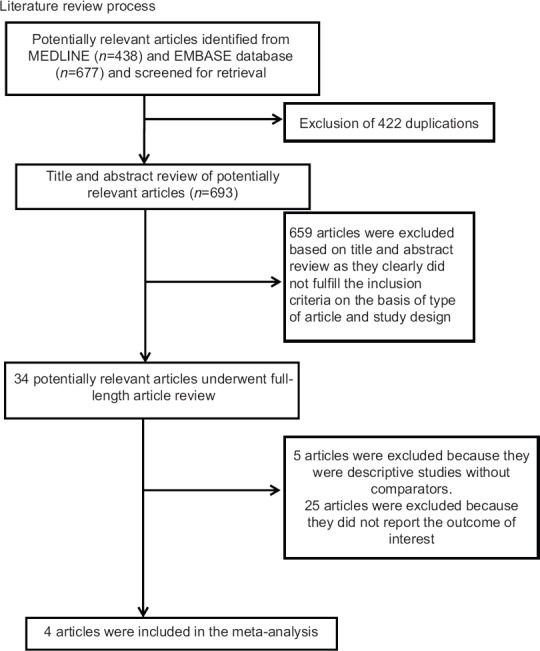
“Therefore, 4 studies (3 case-control studies and 1 cohort study) were included in the data analysis.[9,11-13] Figure 1 outlines the literature review and study selection process.”
BackgroundMethodOrsini, L. G. S., Pinheiro, M. M., Castro, C. H. M., Silva, A. E. B., & Szejnfeld, V. L. (2013) · PLoS ONE · doi:10.1371/journal.pone.0081652 · Cited by 43
Chen, C., Lin, C., & Kao, C. (2015) · Medicine · doi:10.1097/md.0000000000002086 · Cited by 32
Fracture risk in hepatitis C virus infected persons: Results from the DANVIR cohort study
Hansen, A. E., Omland, L. H., Krarup, H. B., & Obel, N. (2014) · Journal of Hepatology · doi:10.1016/j.jhep.2014.03.007 · Cited by 31 · cited 1×
“[6,7] However, data on the association of HCV monoinfection and osteoporosis remains inconclusive.[8-13] This systematic review and meta-analysis was conducted with the aim to summarize all available evidence to assess the risk of osteoporosis among HCV-infected patients.”
MethodThe Effect of HIV-Hepatitis C Co-Infection on Bone Mineral Density and Fracture: A Meta-Analysis
O’Neill, T. J., Rivera, L., Struchkov, V., Zaheen, A., & Thein, H. (2014) · PLoS ONE · doi:10.1371/journal.pone.0101493 · Cited by 25 · cited 1×
“Saudi Journal of Gastroenterology | Volume 23 | Issue 4 | July-August 2017 217 compared with either HIV monoinfection or healthy controls.[6,7] However, data on the association of HCV monoinfection and osteoporosis remains inconclusive.”
BackgroundRaslan, H. M., Elhosary, Y. A., Ezzat, W. M., Rasheed, E. A., & Rasheed, M. (2010) · Transactions of the Royal Society of Tropical Medicine and Hygiene · doi:10.1016/j.trstmh.2010.01.012 · Cited by 22 · cited 3×
“Therefore, 4 studies (3 case-control studies and 1 cohort study) were included in the data analysis.[9,11-13] Figure 1 outlines the literature review and study selection process.”
BackgroundMethod
Cited by
Ebeling, P. R., Nguyen, H. H., Aleksova, J., Vincent, A. J., Wong, P., & Milat, F. (2022) · Endocrine Reviews · doi:10.1210/endrev/bnab028 · Cited by 338
Osteoporosis in chronic liver disease
Guañabens, N., & Parés, A. (2018) · Liver International · doi:10.1111/liv.13730 · Cited by 128
Bone Health in Patients With Liver Diseases
Danford, C. J., Trivedi, H. D., & Bonder, A. (2019) · Journal of Clinical Densitometry · doi:10.1016/j.jocd.2019.01.004 · Cited by 70
Gerresheim, G. K., Roeb, E., Michel, A. M., & Niepmann, M. (2019) · Cells · doi:10.3390/cells8111410 · Cited by 49
Emerging role of liver-bone axis in osteoporosis
Gao, H., Peng, X., Li, N., Gou, L., Xu, T., Wang, Y., Qin, J., Liang, H., Ma, P., Li, S., et al. (2024) · Journal of Orthopaedic Translation · doi:10.1016/j.jot.2024.07.008 · Cited by 36
Metadata
- Authors
- Wijarnpreecha, K., Thongprayoon, C., Panjawatanan, P., Phatharacharukul, P., & Ungprasert, P.
- Affiliations
- Bassett Medical Center (US)
- University of Minnesota (US)
- Mayo Clinic (US)
- Corresponding author
- Wijarnpreecha, Karn
- ORCID
- Venue
- Saudi Journal of Gastroenterology
- Published
- 2017
- Volume
- 23
- Issue
- 4
- Pages
- 216
- ISSN
- 1319-3767 (ISSN-L)
- PMC
- PMC5539674
- OpenAlex
- W2749133881
- Cited by
- 29
- References
- 28
- Citations by year
- 2026: 1 · 2025: 4 · 2024: 5 · 2023: 6 · 2022: 2 · 2021: 3 · 2020: 1 · 2019: 4 · 2018: 3
- FWCI
- 1.35
- Type
- journal article
- Language
- en
- Open access
- diamond
- doi.org
- Licence
- cc-by-nc-sa
- Locations
- Saudi Journal of Gastroenterology (publishedVersion, cc-by-nc-sa)
- PubMed Central (publishedVersion, cc-by-nc-sa)
- PubMed (publishedVersion)
- DOAJ (DOAJ: Directory of Open Access Journals) (submittedVersion, cc-by-sa)
- Topics
- Health Sciences › Medicine › Hepatology › Hepatitis C virus research
- Health Sciences › Medicine › Hepatology › Liver Disease Diagnosis and Treatment
- Health Sciences › Medicine › Orthopedics and Sports Medicine › Bone health and osteoporosis research
- Keywords
- hepatitis C virus, osteoporosis, chronic hepatitis C, bone mineral density, osteoporosis risk, HCV infection
- MeSH terms
- Adult, Female, Fibrosis, Hepatitis C, Humans, Hyperbilirubinemia, Insulin-Like Growth Factor I, Interleukins, Male, Middle Aged, Osteoporosis, Bone Density, Incidence, Case-Control Studies, Hepacivirus, Risk Assessment, Insulin-Like Growth Factor Binding Protein 3, Tumor Necrosis Factors, Osteoprotegerin, RANK Ligand
About these checks
Registry, retraction, Cites and statistics results are computed, not judged, with one exception: a printed reference that no index lists is read once by a model before it counts as a citation error. Claims are extracted by a model and kept only when their quote appears verbatim in the text; each cited source is then checked, with a model’s help, for whether it says what the claim relies on. Those verdicts can be wrong — read the claim’s quote and the cited source before relying on one.
Statistics and arithmetic are recomputed, not judged.
Confidence bands are shown only for fields calibrated on our annotated test set. None is calibrated yet, so no band is shown.
What counts as a claim ›How we measure confidence ›How we check this ›
Are you an author, or do you see a problem with this page? Request a review
Data sources
Bibliographic data: Semantic Scholar, OpenAlex, Crossref.
Contains information from the Semantic Scholar Academic Graph Datasets, made available under the ODC Attribution License (ODC-BY 1.0).
Semantic Scholar’s data is described in: Kinney, R., et al. (2023). The Semantic Scholar Open Data Platform. arXiv:2301.10140.
