

The DOI matches its DataCite record; 1 of the 1 references it cites were found in a registry or an index.
Social Status and Anti-Immigrant Attitudes in Europe: An Examination from the Perspective of Social Dominance Theory
Abstract
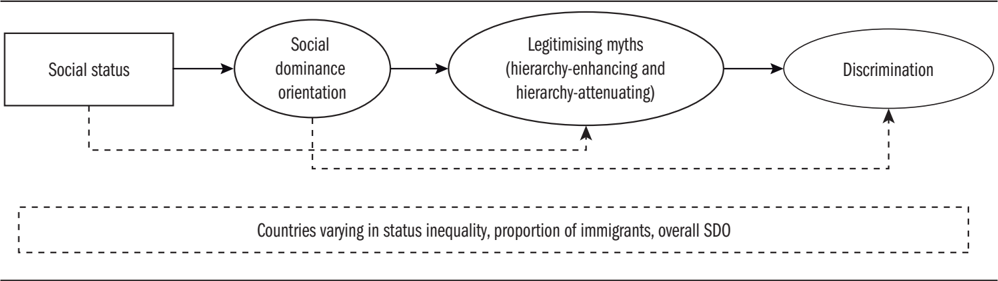
A full test of the Social Dominance Theory model addressed immigration as one of the most prominent current intergroup conflicts in Europe. The hypothesis that members of high status groups tend to discriminate members of low status groups because they are more prone to Social Dominance Orientation (SDO) and refer more to legitimising myths such as prejudice was tested using representative samples from eight European countries (N = 1000 each), considering income and migrant background as social status indicators, SDO, anti-immigrant prejudice and diversity beliefs, and the intention to discriminate immigrants. The results confirm that individuals with higher SDO are more likely to discriminate immigrants, partly because of stronger anti-immigrant prejudice and partly because they believe less in diversity. However, the results question the role of social status. Contrary to the expectations of Social Dominance Theory, individuals with lower income are more prone to SDO and have stronger anti-immigrant attitudes and weaker diversity beliefs. The impact of migrant background was weak and ambivalent. We suggest reconsidering the role of social status to stress status maintenance and enhancement as general social motives. Regardless of their social position, people seemingly try to enhance their relative position by devaluing lower status groups.
Overview
The claims and statistics of this paper haven’t been checked yet.
Run the check — free, no account needed. It reads the open-access text and checks the sources it cites.
Integrity signals
Registry
Cites
Statistics
Figures

Verification
Claims the paper makes
The claims and statistics of this paper haven’t been checked yet.
Run the check — free, no account needed. It reads the open-access text and checks the sources it cites.
Claims other papers make about this one
Each is checked against this paper’s own text: does it say what the citing paper says it does?
In the citing paper
“people higher in social dominance orientation have been found to consistently hold more negative attitudes toward immigrants (e.g., Kupper et al. 2010).”
From Prejudice and Discrimination Toward Immigrants (2021) · cites this paper as Kupper et al. 2010
Self-check
Percentages, sums and reported differences re-computed from the paper’s own numbers.
The self-check needs the paper’s full text.
Citations
Cites
Culture, gender, and the self: Variations and impact of social comparison processes.
Guimond, S., Branscombe, N. R., Brunot, S., Buunk, A. P., Chatard, A., Désert, M., Garcia, D. M., Haque, S., Martinot, D., & Yzerbyt, V. (2007) · Journal of Personality and Social Psychology · doi:10.1037/0022-3514.92.6.1118 · Cited by 341
Research works printed but not linked: 32
- Amiot, Catherine E., and Richard Y. Bourhis. 2005. Ideological Beliefs as Determinants of Discrimination in Positive and Negative Outcome Distributions. European Journal of Social Psychology 35: 581-98.
- Baron, Reuben M., and David A. Kenny. 1986. The Moderator- Mediator Variable Distinction in Social Psychological Research: Conceptual, Strategic, and Statistical Considerations. Journal of Personality and Social Psychology 51: 1173-82.
- Brewer, Marilynn B. 2003. Optimal Distinctiveness, Social Identity, and the Self. In Handbook of Self and Identity, ed. M. Leary and J. Tangney, 480-491. New York: The Guilford Press.
- Cheung, Gordon W. and Roger B. Rensvold. .2002. Evaluating Goodness- of-Fit Indexes for Testing Measurement Invariance. Structural Equation Modeling: A Multidisciplinary Journal 9:233-55.
- Doosje, Bertjan, Anja Zimmermann, Beate Küpper, Andreas Zick, and Roel Meertens. 2010. Terrorist Threat as a Predictor of Out-Group Discrimination and Support for Anti-Immigration Policies -Evidence from 9 European Countries. International Review of Social Psychology 22:203-233.
- Eagly, Alice H., Amanda B. Diekman, Mary C. Johannesen- Schmidt, and Anne M. Koenig. 2004. Gender Gaps in Sociopolitical Attitudes: A Social Psychological Analysis. Journal of Personality and Social Psychology 87:796-816.
- Ekehammar, Bo, Akrami Nazar, Magnus Gylje, and Ingrid Zakrisson. 2004. What Matters Most to Prejudice: Big Five Personality, Social Dominance Orientation or Right-Wing Authoritarianism? European Journal of Personality 18:463-82.
- Guimond, Serge, Michael Dambrun, Nicolas Michinov, and Sandra Duarte. 2003. Does Social Dominance Generate Prejudice? Integrating Individual and Contextual Determinants of Intergroup Cognitions. Journal of Personality and Social Psychology 84:697-721.
- Hello, Evelyn, Mérove Gijsberts, and Peer Scheepers. 2002. Education and Ethnic Exclusionism in European Countries: Explanations for Differential Effects of Education Tested. Scandinavian Journal of Educational Research 46:5-24.
- Jacobs, Jerry A. 1996. Gender Inequality and Higher Education. American Review of Sociology 22:153-85.
- Kemmelmeier, Markus, 2005. The Effects of Race and Social Dominance Orientation in Simulated Juror Decision Making. Journal of Applied Social Psychology 35:1030-45.
- Küpper, Beate, and Andreas Zick. 2010. Inverse Gender Gap in Germany: Social Dominance Orientation among Men and Women in Three Representative Samples. International Journal of Psychology 44 (6): online sample.
- LeVine, Robert A., and Donald T. Campbell. 1972. Ethnocentrism: Theories of Conflict, Ethnic Attitudes, and Group Behavior. New York: Wiley.
- Mauer, Marc. 1999. Race to Incarcerate. New York: New Press.
- Oliver, Mary B., and Janet S. Hyde. 1993. Gender Differences in Sexuality: A Meta-Analysis. Psychological Bulletin 114:29-51.
- Olzak, Susan. 1992. The Dynamics of Ethnic Competition and Conflict. Palo Alto, CA: Stanford University Press.
- Parkins, Irina S., Harold D. Fishbein, and Neal Ritchey. 2006. The Influence of Personality on Workplace Bullying and Discrimination. Journal of Applied Social Psychology 36:2554-77.
- Pettigrew, Thomas F. 1998. Reactions Toward the New Minorities of Western Europe. Annual Review of Sociology 24:77-103.
- Pratto, Felicia, James H. Liu, Shana Levin, Jim Sidanius, Margaret Shih, Hagit Bachrach, and Peter Hegarty. 2000. Social Dominance Orientation and the Legitimization of Inequality across Cultures. Journal of Cross-Cultural Psychology 31:369-409.
- Pratto, Felicia, Jim Sidanius, and Shana Levin. 2006. Social Dominance Theory and the Dynamic of Intergroup Relations: Taking Stock and Looking Forward. European Review of Social Psychology 17:271-320.
- Pratto, Felicia, Jim H. Sidanius, Lisa M. Stallworth, and Bertram F. Malle. 1994. Social Dominance Orientation: A Personality Variable Predicting Social and Political Attitudes. Journal of Personality and Social Psychology 67:741-63.
- Pratto, Felicia, Lisa M. Stallworth, and Sahra Conway-Lanz. 1998. Social Dominance Orientation and the Ideological Legitimization of Social Policy. Journal of Applied Social Psychology 28:1853-75.
- Saris, Willem. E., and Irmtraud N. Gallhofer. 2007. Design, Evaluation, and Analysis of Questionnaires for Survey Research. Hoboken, NJ: Wiley.
- Schmitt, Michael T., Nyla R. Branscombe, and Diana M. Kappen. 2003. Attitudes Toward Group-Based Inequality: Social Dominance or Social Identity? British Journal of Social Psychology 42:161-86.
- Schuman, Howard, Charlotte Steeh, Lawrence D. Bobo, and Maria Krysan. 1997/2005. Racial Attitudes in America: Trends and Interpretations. Cambridge, MA: Harvard University Press.
- Schütz, Heidi, and Bernd Six. 1996. How Strong Is the Relationship Between Prejudice and Discrimination? A Meta-Analytic Answer. International Journal of Intercultural Relations 20:441-62.
- Sidanius, James, Shana Levin, James H. Liu, and Felicia Pratto. 2000. Social Dominance Orientation and the Political Psychology of Gender: An Extension and Cross-Cultural Replication. European Journal of Social Psychology 30:41-67.
- Sidanius, James, and Felicia Pratto. 1999. Social Dominance. Cambridge: Cambridge University Press.
- Sidanius, James, Felicia Pratto, and Lawrence D. Bobo. 1994. Social Dominance Orientation and the Political Psychology of Gender: A Case Of Invariance? Journal of Personality and Social Psychology 67:998-1011.
- Sidanius, James H., Felicia Pratto, and Lawrence D. Bobo. 1996. Racism, Conservatism, Affirmative Action and Intellectual Sophistication: A Matter of Principled Conservatism or Group Dominance? Journal of Personality and Social Psychology 70:476-90.
- Umphress, Elizabeth E., Aneika L. Simmons, Wendy R. Boswell, and María Carmen del Triana. 2008. Managing Discrimination in Selection: The Influence of Directives from an Authority and Social Dominance Orientation. Journal of Applied Psychology 93:982-93.
- Zick, Andreas, Carina Wolf, Beate Küpper, Eldad Davidov, Peter Schmidt, and Wilhelm Heitmeyer. 2008. The Syndrome of Group-Focused Enmity: The Interrelation of Prejudices Tested with Multiple Cross- Sectional and Panel Data. Journal of Social Issues 64:363-83.
Cited by
Sorted by citations
Prejudice and Discrimination Toward Immigrants
Esses, V. M. (2021) · Annual Review of Psychology · doi:10.1146/annurev-psych-080520-102803 · Cited by 344
Metadata
- Authors
- Küpper, B., Wolf, C., & Zick, A.
- Venue
- International Journal of Conflict and Violence (IJCV)
- Publisher
- International Journal of Conflict and Violence (IJCV)
- Published
- 2010-11-15
- References
- 1
About these checks
Registry, retraction, Cites and statistics results are computed, not judged, with one exception: a printed reference that no index lists is read once by a model before it counts as a citation error. Claims are extracted by a model and kept only when their quote appears verbatim in the text; each cited source is then checked, with a model’s help, for whether it says what the claim relies on. Those verdicts can be wrong — read the claim’s quote and the cited source before relying on one.
Statistics and arithmetic are recomputed, not judged.
Confidence bands are shown only for fields calibrated on our annotated test set. None is calibrated yet, so no band is shown.
What counts as a claim ›How we measure confidence ›How we check this ›
Are you an author, or do you see a problem with this page? Request a review
How to cite
Cite CoChat for the checks on this page, and the paper for its own findings.
- This page
- CoChat. (2026). Citation check: Social Status and Anti-Immigrant Attitudes in Europe: An Examination from the Perspective of Social Dominance Theory. https://app.cochat.ai/papers/10.4119/ijcv-2826
- The paper
- Küpper, B., Wolf, C., & Zick, A. (2010). Social Status and Anti-Immigrant Attitudes in Europe: An Examination from the Perspective of Social Dominance Theory. International Journal of Conflict and Violence (IJCV). https://doi.org/10.4119/ijcv-2826
