

Fermented oyster extract promotes height growth in children with mild short stature: a randomized, double-blind, placebo-controlled trial
Open accessThe DOI matches its Crossref record; 45 of the 45 references it cites were found in a registry or an index; none of the 35 sources its claims cite is checked for support yet.
Abstract
BACKGROUNDS/OBJECTIVES: Child growth is affected by genetics, nutrition, physical activity, and environmental factors. Despite the improvements in average height among Korean children due to better socioeconomic and nutritional status, safe and effective growth-promoting interventions are still needed for children with mild short stature. This study evaluated the safety and efficacy of fermented oyster extract (FGO) supplementation in children aged 6 to 9 yrs with heights between the third and 25th percentiles for age and gender. SUBJECTS/METHODS: In this randomized, double-blind, placebo-controlled trial, subjects received FGO (n = 40) or placebo (n = 40) once daily (500 mg/day) for 24 weeks. This study evaluated the height growth, bone age (BA), growth hormone (GH), insulin-like growth factor 1 (IGF-1), insulin-like growth factor binding protein 3 (IGFBP-3), and urine deoxypyridinoline (DPD) for the efficacy of FGO and sex hormones, including estradiol, luteinizing hormone, and testosterone, for its safety. Finally, 66 children (33 each in the FGO and placebo group) completed the study. No significant baseline differences existed between the 2 groups. RESULTS: After 24 weeks, the FGO group showed significant improvements in height, height SD score, and height velocity (all P < 0.001). BA and BA delay improved significantly in the FGO group (P = 0.024 and P = 0.035). The FGO group showed significantly greater changes in the IGF-1 and urine DPD levels (P = 0.010 and 0.001, respectively). The GH and IGFBP-3 concentrations increased in the FGO group, but the difference between the two groups was not significant. No serious adverse events or increase in sex hormones were observed after FGO supplementation, assuring its safety. CONCLUSION: FGO may be a safe and effective health supplement ingredient for height growth in children, irrespective of gender. Future studies will need to evaluate the long-term effects of FGO and its applicability across various populations.
Overview
CoChat Summary
TL;DR
In a 24-week randomized, double-blind, placebo-controlled trial, fermented oyster extract (FGO) at 500 mg/day increased height, height SDS, height velocity, bone age, IGF-1, and urine DPD versus placebo in children aged 6–9 years with mild short stature. FGO was not associated with serious adverse events or increases in sex hormones, although GH and IGFBP-3 changes were not statistically significant.
Key findings
- Height gain was greater with FGO than placebo: 3.40 ± 0.51 cm vs. 2.48 ± 0.61 cm, a 0.92 cm difference (37.1%; P < 0.001). Height SDS change was 0.16 ± 0.11 vs. −0.01 ± 0.14 (P < 0.001), and annualized height velocity was 7.32 ± 1.11 vs. 5.40 ± 1.34 cm/yr (P < 0.001).
- Bone and endocrine markers improved: bone age change was 7.88 ± 3.77 vs. 6.09 ± 2.63 months (P = 0.024); bone age delay change was 2.27 ± 3.79 vs. 0.55 ± 2.63 months (P = 0.035); IGF-1 change was 11.18 ± 29.34 vs. −6.98 ± 25.98 ng/mL (P = 0.010); urine DPD change was 3.05 ± 5.96 vs. −1.95 ± 8.51 nM/mMcr (P = 0.001). GH and IGFBP-3 increased in the FGO group but did not differ significantly between groups.
- Gender-stratified results were consistent: boys’ height gain was 3.51 ± 0.63 vs. 2.54 ± 0.48 cm (P < 0.001); girls’ height gain was 3.30 ± 0.35 vs. 2.43 ± 0.71 cm (P < 0.001). Height SDS improved in boys (P < 0.001) and girls (P = 0.007); height velocity improved in both (P < 0.001).
- Safety: no serious adverse events or increases in estradiol, LH, or testosterone were observed. Two mild rash symptoms occurred in the FGO group, possibly linked to sensitivity to the investigational product, but no definitive causal link with FGO was confirmed.
Methods
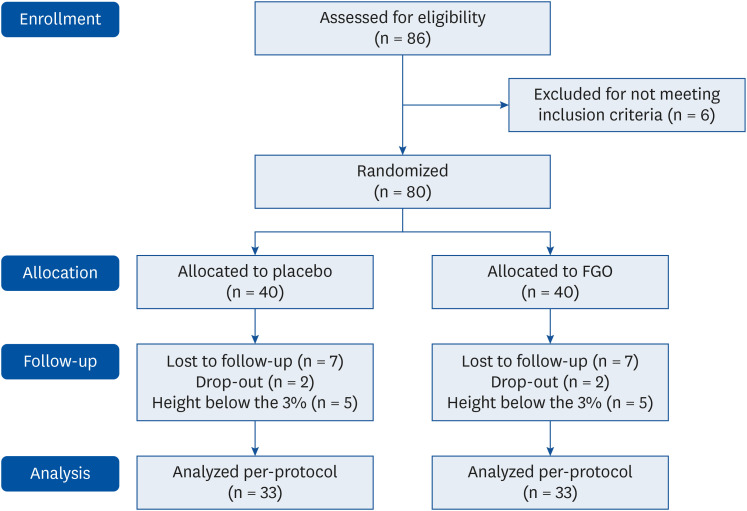
- Randomized, double-blind, placebo-controlled 24-week trial conducted in Korea from January 2022 to December 2023. Eighty children aged 6–9 years with height between the third and 25th percentiles were randomized 1:1; 66 completed per-protocol analysis (33 FGO, 33 placebo). FGO was given as 500 mg/day (57.5 mg GABA) or placebo once daily at bedtime.
- Outcomes included height, height SDS, height velocity, bone age and bone age delay, serum GH, IGF-1, IGFBP-3, urine DPD, and safety markers including estradiol, LH, and testosterone.
- Analyses used SPSS version 26.0, last-observation-carried-forward for missing values, Student’s t-test or Mann–Whitney U test for continuous variables, χ² test for categorical variables, with P < 0.05 considered significant.
Limitations
- Stated in the paper: baseline total caloric intake tended to be higher in the FGO group than placebo (P = 0.069); the 24-week intervention in children aged 6–9 years leaves long-term effects on older children and adolescents, especially during or after secondary sexual characteristics, unexplored; sleep and diet were not fully controlled.
- Evident from the text: the analysis was per-protocol, excluding 4 subjects who withdrew consent and 10 with heights below the third percentile, rather than intention-to-treat. Baseline bone age in boys differed significantly between groups (P = 0.005).
Model-written summary. Check it against the paper before relying on it.
Integrity signals
Registry
Cites
Statistics
Figures
Verification
Claims the paper makes
0 Valid · 0 Not valid · 34 Not checked · 55 Own results and interpretations
A result the paper reports from its own data — it cites no other source for it, so there is none to check. The quote shows it is in the paper.
In the paper
“The FGO group showed a significantly greater change in height SDS than the placebo group (0.16 ± 0.11 vs. −0.01 ± 0.14, P < 0.001).”
§ Fermented oyster extract promotes height growth in children with mild short stature: a randomized, double-blind, placebo-controlled trial > RESULTS > Efficacy outcomes
plainstates a cause- Asserted: passes — The authors put it forward as true.
- Checkable: passes — It can be checked against evidence.
- Load-bearing: passes — The paper’s conclusions depend on it.
- Based: passes — The paper gives a reason why it holds.
A result the paper reports from its own data — it cites no other source for it, so there is none to check. The quote shows it is in the paper.
In the paper
“The present study showed a significant increase in the IGF-1 levels in the FGO group compared to the placebo group, whereas no notable changes in GH levels were observed.”
§ Fermented oyster extract promotes height growth in children with mild short stature: a randomized, double-blind, placebo-controlled trial > DISCUSSION
plain- Asserted: passes — The authors put it forward as true.
- Checkable: passes — It can be checked against evidence.
- Load-bearing: unclear — It is unclear whether the paper’s conclusions depend on it.
- Based: passes — The paper gives a reason why it holds.
A result the paper reports from its own data — it cites no other source for it, so there is none to check. The quote shows it is in the paper.
In the paper
“Girls in the FGO group also exhibited a significant improvement in height (3.30 ± 0.35 cm vs. 2.43 ± 0.71 cm, P < 0.001).”
§ Fermented oyster extract promotes height growth in children with mild short stature: a randomized, double-blind, placebo-controlled trial > RESULTS > Efficacy outcomes
plainstates a cause- Asserted: passes — The authors put it forward as true.
- Checkable: passes — It can be checked against evidence.
- Load-bearing: passes — The paper’s conclusions depend on it.
- Based: passes — The paper gives a reason why it holds.
A result the paper reports from its own data — it cites no other source for it, so there is none to check. The quote shows it is in the paper.
In the paper
“Conversely, the decrease in BA delay in the FGO group suggested catch-up growth.”
§ Fermented oyster extract promotes height growth in children with mild short stature: a randomized, double-blind, placebo-controlled trial > DISCUSSION
hedgedstates a cause- Asserted: passes — The authors put it forward as true.
- Checkable: passes — It can be checked against evidence.
- Load-bearing: passes — The paper’s conclusions depend on it.
- Based: passes — The paper gives a reason why it holds.
A result the paper reports from its own data — it cites no other source for it, so there is none to check. The quote shows it is in the paper.
In the paper
“After 24 weeks, the FGO group showed a significantly greater increase in height than the placebo group (P < 0.001). The increases in height in the placebo and FGO groups were 2.48 ± 0.61 cm and 3.40 ± 0.51 cm, respectively, representing a 0.92 cm difference (37.1%) compared to the placebo group.”
§ Fermented oyster extract promotes height growth in children with mild short stature: a randomized, double-blind, placebo-controlled trial > RESULTS > Efficacy outcomes
plainstates a cause- Asserted: passes — The authors put it forward as true.
- Checkable: passes — It can be checked against evidence.
- Load-bearing: passes — The paper’s conclusions depend on it.
- Based: passes — The paper gives a reason why it holds.
33 more claims
Create a free account to see all 89 claims and to verify the 24 references still open.
- The quote only partly states this claim. 9
- It may state two separate claims as one. 25
- Probably not a substantial claim. 25
Self-check
Percentages, sums and reported differences re-computed from the paper’s own numbers.
Each contradiction between two passages listed here was confirmed by an independent check.
Rated minor: it would not touch a result — a value no result rests on, a p-value that stays on the same side of the significance level, or a conflict that is clerical, resolved elsewhere in the paper, or outside its own findings.
In the paper
§ Fermented oyster extract promotes height growth in children with mild short stature: a randomized, double-blind, placebo-controlled trial > RESULTS > Efficacy outcomes
“Girls in the FGO group also exhibited a significant improvement in height (3.30 ± 0.35 cm vs. 2.43 ± 0.71 cm, P < 0.001).”
§ Fermented oyster extract promotes height growth in children with mild short stature: a randomized, double-blind, placebo-controlled trial > RESULTS > Efficacy outcomes
“| | Change | 2.54 ± 0.48 | 3.51 ± 0.63 | < 0.001 | 2.43 ± 0.74 | 3.30 ± 0.35 | < 0.001 |”
Rated minor: it would not touch a result — a value no result rests on, a p-value that stays on the same side of the significance level, or a conflict that is clerical, resolved elsewhere in the paper, or outside its own findings.
In the paper
§ Fermented oyster extract promotes height growth in children with mild short stature: a randomized, double-blind, placebo-controlled trial > DISCUSSION
“In a study evaluating BA in children aged 7 to 9 yrs, the average difference between BA and CA was approximately 12 mon [38]. On the other hand, the BA delay in the subjects of this study was less than the average.”
§ Fermented oyster extract promotes height growth in children with mild short stature: a randomized, double-blind, placebo-controlled trial > RESULTS > Efficacy outcomes
“| | Baseline | −16.30 ± 10.05 | −19.42 ± 14.64 | 0.316 |”
Rated minor: it would not touch a result — a value no result rests on, a p-value that stays on the same side of the significance level, or a conflict that is clerical, resolved elsewhere in the paper, or outside its own findings.
In the paper
“| ALT (U/L) | ALT (U/L) | | | | | | Baseline | 11.91 ± 2.61 | 12.06 ± 3.62 | 0.846 | | | Endpoint | 11.79 ± 3.08 | 13.00 ± 4.23 | 0.188 | | | Change | −0.12 ± 3.35 | −0.94 ± 3.94 | 0.208 |”
§ Fermented oyster extract promotes height growth in children with mild short stature: a randomized, double-blind, placebo-controlled trial > RESULTS > Safety
Reported -0.94 · recomputed 0.94
Citations
Cites
WHO Child Growth Standards based on length/height, weight and age
WHO MULTICENTRE GROWTH REFERENCE STUDY GROUP, & de Onis, M. (2006) · Acta Paediatrica · doi:10.1111/j.1651-2227.2006.tb02378.x · Cited by 3,977
Stature and Status: Height, Ability, and Labor Market Outcomes
Case, A., & Paxson, C. (2008) · Journal of Political Economy · doi:10.1086/589524 · Cited by 1,032
Kim, J. H., Yun, S., Hwang, S.-S., Shim, J. O., Chae, H. W., Lee, Y. J., Lee, J. H., Kim, S. C., Lim, D., Yang, S. W., et al. (2018) · Korean Journal of Pediatrics · doi:10.3345/kjp.2018.61.5.135 · Cited by 638 · cited 3×
“Healthy prepubertal boys and girls aged 6 to 9 yrs old with a mild short stature, defined as being below the 25th percentile for height according to the Korean children’s growth chart by age and gender, were recruited [18].”
Self-citationInsulin-like growth factor 1 (IGF-1): a growth hormone
Laron, Z. (2001) · Molecular Pathology · doi:10.1136/mp.54.5.311 · Cited by 608
Danaei, G., Andrews, K. G., Sudfeld, C. R., Fink, G., McCoy, D. C., Peet, E., Sania, A., Smith Fawzi, M. C., Ezzati, M., & Fawzi, W. W. (2016) · PLOS Medicine · doi:10.1371/journal.pmed.1002164 · Cited by 534
Adult height, nutrition, and population health
Perkins, J. M., Subramanian, S. V., Davey Smith, G., & Özaltin, E. (2016) · Nutrition Reviews · doi:10.1093/nutrit/nuv105 · Cited by 405
The Use of Bone Age in Clinical Practice – Part 1
Martin, D. D., Wit, J. M., Hochberg, Z., Sävendahl, L., van Rijn, R. R., Fricke, O., Cameron, N., Caliebe, J., Hertel, T., Kiepe, D., et al. (2011) · Hormone Research in Paediatrics · doi:10.1159/000329372 · Cited by 200
Evaluation of Bone Age in Children: A Mini-Review
Cavallo, F., Mohn, A., Chiarelli, F., & Giannini, C. (2021) · Frontiers in Pediatrics · doi:10.3389/fped.2021.580314 · Cited by 166
Effect of Growth Hormone Treatment on Adult Height of Children with Idiopathic Short Stature
Hintz, R. L., Attie, K. M., Baptista, J., & Roche, A. (1999) · New England Journal of Medicine · doi:10.1056/nejm199902183400702 · Cited by 161
The Role of Sleep in Young Children’s Development: A Review
Schlieber, M., & Han, J. (2021) · The Journal of Genetic Psychology · doi:10.1080/00221325.2021.1908218 · Cited by 127
Bone Age: A Handy Tool for Pediatric Providers
Creo, A. L., & Schwenk, W. F. (2017) · Pediatrics · doi:10.1542/peds.2017-1486 · Cited by 122
Ulijaszek, S. J. (2006) · Food and Nutrition Bulletin · doi:10.1177/15648265060274s510 · Cited by 114
Cole, T. J., & Mori, H. (2017) · American Journal of Human Biology · doi:10.1002/ajhb.23054 · Cited by 77
The psychosocial consequences of short stature: a review of the evidence
Sandberg, D. E., & Voss, L. D. (2002) · Best Practice & Research Clinical Endocrinology & Metabolism · doi:10.1053/beem.2002.0211 · Cited by 74
Estimated Cost-effectiveness of Growth Hormone Therapy for Idiopathic Short Stature
Lee, J. M., Davis, M. M., Clark, S. J., Hofer, T. P., & Kemper, A. R. (2006) · Archives of Pediatrics & Adolescent Medicine · doi:10.1001/archpedi.160.3.263 · Cited by 68
Düppe, H., Cooper, C. C., Gärdsell, P., & Johnell, O. (1997) · Calcified Tissue International · doi:10.1007/s002239900253 · Cited by 62
Adverse effects of growth hormone replacement therapy in children
Souza, F. M., & Collett-Solberg, P. F. (2011) · Arquivos Brasileiros de Endocrinologia & Metabologia · doi:10.1590/s0004-27302011000800009 · Cited by 56
Kim, J. R., Lee, Y. S., & Yu, J. (2015) · Korean Journal of Radiology · doi:10.3348/kjr.2015.16.1.201 · Cited by 49
Self-citationBarillé, L., Bris, A. L., Méléder, V., Launeau, P., Robin, M., Louvrou, I., & Ribeiro, L. (2017) · PLoS ONE · doi:10.1371/journal.pone.0185187 · Cited by 43
GABA Supplementation and Growth Hormone Response
Powers, M. E. (2012) · Medicine and sport science/Medicine and sport · doi:10.1159/000341944 · Cited by 41
The GH/IGF-1 Axis in Growth and Development: New Insights Derived from Animal Models
Cannata, D., Vijayakumar, A., Fierz, Y., & LeRoith, D. (2010) · Advances in Pediatrics · doi:10.1016/j.yapd.2010.09.003 · Cited by 40
Vázquez-Borrego, M. C., del Rio-Moreno, M., & Kineman, R. D. (2021) · Cells · doi:10.3390/cells10102532 · Cited by 37
Dagorn, F., Couzinet‐Mossion, A., Kendel, M., Beninger, P. G., Rabesaotra, V., Barnathan, G., & Wielgosz‐Collin, G. (2016) · Marine Drugs · doi:10.3390/md14060104 · Cited by 36
Chae, H. W., Suh, I., Kwon, A., Kim, Y. J., Kim, Y. H., Kang, D. R., Kim, H. Y., Oh, S. M., Kim, H. C., Kim, D. H., et al. (2013) · Journal of Korean Medical Science · doi:10.3346/jkms.2013.28.10.1512 · Cited by 35
Athapaththu, A. M. G. K., Molagoda, I. M. N., Jayasooriya, R. G. P. T., Choi, Y. H., Jeon, Y., Park, J.-H., Lee, B.-J., & Kim, G. (2021) · International Journal of Molecular Sciences · doi:10.3390/ijms222011254 · Cited by 29
Lee, D., Lee, S. H., Song, J., Jee, H., Cha, S. H., & Chang, G. T. (2018) · Phytotherapy Research · doi:10.1002/ptr.5886 · Cited by 24
Biochemical markers of bone turnover in children with clinical bone fragility
Bowden, S. A., Akusoba, C. I., Hayes, J. R., & Mahan, J. D. (2016) · Journal of Pediatric Endocrinology and Metabolism · doi:10.1515/jpem-2014-0525 · Cited by 21
Urinary free deoxypyridinoline levels during childhood
Conti, A., Ferrero, S., Giambona, S., & Sartório, A. (1998) · Journal of Endocrinological Investigation · doi:10.1007/bf03350335 · Cited by 18
Ishida, T., Matsui, H., Matsuda, Y., Hosomi, R., Shimono, T., Kanda, S., Nishiyama, T., Fukunaga, K., & Yoshida, M. (2022) · Foods · doi:10.3390/foods11030373 · Cited by 16
Obara-Moszynska, M., Kctdzia, A., Korman, E., & Niedziela, M. (2008) · Journal of Pediatric Endocrinology and Metabolism · doi:10.1515/jpem-2008-210611 · Cited by 16
Jeong, A., Park, B.-C., Kim, H.-Y., Choi, J.-Y., Cheon, J., Park, J.-H., Lee, B.-J., & Kim, K. (2021) · Integrative Medicine Research · doi:10.1016/j.imr.2020.100691 · Cited by 14
Self-citationChoi, Y. J., Lee, Y. J., Lee, N. Y., Lee, S. H., Kim, S.-K., Ahn, M. B., Kim, S., Cho, W. K., Cho, K., Jung, M. H., et al. (2020) · Annals of Pediatric Endocrinology & Metabolism · doi:10.6065/apem.2040018.009 · Cited by 13
Assessment of growth and nutrition
Gokhale, R., & Kirschner, B. S. (2003) · Best Practice & Research Clinical Gastroenterology · doi:10.1016/s1521-6918(02)00143-9 · Cited by 13
Guerrini Usubini, A., Marazzi, N., Abbruzzese, L., Tringali, G., De Micheli, R., Castelnuovo, G., & Sartorio, A. (2025) · Journal of Clinical Medicine · doi:10.3390/jcm14020538 · Cited by 11
Lee, H., Hwangbo, H., Ji, S. Y., Kim, M. Y., Kim, S. Y., Kim, D. H., Hong, S. H., Lee, S. J., Assefa, F., Kim, G., et al. (2020) · Molecules · doi:10.3390/molecules25194375 · Cited by 11
Effect of fermented oyster extract on growth promotion in Sprague–Dawley rats
Lee, H., Hwangbo, H., Ji, S. Y., Kim, M. Y., Kim, S. Y., Woo, M., Keum, Y., Noh, J. S., Park, J.-H., Lee, B.-J., et al. (2020) · Integrative Medicine Research · doi:10.1016/j.imr.2020.100412 · Cited by 11
Growth Hormone Use in Children with Idiopathic Short Stature
Weise, K. L., & Nahata, M. C. (2004) · Annals of Pharmacotherapy · doi:10.1345/aph.1d548 · Cited by 11
Lee, H. A., Park, B., Park, E. A., Cho, S. J., Kim, H. S., Choi, E. J., Kim, N., & Park, H. (2020) · Journal of Korean Medical Science · doi:10.3346/jkms.2020.35.e91 · Cited by 10
Factors affecting height velocity in normal prepubertal children
Lee, J. H., Kim, S. K., Lee, E. K., Ahn, M. B., Kim, S. H., Cho, W. K., Cho, K. S., Jung, M. H., & Suh, B. (2018) · Annals of Pediatric Endocrinology & Metabolism · doi:10.6065/apem.2018.23.3.148 · Cited by 10
Blum, W. F., Ranke, M. B., Keller, E., Keller, A., Barth, S., de Bruin, C., Wudy, S. A., & Wit, J. M. (2022) · Journal of the Endocrine Society · doi:10.1210/jendso/bvac074 · Cited by 9
Park, J.-S., & Lee, D. (2023) · IEEE Access · doi:10.1109/access.2023.3307731 · Cited by 6
Stritar, J., Stavber, L., Ficko, M., Kotnik, P., Battelino, T., Trebušak Podkrajšek, K., & Hovnik, T. (2021) · Genes · doi:10.3390/genes12101546 · Cited by 4
Leem, J., Kim, J., Suh, K.-S., Lim, Y., & Lee, J. (2018) · 대한한의학회지 · doi:10.13048/jkm.18031 · Cited by 3
Self-citationHa, K. C., Ph.D., P. D., Baek, H. I., Ph.D., P. D., Kim, H. M., s, M. I. N.-G. O. M. J. U., Kim, Y. M., S, B. A. S. B. A., Jeong, D. Y., S, B. A. S. B. A., et al. (2019) · Journal of Korean Medicine Rehabilitation · doi:10.18325/jkmr.2019.29.1.75 · Cited by 3
(2005) · Europe PMC (PubMed Central)
Metadata
- Authors
- Kim, J., Kim, K., Park, M., Park, S., Jin, M. H., Cho, H., & Om, A.-S.
- Affiliations
- LG Household & Health Care Research Park, Seoul 07795, Korea.
- LG (South Korea) (KR)
- Hanyang University (KR)
- Corresponding author
- Cho, Hosong
- Venue
- Nutrition Research and Practice
- Publisher
- XMLink
- Published
- 2026
- Volume
- 20
- Issue
- 3
- Pages
- 461
- ISSN
- 1976-1457 (ISSN-L)
- 2005-6168
- PMC
- PMC13243516
- OpenAlex
- W7163135214
- Cited by
- 0
- References
- 45
- FWCI
- 0.00
- Type
- journal article
- Language
- en
- Open access
- diamond
- doi.org
- Licence
- cc-by-nc
- creativecommons.org/licenses/by-nc/4.0/ (tdm)
- Locations
- Nutrition Research and Practice (publishedVersion, cc-by-nc)
- PubMed Central (publishedVersion, cc-by-nc)
- PubMed (publishedVersion)
- Funders
- Ministry of Oceans and Fisheries (20170285)
- Topics
- Health Sciences › Medicine › Endocrinology, Diabetes and Metabolism › Growth Hormone and Insulin-like Growth Factors
- Health Sciences › Medicine › Pediatrics, Perinatology and Child Health › Human Health and Disease
- Life Sciences › Agricultural and Biological Sciences › Aquatic Science › Aquaculture Nutrition and Growth
- Keywords
- height growth, children, bone age, insulin-like growth factor I, growth hormone, IGFBP-3, deoxypyridinoline, sex hormones, supplement safety
About these checks
Registry, retraction, Cites and statistics results are computed, not judged, with one exception: a printed reference that no index lists is read once by a model before it counts as a citation error. Claims are extracted by a model and kept only when their quote appears verbatim in the text; each cited source is then checked, with a model’s help, for whether it says what the claim relies on. Those verdicts can be wrong — read the claim’s quote and the cited source before relying on one.
A language model drew the claims from the paper on 2026-11-28, under version 3 of the claim definition (model deepseek-v4.1-flash, prompt extract-v3).
A second model labelled each claim on 2026-11-28 (model jev-1.13-20260917, definition revision gold-guideline-v0.2).
Statistics and arithmetic are recomputed, not judged.
Confidence bands are shown only for fields calibrated on our annotated test set. None is calibrated yet, so no band is shown.
What counts as a claim ›How we measure confidence ›How we check this ›
Are you an author, or do you see a problem with this page? Request a review
Data sources
Bibliographic data: Semantic Scholar, OpenAlex, Crossref.
Contains information from the Semantic Scholar Academic Graph Datasets, made available under the ODC Attribution License (ODC-BY 1.0).
Semantic Scholar’s data is described in: Kinney, R., et al. (2023). The Semantic Scholar Open Data Platform. arXiv:2301.10140.
