

The DOI matches its Crossref record; 4 of the 4 references it cites were found in a registry or an index.
Efficacy of Sublingual Immunotherapy for House Dust Mite-Induced Allergic Rhinitis: A Meta-Analysis of Randomized Controlled Trials
Open accessAbstract
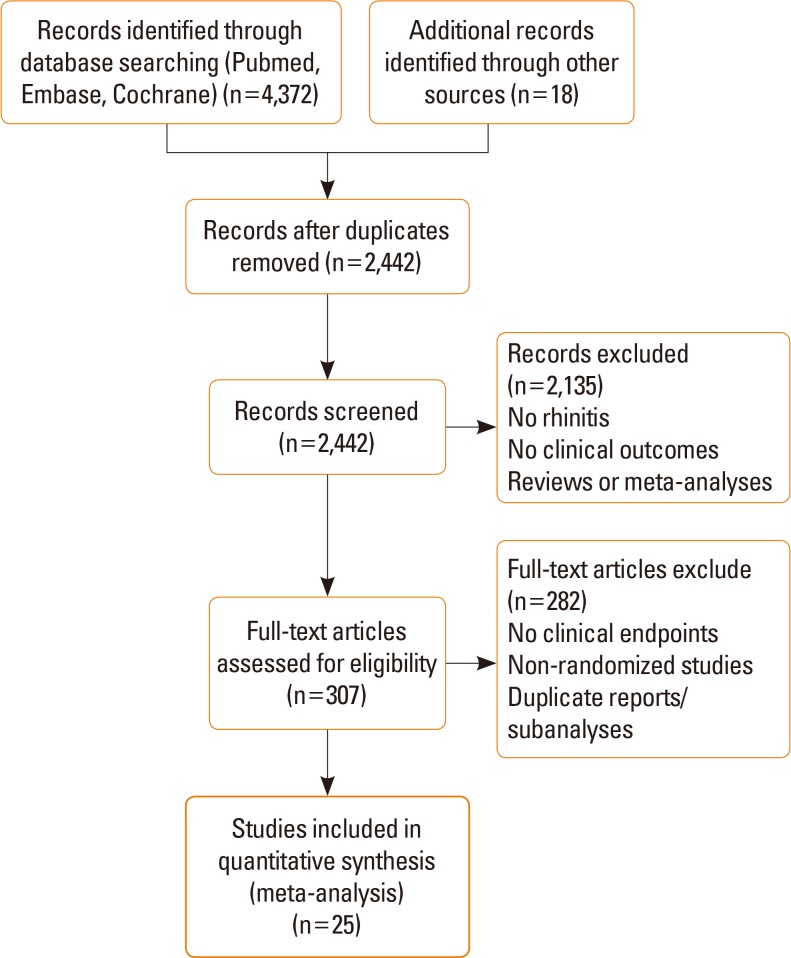
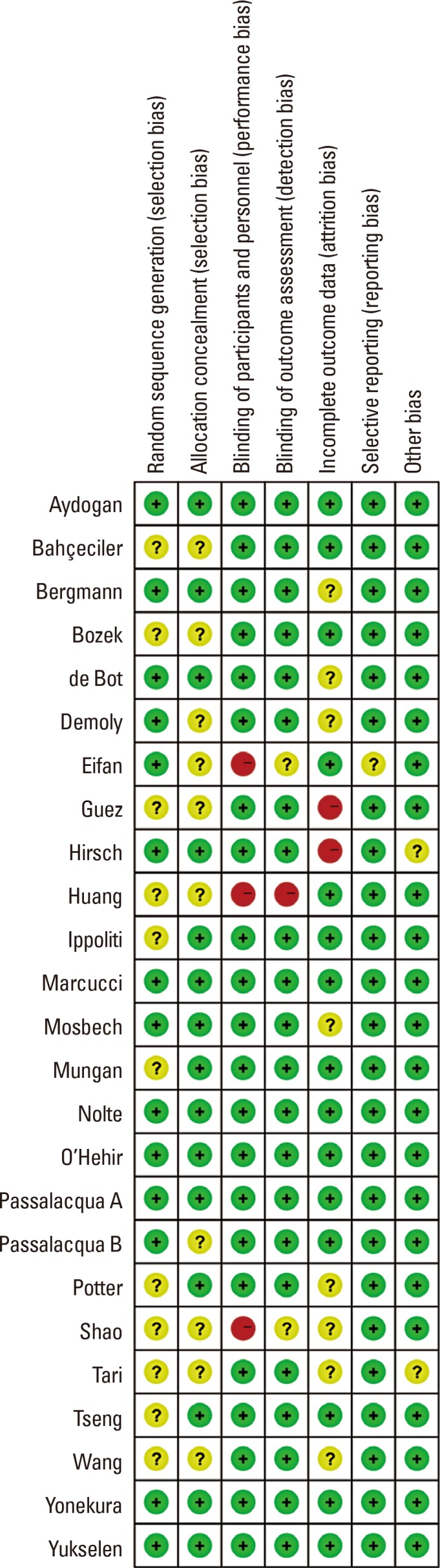
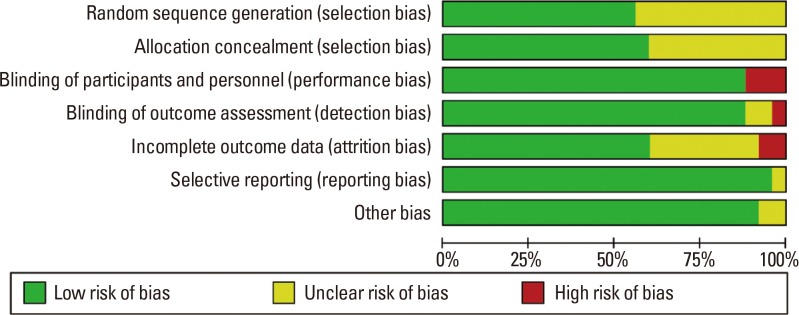
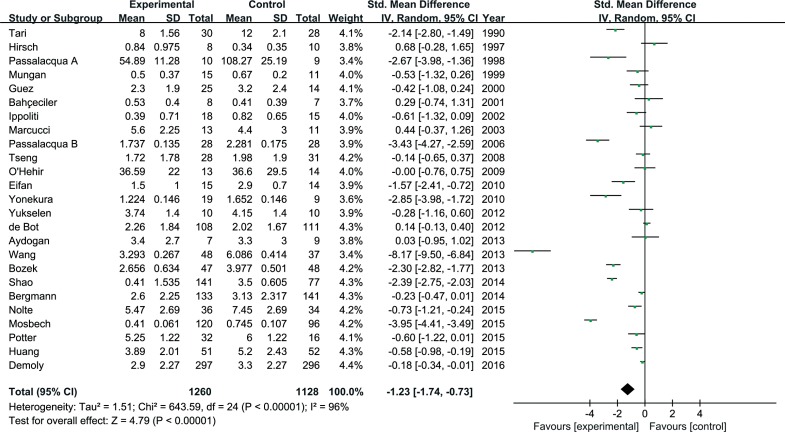
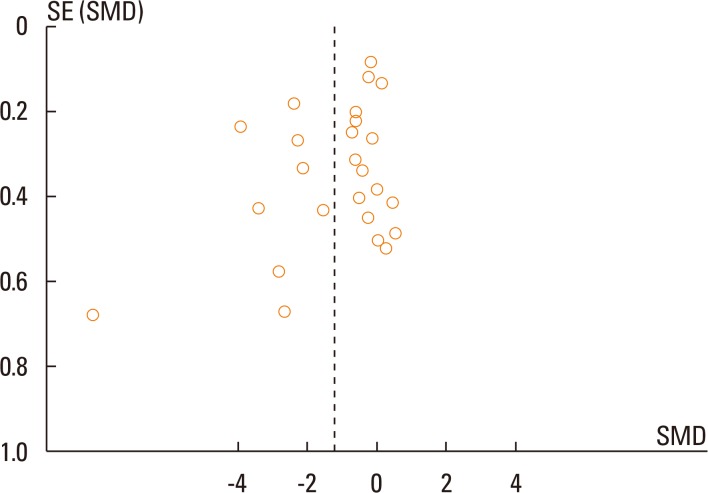
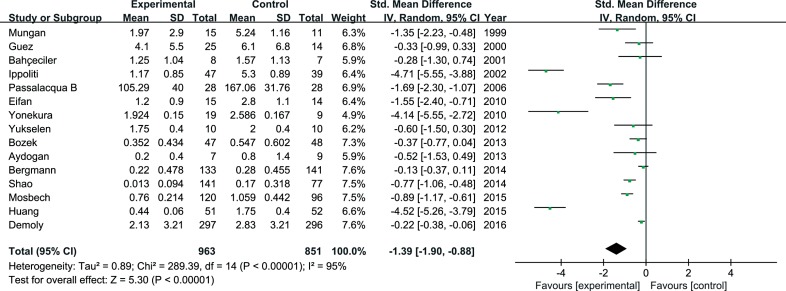
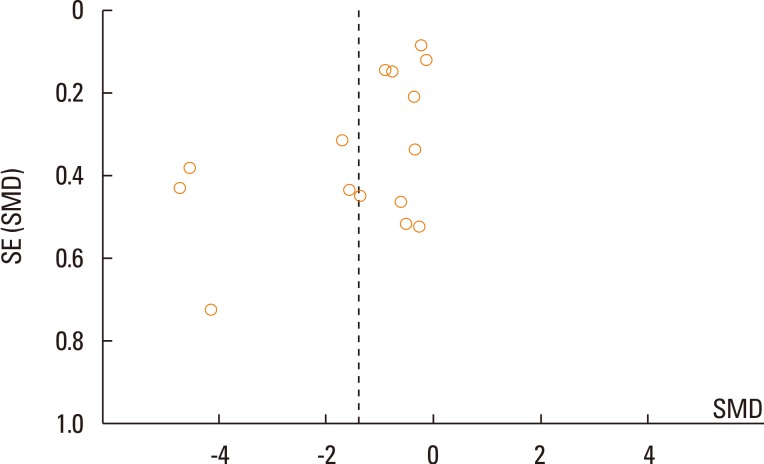
PURPOSE: Allergic rhinitis (AR) has become a global issue for a large part of the general population. Sublingual immunotherapy (SLIT) has been used extensively to treat persistent allergic rhinitis (PAR). Although systematic reviews have confirmed the effectiveness of SLIT for the treatment of AR, a considerable number of studies using extracts of house dust mites (HDMs) for immunotherapy found no consensus on basic treatment parameters and questioned the efficacy of SLIT. METHODS: In this study, we evaluated SLIT for PAR by a meta-analysis of randomized controlled trials (RCTs). Medline, Embase, and Cochrane Library database searches were performed for RCTs on the treatment of PAR by SLIT that assessed clinical outcomes related to efficacy through May 2016. Descriptive and quantitative information was abstracted. An analysis was performed with standardized mean differences (SMDs) under a fixed or random effects model. Subgroup analyses were performed. Heterogeneity was assessed using the I² metric. RESULTS: In total, 25 studies were eligible for inclusion in the meta-analysis for symptom scores and 15 studies for medication scores. SLIT was significantly different from the controls for symptom scores (SMD=1.23; 95% confidence interval [CI]=1.74 to 0.73; P<0.001). For medication scores, significant differences for SLIT were also observed versus the controls (SMD=-1.39; 95% CI=-1.90 to -0.88; P<0.001). CONCLUSIONS: Our meta-analysis indicates that SLIT provided significant symptom relief and reduced the need for medications in PAR. In this study, significant evidence was obtained despite heterogeneity with regard to the use of mite extract. Specifically, the mite extract used was provided by the patients with PAR. Furthermore, to confirm both the objective outcomes and the effective doses of HDM allergen extracts, experimental data should be obtained from large high-quality population-based studies.
Overview
The claims and statistics of this paper haven’t been checked yet.
Run the check — free, no account needed. It reads the open-access text and checks the sources it cites.
Integrity signals
Registry
Cites
Statistics
Figures
Verification
Claims the paper makes
The claims and statistics of this paper haven’t been checked yet.
Run the check — free, no account needed. It reads the open-access text and checks the sources it cites.
Claims other papers make about this one
Each is checked against this paper’s own text: does it say what the citing paper says it does?
The source backs part of the claim, not all of it — or backs it for a different population, condition or comparison.
In the citing paper
“Both subcutaneous immunotherapy (SCIT) [168] and sublingual immunotherapy (SLIT) [169,170] have proven effective in reducing the symptoms (including NO) of seasonal and perennial AR [171].”
From Position Paper on Nasal Obstruction: Evaluation and Treatment (2018) · cites this paper as [170]
Experimental — accuracy not yet measured
Self-check
Percentages, sums and reported differences re-computed from the paper’s own numbers.
The self-check needs the paper’s full text.
Citations
Cites
Sublingual immunotherapy for allergic rhinitis: systematic review and meta‐analysis*
Wilson, D. R., Torres Lima, M., & Durham, S. R. (2005) · Allergy · doi:10.1111/j.1398-9995.2005.00699.x · Cited by 660
Linneberg, A., Henrik Nielsen, N., Frølund, L., Madsen, F., Dirksen, A., & Jørgensen, T. (2002) · Allergy · doi:10.1034/j.1398-9995.2002.23664.x · Cited by 291
Demoly, P., Emminger, W., Rehm, D., Backer, V., Tommerup, L., & Kleine-Tebbe, J. (2016) · Journal of Allergy and Clinical Immunology · doi:10.1016/j.jaci.2015.06.036 · Cited by 240
Salo, P. M., Calatroni, A., Gergen, P. J., Hoppin, J. A., Sever, M. L., Jaramillo, R., Arbes, S. J., & Zeldin, D. C. (2011) · Journal of Allergy and Clinical Immunology · doi:10.1016/j.jaci.2010.12.1106 · Cited by 234
Research works printed but not linked: 46
- Bousquet, 2007, Allergy, 62, 301, 10.1111/j.1398-9995.2006.01293.x · DOI
- Calderón, 2015, J Allergy Clin Immunol, 136, 38, 10.1016/j.jaci.2014.10.012 · DOI
- Miyazawa, 1996, Ann Allergy Asthma Immunol, 76, 170, 10.1016/S1081-1206(10)63418-7 · DOI
- Meltzer, 2011, Ann Allergy Asthma Immunol, 106, S12, 10.1016/j.anai.2010.10.014 · DOI · Paper page
- Yoo, 2016, Allergy Asthma Immunol Res, 8, 527, 10.4168/aair.2016.8.6.527 · DOI
- Brozek, 2010, J Allergy Clin Immunol, 126, 466, 10.1016/j.jaci.2010.06.047 · DOI · Paper page
- Burks, 2013, J Allergy Clin Immunol, 131, 1288, 10.1016/j.jaci.2013.01.049 · DOI
- Jutel, 2016, Allergy Asthma Immunol Res, 8, 191, 10.4168/aair.2016.8.3.191 · DOI
- Morjaria, 2014, Curr Allergy Asthma Rep, 14, 412, 10.1007/s11882-013-0412-6 · DOI
- Dong, 2016, Allergy Asthma Immunol Res, 8, 421, 10.4168/aair.2016.8.5.421 · DOI
- Canonica, 2009, Allergy, 64, 1
- Calderon, 2013, J Allergy Clin Immunol, 132, 1322, 10.1016/j.jaci.2013.09.004 · DOI
- Shekelle, 1999, BMJ, 318, 593, 10.1136/bmj.318.7183.593 · DOI
- Jørgensen, 2006, BMJ, 333, 782, 10.1136/bmj.38973.444699.0B · DOI
- Di Bona, 2015, JAMA Intern Med, 175, 1301, 10.1001/jamainternmed.2015.2840 · DOI · Paper page
- Radulovic, 2010, Cochrane Database Syst Rev, CD002893
- Compalati, 2009, Allergy, 64, 1570, 10.1111/j.1398-9995.2009.02129.x · DOI
- Aydogan, 2013, Respir Med, 107, 1322, 10.1016/j.rmed.2013.06.021 · DOI
- Bahçeciler, 2001, Pediatr Pulmonol, 32, 49, 10.1002/ppul.1088 · DOI
- Bergmann, 2014, J Allergy Clin Immunol, 133, 1608, 10.1016/j.jaci.2013.11.012 · DOI
- Bozek, 2013, Clin Exp Allergy, 43, 242, 10.1111/cea.12039 · DOI
- de Bot, 2012, Pediatr Allergy Immunol, 23, 150
- Eifan, 2010, Clin Exp Allergy, 40, 922, 10.1111/j.1365-2222.2009.03448.x · DOI
- Guez, 2000, Allergy, 55, 369, 10.1034/j.1398-9995.2000.00413.x · DOI
- Hirsch, 1997, Pediatr Allergy Immunol, 8, 21, 10.1111/j.1399-3038.1997.tb00138.x · DOI
- Huang, 2015, Lin Chung Er Bi Yan Hou Tou Jing Wai Ke Za Zhi, 29, 618
- Ippoliti, 2003, Pediatr Allergy Immunol, 14, 216, 10.1034/j.1399-3038.2003.00025.x · DOI
- Marcucci, 2003, Allergy, 58, 657, 10.1034/j.1398-9995.2003.00193.x · DOI
- Mosbech, 2015, Ann Allergy Asthma Immunol, 114, 134, 10.1016/j.anai.2014.11.015 · DOI · Paper page
- Mungan, 1999, Ann Allergy Asthma Immunol, 82, 485, 10.1016/S1081-1206(10)62726-3 · DOI
- Nolte, 2015, J Allergy Clin Immunol, 135, 1494, 10.1016/j.jaci.2014.12.1911 · DOI · Paper page
- O'Hehir, 2009, Am J Respir Crit Care Med, 180, 936, 10.1164/rccm.200905-0686OC · DOI
- Passalacqua, 1998, Lancet, 351, 629, 10.1016/S0140-6736(97)07055-4 · DOI
- Passalacqua, 2006, Allergy, 61, 849, 10.1111/j.1398-9995.2006.01095.x · DOI
- Potter, 2015, Ann Allergy Asthma Immunol, 114, 327, 10.1016/j.anai.2014.12.015 · DOI
- Shao, 2014, Am J Rhinol Allergy, 28, 131, 10.2500/ajra.2014.28.4006 · DOI
- Tari, 1990, Allergol Immunopathol (Madr), 18, 277
- Tseng, 2008, Asian Pac J Allergy Immunol, 26, 105
- Wang, 2013, Laryngoscope, 123, 1334, 10.1002/lary.23935 · DOI
- Yonekura, 2010, Allergol Int, 59, 381, 10.2332/allergolint.10-OA-0200 · DOI
- Yukselen, 2012, Int Arch Allergy Immunol, 157, 288, 10.1159/000327566 · DOI
- Nelson, 2014, Curr Opin Allergy Clin Immunol, 14, 542, 10.1097/ACI.0000000000000104 · DOI
- Cox, 2006, J Allergy Clin Immunol, 117, 1021, 10.1016/j.jaci.2006.02.040 · DOI
- Klimek, 2016, Expert Rev Clin Immunol, 12, 369, 10.1586/1744666X.2016.1144473 · DOI
- Lin, 2013, JAMA, 309, 1278, 10.1001/jama.2013.2049 · DOI · Paper page
- Larenas-Linnemann, 2013, Ann Allergy Asthma Immunol, 110, 402, 10.1016/j.anai.2013.02.017 · DOI
Cited by
Sorted by citations
Position Paper on Nasal Obstruction: Evaluation and Treatment
SEAIC Rhinoconjunctivitis Committee & SEORL Rhinology, A., Valero, A., Navarro, A., del Cuvillo, A., Alobid, I., Benito, Jr., Colás, C., de los Santos, G., Fernández Liesa, R., García-Lliberós, A., et al. (2018) · Journal of Investigational Allergology and Clinical Immunology · doi:10.18176/jiaci.0232 · Cited by 76
Metadata
- Authors
- Feng, B., Xiang, H., Jin, H., Gao, J., Huang, S., Shi, Y., Chen, R., & Chen, B.
- Affiliations
- Wenzhou Medical University (CN)
- Corresponding author
- Chen, Bobei
- Venue
- Allergy, Asthma & Immunology Research
- Publisher
- The Korean Academy of Asthma, Allergy and Clinical Immunology and The Korean Academy of Pediatric Al
- Published
- 2017
- Volume
- 9
- Issue
- 3
- Pages
- 220
- ISSN
- 2092-7355 (ISSN-L)
- 2092-7363
- PMC
- PMC5352573
- OpenAlex
- W2593174422
- Cited by
- 27
- References
- 4
- Citations by year
- 2025: 3 · 2024: 1 · 2023: 2 · 2022: 2 · 2021: 4 · 2020: 3 · 2019: 2 · 2018: 7 · 2017: 3
- FWCI
- 0.64
- Type
- journal article
- Language
- en
- Open access
- hybrid
- doi.org
- Licence
- Locations
- Allergy Asthma and Immunology Research (publishedVersion, cc-by-nc)
- PubMed Central (publishedVersion, cc-by-nc)
- PubMed (publishedVersion)
- Funders
- Pediatric Respiratory of China (523302)
- Topics
- Health Sciences › Medicine › Immunology and Allergy › Allergic Rhinitis and Sensitization
- Health Sciences › Medicine › Immunology and Allergy › Food Allergy and Anaphylaxis Research
- Health Sciences › Medicine › Pulmonary and Respiratory Medicine › Asthma and respiratory diseases
- Keywords
- sublingual immunotherapy, house dust mite allergy, allergic rhinitis, persistent allergic rhinitis, symptom scores, medication use, treatment efficacy
About these checks
Registry, retraction, Cites and statistics results are computed, not judged, with one exception: a printed reference that no index lists is read once by a model before it counts as a citation error. Claims are extracted by a model and kept only when their quote appears verbatim in the text; each cited source is then checked, with a model’s help, for whether it says what the claim relies on. Those verdicts can be wrong — read the claim’s quote and the cited source before relying on one.
Statistics and arithmetic are recomputed, not judged.
Confidence bands are shown only for fields calibrated on our annotated test set. None is calibrated yet, so no band is shown.
What counts as a claim ›How we measure confidence ›How we check this ›
Are you an author, or do you see a problem with this page? Request a review
