

Effects of a Novel Dental Gel on Enamel Surface Recovery from Acid Challenge
Open accessThe DOI matches its Crossref record; 44 of the 45 references it cites were found in a registry or an index.
Abstract
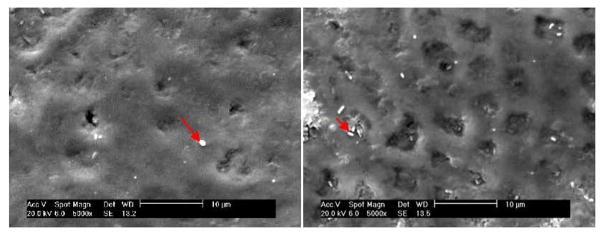
BACKGROUND: ) vs. a comparison dental gel on the surfaces of pre-eroded enamel chips. METHODS: On days 1-5, after toothbrushing with dentifrice, nine subjects each wore 8 enamel chips mounted on a palatal appliance for 4 h. Enamel blocks were pre-demineralized daily. After 2 day washout, subjects repeated the protocol using fresh chips and the second toothpaste on days 8-12. Samples were evaluated using electron microscopy. RESULTS: Ten standardized enamel surface photomicrographs/sample (total 1440 images) were evaluated for signs of erosion visually and on a scale of 0-3 by 1 evaluator. No significant differences were found between the 2 groups (p>0.32, 95% C.I.). Minimal surface erosion on approx. 15% of sample area was visible in both groups. CONCLUSION: The enamel surface appeared similar after usage of a test or control dentifrice. Based on this study, the test formulation did not affect enamel surface recovery from an erosive challenge. PRACTICAL IMPLICATIONS: Dentifrices can contribute to maintaining a healthy enamel surface. An all-natural dental gel formulation with novel anti-plaque mechanism achieved similar recovery from acid challenge to enamel as a control gel.
Overview
The claims and statistics of this paper haven’t been checked yet.
Free: it reads the open-access text and checks the first 5 claims that cite a source we can check. Create a free account to check every claim.
Integrity signals
Registry
Cites
Statistics
Figures
Verification
Claims the paper makes
The claims and statistics of this paper haven’t been checked yet.
Free: it reads the open-access text and checks the first 5 claims that cite a source we can check. Create a free account to check every claim.
Claims other papers make about this one
Each is checked against this paper’s own text: does it say what the citing paper says it does?
The source backs part of the claim, not all of it — or backs it for a different population, condition or comparison.
In the citing paper
“These previous investigations of 2.6% EDTA containing dentifrice lacked the inclusion of fluoride in the formulation.”
From Better living through chemistry? A randomized, double-blind controlled study evaluating the efficacy of plaque control and gingival health impacts of a novel stannous fluoride-containing gel (2023) · cites this paper as [26]
Experimental — accuracy not yet measuredThe source backs part of the claim, not all of it — or backs it for a different population, condition or comparison.
In the citing paper
“previous studies have demonstrated the efficacy of a new dental gel with EDTA, in reducing oral plaque deposits, gingival inflammation, and probing depths with minimal patient-reported side effects or impact upon tooth surface microarchitecture and microhardness. 20-26”
From A randomized double-blind clinical trial evaluating comparative plaque and gingival health associated with commercially available stannous fluoride-containing dentifrices as compared to a sodium fluoride control dentifrice (2023) · cites this paper as [24]
Experimental — accuracy not yet measuredThe source backs part of the claim, not all of it — or backs it for a different population, condition or comparison.
In the citing paper
“While only one of these reports evaluates a formulation that includes stannous fluoride, 26 the comparative efficacy of a similar dentifrice formulation without stannous fluoride in plaque and gingival inflammatory reduction is consistent across studies. 20-26”
From A randomized double-blind clinical trial evaluating comparative plaque and gingival health associated with commercially available stannous fluoride-containing dentifrices as compared to a sodium fluoride control dentifrice (2023) · cites this paper as [24]
Experimental — accuracy not yet measuredThe source backs part of the claim, not all of it — or backs it for a different population, condition or comparison.
In the citing paper
“EDTA usage in the commercially available D1 gel dentifrice without stannous fluoride has been shown to be safe for oral hard and soft tissues. 39,40”
From A randomized double-blind clinical trial evaluating comparative plaque and gingival health associated with commercially available stannous fluoride-containing dentifrices as compared to a sodium fluoride control dentifrice (2023) · cites this paper as [39]
Experimental — accuracy not yet measuredThe check wasn’t confident either way, so it gives no verdict — never disputed.
In the citing paper
“A critique of previous investigations included a lack of comparison between multiple commercially-available dentifrices, including a direct comparison with other stannous fluoride formulations. 20-26”
From A randomized double-blind clinical trial evaluating comparative plaque and gingival health associated with commercially available stannous fluoride-containing dentifrices as compared to a sodium fluoride control dentifrice (2023) · cites this paper as [24]
Experimental — accuracy not yet measured
1 more claim about this paper
Create a free account to see every claim other papers make about this one.
Self-check
Percentages, sums and reported differences re-computed from the paper’s own numbers.
The self-check needs the paper’s full text.
Citations
Cites
The Gingival Index, the Plaque Index and the Retention Index Systems
Löe, H. (1967) · The Journal of Periodontology · doi:10.1902/jop.1967.38.6.610 · Cited by 4,247 · cited 1×
“Dental erosion is a multi-factorial condition wherein an initial softening of the surface in response to an erosive challenge to the enamel is eventually followed by permanent loss of the demineralized tooth structure [19].”
BackgroundSoft Drink Consumption Among US Children and Adolescents
HARNACK, L., STANG, J., & STORY, M. (1999) · Journal of the American Dietetic Association · doi:10.1016/s0002-8223(99)00106-6 · Cited by 777 · cited 2×
“The mineral content of enamel is around 87% by volume [4].”
BackgroundErosive Tooth Wear – A Multifactorial Condition of Growing Concern and Increasing Knowledge
Lussi, A. (2006) · Monographs in Oral Science · doi:10.1159/000093343 · Cited by 451 · cited 3×
“In the United States alone, soft drink consumption has increased by 300% in the last 20 years [2].”
BackgroundOn the Proper Use of the Crossover Design in Clinical Trials
Wellek, S., & Blettner, M. (2012) · Deutsches Ärzteblatt international · doi:10.3238/arztebl.2012.0276 · Cited by 424 · cited 1×
“Indeed, a wide range of studies involving a plethora of toothpastes have reported varying degrees of remineralizing efficacy for many calcium and/or phosphate and/or fluoride-containing formulations [21,43].”
BackgroundInteraction between Attrition,Abrasion and Erosion in Tooth Wear
Addy, M., & Shellis, R. P. (2006) · Monographs in Oral Science · doi:10.1159/000093348 · Cited by 369
Prevalence, Incidence and Distribution of Erosion
Jaeggi, T., & Lussi, A. (2006) · Monographs in Oral Science · doi:10.1159/000093350 · Cited by 366
Understanding the Chemistry of Dental Erosion
Featherstone, J. D. B., & Lussi, A. (2006) · Monographs in Oral Science · doi:10.1159/000093351 · Cited by 357
Review on fluoride, with special emphasis on calcium fluoride mechanisms in caries prevention
ten Cate, J. M. (1997) · European Journal of Oral Sciences · doi:10.1111/j.1600-0722.1997.tb00231.x · Cited by 325
Dental erosion: possible approaches to prevention and control
Amaechi, B. T., & Higham, S. M. (2005) · Journal of Dentistry · doi:10.1016/j.jdent.2004.10.014 · Cited by 233 · cited 2×
“In mild cases of enamel softening, dairy product consumption can assist enamel hardening or re-mineralization, and this observation is attributed to the calcium and phosphate provided by these products as well as an increased rate of salivary flow that can be associated with dairy consumption [5,6].”
BackgroundIn vitro remineralisation of eroded enamel lesions by saliva
Amaechi, B. T., & Higham, S. M. (2001) · Journal of Dentistry · doi:10.1016/s0300-5712(01)00026-4 · Cited by 219 · cited 3×
“The partial loss of mineral on the surface is accompanied by a reduction in microhardness, leaving eroded enamel more prone to abrasion and wear [13].”
Background
Cited by
Kaur, M., Geurs, N. C., Cobb, C. M., Otomo‐Corgel, J., Takesh, T., Lee, J. H., Lam, T. M., Lin, K., Nguyen, A., Nguyen, B. L., et al. (2021) · Journal of Periodontology · doi:10.1002/jper.20-0721 · Cited by 12
Self-citationPlaque Removal and Gingival Health after Use of a Novel Dental Gel: A Clinical Study
Nayudu, A., & Lam, T. (2016) · Dentistry · doi:10.4172/2161-1122.1000396 · Cited by 10
“Previous research has demonstrated that formulations containing activated edathamil may achieve disruption of plaque without adversely affecting the enamel surface microstructure or recovery from acid challenge [19-21].”
BackgroundSelf-citationHo, J., Firmalino, M. V., Anbarani, A. G., Takesh, T., Epstein, J. B., & Smith, P. W. (2017) · Dentistry · doi:10.4172/2161-1122.1000411 · Cited by 5
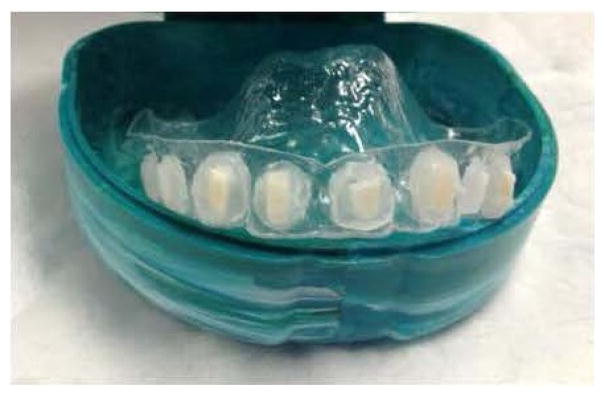
“Subjects wore custom fabricated removable retainers (Figure 1) for 2 periods of 1 week each, with 5 sterilized demineralized enamel chips (Figure 1) attached in the palatal surface of the appliance (Figure 1) [27,28].”
MethodSelf-citationEffects of a Novel Mouthwash on Plaque Presence and Gingival Health
Ajdaharian, J., & Rodríguez, Á. E. (2017) · Dentistry · doi:10.4172/2161-1122.1000460 · Cited by 5
“Study hypothesis: a test mouthwash will remove plaque and support gingival health equally well as an existing OTC mouthwash [17-21].”
BackgroundTakesh, T., Goshtasbi, A., Lin, K., Yang, S. M., Wink, C., Geisinger, M. L., & Wilder‐Smith, P. (2023) · Journal of Periodontology · doi:10.1002/jper.22-0254 · Cited by 4
Geisinger, M. L., Geurs, N. C., Novy, B., Otomo‐Corgel, J., Cobb, C. M., Jacobsen, P. L., Takesh, T., & Wilder‐Smith, P. (2023) · Journal of Periodontology · doi:10.1002/jper.22-0675 · Cited by 3
Influence of Remineralizing Dentifrice in the Treatment of Erosive Enamel Lesions
Ferreira, J. B., Paiva, G. R., Geraldo-Martins, V. R., Faraoni, J. J., Palma‐Dibb, R. G., & Lepri, C. P. (2018) · Journal of Health Sciences · doi:10.17921/2447-8938.2018v20n4p238-242 · Cited by 2
Metadata
- Authors
- Lam, T., & Ho, J.
- Affiliations
- University of California, Irvine (US)
- ORCID
- Lam, Tracie
- Venue
- Dentistry
- Publisher
- OMICS Publishing Group
- Published
- 2016
- Volume
- 06
- Issue
- 10
- ISSN
- 2161-1122 (ISSN-L)
- PMC
- PMC5364811
- OpenAlex
- W2555564122
- Cited by
- 8
- References
- 45
- Citations by year
- 2023: 1 · 2022: 1 · 2020: 1 · 2018: 1 · 2017: 2 · 2016: 2
- FWCI
- 2.40
- Type
- journal article
- Language
- en
- Open access
- hybrid
- doi.org
- Licence
- other-oa
- Locations
- Dentistry (publishedVersion, other-oa)
- PubMed (publishedVersion)
- PubMed Central (acceptedVersion, cc-by)
- eScholarship (California Digital Library) (submittedVersion, cc-by)
- Funders
- National Institutes of Health (P41-EB-015890)
- National Institute of Biomedical Imaging and Bioengineering (R03EB014852, P41EB015890)
- Topics
- Health Sciences › Dentistry › General Dentistry › Dental Erosion and Treatment
- Health Sciences › Dentistry › General Dentistry › Dental Health and Care Utilization
- Physical Sciences › Engineering › Mechanical Engineering › Erosion and Abrasive Machining
- Keywords
- dental erosion, dental gel, toothpaste, acid challenge, enamel demineralization, natural toothpaste
About these checks
Registry, retraction, Cites and statistics results are computed, not judged, with one exception: a printed reference that no index lists is read once by a model before it counts as a citation error. Claims are extracted by a model and kept only when their quote appears verbatim in the text; each cited source is then checked, with a model’s help, for whether it says what the claim relies on. Those verdicts can be wrong — read the claim’s quote and the cited source before relying on one.
Statistics and arithmetic are recomputed, not judged.
Confidence bands are shown only for fields calibrated on our annotated test set. None is calibrated yet, so no band is shown.
What counts as a claim ›How we measure confidence ›How we check this ›
Are you an author, or do you see a problem with this page? Request a review
Data sources
Bibliographic data: Semantic Scholar, OpenAlex, Crossref.
Contains information from the Semantic Scholar Academic Graph Datasets, made available under the ODC Attribution License (ODC-BY 1.0).
Semantic Scholar’s data is described in: Kinney, R., et al. (2023). The Semantic Scholar Open Data Platform. arXiv:2301.10140.
