

Buddhist Realism for Modern Times: Intellectual-Historical Readings into Dharma Master Taixu’s Essays on Realism
Open accessThe DOI matches its Crossref record; 8 of the 8 references it cites were found in a registry or an index; none of the 16 sources its claims cite is checked for support yet.
Abstract
In the early 1930s, when the project of scientific modernization was in full swing in Chinese Buddhist circles, Dharma Master Taixu wrote a series of essays on “Realism” (Xianshi zhuyi 現實主義, 1928–1931). These represent one of the profoundest series of writings documenting his understanding of the link between science and Buddhist epistemology/ontology, and consequently also on the role of his notion of scientific Buddhism for modern times. Aside from his meditations on the relationship between science and Buddhism, in this important series of essays Taixu also provided his more or less critical accounts on modern philosophical currents in contemporary China, including Russell’s “New Realism” and materialism. This paper aims to provide a concise reading of the above-mentioned writings by Taixu, in order to cast some new light on the understanding of Western modern philosophy in Chinese Buddhist modernism of the Republican Era, on the one hand, and to highlight the main theoretical features of Taixu’s notion of scientific Buddhism, on the other. Aside from that, I also aim to present some new insights into the otherwise overlooked aspects of the broader intellectual sphere of Chinese Buddhism of the Republican Era. As regards the broader historical and intellectual context of Taixu’s writings, the analysis provided in this article will be regarded within the framework constructed in my forthcoming article on Taixu’s philosophy in the journal Buddhist Studies Review.
Overview
CoChat Summary
TL;DR
This intellectual-historical article reconstructs Dharma Master Taixu’s 1928–1931 essays on “Realism” (*xianshi zhuyi* 現實主義), arguing that he fused Yogācāra epistemology, Buddhist logic, Chinese cosmological categories, and Bertrand Russell’s New Realism into a modern Buddhist realism. It presents Taixu’s scientific Buddhism as a modernizing project that treated Buddhism as compatible with Russellian scientific objectivism.
Key findings
- Taixu’s “realism” was derived from contemporary Chinese philosophical discourse and specifically aligned with Bertrand Russell’s New Realism. In their 1928 conversation, Taixu said Russell’s views had “much in common with Buddhism”; in 1931 he identified Russell’s New Realism as “neutral monism” and close to Buddha-dharma. The paper argues this predates similar East/West associations by several decades.
- Taixu chose *xianshi zhuyi* 現實主義 over *shizailun* 實在論 and *weishilun* 唯實論; *xianshi* means “reality” with phenomenal connotations, and *weishilun* 唯實論 is close to *weishilun* 唯識論, the Buddhist “Consciousness-Only” term. He used *yuzhou* 宇宙, *shijie* 世界, *rensheng* 人生, and *fajie* 法界, asserting “reality is the universe” while distinguishing *xianshi* from *fajie*.
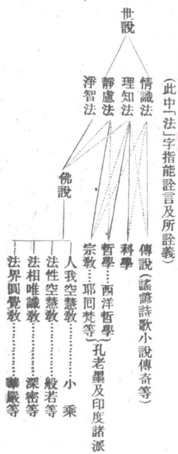
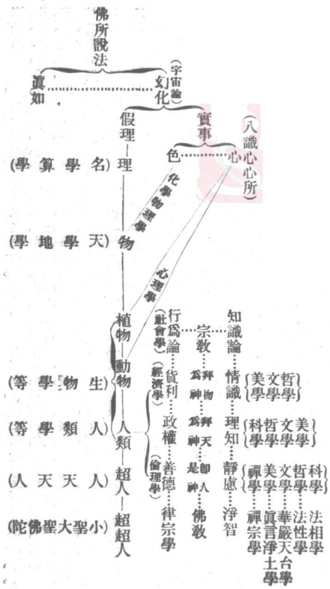
- The methodological foundations in the first 1928 long essay included nine essays on method, covering domains such as perception/inference, mathematics, propositions, establishing/eliminating truth and falseness, inference from perception, and inference from hearing. Taixu drew on Buddhist logic (*yinmingxue* 因明學) and Yogācāra, and outlined a hierarchy: *shi* 識 → *shizhi* 識智 → *zhishi* 智識 → *zhi* 智, with science tied to the “superman” (*chaoren* 超人) and higher stages leading to “super-superman” (*chaochaoren* 超超人).
- The series appeared in more than thirty separate essays in *Haichao yin* between 1928 and 1931. Zhang Shenfu had linked Russell’s realism to Buddhist epistemology and *ālāyavijñāna* in 1920, and Taixu later presented his views on Buddhism and New Realism in his 1931 lectures “Buddhism and New Thought.”
Methods
- Design: intellectual-historical and conceptual/textual reading of Taixu’s writings on realism, focused mostly on the late 1920s and early 1930s, especially the “Realism” (*Xianshi zhuyi*) series in *Haichao yin* 1928–1931.
- Sources: Taixu’s 1926 article, his 1928a–f essays, and 1931 “Buddhism and New Thought”; Chen Qibo’s 1929 report on the Taixu–Russell conversation; Zhang Shenfu’s 1920 and 2005 writings; and secondary literature on Taixu and Chinese Buddhism.
- Analysis: traces terminological choices, Buddhist/Yogācāra and Chinese conceptual categories, and intellectual influences, especially Russell and New Realism; no empirical sample or quantitative analysis is used.
Limitations
- Stated: due to limitation of space, the study cannot offer a broader introduction to Taixu’s life and work, referring readers to Dessein (2020), Goodell (2008), Hammerstrom (2015), Pittman (2001), and Vrhovski (2023, forthcoming).
- Stated: the article is a sequel to a more extensive study forthcoming in *Buddhist Studies Review*, where broader historical and intellectual context will be treated.
- Evident: the analysis is selective and outline-level rather than exhaustive of all thirty-plus essays; the author also cautions about methodological limitations in ascribing ideas across philosophical systems without sufficient intellectual-historical background.
Model-written summary. Check it against the paper before relying on it.
Integrity signals
Registry
Cites
Statistics
Figures
Verification
Claims the paper makes
0 Valid · 4 Not valid · 14 Not checked · 52 Own results and interpretations
A result the paper states — it cites no source for it, so there is none to check. The quote shows it is in the paper.
In the paper
“However, the period in which his endeavours to align Yogācāra with modern scientific objectivity grew into a concrete notion of”
- Also stated in: § Buddhist Realism for Modern Times: Intellectual--Historical Readings into Dharma Master Taixu's Essays · plain
“realism”
- Also stated in: § 2 A Balancing Act of Defining the "Real" · plain
“taking over a central place within his intellectual arsenal, can be traced back to an article published in 1926 and titled”
§ Buddhist Realism for Modern Times: Intellectual--Historical Readings into Dharma Master Taixu's Essays > 2 A Balancing Act of Defining the "Real"
plainstates a cause- Asserted: passes — The authors put it forward as true.
- Checkable: passes — It can be checked against evidence.
- Load-bearing: passes — The paper’s conclusions depend on it.
- Based: passes — The paper gives a reason why it holds.
- Also stated in: § Buddhist Realism for Modern Times: Intellectual--Historical Readings into Dharma Master Taixu's Essays · plain
The paper states this without a source or data behind it here, so there is nothing to check it against. The quote shows it is in the paper.
In the paper
“Furthermore, as was clearly shown in the previous chapter, Taixu in fact used Russell's closeness to Hināyāna in support of his hierarchical classification of consciousness-knowledge-wisdom.”
§ Buddhist Realism for Modern Times: Intellectual--Historical Readings into Dharma Master Taixu's Essays > 4 The Western Experience and New Realism(s)
boostedstates a cause- Asserted: passes — The authors put it forward as true.
- Checkable: passes — It can be checked against evidence.
- Load-bearing: passes — The paper’s conclusions depend on it.
- Based: unclear — It is unclear why the paper says it holds.
In the paper
“What is even more important is that, back in the year 1920, when Zhang was introducing Russell not only to his close circle of scholars, which also included one of the most important contributors to the Yogācāra-revival in the 1920s, Liang Shuming 梁 漱溟, he -Zhang -had already established a direct link between Russell's realism and Buddhist epistemology.”
§ Buddhist Realism for Modern Times: Intellectual--Historical Readings into Dharma Master Taixu's Essays > 4 The Western Experience and New Realism(s)
What the sources say
- Not matchedcites Zhang, 1920
An author–year citation the paper’s reference list doesn’t settle. We don’t search these by name.
plainstates an associationSingle case- Asserted: passes — The authors put it forward as true.
- Checkable: passes — It can be checked against evidence.
- Load-bearing: passes — The paper’s conclusions depend on it.
- Based: passes — The paper gives a reason why it holds.
- Not matched
A result the paper states — it cites no source for it, so there is none to check. The quote shows it is in the paper.
In the paper
“In one way or another, his views on Western realism underwent further changes in the late 1920s, when Taixu acquired more direct, first-hand experience with modern Western scholars and their thought.”
§ Buddhist Realism for Modern Times: Intellectual--Historical Readings into Dharma Master Taixu's Essays > 4 The Western Experience and New Realism(s)
hedgedstates a cause- Asserted: passes — The authors put it forward as true.
- Checkable: passes — It can be checked against evidence.
- Load-bearing: passes — The paper’s conclusions depend on it.
- Based: passes — The paper gives a reason why it holds.
In the paper
“Moreover, Chen Qibo's report about Taixu's conversations with Russell reveals the -albeit probably not so profoundinvolvement of Zhang Shenfu 張申府 in presenting this important contact between Russell and Chinese Buddhism to Chinese readers (ibid., 1).”
§ Buddhist Realism for Modern Times: Intellectual--Historical Readings into Dharma Master Taixu's Essays > 4 The Western Experience and New Realism(s)
What the sources say
- Not matchedcites Chen, 1929
An author–year citation the paper’s reference list doesn’t settle. We don’t search these by name.
hedgedstates a causeSingle case- Asserted: passes — The authors put it forward as true.
- Checkable: passes — It can be checked against evidence.
- Load-bearing: unclear — It is unclear whether the paper’s conclusions depend on it.
- Based: passes — The paper gives a reason why it holds.
- Rests on an assumption not shown here.
- Not matched
18 more claims
Create a free account to see all 70 claims and every source verdict.
- Probably not a substantial claim. 43
- It may state two separate claims as one. 18
Self-check
Percentages, sums and reported differences re-computed from the paper’s own numbers.
Each contradiction between two passages listed here was confirmed by an independent check.
Rated minor: it would not touch a result — a value no result rests on, a p-value that stays on the same side of the significance level, or a conflict that is clerical, resolved elsewhere in the paper, or outside its own findings.
In the paper
§ Buddhist Realism for Modern Times: Intellectual--Historical Readings into Dharma Master Taixu's Essays > References
“In the early 1930s, when the project of scientific modernization was in full swing in Chinese Buddhist circles, Dharma Master Taixu wrote a series of essays on "Realism" (Xianshi zhuyi 現實主義, 1928-1931).”
§ Buddhist Realism for Modern Times: Intellectual--Historical Readings into Dharma Master Taixu's Essays > 3 On the Elementary Logical and Epistemic Method(s) of Realism
“The entire system of Taixu's Buddhist "realism" appeared in more than thirty separate essays, published in the Haichao yin journal between 1928 and 1931.”
Citations
Cites
Toward a modern Chinese Buddhism: Taixu's reforms
(2002) · Choice Reviews Online · doi:10.5860/choice.39-3338 · Cited by 97
A History of Buddhist Philosophy: Continuities and Discontinuities
Kalupahana, D. J. (1992) · University of Hawaii Press eBooks · doi:10.1515/9780824844530 · Cited by 91
A history of Buddhist philosophy: continuities and discontinuities
Kalupahana, D. (1993) · Choice Reviews Online · doi:10.5860/choice.30-2610 · Cited by 59
The Science of Chinese Buddhism: Early Twentieth-Century Engagements
Hammerstrom, E. (2015) · doi:10.7312/columbia/9780231170345.001.0001 · Cited by 33
Why the Buddha Never Uttered a Word
D’Amato, M. (2009) · Oxford University Press eBooks · doi:10.1093/acprof:oso/9780195381559.003.0004 · Cited by 23
The Heritage of Taixu: Philosophy, Taiwan, and Beyond
Dessein, B. (2020) · Asian Studies · doi:10.4312/as.2020.8.3.251-277 · Cited by 8
A Few Important Landmarks in the Chinese Debates on Dialectical and Formal Logic from the 1930s
Vrhovski, J. (2021) · Asian Studies · doi:10.4312/as.2021.9.2.81-103 · Cited by 5
Self-citationThe Subject’s Guide to the Realms of Karma
Vrhovski, J. (2023) · Buddhist Studies Review · doi:10.1558/bsrv.21787 · Cited by 1
Self-citation
Research works printed but not linked: 11
- Chen, Q. 陳濟博, Ji Taixu dashi yu Luosu xiansheng zhi tanhua 記太虛大師與羅素 先生談話 [A Recording of the Conversation between Master Taixu and Bertrand Russell], Haichao yin 海潮音 10 (2), 1929, pp. 1-4.
- Goodell, E., Taixu's Youth and Years of Romantic Idealism, 1890-1914, Chung-Hwa Buddhist Journal [Zhonghua Foxue xuebao 中華佛學學報] 21, 2008, pp. 77-121.
- Taixu 太虛, Dacheng Fofa de zhenyi -xianshi zhuyi de -jingjin zhuyi de 大乘佛 法的真義--現實主義的--精進主義的 [The True Meaning of Mahāyāna Buddhad harma -Realistic and Progressivist], Haichao yin 海潮音 7 (11), 1926, pp. 3-5.
- Taixu 太虛, Xianshi zhuyi 現實主義 [Realism], Haichao yin 海潮音 9 (5), 1928a, pp. 1-19.
- Taixu 太虛, Xianshi zhuyi (xu shangqi) 現實主義(續上期 [Realism (Continued)], Haichao yin 海潮音 9 (6), 1928b, pp. 1-14.
- Taixu 太虛, Xianshi zhuyi (xu shangqi) 現實主義(續上期 [Realism (Continued)], Haichao yin 海潮音 9 (7), 1928c, pp. 1-19.
- Taixu 太虛, Xianshi zhuyi (xu shangqi) 現實主義(續上期 [Realism (Continued)], Haichao yin 海潮音 9 (8), 1928d, pp. 1-14.
- Taixu 太虛, Xianshi zhuyi (xu shangqi) 現實主義(續上期 [Realism (Continued)], Haichao yin 海潮音 9 (9), 1928e, pp. 1-12.
- Taixu 太虛, Xianshi zhuyi (xu shangqi) 現實主義(續上期)[Realism (Continued)], Haichao yin 海潮音 9 (10), 1928f, pp. 13-26.
- Taixu 太虛, Foxue yu xin sixiang 佛學與新思想 [Buddhism and New Thought], (re- corded by Li, C. 李傳書 and Ye, Y. 葉玉甫), Nanyang zhongxue xiaofanhui huikan 南洋:南洋中學校友會會刊 2 (5), 1931, pp. 6-9.
- Zhang, S. 張申府 [Songnian 崧年], Luosu 羅素 [Russell], Xin qingnian 新青年 8 (2), 1920, pp. 1-6.
Metadata
- Authors
- Vrhovski, J.
- Affiliations
- University of Ljubljana (SI)
- Corresponding author
- Vrhovski, Jan
- ORCID
- Vrhovski, Jan
- Venue
- Ars & Humanitas
- Publisher
- University of Ljubljana
- Published
- 2022-12-29
- Volume
- 16
- Issue
- 2
- Pages
- 111-133
- ISSN
- 1854-9632 (ISSN-L)
- 2350-4218
- OpenAlex
- W4323528967
- Semantic Scholar
- 1179b5ee27c24eca5c6b55e515c329c449bab678
- Cited by
- 0
- References
- 8
- FWCI
- 0.00
- Type
- journal article
- Language
- en
- Open access
- diamond
- dx.doi.org
- Licence
- Locations
- Ars & Humanitas (publishedVersion, cc-by-sa)
- Edinburgh Research Explorer (University of Edinburgh) (publishedVersion, other-oa)
- DOAJ (DOAJ: Directory of Open Access Journals) (submittedVersion)
- Topics
- Social Sciences › Arts and Humanities › Religious studies › Indian and Buddhist Studies
- Social Sciences › Arts and Humanities › History › Chinese history and philosophy
- Social Sciences › Arts and Humanities › Philosophy › Study and Philosophy of Religion
- Keywords
- Taixu, Buddhist epistemology, Buddhist ontology, materialism
About these checks
Registry, retraction, Cites and statistics results are computed, not judged, with one exception: a printed reference that no index lists is read once by a model before it counts as a citation error. Claims are extracted by a model and kept only when their quote appears verbatim in the text; each cited source is then checked, with a model’s help, for whether it says what the claim relies on. Those verdicts can be wrong — read the claim’s quote and the cited source before relying on one.
A language model drew the claims from the paper on 2026-10-04, under version 3 of the claim definition (model deepseek-v4.1-flash, prompt extract-v3).
A second model labelled each claim on 2026-10-04 (model jev-1.13-20260917, definition revision gold-guideline-v0.2).
Statistics and arithmetic are recomputed, not judged.
Confidence bands are shown only for fields calibrated on our annotated test set. None is calibrated yet, so no band is shown.
What counts as a claim ›How we measure confidence ›How we check this ›
Are you an author, or do you see a problem with this page? Request a review
Data sources
Bibliographic data: Semantic Scholar, OpenAlex, Crossref.
Contains information from the Semantic Scholar Academic Graph Datasets, made available under the ODC Attribution License (ODC-BY 1.0).
Semantic Scholar’s data is described in: Kinney, R., et al. (2023). The Semantic Scholar Open Data Platform. arXiv:2301.10140.
