

Prevalencia de ansiedad y depresión en pacientes de hemodiálisis
Open accessThe DOI matches its Crossref record; 10 of the 10 references it cites were found in a registry or an index.
Abstract
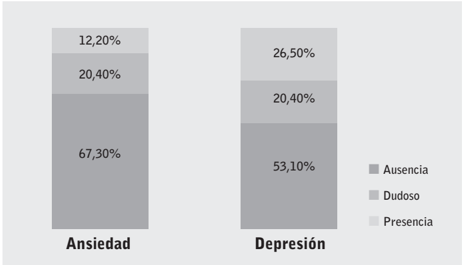
Introduction: Hemodialysis patients have symptoms and emotional disorders such as anxiety and depression. There are few studies that evaluate diagnosis using the Hospital Anxiety and Depression Scale (HADS); our aim is to determine the prevalence of anxiety and depression in patients with chronic kidney disease on hemodialysis. Methods: Cross-sectional study during the first quarter of 2012 was carried out. It was conducted in the hemodialysis service of the Palamós Hospital. Patients on chronic hemodialysis with a dialysis vintage at least than a month were included. Age, sex, height, weight, body mass index, Charlson index, time on hemodialysis and number of drugs were recorded. HADS (Spanish version of Caro-Ibanez) scale was used. Results: 49 patients were analyzed, 25% being women. The mean age was 67.2 years, the average Charlson index was 4.6 (SD: 4.5), a dialysis vintage of 39.9 months (SD: 43.8) and an average BMI of 26.9 (SD: 4.5). The patients in the morning shift were 52.9% and in the evening shift were 50.9%. Depressive symptomatology was represented in 42.9% (95% CI 33.7% -60.6%) and anxiety symptoms in 32.7% (95% CI 21.2% -46.6%) according to HADS scale. The anxiety has significant association with lower body mass index and female, while depression is significantly associated with higher age, lower body mass index and the morning shift. Conclusion: There is a high prevalence of anxiety and depression in patients with chronic kidney disease on hemodialysis. A low body mass index is associated with anxiety and depression, older age with depression, and anxiety is more common in women. Our study suggests that greater control, monitoring and treatment of emotional disorders in patients with chronic kidney disease are necessary.
Overview
The claims and statistics of this paper haven’t been checked yet.
Free: it reads the open-access text and checks the first 5 claims that cite a source we can check. Create a free account to check every claim.
Integrity signals
Registry
Cites
Statistics
Figures
Verification
Claims the paper makes
The claims and statistics of this paper haven’t been checked yet.
Free: it reads the open-access text and checks the first 5 claims that cite a source we can check. Create a free account to check every claim.
Claims other papers make about this one
Each is checked against this paper’s own text: does it say what the citing paper says it does?
The source backs part of the claim, not all of it — or backs it for a different population, condition or comparison.
In the citing paper
“the prevalence of anxiety among HD patients is high, around 40%, although one-third of those affected report mild symptoms.4,5”
From A Pilot Study of Virtual Reality in Hemodialysis for Mitigating Pain and Anxiety: User Experiences and Perceptions (2025) · cites this paper as [5]
Experimental — accuracy not yet measured
Self-check
Percentages, sums and reported differences re-computed from the paper’s own numbers.
The self-check needs the paper’s full text.
Citations
Cites
Mirowsky, J., & Ross, C. E. (1992) · Journal of Health and Social Behavior · doi:10.2307/2137349 · Cited by 837
Depression and anxiety among US adults: associations with body mass index
Zhao, G., Ford, E. S., Dhingra, S., Li, C., Strine, T. W., & Mokdad, A. H. (2009) · International Journal of Obesity · doi:10.1038/ijo.2008.268 · Cited by 423
Kimmel, P. L. (2000) · American Journal of Kidney Diseases · doi:10.1016/s0272-6386(00)70240-x · Cited by 210
Suicide in the United States End-Stage Renal Disease Program
Kurella, M., Kimmel, P. L., Young, B. S., & Chertow, G. M. (2005) · Journal of the American Society of Nephrology · doi:10.1681/asn.2004070550 · Cited by 189
Depression, Perception of Illness and Mortality in Patients with End-Stage Renal Disease
Peterson, R. A., Kimmel, P. L., Sacks, C. R., Mesquita, M. L., Simmens, S. J., & Reiss, D. (1991) · The International Journal of Psychiatry in Medicine · doi:10.2190/d7va-fweu-jn5y-td3e · Cited by 175
The relationship of depression to survival in chronic renal failure.
Burton, H. J., Kline, S. A., Lindsay, R. M., & Heidenheim, A. P. (1986) · Psychosomatic Medicine · doi:10.1097/00006842-198603000-00011 · Cited by 161
García-Llana, H., Remor, E., del Peso, G., & Selgas, R. (2014) · PubMed · doi:10.3265/nefrologia.pre2014.jun.11959 · Cited by 131
Clinical Features and Severity of Nonspecific Symptoms in Dialysis Patients
Parfrey, P. S., Vavasour, H. M., Henry, S., Bullock, M., & GAULT, M. H. (2008) · The Nephron journals/Nephron journals · doi:10.1159/000185141 · Cited by 102
Clinical and Psychological Correlates of Somatic Symptoms in Patients on Dialysis
Barrett, B. J., Vavasour, H. M., Major, A., & Parfrey, P. S. (2008) · The Nephron journals/Nephron journals · doi:10.1159/000185911 · Cited by 78
Depression in End‐Stage Renal Disease Patients
Fishbein, L. J. (1994) · Seminars in Dialysis · doi:10.1111/j.1525-139x.1994.tb00834.x · Cited by 18
Research works printed but not linked: 6
- Páez A, Jofré M, Bortoli MÁ de. Ansiedad y depresión en pacientes con insuficiencia renal crónica en tratamiento de diálisis. Univ Psychol. 2009 May 27;8(1):117-24.
- Muñoz Sancho R, Oto Royo A, Barrio Alonso R, Fernández M. Evolución de la calidad de vida en pacientes en hemodiálisis: Estudio prospectivo a un año. Rev Soc Esp Enferm Nefrológica. 2006 Mar;9(1):55-8.
- Bjelland I, Dahl AA, Haug TT, Neckelmann D. The validity of the Hospital Anxiety and Depression Scale. An updated literature review. J Psychosom Res. 2002 Feb;52(2):69-77.
- Lidia Gómez Vilaseca, et al ] Prevalencia de ansiedad y depresión en pacientes de hemodiálisis 15. Zigmond AS, Snaith RP. The hospital anxiety and depression scale. Acta Psychiatr Scand. 1983 Jun;67(6):361-70.
- Soto J. Las emociones como variables relacionadas con el cambio de hábitos de salud en familiares y amigos próximos de enfermos de cáncer. PSICOONCOLOGÍA. 2003;0(1):75-82.
- Revah-Levy A, Speranza M, Barry C, Hassler C, Gasquet I, Moro M-R, et al. Association between Body Mass Index and depression: the. BMC Public Health. 2011 Aug 16;11(1):649.
Cited by
Soliva, M. S., Carrascosa-López, C., Rico-Salvador, I., Ortiz-Ramón, R., Coca, J. V., Maset, R. G., & García‐Testal, A. (2024) · PLoS ONE · doi:10.1371/journal.pone.0307661 · Cited by 24
Merino Martínez, R. M., Morillo Gallego, N., Sánchez Cabezas, A. M., Gómez López, V. E., & Crespo Montero, R. (2019) · Enfermería Nefrológica · doi:10.4321/s2254-28842019000300006 · Cited by 18
Sousa, L., VALENTİM, O. M. M. D. S., Marques-Vieira, C. M. A., Antunes, A. V., Severino, S., & JOSÉ, H. M. G. (2020) · Revista Portuguesa de Enfermagem de Saúde Mental · doi:10.19131/rpesm.0272 · Cited by 24
Estudio del estado emocional de los pacientes en hemodiálisis
Ruiz, M. A. M. (2017) · Enfermería Nefrológica · doi:10.4321/s2254-28842017000100007 · Cited by 49
Zhang, J., Zhang, L., Qiu, Y., Wu, W., Zhou, S.-J., Ye, X., Zeng, H., & Gao, Y. (2025) · Complementary Therapies in Medicine · doi:10.1016/j.ctim.2025.103199 · Cited by 9
Metadata
- Authors
- Gómez Villaseca, L., Pac Gracía, N., Manresa Traguany, M., Lozano Ramírez, S., & Chevarria Montesinos, J. L.
- Affiliations
- Servicio de Nefrología, Hospital de Palamós. Gerona
- Venue
- Enfermería Nefrológica
- Published
- 2015-06-12
- Volume
- 18
- Issue
- 2
- Pages
- 112-117
- ISSN
- 2254-2884 (ISSN-L)
- 2255-3517
- OpenAlex
- W2233240335
- Cited by
- 17
- References
- 10
- Citations by year
- 2026: 4 · 2025: 2 · 2024: 1 · 2022: 3 · 2020: 2 · 2019: 4 · 2017: 1
- FWCI
- 0.29
- Type
- journal article
- Language
- es
- Open access
- diamond
- doi.org
- Licence
- cc-by-nc
- Locations
- Enfermería Nefrológica (publishedVersion, cc-by-nc)
- DOAJ (DOAJ: Directory of Open Access Journals) (submittedVersion)
- DOAJ (DOAJ: Directory of Open Access Journals) (submittedVersion, cc-by-sa)
- Redalyc (Universidad Autónoma del Estado de México) (submittedVersion)
- Scientific Electronic library online (Sciences Carlos III Health Institute) (submittedVersion)
- Topics
- Health Sciences › Medicine › Nephrology › Dialysis and Renal Disease Management
- Social Sciences › Psychology › Clinical Psychology › COVID-19 and Mental Health
- Social Sciences › Psychology › Experimental and Cognitive Psychology › Anxiety, Depression, Psychometrics, Treatment, Cognitive Processes
- Keywords
- anxiety, depression, hemodialysis, chronic kidney disease, prevalence, Hospital Anxiety and Depression Scale, body mass index, sex differences, age, shift work, emotional disorders
About these checks
Registry, retraction, Cites and statistics results are computed, not judged, with one exception: a printed reference that no index lists is read once by a model before it counts as a citation error. Claims are extracted by a model and kept only when their quote appears verbatim in the text; each cited source is then checked, with a model’s help, for whether it says what the claim relies on. Those verdicts can be wrong — read the claim’s quote and the cited source before relying on one.
Statistics and arithmetic are recomputed, not judged.
Confidence bands are shown only for fields calibrated on our annotated test set. None is calibrated yet, so no band is shown.
What counts as a claim ›How we measure confidence ›How we check this ›
Are you an author, or do you see a problem with this page? Request a review
Data sources
Bibliographic data: Semantic Scholar, OpenAlex, Crossref.
Contains information from the Semantic Scholar Academic Graph Datasets, made available under the ODC Attribution License (ODC-BY 1.0).
Semantic Scholar’s data is described in: Kinney, R., et al. (2023). The Semantic Scholar Open Data Platform. arXiv:2301.10140.
