

Artificial Intelligence–Enabled Educational Tools and Clinical Reasoning in Undergraduate Nursing Education: A Systematic Review
Open accessThe DOI matches its Crossref record; 39 of the 39 references it cites were found in a registry or an index; 110 of the 125 sources its claims cite were checked for support.
Abstract
Background: Clinical reasoning (CR) is a core competency in undergraduate nursing education, directly influencing patient safety and quality of care. Artificial intelligence (AI)–enabled educational tools are increasingly integrated into nursing curricula; however, their effectiveness in enhancing CR remains uncertain due to heterogeneous technologies, outcome measures, and study designs. Objective: To systematically evaluate the effectiveness of AI-enabled educational tools in improving clinical reasoning among undergraduate nursing students compared with traditional teaching approaches or no AI intervention. Methods: This systematic review was conducted in accordance with PRISMA 2020 guidelines. Five databases were searched for studies published between January 2022 and January 15, 2026. Eligible studies involved undergraduate nursing students and reported explicitly operationalized outcomes related to clinical reasoning, clinical judgment, or clinical decision-making. After removal of 332 duplicates, 1,015 records were screened; 33 full texts were assessed, and 9 studies met inclusion criteria. Methodological quality was appraised using Joanna Briggs Institute (JBI) checklists. Results: Nine studies (n = 9) were included, comprising two randomized controlled trials, quasi-experimental designs, and qualitative studies. Interventions included AI-enhanced simulations, rule-based educational chatbots, generative AI/LLM tools, and AI-integrated tutoring systems. Improvements in self-reported clinical reasoning were observed in some studies, whereas others reported null or mixed findings. Performance-based or proxy measures yielded heterogeneous results, and qualitative studies highlighted perceived benefits in information organization and confidence alongside concerns regarding dependency and reduced critical engagement. Risk-of-bias assessment revealed methodological limitations, particularly in non-randomized designs. Conclusion: Current evidence suggests preliminary and context-dependent educational potential for AI-enabled tools in supporting aspects of clinical reasoning. However, findings are heterogeneous, frequently based on self-reported or proxy measures, and limited by methodological constraints. AI should therefore be considered a complementary pedagogical resource rather than a substitute for supervised clinical mentorship. Further rigorously designed studies using standardized performance-based CR measures are needed.
Overview
CoChat Summary
TL;DR
This systematic review of 9 studies found preliminary, context-dependent evidence that AI-enabled educational tools may support aspects of clinical reasoning in undergraduate nursing students, especially when embedded in guided, scenario-based learning. However, findings were heterogeneous, often based on self-reported or proxy measures, and methodological limitations preclude definitive conclusions.
Key findings
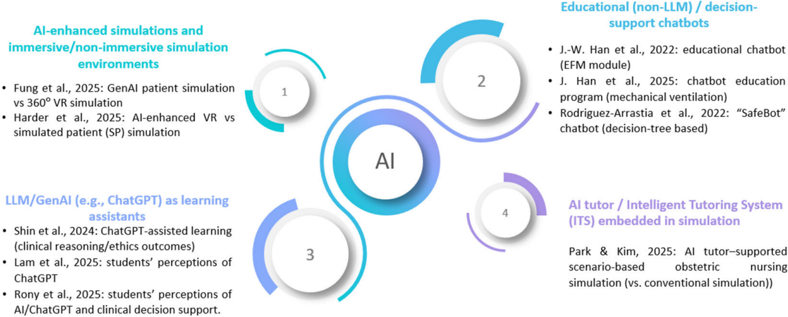
- Nine studies were included: two randomized controlled trials (including one crossover trial), quasi-experimental studies, and qualitative studies. AI tools spanned AI-enhanced simulations, rule-based chatbots, generative AI/LLM assistants, and an AI tutor integrated into simulation.
- Quantitative results were mixed: one chatbot study reported higher self-reported clinical reasoning (t = -5.00; p < 0.001), confidence (t = -2.62; p = 0.011), and satisfaction (t = -3.51; p < 0.001), but no knowledge difference (t = -0.09; p = 0.926); another found no significant between-group difference on a clinical reasoning competency scale (t = 0.75; p = 0.455), though self-directed learning improved (t = 2.72; p = 0.006).
- An AI tutor study reported higher questionnaire-based clinical performance as a proxy for clinical reasoning (p = 0.020) and improved knowledge (p < 0.001), but no significant difference in critical thinking skills (p = 0.098); another study found mixed sub-scores, with several favoring the control condition (p < 0.001).
- Qualitative studies described perceived benefits in information organization, confidence, psychological safety, and decision-making support, alongside concerns about dependency, reduced critical engagement, and effects on the caregiver–patient relationship.
Methods
- PRISMA 2020 systematic review searching PubMed, Scopus, Web of Science Core Collection, ScienceDirect, and ERIC for studies published January 2022–January 15, 2026, in English, involving undergraduate nursing students and AI-enabled educational interventions with explicitly operationalized clinical reasoning, clinical judgment, or clinical decision-making outcomes.
- From 1,347 records, 332 duplicates were removed, 1,015 records were screened, 33 full texts were selected, 16 could not be obtained, 17 were assessed, 8 were excluded, and 9 studies were included.
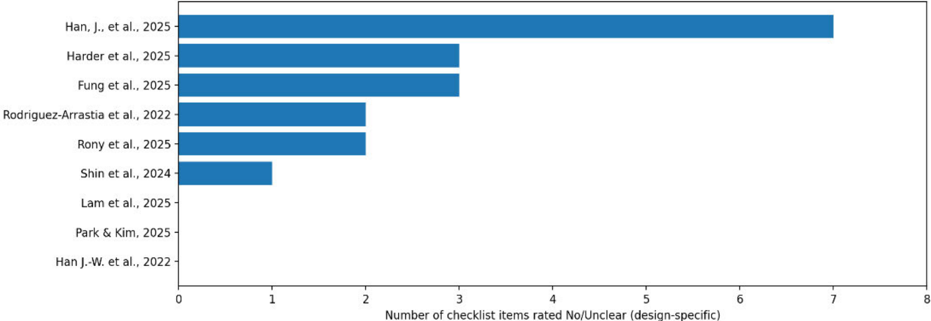
- Methodological quality was appraised with design-specific Joanna Briggs Institute checklists; because of heterogeneity in AI tool categories, designs, comparators, and outcomes, a structured narrative synthesis was conducted rather than meta-analysis.
Limitations
- Stated: the restricted search period may have excluded earlier relevant studies and did not include research after the final search date; CINAHL was not searched; the English-language restriction may have missed studies; 16 full texts were unavailable, introducing potential availability bias; heterogeneity precluded meta-analysis; clinical reasoning was frequently assessed by self-reported or proxy measures; few RCTs and incomplete reporting of methodological safeguards reduced confidence in causal inference; geographic concentration and undergraduate-only focus limit generalizability; rapid AI evolution and inconsistent vendor/proprietary reporting may affect durability and transparency.
- Stated: the review protocol was not prospectively registered, and publication bias could not be formally assessed due to the limited number and heterogeneity of studies.
- Evident from the text: the included evidence base is small (n = 9), and the review itself notes that qualitative studies were not treated as evidence of effectiveness, further limiting conclusions about clinical reasoning performance.
Model-written summary. Check it against the paper before relying on it.
Integrity signals
Registry
Cites
Statistics
Figures


Verification
Claims the paper makes
76 Valid · 5 Not valid · 5 Not checked · 94 Own results and interpretations
The cited sources support only part of this claim — read each source’s verdict below.
In the paper
“Previous syntheses examining digital simulation and virtual patient approaches have suggested potential benefits for applied skill development and engagement [16-19].”
What the sources say
- Not checked — no full text of the sourcecites [16] [16] Labrague, L.J. and S.A. Sabei. 'Integration of AI-powered chatbots in nursing education: a scoping review of their utilization, outcomes and challenges.' Teaching and Learning in Nursing, November 2024. https://doi.org/10.1016/j.teln.2024.11.010. - source
- Partly supportedcites [17] [17] Pérez-Perdomo, A. and A. Zabalegui. 'Teaching strategies for developing clinical reasoning skills in nursing students: a systematic review of randomized controlled trials.' Healthcare, vol. 12, no. 1, 2024, p. 1. https://doi.org/10.3390/healthcare12010090. - sourceExperimental — accuracy not yet measured
The Discussion (page unavailable) reports that virtual simulation improved nursing students’ skill performance and satisfaction, and that a simulation game was well received and increased motivation. The review supports potential benefits for applied skills and engagement, but it does not synthesize virtual-patient approaches specifically; virtual patients appear only in a cited reference title. (LLM, conf=0.83)
- Supportedcites [18] [18] García-Torres, D. et al. 'Enhancing clinical reasoning with virtual patients: a hybrid systematic review combining human reviewers and ChatGPT.' Healthcare, vol. 12, no. 22, 2024, p. 2241. https://doi.org/10.3390/healthcare12222241. - source
This systematic review reports improvements in clinical reasoning, diagnostic skills and history-taking skills in Results §3.2 (page not provided). Results §3.3 reports high student satisfaction and describes virtual patient cases as engaging, supporting the claim's cautious reference to potential benefits for skills and engagement. (LLM, conf=0.88)
- Supportedcites [19] [19] Sim, J.J.M. et al. 'Virtual simulation to enhance clinical reasoning in nursing: a systematic review and meta-analysis.' Clinical Simulation in Nursing, vol. 69, 2022, pp. 26-39. https://doi.org/10.1016/j.ecns.2022.05.006. - source
The Discussion reports that this meta-analysis found improved applied clinical reasoning and performance among nursing students and nurses using virtual simulation. It also describes the potential for virtual environments to enhance motivation and engagement, while cautioning that immersive 3D environments did not appear to improve clinical reasoning skills. (LLM, conf=0.89)
hedgedstates a possible cause- Asserted: passes — The authors put it forward as true.
- Checkable: passes — It can be checked against evidence.
- Load-bearing: unclear — It is unclear whether the paper’s conclusions depend on it.
- Based: passes — The paper gives a reason why it holds.
The cited sources support only part of this claim — read each source’s verdict below.
In the paper
“critical thinking skills (Yoon) did not differ significantly between groups (p = 0.098)”
What the sources say
- Partly supportedcites [23] [23] Park, S.A. and H.Y. Kim. 'Development and effects of a scenario-based labor nursing simulation education program using an artificial intelligence tutor: a quasi-experimental study.' Women's Health Nursing, vol. 31, no. 2, 2025, pp. 143-154. https://doi.org/10.4069/whn.2025.06.18. - sourceExperimental — accuracy not yet measured
The Methods (Instrument) identify Yoon’s tool as a measure of critical thinking disposition, not critical thinking skills. The Results (Hypothesis 2) report that the post-intervention difference between groups on that measure was not statistically significant (p=.098). (LLM, conf=0.85)
plain- Asserted: passes — The authors put it forward as true.
- Checkable: passes — It can be checked against evidence.
- Load-bearing: passes — The paper’s conclusions depend on it.
- Based: passes — The paper gives a reason why it holds.
- Partly supported
Every source the paper cites for this claim was checked and supports it.
In the paper
“However, no difference was observed for knowledge (t = -0.09; p = 0.926).”
- Also stated in: § Assessment of Methodological Quality and Risk of Bias · p. 6 · plain
“signiϐicant change (t = -0.09, p = 0.926).”
What the sources say
- Supportedcites [24] [24] Han, J.W. et al. 'Development and effects of a chatbot education program for self-directed learning in nursing students.' BMC Medical Education, vol. 25, no. 1, 2025. https://doi.org/10.1186/s12909-025-07316-2. - source
The Statistical hypothesis testing section reports no statistically significant difference in knowledge between the chatbot-program and control groups, with the exact values t = -0.09 and p = .926 (Table 3). The Abstract Results states the same finding. The cited result concerns a between-group comparison, not an absence of knowledge gains within either group. (LLM, conf=0.95)
plain- Asserted: passes — The authors put it forward as true.
- Checkable: passes — It can be checked against evidence.
- Load-bearing: unclear — It is unclear whether the paper’s conclusions depend on it.
- Based: passes — The paper gives a reason why it holds.
- Also stated in: § Assessment of Methodological Quality and Risk of Bias · p. 6 · plain
Every source the paper cites for this claim was checked and supports it.
In the paper
“Favorable between-group differences were also reported for confidence (t = -2.62; p = 0.011)”
What the sources say
- Supportedcites [24] [24] Han, J.W. et al. 'Development and effects of a chatbot education program for self-directed learning in nursing students.' BMC Medical Education, vol. 25, no. 1, 2025. https://doi.org/10.1186/s12909-025-07316-2. - source
The Statistical hypothesis testing section (Table 3) reports significantly higher confidence in the chatbot-program group than in the control group, with t = -2.62 and p = .011. This matches the attributed between-group finding. (LLM, conf=0.95)
plain- Asserted: passes — The authors put it forward as true.
- Checkable: passes — It can be checked against evidence.
- Load-bearing: unclear — It is unclear whether the paper’s conclusions depend on it.
- Based: passes — The paper gives a reason why it holds.
- Supported
The cited sources support only part of this claim — read each source’s verdict below.
In the paper
“Aggregating these technologies without differentiation risks obscuring meaningful differences in educational mechanisms and outcomes [9].”
What the sources say
- Partly supportedcites [9] [9] Bozkurt, S.A. et al. 'A systematic review and sequential explanatory synthesis: artificial intelligence in healthcare education, a case of nursing.' International Nursing Review, vol. 72, no. 2, 2025, https://doi.org/10.1111/inr.70018. - sourceExperimental — accuracy not yet measured
The Introduction (page not available) describes distinct uses for AI in nursing education, and the Results from Quantitative Studies (page not available) report different outcomes across interventions, including improved vaccination knowledge but unchanged electronic fetal monitoring knowledge. The paper does not say that aggregating technologies without differentiation obscures those differences; that methodological warning goes beyond what our copy states. (LLM, conf=0.80)
plainstates a possible cause- Asserted: passes — The authors put it forward as true.
- Checkable: passes — It can be checked against evidence.
- Load-bearing: passes — The paper’s conclusions depend on it.
- Based: passes — The paper gives a reason why it holds.
- Partly supported
87 more claims · 40 with their cited sources checked
Create a free account to see all 180 claims and to verify the 5 references still open.
- Probably not a substantial claim. 60
- It may state two separate claims as one. 46
Self-check
Percentages, sums and reported differences re-computed from the paper’s own numbers.
Each contradiction between two passages listed here was confirmed by an independent check.
Rated minor: it would not touch a result — a value no result rests on, a p-value that stays on the same side of the significance level, or a conflict that is clerical, resolved elsewhere in the paper, or outside its own findings.
In the paper
§ Houyam Jelloul 1* , Souad Arhoun 2 , Malika Rmili 3 and Youssef Nafidi 4 · p. 1
“33 full texts were assessed and 9 studies met inclusion criteria.”
§ RESULTS · p. 4
“The full texts of 17 articles were subsequently assessed for eligibility; 8 were excluded for documented reasons”
Citations
Cites
The publisher hasn’t deposited this paper’s reference list.
Research works printed but not linked: 1
- [28][28] Chang, C.Y. et al. 'Chatbot-facilitated nursing education: incorporating a knowledge-based chatbot system into a nursing training program.' Educational Technology & Society, vol. 25, no. 1, 2022, pp. 15-27. -
Cited by
Zeigler, K., & Bester, M. E. (2026) · Nurse Educator · doi:10.1097/nne.0000000000002230
Sánchez, J. D. (2026) · JMIR Medical Education · doi:10.2196/102958 · Cited by 1
“…shows promise in improving engagement, satisfaction, and self-efficacy [7,8,20,21]; that it plausibly complements educators in overstretched systems [4,5]; and that it has not been convincingly shown to build durable, transferable clinical reasoning that persists over longitudinal follow-up [9,22].”
Influential
Metadata
- Authors
- Jelloul, H., Arhouh, S., Rmili, M., & Nafidi, Y.
- Affiliations
- Abdelmalek Essaâdi University (MA)
- Mohammed V University (MA)
- ORCID
- Nafidi, Youssef
- Venue
- Journal of Pioneering Medical Sciences
- Published
- 2026-03-05
- Volume
- 15
- Issue
- 02
- Pages
- 192-203
- ISSN
- 2309-7981 (ISSN-L)
- OpenAlex
- W7134062993
- Cited by
- 3
- References
- 0
- Citations by year
- 2026: 3
- FWCI
- 1.84
- Type
- journal article
- Language
- en
- Open access
- hybrid
- doi.org
- Licence
- cc-by
- Locations
- Journal of Pioneering Medical Science (publishedVersion, cc-by)
- Topics
- Health Sciences › Medicine › Health Informatics › Artificial Intelligence in Healthcare and Education
- Health Sciences › Medicine › Family Practice › Clinical Reasoning and Diagnostic Skills
- Social Sciences › Education › Artificial Intelligence in Education
- Keywords
- artificial intelligence, clinical reasoning, nursing education, undergraduate nursing students, chatbots, generative AI, large language models, AI tutors, clinical judgment, clinical decision-making, simulation-based training, performance-based assessment, clinical mentorship
About these checks
Registry, retraction, Cites and statistics results are computed, not judged, with one exception: a printed reference that no index lists is read once by a model before it counts as a citation error. Claims are extracted by a model and kept only when their quote appears verbatim in the text; each cited source is then checked, with a model’s help, for whether it says what the claim relies on. Those verdicts can be wrong — read the claim’s quote and the cited source before relying on one.
The claim verdicts this report counts are experimental: their accuracy is not yet measured.
A language model drew the claims from the paper on 2026-10-10, under version 3 of the claim definition (model deepseek-v4.1-flash, prompt extract-v3).
A second model labelled each claim on 2026-10-10 (model jev-1.13-20260917, definition revision gold-guideline-v0.2).
Cited sources are checked with a language model’s help (gpt-6-sol).
Statistics and arithmetic are recomputed, not judged.
Confidence bands are shown only for fields calibrated on our annotated test set. None is calibrated yet, so no band is shown.
What counts as a claim ›How we measure confidence ›How we check this ›
Are you an author, or do you see a problem with this page? Request a review
Data sources
Bibliographic data: Semantic Scholar, OpenAlex, Crossref.
Contains information from the Semantic Scholar Academic Graph Datasets, made available under the ODC Attribution License (ODC-BY 1.0).
Semantic Scholar’s data is described in: Kinney, R., et al. (2023). The Semantic Scholar Open Data Platform. arXiv:2301.10140.
