

The DOI matches its Crossref record; 35 of the 35 references it cites were found in a registry or an index; 15 of the 39 sources its claims cite were checked for support.
Development and effects of a chatbot education program for self-directed learning in nursing students
Open accessAbstract
BACKGROUND: Critical care nurses require adequate thinking skills to assess the condition of acutely-ill patients, make decisions, and implement appropriate interventions. Specifically, precise knowledge and swift response to mechanical ventilation-related nursing are of utmost importance. Educational needs of clinical nurses revealed a high demand for education in mechanical ventilation nursing. This study aims to develop a chatbot educational program for self-directed learning to enhance nursing students' skills and assess its impact on clinical reasoning competency, mechanical ventilation nursing-related knowledge, self-confidence, and education satisfaction. METHODS: This study employed a randomized controlled trial with a pretest-posttest parallel group design. The participants included fourth-year nursing students from the Department of Nursing at a university in the "G" province in South Korea, with 31 participants in the experimental group and 29 in the control group. The experimental group had access to the Uniform Resource Locator or URL of the mechanical ventilation nursing chatbot educational program and video lectures, while the control group received only the video lectures. RESULTS: The experimental group demonstrated statistically significantly higher clinical reasoning competency (t=-5.00, p <.001), self-confidence (t=-2.62, p =.011), and satisfaction in education (t=-3.51, p <.001) compared to the control group. However, there was no statistically significant difference in knowledge (t=-0.09, p =.926). CONCLUSIONS: The chatbot educational program could be an effective educational method to positively influence nursing students' clinical reasoning competency, self-confidence, and education satisfaction. It can enhance self-directed learning among nursing students and effectively improve nursing competency. CLINICAL TRIAL NUMBER: Not applicable.
Overview
CoChat Summary
TL;DR
This randomized controlled trial developed a chatbot educational program for mechanical ventilation nursing and tested it among fourth-year nursing students. It found significantly higher clinical reasoning competency, self-confidence, and education satisfaction in the chatbot group, but no significant difference in mechanical ventilation knowledge.
Key findings
- Clinical reasoning competency was significantly higher in the experimental group than the control group (t = -5.00, p < .001); experimental mean rose from 43.68 ± 11.63 to 56.10 ± 9.26, versus control 46.55 ± 9.89 to 47.21 ± 5.51.
- Self-confidence was significantly higher in the experimental group (t = -2.62, p = .011); experimental mean rose from 4.35 ± 1.99 to 6.13 ± 1.67, versus control 4.17 ± 1.71 to 4.76 ± 1.35.
- Satisfaction in education was significantly higher in the experimental group (t = -3.51, p < .001); experimental mean rose from 5.65 ± 2.23 to 7.42 ± 1.59, versus control 6.00 ± 2.05 to 5.55 ± 1.74.
- Mechanical ventilation nursing knowledge did not differ significantly between groups (t = -0.09, p = .926); experimental mean rose from 6.97 ± 1.64 to 7.32 ± 1.22, versus control 6.41 ± 1.50 to 6.72 ± 1.33.
Methods
- Randomized controlled trial with pretest-posttest parallel group design; 60 fourth-year Bachelor of Science in Nursing students in “G” province, South Korea, were included in final analysis (31 experimental, 29 control). Sixty-six were initially selected accounting for a 20.0% dropout rate, with 1:1 allocation via randomization.com using block sizes of 2 and 4.
- Both groups received a 26-minute pre-learning mechanical ventilation video; the experimental group accessed the chatbot educational program via URL, while the control group received only the video lectures per the abstract (data collection states the control group received relevant learning materials and URLs for independent study). Measures included a 15-item clinical reasoning competency scale (Cronbach’s α = 0.96 in this study), a 10-item researcher-developed knowledge tool, and single-item 0–10 Numerical Rating Scales for confidence and education satisfaction.
- Data were analyzed with SPSS version 23.0; Shapiro-Wilk tested normality, homogeneity was assessed with chi-squared tests, Fisher’s exact tests, and t-tests, and independent t-tests compared pre-post mean differences between groups.
Limitations
- The paper states that using the same knowledge assessment tool pre- and post-intervention may have introduced a memory effect; confidence and satisfaction were measured with single-item 0–10 Numerical Rating Scales rather than validated multi-item scales; and actual time spent engaging with educational materials during the self-directed learning phase was not measured.
- The paper also states in its conclusions that the sample came from a single university and that post-assessment of measurement variables was conducted only once.
- Evident from the text: the control condition is described inconsistently—the abstract says the control group received only video lectures, while the data collection section says the control group received relevant learning materials and URLs for independent study—which complicates interpretation of what the chatbot added.
Model-written summary. Check it against the paper before relying on it.
Integrity signals
Registry
Cites
Statistics
Figures


Verification
Claims the paper makes
9 Valid · 3 Not valid · 20 Not checked · 46 Own results and interpretations
The cited sources support only part of this claim — read each source’s verdict below.
In the paper
“Nursing research has been predominantly focusing on the utilization of chatbots in areas such as mental health [18, 19], weight management [20, 21], antenatal education [22], and electronic fetal monitoring [16].”
§ Development and effects of a chatbot education program for self-directed learning in nursing students > Background
What the sources say
- Supportedcites [18] Kuosmanen L, Vartiainen A-K, Nieminen H, Kostenius C, Bond R, Mulvenna M, et al. Development process of artificial intelligence based chatbot to support and promote mental wellbeing in sparsely populated areas of five European countries. Eur Psychiatr. 2022;65:S168. source
The citation is attached to the mental-health example, not to the other applications listed. The Results (p. S168) describe ChatPal as a chatbot offering mental-health information and support, so this paper is an example of research on a mental-health chatbot. (LLM, conf=0.90)
- Partly supportedcites [19] Hungerbuehler I, Daley K, Cavanagh K, Garcia Claro H, Kapps M. Chatbot-based assessment of employees’ mental health: design process and pilot implementation. JMIR Form Res. 2021;5:e21678. sourceExperimental — accuracy not yet measured
The Methods describe a pilot study using a chatbot to assess employees’ mental health, supporting the mental-health application to which this citation is attached. The paper describes a workplace study, not nursing research, and does not establish that nursing research has predominantly focused on this application. (LLM, conf=0.84)
- Supportedcites [20] Zhang J, Oh YJ, Lange P, Yu Z, Fukuoka Y. Artificial intelligence chatbot behavior change model for designing artificial intelligence chatbots to promote physical activity and a healthy diet: viewpoint. J Med Internet Res. 2020;22:e22845. source
The citation is attached to weight management, not to the other application areas in the sentence. In Methods, “Characteristics of AI Chatbot Interventions,” the paper describes a study testing a chatbot to help adolescents with weight management. (LLM, conf=0.88)
- Partly supportedcites [21] Piao M, Kim J, Ryu H, Lee H. Development and usability evaluation of a healthy lifestyle coaching chatbot using a habit formation model. Healthc Inf Res. 2020;26:255–64. sourceExperimental — accuracy not yet measured
The Introduction describes the chatbot as an exercise and healthy-lifestyle intervention for office workers and links its activities to preventing further weight gain. The Discussion says the program helped users make walking and stair-climbing habitual. This makes it a related example, but the paper does not describe the chatbot as a weight-management intervention or report weight-management outcomes. (LLM, conf=0.83)
- Not checked — no full text of the sourcecites [22] Chang CY, Hwang GJ, Gau ML. Promoting students’ learning achievement and self-efficacy: a mobile chatbot approach for nursing training. Br J Educ Technol. 2022;53:171–88. source
plain- Asserted: passes — The authors put it forward as true.
- Checkable: passes — It can be checked against evidence.
- Load-bearing: unclear — It is unclear whether the paper’s conclusions depend on it.
- Based: passes — The paper gives a reason why it holds.
- Supported
The cited sources that could be checked couldn’t confirm or dispute this claim.
In the paper
“Furthermore, chatbots can enhance clinical reasoning competency among nursing students by providing various materials and scenarios, allowing them to experience clinical judgments [17].”
§ Development and effects of a chatbot education program for self-directed learning in nursing students > Background
What the sources say
- Could not verifycites [17] Kuhail MA, Thomas J, Alramlawi S, Shah SJH, Thornquist E. Interacting with a chatbot-based advising system: Understanding the effect of chatbot personality and user gender on behavior. Informatics. 2022;9:81. sourceExperimental — accuracy not yet measured
Section 2.2, “Chatbots in Education” (page not specified), discusses tutoring and learning generally. Section 4.1, “Chatbot Design” (page not specified), describes academic-advising tasks, not clinical scenarios. Searches for nursing students, clinical reasoning, and clinical judgment found no passage addressing whether chatbots improve that competency. (LLM, conf=0.78)
plainstates a cause- Asserted: passes — The authors put it forward as true.
- Checkable: passes — It can be checked against evidence.
- Load-bearing: passes — The paper’s conclusions depend on it.
- Based: passes — The paper gives a reason why it holds.
- Could not verify
The cited sources support only part of this claim — read each source’s verdict below.
In the paper
“For a two-tail test of the difference between two independent means (two groups), with a 1:1 allocation, a power of 0.80, a significance level of 0.05, and an effect size of 0.80, the minimum required sample size for each group was determined to be 26 individuals.”
§ Development and effects of a chatbot education program for self-directed learning in nursing students > Research method > Research participants
What the sources say
- Partly supportedcites [25] Faul F, Erdfelder E, Lang AG, Buchner AG. G*Power 3: a flexible statistical power analysis program for the social, behavioral, and biomedical sciences. Behav Res Methods. 2007;39:175–91. sourceExperimental — accuracy not yet measured
The A Priori Power Analyses section says G*Power computes sample size from desired power, significance level, and effect size; Table 3 in Tests for Means (Univariate Case) includes the independent-means t test. Our copy does not report the claimed calculation or state that its result is 26 per group, so the specific minimum is not directly supported. (LLM, conf=0.84)
plainn = 26- Asserted: passes — The authors put it forward as true.
- Checkable: passes — It can be checked against evidence.
- Load-bearing: passes — The paper’s conclusions depend on it.
- Based: passes — The paper gives a reason why it holds.
- Partly supported
Every source the paper cites for this claim was checked and supports it.
In the paper
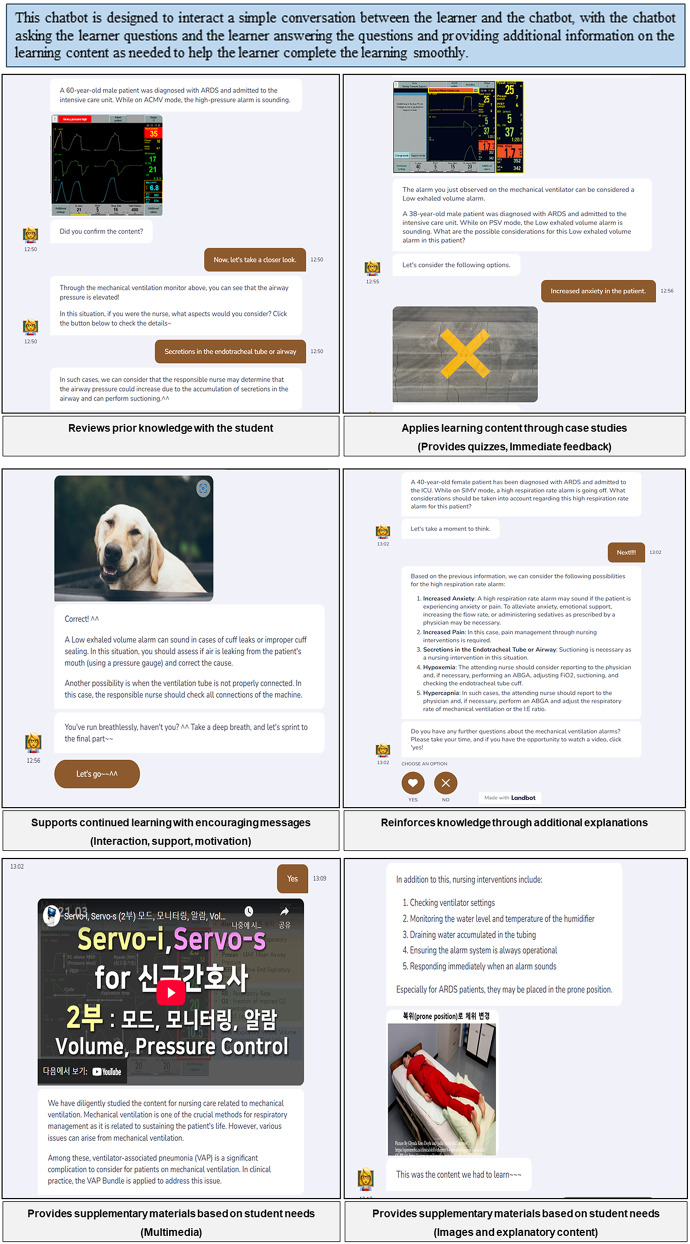
“This aligns with a meta-analysis conducted by Deng and Yu [31], which indicated that chatbot programs can serve three roles in education—teaching assistant, personal tutor, and learning partner (Fig. 2).”
§ Development and effects of a chatbot education program for self-directed learning in nursing students > Research method > Development process of the mechanical ventilation nursing chatbot educational program
What the sources say
- Supportedcites [31] Deng X, Yu Z. A meta-analysis and systematic review of the effect of chatbot technology use in sustainable education. Sustainability. 2023;15:2940. source
The Literature Review (§2; page not provided) explicitly identifies three educational roles for chatbots: teaching assistants, learning partners, and personal tutors. The Discussion (§5) also describes chatbots serving in those roles. (LLM, conf=0.95)
hedged- Asserted: passes — The authors put it forward as true.
- Checkable: passes — It can be checked against evidence.
- Load-bearing: passes — The paper’s conclusions depend on it.
- Based: passes — The paper gives a reason why it holds.
- Supported
A result the paper reports from its own data — it cites no other source for it, so there is none to check. The quote shows it is in the paper.
In the paper
“The experimental group, which received the chatbot educational program, showed statistically significant higher levels of Clinical reasoning competency (t = -5.00, p <.001), Confidence (t = -2.62, p =.011), and Satisfaction in education (t = -3.51, p <.001) compared to the control group.”
- Also stated in: § Discussion · plain
“Fourth, satisfaction with mechanical ventilation nursing education showed a significant difference between the experimental and control groups.”
§ Development and effects of a chatbot education program for self-directed learning in nursing students > Research method > Statistical hypothesis testing
plainn = 61 ·- Asserted: passes — The authors put it forward as true.
- Checkable: passes — It can be checked against evidence.
- Load-bearing: passes — The paper’s conclusions depend on it.
- Based: passes — The paper gives a reason why it holds.
- Also stated in: § Discussion · plain
34 more claims
Create a free account to see all 78 claims and every source verdict.
- Probably not a substantial claim. 25
- It may state two separate claims as one. 20
- The quote only partly states this claim. 1
Claims other papers make about this one
Each is checked against this paper’s own text: does it say what the citing paper says it does?
The source backs part of the claim, not all of it — or backs it for a different population, condition or comparison.
In the citing paper
“The findings of this study also complement emerging evidence on the role of AI in supporting metacognitive processes, adaptive reasoning, and structured learning (Han et al., 2025;Labrague & Al Sabei, 2024;Srinivasan et al., 2024).”
From AI-assisted concept mapping enhances orthopaedic nursing students’ critical thinking: A quasi-experimental study (2026) · cites this paper as Han et al., 2025
Experimental — accuracy not yet measuredThe source backs part of the claim, not all of it — or backs it for a different population, condition or comparison.
In the citing paper
“Emerging literature indicates that generative AI can assist students in synthesizing information, expanding conceptual linkages, and organizing CMAPs more effectively through reflective prompting and scaffolded learning support (Han et al., 2025;Labrague & Al Sabei, 2024).”
From AI-assisted concept mapping enhances orthopaedic nursing students’ critical thinking: A quasi-experimental study (2026) · cites this paper as Han et al., 2025
Experimental — accuracy not yet measuredThe source backs part of the claim, not all of it — or backs it for a different population, condition or comparison.
In the citing paper
“(ii) favorable effects on related dimensions, particularly confidence and satisfaction [24]”
From Artificial Intelligence–Enabled Educational Tools and Clinical Reasoning in Undergraduate Nursing Education: A Systematic Review (2026) · cites this paper as [24]
Experimental — accuracy not yet measuredThe source backs part of the claim, not all of it — or backs it for a different population, condition or comparison.
In the citing paper
“Several studies reported improvements in secondary outcomes such as confidence, satisfaction and self-directed learning [24].”
From Artificial Intelligence–Enabled Educational Tools and Clinical Reasoning in Undergraduate Nursing Education: A Systematic Review (2026) · cites this paper as [24]
Experimental — accuracy not yet measuredThe cited source says what the claim attributes to it.
In the citing paper
“Favorable between-group differences were also reported for confidence (t = -2.62; p = 0.011)”
From Artificial Intelligence–Enabled Educational Tools and Clinical Reasoning in Undergraduate Nursing Education: A Systematic Review (2026) · cites this paper as [24]
10 more claims about this paper
Create a free account to see every claim other papers make about this one.
Self-check
Percentages, sums and reported differences re-computed from the paper’s own numbers.
Each contradiction between two passages listed here was confirmed by an independent check.
Rated major: it would touch a result — a value a result rests on, reported and recomputed p-values on opposite sides of the significance level, two passages that conflict with no sign which is right, or a cited work retracted before this paper was published.
In the paper
§ Development and effects of a chatbot education program for self-directed learning in nursing students > Abstract > Methods
“while the control group received only the video lectures.”
§ Development and effects of a chatbot education program for self-directed learning in nursing students > Research method > Data collection
“In contrast, the control group was provided with relevant learning materials and URLs intended for independent study.”
Rated minor: it would not touch a result — a value no result rests on, a p-value that stays on the same side of the significance level, or a conflict that is clerical, resolved elsewhere in the paper, or outside its own findings.
In the paper
§ Development and effects of a chatbot education program for self-directed learning in nursing students > Research method > Ethical considerations
“All data utilized in this study were obtained from fully anonymized medical records.”
§ Development and effects of a chatbot education program for self-directed learning in nursing students > Research method > Data collection
“Prior to the intervention, both the experimental and control groups completed a pre-survey that assessed their general characteristics, knowledge of mechanical ventilation nursing, perceived clinical reasoning competency, self-confidence in mechanical ventilation nursing, and satisfaction with mechanical ventilation nursing education.”
Rated minor: it would not touch a result — a value no result rests on, a p-value that stays on the same side of the significance level, or a conflict that is clerical, resolved elsewhere in the paper, or outside its own findings.
In the paper
“The items assessed key knowledge areas including basic principles of mechanical ventilation (2 items), classification of ventilation modes (2 items), weaning strategies and applications (2 items), complications and pathophysiological responses (2 items), alarm interpretation and situational decision-making (3 items), and endotracheal tube management and caregiver explanation (1 item).”
§ Development and effects of a chatbot education program for self-directed learning in nursing students > Research method > Research tools
Reported 10 · recomputed 12
Rated minor: it would not touch a result — a value no result rests on, a p-value that stays on the same side of the significance level, or a conflict that is clerical, resolved elsewhere in the paper, or outside its own findings.
In the paper
“| Satisfaction with their major | Satisfaction with their major | Satisfied | 21 (35.0) | 17 (29.3) | 38 (63.3) | 0.56 | 0.788 |”
§ Development and effects of a chatbot education program for self-directed learning in nursing students > Research method > Results
Reported 29.3 · recomputed 28.333333
Rated minor: it would not touch a result — a value no result rests on, a p-value that stays on the same side of the significance level, or a conflict that is clerical, resolved elsewhere in the paper, or outside its own findings.
In the paper
§ Development and effects of a chatbot education program for self-directed learning in nursing students > Research method > Homogeneity testing
“| Confidence | Control | 4.17 ± 1.17 | 0.38 | 0.706 |”
§ Development and effects of a chatbot education program for self-directed learning in nursing students > Research method > Statistical hypothesis testing
“| Confidence | Con | 4.17 ± 1.71 | 4.76 ± 1.35 | -2.62 | 0.011 |”
Citations
Cites
Faul, F., Erdfelder, E., Lang, A.-G., & Buchner, A. (2007) · Behavior Research Methods · doi:10.3758/bf03193146 · Cited by 65,971 · cited 1×
“The sample size calculation for assessing the effectiveness of this study was performed using the G*Power 3.1.9.2 program [25].”
InfluentialAn Overview of Chatbot Technology
Adamopoulou, E., & Moussiades, L. (2020) · IFIP Advances in Information and Communication Technology · doi:10.1007/978-3-030-49186-4_31 · Cited by 990 · cited 1×
“The decision-making engine is the process by which the chatbot decides whether to respond or wait [30].”
Interacting with educational chatbots: A systematic review
Kuhail, M. A., Alturki, N., Alramlawi, S., & Alhejori, K. (2023) · Education and Information Technologies · doi:10.1007/s10639-022-11177-3 · Cited by 841 · cited 1×
“Learners can interact with chatbots, lower tension and stress levels, and engage in repetitive learning [36].”
Baber, H. (2020) · Journal of Education and e-Learning Research · doi:10.20448/journal.509.2020.73.285.292 · Cited by 716 · cited 1×
“They regulate their learning continually and assess and monitor their learning progress while maintaining autonomy [11].”
Virtual simulation in nursing education: a systematic review spanning 1996 to 2018
Foronda, C. L., Fernandez-Burgos, M., Nadeau, C., Kelley, C. N., & Henry, M. N. (2020) · Simulation in Healthcare The Journal of the Society for Simulation in Healthcare · doi:10.1097/sih.0000000000000411 · Cited by 505 · cited 1×
“Furthermore, in cases where group education in specific locations is restricted owing to infectious diseases, there are limitations in conducting programs using standardized patients and simulators [9].”
Zhang, J., Oh, Y. J., Lange, P., Yu, Z., & Fukuoka, Y. (2020) · Journal of Medical Internet Research · doi:10.2196/22845 · Cited by 363 · cited 1×
“Nursing research has been predominantly focusing on the utilization of chatbots in areas such as mental health [18, 19], weight management [20, 21], antenatal education [22], and electronic fetal monitoring [16].”
Self-Directed Learning: A Core Concept in Adult Education
Loeng, S. (2020) · Education Research International · doi:10.1155/2020/3816132 · Cited by 343 · cited 1×
“SDL encompasses learners’ ability to plan learning, regulate the learning environment, adjust cognition and self-monitoring methods for learning tasks (self-monitoring method), and employ cognitive strategies to remember and comprehend the learning material [12].”
Deng, X., & Yu, Z. (2023) · Sustainability · doi:10.3390/su15042940 · Cited by 298 · cited 1×
“This aligns with a meta-analysis conducted by Deng and Yu [31], which indicated that chatbot programs can serve three roles in education— teaching assistant, personal tutor, and learning partner (Fig.”
Chang, C., Hwang, G., & Gau, M. (2022) · British Journal of Educational Technology · doi:10.1111/bjet.13158 · Cited by 294 · cited 3×
“Nursing research has been predominantly focusing on the utilization of chatbots in areas such as mental health [18, 19], weight management [20, 21], antenatal education [22], and electronic fetal monitoring [16].”
Predicted Influences of Artificial Intelligence on the Domains of Nursing: Scoping Review
Buchanan, C., Howitt, M. L., Wilson, R., Booth, R. G., Risling, T., & Bamford, M. (2020) · JMIR Nursing · doi:10.2196/23939 · Cited by 238 · cited 1×
“In the wake of advanced knowledge, skills, clinical judgment abilities, and rapidly-evolving clinical evidence, it is crucial to utilize AI in educational programs to enable nursing students to learn and practice safely and efficiently, especially in areas like mechanical ventilation [23].”
Research works printed but not linked: 1
- Lee YB, Kim YJ. Clinical nurses’ awareness and learning needs of education of core basic nursing skills. Asia Pac J Multimed Serv Converg Art Humanit Sociol. 2019;9:705–16.
Cited by
El-Banna, M. M., Sajid, M. R., Rizvi, M. R., Sami, W., & McNelis, A. M. (2025) · Frontiers in Medicine · doi:10.3389/fmed.2025.1681784 · Cited by 62
achuthan, K. (2025) · Frontiers in Education · doi:10.3389/feduc.2025.1738751 · Cited by 91
Nasirun, H., Mulyono, S., Hapsari, A. W. D., Wiradinata, H. H., & Ratu, M. (2026) · Nurse Education in Practice · doi:10.1016/j.nepr.2026.104847 · Cited by 23
Abdelwahab, A. M. T., Aboraiah, M. I. H., & El-Sayed, H. M. (2025) · BMC Medical Education · doi:10.1186/s12909-025-08391-1 · Cited by 8
“This finding is in line with previous research examining the use of chatbot-enhanced education among fourth-year nursing students, which revealed that the experimental group exhibited significantly greater clinical reasoning competency than did the control group [32].”
Lai, N. M., Lim, Y. S., Thein, W. M., Bhargava, P., Thomas, P., & Ong, Q. C. (2026) · JMIR Medical Education · doi:10.2196/88933 · Cited by 13
“…awareness of group allocation could plausibly influence student confidence through differential feedback, encouragement, and validation beyond the educational content itself; this concern did not apply to the 4 remaining studies, which used largely self-directed learning formats [47,68,70,80].”
Metadata
- Authors
- Han, J.-W., Park, J., & Lee, H.
- Affiliations
- Kyung Hee University (KR)
- Dongnam Health University (KR)
- Gangneung–Wonju National University (KR)
- Corresponding author
- Lee, Hanna
- Venue
- BMC Medical Education
- Published
- 2025-06-02
- Volume
- 25
- Issue
- 1
- Pages
- 825-825
- ISSN
- 1472-6920 (ISSN-L)
- PMC
- PMC12131584
- OpenAlex
- W4410947263
- Semantic Scholar
- f290cc78d8539be73eed231d418e8b824b18d04b
- Cited by
- 41
- References
- 34
- Citations by year
- 2026: 33 · 2025: 8
- FWCI
- 7.77
- Type
- journal article
- Language
- en
- Open access
- gold
- doi.org
- Licence
- cc-by-nc-nd
- creativecommons.org/licenses/by-nc-nd/4.0 (tdm)
- creativecommons.org/licenses/by-nc-nd/4.0 (vor)
- Locations
- BMC Medical Education (publishedVersion, cc-by-nc-nd)
- Europe PMC (PubMed Central) (publishedVersion, cc-by-nc-nd)
- PubMed Central (publishedVersion, cc-by-nc-nd)
- PubMed (publishedVersion)
- DOAJ (DOAJ: Directory of Open Access Journals) (submittedVersion, cc-by-sa)
- Funders
- National Research Foundation of Kore (2022R1I1A3072862)
- Topics
- Health Sciences › Medicine › Health Informatics › Artificial Intelligence in Healthcare and Education
- Health Sciences › Nursing › Leadership and Management › Healthcare Education and Workforce Issues
- Social Sciences › Education › Innovations in Medical Education
- Keywords
- chatbots, self-directed learning, nursing students, clinical reasoning, self-confidence, education satisfaction, critical care nursing education, artificial intelligence in education
- MeSH terms
- Self-Directed Learning as Topic, Generative Artificial Intelligence, Adult, Clinical Competence, Education, Nursing, Baccalaureate, Female, Humans, Male, Respiration, Artificial, Students, Nursing, Young Adult, Republic of Korea
About these checks
Registry, retraction, Cites and statistics results are computed, not judged, with one exception: a printed reference that no index lists is read once by a model before it counts as a citation error. Claims are extracted by a model and kept only when their quote appears verbatim in the text; each cited source is then checked, with a model’s help, for whether it says what the claim relies on. Those verdicts can be wrong — read the claim’s quote and the cited source before relying on one.
The claim verdicts this report counts are experimental: their accuracy is not yet measured.
A language model drew the claims from the paper on 2026-10-10, under version 3 of the claim definition (model deepseek-v4.1-flash, prompt extract-v3).
A second model labelled each claim on 2026-10-10 (model jev-1.13-20260917, definition revision gold-guideline-v0.2).
Cited sources are checked with a language model’s help (gpt-6-sol).
Statistics and arithmetic are recomputed, not judged.
Confidence bands are shown only for fields calibrated on our annotated test set. None is calibrated yet, so no band is shown.
What counts as a claim ›How we measure confidence ›How we check this ›
Are you an author, or do you see a problem with this page? Request a review
How to cite
Cite CoChat for the checks on this page, and the paper for its own findings.
- This page
- CoChat. (2026). Citation check: Development and effects of a chatbot education program for self-directed learning in nursing students. https://app.cochat.ai/papers/10.1186/s12909-025-07316-2
- The paper
- Han, J.-W., Park, J., & Lee, H. (2025). Development and effects of a chatbot education program for self-directed learning in nursing students. BMC Medical Education. https://doi.org/10.1186/s12909-025-07316-2
Data sources
Bibliographic data: Semantic Scholar, OpenAlex, Crossref.
Contains information from the Semantic Scholar Academic Graph Datasets, made available under the ODC Attribution License (ODC-BY 1.0).
Semantic Scholar’s data is described in: Kinney, R., et al. (2023). The Semantic Scholar Open Data Platform. arXiv:2301.10140.
