

Curriculum-embedded AI literacy: a mixed-method study of framework implementation in undergraduate management education
Open accessThe DOI matches its Crossref record; 22 of the 22 references it cites were found in a registry or an index; 3 of the 33 sources its claims cite were checked for support.
Abstract
This paper reports findings from a mixed-methods study examining the integration of Generative Artificial Intelligence (GenAI) literacy within an undergraduate Business Management programme. Drawing on Zhou and Schofield’s (2024) AI literacy framework, AI-integrated learning activities were embedded across each year of study to support four dimensions of AI literacy: ’Know and Understand’, ‘Use and Apply’, ‘Evaluate and Create’, and ‘AI Ethics’. Data collected through surveys and focus groups suggest that students perceived curriculum-embedded AI activities as supporting AI literacy development; however, outcomes varied. Year 1 students reported the strongest development in the Know and Understand dimension, while Year 2 students demonstrated greater development in Use and Apply, and in Evaluate and Create. Year 3 students continued to emphasise foundational understanding, highlighting the need for greater scaffolding of advanced competencies. Engagement with AI Ethics remained comparatively limited. The study demonstrates the importance of a strategic, curriculum-wide approach to AI literacy development.
Overview
CoChat Summary
TL;DR
This mixed-methods study embedded GenAI literacy activities across three years of an undergraduate Business Management programme using Zhou and Schofield’s (2024) four-dimension AI literacy framework. Students perceived the curriculum-embedded activities as supporting AI literacy, but development varied by year and dimension, with AI Ethics consistently least reported.
Key findings
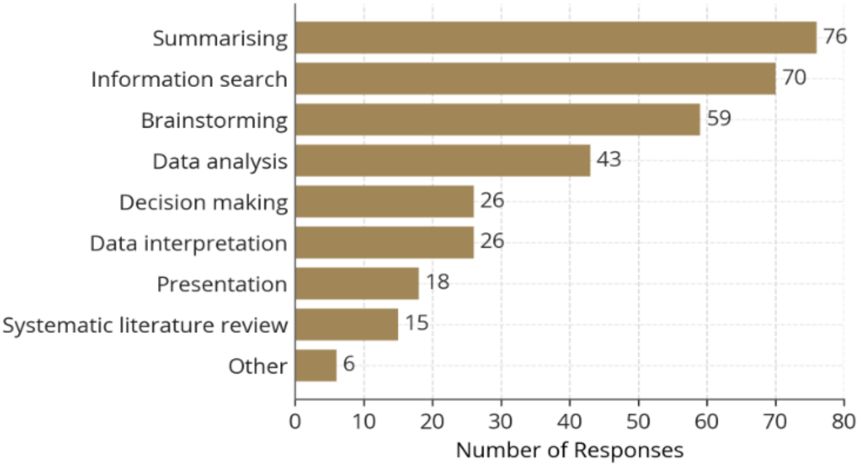
- Students’ most frequent GenAI uses were summarising information (59.8%, n = 76), information searching (55.1%, n = 70), brainstorming (46.5%, n = 59), and data analysis (33.9%, n = 43); presentation preparation (14.2%, n = 18) and systematic literature reviews (11.8%, n = 15) were less common.
- Reported AI-literacy development varied by year: Year 1 most often reported “Know and Understand AI” (71.6%), with lower “Use and Apply AI” (18.52%) and “Evaluate and Create with AI” (4.94%); Year 2 reported stronger “Use and Apply AI” (27.78%) and “Evaluate and Create with AI” (38.89%); Year 3 most often reported “Know and Understand AI” (64.29%) and fewer reported “Evaluate and Create with AI” (10.71%). Across all modules, “AI Ethics” recorded the lowest reported development, ranging from 4.94% to 11.11%.
- Students reported confidence in using GenAI tools (mean 4.00) but some difficulty with specific applications (3.63); they also reported questioning GenAI responses (3.83), evaluating evidence (3.97), and using AI to support original thinking (3.94). Lower scores were recorded for systematic problem-solving (1.26–1.39) and proactive planning (1.39). The highest-rated statement, “I find GenAI useful in my studies,” had a mean of 4.05.
- Students identified four main support needs: prompt engineering guidance, evaluating accuracy and reliability of AI outputs, enhanced technical integration of GenAI tools, and clearer guidance on appropriate AI use.
Methods
- The study embedded AI literacy across the BSc Business Management curriculum from Year 1 to Year 3 in three compulsory modules: Year 1 “Challenges in Business and Management” (e.g., Microsoft Copilot for note-taking, presentations, brainstorming, summarisation); Year 2 “Working with Business Data” (e.g., Copilot, Power BI, Bricks, Julius for data analysis, visualisation, interpretation); and Year 3 “Strategic Analysis and Practice” (GenAI within business simulations for application, evaluation, and co-creation).
- Data were collected through a structured survey administered to 127 undergraduate students, using closed-ended five-point Likert items and open-ended questions, plus four focus groups involving a total of 15 students (one Year 1, two Year 2, one Year 3).
- Quantitative survey data were analysed using descriptive statistics (frequencies, percentages, mean scores); qualitative focus-group and open-ended survey data were analysed using thematic analysis (Braun & Clarke, 2006), and findings were triangulated.
Limitations
- The paper states the study was conducted within a single institution and focused on business-related modules, which may limit transferability to other disciplinary contexts.
- The paper states the design was cross-sectional rather than longitudinal: data came from different student groups at each level rather than tracking the same cohort, so findings provide indicative evidence of progression rather than direct evidence of individual AI-literacy development.
- The paper states the study relied on self-reported perceptions and did not include objective measures of AI-literacy competence, so findings should not be interpreted as evidence of actual gains in AI literacy. Evident in the text, though not framed as a limitation by the authors, the focus groups involved only 15 students and participation was voluntary.
Model-written summary. Check it against the paper before relying on it.
Integrity signals
Registry
Cites
Statistics
Figures
Verification
Claims the paper makes
3 Valid · 0 Not valid · 22 Not checked · 89 Own results and interpretations
The cited sources support only part of this claim — read each source’s verdict below.
In the paper
“Furthermore, students benefit from learning experiences that progressively support movement from foundational understanding towards more independent, evaluative, and reflective engagement with AI (Kong et al., 2024;Laupichler et al., 2022).”
§ Curriculum-embedded AI literacy: a mixed-method study of framework implementation in undergraduate management education > AI literacy and curriculum integration
What the sources say
- Not checked — no full text of the sourcecites Kong et al., 2024 matched to “Developing an artificial intelligence literacy framework: Evaluation of a literacy course for senior secondary students using a project-based learning approach” (2024) source
- Partly supportedcites Laupichler et al., 2022 matched to “Artificial intelligence literacy in higher and adult education: A scoping literature review” (2022) sourceExperimental — accuracy not yet measured
Laupichler et al. (2022) describe a staged conception of AI literacy — Section 3.4 reports Ng et al. (2021b)'s four components ('Know & understand / Use & apply / Evaluate & create / Ethics') structured 'on different levels (from "know" to "create")' and notes some authors focusing 'more on reflective and evaluative skills', and Section 3.7/Table 4 shows courses opening with initial units giving 'a first understanding of what AI is' before hands-on and discussion units. However, the paper does not attribute any student benefit to such progressive sequencing: it states that in the courses reviewed 'A main trend could not be identified' and that there is 'very little fundamental research' on how different populations respond to different teaching opportunities (Section 4.2). The 'students benefit from…' part of the claim, and the independently framed (rather than reported-from-Ng/Kong) progression, is therefore not supported by our copy. (LLM, conf=0.72)
plainstates a cause- Asserted: passes — The authors put it forward as true.
- Checkable: passes — It can be checked against evidence.
- Load-bearing: passes — The paper’s conclusions depend on it.
- Based: passes — The paper gives a reason why it holds.
Every source the paper cites for this claim was checked and supports it.
In the paper
“The findings indicate that curriculum-embedded AI activities can support the development of AI literacy across the four dimensions of Zhou and Schofield's (2024) framework.”
§ Curriculum-embedded AI literacy: a mixed-method study of framework implementation in undergraduate management education > RQ1: To what extent do curriculum-embedded AI activities enhance students' AI literacy across the identified dimensions?
What the sources say
- Supportedcites Zhou & Schofield, 2024 matched to “Developing a conceptual framework for Artificial Intelligence (AI) literacy in higher education” (2024) source
Our copy of Zhou & Schofield (2024) sets out a conceptual framework for integrating AI into the curriculum whose activities are mapped on four dimensions of AI literacy — 'know and understand AI', 'use and apply AI', 'evaluate and create AI' and 'AI ethics' (AI literacy, p. 3; Developing AI for teaching and learning conceptual framework, p. 3), with specific learning objectives, teaching and learning activities and GenAI tools for each dimension (Table 1, pp. 4-8). The Suggestions section (p. 9) likewise describes embedding GenAI activities in the curriculum to enhance students' AI literacy. So the identification of 'the four dimensions of Zhou and Schofield's (2024) framework' and the premise that curriculum-embedded AI activities can develop AI literacy are supported; the 'findings indicate' element is the citing paper's own empirical result, not attributed here to this source (note the source is a conceptual/opinion piece, and its worked curriculum example covered only two of the four dimensions). (LLM, conf=0.86)
hedgedstates a possible cause- Asserted: passes — The authors put it forward as true.
- Checkable: passes — It can be checked against evidence.
- Load-bearing: passes — The paper’s conclusions depend on it.
- Based: passes — The paper gives a reason why it holds.
- Rests on 2 assumptions not shown here.
- Supported
The sources with a verdict support this claim; the rest weren’t checked yet, have no full text we could read, or their verdicts aren’t rated yet.
In the paper
“Consistent with research emphasising the importance of scaffolded AI-literacy development (Kong et al., 2024;Zhou & Schofield, 2024), students demonstrated different patterns of engagement depending on the pedagogical focus of each module and the intended AI-literacy competencies associated with that stage of study.”
§ Curriculum-embedded AI literacy: a mixed-method study of framework implementation in undergraduate management education > RQ1: To what extent do curriculum-embedded AI activities enhance students' AI literacy across the identified dimensions?
What the sources say
- Not checked — no full text of the sourcecites Kong et al., 2024 matched to “Developing an artificial intelligence literacy framework: Evaluation of a literacy course for senior secondary students using a project-based learning approach” (2024) source
- Supportedcites Zhou & Schofield, 2024 matched to “Developing a conceptual framework for Artificial Intelligence (AI) literacy in higher education” (2024) source
The citation is attached only to the clause 'research emphasising the importance of scaffolded AI-literacy development', and our copy states exactly that: 'The framework is designed to facilitate progressive learning. According to Ng et al. (2021), the levels of capability are arranged in a progressive order, adopting Bloom's taxonomy' (Developing AI for teaching and learning conceptual framework, p. 3), reinforced by the programme-director guidance to close gaps and 'ensure consistent development of AI skills among students during their learning journey' (Suggestions for using the conceptual framework, p. 8) and by the aim that 'students, throughout their study, progressively develop AI skills' (Limitations and future direction, p. 9). The observation that students 'demonstrated different patterns of engagement' is the citing authors' own empirical finding, not attributed to this source; this paper is explicitly conceptual ('without empirical studies validating its effectiveness', p. 9) and reports no such engagement comparison beyond one illustrative MSc module targeting the 'use and apply' and 'evaluate and create' dimensions (p. 9). (LLM, conf=0.85)
plainstates an association- Asserted: passes — The authors put it forward as true.
- Checkable: passes — It can be checked against evidence.
- Load-bearing: passes — The paper’s conclusions depend on it.
- Based: passes — The paper gives a reason why it holds.
A result the paper reports from its own data — it cites no other source for it, so there is none to check. The quote shows it is in the paper.
In the paper
“Relatively high scores were recorded for questioning GenAI-generated responses (3.83), evaluating evidence (3.97), and using AI to support original thinking (3.94).”
§ Curriculum-embedded AI literacy: a mixed-method study of framework implementation in undergraduate management education > RQ2: How does the development of AI literacy influence students' learning experiences and the development of transferable skills?
plain- Asserted: passes — The authors put it forward as true.
- Checkable: passes — It can be checked against evidence.
- Load-bearing: unclear — It is unclear whether the paper’s conclusions depend on it.
- Based: passes — The paper gives a reason why it holds.
A result the paper reports from its own data — it cites no other source for it, so there is none to check. The quote shows it is in the paper.
In the paper
“In the Year 2 module, students reported stronger development in the 'Use and Apply AI' (27.78%) and 'Evaluate and Create with AI' (38.89%) dimensions.”
§ Curriculum-embedded AI literacy: a mixed-method study of framework implementation in undergraduate management education > RQ1: Students' use of GenAI and perceived AI literacy development
plain- Asserted: passes — The authors put it forward as true.
- Checkable: passes — It can be checked against evidence.
- Load-bearing: unclear — It is unclear whether the paper’s conclusions depend on it.
- Based: passes — The paper gives a reason why it holds.
58 more claims
Create a free account to see all 114 claims and to verify the 23 references still open.
- It may state two separate claims as one. 27
- Probably not a substantial claim. 31
- The quote only partly states this claim. 2
Self-check
Percentages, sums and reported differences re-computed from the paper’s own numbers.
Each contradiction between two passages listed here was confirmed by an independent check.
Rated minor: it would not touch a result — a value no result rests on, a p-value that stays on the same side of the significance level, or a conflict that is clerical, resolved elsewhere in the paper, or outside its own findings.
In the paper
§ Curriculum-embedded AI literacy: a mixed-method study of framework implementation in undergraduate management education > Theoretical implications
“the dimensions proposed by Ng et al. (2003) and Zhou and Schofield (2024)”
§ Curriculum-embedded AI literacy: a mixed-method study of framework implementation in undergraduate management education > References
“Ng, D. T. K., Leung, J. K. L., Su, J., Ng, R. C. W., & Chu, S. K. W. (2023). Teachers' AI digital competencies and twenty-first century skills in the post-pandemic world.”
Citations
Cites
Using thematic analysis in psychology
Braun, V., & Clarke, V. (2006) · Qualitative Research in Psychology · doi:10.1191/1478088706qp063oa · Cited by 194,414
ChatGPT for good? On opportunities and challenges of large language models for education
Kasneci, E., Sessler, K., Küchemann, S., Bannert, M., Dementieva, D., Fischer, F., Gasser, U., Groh, G., Günnemann, S., Hüllermeier, E., et al. (2023) · Learning and Individual Differences · doi:10.1016/j.lindif.2023.102274 · Cited by 7,326
Teachers’ AI digital competencies and twenty-first century skills in the post-pandemic world
(2023) · doi:10.1007/s11423-023-10203-6 · Cited by 734
Song, C., & Song, Y. (2023) · Frontiers in Psychology · doi:10.3389/fpsyg.2023.1260843 · Cited by 717
Artificial intelligence literacy in higher and adult education: A scoping literature review
Laupichler, M. C., Aster, A., Schirch, J., & Raupach, T. (2022) · Computers and Education Artificial Intelligence · doi:10.1016/j.caeai.2022.100101 · Cited by 658
Southworth, J., Migliaccio, K., Glover, J., Glover, J., Reed, D., McCarty, C., Brendemuhl, J., & Thomas, A. (2023) · Computers and Education: Artificial Intelligence · doi:10.1016/j.caeai.2023.100127 · Cited by 647
The role of ChatGPT in higher education: Benefits, challenges, and future research directions
(2023) · Journal of Applied Learning & Teaching · doi:10.37074/jalt.2023.6.1.29 · Cited by 561
In search of artificial intelligence (AI) literacy in teacher education: A scoping review
Sperling, K., Stenberg, C.-J., McGrath, C., Åkerfeldt, A., Heintz, F., & Stenliden, L. (2024) · Computers and Education Open · doi:10.1016/j.caeo.2024.100169 · Cited by 498
AI competency framework for students
(2024) · UNESCO eBooks · doi:10.54675/jkjb9835 · Cited by 488
Exploring social constructivism: theories and practicalities
Adams, P. (2006) · Education 3-13 · doi:10.1080/03004270600898893 · Cited by 376
ChatGPT: Empowering lifelong learning in the digital age of higher education
Rawas, S. (2024) · Education and Information Technologies · doi:10.1007/s10639-023-12114-8 · Cited by 310
Cukurova, M. (2025) · British Journal of Educational Technology · doi:10.1111/bjet.13514 · Cited by 302
The role of ChatGPT in scientific communication: writing better scientific review articles.
(2023) · PubMed Central · Cited by 289
The influence of AI text generators on critical thinking skills in UK business schools
Essien, A., Bukoye, O. T., O’Dea, X., & Kremantzis, M. (2024) · Studies in Higher Education · doi:10.1080/03075079.2024.2316881 · Cited by 252
Using ChatGPT in academic writing is (not) a form of plagiarism: What does the literature say?
Jarrah, A. M., Wardat, Y., & Fidalgo, P. (2023) · Online Journal of Communication and Media Technologies · doi:10.30935/ojcmt/13572 · Cited by 220 · cited 1×
“Current applications include supporting academic writing through brainstorming, drafting, and editing (Jarrah et al., 2023; Wang, 2025); providing personalised feedback and learning support (Song & Song, 2023); facilitating content creation (Rawas, 2024); and streamlining writing tasks such as…”
Wang, C. (2025) · Technology Knowledge and Learning · doi:10.1007/s10758-024-09744-3 · Cited by 212
Kong, S.-C., Cheung, M.-Y. W., & Tsang, O. (2024) · Computers and Education: Artificial Intelligence · doi:10.1016/j.caeai.2024.100214 · Cited by 167
Yang, Y., Luo, J., Yang, M., Yang, R., & Chen, J. (2024) · Studies in Higher Education · doi:10.1080/03075079.2024.2327003 · Cited by 129 · cited 1×
“Despite growing interest in AI-enhanced learning, research examining the effective use of AI tools within the humanities and social sciences remains limited, particularly in disciplines where critical thinking, interpretation, communication, and reflective judgement are central (Yang et al., 2024).”
Zhou, X., Teng, D., & Al-Samarraie, H. (2024) · Education Sciences · doi:10.3390/educsci14121302 · Cited by 119
Self-citationDeveloping a conceptual framework for Artificial Intelligence (AI) literacy in higher education
Zhou, X., & Schofield, L. (2024) · Journal of Learning Development in Higher Education · doi:10.47408/jldhe.vi31.1354 · Cited by 32
Self-citationLearning with Generative Artificial Intelligence Within a Network of Co-Regulation
Lodge, J. M., De Barba, P., & Broadbent, J. (2024) · Journal of University Teaching and Learning Practice · doi:10.53761/m2v9an32 · Cited by 9
(2023) · Queen Mary Research Online (Queen Mary University of London)
Self-citation
Research works printed but not linked: 1
- Vygotsky, L. S. (1978). Mind in society: the development of higher psychological processes. Harvard University Press.
Cited by
Refozar, R. F. G., Manalo, L. V., & Atento, R. G. (2026) · Journal of Enterprise Strategy and Management Innovation · doi:10.65166/knngcb04
Metadata
- Authors
- Schofield, L., Zhou, X., Petrov, G., & Woon, A.
- Affiliations
- Queen Mary University of London (GB)
- University of Leicester (GB)
- Monash University Malaysia (MY)
- Venue
- Journal of Learning Development in Higher Education
- Published
- 2026-09-30
- Issue
- 41
- ISSN
- 1759-667X (ISSN-L)
- OpenAlex
- W7214944314
- Semantic Scholar
- a9fcf5efe799bdf2258db828d4183492487af213
- Cited by
- 1
- References
- 22
- Citations by year
- 2026: 1
- FWCI
- 3.61
- Type
- journal article
- Language
- en
- Open access
- diamond
- doi.org
- Locations
- Journal of Learning Development in Higher Education (publishedVersion, cc-by)
- DOAJ (DOAJ: Directory of Open Access Journals) (submittedVersion)
- Topics
- Social Sciences › Education › Digital literacy in education
- Social Sciences › Education › Artificial Intelligence in Education
- Social Sciences › Library and Information Sciences › Library Science and Information Literacy
- Keywords
- AI literacy, generative AI, curriculum integration, undergraduate management education, AI ethics, student perceptions, scaffolding, competence development
About these checks
Registry, retraction, Cites and statistics results are computed, not judged, with one exception: a printed reference that no index lists is read once by a model before it counts as a citation error. Claims are extracted by a model and kept only when their quote appears verbatim in the text; each cited source is then checked, with a model’s help, for whether it says what the claim relies on. Those verdicts can be wrong — read the claim’s quote and the cited source before relying on one.
The claim verdicts this report counts are experimental: their accuracy is not yet measured.
A language model drew the claims from the paper on 2026-11-20, under version 3 of the claim definition (model deepseek-v4.1-flash, prompt extract-v3).
A second model labelled each claim on 2026-11-20 (model jev-1.13-20260917, definition revision gold-guideline-v0.2).
Cited sources are checked with a language model’s help (qwen3.8-omni-flash).
Statistics and arithmetic are recomputed, not judged.
Confidence bands are shown only for fields calibrated on our annotated test set. None is calibrated yet, so no band is shown.
What counts as a claim ›How we measure confidence ›How we check this ›
Are you an author, or do you see a problem with this page? Request a review
Data sources
Bibliographic data: Semantic Scholar, OpenAlex, Crossref.
Contains information from the Semantic Scholar Academic Graph Datasets, made available under the ODC Attribution License (ODC-BY 1.0).
Semantic Scholar’s data is described in: Kinney, R., et al. (2023). The Semantic Scholar Open Data Platform. arXiv:2301.10140.
