

Video-based cognitive-behavioral intervention for COVID-19 anxiety: a randomized controlled trial
Open accessThe DOI matches its Crossref record; 49 of the 49 references it cites were found in a registry or an index; none of the 12 sources its claims cite is checked for support yet.
Abstract
OBJECTIVE: Cognitive-behavioral interventions can be effective for relieving anxiety associated with coronavirus disease 2019 (COVID-19), but complications such as social distancing, quarantine, a shortage of experts, and delayed care provisions have made it difficult to access face-to-face therapeutic interventions. The purpose of this study was to investigate the efficacy of a video-based cognitive-behavioral intervention for reducing COVID-19 anxiety. METHOD: In the present randomized controlled trial, 150 college students with severe COVID-19 anxiety were randomly assigned to either an intervention (n = 75) or a waiting list control (n = 75) group. The intervention group participated in a video-based cognitive-behavioral program consisting of nine 15-20-minute sessions (three days a week for three weeks). Dependent measures included the COVID-19 Anxiety Questionnaire, Short Health Anxiety Inventory, Anxiety Sensitivity Index-3, Somatosensory Amplification Scale, Experience of Parasocial Interaction Scale, and Source Credibility Scale. RESULTS: Participants who were randomly assigned to the cognitive-behavioral program reported high parasocial interaction, source credibility, and satisfaction with the intervention. Eighty percent reported that the video-based intervention was a beneficial alternative to traditional face-to-face therapeutic intervention. At post-treatment evaluation, the video-based cognitive-behavioral intervention group showed a significant reduction in COVID-19 anxiety, health anxiety, anxiety sensitivity, and somatosensory amplification when compared to the wait-listed control group. CONCLUSIONS: This study suggests that video-based cognitive-behavioral interventions can be an affordable, feasible, and effective method to reduce anxiety during a large-scale pandemic.
Overview
CoChat Summary
## TL;DR
This randomized controlled trial found that a 9-session video-based cognitive-behavioral intervention reduced COVID-19 anxiety and related symptoms in 150 college students with severe COVID-19 anxiety. The intervention group also reported high engagement and satisfaction, with 80% calling it a beneficial alternative to face-to-face therapy.
## Key findings
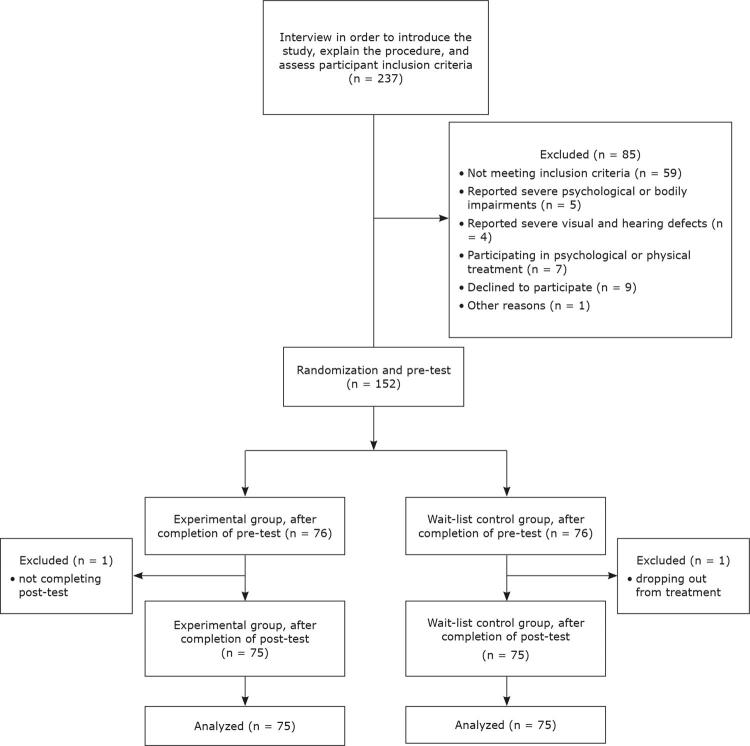
- The final sample included 150 college students (after 2 were excluded post-randomization), randomized to intervention (n = 75) or waiting list control (n = 75).
- At post-treatment, the intervention group showed significant reductions versus control in:
- COVID-19 anxiety (F = 139.22; p < 0.01)
- Health anxiety (F = 42.97; p < 0.01)
- Anxiety sensitivity (F = 40.47; p < 0.01)
- Somatosensory amplification (F = 38.74; p < 0.01)
- The intervention group reported high acceptability: parasocial interaction mean = 32.10 (SD = 4.56), source credibility mean = 81.81 (SD = 10.14), and satisfaction mean = 7.69 (scale described as 1–10); 80% said it was a beneficial alternative to face-to-face therapy.
- The authors state that 63% of total variances in the experimental vs. control groups were due to the independent variable, and the test power was 1.
## Methods
- Design: One-way randomized pretest/post-test experimental design (RCT) comparing a video-based CBT intervention with a waiting list control.
- Sample/data: Convenience sample of college students from Guilan University, Rasht, Iran, recruited in March–April 2020; final sample n = 150, ages 18–40 years, mean age 24.7 (SD = 5.4).
- Analysis: Pre/post outcomes analyzed in SPSS v24 using MANCOVA, with additional univariate ANCOVA follow-ups; assumption checks included Levene’s test, Box’s M, Bartlett’s test, and homogeneity of regression slopes.
## Limitations
- The paper states several limitations: the sample was opportunistic, participants were students and therefore not representative of broader community populations, measures were not fully masked, only self-report outcomes were used, adherence metrics were not measured, effect sizes were relatively low, there was no follow-up, and the intervention was tested only against a wait-list control.
- Evident from the text: the sample was limited to college students from one university in Iran, which further restricts generalizability.
- Evident from the text: the control condition was a wait list, so the study cannot isolate which specific intervention components drove the effects.
Model-written summary. Check it against the paper before relying on it.
Integrity signals
Registry
Cites
Statistics
Figures

Verification
Claims the paper makes
0 Valid · 0 Not valid · 8 Not checked · 45 Own results and interpretations
A result the paper reports from its own data — it cites no other source for it, so there is none to check. The quote shows it is in the paper.
In the paper
“The intervention and waiting list control groups showed a significant difference in at least one of the variables of COVID-19 anxiety, health anxiety, anxiety sensitivity, and somatosensory amplification.”
§ Video-based cognitive-behavioral intervention for COVID-19 anxiety: a randomized controlled trial > Results
plain- Asserted: passes — The authors put it forward as true.
- Checkable: passes — It can be checked against evidence.
- Load-bearing: passes — The paper’s conclusions depend on it.
- Based: passes — The paper gives a reason why it holds.
A result the paper reports from its own data — it cites no other source for it, so there is none to check. The quote shows it is in the paper.
In the paper
“A majority of participants (80%) evaluated the intervention as a beneficial alternative to traditional face-to-face therapeutic interventions.”
§ Video-based cognitive-behavioral intervention for COVID-19 anxiety: a randomized controlled trial > Results
plain- Asserted: passes — The authors put it forward as true.
- Checkable: passes — It can be checked against evidence.
- Load-bearing: unclear — It is unclear whether the paper’s conclusions depend on it.
- Based: passes — The paper gives a reason why it holds.
A result the paper reports from its own data — it cites no other source for it, so there is none to check. The quote shows it is in the paper.
In the paper
“Additionally, participants in the intervention group reported a high experience of parasocial interaction (mean = 32.10; SD = 4.56), source credibility (mean = 81.81; SD = 10.14), and satisfaction (mean = 7.69; at least = 1.12) with the video-based cognitive-behavioral intervention.”
§ Video-based cognitive-behavioral intervention for COVID-19 anxiety: a randomized controlled trial > Results
plain- Asserted: passes — The authors put it forward as true.
- Checkable: passes — It can be checked against evidence.
- Load-bearing: unclear — It is unclear whether the paper’s conclusions depend on it.
- Based: passes — The paper gives a reason why it holds.
A result the paper reports from its own data — it cites no other source for it, so there is none to check. The quote shows it is in the paper.
In the paper
“There was a significant difference between the intervention and control groups in COVID-19 anxiety (F = 139.22; p < 0.01), health anxiety (F = 42.97; p < 0.01), anxiety sensitivity (F = 40.47; p < 0.01), and somatosensory amplification (F = 38.74; p < 0.01).”
§ Video-based cognitive-behavioral intervention for COVID-19 anxiety: a randomized controlled trial > Results
plain- Asserted: passes — The authors put it forward as true.
- Checkable: passes — It can be checked against evidence.
- Load-bearing: passes — The paper’s conclusions depend on it.
- Based: passes — The paper gives a reason why it holds.
A result the paper reports from its own data — it cites no other source for it, so there is none to check. The quote shows it is in the paper.
In the paper
“There was a significant difference between the intervention and control groups in COVID-19 anxiety (F = 139.22; p < 0.01), health anxiety (F = 42.97; p < 0.01), anxiety sensitivity (F = 40.47; p < 0.01), and somatosensory amplification (F = 38.74; p < 0.01).”
§ Video-based cognitive-behavioral intervention for COVID-19 anxiety: a randomized controlled trial > Results
plain- Asserted: passes — The authors put it forward as true.
- Checkable: passes — It can be checked against evidence.
- Load-bearing: passes — The paper’s conclusions depend on it.
- Based: passes — The paper gives a reason why it holds.
20 more claims
Create a free account to see all 53 claims and to verify the 12 references still open.
- Probably not a substantial claim. 18
- It may state two separate claims as one. 12
Claims other papers make about this one
Each is checked against this paper’s own text: does it say what the citing paper says it does?
The source backs part of the claim, not all of it — or backs it for a different population, condition or comparison.
In the citing paper
“There were also several CBT based studies [54,55,58,59,61-65], as well as mixed hybrid CBD studies involving other techniques such as combined CBT with dialectical behavior therapy (DBT) [65] and combined mindfulness with CBT [62,64].”
From Psychological Interventions and Those With Elements of Positive Psychology for Child and Youth Mental Health During the COVID-19 Pandemic: Literature Review, Lessons Learned, and Areas for Future Knowledge Dissemination (2024) · cites this paper as [63]
Experimental — accuracy not yet measuredThe cited source says what the claim attributes to it.
In the citing paper
“The prevalence of mental illness increased in children, adolescents, and young adults during the COVID-19 pandemic, while at the same time, access to treatment facilities has been restricted, resulting in a need for the quick implementation of remote or online interventions.”
The cited source says what the claim attributes to it.
In the citing paper
“Not all studies reported on the feasibility and acceptability of their interventions. Those that did, however, found the intervention to be feasible [57,59] and acceptable [57-59,63], met with high satisfaction [19,62], and more accepted and engaging in the treatment group than in the control group [61].”
The cited source says what the claim attributes to it.
In the citing paper
“The impact on anxiety was more prominent in some studies for the treatment group than for the control group [19,59-61,66,68].”
The cited source says what the claim attributes to it.
In the citing paper
“Several studies reported reduced anxiety [19,47,54,55,59-62,66-68].”
Self-check
Percentages, sums and reported differences re-computed from the paper’s own numbers.
Each contradiction between two passages listed here was confirmed by an independent check.
Rated minor: it would not touch a result — a value no result rests on, a p-value that stays on the same side of the significance level, or a conflict that is clerical, resolved elsewhere in the paper, or outside its own findings.
In the paper
§ Video-based cognitive-behavioral intervention for COVID-19 anxiety: a randomized controlled trial > Method > Measures
“#### Experience of Parasocial Interaction Scale (EPSI) Hartmann & Goldhoorn29 developed the EPSI to examine viewers’ parasocial bond experience with a TV performer.”
§ Video-based cognitive-behavioral intervention for COVID-19 anxiety: a randomized controlled trial > Method > Measures
“Findings of Hartmann & Goldhoorn29 and Shabahang et al.40 confirm appropriate psychometric properties of the ESPI.”
Citations
Cites
Statistical Power Analysis for the Behavioral Sciences
Muller, K. (1989) · Technometrics · doi:10.1080/00401706.1989.10488618 · Cited by 99,167
Element Interactivity and Intrinsic, Extraneous, and Germane Cognitive Load
Sweller, J. (2010) · Educational Psychology Review · doi:10.1007/s10648-010-9128-5 · Cited by 2,020
Taylor, S., Zvolensky, M. J., Cox, B. J., Deacon, B., Heimberg, R. G., Ledley, D. R., Abramowitz, J. S., Holaway, R. M., Sandin, B., Stewart, S. H., et al. (2007) · Psychological Assessment · doi:10.1037/1040-3590.19.2.176 · Cited by 1,866
The American Psychiatric Association (APA)
Strentz, T. (2017) · Psychological Aspects of Crisis Negotiation · doi:10.1201/9781315150581-3 · Cited by 1,850
Roy, D., Tripathy, S., Kar, S. K., Sharma, N., Verma, S. K., & Kaushal, V. (2020) · Asian Journal of Psychiatry · doi:10.1016/j.ajp.2020.102083 · Cited by 1,759
SALKOVSKIS, P. M., RIMES, K. A., WARWICK, H. M. C., & CLARK, D. M. (2002) · Psychological Medicine · doi:10.1017/s0033291702005822 · Cited by 1,351
Barsky, A. J., Orav, E. J., & Bates, D. W. (2005) · Archives of General Psychiatry · doi:10.1001/archpsyc.62.8.903 · Cited by 911
Nursing Research: Design, Statistics, and Computer Analysis
Waltz, C. F., & Bausell, B. (1981) · Medical Entomology and Zoology · Cited by 691
The amplification of somatic symptoms.
Barsky, A. J., Goodson, J. D., Lane, R. S., & Cleary, P. D. (1988) · Psychosomatic Medicine · doi:10.1097/00006842-198809000-00007 · Cited by 668
The Somatosensory Amplification Scale and its relationship to hypochondriasis
Barsky, A. J., Wyshak, G., & Klerman, G. L. (1990) · Journal of Psychiatric Research · doi:10.1016/0022-3956(90)90004-a · Cited by 630
Research works printed but not linked: 9
- [13]. Martínez MP, Belloch A, Botella C. Somatosensory amplification in hypochondriasis and panic disorder. Clin Psychol Psychother 1999;6:46-53.
- [25]. American Psychiatric Association. Diagnostic and Statistical Manual of Mental Disorders, Fifth Edition (DSM-5). Arlington: American Psychiatric Publishing; 2013.
- [27]. Taylor S, Zvolensky MJ, Cox BJ, Deacon B, Heimberg RG, Ledley DR, et al. Robust dimensions of anxiety sensitivity: development and initial validation of the anxiety sensitivity index-3. Psychol Assess. 2007;19:176. 17563199
- [30]. Ohanian R. Communication and validation of a scale to measure celebrity endorser’s perceived attractiveness and design to influence. J Advert. 1990;19:39-52.
- [32]. Lawshe CH. A quantitative approach to content validity 1. Pers Psychol. 1975;28:563-75.
- [34]. Abramowitz JS, Deacon BJ, Valentiner DP. The short health anxiety inventory in an undergraduate sample: Implications for a cognitive-behavioral model of hypochondriasis. Cog Ther Res. 2007;31:871-83. PMC7088052 32214558
- [37]. Nakao M, Kumano H, Kuboki T, Barsky AJ. Reliability and validity of the Japanese version of somatosensory amplification scale: clinical application to psychosomatic illness. Jpn J Psychosom Med. 2001;41:539-47.
- [40]. Shabahang R, Besharat M, Mokhtari Chirani B, Rezaei S, Nikoogoftar M, Bagheri Sheykhangafshe F. Investigation of psychometric attributes of the experience of Parasocial Interaction Scale in Iranian students sample. Soc Psychol Res. 2019;8:17-44.
- [41]. French JR, Raven B, Cartwright D. The bases of social power. Class Org Theory. 1959;7:311-20.
Cited by
Riboldi, I., Cavaleri, D., Calabrese, A., Capogrosso, C. A., Piacenti, S., Bartoli, F., Crocamo, C., & Carrà, G. (2023) · Revista de Psiquiatría y Salud Mental · doi:10.1016/j.rpsm.2022.04.005 · Cited by 86
“…2020, when medical students were still at home Dialectical behaviour therapy Online psychoeducational intervention Anxiety Depression GAD-7 PHQ-9 Shabahang et al., 2021 Iran 150 75 75 51% Undergraduateand graduate-level students March--April 2020, during the second wave of COVID-19…”
Ye, Z., Li, W., & Zhu, R. (2022) · Journal of Affective Disorders · doi:10.1016/j.jad.2022.08.023 · Cited by 56
Han, L., Zhan, Y., Li, W., Xu, Y., Xu, Y., & Zhao, J. (2021) · JMIR Public Health and Surveillance · doi:10.2196/31052 · Cited by 53
Fischer-Grote, L., Fössing, V., Aigner, M., Fehrmann, E., & Boeckle, M. (2024) · JMIR Mental Health · doi:10.2196/46637 · Cited by 42
“Schleider et al [58] examined online single interventions for depressive symptoms, and Shabahang et al [19] targeted COVID-19–related anxiety with self-administered video-based strategies and online booklets.”
BackgroundInfluentialYuan, L., Lu, L., Wang, X., Qu, M., Gao, Y., & Pan, B. (2023) · BMC Psychiatry · doi:10.1186/s12888-023-04638-7 · Cited by 43
Малинаускас, Р. К., & Malinauskiene, V. A. (2022) · International Journal of Environmental Research and Public Health · doi:10.3390/ijerph19159199 · Cited by 44
Zamiri-Miandoab, N., Hasanzadeh, R., & Mirghafourvand, M. (2022) · Annals of General Psychiatry · doi:10.1186/s12991-022-00417-y · Cited by 35
He, J., Lin, J., Sun, W. J., Cheung, T. C. C., Cao, Y., Fu, E., Chan, S. H., & Tsang, H. W. H. (2023) · Scientific Reports · doi:10.1038/s41598-023-45839-0 · Cited by 22
Kim, H. J., Meeker, T. J., Tulloch, I. K., Mullins, R. J., Park, J., & Bae, S. H. (2022) · International Journal of Public Health · doi:10.3389/ijph.2022.1604552 · Cited by 20
Jagayat, J., Kumar, A., Shao, Y., Pannu, A., Patel, C. B., Shirazi, A., Omrani, M., & Alavi, N. (2024) · JMIR Mental Health · doi:10.2196/51704 · Cited by 18
“Therapist-guided support in an i-CBT setting can also include text (ie, messaging and emails) or audio-based (ie, telephone and video) formats, and the mode of therapy may influence treatment outcome [22,33,34].”
InfluentialKurniawan, K., Yosep, I., Maulana, S., Mulyana, A. M., Amirah, S., Abdurrahman, M. F., Sugianti, A., Putri, E. G., Khoirunnisa, K., Komariah, M., et al. (2022) · Sustainability · doi:10.3390/su141912866 · Cited by 14
“The American Psychiatric Association (APA) shows that 40% of Americans report anxiety related to fear of death or serious illness from COVID-19, even if they show only mild symptoms [2].”
BackgroundInfluentialCaycho‐Rodríguez, T., Tomás, J. M., Valencia, P. D., Ventura‐León, J., Vilca, L. W., Carbajal‐León, C., Reyes-Bossio, M. A., White, M., Rojas-Jara, C., Polanco-Carrasco, R., et al. (2022) · Current Psychology · doi:10.1007/s12144-022-03389-0 · Cited by 16
“Finally, it is worth clarifying that this study does not affirm that the variables evaluated are the only factors that can be used in interventions, but that they are feasible to be addressed through interventions (Lin et al., 2020; Shabahang et al., 2021).”
Charbonnier, É., Vigouroux, S. L., Puechlong, C., Montalescot, L., Goncalves, A., Baussard, L., Gisclard, B., Philippe, A. G., & Lespiau, F. (2023) · INQUIRY The Journal of Health Care Organization Provision and Financing · doi:10.1177/00469580231159962 · Cited by 16
Bertollo, A. G., Braga, G. D. C., Tonin, P. T., Luzardo, A. R., Bagatini, M. D., & Ignácio, Z. M. (2023) · Brain Sciences · doi:10.3390/brainsci13101414 · Cited by 13
“Video sessions for cognitive–behavioral intervention in university students with severe COVID-19 anxiety reduced anxiety, suggesting once again that technology-mediated interventions are beneficial in lowering stress symptoms caused by the pandemic [71].”
BackgroundPsychological Determinants and Consequences of COVID-19 Anxiety: A Web-Based Study in Iran
Shabahang, R., Aruguete, M. S., Rezaei, S., & McCutcheon, L. E. (2021) · Health Psychology Research · doi:10.52965/001c.24841 · Cited by 13
“Beck, Steer, and Brown32 defined four categories based on total raw score ranges: Minimal (0-13), Mild (14-19), Moderate (20-28), and Severe (29-63).”
BackgroundSelf-citationAxelsson, E., & Hedman‐Lagerlöf, E. (2023) · Expert Review of Pharmacoeconomics & Outcomes Research · doi:10.1080/14737167.2023.2250915 · Cited by 11
“We identified 19 RCTs from the original search, 1 additional RCT in the update [55], and also revised 1 decision of the original search to exclude one RCT on the basis of subclinical symptoms [56].”
BackgroundSevere COVID anxiety among adults in the United Kingdom: cohort study and nested feasibility trial
Crawford, M., King, J. D., McQuaid, A., Bassett, P., Leeson, V. C., Tella, O., Simplicio, M. C. D., Tyrer, P. J., Tyrer, H., Watt, R. G., et al. (2024) · BMC Psychiatry · doi:10.1186/s12888-023-05446-9 · Cited by 8
“Controlled trials of breathing and relaxation exercises, [44] progressive muscle relaxation, [45] video-based CBT [46] and a self-guided program based on CBT [47] have all reported greater short-term reductions in COVID anxiety among those offered active interventions compared to wait list control.”
BackgroundLyzwinski, L., Zwicker, J. D., Mcdonald, S., & Tough, S. (2024) · JMIR Pediatrics and Parenting · doi:10.2196/59171 · Cited by 7
“Of the studies that demonstrated effectiveness, one was a multicomponent positive psychological intervention [53], several were mindfulness-based interventions [43,52,64,66,70,72,82] as well as CBT based [54,55,58,59,63,64,73,74,77].”
BackgroundDrinking to cope with COVID-19 anxiety predicts greater alcohol problems for undergraduate students
Monley, C. M., Ozmat, E. E., Martin, J. L., & Oh, J.-S. (2023) · Journal of American College Health · doi:10.1080/07448481.2023.2209187 · Cited by 7
“29 A variety of other interventions and services can be made available to college students to address coping motives for drinking.”
Wang, Q., An, S., & Shao, Z. (2023) · PLoS ONE · doi:10.1371/journal.pone.0283208 · Cited by 7
Technological Advances in Treating Anxiety Disorders
Goetter, E. M., & Yuen, E. K. (2024) · Psychiatric Clinics of North America · doi:10.1016/j.psc.2024.04.020 · Cited by 6
Fitrianna, H., Suhud, U., Setiawati, R., & Adirestuty, F. (2025) · Journal of Promotion Management · doi:10.1080/10496491.2025.2460181 · Cited by 12
“Literature on the fear of missing out has examined various contexts, including social media use (Brailovskaia & Margraf, 2024; Shabahang et al., 2021), substance consumption (Brunborg et al., 2022; Riordan et al., 2015), organizational performance (Fridchay & Reizer, 2022), internet and smart-phone…”
Hechanova, M. R. M., Co, T. A. C., Soliman, J. A., Guevara, A. M. I. C., Tuliao, A. P., Botor, N. J. B., & Felipe, M. V. (2024) · Drugs Habits and Social Policy · doi:10.1108/dhs-08-2023-0031 · Cited by 4
ASHER, I. B., Ritholz, M. D., Horwitz, D. L., Manejwala, O., Behar, E., & Fundoiano-Hershcovitz, . (2024) · JMIR Formative Research · doi:10.2196/50506 · Cited by 5
“A recurring element described in the literature is video-based self-administrated intervention programs, which are mainly rooted in a CBT framework [39,40].”
BackgroundDinarvand, F., Bakhtiarpour, S., & Heydarei, A. (2022) · Journal of Research in Behavioural Sciences · doi:10.52547/rbs.19.4.590 · Cited by 4
Xu, F., Zhu, W., Chen, Q., & Tang, Y. (2023) · Current Psychology · doi:10.1007/s12144-023-05188-7 · Cited by 3
Frydendal, D. H., Ingeman, K., Fink, P., Wellnitz, K. B., & Frostholm, L. (2025) · Nordic Journal of Psychiatry · doi:10.1080/08039488.2025.2506560 · Cited by 3
“However, an RCT investigating video-based CBT for COVID-19 anxiety found significant reductions in both COVID-19 anxiety and HA symptoms [35].”
Trajectory of severe COVID anxiety and predictors for recovery in an 18-month UK cohort
King, J. D., McQuaid, A., Barnicot, K., Bassett, P., Leeson, V. C., Simplicio, M. C. D., Tyrer, P. J., Tyrer, H., Watt, R. G., & Crawford, M. (2025) · BJPsych Open · doi:10.1192/bjo.2025.10884 · Cited by 3
“Health conditions and participants ’ ethnic background were assessed as increasing an individual ’ s risk to COVID-19 with the QCOVID tool (https://qcovid.org/).”
InfluentialIntervenção psicoeducativa de estudantes universitários: efeitos na qualidade de vida
Carvalho, A. A., Assunção, L. D. P., de Alcântara, K. C., & Lopes, F. M. (2024) · Revista Psicopedagogia · doi:10.51207/2179-4057.20240043 · Cited by 2
Sarboozi-hoseinabadi, T., Irani, M., Namazinia, M., Raznahan, R., Aradmehr, M., & Abadi, S. S. H. (2025) · Journal of Education and Health Promotion · doi:10.4103/jehp.jehp_1818_23 · Cited by 2
“[41] (2021), who found that telehealth could effectively deliver cognitive‑behavioral therapies to COVID‑19 patients, with a noted improvement in their mental health.”
Parent PTSD, social support and differential associations with facets of anxiety sensitivity
Bermingham, K., Latourrette, C., Chartier, K. G., Spit for Science Working Group, Amstadter, A. B., & Bountress, K. E. (2025) · European Journal of Psychotraumatology · doi:10.1080/20008066.2025.2565060 · Cited by 2
“AS has three sub-components: cognitive (e.g. lack of cognitive control is a sign of going crazy), physical (e.g. physical sensations are a sign of a heart attack), and social concerns (e.g. fear of publicly observable anxiety) (Shabahang et al., 2021).”
Yirdaw, B. A., Sunglao, J. A., Alkasaby, M. A., & Eaton, J. (2025) · Cambridge Prisms Global Mental Health · doi:10.1017/gmh.2025.22 · Cited by 2
“…Li et al., 2020; Liu et al., 2021; Sun et al., 2022), six from Iran (Ghazanfarpour et al., 2022; Khos-ravi et al., 2022; Mirhosseini et al., 2022; Shabahang et al., 2021; Shaygan et al., 2021; Shaygan et al., 2023), two from Turkey (Dincer and Inangil, 2021; Hosseinzadeh, 2022), one from India…”
InfluentialJorge, M. S. B., da Silva, D. M. F., Pinto, J., & Cartaxo, N. T. D. S. (2022) · Research Society and Development · doi:10.33448/rsd-v11i1.24687 · Cited by 1
“Em outras palavras, uma intervenção cognitivocomportamental baseada em vídeo de autoajuda é um meio eficaz de aliviar a ansiedade Covid-19, ansiedade de saúde, sensibilidade à ansiedade e amplificação somatossensorial (Shabahang et al., 2021).”
BackgroundPereira, E. B., de Brito, N. F. C., & Campos, E. D. M. (2023) · Research Society and Development · doi:10.33448/rsd-v12i1.38897 · Cited by 2
Antesberger, S., Blum, T., Böswald, R., Brandl, H. M., Brenzinger, N., Bunk, X., Carr, S., Gans, J., Gieg, R., Hainke, L., et al. (2021) · PsyArXiv (OSF Preprints) · doi:10.31234/osf.io/fw78q · Cited by 1
Passos, Á. L. V., Melo, J. R., & Leal, C. E. G. (2023) · Persona · doi:10.26439/persona2022.n25(2).5949
Alavi, S. S., Ghanizadeh, M., Sotoudeh, H. G., Mohammadi, M. R., Jannatifard, F., & Khaleghi, A. (2024) · Journal of Iranian Medical Council · doi:10.18502/jimc.v7i2.15042 · Cited by 2
Grocott, L., King, J. D., McQuaid, A., Leeson, V. C., & Crawford, M. (2025) · medRxiv · doi:10.1101/2025.02.26.25322939
“Research has already shown that some interventions, particularly Cognitive Behavioural Therapy techniques may be helpful for improving anxious and depressive symptomatology among people with COVID anxiety, but the impact on somatic symptoms does not appear to have been studied 52-54 .”
Babaei, N. (2023) · YorkSpace (York University)
GIUSTI, E. (2024) · Electronic Theses and Dissertations Repository (University of Pisa)
Psychological responses to the COVID-19 pandemic and the role of psychological interventions
Adams, S. (2026) · Enlighten: Theses (The University of Glasgow) · doi:10.5525/gla.thesis.85912
Antón-Ruiz, J. A., Cuevas-Caravaca, E., Heredia-Oliva, E., Sánchez-Ramón, R., & Bernabé, M. A. P. (2026) · Frontiers in Public Health · doi:10.3389/fpubh.2026.2013904
Metadata
- Authors
- Shabahang, R., Aruguete, M. S., & McCutcheon, L.
- Affiliations
- University of Tehran (IR)
- Lincoln University - Missouri (US)
- Venue
- Trends in Psychiatry and Psychotherapy
- Publisher
- EDITORA SCIENTIFIC
- Published
- 2021
- Volume
- 43
- Issue
- 2
- Pages
- 141-150
- ISSN
- 2237-6089 (ISSN-L)
- 2238-0019
- PMC
- PMC8317544
- OpenAlex
- W3119745094
- Cited by
- 35
- References
- 48
- Citations by year
- 2025: 5 · 2024: 7 · 2023: 11 · 2022: 9 · 2021: 3
- FWCI
- 6.74
- Type
- journal article
- Language
- en
- Open access
- diamond
- doi.org
- Licence
- cc-by
- Locations
- Trends in Psychiatry and Psychotherapy (publishedVersion, cc-by)
- PubMed Central (publishedVersion, cc-by)
- PubMed (publishedVersion)
- LA Referencia (Red Federada de Repositorios Institucionales de Publicaciones Científicas) (publishedVersion, other-oa)
- DOAJ (DOAJ: Directory of Open Access Journals) (submittedVersion, cc-by-sa)
- Topics
- Social Sciences › Psychology › Applied Psychology › Digital Mental Health Interventions
- Social Sciences › Psychology › Clinical Psychology › COVID-19 and Mental Health
- Social Sciences › Psychology › Experimental and Cognitive Psychology › Anxiety, Depression, Psychometrics, Treatment, Cognitive Processes
- Keywords
- COVID-19 anxiety, university students, health anxiety, anxiety sensitivity, somatosensory amplification, parasocial interaction, source credibility, telemedicine, mental health during pandemic
- MeSH terms
- COVID-19, Anxiety, Female, Humans, Male, Psychiatric Status Rating Scales, Surveys and Questionnaires, Video Recording, Cognitive Behavioral Therapy, Young Adult
About these checks
Registry, retraction, Cites and statistics results are computed, not judged, with one exception: a printed reference that no index lists is read once by a model before it counts as a citation error. Claims are extracted by a model and kept only when their quote appears verbatim in the text; each cited source is then checked, with a model’s help, for whether it says what the claim relies on. Those verdicts can be wrong — read the claim’s quote and the cited source before relying on one.
A language model drew the claims from the paper on 2026-10-11, under version 3 of the claim definition (model deepseek-v4.1-flash, prompt extract-v3).
A second model labelled each claim on 2026-10-11 (model jev-1.13-20260917, definition revision gold-guideline-v0.2).
Statistics and arithmetic are recomputed, not judged.
Confidence bands are shown only for fields calibrated on our annotated test set. None is calibrated yet, so no band is shown.
What counts as a claim ›How we measure confidence ›How we check this ›
Are you an author, or do you see a problem with this page? Request a review
Data sources
Bibliographic data: Semantic Scholar, OpenAlex, Crossref.
Contains information from the Semantic Scholar Academic Graph Datasets, made available under the ODC Attribution License (ODC-BY 1.0).
Semantic Scholar’s data is described in: Kinney, R., et al. (2023). The Semantic Scholar Open Data Platform. arXiv:2301.10140.
