

The DOI matches its DataCite record; 3 of the 3 references it cites were found in a registry or an index.
Automatic tagging using deep convolutional neural networks
Abstract
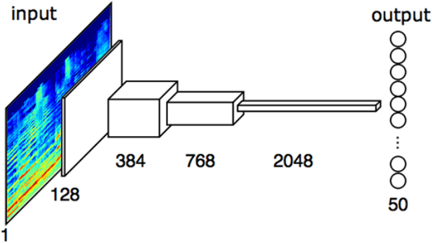
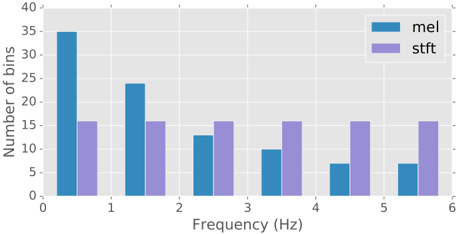
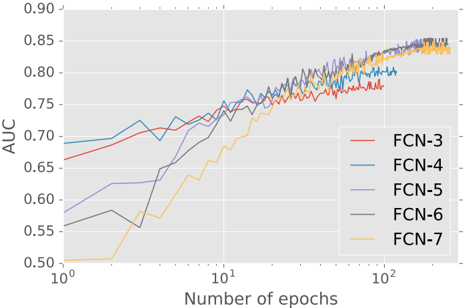
We present a content-based automatic music tagging algorithm using fully convolutional neural networks (FCNs). We evaluate different architectures consisting of 2D convolutional layers and subsampling layers only. In the experiments, we measure the AUC-ROC scores of the architectures with different complexities and input types using the MagnaTagATune dataset, where a 4-layer architecture shows state-of-the-art performance with mel-spectrogram input. Furthermore, we evaluated the performances of the architectures with varying the number of layers on a larger dataset (Million Song Dataset), and found that deeper models outperformed the 4-layer architecture. The experiments show that mel-spectrogram is an effective time-frequency representation for automatic tagging and that more complex models benefit from more training data.
Overview
The claims and statistics of this paper haven’t been checked yet.
Run the check — free, no account needed. It reads the open-access text and checks the sources it cites.
Integrity signals
Registry
Cites
Statistics
Figures
Verification
Claims the paper makes
The claims and statistics of this paper haven’t been checked yet.
Run the check — free, no account needed. It reads the open-access text and checks the sources it cites.
Self-check
Percentages, sums and reported differences re-computed from the paper’s own numbers.
The self-check needs the paper’s full text.
Citations
Cites
Deep Residual Learning for Image Recognition
He, K., Zhang, X., Ren, S., & Sun, J. (2016) · 2016 IEEE Conference on Computer Vision and Pattern Recognition (CVPR) · doi:10.1109/cvpr.2016.90 · Cited by 235,474
Adam: A Method for Stochastic Optimization
Kingma, D. P., & Ba, J. (2014) · arXiv · doi:10.48550/arxiv.1412.6980 · Cited by 98,946
Bertin-Mahieux, T., Ellis, D. P. W., Whitman, B., & Lamere, P. (2011) · Columbia University · doi:10.7916/d8nz8j07 · Cited by 944
Research works printed but not linked: 24
- Frédéric Bastien, Pascal Lamblin, Razvan Pascanu, James Bergstra, Ian Goodfellow, Arnaud Bergeron, Nicolas Bouchard, David Warde-Farley, and Yoshua Bengio. Theano: new features and speed improve- ments. arXiv preprint arXiv:1211.5590, 2012. · arXiv
- Keunwoo Choi, George Fazekas, Mark Sandler, and Jeonghee Kim. Auralisation of deep convolutional neu- ral networks: Listening to learned features. In Proceed- ings of the 16th International Society for Music In- formation Retrieval Conference, ISMIR 2015, Málaga, Spain, October 26-30, 2015, 2015.
- Sander Dieleman and Benjamin Schrauwen. Multi- scale approaches to music audio feature learning. In Proceedings of the 14th International Society for Mu- sic Information Retrieval Conference, ISMIR 2013, Curitiba, Brazil, November 4-8, 2013, 2013.
- Sander Dieleman and Benjamin Schrauwen. End-to- end learning for music audio. In Acoustics, Speech and Signal Processing (ICASSP), 2014 IEEE International Conference on, pages 6964-6968. IEEE, 2014.
- Thomas Grill and Jan Schlüter. Music boundary detec- tion using neural networks on spectrograms and self- similarity lag matrices. In Proceedings of the 23rd European Signal Processing Conference (EUSPICO 2015), Nice, France, 2015.
- Philippe Hamel, Simon Lemieux, Yoshua Bengio, and Douglas Eck. Temporal pooling and multiscale learn- ing for automatic annotation and ranking of music au- dio. In Proceedings of the 12th International Soci- ety for Music Information Retrieval Conference, IS- MIR 2011, Miami, Florida, USA, October 24-28, 2011, pages 729-734, 2011.
- Eric J Humphrey and Juan P Bello. Rethinking auto- matic chord recognition with convolutional neural net- works. In Machine Learning and Applications, 11th In- ternational Conference on, volume 2, pages 357-362. IEEE, 2012.
- Sergey Ioffe and Christian Szegedy. Batch nor- malization: Accelerating deep network training by reducing internal covariate shift. arXiv preprint arXiv:1502.03167, 2015. · arXiv
- Edith Law, Kris West, Michael I Mandel, Mert Bay, and J Stephen Downie. Evaluation of algorithms using games: The case of music tagging. In Proceedings of the 10th International Society for Music Information Retrieval Conference, ISMIR 2009, Kobe, Japan, Oc- tober 26-30, 2009, pages 387-392. ISMIR, 2009.
- Yann LeCun and Yoshua Bengio. Convolutional net- works for images, speech, and time series. The hand- book of brain theory and neural networks, 3361(10), 1995.
- Dawen Liang, Minshu Zhan, and Daniel PW Ellis. Content-aware collaborative music recommendation using pre-trained neural networks. In Proceedings of the 16th International Society for Music Information Retrieval Conference, ISMIR 2015, Málaga, Spain, October 26-30, 2015, 2015.
- Min Lin, Qiang Chen, and Shuicheng Yan. Network in network. CoRR, abs/1312.4400, 2013. · arXiv
- Juhan Nam, Jorge Herrera, and Kyogu Lee. A deep bag-of-features model for music auto-tagging. arXiv preprint arXiv:1508.04999, 2015. · arXiv
- Tara N Sainath, Abdel-rahman Mohamed, Brian Kingsbury, and Bhuvana Ramabhadran. Deep convo- lutional neural networks for lvcsr. In Acoustics, Speech and Signal Processing (ICASSP), 2013 IEEE Interna- tional Conference on, pages 8614-8618. IEEE, 2013.
- Tara N Sainath, Ron J Weiss, Andrew Senior, Kevin W Wilson, and Oriol Vinyals. Learning the speech front- end with raw waveform cldnns. In Proc. Interspeech, 2015.
- Jan Schluter and Sebastian Bock. Improved musical onset detection with convolutional neural networks. In Acoustics, Speech and Signal Processing (ICASSP), IEEE International Conference on. IEEE, 2014.
- Siddharth Sigtia, Emmanouil Benetos, and Simon Dixon. An end-to-end neural network for polyphonic music transcription. arXiv preprint arXiv:1508.01774, 2015. · arXiv
- Andrew JR Simpson, Gerard Roma, and Mark D Plumbley. Deep karaoke: Extracting vocals from mu- sical mixtures using a convolutional deep neural net- work. arXiv preprint arXiv:1504.04658, 2015. · arXiv
- Nitish Srivastava, Geoffrey Hinton, Alex Krizhevsky, Ilya Sutskever, and Ruslan Salakhutdinov. Dropout: A simple way to prevent neural networks from over- fitting. The Journal of Machine Learning Research, 15(1):1929-1958, 2014.
- George Tzanetakis and Perry Cook. Musical genre classification of audio signals. Speech and Audio Pro- cessing, IEEE transactions on, 10(5):293-302, 2002.
- Karen Ullrich, Jan Schlüter, and Thomas Grill. Bound- ary detection in music structure analysis using convo- lutional neural networks. In Proceedings of the 15th International Society for Music Information Retrieval Conference, ISMIR 2014, Taipei, Taiwan, 2014.
- Aaron Van den Oord, Sander Dieleman, and Benjamin Schrauwen. Deep content-based music recommenda- tion. In Advances in Neural Information Processing Systems, pages 2643-2651, 2013.
- Aäron Van Den Oord, Sander Dieleman, and Ben- jamin Schrauwen. Transfer learning by supervised pre- training for audio-based music classification. In Pro- ceedings of the 15th International Society for Music Information Retrieval Conference, ISMIR 2014, Taipei, Taiwan, October 27-31, 2014, 2014.
- Yusuf Yaslan and Zehra Cataltepe. Audio music genre classification using different classifiers and feature se- lection methods. In 18th ICPR 2006, volume 2, pages 573-576. IEEE, 2006.
Cited by
Sorted by citations
Audio Caption: Listen and Tell
Wu, M., Dinkel, H., & Yu, K. (2019) · ICASSP 2019 - 2019 IEEE International Conference on Acoustics, Speech and Signal Processing (ICASSP) · doi:10.1109/icassp.2019.8682377 · Cited by 52
MusCaps: Generating Captions for Music Audio
Manco, I., Benetos, E., Quinton, E., & Fazekas, G. (2021) · 2021 International Joint Conference on Neural Networks (IJCNN) · doi:10.1109/ijcnn52387.2021.9533461 · Cited by 36
Self-citationVessel Classification through Convolutional Neural Networks using Passive Sonar Spectrogram Images
Cinelli, L., Chaves, G., & Lima, M. (2018) · Anais de XXXVI Simpósio Brasileiro de Telecomunicações e Processamento de Sinais · doi:10.14209/sbrt.2018.340 · Cited by 13
Learning Music Sequence Representation From Text Supervision
Chen, T., Xie, Y., Zhang, S., Huang, S., Zhou, H., & Li, J. (2022) · ICASSP 2022 - 2022 IEEE International Conference on Acoustics, Speech and Signal Processing (ICASSP) · doi:10.1109/icassp43922.2022.9746131 · Cited by 8
Metadata
- Authors
- Choi, K., Fazekas, G., & Sandler, M.
- Venue
- arXiv
- Publisher
- arXiv
- Published
- 2016
- arXiv
- 1606.00298
- References
- 3
- Type
- Preprint
About these checks
Registry, retraction, Cites and statistics results are computed, not judged, with one exception: a printed reference that no index lists is read once by a model before it counts as a citation error. Claims are extracted by a model and kept only when their quote appears verbatim in the text; each cited source is then checked, with a model’s help, for whether it says what the claim relies on. Those verdicts can be wrong — read the claim’s quote and the cited source before relying on one.
Statistics and arithmetic are recomputed, not judged.
Confidence bands are shown only for fields calibrated on our annotated test set. None is calibrated yet, so no band is shown.
What counts as a claim ›How we measure confidence ›How we check this ›
Are you an author, or do you see a problem with this page? Request a review
How to cite
Cite CoChat for the checks on this page, and the paper for its own findings.
- This page
- CoChat. (2026). Citation check: Automatic tagging using deep convolutional neural networks. https://app.cochat.ai/papers/10.48550/arxiv.1606.00298
- The paper
- Choi, K., Fazekas, G., & Sandler, M. (2016). Automatic tagging using deep convolutional neural networks. arXiv. https://doi.org/10.48550/arxiv.1606.00298
