

The DOI matches its DataCite record; 77 of the 77 references it cites were found in a registry or an index; 38 of the 46 sources its claims cite were checked for support.
Retrieval-Augmented Generation for Knowledge-Intensive NLP Tasks
Open accessAbstract
Large pre-trained language models have been shown to store factual knowledge in their parameters, and achieve state-of-the-art results when fine-tuned on downstream NLP tasks. However, their ability to access and precisely manipulate knowledge is still limited, and hence on knowledge-intensive tasks, their performance lags behind task-specific architectures. Additionally, providing provenance for their decisions and updating their world knowledge remain open research problems. Pre-trained models with a differentiable access mechanism to explicit non-parametric memory can overcome this issue, but have so far been only investigated for extractive downstream tasks. We explore a general-purpose fine-tuning recipe for retrieval-augmented generation (RAG) -- models which combine pre-trained parametric and non-parametric memory for language generation. We introduce RAG models where the parametric memory is a pre-trained seq2seq model and the non-parametric memory is a dense vector index of Wikipedia, accessed with a pre-trained neural retriever. We compare two RAG formulations, one which conditions on the same retrieved passages across the whole generated sequence, the other can use different passages per token. We fine-tune and evaluate our models on a wide range of knowledge-intensive NLP tasks and set the state-of-the-art on three open domain QA tasks, outperforming parametric seq2seq models and task-specific retrieve-and-extract architectures. For language generation tasks, we find that RAG models generate more specific, diverse and factual language than a state-of-the-art parametric-only seq2seq baseline.
Overview
AI snapshot
Written from the paper’s full text.
TL;DR
RAG combines a pre-trained DPR retriever over a Wikipedia dense index with a BART seq2seq generator, fine-tuned end-to-end by marginalizing over retrieved passages. It sets state of the art on open-domain QA and generates more factual, specific, and diverse text than a parametric-only BART baseline.
Key findings
- Open-domain QA: RAG-Sequence reaches 44.5 EM on NQ, 56.8/68.0 on TriviaQA, 45.2 on WebQuestions, and 52.2 on CuratedTrec; RAG-Token reaches 44.1, 55.2/66.1, 45.5, and 50.0 respectively. The paper reports RAG sets a new state of the art on all four tasks, with the TQA comparison only on the T5-comparable split.
- Generation: RAG-Sequence outperforms BART on MS-MARCO by 2.6 BLEU and 2.6 Rouge-L points (44.2 B-1, 40.8 R-L vs. BART’s 41.6, 38.2). On Jeopardy question generation, RAG-Token scores 22.2 Q-BLEU-1 vs. BART’s 19.7; human evaluators found RAG more factual in 42.7% of cases vs. BART in 7.1%, and more specific in 37.4% vs. 16.8%.
- FEVER: RAG is within 4.3% of state of the art on 3-way classification and within 2.7% on 2-way classification; the top retrieved document is from a gold article in 71% of cases, and a gold article appears in the top 10 retrieved articles in 90% of cases.
- Index hot-swapping: RAG answers 70% correctly using a 2016 index for 2016 world leaders and 68% using a 2018 index for 2018 world leaders; mismatched indices drop to 12% and 4%.
Methods
- RAG uses a DPR bi-encoder retriever over a dense Wikipedia index (December 2018 dump, 21M disjoint 100-word chunks, FAISS MIPS) and a BART-large generator with 400M parameters. RAG-Sequence marginalizes the same retrieved document across the whole output; RAG-Token marginalizes a different document per target token.
- The retriever and generator are jointly fine-tuned without direct supervision on which document should be retrieved; the document encoder and index are kept fixed. Tasks include open-domain QA (NQ, TriviaQA, WebQuestions, CuratedTrec), abstractive QA (MS-MARCO), Jeopardy question generation, and FEVER fact verification.
- Training uses Fairseq with mixed precision on 8×32GB NVIDIA V100 GPUs; training retrieves k ∈ {5,10} documents, with test-time k tuned on dev data. Evaluation includes comparisons to closed-book and open-book baselines, BART, BM25 and frozen-retriever ablations, human factuality/specificity judgments, and distinct n-gram diversity.
Limitations
- Stated: MS-MARCO contains questions that cannot be answered without gold passages and some that cannot be answered from Wikipedia alone; FEVER’s evidence-extraction sub-task is not addressed because FEVER uses a different Wikipedia dump; retrieval collapse was observed in preliminary experiments for some tasks such as story generation; null-document mechanisms did not improve performance.
- Stated: RAG’s retriever is initialized from DPR, which used retrieval supervision on Natural Questions and TriviaQA; joint pre-training of both components from scratch is left to future work.
- Evident from the text: evaluation is limited to English Wikipedia and the listed datasets, and the broader-impact section notes that Wikipedia may never be entirely factual or free of bias.
Model-written summary. Check it against the paper before relying on it.
Integrity signals
Registry
Cites
Statistics
Figures
Verification
Claims the paper makes
35 Own result · 17 Own interpretation · 11 Supported · 9 Partly supported · 9 No basis given · 3 Own method · 2 Supported so far · 2 Not checked yet · 1 No full text of the sources · accuracy not yet measured
The cited sources support only part of this claim — read each source’s verdict below.
In the paper
“They can do so without any access to an external memory, as a parameterized implicit knowledge base [51, 52].”
What the sources say
- Partly supportedcites [51] [51] Colin Raffel, Noam Shazeer, Adam Roberts, Katherine Lee, Sharan Narang, Michael Matena, Yanqi Zhou, Wei Li, and Peter J. Liu. Exploring the limits of transfer learning with a unified text-to-text transformer. arXiv e-prints , 2019. URL https://arxiv.org/abs/1910.10683 . - sourceExperimental — accuracy not yet measured
The Introduction (pp. 1–2) says models can learn general-purpose knowledge through pre-training, and §4.2 (p. 43) describes pre-training as a way to provide that knowledge. The paper does not characterize the model as an implicit knowledge base or establish the claim that it learns without access to external memory. (LLM, conf=0.82)
- Supportedcites [52] [52] Adam Roberts, Colin Raffel, and Noam Shazeer. How much knowledge can you pack into the parameters of a language model? arXiv e-prints , 2020. URL https://arxiv.org/abs/ 2002.08910 . - source
The Abstract says language models trained on unstructured text can implicitly store and retrieve knowledge. The Background and Pre-training Fine-tuning sections explain that, when answering questions without external context or knowledge, the model retrieves information learned during pre-training from its parameters. This supports the paraphrase of a parameterized implicit knowledge base. (LLM, conf=0.94)
plaindirect- Asserted: passes — The authors put it forward as true.
- Checkable: passes — It can be checked against evidence.
- Load-bearing: passes — The paper’s conclusions depend on it.
- Based: passes — The paper gives a reason why it holds.
- Partly supported
Every source the paper cites for this claim was checked and supports it.
In the paper
“For FEVER [56] fact verification, we achieve results within 4.3% of state-of-the-art pipeline models which use strong retrieval supervision.”
What the sources say
- Supportedcites [56] [56] James Thorne, Andreas Vlachos, Christos Christodoulopoulos, and Arpit Mittal. FEVER: a large-scale dataset for fact extraction and VERification. In Proceedings of the 2018 Conference of the North American Chapter of the Association for Computational Linguistics: Human Language Technologies, Volume 1 (Long Papers) , pages 809-819, New Orleans, Louisiana, June 2018. Association for Computational Linguistics. doi: 10.18653/v1/N18-1074. URL https://www.aclweb.org/anthology/N18-1074 . - source
The citation is attached to “FEVER” and identifies the fact-verification dataset, not the citing authors’ RAG result. The source’s Conclusions (Section 7) explicitly introduce FEVER as a dataset for fact extraction and verification. The 4.3% comparison is presented as the citing authors’ own result. (LLM, conf=0.93)
plain- Asserted: passes — The authors put it forward as true.
- Checkable: passes — It can be checked against evidence.
- Load-bearing: passes — The paper’s conclusions depend on it.
- Based: passes — The paper gives a reason why it holds.
- Supported
Every source the paper cites for this claim was checked and supports it.
In the paper
“Updating the document encoder BERT d during training is costly as it requires the document index to be periodically updated as REALM does during pre-training [20].”
What the sources say
- Supportedcites [20] [20] Kelvin Guu, Kenton Lee, Zora Tung, Panupong Pasupat, and Ming-Wei Chang. REALM: Retrieval-augmented language model pre-training. ArXiv , abs/2002.08909, 2020. URL https: //arxiv.org/abs/2002.08909 . - source
The Introduction (p. 2) describes large-scale neural retrieval during pre-training as a significant computational challenge. Section 3.3 (p. 4) explains that updating document-encoder parameters makes the search index stale, so REALM periodically re-embeds and re-indexes all documents; Section 4.5 (p. 8) confirms this occurs during pre-training. (LLM, conf=0.93)
plaindirect- Asserted: passes — The authors put it forward as true.
- Checkable: passes — It can be checked against evidence.
- Load-bearing: passes — The paper’s conclusions depend on it.
- Based: passes — The paper gives a reason why it holds.
- Supported
The cited sources support only part of this claim — read each source’s verdict below.
In the paper
“Pretrained models with a differentiable access mechanism to explicit non-parametric memory have so far been only investigated for extractive downstream tasks.”
What the sources say
- Partly supportedcites [20] [20] Kelvin Guu, Kenton Lee, Zora Tung, Panupong Pasupat, and Ming-Wei Chang. REALM: Retrieval-augmented language model pre-training. ArXiv , abs/2002.08909, 2020. URL https: //arxiv.org/abs/2002.08909 . - sourceExperimental — accuracy not yet measured
The Introduction (p. 2) says REALM is fine-tuned and evaluated on three Open-QA benchmarks, and Model architecture (p. 4) specifies that its answers are extracted as contiguous spans from retrieved documents. This supports the claim for REALM, but the paper does not establish that all pretrained models with differentiable access to explicit non-parametric memory had only been investigated on extractive downstream tasks. (LLM, conf=0.85)
- Partly supportedcites [31] [31] Kenton Lee, Ming-Wei Chang, and Kristina Toutanova. Latent retrieval for weakly supervised open domain question answering. In Proceedings of the 57th Annual Meeting of the Association for Computational Linguistics , pages 6086-6096, Florence, Italy, July 2019. Association for Computational Linguistics. doi: 10.18653/v1/P19-1612. URL https://www.aclweb.org/ anthology/P19-1612 . - sourceExperimental — accuracy not yet measured
The Retriever component describes a learnable retriever over evidence blocks and a span-based reader; Section 4 describes retrieval pre-training. This supports the paper as an example of a pretrained retrieval model used for an extractive task, but the paper does not establish that such models had only been investigated for extractive downstream tasks. (LLM, conf=0.83)
plain- Asserted: passes — The authors put it forward as true.
- Checkable: passes — It can be checked against evidence.
- Load-bearing: passes — The paper’s conclusions depend on it.
- Based: passes — The paper gives a reason why it holds.
- Partly supported
Every source the paper cites for this claim was checked and supports it.
In the paper
“Pre-trained neural language models have been shown to learn a substantial amount of in-depth knowledge from data [47].”
What the sources say
- Supportedcites [47] [47] Fabio Petroni, Tim Rocktäschel, Sebastian Riedel, Patrick Lewis, Anton Bakhtin, Yuxiang Wu, and Alexander Miller. Language models as knowledge bases? In Proceedings of the 2019 Conference on Empirical Methods in Natural Language Processing and the 9th International Joint Conference on Natural Language Processing (EMNLP-IJCNLP) , pages 2463-2473, Hong Kong, China, November 2019. Association for Computational Linguistics. doi: 10.18653/v1/ D19-1250. URL https://www.aclweb.org/anthology/D19-1250 . - source
The Discussion and Conclusion says the study focused on knowledge present in the weights of existing pretrained models and found that BERT-large could recall factual and commonsense knowledge. The results also note that recovery varies by type of relation; the citing sentence does not claim that every fact is learned. (LLM, conf=0.92)
plain- Asserted: passes — The authors put it forward as true.
- Checkable: passes — It can be checked against evidence.
- Load-bearing: passes — The paper’s conclusions depend on it.
- Based: passes — The paper gives a reason why it holds.
- Supported
Every source the paper cites for this claim was checked and supports it.
In the paper
“Unlike REALM and T5+SSM, RAG enjoys strong results without expensive, specialized 'salient span masking' pre-training [20].”
What the sources say
- Supportedcites [20] [20] Kelvin Guu, Kenton Lee, Zora Tung, Panupong Pasupat, and Ming-Wei Chang. REALM: Retrieval-augmented language model pre-training. ArXiv , abs/2002.08909, 2020. URL https: //arxiv.org/abs/2002.08909 . - source
The citation supports the REALM-specific part of the comparison. Section 3.4 (p. 5) says REALM uses salient span masking during pre-training; Section 4.5 (p. 8) calls it crucial for REALM, and Section 4.3 (p. 7) reports substantial pre-training resources. The claim about RAG’s results is the citing authors’ own comparison, not a finding attributed to REALM. (LLM, conf=0.89)
boosted- Asserted: passes — The authors put it forward as true.
- Checkable: passes — It can be checked against evidence.
- Load-bearing: unclear — It is unclear whether the paper’s conclusions depend on it.
- Based: passes — The paper gives a reason why it holds.
- Supported
Every source the paper cites for this claim was checked and supports it.
In the paper
“strongly outperform recent approaches that use specialised pre-training objectives on TriviaQA [24].”
What the sources say
- Supportedcites [24] [24] Mandar Joshi, Eunsol Choi, Daniel Weld, and Luke Zettlemoyer. TriviaQA: A Large Scale Distantly Supervised Challenge Dataset for Reading Comprehension. In Proceedings of the 55th Annual Meeting of the Association for Computational Linguistics (Volume 1: Long Papers) , pages 1601-1611, Vancouver, Canada, July 2017. Association for Computational Linguistics. doi: 10.18653/v1/P17-1147. URL https://www.aclweb.org/anthology/P17-1147 . - source
The citation identifies TriviaQA as the benchmark on which the citing paper compares approaches; it does not attribute the RAG performance comparison to Joshi et al. The Introduction describes TriviaQA as a dataset, and Section 6 reports experiments on it. (LLM, conf=0.92)
boosteddirect- Asserted: passes — The authors put it forward as true.
- Checkable: passes — It can be checked against evidence.
- Load-bearing: passes — The paper’s conclusions depend on it.
- Based: passes — The paper gives a reason why it holds.
- Supported
The cited sources support only part of this claim — read each source’s verdict below.
In the paper
“T5-large (770M parameters), which achieves a score of 28.9 EM on Natural Questions [52]”
What the sources say
- Partly supportedcites [52] [52] Adam Roberts, Colin Raffel, and Noam Shazeer. How much knowledge can you pack into the parameters of a language model? arXiv e-prints , 2020. URL https://arxiv.org/abs/ 2002.08910 . - sourceExperimental — accuracy not yet measured
The Background identifies T5-Large as the 770-million-parameter variant, and the Results say the paper evaluates T5 on open-domain Natural Questions. However, Table 1’s numerical scores are missing from our copy, so it does not verify the attributed 28.9 exact-match score. (LLM, conf=0.78)
plain- Asserted: passes — The authors put it forward as true.
- Checkable: passes — It can be checked against evidence.
- Load-bearing: passes — The paper’s conclusions depend on it.
- Based: passes — The paper gives a reason why it holds.
- Partly supported
The cited sources support only part of this claim — read each source’s verdict below.
In the paper
“For 2-way classification, we compare against Thorne and Vlachos [57], who train RoBERTa [35] to classify the claim as true or false given the gold evidence sentence. RAG achieves an accuracy within 2.7% of this model, despite being supplied with only the claim and retrieving its own evidence.”
What the sources say
- Supportedcites [57] [57] James H. Thorne and Andreas Vlachos. Avoiding catastrophic forgetting in mitigating model biases in sentence-pair classification with elastic weight consolidation. ArXiv , abs/2004.14366, 2020. URL https://arxiv.org/abs/2004.14366 . - source
Table 2 (appendix; page not available) reports 92.24% validation accuracy for RoBERTa sentence-pair classification on two-way FEVER, with NOTENOUGHINFO cases excluded. The citation identifies the RoBERTa baseline; the 2.7% comparison with RAG is the citing authors’ own result, not a finding attributed to this source. (LLM, conf=0.89)
- Could not verifycites [35] [35] Hairong Liu, Mingbo Ma, Liang Huang, Hao Xiong, and Zhongjun He. Robust neural machine translation with joint textual and phonetic embedding. In Proceedings of the 57th Annual Meeting of the Association for Computational Linguistics , pages 3044-3049, Florence, Italy, July 2019. Association for Computational Linguistics. doi: 10.18653/v1/P19-1291. URL https://www.aclweb.org/anthology/P19-1291 . - sourceExperimental — accuracy not yet measured
Section 3.3 reports BLEU scores for neural machine translation, and the Conclusion discusses robustness to homophone noise. Searches for FEVER, RAG, RoBERTa, gold evidence, and the 2.7% accuracy comparison found no passage addressing the claim. (LLM, conf=0.78)
plain- Asserted: passes — The authors put it forward as true.
- Checkable: passes — It can be checked against evidence.
- Load-bearing: passes — The paper’s conclusions depend on it.
- Based: passes — The paper gives a reason why it holds.
- Supported
The paper states this without a source or data behind it here, so there is nothing to check it against. The quote shows it is in the paper.
In the paper
“Finally, we demonstrate that the non-parametric memory can be replaced to update the models' knowledge as the world changes.”
boosteddirect- Asserted: passes — The authors put it forward as true.
- Checkable: passes — It can be checked against evidence.
- Load-bearing: passes — The paper’s conclusions depend on it.
- Based: unclear — It is unclear why the paper says it holds.
- It may state two separate claims as one. 28
- Probably not a substantial claim. 26
Every source the paper cites for this claim was checked and supports it.
In the paper
“Like T5 [51] or BART, RAG can be fine-tuned on any seq2seq task, whereby both the generator and retriever are jointly learned.”
What the sources say
- Supportedcites [51] [51] Colin Raffel, Noam Shazeer, Adam Roberts, Katherine Lee, Sharan Narang, Michael Matena, Yanqi Zhou, Wei Li, and Peter J. Liu. Exploring the limits of transfer learning with a unified text-to-text transformer. arXiv e-prints , 2019. URL https://arxiv.org/abs/1910.10683 . - source
The citation identifies T5 as an example of a model that can be fine-tuned for text-to-text tasks. Section 2.4 (pp. 8–9) describes a common fine-tuning framework for diverse tasks and says the model can be fine-tuned separately on individual tasks. The statement about jointly learning RAG’s generator and retriever is not attributed to the T5 citation. (LLM, conf=0.90)
- Supportedcites [32] [32] Mike Lewis, Yinhan Liu, Naman Goyal, Marjan Ghazvininejad, Abdelrahman Mohamed, Omer Levy, Veselin Stoyanov, and Luke Zettlemoyer. BART: Denoising sequence-to-sequence pre-training for natural language generation, translation, and comprehension. arXiv preprint arXiv:1910.13461 , 2019. URL https://arxiv.org/abs/1910.13461 . - source
The citation identifies BART as the seq2seq model used for comparison, not as evidence about RAG’s retriever. Section 5.3 (Generation Tasks; page unavailable) says BART is fine-tuned as a standard sequence-to-sequence model, and §3.3 gives examples of generation tasks. (LLM, conf=0.90)
plaindirect- Asserted: passes — The authors put it forward as true.
- Checkable: passes — It can be checked against evidence.
- Load-bearing: passes — The paper’s conclusions depend on it.
- Based: passes — The paper gives a reason why it holds.
It may state two separate claims as one.
- Supported
The sources with a verdict support this claim; the rest weren’t checked yet, have no full text we could read, or their verdicts aren’t rated yet.
In the paper
“REALM [20] and ORQA [31], two recently introduced models that combine masked language models [8] with a differentiable retriever, have shown promising results, but have only explored open-domain extractive question answering.”
What the sources say
- Supportedcites [20] [20] Kelvin Guu, Kenton Lee, Zora Tung, Panupong Pasupat, and Ming-Wei Chang. REALM: Retrieval-augmented language model pre-training. ArXiv , abs/2002.08909, 2020. URL https: //arxiv.org/abs/2002.08909 . - source
The Abstract (p. 1) describes REALM using masked-language-model training with backpropagation through retrieval, and the Introduction (p. 2) reports strong results on three open-domain QA benchmarks. Section 4.2 (p. 6) describes the evaluated retrieval-based approach as extracting answers from documents and identifies ORQA as a closely related learned-retrieval model. The paper’s reported downstream experiments are in open-domain QA. (LLM, conf=0.88)
- Supportedcites [31] [31] Kenton Lee, Ming-Wei Chang, and Kristina Toutanova. Latent retrieval for weakly supervised open domain question answering. In Proceedings of the 57th Annual Meeting of the Association for Computational Linguistics , pages 6086-6096, Florence, Italy, July 2019. Association for Computational Linguistics. doi: 10.18653/v1/P19-1612. URL https://www.aclweb.org/ anthology/P19-1612 . - source
For ORQA, the cited paper’s Section 3 says its jointly learned retriever and reader use BERT-based scoring components. The Retriever component section describes a span-based reader, and the Introduction reports improvements on open-domain QA datasets. This citation supports the claim about ORQA; REALM is cited separately. (LLM, conf=0.90)
- Not checked — no full text of the sourcecites [8] [8] Jacob Devlin, Ming-Wei Chang, Kenton Lee, and Kristina Toutanova. BERT: Pre-training of Deep Bidirectional Transformers for Language Understanding. In Proceedings of the 2019 Conference of the North American Chapter of the Association for Computational Linguistics: Human Language Technologies, Volume 1 (Long and Short Papers) , pages 4171-4186, Minneapolis, Minnesota, June 2019. Association for Computational Linguistics. doi: 10.18653/v1/N19-1423. URL https://www.aclweb.org/anthology/N19-1423 . - source
plain- Asserted: passes — The authors put it forward as true.
- Checkable: passes — It can be checked against evidence.
- Load-bearing: passes — The paper’s conclusions depend on it.
- Based: passes — The paper gives a reason why it holds.
It may state two separate claims as one.
- Supported
Every source the paper cites for this claim was checked and supports it.
In the paper
“FEVER [56] requires classifying whether a natural language claim is supported or refuted by Wikipedia, or whether there is not enough information to decide.”
What the sources say
- Supportedcites [56] [56] James Thorne, Andreas Vlachos, Christos Christodoulopoulos, and Arpit Mittal. FEVER: a large-scale dataset for fact extraction and VERification. In Proceedings of the 2018 Conference of the North American Chapter of the Association for Computational Linguistics: Human Language Technologies, Volume 1 (Long Papers) , pages 809-819, New Orleans, Louisiana, June 2018. Association for Computational Linguistics. doi: 10.18653/v1/N18-1074. URL https://www.aclweb.org/anthology/N18-1074 . - source
The Claim Labeling passage describes classifying whether Wikipedia supports or refutes a claim, or whether there is not enough information to decide. The Introduction likewise identifies the three FEVER labels as SUPPORTED, REFUTED, and NOTENOUGHINFO. (LLM, conf=0.95)
plain- Asserted: passes — The authors put it forward as true.
- Checkable: passes — It can be checked against evidence.
- Load-bearing: passes — The paper’s conclusions depend on it.
- Based: passes — The paper gives a reason why it holds.
Probably not a substantial claim.
- Supported
Every source the paper cites for this claim was checked and supports it.
In the paper
“It has obtained state-of-the-art results on a diverse set of generation tasks and outperforms comparably-sized T5 models [32].”
What the sources say
- Supportedcites [32] [32] Mike Lewis, Yinhan Liu, Naman Goyal, Marjan Ghazvininejad, Abdelrahman Mohamed, Omer Levy, Veselin Stoyanov, and Luke Zettlemoyer. BART: Denoising sequence-to-sequence pre-training for natural language generation, translation, and comprehension. arXiv preprint arXiv:1910.13461 , 2019. URL https://arxiv.org/abs/1910.13461 . - source
Section 5.3 reports that BART outperforms previous work on the CNN/DailyMail and XSum generation tasks; the paper also reports gains on other generation tasks. Section 7 (Related Work) explicitly says BART achieves higher performance than T5 at similar model sizes, particularly on summarization. Page numbers are not available in our copy. (LLM, conf=0.93)
plain- Asserted: passes — The authors put it forward as true.
- Checkable: passes — It can be checked against evidence.
- Load-bearing: fails — The paper’s conclusions may not depend on it.
- Based: passes — The paper gives a reason why it holds.
Probably not a substantial claim. The paper’s conclusions may not depend on it. It may state two separate claims as one.
- Supported
Every source the paper cites for this claim was checked and supports it.
In the paper
“Open-domain question answering (QA) is an important real-world application and common testbed for knowledge-intensive tasks [20].”
What the sources say
- Supportedcites [20] [20] Kelvin Guu, Kenton Lee, Zora Tung, Panupong Pasupat, and Ming-Wei Chang. REALM: Retrieval-augmented language model pre-training. ArXiv , abs/2002.08909, 2020. URL https: //arxiv.org/abs/2002.08909 . - source
The Background (p. 2) identifies Open-QA as a knowledge-intensive task used to measure a model’s ability to incorporate world knowledge. The Introduction (p. 2) evaluates it on three popular benchmarks, while the Open-QA Benchmarks section (p. 6) says its questions reflect realistic information-seeking needs. (LLM, conf=0.90)
plain- Asserted: passes — The authors put it forward as true.
- Checkable: passes — It can be checked against evidence.
- Load-bearing: fails — The paper’s conclusions may not depend on it.
- Based: passes — The paper gives a reason why it holds.
Probably not a substantial claim. The paper’s conclusions may not depend on it. It may state two separate claims as one.
- Supported
Every source the paper cites for this claim was checked and supports it.
In the paper
“Q-BLEU is a variant of BLEU with a higher weight for matching entities and has higher correlation with human judgment for question generation than standard metrics.”
What the sources say
- Supportedcites [42] [42] Preksha Nema and Mitesh M. Khapra. Towards a better metric for evaluating question generation systems. In Proceedings of the 2018 Conference on Empirical Methods in Natural Language Processing , pages 3950-3959, Brussels, Belgium, October-November 2018. Association for Computational Linguistics. doi: 10.18653/v1/D18-1429. URL https://www.aclweb.org/ anthology/D18-1429 . - source
Section 5 describes Q-BLEU as BLEU combined with an answerability component that explicitly weights matching named entities; Section 5.1 shows that the weight varies by dataset. Section 5.2 reports that the modified metrics correlate more strongly with human judgments than the existing metrics tested. (LLM, conf=0.90)
plaincorrelational- Asserted: passes — The authors put it forward as true.
- Checkable: passes — It can be checked against evidence.
- Load-bearing: fails — The paper’s conclusions may not depend on it.
- Based: passes — The paper gives a reason why it holds.
Probably not a substantial claim. The paper’s conclusions may not depend on it. It may state two separate claims as one.
- Supported
The cited sources support only part of this claim — read each source’s verdict below.
In the paper
“Hybrid models that combine parametric memory with non-parametric (i.e., retrieval-based) memories [20, 26, 48] can address some of these issues because knowledge can be directly revised and expanded, and accessed knowledge can be inspected and interpreted.”
What the sources say
- Supportedcites [20] [20] Kelvin Guu, Kenton Lee, Zora Tung, Panupong Pasupat, and Ming-Wei Chang. REALM: Retrieval-augmented language model pre-training. ArXiv , abs/2002.08909, 2020. URL https: //arxiv.org/abs/2002.08909 . - source
The Introduction (p. 1) describes REALM as combining language-model pre-training with retrieval from a textual knowledge corpus, making the role of retrieved knowledge explicit. Appendix C (p. 11) shows that changing the corpus can update predictions, including when a new document is added; the Discussion (p. 8) says document-grounded retrieval provides interpretable provenance. The paper notes that some predictions may still rely on knowledge retained in model parameters, which is consistent with the claim's qualified wording, “can.” (LLM, conf=0.91)
- Partly supportedcites [26] [26] Vladimir Karpukhin, Barlas Oguz, Sewon Min, Ledell Wu, Sergey Edunov, Danqi Chen, and Wen-tau Yih. Dense passage retrieval for open-domain question answering. arXiv preprint arXiv:2004.04906 , 2020. URL https://arxiv.org/abs/2004.04906 . - sourceExperimental — accuracy not yet measured
The Introduction describes a retrieval-based QA system that selects passages for a reader, and Related Work says DPR can be combined with generative models. These passages support the hybrid-model example, but our copy does not state that knowledge can be directly revised or expanded, or that accessed knowledge can be inspected and interpreted. (LLM, conf=0.82)
- Not matchedcites [48] [48] Fabio Petroni, Patrick Lewis, Aleksandra Piktus, Tim Rocktäschel, Yuxiang Wu, Alexander H. Miller, and Sebastian Riedel. How context affects language models' factual predictions. In Automated Knowledge Base Construction , 2020. URL https://openreview.net/forum? id=025X0zPfn . -
Couldn’t be matched to a paper in Crossref, so it can’t be checked.
plainconditional- Asserted: passes — The authors put it forward as true.
- Checkable: passes — It can be checked against evidence.
- Load-bearing: passes — The paper’s conclusions depend on it.
- Based: passes — The paper gives a reason why it holds.
It may state two separate claims as one.
- Rests on an assumption: Pre-trained language models' ability to access and precisely manipulate knowledge is still limited.
- Rests on an assumption: On knowledge-intensive tasks, pre-trained language models' performance lags behind task-specific architectures.
- Supported
The cited sources support only part of this claim — read each source’s verdict below.
In the paper
“It is worth noting that RAG's retriever is initialized using DPR's retriever, which uses retrieval supervision on Natural Questions and TriviaQA.”
What the sources say
- Partly supportedcites [26] [26] Vladimir Karpukhin, Barlas Oguz, Sewon Min, Ledell Wu, Sergey Edunov, Danqi Chen, and Wen-tau Yih. Dense passage retrieval for open-domain question answering. arXiv preprint arXiv:2004.04906 , 2020. URL https://arxiv.org/abs/2004.04906 . - sourceExperimental — accuracy not yet measured
Section 5 (Experiments: Passage Retrieval) says DPR’s retriever was trained on Natural Questions and TriviaQA, supporting the retrieval-supervision portion. Section 7 (Related Work) says DPR has been combined with generation models, but our copy does not say that RAG’s retriever was initialized from DPR. (LLM, conf=0.86)
plaindirect- Asserted: passes — The authors put it forward as true.
- Checkable: passes — It can be checked against evidence.
- Load-bearing: fails — The paper’s conclusions may not depend on it.
- Based: passes — The paper gives a reason why it holds.
Probably not a substantial claim. The paper’s conclusions may not depend on it. It may state two separate claims as one.
- Partly supported
The cited sources support only part of this claim — read each source’s verdict below.
In the paper
“BART [32] and T5 [51, 52] propose a single, pre-trained encoder-decoder model that leverages bi-directional attention to achieve stronger performance on discriminative and generative tasks.”
What the sources say
- Partly supportedcites [32] [32] Mike Lewis, Yinhan Liu, Naman Goyal, Marjan Ghazvininejad, Abdelrahman Mohamed, Omer Levy, Veselin Stoyanov, and Luke Zettlemoyer. BART: Denoising sequence-to-sequence pre-training for natural language generation, translation, and comprehension. arXiv preprint arXiv:1910.13461 , 2019. URL https://arxiv.org/abs/1910.13461 . - sourceExperimental — accuracy not yet measured
The Model section describes BART as a pre-trained sequence-to-sequence model with a bidirectional encoder and a left-to-right autoregressive decoder. The Introduction and §5.3 report improved generation results, but §5.2 says BART performs similarly to RoBERTa on discriminative tasks, not more strongly. This verdict concerns BART [32]; T5 has separate citations in the citing sentence. (LLM, conf=0.88)
- Supportedcites [51] [51] Colin Raffel, Noam Shazeer, Adam Roberts, Katherine Lee, Sharan Narang, Michael Matena, Yanqi Zhou, Wei Li, and Peter J. Liu. Exploring the limits of transfer learning with a unified text-to-text transformer. arXiv e-prints , 2019. URL https://arxiv.org/abs/1910.10683 . - source
For T5, the cited paper describes an encoder-decoder Transformer whose encoder uses a fully visible attention mask (Model Structures, p. 15). It reports good results on both generative and classification tasks (Model, p. 11), and finds that its denoising encoder-decoder variant performed best among the architectures compared (Results, p. 19). The separate citation to BART is outside this verdict. (LLM, conf=0.88)
- Partly supportedcites [52] [52] Adam Roberts, Colin Raffel, and Noam Shazeer. How much knowledge can you pack into the parameters of a language model? arXiv e-prints , 2020. URL https://arxiv.org/abs/ 2002.08910 . - sourceExperimental — accuracy not yet measured
The Background describes T5 as a pre-trained encoder-decoder Transformer and says its pre-training included classification, summarization, and other tasks. It also reports strong reading-comprehension results. Our copy does not attribute those results to bidirectional attention or establish stronger performance across both discriminative and generative tasks; this verdict concerns the T5 portion of the sentence, not BART. (LLM, conf=0.84)
plaindirect- Asserted: passes — The authors put it forward as true.
- Checkable: passes — It can be checked against evidence.
- Load-bearing: fails — The paper’s conclusions may not depend on it.
- Based: passes — The paper gives a reason why it holds.
Probably not a substantial claim. The paper’s conclusions may not depend on it.
- Partly supported
Every source the paper cites for this claim was checked and supports it.
In the paper
“There is significant work on learning to retrieve documents in information retrieval, more recently with pre-trained, neural language models [44, 26] similar to ours.”
What the sources say
- Supportedcites [44] [44] Rodrigo Nogueira and Kyunghyun Cho. Passage re-ranking with BERT. arXiv preprint arXiv:1901.04085 , 2019. URL https://arxiv.org/abs/1901.04085 . - source
The Abstract (p. 1) identifies the work as a BERT-based query-passage re-ranking system evaluated on passage retrieval tasks. The Introduction (p. 1) also describes substantial work on neural ranking models in information retrieval. It therefore supports the citation as an example of using a pre-trained neural language model for retrieval-related ranking. (LLM, conf=0.90)
- Supportedcites [26] [26] Vladimir Karpukhin, Barlas Oguz, Sewon Min, Ledell Wu, Sergey Edunov, Danqi Chen, and Wen-tau Yih. Dense passage retrieval for open-domain question answering. arXiv preprint arXiv:2004.04906 , 2020. URL https://arxiv.org/abs/2004.04906 . - source
The Introduction describes training a dense retriever using a pretrained BERT model and question–passage pairs. Section 3.1 explains that its BERT encoders retrieve passages from an index, making this paper an example of the recent neural retrieval work cited in the sentence. (LLM, conf=0.93)
plain- Asserted: passes — The authors put it forward as true.
- Checkable: passes — It can be checked against evidence.
- Load-bearing: fails — The paper’s conclusions may not depend on it.
- Based: passes — The paper gives a reason why it holds.
Probably not a substantial claim. The paper’s conclusions may not depend on it.
- Supported
The cited sources support only part of this claim — read each source’s verdict below.
In the paper
“Some work optimizes the retrieval module to aid in a specific, downstream task such as question answering, using search [46], reinforcement learning [6, 63, 62], or a latent variable approach [31, 20] as in our work.”
What the sources say
- Partly supportedcites [46] [46] Ethan Perez, Siddharth Karamcheti, Rob Fergus, Jason Weston, Douwe Kiela, and Kyunghyun Cho. Finding generalizable evidence by learning to convince q&a models. In Proceedings of the 2019 Conference on Empirical Methods in Natural Language Processing and the 9th International Joint Conference on Natural Language Processing (EMNLP-IJCNLP) , pages 2402-2411, Hong Kong, China, November 2019. Association for Computational Linguistics. doi: 10.18653/v1/D19-1244. URL https://www.aclweb.org/anthology/D19-1244 . - sourceExperimental — accuracy not yet measured
The Introduction and §2.2 describe selecting passage sentences to influence a question-answering model, so the paper supports the general point about task-directed evidence selection. But the citation is attached to “a latent variable approach,” while §2.2 describes exhaustive search and a learned predictor, not a latent-variable method. (LLM, conf=0.86)
- Supportedcites [6] [6] Eunsol Choi, Daniel Hewlett, Jakob Uszkoreit, Illia Polosukhin, Alexandre Lacoste, and Jonathan Berant. Coarse-to-fine question answering for long documents. In Proceedings of the 55th Annual Meeting of the Association for Computational Linguistics (Volume 1: Long Papers) , pages 209-220, Vancouver, Canada, July 2017. Association for Computational Linguistics. doi: 10.18653/v1/P17-1020. URL https://www.aclweb.org/anthology/P17-1020 . - source
The Introduction says the paper treats answer-sentence selection as a latent variable and trains it jointly with answer generation for question answering. The Abstract identifies this as a coarse model that selects relevant sentences before a more expensive model produces the answer, matching the cited latent-variable approach to task-focused retrieval. (LLM, conf=0.93)
- Supportedcites [63] [63] Shuohang Wang, Mo Yu, Jing Jiang, Wei Zhang, Xiaoxiao Guo, Shiyu Chang, Zhiguo Wang, Tim Klinger, Gerald Tesauro, and Murray Campbell. Evidence aggregation for answer reranking in open-domain question answering. In ICLR , 2018. URL https://openreview. net/forum?id=rJl3yM-Ab . - source
The Introduction says the Ranker selects passages for the Reader and is trained with REINFORCE using a reward based on the Reader’s answer extraction. This supports the claim’s reinforcement-learning example: passage ranking is optimized for the downstream question-answering task. (LLM, conf=0.93)
- Supportedcites [62] [62] Shuohang Wang, Mo Yu, Xiaoxiao Guo, Zhiguo Wang, Tim Klinger, Wei Zhang, Shiyu Chang, Gerry Tesauro, Bowen Zhou, and Jing Jiang. R 3 : Reinforced ranker-reader for open-domain question answering. In Sheila A. McIlraith and Kilian Q. Weinberger, editors, Proceedings of the Thirty-Second AAAI Conference on Artificial Intelligence, (AAAI-18), the 30th innovative Applications of Artificial Intelligence (IAAI-18), and the 8th AAAI Symposium on Educational Advances in Artificial Intelligence (EAAI-18), New Orleans, Louisiana, USA, February 2-7, 2018 , pages 5981-5988. AAAI Press, 2018. URL http source
The Introduction says the Ranker selects passages for the Reader and is trained with REINFORCE using a reward based on answer extraction. It explicitly states that this optimizes ranking for downstream answer-prediction performance, supporting the citation's reinforcement-learning example. (LLM, conf=0.93)
- Supportedcites [31] [31] Kenton Lee, Ming-Wei Chang, and Kristina Toutanova. Latent retrieval for weakly supervised open domain question answering. In Proceedings of the 57th Annual Meeting of the Association for Computational Linguistics , pages 6086-6096, Florence, Italy, July 2019. Association for Computational Linguistics. doi: 10.18653/v1/P19-1612. URL https://www.aclweb.org/ anthology/P19-1612 . - source
The Introduction describes ORQA as a joint retriever–reader model fine-tuned end-to-end for open-domain question answering. Section 6 (Learning) specifies optimization of the marginal log-likelihood over answer derivations, supporting its identification as a latent-variable approach to task-driven retrieval. (LLM, conf=0.93)
- Supportedcites [20] [20] Kelvin Guu, Kenton Lee, Zora Tung, Panupong Pasupat, and Ming-Wei Chang. REALM: Retrieval-augmented language model pre-training. ArXiv , abs/2002.08909, 2020. URL https: //arxiv.org/abs/2002.08909 . - source
The citation to REALM is attached to the latent-variable approach, not to search or reinforcement learning. The Introduction (p. 2) describes retrieval as a latent-variable model optimized by marginal likelihood; Training (p. 4) says the retriever is optimized during both pre-training and fine-tuning, and the Abstract (p. 1) identifies Open-QA as the fine-tuning task. (LLM, conf=0.93)
plaindirect- Asserted: passes — The authors put it forward as true.
- Checkable: passes — It can be checked against evidence.
- Load-bearing: fails — The paper’s conclusions may not depend on it.
- Based: passes — The paper gives a reason why it holds.
Probably not a substantial claim. The paper’s conclusions may not depend on it.
- Partly supported
The cited sources support only part of this claim — read each source’s verdict below.
In the paper
“Prior work has shown that retrieval improves performance across a variety of NLP tasks when considered in isolation.”
What the sources say
- Partly supportedcites [5] [5] Danqi Chen, Adam Fisch, Jason Weston, and Antoine Bordes. Reading Wikipedia to Answer Open-Domain Questions. In Proceedings of the 55th Annual Meeting of the Association for Computational Linguistics (Volume 1: Long Papers) , pages 1870-1879, Vancouver, Canada, July 2017. Association for Computational Linguistics. doi: 10.18653/v1/P17-1171. URL https://www.aclweb.org/anthology/P17-1171 . - sourceExperimental — accuracy not yet measured
Section 5.1 (p. 7) evaluates the Document Retriever separately and finds that it outperforms Wikipedia Search across the QA datasets tested. This supports an isolated retrieval improvement, but the paper does not show improved performance across a variety of NLP tasks; its comparison is limited to finding answer-containing articles for question answering. (LLM, conf=0.85)
- Not checked — no full text of the sourcecites [29] [29] Tom Kwiatkowski, Jennimaria Palomaki, Olivia Redfield, Michael Collins, Ankur Parikh, Chris Alberti, Danielle Epstein, Illia Polosukhin, Matthew Kelcey, Jacob Devlin, Kenton Lee, Kristina N. Toutanova, Llion Jones, Ming-Wei Chang, Andrew Dai, Jakob Uszkoreit, Quoc Le, and Slav Petrov. Natural Questions: a Benchmark for Question Answering Research. Transactions of the Association of Computational Linguistics , 2019. URL https://tomkwiat.users.x20web.corp.google.com/papers/ natural-questions/main-1455-kwiatkowski.pdf . - source
- Partly supportedcites [56] [56] James Thorne, Andreas Vlachos, Christos Christodoulopoulos, and Arpit Mittal. FEVER: a large-scale dataset for fact extraction and VERification. In Proceedings of the 2018 Conference of the North American Chapter of the Association for Computational Linguistics: Human Language Technologies, Volume 1 (Long Papers) , pages 809-819, New Orleans, Louisiana, June 2018. Association for Computational Linguistics. doi: 10.18653/v1/N18-1074. URL https://www.aclweb.org/anthology/N18-1074 . - sourceExperimental — accuracy not yet measured
The ablation discussion (page unavailable) reports that removing sentence selection substantially reduced accuracy for some models in an oracle evaluation; the pipeline results also report an accuracy decrease without it. This supports a performance benefit for sentence selection in FEVER’s fact-verification task, but not the broader claim that retrieval improves performance across a variety of NLP tasks. (LLM, conf=0.85)
- Not matchedcites [48] [48] Fabio Petroni, Patrick Lewis, Aleksandra Piktus, Tim Rocktäschel, Yuxiang Wu, Alexander H. Miller, and Sebastian Riedel. How context affects language models' factual predictions. In Automated Knowledge Base Construction , 2020. URL https://openreview.net/forum? id=025X0zPfn . -
Couldn’t be matched to a paper in Crossref, so it can’t be checked.
plaindirect- Asserted: passes — The authors put it forward as true.
- Checkable: passes — It can be checked against evidence.
- Load-bearing: passes — The paper’s conclusions depend on it.
- Based: passes — The paper gives a reason why it holds.
Probably not a substantial claim.
- Partly supported
The sources with a verdict support this claim; the rest weren’t checked yet, have no full text we could read, or their verdicts aren’t rated yet.
In the paper
“A single, pre-trained language model has been shown to achieve strong performance on various classification tasks in the GLUE benchmarks [60, 61] after fine-tuning [49, 8].”
What the sources say
- Supportedcites [60] [60] Alex Wang, Amanpreet Singh, Julian Michael, Felix Hill, Omer Levy, and Samuel Bowman. GLUE: A multi-task benchmark and analysis platform for natural language understanding. In Proceedings of the 2018 EMNLP Workshop BlackboxNLP: Analyzing and Interpreting Neural Networks for NLP , pages 353-355, Brussels, Belgium, November 2018. Association for Computational Linguistics. doi: 10.18653/v1/W18-5446. URL https://www.aclweb.org/ anthology/W18-5446 . - source
The citation to this paper is attached to “GLUE benchmarks,” while the fine-tuning and performance claim is cited separately. The benchmark description and Table 1 identify nine NLU tasks, most of them classification tasks, so this paper supports the part attributed to it. (LLM, conf=0.91)
- Supportedcites [61] [61] Alex Wang, Yada Pruksachatkun, Nikita Nangia, Amanpreet Singh, Julian Michael, Felix Hill, Omer Levy, and Samuel Bowman. SuperGLUE: A Stickier Benchmark for GeneralPurpose Language Understanding Systems. In H. Wallach, H. Larochelle, A. Beygelzimer, F. d\textquotesingle Alché-Buc, E. Fox, and R. Garnett, editors, Advances in Neural Information Processing Systems 32 , pages 3261-3275. Curran Associates, Inc., 2019. URL https:// arxiv.org/abs/1905.00537 . - source
Related Work (p. 3) reports strong GLUE scores for pretrained models including BERT and GPT. The Introduction (p. 2) describes GLUE’s tasks as sentence and sentence-pair classification, while Baselines (p. 8) describes fine-tuning copies of a pretrained BERT model separately for tasks. Together, these passages support the claim without implying that one fine-tuned copy was used for every task. (LLM, conf=0.88)
- Not checked yetcites [49] [49] Alec Radford, Karthik Narasimhan, Tim Salimans, and Ilya Sutskever. Improving Language Understanding by Generative Pre-Training, 2018. URL https://s3-us-west-2.amazonaws.com/openai-assets/research-covers/ language-unsupervised/language\_understanding\_paper.pdf . -
- Not checked — no full text of the sourcecites [8] [8] Jacob Devlin, Ming-Wei Chang, Kenton Lee, and Kristina Toutanova. BERT: Pre-training of Deep Bidirectional Transformers for Language Understanding. In Proceedings of the 2019 Conference of the North American Chapter of the Association for Computational Linguistics: Human Language Technologies, Volume 1 (Long and Short Papers) , pages 4171-4186, Minneapolis, Minnesota, June 2019. Association for Computational Linguistics. doi: 10.18653/v1/N19-1423. URL https://www.aclweb.org/anthology/N19-1423 . - source
plaindirect- Asserted: passes — The authors put it forward as true.
- Checkable: passes — It can be checked against evidence.
- Load-bearing: fails — The paper’s conclusions may not depend on it.
- Based: passes — The paper gives a reason why it holds.
Probably not a substantial claim. The paper’s conclusions may not depend on it.
- Supported
A result the paper reports from its own data — it cites no other source for it, so there is none to check. The quote shows it is in the paper.
In the paper
“On all four open-domain QA tasks, RAG sets a new state of the art (only on the T5-comparable split for TQA).”
plain- Asserted: passes — The authors put it forward as true.
- Checkable: passes — It can be checked against evidence.
- Load-bearing: passes — The paper’s conclusions depend on it.
- Based: passes — The paper gives a reason why it holds.
It may state two separate claims as one.
A result the paper reports from its own data — it cites no other source for it, so there is none to check. The quote shows it is in the paper.
In the paper
“Evaluators indicated that BART was more factual than RAG in only 7.1% of cases, while RAG was more factual in 42.7% of cases, and both RAG and BART were factual in a further 17% of cases”
hedged- Asserted: passes — The authors put it forward as true.
- Checkable: passes — It can be checked against evidence.
- Load-bearing: passes — The paper’s conclusions depend on it.
- Based: passes — The paper gives a reason why it holds.
It may state two separate claims as one.
A result the paper reports from its own data — it cites no other source for it, so there is none to check. The quote shows it is in the paper.
In the paper
“Differentiable retrieval improves results on all other tasks, especially for Open-Domain QA, where it is crucial.”
plaindirect- Asserted: passes — The authors put it forward as true.
- Checkable: passes — It can be checked against evidence.
- Load-bearing: passes — The paper’s conclusions depend on it.
- Based: passes — The paper gives a reason why it holds.
It may state two separate claims as one.
The paper states this without a source or data behind it here, so there is nothing to check it against. The quote shows it is in the paper.
In the paper
“We find that doing Maximum Inner Product Search with FAISS is sufficiently fast on CPU”
plain- Asserted: passes — The authors put it forward as true.
- Checkable: passes — It can be checked against evidence.
- Load-bearing: fails — The paper’s conclusions may not depend on it.
- Based: fails — The paper may give no reason why it holds.
Probably not a substantial claim. The paper’s conclusions may not depend on it. The paper may give no reason why it holds.
A result the paper reports from its own data — it cites no other source for it, so there is none to check. The quote shows it is in the paper.
In the paper
“as Thorough Decoding did not improve performance.”
plain- Asserted: passes — The authors put it forward as true.
- Checkable: passes — It can be checked against evidence.
- Load-bearing: fails — The paper’s conclusions may not depend on it.
- Based: passes — The paper gives a reason why it holds.
Probably not a substantial claim. The paper’s conclusions may not depend on it.
A result the paper reports from its own data — it cites no other source for it, so there is none to check. The quote shows it is in the paper.
In the paper
“RAG answers 70% correctly using the 2016 index for 2016 world leaders and 68% using the 2018 index for 2018 world leaders.”
plain- Asserted: passes — The authors put it forward as true.
- Checkable: passes — It can be checked against evidence.
- Load-bearing: passes — The paper’s conclusions depend on it.
- Based: passes — The paper gives a reason why it holds.
It may state two separate claims as one.
The paper states this without a source or data behind it here, so there is nothing to check it against. The quote shows it is in the paper.
In the paper
“we illustrated how the retrieval index can be hot-swapped to update the model without requiring any retraining.”
plaindirect- Asserted: passes — The authors put it forward as true.
- Checkable: passes — It can be checked against evidence.
- Load-bearing: fails — The paper’s conclusions may not depend on it.
- Based: passes — The paper gives a reason why it holds.
Probably not a substantial claim. The paper’s conclusions may not depend on it.
A result the paper reports from its own data — it cites no other source for it, so there is none to check. The quote shows it is in the paper.
In the paper
“Figure 3 (right) shows that retrieving more documents leads to higher Rouge-L for RAG-Token at the expense of Bleu-1, but the effect is less pronounced for RAG-Sequence.”
plaindirect- Asserted: passes — The authors put it forward as true.
- Checkable: passes — It can be checked against evidence.
- Load-bearing: unclear — It is unclear whether the paper’s conclusions depend on it.
- Based: passes — The paper gives a reason why it holds.
It may state two separate claims as one.
A result the paper reports from its own data — it cites no other source for it, so there is none to check. The quote shows it is in the paper.
In the paper
“For RAG, we also make use of multiple annotation examples for Natural Questions and WebQuestions by training the model with each ( q, a ) pair separately, leading to a small increase in accuracy.”
plaindirect- Asserted: passes — The authors put it forward as true.
- Checkable: passes — It can be checked against evidence.
- Load-bearing: fails — The paper’s conclusions may not depend on it.
- Based: passes — The paper gives a reason why it holds.
Probably not a substantial claim. The paper’s conclusions may not depend on it.
A result the paper reports from its own data — it cites no other source for it, so there is none to check. The quote shows it is in the paper.
In the paper
“Table 2 shows that RAG-Token performs better than RAG-Sequence on Jeopardy question generation, with both models outperforming BART on Q-BLEU-1.”
plain- Asserted: passes — The authors put it forward as true.
- Checkable: passes — It can be checked against evidence.
- Load-bearing: unclear — It is unclear whether the paper’s conclusions depend on it.
- Based: passes — The paper gives a reason why it holds.
It may state two separate claims as one.
A result the paper reports from its own data — it cites no other source for it, so there is none to check. The quote shows it is in the paper.
In the paper
“We find that the top retrieved document is from a gold article in 71% of cases, and a gold article is present in the top 10 retrieved articles in 90% of cases.”
plain- Asserted: passes — The authors put it forward as true.
- Checkable: passes — It can be checked against evidence.
- Load-bearing: unclear — It is unclear whether the paper’s conclusions depend on it.
- Based: passes — The paper gives a reason why it holds.
It may state two separate claims as one.
The paper states this without a source or data behind it here, so there is nothing to check it against. The quote shows it is in the paper.
In the paper
“For FEVER, BM25 performs best, perhaps since FEVER claims are heavily entity-centric and thus well-suited for word overlap-based retrieval.”
hedgedconditional- Asserted: passes — The authors put it forward as true.
- Checkable: passes — It can be checked against evidence.
- Load-bearing: unclear — It is unclear whether the paper’s conclusions depend on it.
- Based: passes — The paper gives a reason why it holds.
It may state two separate claims as one.
A result the paper reports from its own data — it cites no other source for it, so there is none to check. The quote shows it is in the paper.
In the paper
“We use greedy decoding for QA as we did not find beam search improved results.”
plain- Asserted: passes — The authors put it forward as true.
- Checkable: passes — It can be checked against evidence.
- Load-bearing: fails — The paper’s conclusions may not depend on it.
- Based: passes — The paper gives a reason why it holds.
Probably not a substantial claim. The paper’s conclusions may not depend on it.
A result the paper reports from its own data — it cites no other source for it, so there is none to check. The quote shows it is in the paper.
In the paper
“Table 5 shows that RAG-Sequence's generations are more diverse than RAG-Token's, and both are significantly more diverse than BART without needing any diversity-promoting decoding.”
plaincorrelational- Asserted: passes — The authors put it forward as true.
- Checkable: passes — It can be checked against evidence.
- Load-bearing: unclear — It is unclear whether the paper’s conclusions depend on it.
- Based: passes — The paper gives a reason why it holds.
It may state two separate claims as one.
A result the paper reports from its own data — it cites no other source for it, so there is none to check. The quote shows it is in the paper.
In the paper
“Figure 3 (left) shows that retrieving more documents at test time monotonically improves Open-domain QA results for RAG-Sequence, but performance peaks for RAG-Token at 10 retrieved documents.”
plaindirect- Asserted: passes — The authors put it forward as true.
- Checkable: passes — It can be checked against evidence.
- Load-bearing: unclear — It is unclear whether the paper’s conclusions depend on it.
- Based: passes — The paper gives a reason why it holds.
It may state two separate claims as one.
A result the paper reports from its own data — it cites no other source for it, so there is none to check. The quote shows it is in the paper.
In the paper
“Accuracy with mismatched indices is low (12% with the 2018 index and 2016 leaders, 4% with the 2016 index and 2018 leaders).”
plain- Asserted: passes — The authors put it forward as true.
- Checkable: passes — It can be checked against evidence.
- Load-bearing: passes — The paper’s conclusions depend on it.
- Based: passes — The paper gives a reason why it holds.
It may state two separate claims as one.
A result the paper reports from its own data — it cites no other source for it, so there is none to check. The quote shows it is in the paper.
In the paper
“Qualitatively, we find that RAG models hallucinate less and generate factually correct text more often than BART.”
plaindirect- Asserted: passes — The authors put it forward as true.
- Checkable: passes — It can be checked against evidence.
- Load-bearing: passes — The paper’s conclusions depend on it.
- Based: passes — The paper gives a reason why it holds.
It may state two separate claims as one.
A result the paper reports from its own data — it cites no other source for it, so there is none to check. The quote shows it is in the paper.
In the paper
“We also compress the document index using FAISS's compression tools, reducing the CPU memory requirement to 36GB.”
plaindirect- Asserted: passes — The authors put it forward as true.
- Checkable: passes — It can be checked against evidence.
- Load-bearing: fails — The paper’s conclusions may not depend on it.
- Based: passes — The paper gives a reason why it holds.
Probably not a substantial claim. The paper’s conclusions may not depend on it.
A conclusion the paper draws from its own results — it cites no other source for it, so there is none to check. The quote shows it is in the paper.
In the paper
“Crucially, by using pre-trained access mechanisms, the ability to access knowledge is present without additional training.”
plaindirect- Asserted: passes — The authors put it forward as true.
- Checkable: passes — It can be checked against evidence.
- Load-bearing: passes — The paper’s conclusions depend on it.
- Based: fails — The paper may give no reason why it holds.
Probably not a substantial claim. The paper may give no reason why it holds.
What the paper did — it cites no source for this, so there is none to check. The quote shows it is in the paper.
In the paper
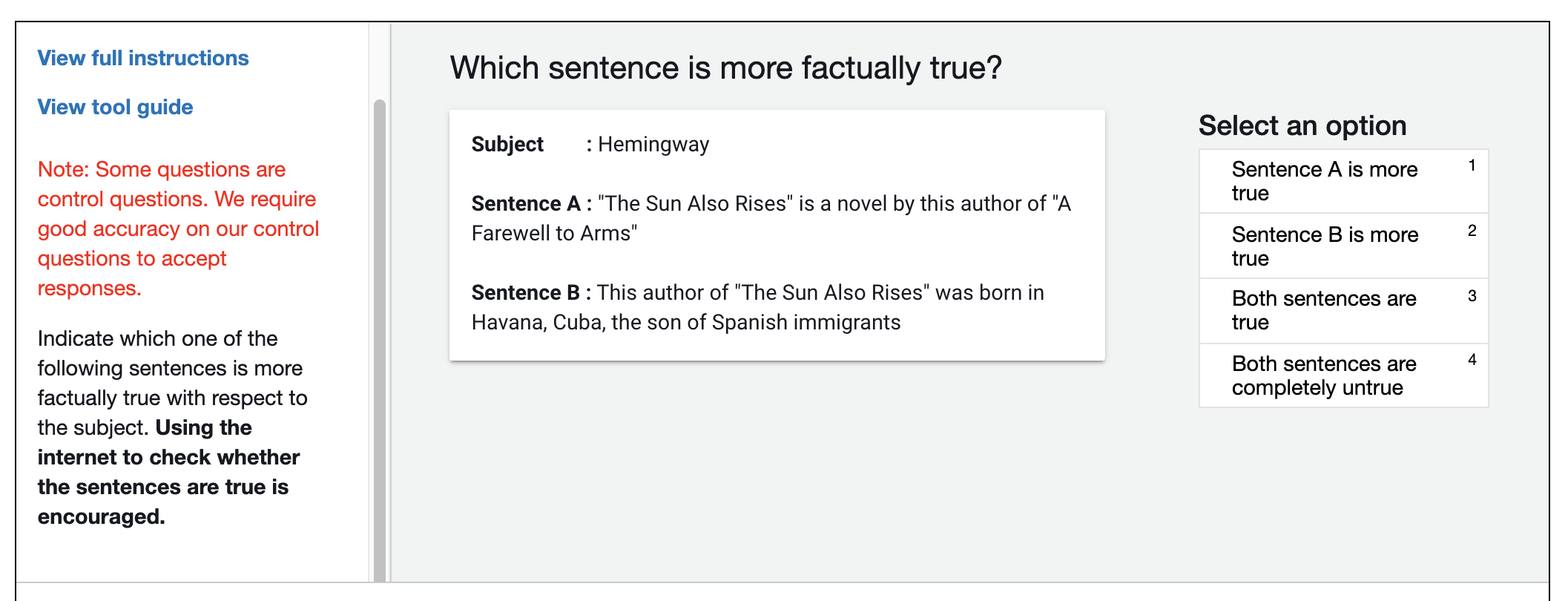
“To avoid any biases for screen position, which model corresponded to sentence A and sentence B was randomly selected for each example.”
plaindirect- Asserted: passes — The authors put it forward as true.
- Checkable: passes — It can be checked against evidence.
- Load-bearing: fails — The paper’s conclusions may not depend on it.
- Based: passes — The paper gives a reason why it holds.
Probably not a substantial claim. The paper’s conclusions may not depend on it.
A conclusion the paper draws from its own results — it cites no other source for it, so there is none to check. The quote shows it is in the paper.
In the paper
“This example shows how parametric and non-parametric memories work together -the non-parametric component helps to guide the generation, drawing out specific knowledge stored in the parametric memory.”
plaindirectSingle case- Asserted: passes — The authors put it forward as true.
- Checkable: passes — It can be checked against evidence.
- Load-bearing: unclear — It is unclear whether the paper’s conclusions depend on it.
- Based: passes — The paper gives a reason why it holds.
It may state two separate claims as one.
A conclusion the paper draws from its own results — it cites no other source for it, so there is none to check. The quote shows it is in the paper.
In the paper
“Documents with clues about the answer but do not contain the answer verbatim can still contribute towards a correct answer being generated, which is not possible with standard extractive approaches, leading to more effective marginalization over documents.”
plaindirect- Asserted: passes — The authors put it forward as true.
- Checkable: passes — It can be checked against evidence.
- Load-bearing: passes — The paper’s conclusions depend on it.
- Based: passes — The paper gives a reason why it holds.
It may state two separate claims as one.
A conclusion the paper draws from its own results — it cites no other source for it, so there is none to check. The quote shows it is in the paper.
In the paper
“Intriguingly, after the first token of each book is generated, the document posterior flattens. This observation suggests that the generator can complete the titles without depending on specific documents.”
hedgedconditional- Asserted: passes — The authors put it forward as true.
- Checkable: passes — It can be checked against evidence.
- Load-bearing: passes — The paper’s conclusions depend on it.
- Based: passes — The paper gives a reason why it holds.
It may state two separate claims as one.
What the paper did — it cites no source for this, so there is none to check. The quote shows it is in the paper.
In the paper
“We included some gold sentences in order to assess the accuracy of the annotators.”
plaindirect- Asserted: passes — The authors put it forward as true.
- Checkable: passes — It can be checked against evidence.
- Load-bearing: fails — The paper’s conclusions may not depend on it.
- Based: passes — The paper gives a reason why it holds.
Probably not a substantial claim. The paper’s conclusions may not depend on it.
A conclusion the paper draws from its own results — it cites no other source for it, so there is none to check. The quote shows it is in the paper.
In the paper
“Our work unifies previous successes in incorporating retrieval into individual tasks, showing that a single retrieval-based architecture is capable of achieving strong performance across several tasks.”
boosteddirect- Asserted: passes — The authors put it forward as true.
- Checkable: passes — It can be checked against evidence.
- Load-bearing: passes — The paper’s conclusions depend on it.
- Based: unclear — It is unclear why the paper says it holds.
It may state two separate claims as one.
What the paper did — it cites no source for this, so there is none to check. The quote shows it is in the paper.
In the paper
“Two annotators did not perform well on these examples and their annotations were removed from the results.”
plaindirect- Asserted: passes — The authors put it forward as true.
- Checkable: passes — It can be checked against evidence.
- Load-bearing: fails — The paper’s conclusions may not depend on it.
- Based: passes — The paper gives a reason why it holds.
Probably not a substantial claim. The paper’s conclusions may not depend on it. It may state two separate claims as one.
A conclusion the paper draws from its own results — it cites no other source for it, so there is none to check. The quote shows it is in the paper.
In the paper
“These successes leverage different retrieval-based architectures and optimization techniques to achieve strong performance on a single task, while we show that a single retrieval-based architecture can be fine-tuned for strong performance on a variety of tasks.”
plaindirect- Asserted: passes — The authors put it forward as true.
- Checkable: passes — It can be checked against evidence.
- Load-bearing: passes — The paper’s conclusions depend on it.
- Based: unclear — It is unclear why the paper says it holds.
It may state two separate claims as one.
A conclusion the paper draws from its own results — it cites no other source for it, so there is none to check. The quote shows it is in the paper.
In the paper
“Jeopardy questions often contain two separate pieces of information, and RAG-Token may perform best because it can generate responses that combine content from several documents.”
hedgedconditional- Asserted: passes — The authors put it forward as true.
- Checkable: passes — It can be checked against evidence.
- Load-bearing: fails — The paper’s conclusions may not depend on it.
- Based: passes — The paper gives a reason why it holds.
Probably not a substantial claim. The paper’s conclusions may not depend on it. It may state two separate claims as one.
A conclusion the paper draws from its own results — it cites no other source for it, so there is none to check. The quote shows it is in the paper.
In the paper
“which we attribute to the official Wiki test set questions being simpler to answer from Wikipedia.”
plaindirect- Asserted: passes — The authors put it forward as true.
- Checkable: passes — It can be checked against evidence.
- Load-bearing: passes — The paper’s conclusions depend on it.
- Based: fails — The paper may give no reason why it holds.
Probably not a substantial claim. The paper may give no reason why it holds.
In the paper
“GPT-2 [50] later showed that a single, left-to-right, pre-trained language model could achieve strong performance across both discriminative and generative tasks.”
What the sources say
- Not checked yetcites [50] [50] Alec Radford, Jeff Wu, Rewon Child, David Luan, Dario Amodei, and Ilya Sutskever. Language models are unsupervised multitask learners, 2019. URL https://d4mucfpksywv.cloudfront.net/better-language-models/language\_ models\_are\_unsupervised\_multitask\_learners.pdf . -
boosteddirect- Asserted: passes — The authors put it forward as true.
- Checkable: passes — It can be checked against evidence.
- Load-bearing: fails — The paper’s conclusions may not depend on it.
- Based: passes — The paper gives a reason why it holds.
Probably not a substantial claim. The paper’s conclusions may not depend on it.
A conclusion the paper draws from its own results — it cites no other source for it, so there is none to check. The quote shows it is in the paper.
In the paper
“and offers more control and interpretability.”
plaindirect- Asserted: passes — The authors put it forward as true.
- Checkable: fails — It may be too vague to check against evidence.
- Load-bearing: fails — The paper’s conclusions may not depend on it.
- Based: fails — The paper may give no reason why it holds.
Probably not a substantial claim. It may be too vague to check against evidence. The paper’s conclusions may not depend on it. The paper may give no reason why it holds.
A conclusion the paper draws from its own results — it cites no other source for it, so there is none to check. The quote shows it is in the paper.
In the paper
“An advantage of non-parametric memory models like RAG is that knowledge can be easily updated at test time. Parametric-only models like T5 or BART need further training to update their behavior as the world changes.”
plaindirect- Asserted: passes — The authors put it forward as true.
- Checkable: passes — It can be checked against evidence.
- Load-bearing: passes — The paper’s conclusions depend on it.
- Based: passes — The paper gives a reason why it holds.
It may state two separate claims as one.
A conclusion the paper draws from its own results — it cites no other source for it, so there is none to check. The quote shows it is in the paper.
In the paper
“the fact that it is more strongly grounded in real factual knowledge (in this case Wikipedia) makes it 'hallucinate' less with generations that are more factual”
boosteddirect- Asserted: passes — The authors put it forward as true.
- Checkable: passes — It can be checked against evidence.
- Load-bearing: passes — The paper’s conclusions depend on it.
- Based: fails — The paper may give no reason why it holds.
Probably not a substantial claim. The paper may give no reason why it holds. It may state two separate claims as one.
None of the sources cited for this claim have been checked yet.
In the paper
“Prior work on general-purpose architectures for NLP tasks has shown great success without the use of retrieval.”
boosted- Asserted: passes — The authors put it forward as true.
- Checkable: passes — It can be checked against evidence.
- Load-bearing: fails — The paper’s conclusions may not depend on it.
- Based: passes — The paper gives a reason why it holds.
Probably not a substantial claim. The paper’s conclusions may not depend on it.
The paper relies on this without support.
Pre-trained language models' ability to access and precisely manipulate knowledge is still limited.
“However, their ability to access and precisely manipulate knowledge is still limited”
The paper relies on this without support.
On knowledge-intensive tasks, pre-trained language models' performance lags behind task-specific architectures.
“and hence on knowledge-intensive tasks, their performance lags behind task-specific architectures.”
The paper relies on this without support.
Providing provenance for pre-trained language models' decisions remains an open research problem.
“Additionally, providing provenance for their decisions and updating their world knowledge remain open research problems.”
The paper relies on this without support.
Updating pre-trained language models' world knowledge remains an open research problem.
“Additionally, providing provenance for their decisions and updating their world knowledge remain open research problems.”
Claims other papers make about this one
Each is checked against this paper’s own text: does it say what the citing paper says it does?
The cited source doesn’t support the claim as written.
In the citing paper
“In contrast to fine-tuning, RAG does not seek to adjust the internal parameters (or internal memory) of an LLM.”
From ChatGPT, extended: large language models and the extended mind (2025) · cites this paper as Lewis et al., 2020
Checked by a reasoning model — may be wrong.
Experimental — accuracy not yet measuredThe cited source doesn’t support the claim as written.
In the citing paper
“standard RAG architectures lack the temporal awareness, version tracking, and memory update mechanisms needed for conversational memory where information evolves over time.”
From Cognis: Context-Aware Memory for Conversational AI Agents (2026) · cites this paper as Lewis et al., 2020
Checked by a reasoning model — may be wrong.
Experimental — accuracy not yet measuredThe cited source doesn’t support the claim as written.
In the citing paper
“The proposed memory-augmented architecture differs from Retrieval-Augmented Generation (RAG) [6] by focusing on adaptive, real-time memory management tailored for ongoing dialogues, as opposed to RAG's static knowledge retrieval from fixed databases.”
From Memory-Augmented Architecture for Long-Term Context Handling in Large Language Models (2026) · cites this paper as [6]
Checked by a reasoning model — may be wrong.
Experimental — accuracy not yet measuredThe cited source doesn’t support the claim as written.
In the citing paper
“The retrieval-plus-rerank decomposition we adopt descends from RAG (Lewis et al., 2020).”
From E-GEO: A Testbed for Generative Engine Optimization in E-Commerce (2025) · cites this paper as Lewis et al., 2020
Checked by a reasoning model — may be wrong.
Experimental — accuracy not yet measuredThe source backs part of the claim, not all of it — or backs it for a different population, condition or comparison.
In the citing paper
“Retrieving relevant knowledge is a widely used strategy to eliminate hallucination (Lewis et al., 2020;Li et al., 2023a).”
From HaluEval: A Large-Scale Hallucination Evaluation Benchmark for Large Language Models (2023) · cites this paper as Lewis et al., 2020
Experimental — accuracy not yet measured
The source backs part of the claim, not all of it — or backs it for a different population, condition or comparison.
In the citing paper
“For AI Agents, RAG has the potential to mitigate hallucinations and can expand static LLM knowledge by grounding outputs in real-time data [216].”
From AI Agents vs. Agentic AI: A Conceptual taxonomy, applications and challenges (2026) · cites this paper as [216]
Experimental — accuracy not yet measuredThe source backs part of the claim, not all of it — or backs it for a different population, condition or comparison.
In the citing paper
“While traditional retrieval-augmented language models (Guu et al., 2020; Lewis et al., 2020; Borgeaud et al., 2022) only read from human-written corpora”
From Cognitive Architectures for Language Agents (2023) · cites this paper as Lewis et al., 2020
Experimental — accuracy not yet measuredThe source backs part of the claim, not all of it — or backs it for a different population, condition or comparison.
In the citing paper
“Information retrieval problems : Naive retrievalaugmented generation [7] lacks temporal awareness and consistency checking, frequently injecting contradictory or outdated context that degrades response quality.”
From From Goldfish to Elephant: Long-Term Memory for Large Language Models via Selective Storage and Hierarchical Compression (2026) · cites this paper as [7]
Experimental — accuracy not yet measuredThe source backs part of the claim, not all of it — or backs it for a different population, condition or comparison.
In the citing paper
“RAG incorporation ensures GenAI agents access relevant and accurate knowledge for context-specific prompts (Gao et al., 2023; Lewis et al., 2020).”
From The effects of generative AI agents and scaffolding on enhancing students’ comprehension of visual learning analytics (2025) · cites this paper as Lewis et al., 2020
Experimental — accuracy not yet measuredThe source backs part of the claim, not all of it — or backs it for a different population, condition or comparison.
In the citing paper
“Current literature on detecting and mitigating factual errors generated by machine learning models focuses predominantly on a single specific task, for example, retrieval-augmented verification models for QA (Lewis et al., 2020), hallucination detection models for text summarization (Fabbri et al., 2022), and execution-based evaluation for code (Shi et al., 2022).”
From FacTool: Factuality Detection in Generative AI - A Tool Augmented Framework for Multi-Task and Multi-Domain Scenarios (2023) · cites this paper as Lewis et al., 2020
Experimental — accuracy not yet measuredThe source backs part of the claim, not all of it — or backs it for a different population, condition or comparison.
In the citing paper
“Prior work optimizes citation accuracy via better retrieval [8, 9] or training [10, 11], but ignores when and how often systems should abstain rather than hallucinate .”
From Abstention vs. Hallucination: Benchmarking LLM Source Attribution for Scientific Citations (2024) · cites this paper as [9]
Experimental — accuracy not yet measuredThe source backs part of the claim, not all of it — or backs it for a different population, condition or comparison.
In the citing paper
“More broadly, work on retrieval and memory-augmented language models suggests that useful context should often be accessed adaptively rather than monolithically packed into a single prompt [28; 48; 37; 56].”
From Meta-Harness: End-to-End Optimization of Model Harnesses (2026) · cites this paper as [28]
Experimental — accuracy not yet measuredThe source backs part of the claim, not all of it — or backs it for a different population, condition or comparison.
In the citing paper
“Retrieval-Augmented Generation (RAG) uses vector-space semantic search to supply only the most contextually similar passages, reducing input length and theoretically suppressing irrelevant distraction.[5]”
From When Context Overwhelms: A Study of Long-Context vs. Retrieval-Based QA Under Noise (2026) · cites this paper as [5]
Experimental — accuracy not yet measuredThe source backs part of the claim, not all of it — or backs it for a different population, condition or comparison.
In the citing paper
“Lewis et al. (2020) established the foundational RAG architecture, demonstrating that grounding generative outputs in retrieved evidence substantially reduces hallucination in open-domain QA. [5]”
From When Context Overwhelms: A Study of Long-Context vs. Retrieval-Based QA Under Noise (2026) · cites this paper as [5]
Experimental — accuracy not yet measuredThe source backs part of the claim, not all of it — or backs it for a different population, condition or comparison.
In the citing paper
“While retrieval-augmented generation (RAG) [Lewis et al., 2020] has become the dominant paradigm for grounding LLM outputs in external knowledge, most RAG systems target document corpora rather than the incremental, personalized memories that accumulate during daily assistant interactions.”
From MemX: A Local-First Long-Term Memory System for AI Assistants (2026) · cites this paper as Lewis et al., 2020
Experimental — accuracy not yet measuredThe source backs part of the claim, not all of it — or backs it for a different population, condition or comparison.
In the citing paper
“This architecture enables the integration of up-to-date information, enhances transparency, reduces hallucinations, and produces evidence-grounded outputs, making RAG well-suited for medical applications.”
From Retrieval-Augmented Generation (RAG) in Healthcare: A Comprehensive Review (2025) · cites this paper as [8]
Experimental — accuracy not yet measuredThe source backs part of the claim, not all of it — or backs it for a different population, condition or comparison.
In the citing paper
“Introduced in 2020, Retrieval-Augmented Generation (RAG) mitigates these limitations by combining a retriever which accesses external sources such as clinical guidelines or EHRs with a generator that conditions responses on both the query and retrieved content [8].”
From Retrieval-Augmented Generation (RAG) in Healthcare: A Comprehensive Review (2025) · cites this paper as [8]
Experimental — accuracy not yet measuredThe source backs part of the claim, not all of it — or backs it for a different population, condition or comparison.
In the citing paper
“To address these problems, Retrieval-Augmented Generation (RAG) was introduced as a framework combining generative reasoning explicitly with non-parametric retrieval from verified external sources [6].”
From Multi-Agent Retrieval Augmented Generation for Clinical Decision Support: A Systematic Review and Integrative Conceptual Framework (2026) · cites this paper as [6]
Experimental — accuracy not yet measuredThe source backs part of the claim, not all of it — or backs it for a different population, condition or comparison.
In the citing paper
“First to couple a seq2seq generator with a dense docu- ment retriever at NeurIPS 2020.”
From Memory for Autonomous LLM Agents:Mechanisms, Evaluation, and Emerging Frontiers (2026) · cites this paper as Lewis et al., 2020
Experimental — accuracy not yet measuredThe source backs part of the claim, not all of it — or backs it for a different population, condition or comparison.
In the citing paper
“The typical architecture integrates four fundamental components: (i) a planning module that decomposes a complex goal into subtasks; (ii) tool use interfaces to query databases, execute bioinformatics pipelines, or control experimental automations; (iii) short- and long-term memory, often implemented through retrieval-augmented generation (RAG), to maintain context and documentary grounding [18];”
From The next paradigm in bioinformatics: a review of multi-agent systems and foundational models for end-to-end scientific discovery (2026) · cites this paper as [18]
Experimental — accuracy not yet measuredThe source backs part of the claim, not all of it — or backs it for a different population, condition or comparison.
In the citing paper
“While RAG substantially improves factual recall in long-horizon settings, its implications for belief tracking are less understood.”
From BeliefShift: Benchmarking Temporal Belief Consistency and Opinion Drift in LLM Agents (2026) · cites this paper as [20]
Experimental — accuracy not yet measuredThe source backs part of the claim, not all of it — or backs it for a different population, condition or comparison.
In the citing paper
“This is the core limitation of retrieval-augmented approaches to longitudinal memory: they solve the access problem but not the interpretation problem [20, 5].”
From BeliefShift: Benchmarking Temporal Belief Consistency and Opinion Drift in LLM Agents (2026) · cites this paper as [20]
Experimental — accuracy not yet measuredThe source backs part of the claim, not all of it — or backs it for a different population, condition or comparison.
In the citing paper
“or employ retrieval-augmented generation (RAG) that does not validate whether cited sources are accessible, topically relevant, or factually consistent with the claims they support (Lewis et al., 2020; Lumer et al., 2025a; Gulati et al., 2026b)”
From Cited but Not Verified: Parsing and Evaluating Source Attribution in LLM Deep Research Agents (2026) · cites this paper as Lewis et al., 2020
Experimental — accuracy not yet measuredThe source backs part of the claim, not all of it — or backs it for a different population, condition or comparison.
In the citing paper
“LLMs can generate responses with inline citations through web search integration and retrieval-augmented generation (RAG) (Lewis et al., 2020).”
From Cited but Not Verified: Parsing and Evaluating Source Attribution in LLM Deep Research Agents (2026) · cites this paper as Lewis et al., 2020
Experimental — accuracy not yet measuredThe source backs part of the claim, not all of it — or backs it for a different population, condition or comparison.
In the citing paper
“Early RAG implementations, however, often relied on document retrieval methods that introduced noise and excessive context [26, 55, 60, 122].”
From LEGO-GraphRAG: Modularizing Graph-Based Retrieval-Augmented Generation for Design Space Exploration (2025) · cites this paper as [60]
Experimental — accuracy not yet measuredThe source backs part of the claim, not all of it — or backs it for a different population, condition or comparison.
In the citing paper
“Recent work has demonstrated that equipping LLM agents with long-term memory significantly enhances their ability to reason over extended horizons [9, 11].”
From Collaborative Memory: Multi-User Memory Sharing in LLM Agents with Dynamic Access Control (2025) · cites this paper as [9]
Experimental — accuracy not yet measuredThe source backs part of the claim, not all of it — or backs it for a different population, condition or comparison.
In the citing paper
“As opposed to CoT, this architecture directly feeds useful information to the QA model, thus grounding the response, reducing factuality hallucinations, and improving explainability of results.”
From ProSLM: A Prolog Synergized Language Model for explainable Domain Specific Knowledge Based Question Answering (2024) · cites this paper as [10]
Experimental — accuracy not yet measuredThe source backs part of the claim, not all of it — or backs it for a different population, condition or comparison.
In the citing paper
“Generative search inherits elements from retrieval-augmented generation: retrieve candidate material, ground a response, and provide attribution [12,13,14,15].”
From From Citation Selection to Citation Absorption: A Measurement Framework for Generative Engine Optimization Across AI Search Platforms (2026) · cites this paper as [12]
Experimental — accuracy not yet measuredThe source backs part of the claim, not all of it — or backs it for a different population, condition or comparison.
In the citing paper
“Deep search agents conduct tasks through iterative query reasoning, search planning, and reflection on retrieved results (Asai et al., 2024), outperforming the traditional single-round retrieval-augmented generation paradigm (Lewis et al., 2020).”
From BrowseComp-Plus: A Fair and Disentangled Evaluation Benchmark for Deep Search Agents (2026) · cites this paper as Lewis et al., 2020
Experimental — accuracy not yet measuredThe source backs part of the claim, not all of it — or backs it for a different population, condition or comparison.
In the citing paper
“At a high level, e-commerce generative engines can be viewed as instances of retrieval-augmented generation (RAG) (Lewis et al., 2020).”
From E-GEO: A Testbed for Generative Engine Optimization in E-Commerce (2025) · cites this paper as Lewis et al., 2020
Experimental — accuracy not yet measuredThe source backs part of the claim, not all of it — or backs it for a different population, condition or comparison.
In the citing paper
“Memory-augmented methods extend this concept by retrieving user-specific information from past interactions. This addresses the challenge of a limited context window and enables the integration of past information into the input prompt [25, 29, 45].”
From CAIM: Development and Evaluation of a Cognitive AI Memory Framework for Long-Term Interaction with Intelligent Agents (2026) · cites this paper as [29]
Experimental — accuracy not yet measuredThe source backs part of the claim, not all of it — or backs it for a different population, condition or comparison.
In the citing paper
“Retrieval has not disappeared, since retrieval-augmented generation [34] made it a standard component of LLM systems, but the retrieved text is now often read by a model before, or instead of, a person.”
From Agentic Memory Management Is the Next Frontier of Information Retrieval (2026) · cites this paper as [34]
Experimental — accuracy not yet measuredThe cited source says what the claim attributes to it.
In the citing paper
“RAG combines a parametric sequence-to-sequence model with a dense non-parametric memory of retrieved passages, making retrieval a first-class component of generation [12].”
From Oracle Agent Memory as an Enterprise Memory Substrate for Long-Horizon AI Agents (2026) · cites this paper as [12]
The cited source says what the claim attributes to it.
In the citing paper
“Retrieval-Augmented Generation grounds LLM outputs in external evidence retrieved at inference time (Lewis et al., 2020; Gao et al., 2023).”
From Membox: Weaving Topic Continuity into Long-Range Memory for LLM Agents (2026) · cites this paper as Lewis et al., 2020
The cited source says what the claim attributes to it.
In the citing paper
“Instead, RAG relies on the retrieval of information from an externally-situated store, which functions as a form of non-parametric (or external) memory.”
From ChatGPT, extended: large language models and the extended mind (2025) · cites this paper as Lewis et al., 2020
The cited source says what the claim attributes to it.
In the citing paper
“RAG [7], REALM [10], and RETRO [11] retrieve from large corpora.”
From From Goldfish to Elephant: Long-Term Memory for Large Language Models via Selective Storage and Hierarchical Compression (2026) · cites this paper as [7]
The cited source says what the claim attributes to it.
In the citing paper
“These systems proved a crucial point: external knowledge stores can be queried dynamically during generation without retraining.”
From Memory for Autonomous LLM Agents:Mechanisms, Evaluation, and Emerging Frontiers (2026) · cites this paper as Lewis et al., 2020
The cited source says what the claim attributes to it.
In the citing paper
“RAG [Lewis et al., 2020] demonstrated that pairing a generator with a non-parametric retrieval index produces strong results on knowledge-intensive tasks.”
From Memory for Autonomous LLM Agents:Mechanisms, Evaluation, and Emerging Frontiers (2026) · cites this paper as Lewis et al., 2020
The cited source says what the claim attributes to it.
In the citing paper
“Non-parametric memory serves as a supplementary knowledge source that can be dynamically accessed by the large language model, enhancing its ability to retrieve relevant information in realtime, as seen in retrieval-augmented generation (RAG) [25].”
From From Human Memory to AI Memory: A Survey on Memory Mechanisms in the Era of LLMs (2025) · cites this paper as [25]
The cited source says what the claim attributes to it.
In the citing paper
“We then classify AI long-term memory into parametric and non-parametric memory in Sec. 4, based on the form of storage [27, 28].”
From Human-inspired Perspectives: A Survey on AI Long-term Memory (2024) · cites this paper as [27]
The cited source says what the claim attributes to it.
In the citing paper
“Based on these observations, we categorize AI long-term memory into non-parametric memory (Sec. 4.1) and parametric memory (Sec. 4.2), following the criteria illustrated by Lewis et al. [27] and Mallen et al. [28] and depicted in Fig. 5.”
From Human-inspired Perspectives: A Survey on AI Long-term Memory (2024) · cites this paper as [27]
The cited source says what the claim attributes to it.
In the citing paper
“Additionally, the static nature of parametric memory can lead to information lag, posing challenges in maintaining the relevance of the stored data as it may not reflect the most current information [27, 166].”
From Human-inspired Perspectives: A Survey on AI Long-term Memory (2024) · cites this paper as [27]
The cited source says what the claim attributes to it.
In the citing paper
“Several prior works note the benefits of treating large knowledge sources or long inputs as external resources that a language model accesses adaptively, rather than consuming them in a single pass.”
From Meta-Harness: End-to-End Optimization of Model Harnesses (2026) · cites this paper as [28]
The cited source says what the claim attributes to it.
In the citing paper
“Memory research has progressed from simple retrieval augmentation to more selective and tiered memory architectures [Lewis et al., 2020, Packer et al., 2023, Chhikara et al., 2025, Xu et al., 2025b].”
From Externalization in LLM Agents: A Unified Review of Memory, Skills, Protocols and Harness Engineering (2026) · cites this paper as Lewis et al., 2020
The cited source says what the claim attributes to it.
In the citing paper
“Notably, RAG (Lewis et al., 2020) serves as flat factual memory in our setup, only outperforming on single-hop questions.”
From Bi-Mem: Bidirectional Construction of Hierarchical Memory for Personalized LLMs via Inductive-Reflective Agents (2026) · cites this paper as Lewis et al., 2020
The cited source says what the claim attributes to it.
In the citing paper
“Retrieval-Augmented Generation (RAG) is a promising approach for mitigating the hallucination of large language models (LLMs).”
From Benchmarking Large Language Models in Retrieval-Augmented Generation (2024) · cites this paper as Lewis et al. 2020
The cited source says what the claim attributes to it.
In the citing paper
“Retrieval-Augmented Generation (RAG) has gained attention as a method to enhance LLM capabilities by grounding responses in retrieved contextual information (10).”
From Unlocking electronic health records: a hybrid graph RAG approach to safe clinical AI for patient QA (2026) · cites this paper as [10]
The cited source says what the claim attributes to it.
In the citing paper
“Retrieval-Augmented Generation (RAG) enhances large language models (LLMs) by integrating external knowledge retrieval to improve factual consistency and reduce hallucinations.”
From Retrieval-Augmented Generation (RAG) in Healthcare: A Comprehensive Review (2025) · cites this paper as [8]
The cited source says what the claim attributes to it.
In the citing paper
“Recent studies have started exploring the joint modeling of retrieval and generation in knowledgeintensive tasks, such as question answering (Guu et al., 2020;Lewis et al., 2020;Izacard et al., 2022) and dialogue generation (Zhang et al., 2022).”
From RepoCoder: Repository-Level Code Completion Through Iterative Retrieval and Generation (2023) · cites this paper as Lewis et al., 2020
The cited source says what the claim attributes to it.
In the citing paper
“Many works have identified reducing factual errors (sometimes called 'hallucinations') as a key challenge for building more reliable language models (Lewis et al., 2020; Kadavath et al., 2022; Zhang et al., 2023), even for the most powerful language models (Bubeck et al., 2023).”
From Fine-tuning Language Models for Factuality (2023) · cites this paper as Lewis et al., 2020
The cited source says what the claim attributes to it.
In the citing paper
“RetrievalAugmented Generation (RAG) [26] can, in principle, ground explanations on retrieved sources, enabling verification against clinical guidelines [63,94].”
From Explainability of decoder-only clinical large language models: A scoping review (2026) · cites this paper as [26]
The cited source says what the claim attributes to it.
In the citing paper
“On the other hand, using RAG methods as a long-term memory system offers a simple way to update knowledge over time [36, 42, 66, 73].”
From HippoRAG: Neurobiologically Inspired Long-Term Memory for Large Language Models (2024) · cites this paper as [42]
The cited source says what the claim attributes to it.
In the citing paper
“Adapting through contexts rather than weights offers several key advantages. Contexts are interpretable and explainable for users and developers (Wei et al., 2022; Wang et al., 2023), allow rapid integration of new knowledge at runtime (Lewis et al., 2020; Borgeaud et al., 2022), and can be shared across models or modules in a compound system (Khot et al., 2023).”
From Agentic Context Engineering: Evolving Contexts for Self-Improving Language Models (2025) · cites this paper as Lewis et al., 2020
The cited source says what the claim attributes to it.
In the citing paper
“Retrieval-Augmented Generation (RAG) methods (Figure 1 left; Lewis et al. 2020; Guu et al. 2020) augment the input of LLMs with relevant retrieved passages, reducing factual errors in knowledge-intensive tasks (Ram et al., 2023; Asai et al., 2023a).”
From CareerX: A Retrieval-Augmented Generation Framework for Personalized AI-Driven Career Guidance (2023) · cites this paper as Lewis et al. 2020
The cited source says what the claim attributes to it.
In the citing paper
“In-context learning methods now routinely invoke tools, leading to LM pipelines that use retrieval models (Chen et al., 2017; Lewis et al., 2020; Guu et al., 2020; Lazaridou et al., 2022; Izacard et al., 2022), multimodal foundation models, and more traditional tools like APIs (Nakano et al., 2021) and calculators.”
From DSPy: Compiling Declarative Language Model Calls into Self-Improving Pipelines (2023) · cites this paper as Lewis et al., 2020
The cited source says what the claim attributes to it.
In the citing paper
“RAG systems typically operate on a finite knowledge base [46].”
From Cache-Craft: Managing Chunk-Caches for Efficient Retrieval-Augmented Generation (2025) · cites this paper as [46]
The cited source says what the claim attributes to it.
In the citing paper
“This paradigm has already been proven to be effective in multiple IA tasks such as question answering [85].”
From Foundations of GenIR (2025) · cites this paper as [85]
The cited source says what the claim attributes to it.
In the citing paper
“Instead of using single-turn retrieval-augmented generation (RAG) to load memory into context [22], M3-Agent employs reinforcement learning to enable multi-turn reasoning and iterative memory retrieval, resulting in higher task success rates.”
From Seeing, Listening, Remembering, and Reasoning: A Multimodal Agent with Long-Term Memory (2025) · cites this paper as [22]
The cited source says what the claim attributes to it.
In the citing paper
“Lewis et al. (2020) introduced RAG to access specific knowledge bases more precisely when using LLMs and reduce the 'hallucination' rates, when a model makes up information in a confident manner.”
From Grounding Large Language Models in Clinical Evidence: A Retrieval-Augmented Generation System for Querying UK NICE Clinical Guidelines (2025) · cites this paper as Lewis et al., 2020
The cited source says what the claim attributes to it.
In the citing paper
“Even retrievalaugmented models (Guu et al., 2020;Lewis et al., 2020), which retrieve relevant documents and then condition on them to generate text, still do not guarantee attribution.”
From RARR: Researching and revising what language models say, using language models (2023) · cites this paper as Lewis et al., 2020
The cited source says what the claim attributes to it.
In the citing paper
“RAG models augment LLMs with an information retrieval mechanism that concatenates input prompts with relevant text retrieved from a vector index (Lewis et al., 2020).”
From Ranking Manipulation for Conversational Search Engines (2024) · cites this paper as Lewis et al., 2020
The cited source says what the claim attributes to it.
In the citing paper
“Finally, users can insert custom local modules after some of the existing blocks, which could allow use-cases like retrieval-augmented generation (Borgeaud et al., 2021;Lewis et al., 2020).”
From Petals: Collaborative Inference and Fine-tuning of Large Models (2023) · cites this paper as Lewis et al., 2020
The check wasn’t confident either way, so it gives no verdict — never disputed.
In the citing paper
“Current large language models (LLMs) exhibit remarkable single-turn capabilities but suffer from severe limitations in maintaining coherent, personalized interactions over extended temporal horizons a phenomenon we term the 'goldfish problem.'”
From From Goldfish to Elephant: Long-Term Memory for Large Language Models via Selective Storage and Hierarchical Compression (2026) · cites this paper as [7]
Experimental — accuracy not yet measuredThe check wasn’t confident either way, so it gives no verdict — never disputed.
In the citing paper
“The strongest non-A-Mem baselines are domain-dependent (rolling Summary on the coding QA axis and Naive RAG on retrieval), both of which A-Mem beats by a comfortable margin under maximum pressure.”
From MemGym: a Long-Horizon Memory Environment for LLM Agents (2026) · cites this paper as [25]
Experimental — accuracy not yet measuredThe check wasn’t confident either way, so it gives no verdict — never disputed.
In the citing paper
“The payoff of memory therefore grows with pressure, and the gap is most visible on retrieval depth: A-Mem's lead over Naive RAG widens with hop count because note-evolution links bridge passages whose isolated query-relevance is low, which is the failure mode of a flat retriever at 5 / 6 -hop.”
From MemGym: a Long-Horizon Memory Environment for LLM Agents (2026) · cites this paper as [25]
Experimental — accuracy not yet measuredThe check wasn’t confident either way, so it gives no verdict — never disputed.
In the citing paper
“HyDE [11] construct hypothetical documents (assumed answers to the original query).It focuses on embedding similarity from answer to answer rather than seeking embedding similarity for the problem or query.”
From Retrieval-Augmented Generation for Large Language Models: A Survey (2023) · cites this paper as [11]
Experimental — accuracy not yet measuredThe check wasn’t confident either way, so it gives no verdict — never disputed.
In the citing paper
“This structure-aware retrieval enables multi-hop reasoning that flat semantic search cannot support [Lewis et al., 2020, Gao et al., 2023].”
From Accurate and Efficient Long-Term Memory for LLM Agents (2026) · cites this paper as Lewis et al., 2020
Experimental — accuracy not yet measuredThe check wasn’t confident either way, so it gives no verdict — never disputed.
In the citing paper
“Conversational search engines are fundamentally based on the Retrieval-Augmented Generation (RAG) architecture.”
From Ranking Manipulation for Conversational Search Engines (2024) · cites this paper as Lewis et al., 2020
Experimental — accuracy not yet measuredIn the citing paper
“While modern Retrieval-Augmented Generation (RAG) systems (Lewis et al., 2020) share surface similarities with CBR, they typically query static document corpora and lack mechanisms for continual adaptation (Gao et al., 2023).”
From Memento: Fine-tuning LLM Agents without Fine-tuning LLMs (2025) · cites this paper as Lewis et al., 2020
Self-check
Percentages, sums and reported differences re-computed from the paper’s own numbers.
Each contradiction between two passages listed here was confirmed by an independent check.
Rated minor: it would not touch a result — a value no result rests on, a p-value that stays on the same side of the significance level, or a conflict that is clerical, resolved elsewhere in the paper, or outside its own findings.
In the paper
§ 4.3 Jeopardy Question Generation · p. 6
“both RAG and BART were factual in a further 17% of cases”
§ 4.5 Additional Results · p. 8
“| Both good | 11.7% | 11.8% |”
Citations
Cites
Vaswani, A., Shazeer, N., Parmar, N., Uszkoreit, J., Jones, L., Gomez, A. N., Kaiser, L., & Polosukhin, I. (2017) · arXiv · doi:10.48550/arxiv.1706.03762 · Cited by 120,404
Adam: A Method for Stochastic Optimization
Kingma, D. P., & Ba, J. (2014) · arXiv · doi:10.48550/arxiv.1412.6980 · Cited by 98,946
BERT: Pre-training of Deep Bidirectional Transformers for Language Understanding
Devlin, J., Chang, M.-W., Lee, K., & Toutanova, K. (2019) · Proceedings of the 2019 Conference of the North American Chapter of the Association for Computational Linguistics: Human Language Technologies, Volume 1 (Long and Short Papers) · doi:10.18653/v1/n19-1423 · Cited by 54,325
Exploring the Limits of Transfer Learning with a Unified Text-to-Text Transformer
Raffel, C., Shazeer, N., Roberts, A., Lee, K., Narang, S., Matena, M., Zhou, Y., Li, W., & Liu, P. J. (2019) · arXiv · doi:10.48550/arxiv.1910.10683 · Cited by 10,929
Lewis, M., Liu, Y., Goyal, N., Ghazvininejad, M., Mohamed, A., Levy, O., Stoyanov, V., & Zettlemoyer, L. (2020) · Proceedings of the 58th Annual Meeting of the Association for Computational Linguistics · doi:10.18653/v1/2020.acl-main.703 · Cited by 8,821
Self-citationLewis, M., Liu, Y., Goyal, N., Ghazvininejad, M., Mohamed, A., Levy, O., Stoyanov, V., & Zettlemoyer, L. (2019) · arXiv · doi:10.48550/arxiv.1910.13461 · Cited by 8,816
Self-citationDense Passage Retrieval for Open-Domain Question Answering
Karpukhin, V., Oğuz, B., Min, S., Lewis, P., Wu, L., Edunov, S., Chen, D., & Yih, W.-T. (2020) · arXiv · doi:10.48550/arxiv.2004.04906 · Cited by 5,311
Self-citationBillion-scale similarity search with GPUs
Johnson, J., Douze, M., & Jegou, H. (2021) · IEEE Transactions on Big Data · doi:10.1109/tbdata.2019.2921572 · Cited by 4,228
GLUE: A Multi-Task Benchmark and Analysis Platform for Natural Language Understanding
Wang, A., Singh, A., Michael, J., Hill, F., Levy, O., & Bowman, S. (2018) · Proceedings of the 2018 EMNLP Workshop BlackboxNLP: Analyzing and Interpreting Neural Networks for NLP · doi:10.18653/v1/w18-5446 · Cited by 4,222
Billion-scale similarity search with GPUs
Johnson, J., Douze, M., & Jégou, H. (2017) · arXiv · doi:10.48550/arxiv.1702.08734 · Cited by 4,140
Research works printed but not linked: 4
- [18][18] Jiatao Gu, Yong Wang, Kyunghyun Cho, and Victor O.K. Li. Search engine guided neural machine translation. In 32nd AAAI Conference on Artificial Intelligence, AAAI 2018 , 32nd AAAI Conference on Artificial Intelligence, AAAI 2018, pages 5133-5140. AAAI press, 2018. 32nd AAAI Conference on Artificial Intelligence, AAAI 2018 ; Conference date: 02-02-2018 Through 07-02-2018. -
- [25][25] Armand Joulin and Tomas Mikolov. Inferring algorithmic patterns with stackaugmented recurrent nets. In Proceedings of the 28th International Conference on Neural Information Processing Systems -Volume 1 , NIPS'15, page 190-198, Cambridge, MA, USA, 2015. MIT Press. URL https://papers.nips.cc/paper/ 5857-inferring-algorithmic-patterns-with-stack-augmented-recurrent-nets . -
- [27][27] Urvashi Khandelwal, Omer Levy, Dan Jurafsky, Luke Zettlemoyer, and Mike Lewis. Generalization through memorization: Nearest neighbor language models. In International Conference on Learning Representations , 2020. URL https://openreview.net/forum?id=HklBjCEKvH . -
- [62][62] Shuohang Wang, Mo Yu, Xiaoxiao Guo, Zhiguo Wang, Tim Klinger, Wei Zhang, Shiyu Chang, Gerry Tesauro, Bowen Zhou, and Jing Jiang. R 3 : Reinforced ranker-reader for open-domain question answering. In Sheila A. McIlraith and Kilian Q. Weinberger, editors, Proceedings of the Thirty-Second AAAI Conference on Artificial Intelligence, (AAAI-18), the 30th innovative Applications of Artificial Intelligence (IAAI-18), and the 8th AAAI Symposium on Educational Advances in Artificial Intelligence (EAAI-18), New Orleans, Louisiana, USA, February 2-7, 2018 , pages 5981-5988. AAAI Press, 2018. URL https://www.aaai.org/ocs/index. php/AAAI/AAAI18/paper/view/16712 . -
Cited by
Sorted by citations
Items 201–300 of 6,151
Graph Neural Prompting with Large Language Models
Tian, Y., Song, H., Wang, Z., Wang, H., Hu, Z., Wang, F., Chawla, N. V., & Xu, P. (2024) · Proceedings of the AAAI Conference on Artificial Intelligence · doi:10.1609/aaai.v38i17.29875 · Cited by 105
Towards effective teaching assistants: From intent-based chatbots to LLM-powered teaching assistants
Alsafari, B., Atwell, E., Walker, A., & Callaghan, M. J. (2024) · Natural Language Processing Journal · doi:10.1016/j.nlp.2024.100101 · Cited by 101
Advancing building energy modeling with large language models: Exploration and case studies
Zhang, L., Chen, Z., & Ford, V. (2024) · Energy and Buildings · doi:10.1016/j.enbuild.2024.114788 · Cited by 101
Uhm, M., Kim, J., Ahn, S., Jeong, H., & Kim, H. (2024) · Automation in Construction · doi:10.1016/j.autcon.2024.105926 · Cited by 100
RCAgent: Cloud Root Cause Analysis by Autonomous Agents with Tool-Augmented Large Language Models
Wang, Z., Liu, Z., Zhang, Y., Zhong, A., Wang, J., Yin, F., Fan, L., Wu, L., & Wen, Q. (2024) · Proceedings of the 33rd ACM International Conference on Information and Knowledge Management · doi:10.1145/3627673.3680016 · Cited by 99
SelfKG: Self-Supervised Entity Alignment in Knowledge Graphs
Liu, X., Hong, H., Wang, X., Chen, Z., Kharlamov, E., Dong, Y., & Tang, J. (2022) · International World Wide Web Conference (WWW) · doi:10.1145/3485447.3511945 · Cited by 99
AI and the Future of Collaborative Work: Group Ideation with an LLM in a Virtual Canvas
He, J., Houde, S., Gonzalez, G. E., Moran, D., Ross, S., Muller, M. J., & Weisz, J. D. (2024) · Annual Symposium on Human-Computer Interaction for Work (CHIWORK) · doi:10.1145/3663384.3663398 · Cited by 98
Small language models learn enhanced reasoning skills from medical textbooks
Kim, H., Hwang, H., Lee, J.-W., Park, S., Kim, D. R., Lee, T., Yoon, C., Sohn, J., Park, J., Reykhart, O., et al. (2025) · npj Digital Medicine · doi:10.1038/s41746-025-01653-8 · Cited by 110
Generative Spoken Dialogue Language Modeling
Nguyen, T. A., Kharitonov, E., Copet, J., Adi, Y., Hsu, W.-N., Elkahky, A. M., Tomasello, P., Algayres, R., Sagot, B., Mohamed, A., et al. (2023) · Transactions of the Association for Computational Linguistics · doi:10.1162/tacl_a_00545 · Cited by 97
Retrieval Augmented Classification for Long-Tail Visual Recognition
Long, A., Yin, W., Ajanthan, T., Nguyen, D.-V., Purkait, P., Garg, R., Blair, A., Shen, C., & van den Hengel, A. (2022) · IEEE Computer Society Conference on Computer Vision and Pattern Recognition/Proceedings - IEEE Computer Society Conference on Computer Vision and Pattern Recognition/Proceedings · doi:10.1109/cvpr52688.2022.00683 · Cited by 97
Reducing hallucination in structured outputs via Retrieval-Augmented Generation
Ayala, O., & Bechard, P. (2024) · Proceedings of the 2024 Conference of the North American Chapter of the Association for Computational Linguistics: Human Language Technologies (Volume 6: Industry Track) · doi:10.18653/v1/2024.naacl-industry.19 · Cited by 97
“Retrieval-Augmented Generation is a common approach to limit generation of false or outdated information in classical NLP tasks such as question answering and summarization (Lewis et al., 2020; Izacard and Grave, 2021; Shuster et al., 2021).”
BackgroundMethodTowards Few-shot Fact-Checking via Perplexity
Lee, N., Bang, Y., Madotto, A., & Fung, P. (2021) · Conference of the North American Chapter of the Association for Computational Linguistics: Human Language Technologies (NAACL-HLT) · doi:10.18653/v1/2021.naacl-main.158 · Cited by 96
Song, Y., Wu, K., & Ding, J. (2024) · Computers & Education X Reality · doi:10.1016/j.cexr.2024.100069 · Cited by 96
Few-Shot Bot: Prompt-Based Learning for Dialogue SystemsPreprint
Madotto, A., Lin, Z., Winata, G. I., & Fung, P. (2021) · arXiv (Cornell University) · doi:10.48550/arxiv.2110.08118 · Cited by 96
Neural Machine Translation with Monolingual Translation Memory
Cai, D., Wang, Y., Li, H., Lam, W. P., & Liu, L. (2021) · Annual Meeting of the Association for Computational Linguistics · doi:10.18653/v1/2021.acl-long.567 · Cited by 95
Evaluating the effectiveness of biomedical fine-tuning for large language models on clinical tasks
Dorfner, F. J., Dada, A., Busch, F., Makowski, M. R., Han, T., Truhn, D., Kleesiek, J., Sushil, M., Adams, L. C., & Bressem, K. K. (2025) · Journal of the American Medical Informatics Association · doi:10.1093/jamia/ocaf045 · Cited by 95
Application of large language models in medicine
Liu, F., Zhou, H., Gu, B., Zou, X., Huang, J., Wu, J., Li, Y., Chen, S. S., Hua, Y., Zhou, P., et al. (2025) · Nature Reviews Bioengineering · doi:10.1038/s44222-025-00279-5 · Cited by 94
LightningDOT: Pre-training Visual-Semantic Embeddings for Real-Time Image-Text Retrieval
Sun, S., Chen, Y.-C., Li, L., Wang, S., Fang, Y., & Liu, J. (2021) · Conference of the North American Chapter of the Association for Computational Linguistics: Human Language Technologies (NAACL-HLT) · doi:10.18653/v1/2021.naacl-main.77 · Cited by 94
Alawwad, H. A., Alhothali, A., Naseem, U., Alkhathlan, A., & Jamal, A. T. (2025) · Pattern Recognition · doi:10.1016/j.patcog.2024.111332 · Cited by 96
Towards Lifelong Learning of Large Language Models: A Survey
Zheng, J., Qiu, S., Shi, C., & Ma, Q. (2025) · ACM Computing Surveys · doi:10.1145/3716629 · Cited by 93
Yuan, M., Bao, P., Yuan, J., Shen, Y., Chen, Z., Xie, Y., Zhao, J., Li, Q., Chen, Y., Zhang, L., et al. (2024) · Medicine Plus · doi:10.1016/j.medp.2024.100030 · Cited by 93
From Word Embeddings to Pre-Trained Language Models: A State-of-the-Art Walkthrough
Mars, M. (2022) · Applied Sciences · doi:10.3390/app12178805 · Cited by 91
Liu, W., Yu, A., Zan, D., Shen, B., Zhang, W., Zhao, H., Jin, Z. G., & Wang, Q. (2024) · IEEE/ACM International Conference on Automated Software Engineering (ASE) · doi:10.1145/3691620.3695054 · Cited by 91
An autonomous GIS agent framework for geospatial data retrieval
Ning, H., Li, Z., Akinboyewa, T., & Lessani, M. N. (2025) · International Journal of Digital Earth · doi:10.1080/17538947.2025.2458688 · Cited by 91
Zhu, R. (2020) · arXiv (Cornell University) · doi:10.48550/arxiv.2012.08290 · Cited by 91
Mind the Gap: Assessing Temporal Generalization in Neural Language Models
Lazaridou, A., Kuncoro, A., Gribovskaya, E., Agrawal, D., Liska, A., Terzi, T., Gimenez, M., d'Autume, C. D. M., Kocisky, T., Ruder, S., et al. (2021) · arXiv · doi:10.48550/arxiv.2102.01951 · Cited by 90
Improving Passage Retrieval with Zero-Shot Question Generation
Sachan, D., Lewis, M., Joshi, M., Aghajanyan, A., Yih, W.-T., Pineau, J., & Zettlemoyer, L. (2022) · Proceedings of the 2022 Conference on Empirical Methods in Natural Language Processing · doi:10.18653/v1/2022.emnlp-main.249 · Cited by 90
Self-citationDynamic Retrieval Augmented Generation of Ontologies using Artificial Intelligence (DRAGON-AI)
Toro, S., Anagnostopoulos, A. V., Bello, S. M., Blumberg, K., Cameron, R., Carmody, L., Diehl, A. D., Dooley, D., Duncan, W. D., Fey, P., et al. (2024) · Journal of Biomedical Semantics · doi:10.1186/s13326-024-00320-3 · Cited by 96
Xu, L., Zhang, J., Li, B., Wang, J., Chen, S., Zhao, W. X., & Wen, J.-R. (2025) · ACM Transactions on Knowledge Discovery from Data · doi:10.1145/3726871 · Cited by 90
Self-Reflection in LLM Agents: Effects on Problem-Solving Performance
Renze, M., & Guven, E. (2024) · arXiv · doi:10.48550/arxiv.2405.06682 · Cited by 89
Zhou, X., Kim, K., Xu, B., Han, D., & Lo, D. (2024) · ACM/IEEE International Conference on Software Engineering: Companion Proceedings (ICSE-Companion) · doi:10.1145/3597503.3639222 · Cited by 89
End-to-End Training of Neural Retrievers for Open-Domain Question Answering
Sachan, D. S., Patwary, M. A., Shoeybi, M., Kant, N., Ping, W., Hamilton, W. L., & Catanzaro, B. (2021) · Annual Meeting of the Association for Computational Linguistics · doi:10.18653/v1/2021.acl-long.519 · Cited by 88
Efficient Passage Retrieval with Hashing for Open-domain Question Answering
Yamada, I., Asai, A., & Hajishirzi, H. (2021) · doi:10.18653/v1/2021.acl-short.123 · Cited by 88
A Survey of Robot Intelligence with Large Language Models
Jeong, H., Lee, H., Kim, C., & Shin, S. (2024) · Applied Sciences · doi:10.3390/app14198868 · Cited by 89
Dimensions of commonsense knowledge
Ilievski, F., Oltramari, A., Ma, K., Zhang, B., McGuinness, D. L., & Szekely, P. A. (2021) · Knowledge-Based Systems · doi:10.1016/j.knosys.2021.107347 · Cited by 87
Tell Me Your Prompts and I Will Make Them True: The Alchemy of Prompt Engineering and Generative AI
Bozkurt, A. (2024) · Open Praxis · doi:10.55982/openpraxis.16.2.661 · Cited by 87
Pandey, S., Xu, R., Wang, W., & Chu, X. (2025) · Physics of Fluids · doi:10.1063/5.0257555 · Cited by 87
Generative AI in architectural design: Application, data, and evaluation methods
Jang, S., Roh, H., & Lee, G. (2025) · Automation in Construction · doi:10.1016/j.autcon.2025.106174 · Cited by 87
The Revolution of Multimodal Large Language Models: A Survey
Caffagni, D., Cocchi, F., Barsellotti, L., Moratelli, N., Sarto, S., Baraldi, L., Baraldi, L., Cornia, M., & Cucchiara, R. (2024) · Findings of the Association for Computational Linguistics ACL 2024 · doi:10.18653/v1/2024.findings-acl.807 · Cited by 98
“While retrieval-augmented generation (RAG) is a consolidated technique in LLMs (Lewis et al., 2020; Asai et al., 2023), its application in MLLMs is still under-explored.”
Transforming literature screening: The emerging role of large language models in systematic reviews
Delgado-Chaves, F. M., Jennings, M. J., Atalaia, A., Wolff, J., Horvath, R., Mamdouh, Z. M., Baumbach, J., & Baumbach, L. (2025) · Proceedings of the National Academy of Sciences · doi:10.1073/pnas.2411962122 · Cited by 86
MemoRAG: Boosting Long Context Processing with Global Memory-Enhanced Retrieval Augmentation
Qian, H., Liu, Z., Zhang, P., Mao, K., Lian, D., Dou, Z., & Huang, T. (2025) · Proceedings of the ACM on Web Conference 2025 · doi:10.1145/3696410.3714805 · Cited by 86
Wang, C., Ong, J., Wang, C., Ong, D., Cheng, R., & Ong, D. (2023) · Annals of Biomedical Engineering · doi:10.1007/s10439-023-03327-6 · Cited by 86
Envisioning Information Access Systems: What Makes for Good Tools and a Healthy Web?
Shah, C. S., & Bender, E. M. (2024) · ACM Transactions on the Web · doi:10.1145/3649468 · Cited by 86
An advanced retrieval-augmented generation system for manufacturing quality control
Heredia, J. A., & Barreda, J. G. (2024) · Advanced Engineering Informatics · doi:10.1016/j.aei.2024.103007 · Cited by 90
Yan, L., Martinez-Maldonado, R., Jin, Y., Echeverria, V., Milesi, M., Fan, J., Zhao, L., Alfredo, R., Li, X., & Gašević, D. (2025) · Computers & Education · doi:10.1016/j.compedu.2025.105322 · Cited by 85
WebGLM: Towards An Efficient Web-Enhanced Question Answering System with Human Preferences
Liu, X., Lai, H., Yu, H., Xu, Y., Zeng, A., Du, Z., Zhang, P., Dong, Y., & Tang, J. (2023) · ACM SIGKDD Conference on Knowledge Discovery and Data Mining (KDD) · doi:10.1145/3580305.3599931 · Cited by 86
Natural-Language Agent HarnessesPreprint
Pan, L., Zou, L., Guo, S., Ni, J., & Zheng, H.-T. (2026) · arXiv (Cornell University) · doi:10.48550/arxiv.2603.25723 · Cited by 84
Tree of Clarifications: Answering Ambiguous Questions with Retrieval-Augmented Large Language Models
Kim, G., Kim, S., Jeon, B., Park, J., & Kang, J. (2023) · Conference on Empirical Methods in Natural Language Processing (EMNLP) · doi:10.18653/v1/2023.emnlp-main.63 · Cited by 84
Jill Watson: A Virtual Teaching Assistant Powered by ChatGPT
Taneja, K., Maiti, P., Kakar, S., Guruprasad, P., Rao, S., & Goel, A. K. (2024) · Lecture notes in computer science · doi:10.1007/978-3-031-64302-6_23 · Cited by 84
Leveraging LLMs for the Quality Assurance of Software Requirements
Lubos, S., Felfernig, A., Tran, T. N. T., Garber, D., Mansi, M. E., Erdeniz, S. P., & Le, V.-M. (2024) · IEEE International Requirements Engineering Conference (RE) · doi:10.1109/re59067.2024.00046 · Cited by 83
Knowledge-Aware Language Model PretrainingPreprint
Rosset, C., Xiong, C., Phan, M., Song, X., Bennett, P. N., & Tiwary, S. (2020) · arXiv (Cornell University) · doi:10.48550/arxiv.2007.00655 · Cited by 84
Automated Root Causing of Cloud Incidents using In-Context Learning with GPT-4
Zhang, X., Ghosh, S., Bansal, C., Wang, R., Ma, M., Kang, Y., & Rajmohan, S. (2024) · ACM Joint European Software Engineering Conference and Symposium on the Foundations of Software Engineering (ESEC/FSE) · doi:10.1145/3663529.3663846 · Cited by 88
Harnessing artificial intelligence to fill global shortfalls in biodiversity knowledge
Pollock, L. J., Kitzes, J. A., Beery, S., Gaynor, K. M., Jarzyna, M. A., Aodha, O. M., Meyer, B. E., Rolnick, D., Taylor, G. W., Tuia, D., et al. (2025) · Nature Reviews Biodiversity · doi:10.1038/s44358-025-00022-3 · Cited by 82
Glicksberg, B. S., Timsina, P., Patel, D., Sawant, A., Vaid, A., Raut, G., Charney, A. W., Apakama, D., Carr, B. G., Freeman, R., et al. (2024) · Journal of the American Medical Informatics Association · doi:10.1093/jamia/ocae103 · Cited by 82
Natural language processing in the era of large language models
Zubiaga, A. (2024) · Frontiers in Artificial Intelligence · doi:10.3389/frai.2023.1350306 · Cited by 81
Retrieval-based Language Models and Applications
Asai, A., Min, S., Zhong, Z., & Chen, D. (2023) · Proceedings of the 61st Annual Meeting of the Association for Computational Linguistics (Volume 6: Tutorial Abstracts) · doi:10.18653/v1/2023.acl-tutorials.6 · Cited by 81
Relevance-guided Supervision for OpenQA with ColBERT
Khattab, O., Potts, C., & Zaharia, M. (2021) · Transactions of the Association for Computational Linguistics · doi:10.1162/tacl_a_00405 · Cited by 81
SPARTA: Efficient Open-Domain Question Answering via Sparse Transformer Matching Retrieval
Zhao, T., Lu, X., & Lee, K. (2021) · Conference of the North American Chapter of the Association for Computational Linguistics: Human Language Technologies (NAACL-HLT) · doi:10.18653/v1/2021.naacl-main.47 · Cited by 81
Generative AI in education: ChatGPT-4 in evaluating students’ written responses
Jauhiainen, J. S., & Guerra, A. G. (2024) · Innovations in Education and Teaching International · doi:10.1080/14703297.2024.2422337 · Cited by 81
Chen, L.-C., Pardeshi, M. S., Liao, Y., & Pai, K.-C. (2025) · Computer Standards & Interfaces · doi:10.1016/j.csi.2025.103995 · Cited by 81
Generative Artificial Intelligence in Qualitative Data Analysis: Analyzing—Or Just Chatting?
Nguyen, D. C., & Welch, C. (2025) · Organizational Research Methods · doi:10.1177/10944281251377154 · Cited by 81
Ontology-enhanced Prompt-tuning for Few-shot Learning
Ye, H., Zhang, N., Deng, S., Chen, X., Chen, H., Xiong, F., Chen, X., & Chen, H. (2022) · International World Wide Web Conference (WWW) · doi:10.1145/3485447.3511921 · Cited by 80
HealAI: A Healthcare LLM for Effective Medical Documentation
Goyal, S., Rastogi, E., Rajagopal, S. P., Yuan, D., Zhao, F., Chintagunta, J., Naik, G., & Ward, J. (2024) · ACM International Conference on Web Search and Data Mining (WSDM) · doi:10.1145/3616855.3635739 · Cited by 80
Mobile-LLaMA: Instruction Fine-Tuning Open-Source LLM for Network Analysis in 5G Networks
Kan, K. B., Mun, H., Cao, G., & Lee, Y. (2024) · IEEE Network · doi:10.1109/mnet.2024.3421306 · Cited by 79
ChatEV: Predicting electric vehicle charging demand as natural language processing
Qu, H., Li, H., You, L., Zhu, R., Yan, J., Santi, P., Ratti, C., & Yuen, C. (2024) · Transportation Research Part D Transport and Environment · doi:10.1016/j.trd.2024.104470 · Cited by 79
Han, S., Wang, M., Zhang, J., Li, D., & Duan, J. (2024) · Electronics · doi:10.3390/electronics13245040 · Cited by 81
Don't Do RAG: When Cache-Augmented Generation is All You Need for Knowledge Tasks
Chan, B. J., Chen, C.-T., Cheng, J.-H., & Huang, H. (2025) · International World Wide Web Conference (WWW) · doi:10.1145/3701716.3715490 · Cited by 79
Buess, L., Keicher, M., Navab, N., Maier, A., & Arasteh, S. T. (2025) · Biomedical Engineering Letters · doi:10.1007/s13534-025-00497-1 · Cited by 79
Democratizing Financial Knowledge with ChatGPT by OpenAI: Unleashing the Power of TechnologyPreprint
Yue, T., Au, D., Au, C. C., & Iu, K. Y. (2023) · SSRN Electronic Journal · doi:10.2139/ssrn.4346152 · Cited by 74
Wu, Z., Kong, L., Bi, W., Li, X., & Kao, B. (2021) · doi:10.18653/v1/2021.acl-long.480 · Cited by 78
Foundation Models for Natural Language Processing
Paaß, G., & Giesselbach, S. (2023) · Artificial intelligence: foundations, theory, and algorithms/Artificial intelligence: Foundations, theory, and algorithms · doi:10.1007/978-3-031-23190-2 · Cited by 79
Semnani, S. J., Yao, V., Zhang, H., & Lam, M. S. (2023) · Findings of the Association for Computational Linguistics: EMNLP (Findings of EMNLP) · doi:10.18653/v1/2023.findings-emnlp.157 · Cited by 78
Jose, S., Nguyen, K. T. P., Medjaher, K., Zemouri, R. M., Lévesque, M., & Tahan, A. S. (2024) · Expert Systems with Applications · doi:10.1016/j.eswa.2024.124603 · Cited by 78
GIScience in the era of Artificial Intelligence: a research agenda towards Autonomous GIS
Li, Z., Ning, H., Gao, S., Janowicz, K., Li, W., Arundel, S. T., Yang, C. P., Bhaduri, B., Wang, S., Zhu, A.-X., et al. (2025) · Annals of GIS · doi:10.1080/19475683.2025.2552161 · Cited by 78
Jang, S., Lee, G., Oh, J., Lee, J., & Koo, B. (2024) · Advanced Engineering Informatics · doi:10.1016/j.aei.2024.102532 · Cited by 77
Generative AI for self-adaptive systems: State of the art and research roadmap
Li, J., Zhang, M., Li, N., Weyns, D., Jin, Z., & Tei, K. (2024) · ACM Transactions on Autonomous and Adaptive Systems · doi:10.1145/3686803 · Cited by 77
Kharchenko, J., Roosta, T. G., Chadha, A. R., & Shah, C. (2024) · arXiv (Cornell University) · doi:10.13140/rg.2.2.30422.25927 · Cited by 77
Frisoni, G., Moro, G., & Carbonaro, A. (2021) · IEEE Access · doi:10.1109/access.2021.3130956 · Cited by 76
Retrieving Multimodal Information for Augmented Generation: A Survey
Zhao, R., Chen, H., Wang, W., Jiao, F., Long, X., Qin, C., Ding, B., Guo, X., Li, M., Li, X., et al. (2023) · Findings of the Association for Computational Linguistics: EMNLP (Findings of EMNLP) · doi:10.18653/v1/2023.findings-emnlp.314 · Cited by 75
Hussien, M. M., Melo, A. N., Ballardini, A. L., Salinas, C., Izquierdo, R., & Sotelo, M. Á. (2024) · Expert Systems with Applications · doi:10.1016/j.eswa.2024.125914 · Cited by 76
Knollmeyer, S., Caymazer, O., & Großmann, D. (2025) · Electronics · doi:10.3390/electronics14112102 · Cited by 76
Retrieving Supporting Evidence for Generative Question Answering
Huo, S., Arabzadeh, N., & Clarke, C. L. A. (2023) · Annual International ACM SIGIR Conference on Research and Development in Information Retrieval in the Asia Pacific Region (SIGIR-AP) · doi:10.1145/3624918.3625336 · Cited by 75
Large language models present new questions for decision support
Handler, A., Larsen, K. R. T., & Hackathorn, R. D. (2024) · International Journal of Information Management · doi:10.1016/j.ijinfomgt.2024.102811 · Cited by 75
Large Language Models Meet Next-Generation Networking Technologies: A Review
Hang, C. N., Yu, P.-D., Morabito, R., & Tan, C. W. (2024) · Future Internet · doi:10.3390/fi16100365 · Cited by 75
Menezes, G. L., Mazon, G., Ferreira, R. E. P., Cabrera, V. E., & Dórea, J. R. R. (2024) · Animal Frontiers · doi:10.1093/af/vfae048 · Cited by 75
Weakly-Supervised Visual-Retriever-Reader for Knowledge-based Question Answering
Luo, M., Zeng, Y., Banerjee, P., & Baral, C. R. (2021) · Conference on Empirical Methods in Natural Language Processing (EMNLP) · doi:10.18653/v1/2021.emnlp-main.517 · Cited by 74
CDLM: Cross-Document Language Modeling
Caciularu, A., Cohan, A., Beltagy, I., Peters, M. E., Cattan, A., & Dagan, I. (2021) · Findings of the Association for Computational Linguistics: EMNLP (Findings of EMNLP) · doi:10.18653/v1/2021.findings-emnlp.225 · Cited by 75
Large Foundation Models for Power Systems
Huang, C., Li, S., Liu, R., Wang, H., & Chen, Y. (2024) · IEEE Power Engineering Society General Meeting · doi:10.1109/pesgm51994.2024.10688670 · Cited by 74
From screens to scenes: A survey of embodied AI in healthcare
Liu, Y., Cao, X., Chen, T., Jiang, Y., You, J., Wu, M., Wang, X., Feng, M., Jin, Y., & Chen, J. (2025) · Information Fusion · doi:10.1016/j.inffus.2025.103033 · Cited by 76
Parametric Retrieval Augmented Generation
Su, W., Tang, Y., Ai, Q., Yan, J., Wang, C., Wang, H., Ye, Z., Zhou, Y., & Liu, Y. (2025) · International ACM SIGIR Conference on Research and Development in Information Retrieval (SIGIR) · doi:10.1145/3726302.3729957 · Cited by 74
Enhancing supply chain visibility with knowledge graphs and large language models
AlMahri, S., Xu, L., & Brintrup, A. (2025) · International Journal of Production Research · doi:10.1080/00207543.2025.2575841 · Cited by 74
Dr ChatGPT tell me what I want to hear: How different prompts impact health answer correctness
Koopman, B., & Zuccon, G. (2023) · Proceedings of the 2023 Conference on Empirical Methods in Natural Language Processing · doi:10.18653/v1/2023.emnlp-main.928 · Cited by 73
“This is important when LLMs are integrated in a retrieve-then-generate 1 pipeline (Chen et al., 2017; Karpukhin et al., 2020; Lewis et al., 2020), where information related to the question is first identi-fied from a corpus (e.g., the Web), and this is then passed to the model via the prompt to…”
BackgroundCategorizing Variants of Goodhart's Law
Manheim, D., & Garrabrant, S. (2018) · arXiv · doi:10.48550/arxiv.1803.04585 · Cited by 73
Expert-Guided Large Language Models for Clinical Decision Support in Precision Oncology
Lammert, J., Dreyer, T. F., Mathes, S., Kuligin, L., Borm, K. J., Schatz, U. A., Kiechle, M. B., Lörsch, A. M., Jung, J., Lange, S., et al. (2024) · JCO Precision Oncology · doi:10.1200/po-24-00478 · Cited by 73
An Empirical Study on Challenges for LLM Application Developers
Chen, X., Gao, C., Chen, C., Zhang, G., & Liu, Y. (2025) · ACM Transactions on Software Engineering and Methodology · doi:10.1145/3715007 · Cited by 73
AIGC-empowered smart manufacturing: Prospects and challenges
Leng, J., Zheng, K., Li, R. C., Chen, C., Wang, B., Liu, Q., Chen, X., & Shen, W. (2025) · Robotics and Computer-Integrated Manufacturing · doi:10.1016/j.rcim.2025.103076 · Cited by 74
Cognitive Architectures for Language Agents
Sumers, T. R., Yao, S., Narasimhan, K., & Griffiths, T. L. (2023) · arXiv · doi:10.48550/arxiv.2309.02427 · Cited by 72
“Retrieval Augmented Generation (Lewis et al., 2020) Table 1: Conceptual diagram illustrating how prompting methods manipulate the input string before generating completions.”
BackgroundMethodInfluentialGraph Retrieval-Augmented Generation for Large Language Models: A Survey
Procko, T. T., & Ochoa, O. (2024) · 2024 Conference on AI, Science, Engineering, and Technology (AIxSET) · doi:10.1109/aixset62544.2024.00030 · Cited by 125
KG-FiD: Infusing Knowledge Graph in Fusion-in-Decoder for Open-Domain Question Answering
Yu, D., Zhu, C., Fang, Y., Yu, W., Wang, S., Xu, Y., Ren, X., Yang, Y., & Zeng, M. (2022) · Proceedings of the conference - Association for Computational Linguistics. Meeting · doi:10.18653/v1/2022.acl-long.340 · Cited by 72
LLM-based and Retrieval-Augmented Control Code Generation
Koziolek, H., Grüner, S., Hark, R., Ashiwal, V., Linsbauer, L., & Eskandani, N. (2024) · International Workshop on Large Language Models for Code (LLM4Code) · doi:10.1145/3643795.3648384 · Cited by 72
Metadata
- Authors
- Lewis, P., Perez, E., Piktus, A., Petroni, F., Karpukhin, V., Goyal, N., Küttler, H., Lewis, M., Yih, W.-T., Rocktäschel, T., Riedel, S., & Kiela, D.
- Affiliations
- Meta (United Kingdom) (GB)
- Venue
- arXiv
- Publisher
- arXiv
- Published
- 2020
- ISSN
- 2331-8422 (ISSN-L)
- arXiv
- 2005.11401
- OpenAlex
- W3027879771
- Cited by
- 3,101
- References
- 59
- Citations by year
- 2026: 243 · 2025: 1260 · 2024: 924 · 2023: 318 · 2022: 168 · 2021: 156 · 2020: 31
- Type
- posted content
- Language
- en
- Open access
- green
- arxiv.org
- Locations
- arXiv (Cornell University) (submittedVersion)
- arXiv (Cornell University)
- Topics
- Physical Sciences › Engineering › Safety, Risk, Reliability and Quality › Safety Systems Engineering in Autonomy
- Physical Sciences › Computer Science › Artificial Intelligence › Ethics and Social Impacts of AI
- Physical Sciences › Computer Science › Artificial Intelligence › Adversarial Robustness in Machine Learning
- Keywords
- certification framework, retrieval-augmented generation, LLM reliability
About these checks
Registry, retraction, Cites and statistics results are computed, not judged, with one exception: a printed reference that no index lists is read once by a model before it counts as a citation error. Claims are extracted by a model and kept only when their quote appears verbatim in the text; each cited source is then checked, with a model’s help, for whether it says what the claim relies on. Those verdicts can be wrong — read the claim’s quote and the cited source before relying on one.
A language model drew the claims from the paper on 2026-11-08, under version 3 of the claim definition (model deepseek-v4.1-flash, prompt extract-v3).
A second model labelled each claim on 2026-11-08 (model jev-1.13-20260917, definition revision gold-guideline-v0.2).
Cited sources are checked with a language model’s help (gpt-6-sol).
Statistics and arithmetic are recomputed, not judged.
Confidence bands are shown only for fields calibrated on our annotated test set. None is calibrated yet, so no band is shown.
What counts as a claim ›How we measure confidence ›How we check this ›
Are you an author, or do you see a problem with this page? Request a review
