

The DOI matches its Crossref record; 33 of the 33 references it cites were found in a registry or an index.
Latent Retrieval for Weakly Supervised Open Domain Question Answering
Open accessAbstract
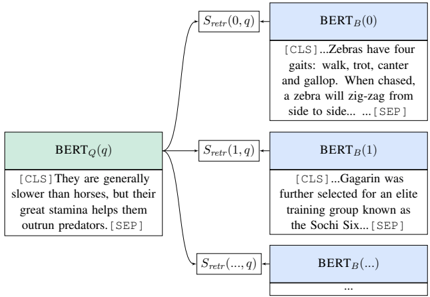
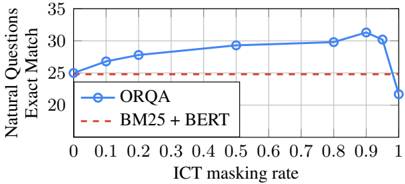
Recent work on open domain question answering (QA) assumes strong supervision of the supporting evidence and/or assumes a blackbox information retrieval (IR) system to retrieve evidence candidates.We argue that both are suboptimal, since gold evidence is not always available, and QA is fundamentally different from IR.We show for the first time that it is possible to jointly learn the retriever and reader from question-answer string pairs and without any IR system.In this setting, evidence retrieval from all of Wikipedia is treated as a latent variable.Since this is impractical to learn from scratch, we pre-train the retriever with an Inverse Cloze Task.We evaluate on open versions of five QA datasets.On datasets where the questioner already knows the answer, a traditional IR system such as BM25 is sufficient.On datasets where a user is genuinely seeking an answer, we show that learned retrieval is crucial, outperforming BM25 by up to 19 points in exact match.
Overview
The claims and statistics of this paper haven’t been checked yet.
Free: it reads the open-access text and checks the first 5 claims that cite a source we can check. Create a free account to check every claim.
Integrity signals
Registry
Cites
Statistics
Figures

Verification
Claims the paper makes
The claims and statistics of this paper haven’t been checked yet.
Free: it reads the open-access text and checks the first 5 claims that cite a source we can check. Create a free account to check every claim.
Claims other papers make about this one
Each is checked against this paper’s own text: does it say what the citing paper says it does?
The source backs part of the claim, not all of it — or backs it for a different population, condition or comparison.
In the citing paper
“Pretrained models with a differentiable access mechanism to explicit non-parametric memory have so far been only investigated for extractive downstream tasks.”
From Retrieval-Augmented Generation for Knowledge-Intensive NLP Tasks (2020) · cites this paper as [31]
Experimental — accuracy not yet measuredThe source backs part of the claim, not all of it — or backs it for a different population, condition or comparison.
In the citing paper
“The standard solution to these issues is to rely on Retrieval Augmented Generation (RAG) (Lee et al., 2019;Lewis et al., 2020;Guu et al., 2020).”
From RAGAs: Automated Evaluation of Retrieval Augmented Generation (2024) · cites this paper as Lee et al., 2019
Experimental — accuracy not yet measuredThe source backs part of the claim, not all of it — or backs it for a different population, condition or comparison.
In the citing paper
“Dense retrieval methods have thus never be shown to outperform TF-IDF/BM25 for opendomain QA before ORQA (Lee et al., 2019)”
From Dense passage retrieval for open-domain question answering (2020) · cites this paper as Lee et al., 2019
Experimental — accuracy not yet measuredThe cited source says what the claim attributes to it.
In the citing paper
“We instantiate this task with data from NaturalQuestions-Open (Lee et al., 2019;Kwiatkowski et al., 2019), which contains historical queries issued to the Google search engine, coupled with human-annotated answers extracted from Wikipedia.”
From Lost in the Middle: How Language Models Use Long Contexts (2024) · cites this paper as Lee et al., 2019
The cited source says what the claim attributes to it.
In the citing paper
“REALM [20] and ORQA [31], two recently introduced models that combine masked language models [8] with a differentiable retriever, have shown promising results, but have only explored open-domain extractive question answering.”
From Retrieval-Augmented Generation for Knowledge-Intensive NLP Tasks (2020) · cites this paper as [31]
8 more claims about this paper
Create a free account to see every claim other papers make about this one.
Self-check
Percentages, sums and reported differences re-computed from the paper’s own numbers.
The self-check needs the paper’s full text.
Citations
Cites
BERT: Pre-training of Deep Bidirectional Transformers for Language Understanding
Devlin, J., Chang, M.-W., Lee, K., & Toutanova, K. (2018) · arXiv · doi:10.48550/arxiv.1810.04805 · Cited by 73,173 · cited 3×
“Following recent advances in transfer learning, all scoring components are derived from BERT (Devlin et al., 2018), a bidirectional transformer that has been pre-trained on unsupervised language-modeling data.”
BackgroundMethodSelf-citationBERT: Pre-training of Deep Bidirectional Transformers for Language Understanding
Devlin, J., Chang, M.-W., Lee, K., & Toutanova, K. (2019) · Proceedings of the 2019 Conference of the North American Chapter of the Association for Computational Linguistics: Human Language Technologies, Volume 1 (Long and Short Papers) · doi:10.18653/v1/n19-1423 · Cited by 54,325 · cited 3×
“Following recent advances in transfer learning, all scoring components are derived from BERT (Devlin et al., 2018), a bidirectional transformer that has been pre-trained on unsupervised language-modeling data.”
BackgroundMethodSelf-citationEfficient Estimation of Word Representations in Vector Space
Mikolov, T., Chen, K., Corrado, G., & Dean, J. (2013) · arXiv · doi:10.48550/arxiv.1301.3781 · Cited by 26,568 · cited 1×
“ICT can be considered a generalization of the skip-gram objective (Mikolov et al., 2013), with a coarser granularity, deep architecture, and in-batch negative sampling from Logeswaran and Lee (2018).”
BackgroundDeep Contextualized Word Representations
Peters, M., Neumann, M., Iyyer, M., Gardner, M., Clark, C., Lee, K., & Zettlemoyer, L. (2018) · Proceedings of the 2018 Conference of the North American Chapter of the Association for Computational Linguistics: Human Language Technologies, Volume 1 (Long Papers) · doi:10.18653/v1/n18-1202 · Cited by 11,983 · cited 2×
“, 2003),4 and (2) ELMO (small), a context-dependent bidirectional LSTM (Peters et al., 2018).”
BackgroundMethodSelf-citationSQuAD: 100,000+ Questions for Machine Comprehension of Text
Rajpurkar, P., Zhang, J., Lopyrev, K., & Liang, P. (2016) · Proceedings of the 2016 Conference on Empirical Methods in Natural Language Processing · doi:10.18653/v1/d16-1264 · Cited by 6,208 · cited 8×
“In the strongly supervised setting popularized by DrQA (Chen et al., 2017), they also assume a reading comprehension model trained on question-answer-evidence triples, such as SQuAD (Rajpurkar et al., 2016).”
BackgroundMethodResultInfluential“Cloze Procedure”: A New Tool for Measuring Readability
Taylor, W. L. (1953) · Journalism Quarterly · doi:10.1177/107769905303000401 · Cited by 2,332 · cited 1×
“In the standard Cloze task (Taylor, 1953), the goal is to predict masked-out text based on its context.”
BackgroundNatural Questions: A benchmark for question answering research
Kwiatkowski, T., Palomaki, J., Redfield, O., Collins, M., Parikh, A., Alberti, C., Epstein, D., Polosukhin, I., Devlin, J., Lee, K., et al. (2019) · Transactions of the Association for Computational Linguistics · doi:10.1162/tacl_a_00276 · Cited by 2,069 · cited 3×
“Natural Questions contains question from aggregated queries to Google Search (Kwiatkowski et al., 2019).”
BackgroundSelf-citationTriviaQA: A Large Scale Distantly Supervised Challenge Dataset for Reading Comprehension
Joshi, M., Choi, E., Weld, D., & Zettlemoyer, L. (2017) · Proceedings of the 55th Annual Meeting of the Association for Computational Linguistics (Volume 1: Long Papers) · doi:10.18653/v1/p17-1147 · Cited by 1,690 · cited 8×
“TriviaQA is a collection of trivia questionanswer pairs that were scraped from the web (Joshi et al., 2017).”
BackgroundMethodInfluentialTriviaQA: A Large Scale Distantly Supervised Challenge Dataset for Reading Comprehension
Joshi, M., Choi, E., Weld, D. S., & Zettlemoyer, L. (2017) · arXiv · doi:10.48550/arxiv.1705.03551 · Cited by 1,650 · cited 8×
“TriviaQA is a collection of trivia questionanswer pairs that were scraped from the web (Joshi et al., 2017).”
BackgroundMethodInfluential(2000) · CrossRef Listing of Deleted DOIs · doi:10.1162/153244303322533223 · Cited by 1,566 · cited 3×
“Based on existing IR literature and the intuition that LMs do not explicitly optimize for retrieval, we do not expect these to be strong base-lines, but they demonstrate the difficulty of encoding blocks of text into 128 dimensions.”
Method
Research works printed but not linked: 6
- Yoshua Bengio, Réjean Ducharme, Pascal Vincent, and Christian Jauvin. 2003. A neural probabilistic lan- guage model. Journal of machine learning research, 3(Feb):1137-1155.
- Danqi Chen, Adam Fisch, Jason Weston, and Antoine Bordes. 2017. Reading wikipedia to answer open- domain questions. In Proceedings of the 55th An- nual Meeting of the Association for Computational Linguistics (Volume 1: Long Papers), volume 1, pages 1870-1879.
- Rajarshi Das, Shehzaad Dhuliawala, Manzil Zaheer, and Andrew McCallum. 2019. Multi-step retriever- reader interaction for scalable open-domain question answering. In International Conference on Learn- ing Representations.
- Matthew E. Peters, Mark Neumann, Mohit Iyyer, Matt Gardner, Christopher Clark, Kenton Lee, and Luke Zettlemoyer. 2018. Deep contextualized word rep- resentations. In Proc. of NAACL.
- Stephen Robertson, Hugo Zaragoza, et al. 2009. The probabilistic relevance framework: Bm25 and be- yond. Foundations and Trends in Information Re- trieval, 3(4):333-389.
- Shuohang Wang, Mo Yu, Xiaoxiao Guo, Zhiguo Wang, Tim Klinger, Wei Zhang, Shiyu Chang, Gerry Tesauro, Bowen Zhou, and Jing Jiang. 2018. R 3: Reinforced ranker-reader for open-domain question answering. In Thirty-Second AAAI Conference on Artificial Intelligence.
Cited by
Dense passage retrieval for open-domain question answering
Karpukhin, V., Oguz, B., Min, S., Lewis, P., Wu, L., Edunov, S., Chen, D., & Yih, W.-T. (2020) · Proceedings of the 2020 Conference on Empirical Methods in Natural Language Processing (EMNLP) · doi:10.18653/v1/2020.emnlp-main.550 · Cited by 3,575
Retrieval-Augmented Generation for Knowledge-Intensive NLP Tasks
Lewis, P., Perez, E., Piktus, A., Petroni, F., Karpukhin, V., Goyal, N., Küttler, H., Lewis, M., Yih, W.-T., Rocktäschel, T., et al. (2020) · arXiv · doi:10.48550/arxiv.2005.11401 · Cited by 3,101
“Following Lee et al. [27] and Karpukhin et al. [22], we use the December 2018 dump.”
MethodResultInfluentialLost in the Middle: How Language Models Use Long Contexts
Liu, N. F., Lin, K., Hewitt, J., Paranjape, A., Bevilacqua, M., Petroni, F., & Liang, P. (2024) · Transactions of the Association for Computational Linguistics · doi:10.1162/tacl_a_00638 · Cited by 1,612
“When retrieving from Wikipedia to answer queries from NaturalQuestions-Open, we find that model performance saturates long before retriever re-call saturates, indicating that current models fail to effectively use additional retrieved doc-uments—using 50 documents instead of 20 retrieved documents only marginally impr…”
MethodInfluentialLost in the Middle: How Language Models Use Long Contexts
Liu, N. F., Lin, K., Hewitt, J., Paranjape, A., Bevilacqua, M., Petroni, F., & Liang, P. (2023) · arXiv · doi:10.48550/arxiv.2307.03172 · Cited by 1,599
“When retrieving from Wikipedia to answer queries from NaturalQuestions-Open, we find that model performance saturates long before retriever re-call saturates, indicating that current models fail to effectively use additional retrieved doc-uments—using 50 documents instead of 20 retrieved documents only marginally impr…”
MethodInfluentialBig Bird: Transformers for Longer Sequences
Zaheer, M., Guruganesh, G., Dubey, A., Ainslie, J., Alberti, C., Ontanon, S., Pham, P., Ravula, A., Wang, Q., Yang, L., et al. (2020) · arXiv · doi:10.48550/arxiv.2007.14062 · Cited by 1,349
“Most prominently, SpanBERT [42], ORQA [54], REALM [34], RAG [57] have achieved strong performance for different tasks.”
Method
Metadata
- Authors
- Lee, K., Chang, M.-W., & Toutanova, K.
- Affiliations
- Google (United States) (US)
- Venue
- Proceedings of the 57th Annual Meeting of the Association for Computational Linguistics
- Published
- 2019
- Pages
- 6086-6096
- ISSN
- 0736-587X (ISSN-L)
- OpenAlex
- W2947497897
- Cited by
- 771
- References
- 30
- Citations by year
- 2026: 36 · 2025: 67 · 2024: 70 · 2023: 159 · 2022: 134 · 2021: 194 · 2020: 101 · 2019: 10
- FWCI
- 41.99
- Type
- conference paper
- Language
- en
- Open access
- hybrid
- doi.org
- Licence
- cc-by
- Locations
- Proceedings of the conference - Association for Computational Linguistics. Meeting (publishedVersion, cc-by)
- arXiv (Cornell University) (submittedVersion)
- arXiv (Cornell University)
- Topics
- Physical Sciences › Computer Science › Artificial Intelligence › Topic Modeling
- Physical Sciences › Computer Science › Information Systems › Information Retrieval and Search Behavior
- Physical Sciences › Computer Science › Computer Vision and Pattern Recognition › Multimodal Machine Learning Applications
- Keywords
- open-domain question answering, weakly supervised learning, evidence retrieval
About these checks
Registry, retraction, Cites and statistics results are computed, not judged, with one exception: a printed reference that no index lists is read once by a model before it counts as a citation error. Claims are extracted by a model and kept only when their quote appears verbatim in the text; each cited source is then checked, with a model’s help, for whether it says what the claim relies on. Those verdicts can be wrong — read the claim’s quote and the cited source before relying on one.
Statistics and arithmetic are recomputed, not judged.
Confidence bands are shown only for fields calibrated on our annotated test set. None is calibrated yet, so no band is shown.
What counts as a claim ›How we measure confidence ›How we check this ›
Are you an author, or do you see a problem with this page? Request a review
How to cite
Cite CoChat for the checks on this page, and the paper for its own findings.
- This page
- CoChat. (2026). Citation check: Latent Retrieval for Weakly Supervised Open Domain Question Answering. https://app.cochat.ai/papers/10.18653/v1/p19-1612
- The paper
- Lee, K., Chang, M.-W., & Toutanova, K. (2019). Latent Retrieval for Weakly Supervised Open Domain Question Answering. Proceedings of the 57th Annual Meeting of the Association for Computational Linguistics. https://doi.org/10.18653/v1/p19-1612
Data sources
Bibliographic data: Semantic Scholar, OpenAlex, Crossref.
Contains information from the Semantic Scholar Academic Graph Datasets, made available under the ODC Attribution License (ODC-BY 1.0).
Semantic Scholar’s data is described in: Kinney, R., et al. (2023). The Semantic Scholar Open Data Platform. arXiv:2301.10140.
