

The DOI matches its DataCite record; 49 of the 49 references it cites were found in a registry or an index; 10 of the 38 sources its claims cite were checked for support.
Score-Based Generative Modeling through Stochastic Differential Equations
Open accessAbstract
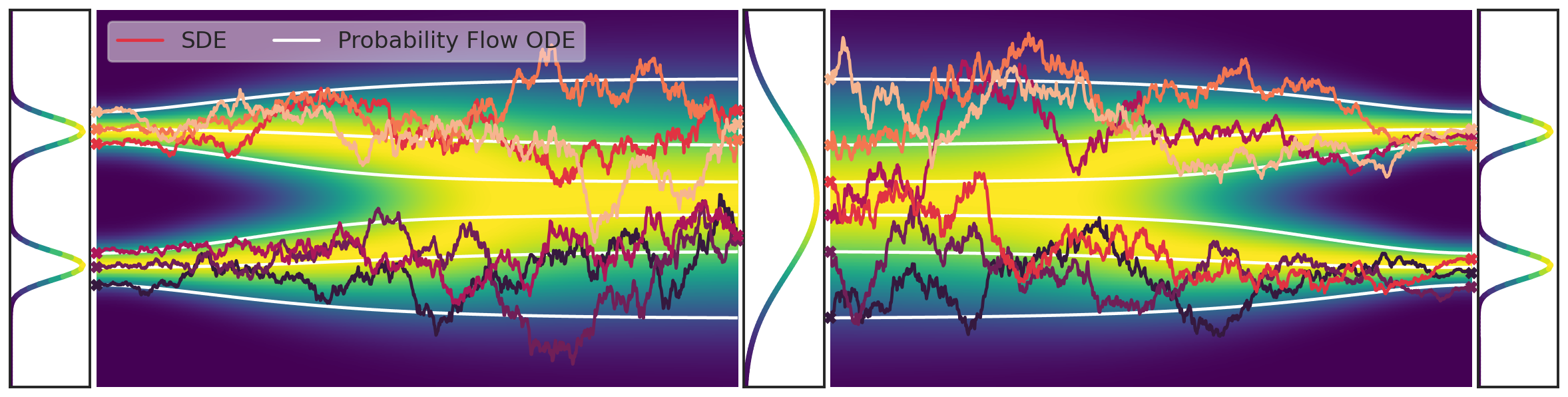
Creating noise from data is easy; creating data from noise is generative modeling. We present a stochastic differential equation (SDE) that smoothly transforms a complex data distribution to a known prior distribution by slowly injecting noise, and a corresponding reverse-time SDE that transforms the prior distribution back into the data distribution by slowly removing the noise. Crucially, the reverse-time SDE depends only on the time-dependent gradient field (\aka, score) of the perturbed data distribution. By leveraging advances in score-based generative modeling, we can accurately estimate these scores with neural networks, and use numerical SDE solvers to generate samples. We show that this framework encapsulates previous approaches in score-based generative modeling and diffusion probabilistic modeling, allowing for new sampling procedures and new modeling capabilities. In particular, we introduce a predictor-corrector framework to correct errors in the evolution of the discretized reverse-time SDE. We also derive an equivalent neural ODE that samples from the same distribution as the SDE, but additionally enables exact likelihood computation, and improved sampling efficiency. In addition, we provide a new way to solve inverse problems with score-based models, as demonstrated with experiments on class-conditional generation, image inpainting, and colorization. Combined with multiple architectural improvements, we achieve record-breaking performance for unconditional image generation on CIFAR-10 with an Inception score of 9.89 and FID of 2.20, a competitive likelihood of 2.99 bits/dim, and demonstrate high fidelity generation of 1024 x 1024 images for the first time from a score-based generative model.
Overview
AI snapshot
Written from the paper’s full text.
TL;DR
The paper introduces a stochastic differential equation framework that unifies score-based generative modeling and diffusion probabilistic modeling by reversing a noising SDE with a learned time-dependent score network. It derives predictor-corrector and probability-flow ODE samplers, enabling exact likelihoods and controllable generation, and reports record CIFAR-10 sample quality and likelihood plus first 1024×1024 score-based samples.
Key findings
- SMLD and DDPM are unified as discretizations of Variance Exploding (VE) and Variance Preserving (VP) SDEs; the reverse-time SDE depends only on the time-dependent score, and a new sub-VP SDE is proposed.
- Predictor-Corrector samplers improve sample quality, while the probability flow ODE enables exact likelihood computation, fast adaptive sampling, latent manipulation, and uniquely identifiable encoding.
- On CIFAR-10, NCSN++ cont. (deep, VE) achieves an Inception score of 9.89 and FID of 2.20 for unconditional generation; DDPM++ cont. (deep, sub-VP) achieves 2.99 bits/dim on uniformly dequantized CIFAR-10.
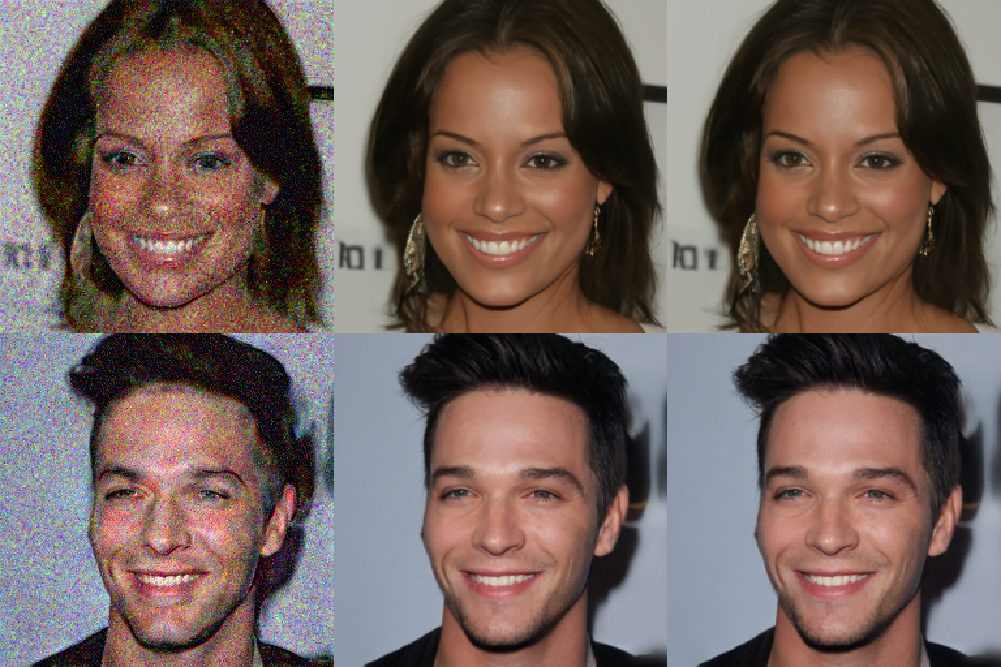
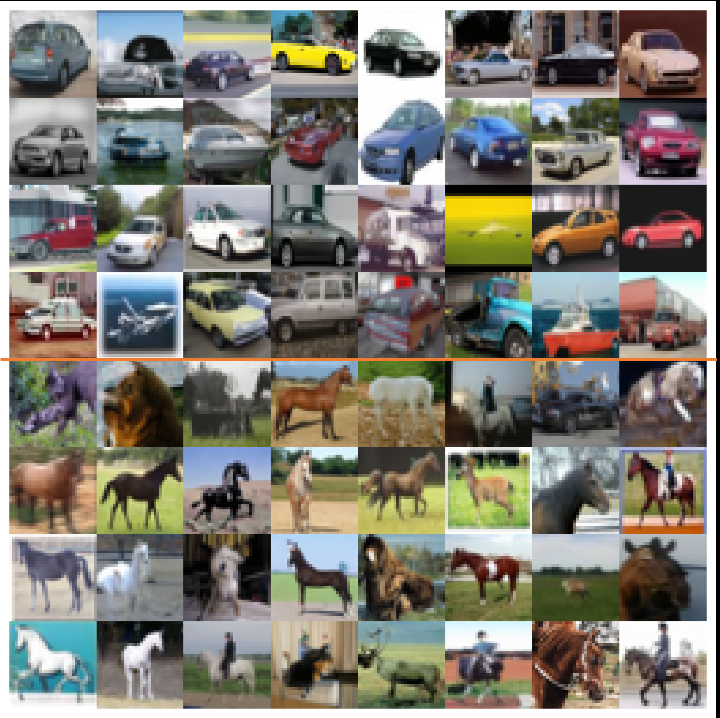
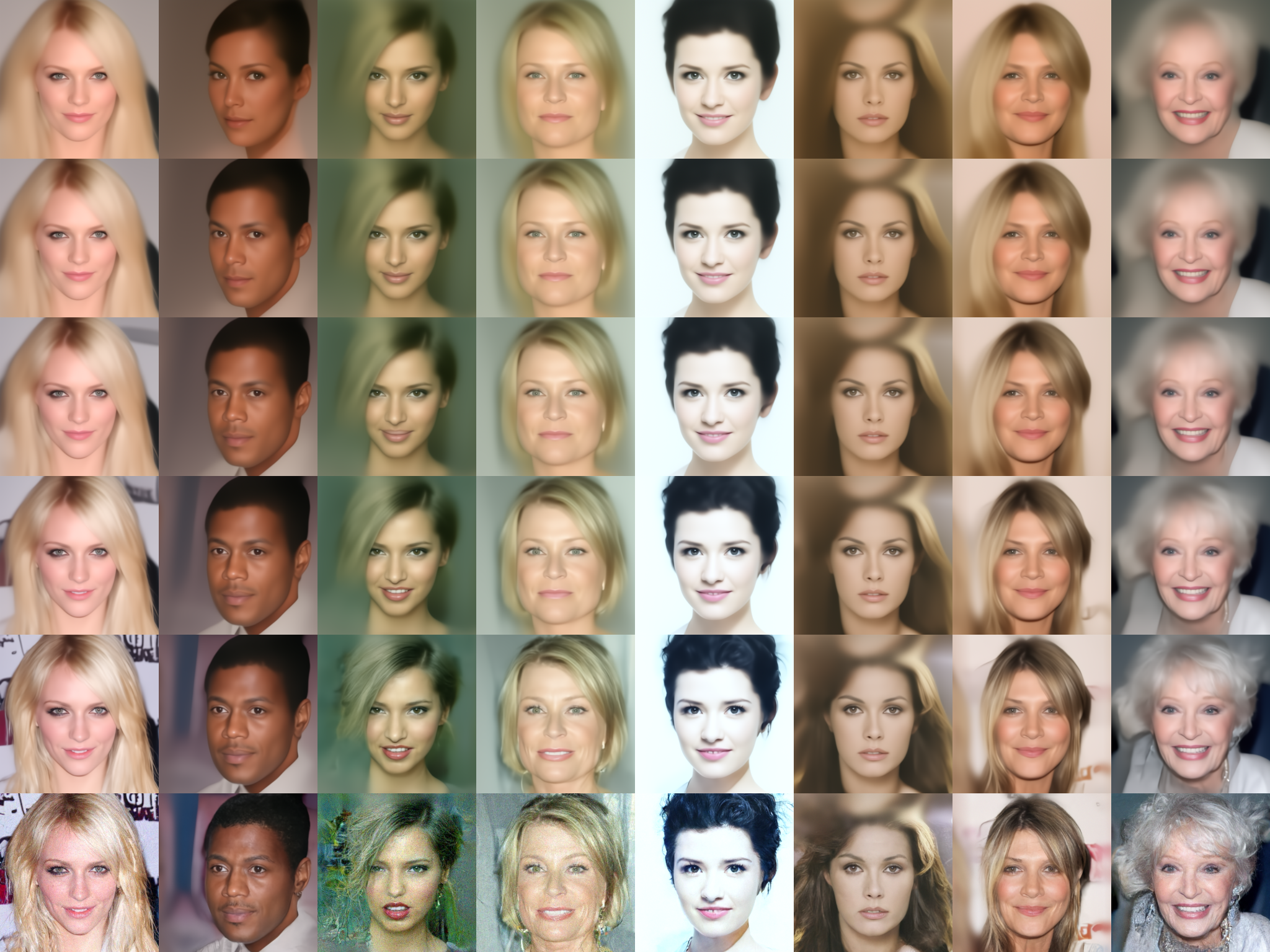
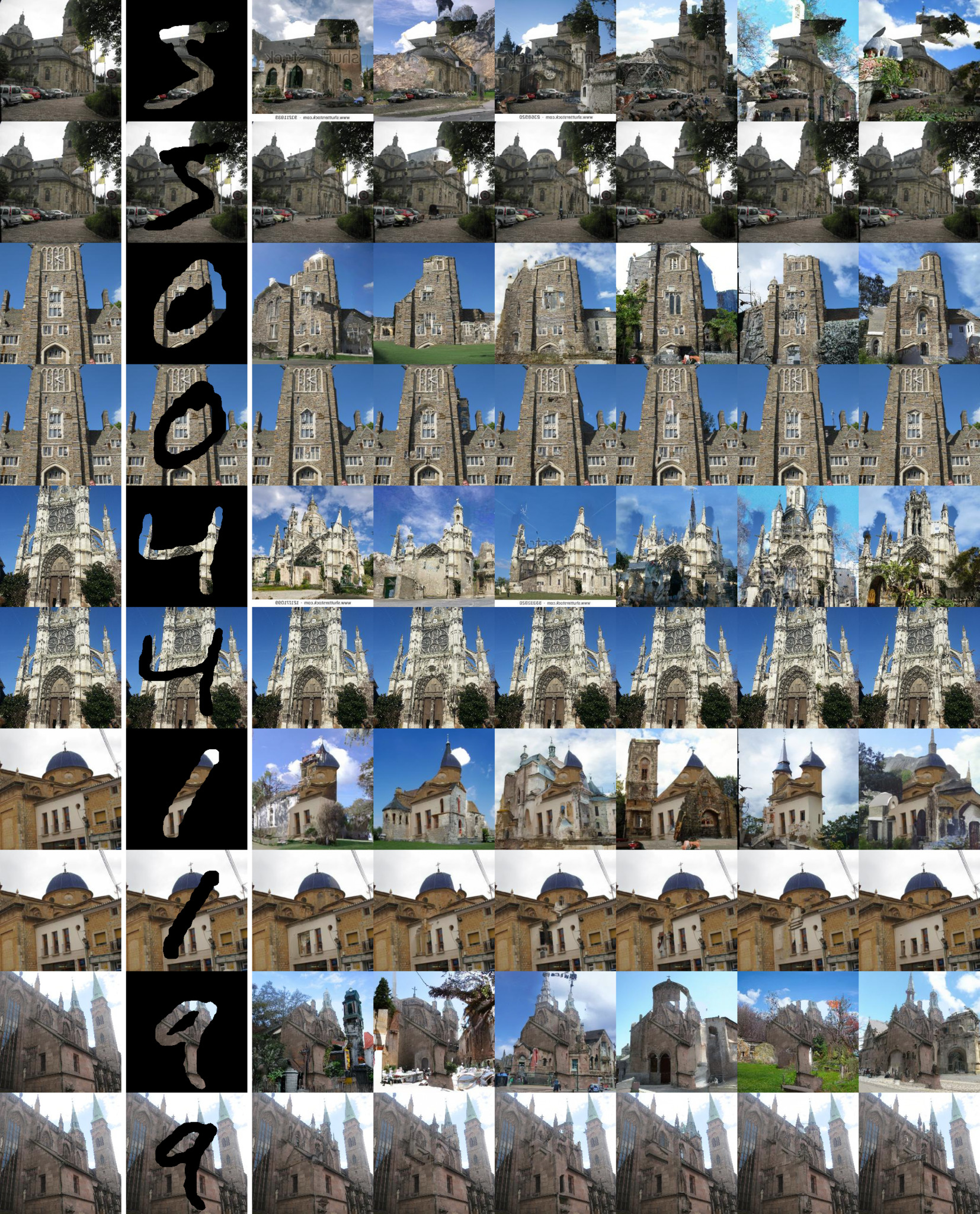
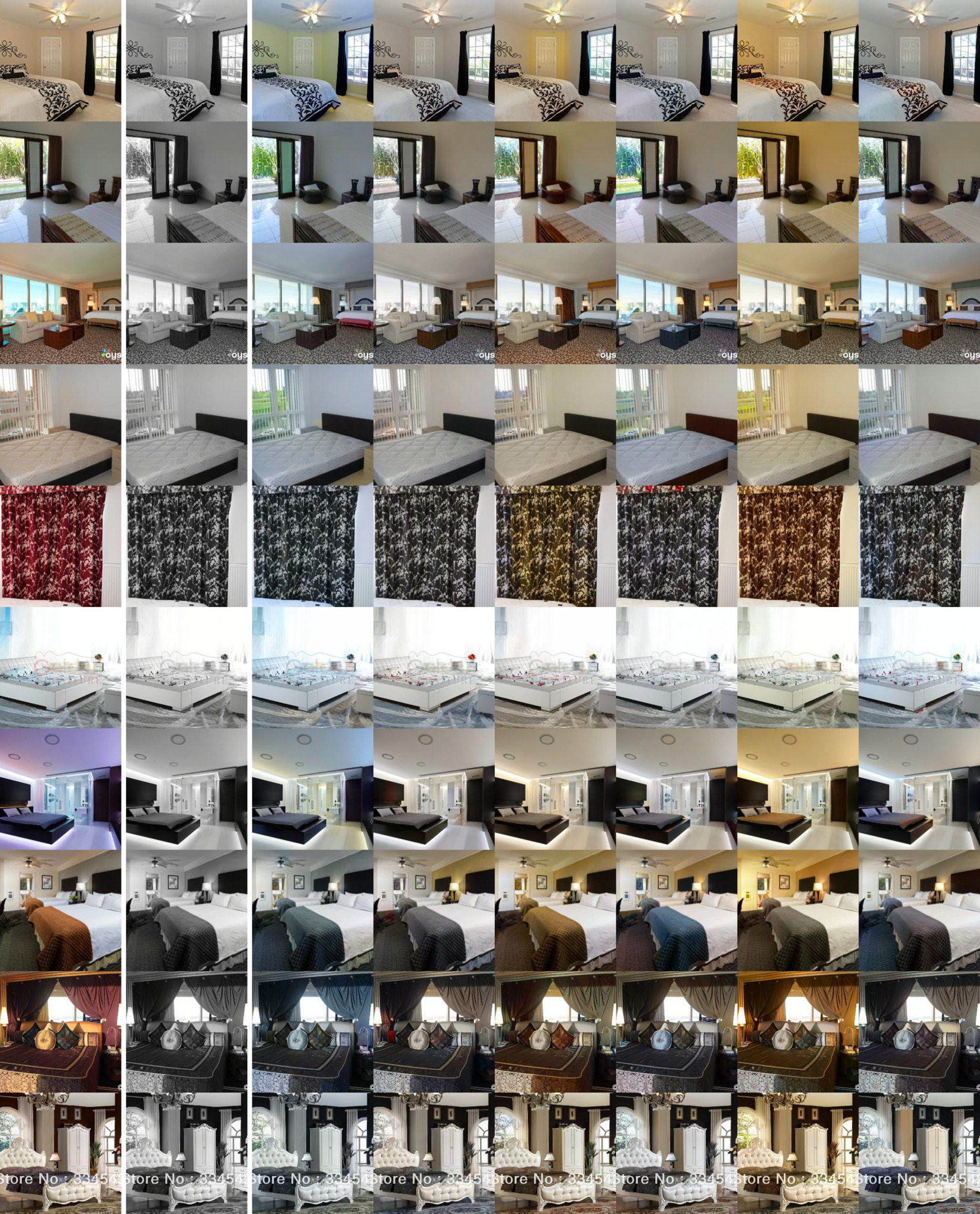
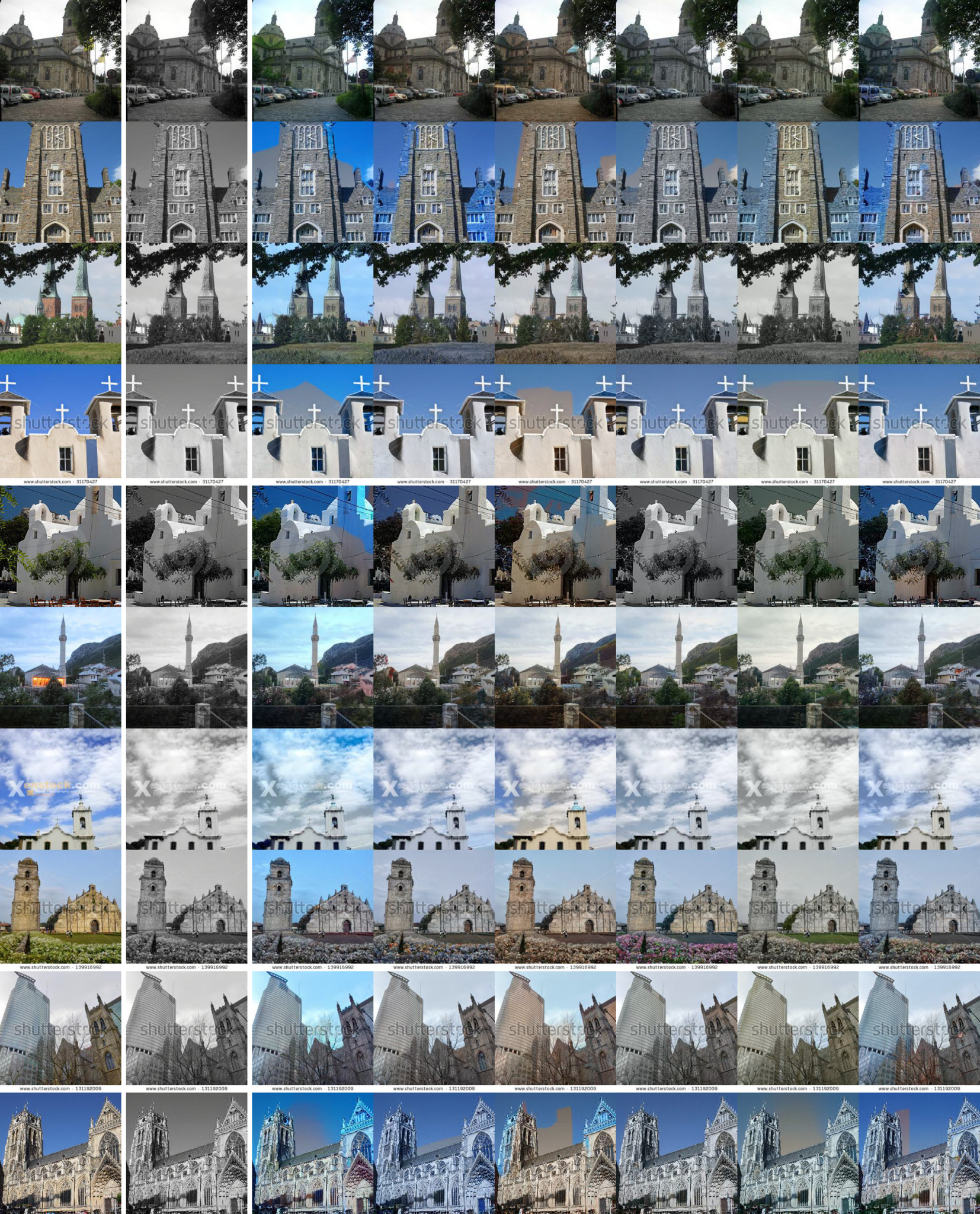
- Controllable generation is demonstrated for class-conditional CIFAR-10, image inpainting and colorization on 256×256 LSUN, and high-fidelity 1024×1024 CelebA-HQ samples from a score-based model.
Methods
- The framework models data corruption as a continuous-time diffusion process `dx = f(x,t)dt + g(t)dw`, derives the reverse-time SDE and probability flow ODE, and trains a time-dependent score model `sθ(x,t)` via denoising score matching; VE, VP, and sub-VP SDEs are instantiated.
- Sampling uses general-purpose SDE solvers, reverse diffusion, ancestral sampling, Predictor-Corrector samplers with Langevin correctors, and probability flow ODE solvers; architecture improvements yield NCSN++ and DDPM++ models.
- Experiments evaluate FID, Inception score, bits/dim negative log-likelihood, and qualitative samples on CIFAR-10, CelebA-HQ 1024×1024, and LSUN 256×256 bedroom/church; class-conditional generation uses a time-dependent classifier.
Limitations
- Stated: sampling remains slower than GANs on the same datasets, and the breadth of available samplers introduces many hyperparameters; future work is needed for automatic selection and tuning.
- Stated/evident: the 1024×1024 samples are not perfect, with visible flaws such as facial symmetry; architecture exploration for VP SDEs was limited to CIFAR-10 due to limited computing resources.
- Evident: likelihood comparisons omit models evaluated with variational dequantization or discrete data except DDPM ELBO values annotated with an asterisk; sample quality and likelihood favor different SDEs (VE better sample quality, VP/sub-VP better likelihood), requiring per-domain experimentation.
Model-written summary. Check it against the paper before relying on it.
Integrity signals
Registry
Cites
Statistics
Figures
Verification
Claims the paper makes
78 Own interpretation · 40 Own result · 14 Sources not found · 14 No basis given · 5 Partly supported · 4 Supported · 4 No full text of the sources · 3 Not checked yet · 2 Own method · 1 Not supported · accuracy not yet measured
At least one cited source doesn’t support this claim or points to a different paper, and none confirmed it — see the verdicts below.
In the paper
“Unlike most current invertible models, our encoding is uniquely identifiable, meaning that with sufficient training data, model capacity, and optimization accuracy, the encoding for an input is uniquely determined by the data distribution (Roeder et al., 2020).”
§ 4 SOLVING THE REVERSE SDE > 4.3 PROBABILITY FLOW AND CONNECTION TO NEURAL ODES
What the sources say
- Disputedcites Roeder et al., 2020 sourceExperimental — accuracy not yet measured
The paper supports an asymptotic identifiability result, but not a uniquely determined encoding. Section 3.2 (p. 4) defines identifiability only up to an invertible linear transformation, and the Introduction (p. 1) describes distinct representation functions learned from the same data distribution. (LLM, conf=0.90)
Checked by a reasoning model — may be wrong.
plaindirect- Asserted: passes — The authors put it forward as true.
- Checkable: passes — It can be checked against evidence.
- Load-bearing: unclear — It is unclear whether the paper’s conclusions depend on it.
- Based: passes — The paper gives a reason why it holds.
- Disputed
The cited sources support only part of this claim — read each source’s verdict below.
In the paper
“Although DDPM (Ho et al., 2020) was recently reported to achieve higher sample quality than SMLD (Song & Ermon, 2019; 2020), we show that with better architectures and new sampling algorithms allowed by our framework, the latter can catch up”
What the sources say
- Not matchedcites Ho et al., 2020
Couldn’t be matched to a paper in Crossref, so it can’t be checked.
- Not matchedcites Song & Ermon, 2019
Couldn’t be matched to a paper in Crossref, so it can’t be checked.
- Supportedcites Song & Ermon, 2020 source
The Introduction (p. 1) describes improved score-based models and Langevin-dynamics sampling, supporting the citation’s identification of the SMLD line of work. The statement that SMLD can catch up to DDPM is introduced as the citing authors’ own result (“we show”), not attributed to this source; this paper does not establish a DDPM comparison. (LLM, conf=0.82)
plaindirect- Asserted: passes — The authors put it forward as true.
- Checkable: passes — It can be checked against evidence.
- Load-bearing: passes — The paper’s conclusions depend on it.
- Based: passes — The paper gives a reason why it holds.
- Not matched
The cited sources support only part of this claim — read each source’s verdict below.
In the paper
“Crucially, the reverse-time SDE depends only on the time-dependent gradient field (a.k.a., score) of the perturbed data distribution.”
- Also stated in: § 1 INTRODUCTION · plain
“Crucially, this reverse process satisfies a reverse-time SDE (Anderson, 1982), which can be derived from the forward SDE given the score of the marginal probability densities as a function of time.”
What the sources say
- Partly supportedcites Anderson, 1982 sourceExperimental — accuracy not yet measured
The theorem in Section 3 (eqs. 3.11–3.12) makes the reverse-time drift depend on the time-dependent density and its spatial derivative, consistent with the score being relevant. But its formula also includes the forward drift and diffusion coefficient, so the reverse-time SDE does not depend only on the score. The copy provides no page number for this passage. (LLM, conf=0.88)
plaindirect- Asserted: passes — The authors put it forward as true.
- Checkable: passes — It can be checked against evidence.
- Load-bearing: passes — The paper’s conclusions depend on it.
- Based: passes — The paper gives a reason why it holds.
- Also stated in: § 1 INTRODUCTION · plain
The cited sources support only part of this claim — read each source’s verdict below.
In the paper
“When the score function is approximated by the time-dependent score-based model, which is typically a neural network, this is an example of a neural ODE (Chen et al., 2018).”
§ 4 SOLVING THE REVERSE SDE > 4.3 PROBABILITY FLOW AND CONNECTION TO NEURAL ODES
What the sources say
- Partly supportedcites Chen et al., 2018 sourceExperimental — accuracy not yet measured
The Introduction (p. 1) defines a neural ODE as continuous dynamics specified by a neural network, supporting the general classification. Our copy does not discuss score functions or establish that approximating one with a time-dependent score-based model yields an ODE, so it does not support that specific application. (LLM, conf=0.84)
plaindirect- Asserted: passes — The authors put it forward as true.
- Checkable: passes — It can be checked against evidence.
- Load-bearing: unclear — It is unclear whether the paper’s conclusions depend on it.
- Based: passes — The paper gives a reason why it holds.
- Partly supported
Every source the paper cites for this claim was checked and supports it.
In the paper
“A remarkable result from Anderson (1982) states that the reverse of a diffusion process is also a diffusion process, running backwards in time and given by the reverse-time SDE:”
§ 3 SCORE-BASED GENERATIVE MODELING WITH SDES > 3.2 GENERATING SAMPLES BY REVERSING THE SDE
What the sources say
- Supportedcites Anderson, 1982 source
The Introduction states that, for a wide variety of diffusion processes, a forward-time representation generates a reverse-time representation. Section 3 defines that representation as a reverse-time stochastic differential equation. The paper notes regularity restrictions, so the result is not stated for every diffusion process. (LLM, conf=0.90)
boosteddirect- Asserted: passes — The authors put it forward as true.
- Checkable: passes — It can be checked against evidence.
- Load-bearing: passes — The paper’s conclusions depend on it.
- Based: passes — The paper gives a reason why it holds.
- Supported
Every source the paper cites for this claim was checked and supports it.
In the paper
“As noted by Jolicoeur-Martineau et al. (2020), FIDs can be significantly worse without removing this noise.”
§ 0 100 200 300 > 0.00 0.25 0.50 0.75 1.00
What the sources say
- Supportedcites Jolicoeur-Martineau et al., 2020 source
Section 4 says denoising is critical to the FID score even when its effect is not visible to the human eye. The Section 6.1 ablation study reports an improvement in FID from denoising in every comparison, supporting the claim that leaving the noise in generated samples can substantially worsen FID. (LLM, conf=0.93)
plaindirect- Asserted: passes — The authors put it forward as true.
- Checkable: passes — It can be checked against evidence.
- Load-bearing: passes — The paper’s conclusions depend on it.
- Based: passes — The paper gives a reason why it holds.
- Supported
The cited sources support only part of this claim — read each source’s verdict below.
In the paper
“For both SMLD and DDPM models, the generated samples typically contain small noise that is hard to detect by humans.”
§ 0 100 200 300 > 0.00 0.25 0.50 0.75 1.00
What the sources say
- Partly supportedcites Jolicoeur-Martineau et al., 2020 sourceExperimental — accuracy not yet measured
Section 4 reports that denoising final Langevin samples substantially improves FID even though the change cannot be perceived by the human eye. This supports the claim for the paper’s score-matching/Langevin samples, but not its extension to DDPM samples; Section 6.1 says Ho et al. denoised their final sample. (LLM, conf=0.84)
plain- Asserted: passes — The authors put it forward as true.
- Checkable: passes — It can be checked against evidence.
- Load-bearing: passes — The paper’s conclusions depend on it.
- Based: passes — The paper gives a reason why it holds.
- Partly supported
A result the paper reports from its own data — it cites no other source for it, so there is none to check. The quote shows it is in the paper.
In the paper
“demonstrate high fidelity generation of 1024ˆ 1024 images for the first time from a score-based generative model.”
boosted- Asserted: passes — The authors put it forward as true.
- Checkable: passes — It can be checked against evidence.
- Load-bearing: passes — The paper’s conclusions depend on it.
- Based: passes — The paper gives a reason why it holds.
The paper states this without a source or data behind it here, so there is nothing to check it against. The quote shows it is in the paper.
In the paper
“Combined with multiple architectural improvements, we achieve record-breaking performance for unconditional image generation on CIFAR-10 with an Inception score of 9.89 and FID of 2.20”
- Also stated in: § 1 INTRODUCTION · plain
“with better architectures and new sampling algorithms allowed by our framework, the latter can catch up—it achieves new state-of-the-art Inception score (9.89) and FID score (2.20) on CIFAR-10”
plaindirect- Asserted: passes — The authors put it forward as true.
- Checkable: passes — It can be checked against evidence.
- Load-bearing: passes — The paper’s conclusions depend on it.
- Based: passes — The paper gives a reason why it holds.
- Also stated in: § 1 INTRODUCTION · plain
A result the paper reports from its own data — it cites no other source for it, so there is none to check. The quote shows it is in the paper.
In the paper
“a competitive likelihood of 2.99 bits/dim”
- Also stated in: § 1 INTRODUCTION · plain
“we propose a new SDE under our framework that achieves a likelihood value of 2.99 bits/dim on uniformly dequantized CIFAR-10 images”
plain- Asserted: passes — The authors put it forward as true.
- Checkable: passes — It can be checked against evidence.
- Load-bearing: passes — The paper’s conclusions depend on it.
- Based: passes — The paper gives a reason why it holds.
- Also stated in: § 1 INTRODUCTION · plain
- It may state two separate claims as one. 40
- Probably not a substantial claim. 25
Every source the paper cites for this claim was checked and supports it.
In the paper
“Crucially, this reverse process satisfies a reverse-time SDE (Anderson, 1982), which can be derived from the forward SDE given the score of the marginal probability densities as a function of time.”
What the sources say
- Supportedcites Anderson, 1982 source
The theorem in Section 3, equations (3.11)–(3.12), constructs a reverse-time SDE from the forward process and gives its drift in terms of the time-dependent marginal density and diffusion coefficients. Section 5, equations (5.6)–(5.7), also derives the reverse-time equation using that density. The density-dependent term is the score term when the diffusion coefficient is independent of the state. (LLM, conf=0.91)
plaindirect- Asserted: passes — The authors put it forward as true.
- Checkable: passes — It can be checked against evidence.
- Load-bearing: passes — The paper’s conclusions depend on it.
- Based: passes — The paper gives a reason why it holds.
It may state two separate claims as one.
- Supported
Every source the paper cites for this claim was checked and supports it.
In the paper
“The bits/dim values in Table 2 are computed with atol=1e-5 and rtol=1e-5, same as Grathwohl et al. (2018).”
§ 2 log > 0.0 0.2 0.4 0.6 0.8 1.0
What the sources say
- Supportedcites Grathwohl et al. (2018) source
Appendix C (page not provided) says FFJORD set both atol and rtol to the same tolerance and used 10^-5 for most experiments. That supports the cited comparison of solver tolerances; the paper specifies different settings for its tabular experiments. The citing paper’s own Table 2 values cannot be checked against this source. (LLM, conf=0.89)
plain- Asserted: passes — The authors put it forward as true.
- Checkable: passes — It can be checked against evidence.
- Load-bearing: fails — The paper’s conclusions may not depend on it.
- Based: passes — The paper gives a reason why it holds.
Probably not a substantial claim. The paper’s conclusions may not depend on it.
- Supported
The cited sources support only part of this claim — read each source’s verdict below.
In the paper
“a task that was previously only achievable by some GAN models and VQ-VAE-2 (Razavi et al., 2019).”
What the sources say
- Partly supportedcites Razavi et al., 2019 sourceExperimental — accuracy not yet measured
Section 5.1 (pp. 6–7) reports that VQ-VAE-2 generated 1024 × 1024 face images, but the dataset was FFHQ, not CelebA-HQ. The Related Works section (p. 5) discusses high-resolution GANs and other approaches; it does not establish that only GAN models and VQ-VAE-2 could perform the claimed task. (LLM, conf=0.88)
plain- Asserted: passes — The authors put it forward as true.
- Checkable: passes — It can be checked against evidence.
- Load-bearing: fails — The paper’s conclusions may not depend on it.
- Based: passes — The paper gives a reason why it holds.
Probably not a substantial claim. The paper’s conclusions may not depend on it.
- Partly supported
The paper states this without a source or data behind it here, so there is nothing to check it against. The quote shows it is in the paper.
In the paper
“In addition, we propose a new SDE under our framework that achieves a likelihood value of 2.99 bits/dim on uniformly dequantized CIFAR-10 images, setting a new record on this task.”
plaindirect- Asserted: passes — The authors put it forward as true.
- Checkable: passes — It can be checked against evidence.
- Load-bearing: passes — The paper’s conclusions depend on it.
- Based: passes — The paper gives a reason why it holds.
It may state two separate claims as one.
A result the paper reports from its own data — it cites no other source for it, so there is none to check. The quote shows it is in the paper.
In the paper
“Our best model for likelihoods, DDPM++ cont. (deep, sub-VP), similarly doubles the network depth and achieves a log-likelihood of 2.99 bits/dim with the continuous objective in Eq. (7).”
§ 100 101 102 103 > 4.4 ARCHITECTURE IMPROVEMENTS
plaindirect- Asserted: passes — The authors put it forward as true.
- Checkable: passes — It can be checked against evidence.
- Load-bearing: passes — The paper’s conclusions depend on it.
- Based: passes — The paper gives a reason why it holds.
It may state two separate claims as one.
The paper states this without a source or data behind it here, so there is nothing to check it against. The quote shows it is in the paper.
In the paper
“although samples across different ε look visually the same to human eyes.”
§ 2 log > 0.0 0.2 0.4 0.6 0.8 1.0
plain- Asserted: passes — The authors put it forward as true.
- Checkable: passes — It can be checked against evidence.
- Load-bearing: fails — The paper’s conclusions may not depend on it.
- Based: passes — The paper gives a reason why it holds.
Probably not a substantial claim. The paper’s conclusions may not depend on it.
A result the paper reports from its own data — it cites no other source for it, so there is none to check. The quote shows it is in the paper.
In the paper
“As shown in Table 3, VE SDEs typically provide better sample quality than VP/sub-VP SDEs, but we also empirically observe that their likelihoods are worse than VP/sub-VP SDE counterparts.”
§ 100 101 102 103 > 4.4 ARCHITECTURE IMPROVEMENTS
plaincorrelational- Asserted: passes — The authors put it forward as true.
- Checkable: passes — It can be checked against evidence.
- Load-bearing: passes — The paper’s conclusions depend on it.
- Based: passes — The paper gives a reason why it holds.
It may state two separate claims as one.
A result the paper reports from its own data — it cites no other source for it, so there is none to check. The quote shows it is in the paper.
In the paper
“For all predictors, adding one corrector step for each predictor step (PC1000) doubles computation but always improves sample quality (against P1000).”
§ 4 SOLVING THE REVERSE SDE > 4.2 PREDICTOR-CORRECTOR SAMPLERS
plaindirect- Asserted: passes — The authors put it forward as true.
- Checkable: passes — It can be checked against evidence.
- Load-bearing: unclear — It is unclear whether the paper’s conclusions depend on it.
- Based: passes — The paper gives a reason why it holds.
It may state two separate claims as one.
In the paper
“For the same DDPM model in Ho et al. (2020), we obtain better bits/dim than ELBO, since our likelihoods are exact”
§ 4 SOLVING THE REVERSE SDE > 4.3 PROBABILITY FLOW AND CONNECTION TO NEURAL ODES
What the sources say
- Not matchedcites Ho et al. (2020)
Couldn’t be matched to a paper in Crossref, so it can’t be checked.
plaindirect- Asserted: passes — The authors put it forward as true.
- Checkable: passes — It can be checked against evidence.
- Load-bearing: passes — The paper’s conclusions depend on it.
- Based: passes — The paper gives a reason why it holds.
It may state two separate claims as one.
- Not matched
A result the paper reports from its own data — it cites no other source for it, so there is none to check. The quote shows it is in the paper.
In the paper
“By switching to the continuous training objective in Eq. (7), and increasing the network depth, we can further improve sample quality for all models.”
§ 100 101 102 103 > 4.4 ARCHITECTURE IMPROVEMENTS
plaindirect- Asserted: passes — The authors put it forward as true.
- Checkable: passes — It can be checked against evidence.
- Load-bearing: unclear — It is unclear whether the paper’s conclusions depend on it.
- Based: passes — The paper gives a reason why it holds.
It may state two separate claims as one.
A result the paper reports from its own data — it cites no other source for it, so there is none to check. The quote shows it is in the paper.
In the paper
“We observe that our reverse diffusion sampler always outperform ancestral sampling, and corrector-only methods (C2000) perform worse than other competitors (P2000, PC1000) with the same computation”
§ 4 SOLVING THE REVERSE SDE > 4.2 PREDICTOR-CORRECTOR SAMPLERS
plaindirect- Asserted: passes — The authors put it forward as true.
- Checkable: passes — It can be checked against evidence.
- Load-bearing: unclear — It is unclear whether the paper’s conclusions depend on it.
- Based: passes — The paper gives a reason why it holds.
It may state two separate claims as one.
A result the paper reports from its own data — it cites no other source for it, so there is none to check. The quote shows it is in the paper.
In the paper
“For sampling, it is important to use an appropriate ε for better Inception scores and FIDs, although samples across different ε look visually the same to human eyes.”
§ 2 log > 0.0 0.2 0.4 0.6 0.8 1.0
plaindirect- Asserted: passes — The authors put it forward as true.
- Checkable: passes — It can be checked against evidence.
- Load-bearing: fails — The paper’s conclusions may not depend on it.
- Based: passes — The paper gives a reason why it holds.
Probably not a substantial claim. The paper’s conclusions may not depend on it.
A result the paper reports from its own data — it cites no other source for it, so there is none to check. The quote shows it is in the paper.
In the paper
“Our best model for sample quality, NCSN++ cont. (deep, VE), doubles the network depth and sets new records for both inception score and FID on unconditional generation for CIFAR-10.”
§ 100 101 102 103 > 4.4 ARCHITECTURE IMPROVEMENTS
plaindirect- Asserted: passes — The authors put it forward as true.
- Checkable: passes — It can be checked against evidence.
- Load-bearing: passes — The paper’s conclusions depend on it.
- Based: passes — The paper gives a reason why it holds.
It may state two separate claims as one.
In the paper
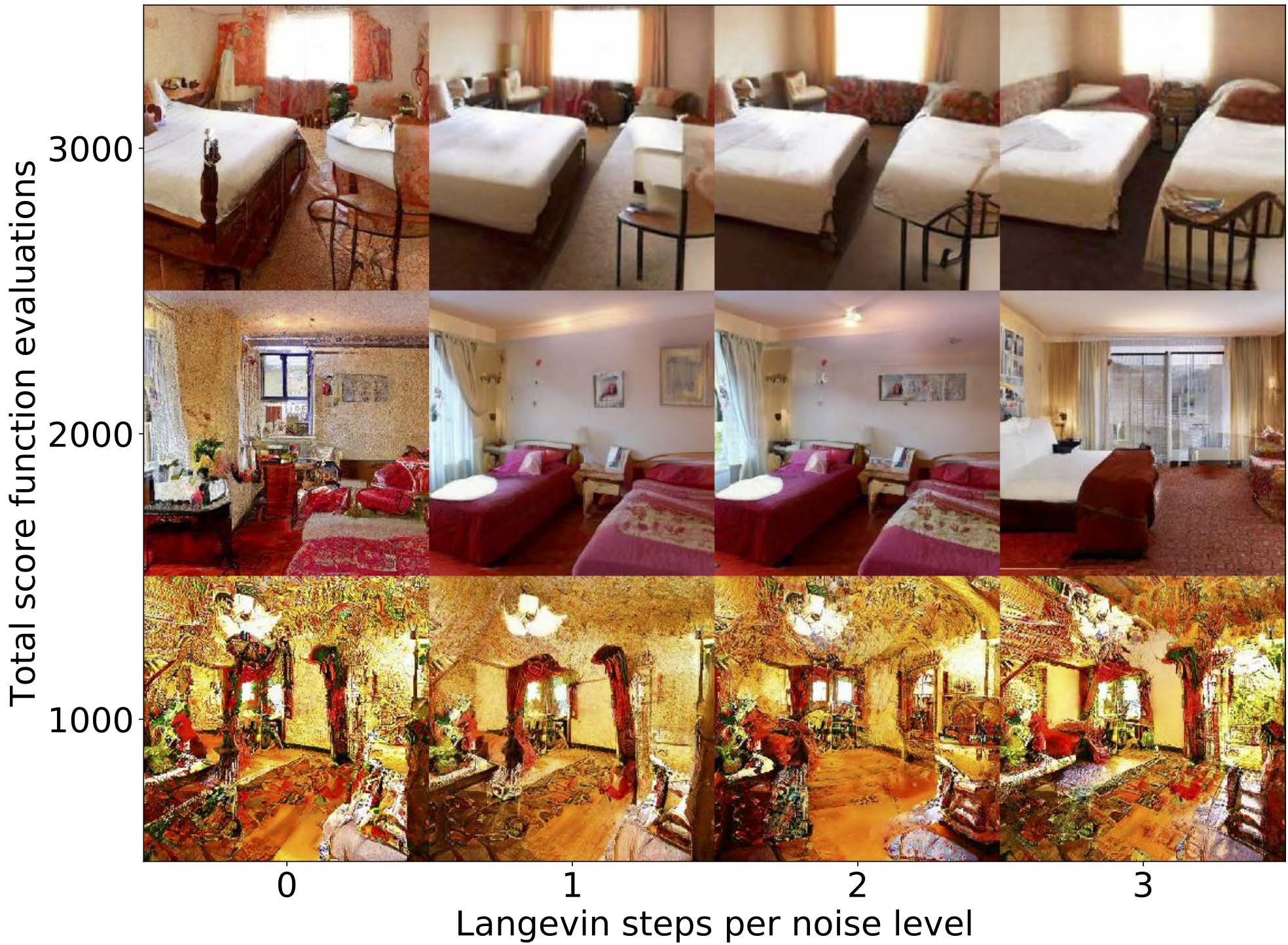
“Using a black-box ODE solver (Dormand & Prince, 1980) not only produces high quality samples (Table 2, details in Appendix D.4), but also allows us to explicitly trade-off accuracy for efficiency. With a larger error tolerance, the number of function evaluations can be reduced by over 90% without affecting the visual quality of samples (Fig. 3).”
What the sources say
- Not checked — no full text of the sourcecites Dormand & Prince, 1980 source
plaindirect- Asserted: passes — The authors put it forward as true.
- Checkable: passes — It can be checked against evidence.
- Load-bearing: passes — The paper’s conclusions depend on it.
- Based: passes — The paper gives a reason why it holds.
It may state two separate claims as one.
A result the paper reports from its own data — it cites no other source for it, so there is none to check. The quote shows it is in the paper.
In the paper
“Our optimal architecture for the VE SDE, named NCSN++, achieves an FID of 2.45 on CIFAR-10 with PC samplers, while our optimal architecture for the VP SDE, called DDPM++, achieves 2.78.”
§ 100 101 102 103 > 4.4 ARCHITECTURE IMPROVEMENTS
plain- Asserted: passes — The authors put it forward as true.
- Checkable: passes — It can be checked against evidence.
- Load-bearing: passes — The paper’s conclusions depend on it.
- Based: passes — The paper gives a reason why it holds.
It may state two separate claims as one.
The paper states this without a source or data behind it here, so there is nothing to check it against. The quote shows it is in the paper.
In the paper
“Our endeavor gives rise to new state-of-the-art sample quality on CIFAR-10, new state-of-the-art likelihood on uniformly dequantized CIFAR-10, and enables the first high-fidelity image samples of resolution 1024ˆ 1024 from score-based generative models.”
§ 0 100 200 300 > 3.06 ˘ .03
plaindirect- Asserted: passes — The authors put it forward as true.
- Checkable: passes — It can be checked against evidence.
- Load-bearing: passes — The paper’s conclusions depend on it.
- Based: passes — The paper gives a reason why it holds.
It may state two separate claims as one.
A result the paper reports from its own data — it cites no other source for it, so there is none to check. The quote shows it is in the paper.
In the paper
“We observe that different interpolation methods result in performance differences but maintain the general trend of predictor-corrector methods performing on par or better than predictor-only or corrector-only samplers.”
§ 0 100 200 300 > 3.06 ˘ .03
plaincorrelational- Asserted: passes — The authors put it forward as true.
- Checkable: passes — It can be checked against evidence.
- Load-bearing: unclear — It is unclear whether the paper’s conclusions depend on it.
- Based: passes — The paper gives a reason why it holds.
It may state two separate claims as one.
A result the paper reports from its own data — it cites no other source for it, so there is none to check. The quote shows it is in the paper.
In the paper
“The basic NCSN++ model with 4 residual blocks per resolution achieves an FID of 2.45 on CIFAR-10, whereas the basic DDPM++ model achieves an FID of 2.78.”
plain- Asserted: passes — The authors put it forward as true.
- Checkable: passes — It can be checked against evidence.
- Load-bearing: unclear — It is unclear whether the paper’s conclusions depend on it.
- Based: passes — The paper gives a reason why it holds.
It may state two separate claims as one.
A result the paper reports from its own data — it cites no other source for it, so there is none to check. The quote shows it is in the paper.
In the paper
“For progressive growing, it is not clear which combination of configurations consistently performs the best, but the results are typically better than when no progressive growing architecture is used.”
hedgedconditional- Asserted: passes — The authors put it forward as true.
- Checkable: passes — It can be checked against evidence.
- Load-bearing: unclear — It is unclear whether the paper’s conclusions depend on it.
- Based: passes — The paper gives a reason why it holds.
It may state two separate claims as one.
A result the paper reports from its own data — it cites no other source for it, so there is none to check. The quote shows it is in the paper.
In the paper
“The NCSN++ architecture worked decently well for VP SDEs, ranked 4th place over all 144 possible configurations.”
plain- Asserted: passes — The authors put it forward as true.
- Checkable: passes — It can be checked against evidence.
- Load-bearing: unclear — It is unclear whether the paper’s conclusions depend on it.
- Based: passes — The paper gives a reason why it holds.
It may state two separate claims as one.
A result the paper reports from its own data — it cites no other source for it, so there is none to check. The quote shows it is in the paper.
In the paper
“Its FID score is 2.41, same for both VP and sub-VP SDEs.”
plain- Asserted: passes — The authors put it forward as true.
- Checkable: passes — It can be checked against evidence.
- Load-bearing: unclear — It is unclear whether the paper’s conclusions depend on it.
- Based: passes — The paper gives a reason why it holds.
It may state two separate claims as one.
A conclusion the paper draws from its own results — it cites no other source for it, so there is none to check. The quote shows it is in the paper.
In the paper
“We can therefore approximate the reverse-time SDE by training a time-dependent neural network to estimate the scores, and then produce samples using numerical SDE solvers.”
plaindirect- Asserted: passes — The authors put it forward as true.
- Checkable: passes — It can be checked against evidence.
- Load-bearing: passes — The paper’s conclusions depend on it.
- Based: passes — The paper gives a reason why it holds.
It may state two separate claims as one.
A conclusion the paper draws from its own results — it cites no other source for it, so there is none to check. The quote shows it is in the paper.
In the paper
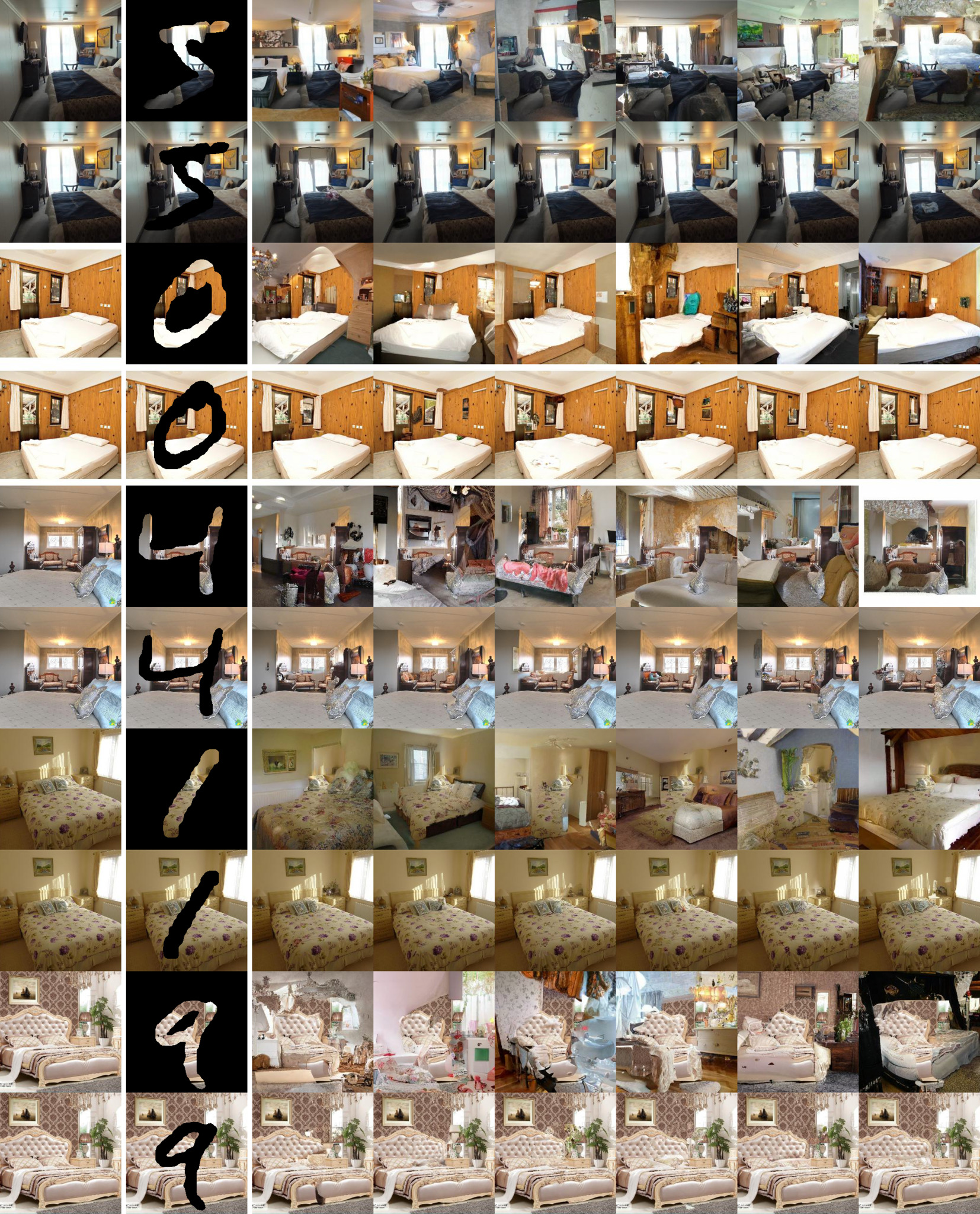
“This enables applications such as class-conditional generation, image inpainting, colorization and other inverse problems, all achievable using a single unconditional score-based model without re-training.”
plaindirect- Asserted: passes — The authors put it forward as true.
- Checkable: passes — It can be checked against evidence.
- Load-bearing: passes — The paper’s conclusions depend on it.
- Based: passes — The paper gives a reason why it holds.
It may state two separate claims as one.
A conclusion the paper draws from its own results — it cites no other source for it, so there is none to check. The quote shows it is in the paper.
In the paper
“We also derive an equivalent neural ODE that samples from the same distribution as the SDE, but additionally enables exact likelihood computation, and improved sampling efficiency.”
plaindirect- Asserted: passes — The authors put it forward as true.
- Checkable: passes — It can be checked against evidence.
- Load-bearing: passes — The paper’s conclusions depend on it.
- Based: passes — The paper gives a reason why it holds.
It may state two separate claims as one.
None of the sources cited for this claim have been checked yet.
In the paper
“we propose two special methods not viable for general SDEs: (i) Predictor-Corrector (PC) samplers that combine numerical SDE solvers with score-based MCMC approaches, such as Langevin MCMC (Parisi, 1981) and HMC (Neal et al., 2011); and (ii) deterministic samplers based on the probability flow ordinary differential equation (ODE).”
What the sources say
- Not checked — no full text of the sourcecites Parisi, 1981 source
- Not matchedcites Neal et al., 2011
Couldn’t be matched to a paper in Crossref, so it can’t be checked.
plain- Asserted: passes — The authors put it forward as true.
- Checkable: passes — It can be checked against evidence.
- Load-bearing: passes — The paper’s conclusions depend on it.
- Based: passes — The paper gives a reason why it holds.
It may state two separate claims as one.
A conclusion the paper draws from its own results — it cites no other source for it, so there is none to check. The quote shows it is in the paper.
In the paper
“The latter allows for fast adaptive sampling via black-box ODE solvers, flexible data manipulation via latent codes, a uniquely identifiable encoding, and notably, exact likelihood computation.”
plaindirect- Asserted: passes — The authors put it forward as true.
- Checkable: passes — It can be checked against evidence.
- Load-bearing: passes — The paper’s conclusions depend on it.
- Based: unclear — It is unclear why the paper says it holds.
It may state two separate claims as one.
None of the sources cited for this claim could be matched to a paper in Crossref, so there is nothing to check it against.
In the paper
“Denoising diffusion probabilistic modeling (DDPM) (Sohl-Dickstein et al., 2015; Ho et al., 2020) trains a sequence of probabilistic models to reverse each step of the noise corruption, using knowledge of the functional form of the reverse distributions to make training tractable.”
What the sources say
- Not matchedcites Sohl-Dickstein et al., 2015
Couldn’t be matched to a paper in Crossref, so it can’t be checked.
- Not matchedcites Ho et al., 2020
Couldn’t be matched to a paper in Crossref, so it can’t be checked.
plaindirect- Asserted: passes — The authors put it forward as true.
- Checkable: passes — It can be checked against evidence.
- Load-bearing: fails — The paper’s conclusions may not depend on it.
- Based: passes — The paper gives a reason why it holds.
Probably not a substantial claim. The paper’s conclusions may not depend on it.
- Not matched
A conclusion the paper draws from its own results — it cites no other source for it, so there is none to check. The quote shows it is in the paper.
In the paper
“The former unifies and improves over existing sampling methods for score-based models.”
plaindirect- Asserted: passes — The authors put it forward as true.
- Checkable: passes — It can be checked against evidence.
- Load-bearing: passes — The paper’s conclusions depend on it.
- Based: unclear — It is unclear why the paper says it holds.
It may state two separate claims as one.
A conclusion the paper draws from its own results — it cites no other source for it, so there is none to check. The quote shows it is in the paper.
In the paper
“We can employ any general-purpose SDE solver to integrate the reverse-time SDE for sampling.”
plaindirect- Asserted: passes — The authors put it forward as true.
- Checkable: passes — It can be checked against evidence.
- Load-bearing: passes — The paper’s conclusions depend on it.
- Based: fails — The paper may give no reason why it holds.
Probably not a substantial claim. The paper may give no reason why it holds.
A conclusion the paper draws from its own results — it cites no other source for it, so there is none to check. The quote shows it is in the paper.
In the paper
“By leveraging advances in score-based generative modeling, we can accurately estimate these scores with neural networks, and use numerical SDE solvers to generate samples.”
plaindirect- Asserted: passes — The authors put it forward as true.
- Checkable: passes — It can be checked against evidence.
- Load-bearing: passes — The paper’s conclusions depend on it.
- Based: passes — The paper gives a reason why it holds.
It may state two separate claims as one.
In the paper
“Score matching with Langevin dynamics (SMLD) (Song & Ermon, 2019) estimates the score (i.e., the gradient of the log probability density with respect to data) at each noise scale, and then uses Langevin dynamics to sample from a sequence of decreasing noise scales during generation.”
What the sources say
- Not matchedcites Song & Ermon, 2019
Couldn’t be matched to a paper in Crossref, so it can’t be checked.
plaindirect- Asserted: passes — The authors put it forward as true.
- Checkable: passes — It can be checked against evidence.
- Load-bearing: fails — The paper’s conclusions may not depend on it.
- Based: passes — The paper gives a reason why it holds.
Probably not a substantial claim. The paper’s conclusions may not depend on it. It may state two separate claims as one.
- Not matched
A conclusion the paper draws from its own results — it cites no other source for it, so there is none to check. The quote shows it is in the paper.
In the paper
“We can modulate the generation process by conditioning on information not available during training, because the conditional reverse-time SDE can be efficiently estimated from unconditional scores.”
plaindirect- Asserted: passes — The authors put it forward as true.
- Checkable: passes — It can be checked against evidence.
- Load-bearing: passes — The paper’s conclusions depend on it.
- Based: unclear — It is unclear why the paper says it holds.
It may state two separate claims as one.
A conclusion the paper draws from its own results — it cites no other source for it, so there is none to check. The quote shows it is in the paper.
In the paper
“This process progressively diffuses a data point into random noise, and is given by a prescribed SDE that does not depend on the data and has no trainable parameters.”
plaindirect- Asserted: passes — The authors put it forward as true.
- Checkable: passes — It can be checked against evidence.
- Load-bearing: passes — The paper’s conclusions depend on it.
- Based: passes — The paper gives a reason why it holds.
It may state two separate claims as one.
The paper states this without a source or data behind it here, so there is nothing to check it against. The quote shows it is in the paper.
In the paper
“When the drift and diffusion coefficient of an SDE are not affine, it can be difficult to compute the transition kernel p0tpxptq | xp0qq in closed form.”
plainconditional- Asserted: passes — The authors put it forward as true.
- Checkable: passes — It can be checked against evidence.
- Load-bearing: passes — The paper’s conclusions depend on it.
- Based: fails — The paper may give no reason why it holds.
Probably not a substantial claim. The paper may give no reason why it holds.
What the paper did — it cites no source for this, so there is none to check. The quote shows it is in the paper.
In the paper
“Therefore, same as the VE SDE, we restrict computation to t P rε, 1s for a small ε ą 0.”
§ 2 log > 0.0 0.2 0.4 0.6 0.8 1.0
plain- Asserted: passes — The authors put it forward as true.
- Checkable: passes — It can be checked against evidence.
- Load-bearing: fails — The paper’s conclusions may not depend on it.
- Based: passes — The paper gives a reason why it holds.
Probably not a substantial claim. The paper’s conclusions may not depend on it.
In the paper
“For example, when using sliced score matching (Song et al., 2019a), our training objective Eq. (7) becomes”
What the sources say
- Not matchedcites Song et al., 2019a
Couldn’t be matched to a paper in Crossref, so it can’t be checked.
plaindirect- Asserted: passes — The authors put it forward as true.
- Checkable: passes — It can be checked against evidence.
- Load-bearing: fails — The paper’s conclusions may not depend on it.
- Based: passes — The paper gives a reason why it holds.
Probably not a substantial claim. The paper’s conclusions may not depend on it.
- Not matched
A conclusion the paper draws from its own results — it cites no other source for it, so there is none to check. The quote shows it is in the paper.
In the paper
“By integrating Eq. (13), we can encode any datapoint xp0q into a latent space xpT q. Decoding can be achieved by integrating a corresponding ODE for the reverse-time SDE.”
§ 4 SOLVING THE REVERSE SDE > 4.3 PROBABILITY FLOW AND CONNECTION TO NEURAL ODES
plaindirect- Asserted: passes — The authors put it forward as true.
- Checkable: passes — It can be checked against evidence.
- Load-bearing: passes — The paper’s conclusions depend on it.
- Based: passes — The paper gives a reason why it holds.
It may state two separate claims as one.
A conclusion the paper draws from its own results — it cites no other source for it, so there is none to check. The quote shows it is in the paper.
In the paper
“The noise perturbations used in SMLD and DDPM can be regarded as discretizations of two different SDEs.”
- Also stated in: § 3.4 EXAMPLES: VE, VP SDES AND BEYOND · plain
“Therefore, the noise perturbations used in SMLD and DDPM correspond to discretizations of SDEs Eqs. (9) and (11).”
§ 3 SCORE-BASED GENERATIVE MODELING WITH SDES > 3.4 EXAMPLES: VE, VP SDES AND BEYOND
plaindirect- Asserted: passes — The authors put it forward as true.
- Checkable: passes — It can be checked against evidence.
- Load-bearing: passes — The paper’s conclusions depend on it.
- Based: passes — The paper gives a reason why it holds.
It may state two separate claims as one.
- Also stated in: § 3.4 EXAMPLES: VE, VP SDES AND BEYOND · plain
In the paper
“The SDE has a unique strong solution as long as the coefficients are globally Lipschitz in both state and time (Øksendal, 2003).”
§ 3 SCORE-BASED GENERATIVE MODELING WITH SDES > 3.1 PERTURBING DATA WITH SDES
What the sources say
- Not checked — no full text of the sourcecites Øksendal, 2003 source
plaindirect- Asserted: passes — The authors put it forward as true.
- Checkable: passes — It can be checked against evidence.
- Load-bearing: fails — The paper’s conclusions may not depend on it.
- Based: passes — The paper gives a reason why it holds.
Probably not a substantial claim. The paper’s conclusions may not depend on it.
In the paper
“Leveraging the connection to neural ODEs, we can compute the density defined by Eq. (13) via the instantaneous change of variables formula (Chen et al., 2018). This allows us to compute the exact likelihood on any input data (details in Appendix D.2).”
§ 4 SOLVING THE REVERSE SDE > 4.3 PROBABILITY FLOW AND CONNECTION TO NEURAL ODES
What the sources say
- Not matchedcites Chen et al., 2018
Couldn’t be matched to a paper in Crossref, so it can’t be checked.
plaindirect- Asserted: passes — The authors put it forward as true.
- Checkable: passes — It can be checked against evidence.
- Load-bearing: passes — The paper’s conclusions depend on it.
- Based: passes — The paper gives a reason why it holds.
It may state two separate claims as one.
- Not matched
What the paper did — it cites no source for this, so there is none to check. The quote shows it is in the paper.
In the paper
“As a sanity check for our SDE generalizations to SMLD and DDPM, we compare the perturbation kernels of SDEs and original discrete Markov chains in Fig. 5.”
§ 2 log > 0.0 0.2 0.4 0.6 0.8 1.0
plaincorrelational- Asserted: passes — The authors put it forward as true.
- Checkable: passes — It can be checked against evidence.
- Load-bearing: fails — The paper’s conclusions may not depend on it.
- Based: passes — The paper gives a reason why it holds.
Probably not a substantial claim. The paper’s conclusions may not depend on it.
A conclusion the paper draws from its own results — it cites no other source for it, so there is none to check. The quote shows it is in the paper.
In the paper
“In Appendix I.4, we provide a broadly applicable method for obtaining such an estimate without the need of training auxiliary models.”
plain- Asserted: passes — The authors put it forward as true.
- Checkable: passes — It can be checked against evidence.
- Load-bearing: fails — The paper’s conclusions may not depend on it.
- Based: passes — The paper gives a reason why it holds.
Probably not a substantial claim. The paper’s conclusions may not depend on it.
The paper states this without a source or data behind it here, so there is nothing to check it against. The quote shows it is in the paper.
In the paper
“Perturbing data with multiple noise scales is key to the success of previous methods.”
plaindirect- Asserted: passes — The authors put it forward as true.
- Checkable: passes — It can be checked against evidence.
- Load-bearing: passes — The paper’s conclusions depend on it.
- Based: fails — The paper may give no reason why it holds.
Probably not a substantial claim. The paper may give no reason why it holds.
A conclusion the paper draws from its own results — it cites no other source for it, so there is none to check. The quote shows it is in the paper.
In the paper
“To overcome this difficulty, we can replace denoising score matching in Eq. (7) with other efficient variants of score matching that do not require computing ∇xptq log p0tpxptq | xp0qq.”
plain- Asserted: passes — The authors put it forward as true.
- Checkable: passes — It can be checked against evidence.
- Load-bearing: fails — The paper’s conclusions may not depend on it.
- Based: passes — The paper gives a reason why it holds.
Probably not a substantial claim. The paper’s conclusions may not depend on it.
A conclusion the paper draws from its own results — it cites no other source for it, so there is none to check. The quote shows it is in the paper.
In the paper
“Our work enables a better understanding of existing approaches, new sampling algorithms, exact likelihood computation, uniquely identifiable encoding, latent code manipulation, and brings new conditional generation abilities to the family of score-based generative models.”
plaindirect- Asserted: passes — The authors put it forward as true.
- Checkable: fails — It may be too vague to check against evidence.
- Load-bearing: passes — The paper’s conclusions depend on it.
- Based: fails — The paper may give no reason why it holds.
Probably not a substantial claim. It may be too vague to check against evidence. The paper may give no reason why it holds.
In the paper
“Therefore, the original ancestral sampler of Eq. (4) is essentially a different discretization to the same reverse-time SDE. This unifies the sampling method in Ho et al. (2020) as a numerical solver to the reverse-time VP SDE in our continuous framework.”
§ 0 100 200 300 > 0.00 0.25 0.50 0.75 1.00
What the sources say
- Not matchedcites Ho et al., 2020
Couldn’t be matched to a paper in Crossref, so it can’t be checked.
plaincorrelational- Asserted: passes — The authors put it forward as true.
- Checkable: passes — It can be checked against evidence.
- Load-bearing: passes — The paper’s conclusions depend on it.
- Based: passes — The paper gives a reason why it holds.
It may state two separate claims as one.
- Not matched
In the paper
“Therefore, their perturbation kernels p0tpxptq | xp0qq are all Gaussian and can be computed with Eqs. (5.50) and (5.51) in Särkkä & Solin (2019):”
What the sources say
- Not matchedcites Särkkä & Solin (2019)
Couldn’t be matched to a paper in Crossref, so it can’t be checked.
plain- Asserted: passes — The authors put it forward as true.
- Checkable: passes — It can be checked against evidence.
- Load-bearing: unclear — It is unclear whether the paper’s conclusions depend on it.
- Based: passes — The paper gives a reason why it holds.
It may state two separate claims as one.
- Not matched
A conclusion the paper draws from its own results — it cites no other source for it, so there is none to check. The quote shows it is in the paper.
In the paper
“Since VE, VP and sub-VP SDEs all have affine drift coefficients, their perturbation kernels p0tpxptq | xp0qq are all Gaussian and can be computed in closed-forms, as discussed in Section 3.3.”
§ 3 SCORE-BASED GENERATIVE MODELING WITH SDES > 3.4 EXAMPLES: VE, VP SDES AND BEYOND
plaindirect- Asserted: passes — The authors put it forward as true.
- Checkable: passes — It can be checked against evidence.
- Load-bearing: passes — The paper’s conclusions depend on it.
- Based: passes — The paper gives a reason why it holds.
It may state two separate claims as one.
A conclusion the paper draws from its own results — it cites no other source for it, so there is none to check. The quote shows it is in the paper.
In the paper
“Our work enables a better understanding of existing approaches, new sampling algorithms, exact likelihood computation, uniquely identifiable encoding, latent code manipulation, and brings new conditional generation abilities to the family of score-based generative models.”
plaindirect- Asserted: passes — The authors put it forward as true.
- Checkable: passes — It can be checked against evidence.
- Load-bearing: passes — The paper’s conclusions depend on it.
- Based: fails — The paper may give no reason why it holds.
Probably not a substantial claim. The paper may give no reason why it holds.
A conclusion the paper draws from its own results — it cites no other source for it, so there is none to check. The quote shows it is in the paper.
In the paper
“Additionally, the breadth of samplers one can use when given access to score functions introduces a number of hyper-parameters.”
plaindirect- Asserted: passes — The authors put it forward as true.
- Checkable: passes — It can be checked against evidence.
- Load-bearing: fails — The paper’s conclusions may not depend on it.
- Based: fails — The paper may give no reason why it holds.
Probably not a substantial claim. The paper’s conclusions may not depend on it. The paper may give no reason why it holds.
A conclusion the paper draws from its own results — it cites no other source for it, so there is none to check. The quote shows it is in the paper.
In the paper
“We can always simulate the SDE to sample from p0tpxptq | xp0qq, and solve Eq. (19) to train the time-dependent score-based model sθpx, tq.”
plaindirect- Asserted: passes — The authors put it forward as true.
- Checkable: passes — It can be checked against evidence.
- Load-bearing: passes — The paper’s conclusions depend on it.
- Based: fails — The paper may give no reason why it holds.
Probably not a substantial claim. The paper may give no reason why it holds. It may state two separate claims as one.
In the paper
“Like Eq. (1), Eq. (3) is also a weighted sum of denoising score matching objectives, which implies that the optimal model, sθ˚px̃, iq, matches the score of the perturbed data distribution, ∇x log pαipxq.”
§ 2 BACKGROUND > 2.2 DENOISING DIFFUSION PROBABILISTIC MODELS (DDPM)
What the sources say
- Not matchedcites Ho et al., 2020
Couldn’t be matched to a paper in Crossref, so it can’t be checked.
plaindirect- Asserted: passes — The authors put it forward as true.
- Checkable: passes — It can be checked against evidence.
- Load-bearing: unclear — It is unclear whether the paper’s conclusions depend on it.
- Based: passes — The paper gives a reason why it holds.
It may state two separate claims as one.
- Not matched
A conclusion the paper draws from its own results — it cites no other source for it, so there is none to check. The quote shows it is in the paper.
In the paper
“VE, VP and sub-VP SDEs all have affine drift coefficients.”
plain- Asserted: passes — The authors put it forward as true.
- Checkable: passes — It can be checked against evidence.
- Load-bearing: passes — The paper’s conclusions depend on it.
- Based: passes — The paper gives a reason why it holds.
It may state two separate claims as one.
A conclusion the paper draws from its own results — it cites no other source for it, so there is none to check. The quote shows it is in the paper.
In the paper
“This is because the discretization strategy of the original DDPM method does not match the variance of the continuous process well when t Ñ 0, which significantly hurts FID scores.”
plaindirect- Asserted: passes — The authors put it forward as true.
- Checkable: passes — It can be checked against evidence.
- Load-bearing: passes — The paper’s conclusions depend on it.
- Based: unclear — It is unclear why the paper says it holds.
It may state two separate claims as one.
A conclusion the paper draws from its own results — it cites no other source for it, so there is none to check. The quote shows it is in the paper.
In the paper
“Colorization is a special case of imputation, except that the known data dimensions are coupled.”
plain- Asserted: passes — The authors put it forward as true.
- Checkable: passes — It can be checked against evidence.
- Load-bearing: fails — The paper’s conclusions may not depend on it.
- Based: passes — The paper gives a reason why it holds.
Probably not a substantial claim. The paper’s conclusions may not depend on it.
A conclusion the paper draws from its own results — it cites no other source for it, so there is none to check. The quote shows it is in the paper.
In the paper
“Because the transformations are all orthogonal matrices, the standard Wiener process wptq will still be a standard Wiener process in the transformed space, allowing us to build an SDE and use the same imputation method in Appendix I.2.”
§ 10 2 10 1 100 101 > 0.577 ´0.816 0
plaindirect- Asserted: passes — The authors put it forward as true.
- Checkable: passes — It can be checked against evidence.
- Load-bearing: unclear — It is unclear whether the paper’s conclusions depend on it.
- Based: passes — The paper gives a reason why it holds.
It may state two separate claims as one.
A conclusion the paper draws from its own results — it cites no other source for it, so there is none to check. The quote shows it is in the paper.
In the paper
“We can decouple these data dimensions by using an orthogonal linear transformation to map the gray-scale image to a separate channel in a different space, and then perform imputation to complete the other channels before transforming everything back to the original image space.”
plaindirect- Asserted: passes — The authors put it forward as true.
- Checkable: passes — It can be checked against evidence.
- Load-bearing: fails — The paper’s conclusions may not depend on it.
- Based: passes — The paper gives a reason why it holds.
Probably not a substantial claim. The paper’s conclusions may not depend on it. It may state two separate claims as one.
A conclusion the paper draws from its own results — it cites no other source for it, so there is none to check. The quote shows it is in the paper.
In the paper
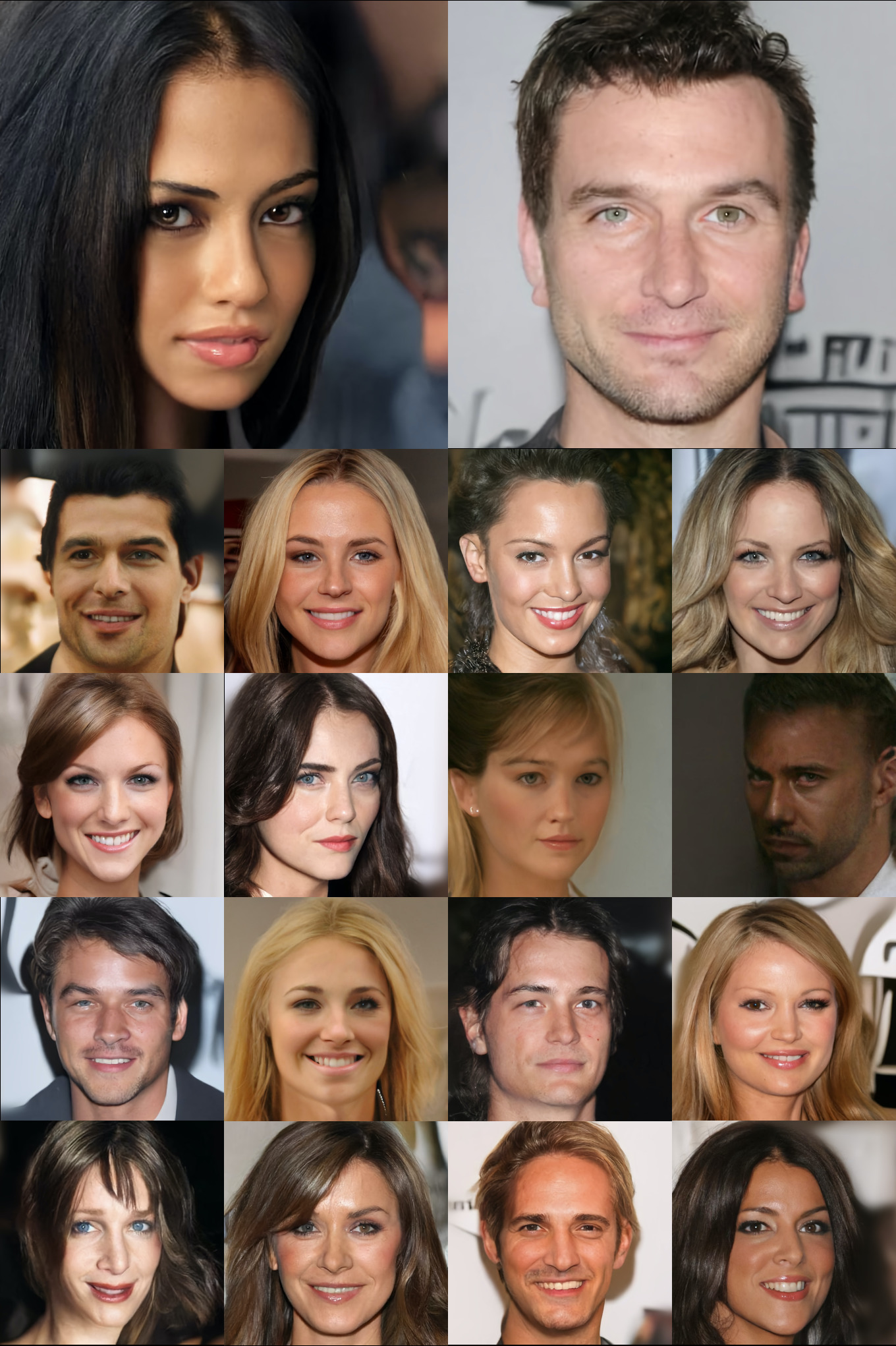
“Although these samples are not perfect (e.g., there are visible flaws on facial symmetry), we believe these results are encouraging and can demonstrate the scalability of our approach.”
plain- Asserted: passes — The authors put it forward as true.
- Checkable: passes — It can be checked against evidence.
- Load-bearing: fails — The paper’s conclusions may not depend on it.
- Based: passes — The paper gives a reason why it holds.
Probably not a substantial claim. The paper’s conclusions may not depend on it. It may state two separate claims as one.
A conclusion the paper draws from its own results — it cites no other source for it, so there is none to check. The quote shows it is in the paper.
In the paper
“∇x log ptpxptq | yq”
plain- Asserted: fails — The authors may not put it forward as true.
- Checkable: passes — It can be checked against evidence.
- Load-bearing: fails — The paper’s conclusions may not depend on it.
- Based: fails — The paper may give no reason why it holds.
Probably not a substantial claim. The authors may not put it forward as true. The paper’s conclusions may not depend on it. The paper may give no reason why it holds.
A conclusion the paper draws from its own results — it cites no other source for it, so there is none to check. The quote shows it is in the paper.
In the paper
“All sampling methods we have discussed so far can be applied to the conditional reverse-time SDE for sample generation.”
plain- Asserted: passes — The authors put it forward as true.
- Checkable: passes — It can be checked against evidence.
- Load-bearing: fails — The paper’s conclusions may not depend on it.
- Based: passes — The paper gives a reason why it holds.
Probably not a substantial claim. The paper’s conclusions may not depend on it.
A conclusion the paper draws from its own results — it cites no other source for it, so there is none to check. The quote shows it is in the paper.
In the paper
“Imputation is a special case of conditional sampling.”
plain- Asserted: passes — The authors put it forward as true.
- Checkable: passes — It can be checked against evidence.
- Load-bearing: fails — The paper’s conclusions may not depend on it.
- Based: fails — The paper may give no reason why it holds.
Probably not a substantial claim. The paper’s conclusions may not depend on it. The paper may give no reason why it holds.
The authors state this as an assumption.
For ease of presentation, the diffusion coefficient is assumed to be a scalar and not to depend on x.
“For ease of presentation we assume the diffusion coefficient is a scalar (instead of a dˆ d matrix) and does not depend on x, but our theory can be generalized to hold in those cases (see Appendix A).”
The authors state this as an assumption.
The discretization schedule of time is fixed beforehand.
“We assume the discretization schedule of time is fixed beforehand, and thus we absorb the dependency on ∆t into the notations of fi and Gi.”
The paper relies on this without support.
In colorization, the known data dimensions are coupled.
“Colorization is a special case of imputation, except that the known data dimensions are coupled.”
The authors state this as an assumption.
p(y(t)|y) is tractable.
“• ppyptq | yq is tractable. We can often derive this distribution from the interaction between the forward process and the SDE, like in the case of image imputation and colorization.”
The authors state this as an assumption.
pt(x(t)|y(t),y) ≈ pt(x(t)|y(t)).
“• ptpxptq | yptq,yq « ptpxptq | yptqq. For small t, yptq is almost the same as y so the approximation holds. For large t, y becomes further away from xptq in the Markov chain, and thus have smaller impact on xptq. Moreover, the approximation error for large t matter less for the final sample, since it is used early in the sampling process.”
Claims other papers make about this one
Each is checked against this paper’s own text: does it say what the citing paper says it does?
The source backs part of the claim, not all of it — or backs it for a different population, condition or comparison.
In the citing paper
“Song et al. [60] found that further changes to the UNet architecture improved performance on the CIFAR-10 [31] and CelebA-64 [34] datasets.”
From Diffusion Models Beat GANs on Image Synthesis (2021) · cites this paper as [60]
Experimental — accuracy not yet measuredThe cited source says what the claim attributes to it.
In the citing paper
“An intriguing feature of diffusion models is that unconditional models can be conditioned at test-time [15, 82, 85].”
From High-Resolution Image Synthesis with Latent Diffusion Models (2022) · cites this paper as [85]
The cited source says what the claim attributes to it.
In the citing paper
“This class of models already holds the state-of-the-art [60] on CIFAR-10 [31]”
From Diffusion Models Beat GANs on Image Synthesis (2021) · cites this paper as [60]
The cited source says what the claim attributes to it.
In the citing paper
“In particular, we can train a classifier pφ(y|xt, t) on noisy images xt, and then use gradients ∇xt log pφ(y|xt, t) to guide the diffusion sampling process towards an arbitrary class label y.”
From Diffusion Models Beat GANs on Image Synthesis (2021) · cites this paper as [60]
The cited source says what the claim attributes to it.
In the citing paper
“Sohl-Dickstein et al. [56] and Song et al. [60] show one way to achieve this, wherein a pre-trained diffusion model can be conditioned using the gradients of a classifier.”
From Diffusion Models Beat GANs on Image Synthesis (2021) · cites this paper as [60]
The cited source says what the claim attributes to it.
In the citing paper
“To this end, we use a score-based conditioning trick adapted from Song et al. [60]”
From Diffusion Models Beat GANs on Image Synthesis (2021) · cites this paper as [60]
The check wasn’t confident either way, so it gives no verdict — never disputed.
In the citing paper
“Continuous visual tokenizers, often including Autoencoder (AE) and Variational Autoencoder (VAE), compress visual data into a continuous latent space where diffusion-based models can be efficiently trained on (Ho et al., 2020; Lipman et al., 2022; Song et al., 2020).”
From Cosmos World Foundation Model Platform for Physical AI (2025) · cites this paper as Song et al., 2020
Experimental — accuracy not yet measured
Self-check
Percentages, sums and reported differences re-computed from the paper’s own numbers.
Each contradiction between two passages listed here was confirmed by an independent check.
Rated minor: it would not touch a result — a value no result rests on, a p-value that stays on the same side of the significance level, or a conflict that is clerical, resolved elsewhere in the paper, or outside its own findings.
In the paper
§ 0 100 200 300 > 0.00 0.25 0.50 0.75 1.00
“where sθpxi, iq is to estimate z{σi.”
§ 2 BACKGROUND > 2.1 DENOISING SCORE MATCHING WITH LANGEVIN DYNAMICS (SMLD)
“Given sufficient data and model capacity, the optimal score-based model sθ˚px, σq matches ∇x log pσpxq almost everywhere for σ P tσiuNi"1.”
Citations
Cites
Learning Multiple Layers of Features from Tiny Images
Krizhevsky, A. (2024) · doi:10.57702/zp44cu3g · Cited by 23,889
GAN(Generative Adversarial Nets)
淳司, 柴. (2017) · Journal of Japan Society for Fuzzy Theory and Intelligent Informatics · doi:10.3156/jsoft.29.5_177_2 · Cited by 20,507
A Style-Based Generator Architecture for Generative Adversarial Networks
Karras, T., Laine, S., & Aila, T. (2019) · 2019 IEEE/CVF Conference on Computer Vision and Pattern Recognition (CVPR) · doi:10.1109/cvpr.2019.00453 · Cited by 11,714
Deep Learning Face Attributes in the Wild
Liu, Z., Luo, P., Wang, X., & Tang, X. (2015) · 2015 IEEE International Conference on Computer Vision (ICCV) · doi:10.1109/iccv.2015.425 · Cited by 7,747
Zagoruyko, S., & Komodakis, N. (2016) · Procedings of the British Machine Vision Conference 2016 · doi:10.5244/c.30.87 · Cited by 7,244
Analyzing and Improving the Image Quality of StyleGAN
Karras, T., Laine, S., Aittala, M., Hellsten, J., Lehtinen, J., & Aila, T. (2020) · 2020 IEEE/CVF Conference on Computer Vision and Pattern Recognition (CVPR) · doi:10.1109/cvpr42600.2020.00813 · Cited by 6,332
Numerical solution of stochastic differential equations
Kloeden, P. E. 1., & Platen, E. (2016) · doi:10.5194/gmd-2016-45-rc1 · Cited by 5,119
Large Scale GAN Training for High Fidelity Natural Image Synthesis
Brock, A., Donahue, J., & Simonyan, K. (2018) · arXiv · doi:10.48550/arxiv.1809.11096 · Cited by 3,717
A family of embedded Runge-Kutta formulae
Dormand, J. R., & Prince, P. J. (1980) · Journal of Computational and Applied Mathematics · doi:10.1016/0771-050x(80)90013-3 · Cited by 3,634
Stochastic Differential Equations
Øksendal, B. (2003) · Universitext · doi:10.1007/978-3-642-14394-6_5 · Cited by 3,081
Research works printed but not linked: 6
- Ian Goodfellow, Jean Pouget-Abadie, Mehdi Mirza, Bing Xu, David Warde-Farley, Sherjil Ozair, Aaron Courville, and Yoshua Bengio. Generative adversarial nets. In Advances in neural informa- tion processing systems, pp. 2672–2680, 2014.
- Anirudh Goyal Alias Parth Goyal, Nan Rosemary Ke, Surya Ganguli, and Yoshua Bengio. Variational walkback: Learning a transition operator as a stochastic recurrent net. In Advances in Neural Information Processing Systems, pp. 4392–4402, 2017.
- Jonathan Ho, Xi Chen, Aravind Srinivas, Yan Duan, and Pieter Abbeel. Flow++: Improving flow- based generative models with variational dequantization and architecture design. In International Conference on Machine Learning, pp. 2722–2730, 2019.
- Tero Karras, Timo Aila, Samuli Laine, and Jaakko Lehtinen. Progressive growing of gans for improved quality, stability, and variation. In International Conference on Learning Representations, 2018.
- Durk P Kingma and Prafulla Dhariwal. Glow: Generative flow with invertible 1x1 convolutions. In Advances in Neural Information Processing Systems, pp. 10215–10224, 2018.
- Yang Song, Chenlin Meng, and Stefano Ermon. Mintnet: Building invertible neural networks with masked convolutions. In Advances in Neural Information Processing Systems, pp. 11002–11012, 2019b.
Cited by
Sorted by citations
Items 3,201–3,300 of 6,172
Yu, Z., Bai, J. Y., & Lu, Q. (2024) · Applied Optics · doi:10.1364/ao.522776 · Cited by 3
Diffusion model based on generalized map for accelerated MRI
Xiao, Z., Lü, Y., He, B., Tan, P., Wang, S., Xu, X., & Liu, Q. (2024) · NMR in Biomedicine · doi:10.1002/nbm.5232 · Cited by 3
Bayesian quickest change detection for unnormalized and score-based models
Banerjee, T., & Tarokh, V. (2024) · Sequential Analysis · doi:10.1080/07474946.2024.2373118 · Cited by 3
Chen, R., Zhang, Z.-L., Quan, G., Du, Y., Chen, Y., & Li, Y. (2024) · IEEE Transactions on Medical Imaging · doi:10.1109/tmi.2024.3440651 · Cited by 3
ExtraNeRF: Visibility-Aware View Extrapolation of Neural Radiance Fields with Diffusion Models
Shih, M.-L., Ma, W.-C., Boyice, L., Holynski, A., Cole, F. H., Curless, B., & Kontkanen, J. (2024) · IEEE Computer Society Conference on Computer Vision and Pattern Recognition/Proceedings - IEEE Computer Society Conference on Computer Vision and Pattern Recognition/Proceedings · doi:10.1109/cvpr52733.2024.01927 · Cited by 4
Zhang, X., Cui, Q., Bao, Q., Yang, W., & Liao, Q. (2024) · ACM International Conference on Multimedia (ACM MM) · doi:10.1145/3664647.3681265 · Cited by 3
Diffusion Models for Counterfactual Explanations
Jeanneret, G., Simon, L., & Jurie, F. (2024) · Computer Vision and Image Understanding · doi:10.1016/j.cviu.2024.104207 · Cited by 3
Semantic information guided diffusion posterior sampling for remote sensing image fusion
Zhang, C., Chang, Y., Wu, Y., Shui, Y., Wang, Z., & Zhu, J. (2024) · Scientific Reports · doi:10.1038/s41598-024-78778-5 · Cited by 3
Robust Diffusion‐based Motion In‐betweening
Qin, J., Yan, P., & An, B. (2024) · Computer Graphics Forum · doi:10.1111/cgf.15260 · Cited by 3
Rethinking Image Skip Connections in StyleGAN2
Park, S., & Shin, Y.-G. (2024) · IEEE Transactions on Neural Networks and Learning Systems · doi:10.1109/tnnls.2024.3495633 · Cited by 3
Enable Fast Sampling for Seq2Seq Text Diffusion
Liu, P., Tian, X., & Lin, Z. (2024) · Findings of the Association for Computational Linguistics: EMNLP (Findings of EMNLP) · doi:10.18653/v1/2024.findings-emnlp.497 · Cited by 3
PRM: Photometric Stereo Based Large Reconstruction Model
Ge, W., Lin, J., Shen, G., Feng, J., Hu, T., Xu, X., & Chen, Y.-C. (2025) · IEEE/CVF International Conference on Computer Vision (ICCV) · doi:10.1109/iccv51701.2025.02319 · Cited by 3
Bayesian Sampling Using Interacting Particles
Chen, S., Ding, Z., & Li, Q. (2024) · Modeling and simulation in science, engineering & technology · doi:10.1007/978-3-031-73423-6_5 · Cited by 3
Quantum dynamics of machine learning
Wang, P., & Maimaitiabudula, M. (2025) · Acta Physica Sinica · doi:10.7498/aps.74.20240999 · Cited by 3
Xu, Z., Liu, J., Mao, Q., & Peng, Q. (2025) · Journal of Geophysics and Engineering · doi:10.1093/jge/gxaf023 · Cited by 3
Gait Sequence Upsampling using Diffusion Models for Single LiDAR Sensors
Ahn, J., Nakashima, K., Yoshino, K., Iwashita, Y., & Kurazume, R. (2025) · IEEE/SICE International Symposium on System Integration (SII) · doi:10.1109/sii59315.2025.10870999 · Cited by 3
A diffusion model-based dual domain approach for CT metal artifact reduction
Hyun, S., Choi, D.-I., Yun, S., Moon, R. H., & Cho, S. (2025) · SPIE Medical Imaging: Physics of Medical Imaging · doi:10.1117/12.3046879 · Cited by 3
Zhong, J., Tang, Y. M., Ng, K. C., & Yung, K. L. (2025) · IEEE Transactions on Instrumentation and Measurement · doi:10.1109/tim.2025.3548795 · Cited by 3
Tıbbi Görüntülemede Derin Üretken Modeller : Bir Literatür Taraması
Şener, B. (2025) · Journal of Polytechnic · doi:10.2339/politeknik.1357144 · Cited by 3
Critically-Damped Third-Order Langevin Dynamics
Sterling, B., & Bugallo, M. F. (2025) · IEEE International Conference on Acoustics Speech and Signal Processing · doi:10.1109/icassp49660.2025.10889657 · Cited by 3
Music2Latent2: Audio Compression with Summary Embeddings and Autoregressive Decoding
Pasini, M., Lattner, S., & Fazekas, G. (2025) · IEEE International Conference on Acoustics Speech and Signal Processing · doi:10.1109/icassp49660.2025.10890049 · Cited by 3
Evaluating the Posterior Sampling Ability of Plug&Play Diffusion Methods in Sparse-View CT
Moroy, L., Bourmaud, G., Champagnat, F., & Giovannelli, J. (2025) · IEEE International Conference on Acoustics Speech and Signal Processing · doi:10.1109/icassp49660.2025.10888207 · Cited by 3
D^2-DPM: Dual Denoising for Quantized Diffusion Probabilistic Models
Zeng, Q., Song, J., Zheng, H., Jiang, H., & Song, M. (2025) · Proceedings of the AAAI Conference on Artificial Intelligence · doi:10.1609/aaai.v39i9.33063 · Cited by 3
An Efficient Framework for Enhancing Discriminative Models via Diffusion Techniques
Li, C., Wang, X., Miao, B., Xie, C., Wang, Z., & Zhu, Y. P. (2025) · Proceedings of the AAAI Conference on Artificial Intelligence · doi:10.1609/aaai.v39i5.32493 · Cited by 3
Progressive Skip Connection Improves Consistency of Diffusion-Based Speech Enhancement
Lei, Y., Luo, X., Tai, W., & Zhou, F. (2025) · IEEE Signal Processing Letters · doi:10.1109/lsp.2025.3560622 · Cited by 4
CrossModalityDiffusion: Multi-Modal Novel View Synthesis with Unified Intermediate Representation
Berian, A., Brignac, D., Wu, J., Daba, N., & Mahalanobis, A. (2025) · IEEE/CVF Winter Conference on Applications of Computer Vision Workshops (WACVW) · doi:10.1109/wacvw65960.2025.00057 · Cited by 3
Robust Score-Based Quickest Change Detection
Moushegian, S., Wu, S., Diao, E., Ding, J., Banerjee, T., & Tarokh, V. (2025) · IEEE Transactions on Information Theory · doi:10.1109/tit.2025.3566677 · Cited by 3
Lin, X., Chen, Z., Li, Y. G., Ma, Z., Fan, C., Cao, Z., Feng, S., Zhang, J., & Gao, Y. Q. (2025) · Chemical Science · doi:10.1039/d5sc02055g · Cited by 3
Partial differential equations in data science
Bertozzi, A. L., Drenska, N., Latz, J., & Thorpe, M. (2025) · Philosophical Transactions of the Royal Society A Mathematical Physical and Engineering Sciences · doi:10.1098/rsta.2024.0249 · Cited by 3
Decentralized Request Dispatch for Edge-Clouds: A Diffusion-Based Reinforcement Learning Paradigm
Peng, Y., Peng, H., & Wang, W. (2025) · IEEE Transactions on Services Computing · doi:10.1109/tsc.2025.3577458 · Cited by 3
Stevens, T. S. W., Overdevest, J., Nolan, O., van Nierop, W. L., van Sloun, R. J. G., & Eldar, Y. C. (2025) · Philosophical Transactions of the Royal Society A Mathematical Physical and Engineering Sciences · doi:10.1098/rsta.2024.0327 · Cited by 3
Dose-aware denoising diffusion model for low-dose CT
Kim, S.-J., Kim, B., & Baek, J. (2025) · Physics in Medicine and Biology · doi:10.1088/1361-6560/ade8cc · Cited by 3
Posterior Transition Modeling for Unsupervised Diffusion-Based Speech Enhancement
Sadeghi, M., Ayilo, J.-E., Serizel, R., & Alameda-Pineda, X. (2025) · IEEE Signal Processing Letters · doi:10.1109/lsp.2025.3583967 · Cited by 3
Afgan, M. S., Liu, B., Asghar, M. N., Khalid, W., Zou, K., & Sheng, D. (2025) · Information Fusion · doi:10.1016/j.inffus.2025.103431 · Cited by 3
Visual tracking by matching points using diffusion model
Alansari, M., Ganapathi, I. I., Alansari, S., Al-Marzouqi, H., & Javed, S. (2025) · Alexandria Engineering Journal · doi:10.1016/j.aej.2025.06.042 · Cited by 3
Multi-Person Interaction Generation from Two-Person Motion Priors
Xu, W., Fan, S., Henderson, P., & Ho, E. S. L. (2025) · ACM SIGGRAPH Conference (SIGGRAPH) · doi:10.1145/3721238.3730688 · Cited by 3
Wadayama, T., & Wei, L. (2025) · IEEE Access · doi:10.1109/access.2025.3592296 · Cited by 3
Image-to-Image Bayesian Flow Networks With Structurally Informative Priors
Dou, H., Du, J., Jiang, X., Li, H., Yao, W., & Deng, Y. C. (2025) · IEEE Transactions on Image Processing · doi:10.1109/tip.2025.3592546 · Cited by 3
Benchmarking Diffusion Annealing-Based Bayesian Inverse Problem Solvers
Crafts, E. S., & Villa, U. (2025) · IEEE Open Journal of Signal Processing · doi:10.1109/ojsp.2025.3597867 · Cited by 3
Learning correlated astrophysical foregrounds with denoising diffusion probabilistic models
Prabhu, K., Raghunathan, S., Anderes, E., & Knox, L. (2025) · Journal of Cosmology and Astroparticle Physics · doi:10.1088/1475-7516/2025/09/012 · Cited by 3
Multi-Agent Trajectory Prediction with Scalable Diffusion Transformer
Zhang, S., Kai, S., Chen, C., Zhuang, Y., Zhu, Z., Liu, M., & Zhang, W. (2024) · doi:10.1145/3719545.3720337 · Cited by 3
Noise Optimized Conditional Diffusion for Domain Adaptation
Luo, L., Hu, S., & Chen, L. (2025) · International Joint Conference on Artificial Intelligence · doi:10.24963/ijcai.2025/193 · Cited by 3
Source-free cross-modality medical image synthesis with diffusion priors
Chen, J., Wang, X., Bai, J., Yang, K. G., Hu, X., & Li, Y. (2025) · Journal of King Saud University - Computer and Information Sciences · doi:10.1007/s44443-025-00200-5 · Cited by 3
DCI: Dual-Conditional Inversion for Boosting Diffusion-Based Image Editing
Li, Z., Wang, H., Wang, W., Tan, C., Wei, Y., & Zhao, Y. (2025) · neural information processing systems · doi:10.52202/085713-0017 · Cited by 3
Probability Density from Latent Diffusion Models for Out-of-Distribution Detection
Järve, J., Haavel, K. K., & Kull, M. (2025) · Frontiers in artificial intelligence and applications · doi:10.3233/faia251417 · Cited by 3
Subject-driven Text-to-Image Generation via Preference-based Reinforcement Learning
Miao, Y., Loh, W., Kothawade, S. N., Poupart, P., Rashwan, A. M., & Li, Y. (2024) · neural information processing systems · doi:10.52202/079017-3928 · Cited by 3
Generating Highly Designable Proteins with Geometric Algebra Flow Matching
Wagner, S., Seute, L., Viliuga, V., Wolf, N., Gräter, F., & Stühmer, J. (2024) · neural information processing systems · doi:10.52202/079017-2479 · Cited by 3
EDT: An Efficient Diffusion Transformer Framework Inspired by Human-like Sketching
Chen, X., Liu, N., Zhu, Y., Feng, F., & Tang, J. (2024) · neural information processing systems · doi:10.52202/079017-4261 · Cited by 3
Bisimulation Metrics are Optimal Transport Distances, and Can be Computed Efficiently
Calo, S., Jönsson, A., Neu, G., Schwartz, L., & Segovia‐Aguas, J. (2024) · neural information processing systems · doi:10.52202/079017-4269 · Cited by 3
Zhang, Y., Cao, C., Yu, C., & Zhu, J. (2025) · IEEE/CVF International Conference on Computer Vision (ICCV) · doi:10.1109/iccv51701.2025.01352 · Cited by 3
Zhao, Y. B., Gu, Q. L., Angelis, G. I., Reader, A. J., Fan, Y., & Meikle, S. R. (2026) · IEEE Transactions on Medical Imaging · doi:10.1109/tmi.2026.3692917 · Cited by 3
Learning Truthful Mechanisms without Discretization
Ma, Y., Wang, S., Duan, Z., Cheng, Y., & Deng, X. (2026) · Adaptive Agents and Multi-Agents Systems · doi:10.65109/jtxl5273 · Cited by 3
LaGen: Towards Autoregressive LiDAR Scene Generation
Zhou, S. K., Jia, X., Zhang, F., Li, J., Zhang, J., Feng, Y., Sun, J., Wong, S., You, J., & Yan, J. (2026) · Lecture notes in computer science · doi:10.1007/978-3-032-37252-9_31 · Cited by 3
MELA-TTS: Joint Transformer-Diffusion Model with Representation Alignment for Speech Synthesis
An, K., Zhang, Z., Gao, C., Li, Y., Peng, Z., Wang, H., Du, Z., Zhao, H., Gao, Z., & Li, X. (2026) · IEEE International Conference on Acoustics Speech and Signal Processing · doi:10.1109/icassp55912.2026.11461891 · Cited by 3
Autoscape: Geometry-Consistent Long-Horizon Scene Generation
Chen, J., Jiang, Z., Liang, M., Zhuang, B., Su, J.-C., Garg, S., Wu, Y., & Chandraker, M. K. (2025) · IEEE/CVF International Conference on Computer Vision (ICCV) · doi:10.1109/iccv51701.2025.02384 · Cited by 3
Multi-dimensional Preference Alignment by Conditioning Reward Itself
Jang, J., Kim, J.-Y., Baek, K., & Kwak, N. (2026) · Lecture notes in computer science · doi:10.1007/978-3-032-37520-9_35 · Cited by 3
An EOF-Based Emulator of Means and Covariances of Monthly Climate Fields
Geogdzhayev, G., Souza, A. N., Flierl, G. R., & Ferrari, R. (2026) · Earth System Dynamics · doi:10.5194/esd-17-235-2026 · Cited by 3
CCDM: Channel-Aware Contrastive Conditional Diffusion for Multivariate Probabilistic Forecasting
Li, S., Chen, Y., & Xiong, H. (2026) · IEEE Transactions on Artificial Intelligence · doi:10.1109/tai.2026.3679847 · Cited by 3
FrameCrafter: Novel View Synthesis as Video Completion
Wu, Q., Vuong, K., Jeon, M., Narasimhan, S. G., & Ramanan, D. (2026) · Lecture notes in computer science · doi:10.1007/978-3-032-37038-9_5 · Cited by 3
Tomczak, J. M. (2021) · Springer eBooks · doi:10.1007/978-3-030-93158-2_4 · Cited by 3
Zhao, L., Xiong, Q., Yang, Y., Li, P., Yu, B., Sun, F., Sun, C., & Xue, P. (2022) · IEEE Vehicular Technology Conference · doi:10.1109/vtc2022-fall57202.2022.10012991 · Cited by 3
Low-rank tensor assisted K-space generative model for parallel imaging reconstruction
Zhang, W., Xiao, Z., Tao, H., Zhang, M., Xu, X., & Liu, Q. (2023) · Magnetic Resonance Imaging · doi:10.1016/j.mri.2023.07.004 · Cited by 3
Aoshima, T., & Matsubara, T. (2023) · IEEE Computer Society Conference on Computer Vision and Pattern Recognition/Proceedings - IEEE Computer Society Conference on Computer Vision and Pattern Recognition/Proceedings · doi:10.1109/cvpr52729.2023.00577 · Cited by 3
Odd: One-Class Anomaly Detection Via The Diffusion Model
Wang, H., Dai, L., Tong, J., & Zhai, Y. (2023) · Proceedings - International Conference on Image Processing · doi:10.1109/icip49359.2023.10222162 · Cited by 3
Generative modeling of time-dependent densities via optimal transport and projection pursuit
Botvinick-Greenhouse, J., Yang, Y., & Maulik, R. (2023) · Chaos An Interdisciplinary Journal of Nonlinear Science · doi:10.1063/5.0155783 · Cited by 3
Diffusion Probabilistic Model Based End-to-End Latent Fingerprint Synthesis
Li, K., & Yang, X. (2023) · IEEE International Conference on Pattern Recognition and Machine Learning (PRML) · doi:10.1109/prml59573.2023.10348203 · Cited by 3
Destruction-Restoration Suppresses Data Protection Perturbations against Diffusion Models
Qin, T., Gao, X., Zhao, J., & Ye, K. (2023) · IEEE International Conference on Tools with Artificial Intelligence (ICTAI) · doi:10.1109/ictai59109.2023.00093 · Cited by 3
Permod: Perceptually Grounded Voice Modification With Latent Diffusion Models
Netzorg, R., Jalal, A., McNulty, L., & Anumanchipalli, G. K. (2023) · IEEE Workshop on Automatic Speech Recognition and Understanding (ASRU) · doi:10.1109/asru57964.2023.10389745 · Cited by 3
Diffusion Schrödinger Bridges for Bayesian Computation
Heng, J., Bortoli, V. D., & Arnaud Doucet, B. (2024) · Statistical Science · doi:10.1214/23-sts908 · Cited by 3
Mtdiffusion: Multi-Task Diffusion Model With Dual-Unet for Foley Sound Generation
Qi, A., Xie, X., & Wang, J. (2024) · IEEE International Conference on Acoustics Speech and Signal Processing · doi:10.1109/icassp48485.2024.10445928 · Cited by 3
Understanding the Generalization of Pretrained Diffusion Models on Out-of-Distribution Data
Ramachandran, S. N., Mukhopadhyay, R., Agarwal, M., Jawahar, C. V., & Namboodiri, V. P. (2024) · Proceedings of the AAAI Conference on Artificial Intelligence · doi:10.1609/aaai.v38i13.29395 · Cited by 3
Hur, J., Choi, J., Han, G., Lee, D., & Kim, J. (2024) · IEEE Winter Conference on Applications of Computer Vision · doi:10.1109/wacv57701.2024.00495 · Cited by 3
A Survey of Data-Driven 2D Diffusion Models for Generating Images from Text
Fang, S. (2024) · EAI Endorsed Transactions on AI and Robotics · doi:10.4108/airo.5453 · Cited by 3
Streamlining Image Editing with Layered Diffusion Brushes
Gholami, P., & Xiao, R. (2025) · IEEE/CVF International Conference on Computer Vision (ICCV) · doi:10.1109/iccv51701.2025.01613 · Cited by 3
Leveraging the Turnpike Effect for Mean Field Games Numerics
Carmona, R. A., & Zeng, C. (2024) · IEEE Open Journal of Control Systems · doi:10.1109/ojcsys.2024.3419642 · Cited by 3
Model-Based Diffusion for Mitigating Automotive Radar Interference
Overdevest, J., Wei, X., van Gorp, H., & van Sloun, R. J. G. (2024) · IEEE International Conference on Acoustics, Speech, and Signal Processing Workshops (ICASSPW) · doi:10.1109/icasspw62465.2024.10626218 · Cited by 3
Surf-CDM: Score-Based Surface Cold-Diffusion Model for Medical Image Segmentation
Zaman, F. A., Jacob, M., Chang, A., Liu, K., Milan Sonka, A., & Wu, X. (2024) · IEEE International Symposium on Biomedical Imaging (ISBI) · doi:10.1109/isbi56570.2024.10635329 · Cited by 3
Solution analysis of Solow Growth Model for financial practices and applications
Edeki, S. O., Arowosegbe, D. O., Akinlabi, G. O., & Khalique, C. M. (2024) · Partial Differential Equations in Applied Mathematics · doi:10.1016/j.padiff.2024.100905 · Cited by 3
You, D., & Dragotti, P. L. (2024) · IEEE Journal of Selected Topics in Signal Processing · doi:10.1109/jstsp.2024.3454957 · Cited by 3
Uncertainty Visualization via Low-Dimensional Posterior Projections
Yair, O., Nehme, E., & Michaeli, T. (2024) · IEEE Computer Society Conference on Computer Vision and Pattern Recognition/Proceedings - IEEE Computer Society Conference on Computer Vision and Pattern Recognition/Proceedings · doi:10.1109/cvpr52733.2024.01050 · Cited by 3
Versatile Navigation Under Partial Observability via Value-Guided Diffusion Policy
Zhang, G., Tang, H., & Yan, Y. (2024) · IEEE Computer Society Conference on Computer Vision and Pattern Recognition/Proceedings - IEEE Computer Society Conference on Computer Vision and Pattern Recognition/Proceedings · doi:10.1109/cvpr52733.2024.01699 · Cited by 3
Embedding an Ethical Mind: Aligning Text-to-Image Synthesis via Lightweight Value Optimization
Wang, X., Yi, X., Xie, X., & Jia, J. (2024) · ACM International Conference on Multimedia (ACM MM) · doi:10.1145/3664647.3681652 · Cited by 3
Multi-Scale Generative Modeling for Fast Sampling
Xiao, X., Li, S., Huang, L., Cheng, A., Yang, W., Liu, G., Nguyen, T., Huang, Y., & Bogdan, P. (2026) · IEEE International Conference on Acoustics Speech and Signal Processing · doi:10.1109/icassp55912.2026.11462497 · Cited by 3
Hsu, W.-S., Lin, G., & Wang, W.-H. (2024) · Diagnostics · doi:10.3390/diagnostics14232693 · Cited by 3
BlobGEN-3D: Compositional 3D-Consistent Freeview Image Generation with 3D Blobs
Liu, C., Nie, W., Liu, S., Badki, A., Su, H., Mardani, M., Eckart, B., & Vahdat, A. (2024) · SIGGRAPH Asia Conference Papers · doi:10.1145/3680528.3687645 · Cited by 3
Low-rank Angular Prior Guided Multi-diffusion Model for Few-shot Low-dose CT Reconstruction
Zhang, W., Huang, B., Chen, S., Xu, X., Wu, W., & Liu, Q. (2024) · IEEE Transactions on Computational Imaging · doi:10.1109/tci.2024.3503366 · Cited by 3
IntroStyle: Training-Free Introspective Style Attribution Using Diffusion Features
Kumar, A., Mu, J., & Vasconcelos, N. M. (2025) · IEEE/CVF International Conference on Computer Vision (ICCV) · doi:10.1109/iccv51701.2025.01383 · Cited by 3
Self-citationAdaptive Planning with Generative Models under Uncertainty
Jutras-Dubé, P., Zhang, R., & Bera, A. (2024) · IEEE/RSJ International Conference on Intelligent Robots and Systems (IROS) · doi:10.1109/iros58592.2024.10802624 · Cited by 3
DDPMVC: Non-parallel any-to-many voice conversion using diffusion encoder
Hatakeyama, R., Okuda, K., & Nakashika, T. (2024) · Asia-Pacific Signal and Information Processing Association Annual Summit and Conference (APSIPA ASC) · doi:10.1109/apsipaasc63619.2025.10849015 · Cited by 3
Denoising Diffusion-Based Control of Nonlinear Systems
Elamvazhuthi, K., Gadginmath, D., & Pasqualetti, F. (2024) · IEEE Conference on Decision and Control (CDC) · doi:10.1109/cdc56724.2024.10886071 · Cited by 3
AutoDPS: An unsupervised diffusion model based method for multiple degradation removal in MRI
Sarkar, A., Das, A., Ram, K., Ramanarayanan, S., Joel, S. E., & Sivaprakasam, M. (2025) · Computer Methods and Programs in Biomedicine · doi:10.1016/j.cmpb.2025.108684 · Cited by 3
Preconditioned Score-Based Generative Models
Ma, H., Zhu, X., Feng, J., & Zhang, L. (2025) · International Journal of Computer Vision · doi:10.1007/s11263-025-02410-w · Cited by 3
Joint reconstruction and scatter estimation in cone-beam CT using diffusion posterior sampling
Lorenzon, A., Jiang, X., Gang, G. J., & Stayman, J. W. (2025) · SPIE Medical Imaging: Physics of Medical Imaging · doi:10.1117/12.3047684 · Cited by 3
Non-Cross Diffusion for Semantic Consistency
Zheng, Z., Gao, R., & Xu, Q. (2025) · IEEE Winter Conference on Applications of Computer Vision · doi:10.1109/wacv61041.2025.00383 · Cited by 3
Self-Supervised Anomaly Segmentation via Diffusion Models with Dynamic Transformer UNet
Kumar, K., Chakraborty, S., Mahapatra, D., Bozorgtabar, B., & Roy, S. S. (2025) · IEEE Winter Conference on Applications of Computer Vision · doi:10.1109/wacv61041.2025.00770 · Cited by 3
Tumor Synthesis Conditioned on Radiomics
Kim, J., Na, I., Ko, E. S., & Park, H. (2025) · IEEE Winter Conference on Applications of Computer Vision · doi:10.1109/wacv61041.2025.00358 · Cited by 3
CA-Edit: Causality-Aware Condition Adapter for High-Fidelity Local Facial Attribute Editing
Xian, X., He, X., Niu, Z., Zhang, J., Xie, W., Song, S., Yu, Z., & Shen, L. (2025) · Proceedings of the AAAI Conference on Artificial Intelligence · doi:10.1609/aaai.v39i8.32928 · Cited by 3
Skip Mamba Diffusion for Monocular 3D Semantic Scene Completion
Liang, L., Akhtar, N., Vice, J., Kong, X., & Mian, A. S. (2025) · Proceedings of the AAAI Conference on Artificial Intelligence · doi:10.1609/aaai.v39i5.32547 · Cited by 3
Conditional Generative Models for Contrast-Enhanced Synthesis of T1W and T1 Maps in Brain MRI
Piening, M., Altekrüger, F., Steidl, G., Hattingen, E., & Steidl, E. (2025) · IEEE International Symposium on Biomedical Imaging (ISBI) · doi:10.1109/isbi60581.2025.10980893 · Cited by 3
DenoSR: A high‐fidelity super‐resolution approach for noisy images
Guo, Z., Shao, H., Deng, X., & Jiang, Y. (2025) · ETRI Journal · doi:10.4218/etrij.2024-0295 · Cited by 3
Metadata
- Authors
- Song, Y., Sohl-Dickstein, J., Kingma, D. P., Kumar, A., Ermon, S., & Poole, B.
- Affiliations
- Stanford University (US)
- Google (United States) (US)
- Venue
- arXiv
- Publisher
- arXiv
- Published
- 2020
- ISSN
- 2331-8422 (ISSN-L)
- arXiv
- 2011.13456
- OpenAlex
- W3110257065
- Semantic Scholar
- 633e2fbfc0b21e959a244100937c5853afca4853
- Cited by
- 1,953
- References
- 48
- Citations by year
- 2026: 51 · 2025: 576 · 2024: 858 · 2023: 385 · 2022: 56 · 2021: 25 · 2020: 1
- Type
- posted content
- Language
- en
- Open access
- green
- arxiv.org
- Locations
- arXiv (Cornell University) (submittedVersion)
- arXiv (Cornell University)
- Topics
- Physical Sciences › Computer Science › Computer Vision and Pattern Recognition › Generative Adversarial Networks and Image Synthesis
- Physical Sciences › Computer Science › Artificial Intelligence › Adversarial Robustness in Machine Learning
- Physical Sciences › Physics and Astronomy › Statistical and Nonlinear Physics › Model Reduction and Neural Networks
- Keywords
- stochastic differential equations, score estimation, diffusion probabilistic models, neural ordinary differential equations, exact likelihood, inverse problems, image generation, image inpainting, image colorization
About these checks
Registry, retraction, Cites and statistics results are computed, not judged, with one exception: a printed reference that no index lists is read once by a model before it counts as a citation error. Claims are extracted by a model and kept only when their quote appears verbatim in the text; each cited source is then checked, with a model’s help, for whether it says what the claim relies on. Those verdicts can be wrong — read the claim’s quote and the cited source before relying on one.
A language model drew the claims from the paper on 2026-11-08, under version 3 of the claim definition (model deepseek-v4.1-flash, prompt extract-v3).
A second model labelled each claim on 2026-11-08 (model jev-1.13-20260917, definition revision gold-guideline-v0.2).
Cited sources are checked with a language model’s help (gpt-6-sol).
Statistics and arithmetic are recomputed, not judged.
Confidence bands are shown only for fields calibrated on our annotated test set. None is calibrated yet, so no band is shown.
What counts as a claim ›How we measure confidence ›How we check this ›
Are you an author, or do you see a problem with this page? Request a review
