

The DOI matches its DataCite record; 49 of the 49 references it cites were found in a registry or an index; 10 of the 38 sources its claims cite were checked for support.
Score-Based Generative Modeling through Stochastic Differential Equations
Open accessAbstract
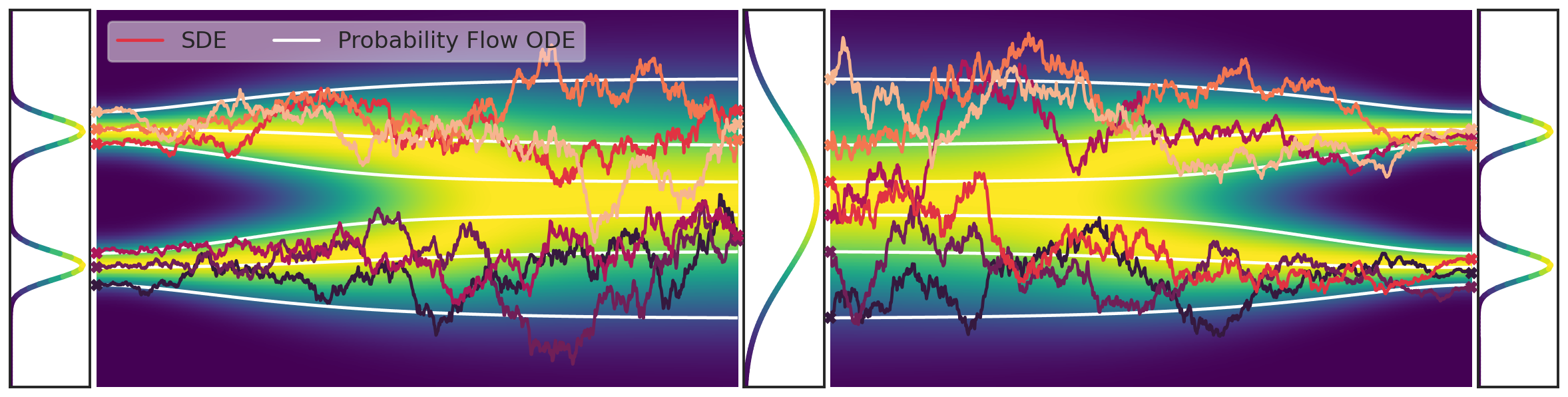
Creating noise from data is easy; creating data from noise is generative modeling. We present a stochastic differential equation (SDE) that smoothly transforms a complex data distribution to a known prior distribution by slowly injecting noise, and a corresponding reverse-time SDE that transforms the prior distribution back into the data distribution by slowly removing the noise. Crucially, the reverse-time SDE depends only on the time-dependent gradient field (\aka, score) of the perturbed data distribution. By leveraging advances in score-based generative modeling, we can accurately estimate these scores with neural networks, and use numerical SDE solvers to generate samples. We show that this framework encapsulates previous approaches in score-based generative modeling and diffusion probabilistic modeling, allowing for new sampling procedures and new modeling capabilities. In particular, we introduce a predictor-corrector framework to correct errors in the evolution of the discretized reverse-time SDE. We also derive an equivalent neural ODE that samples from the same distribution as the SDE, but additionally enables exact likelihood computation, and improved sampling efficiency. In addition, we provide a new way to solve inverse problems with score-based models, as demonstrated with experiments on class-conditional generation, image inpainting, and colorization. Combined with multiple architectural improvements, we achieve record-breaking performance for unconditional image generation on CIFAR-10 with an Inception score of 9.89 and FID of 2.20, a competitive likelihood of 2.99 bits/dim, and demonstrate high fidelity generation of 1024 x 1024 images for the first time from a score-based generative model.
Overview
AI snapshot
Written from the paper’s full text.
TL;DR
The paper introduces a stochastic differential equation framework that unifies score-based generative modeling and diffusion probabilistic modeling by reversing a noising SDE with a learned time-dependent score network. It derives predictor-corrector and probability-flow ODE samplers, enabling exact likelihoods and controllable generation, and reports record CIFAR-10 sample quality and likelihood plus first 1024×1024 score-based samples.
Key findings
- SMLD and DDPM are unified as discretizations of Variance Exploding (VE) and Variance Preserving (VP) SDEs; the reverse-time SDE depends only on the time-dependent score, and a new sub-VP SDE is proposed.
- Predictor-Corrector samplers improve sample quality, while the probability flow ODE enables exact likelihood computation, fast adaptive sampling, latent manipulation, and uniquely identifiable encoding.
- On CIFAR-10, NCSN++ cont. (deep, VE) achieves an Inception score of 9.89 and FID of 2.20 for unconditional generation; DDPM++ cont. (deep, sub-VP) achieves 2.99 bits/dim on uniformly dequantized CIFAR-10.
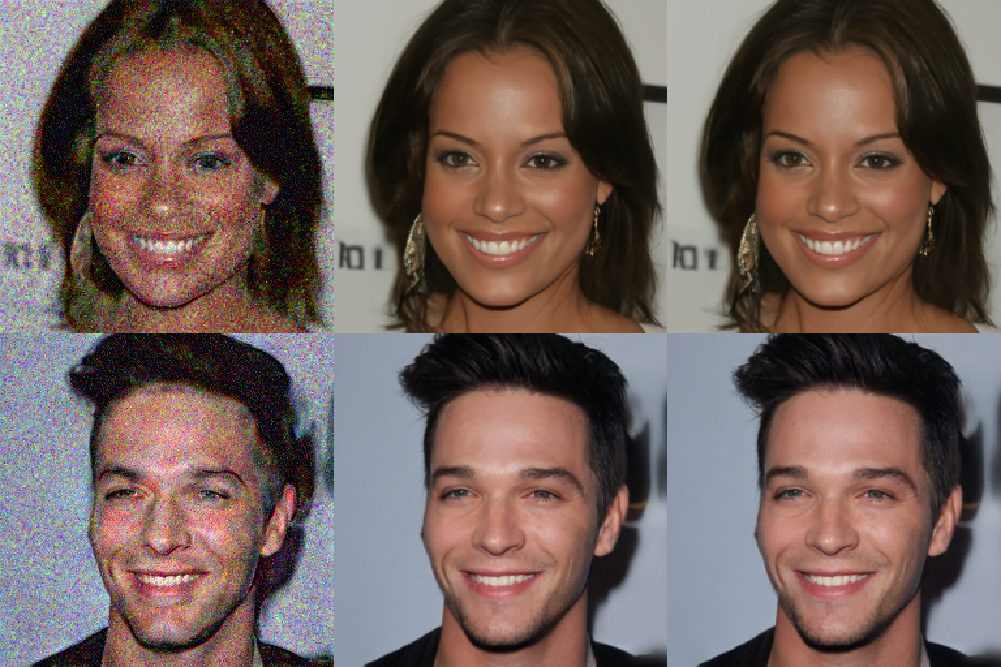
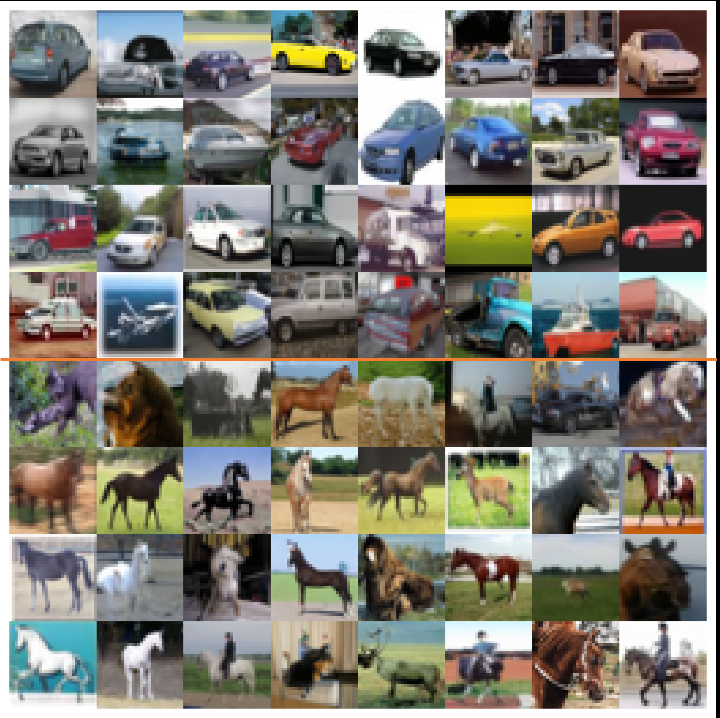
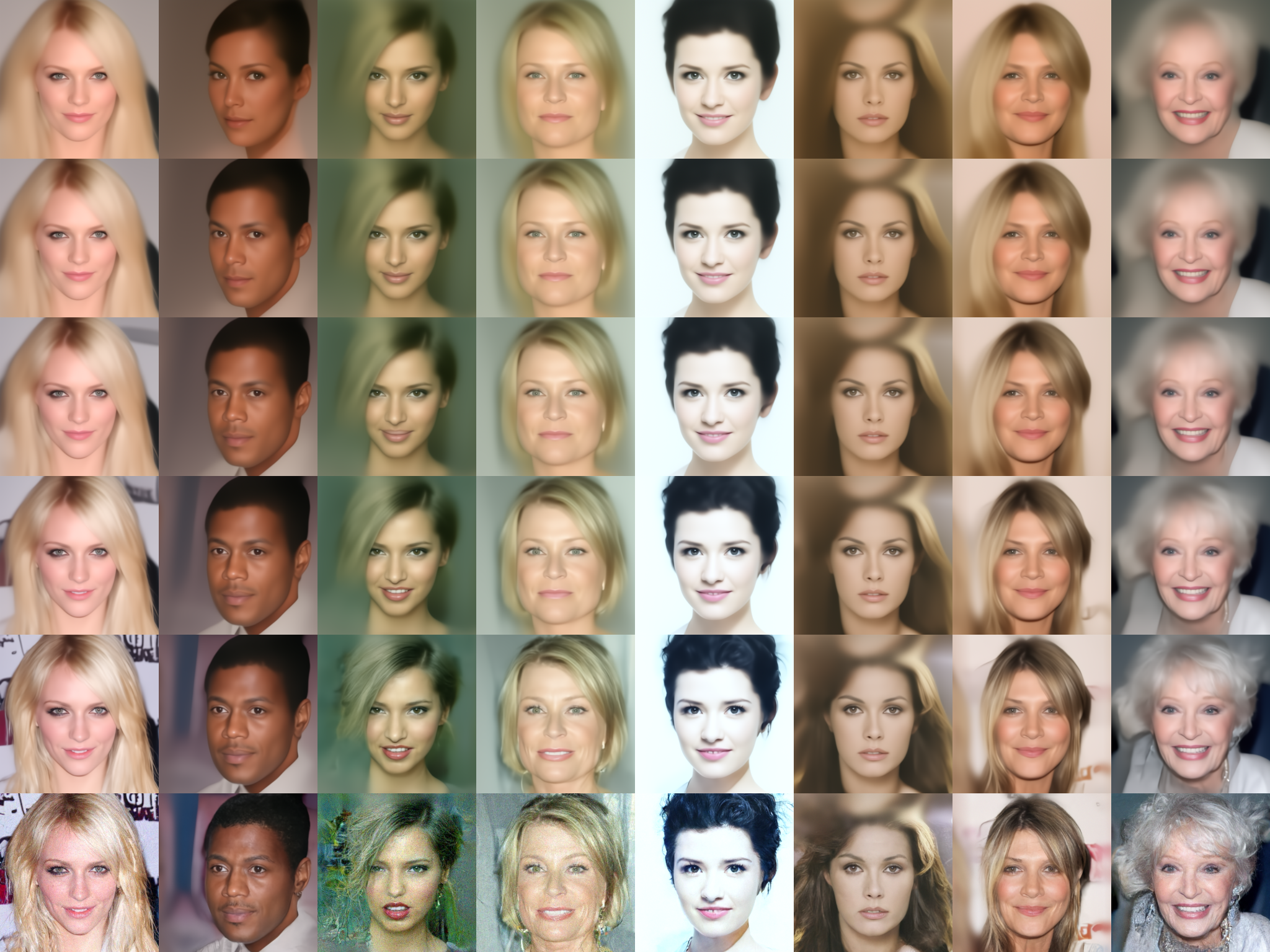
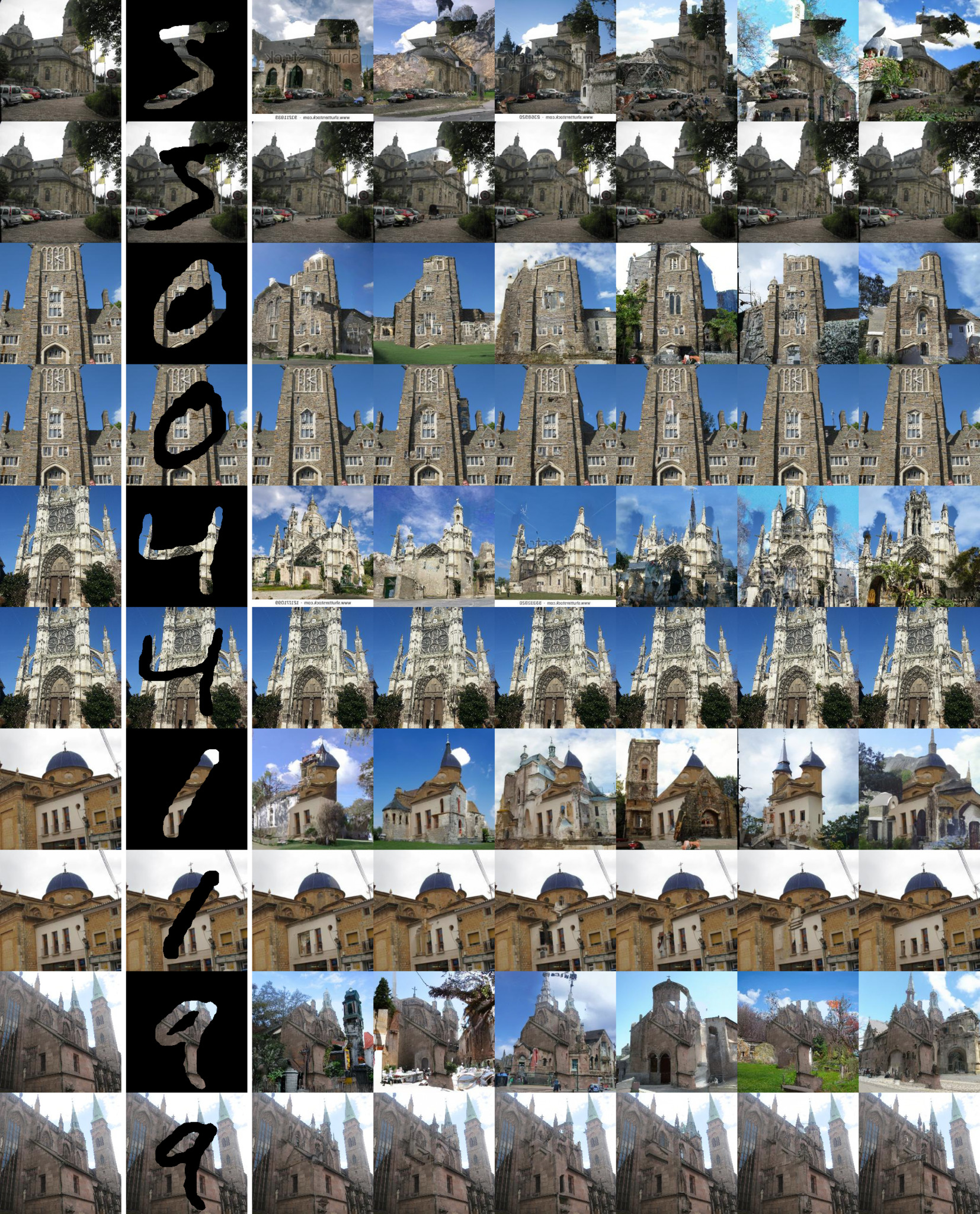
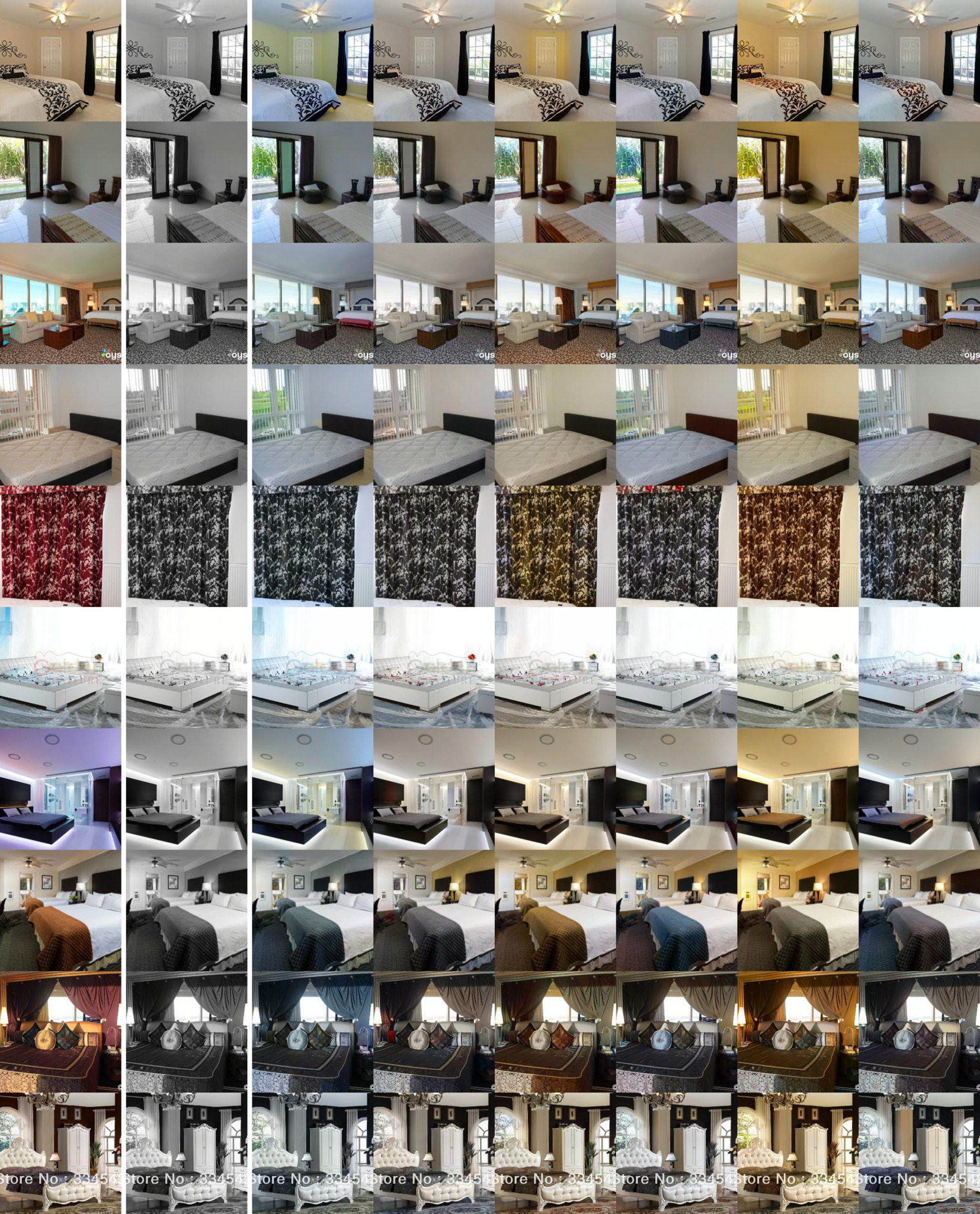
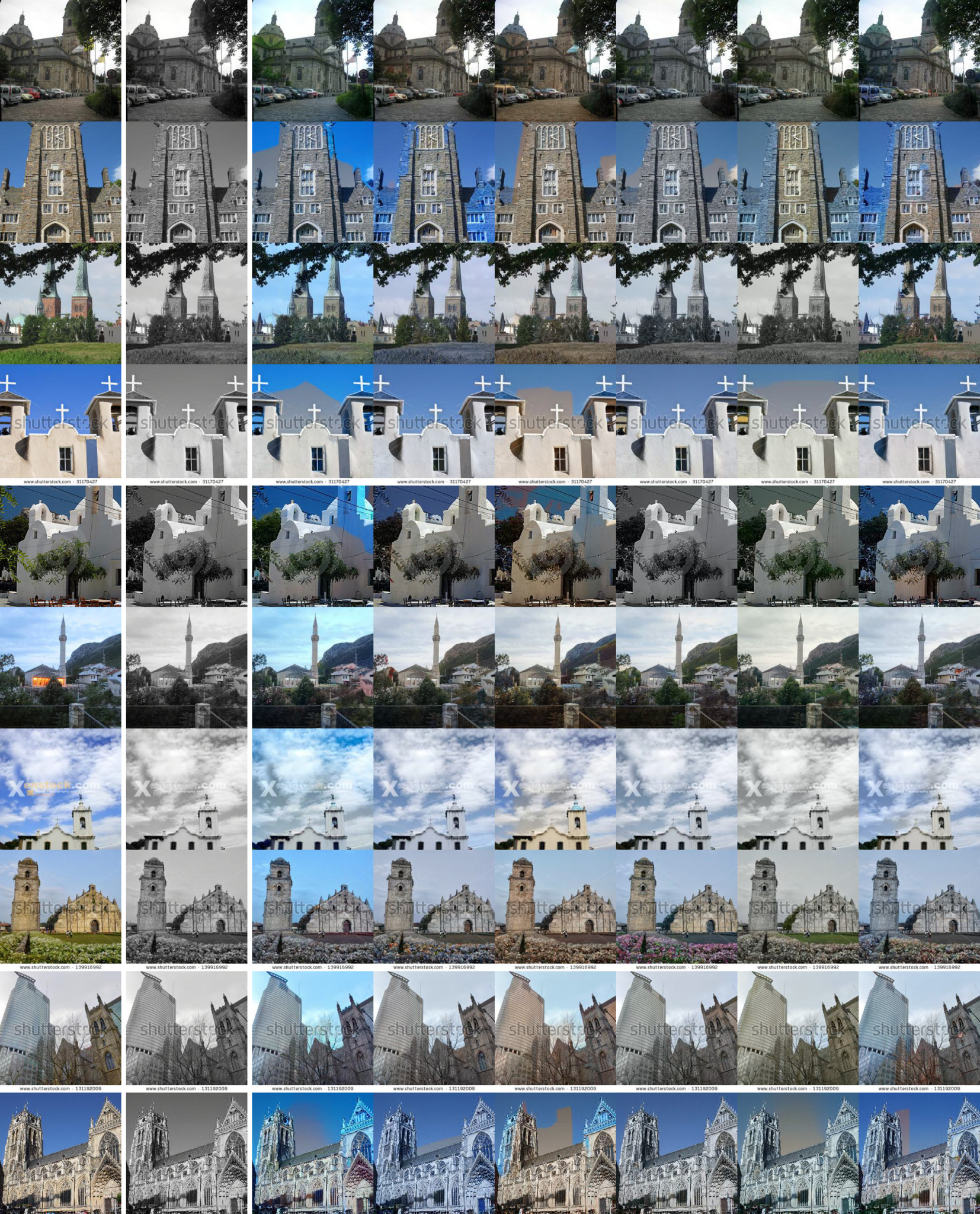
- Controllable generation is demonstrated for class-conditional CIFAR-10, image inpainting and colorization on 256×256 LSUN, and high-fidelity 1024×1024 CelebA-HQ samples from a score-based model.
Methods
- The framework models data corruption as a continuous-time diffusion process `dx = f(x,t)dt + g(t)dw`, derives the reverse-time SDE and probability flow ODE, and trains a time-dependent score model `sθ(x,t)` via denoising score matching; VE, VP, and sub-VP SDEs are instantiated.
- Sampling uses general-purpose SDE solvers, reverse diffusion, ancestral sampling, Predictor-Corrector samplers with Langevin correctors, and probability flow ODE solvers; architecture improvements yield NCSN++ and DDPM++ models.
- Experiments evaluate FID, Inception score, bits/dim negative log-likelihood, and qualitative samples on CIFAR-10, CelebA-HQ 1024×1024, and LSUN 256×256 bedroom/church; class-conditional generation uses a time-dependent classifier.
Limitations
- Stated: sampling remains slower than GANs on the same datasets, and the breadth of available samplers introduces many hyperparameters; future work is needed for automatic selection and tuning.
- Stated/evident: the 1024×1024 samples are not perfect, with visible flaws such as facial symmetry; architecture exploration for VP SDEs was limited to CIFAR-10 due to limited computing resources.
- Evident: likelihood comparisons omit models evaluated with variational dequantization or discrete data except DDPM ELBO values annotated with an asterisk; sample quality and likelihood favor different SDEs (VE better sample quality, VP/sub-VP better likelihood), requiring per-domain experimentation.
Model-written summary. Check it against the paper before relying on it.
Integrity signals
Registry
Cites
Statistics
Figures
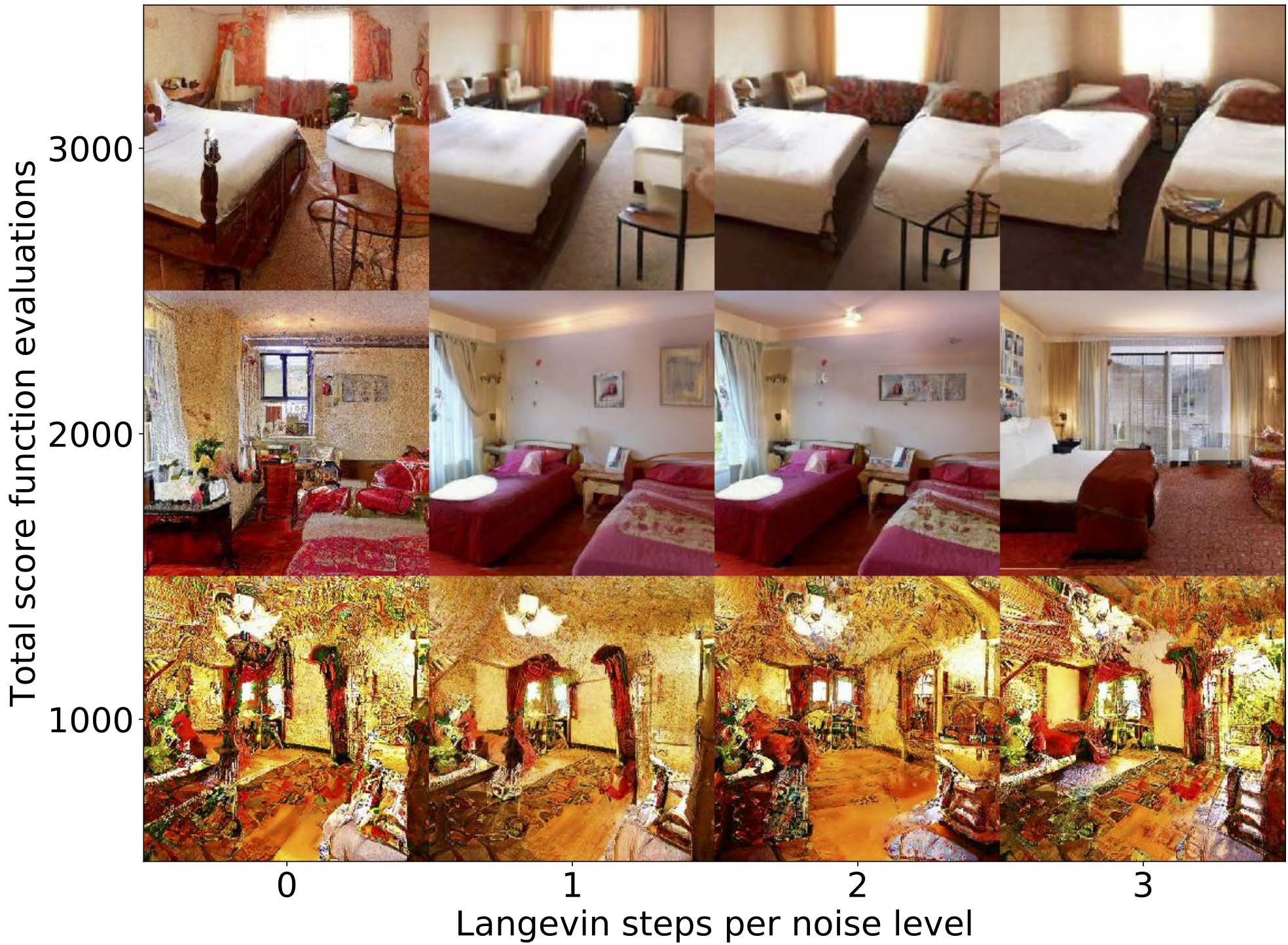
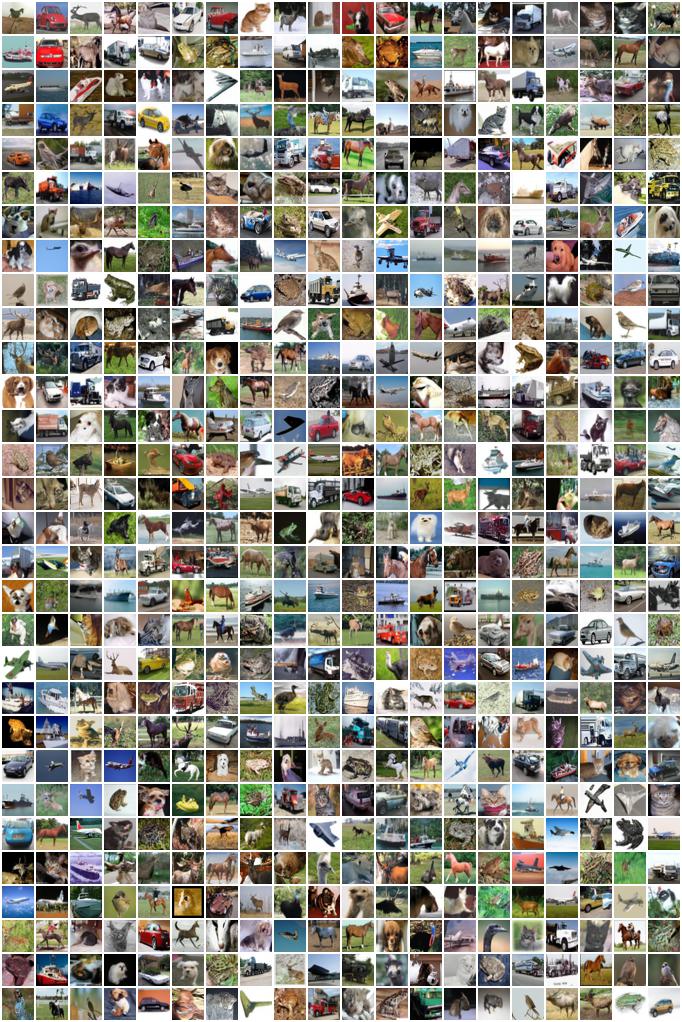
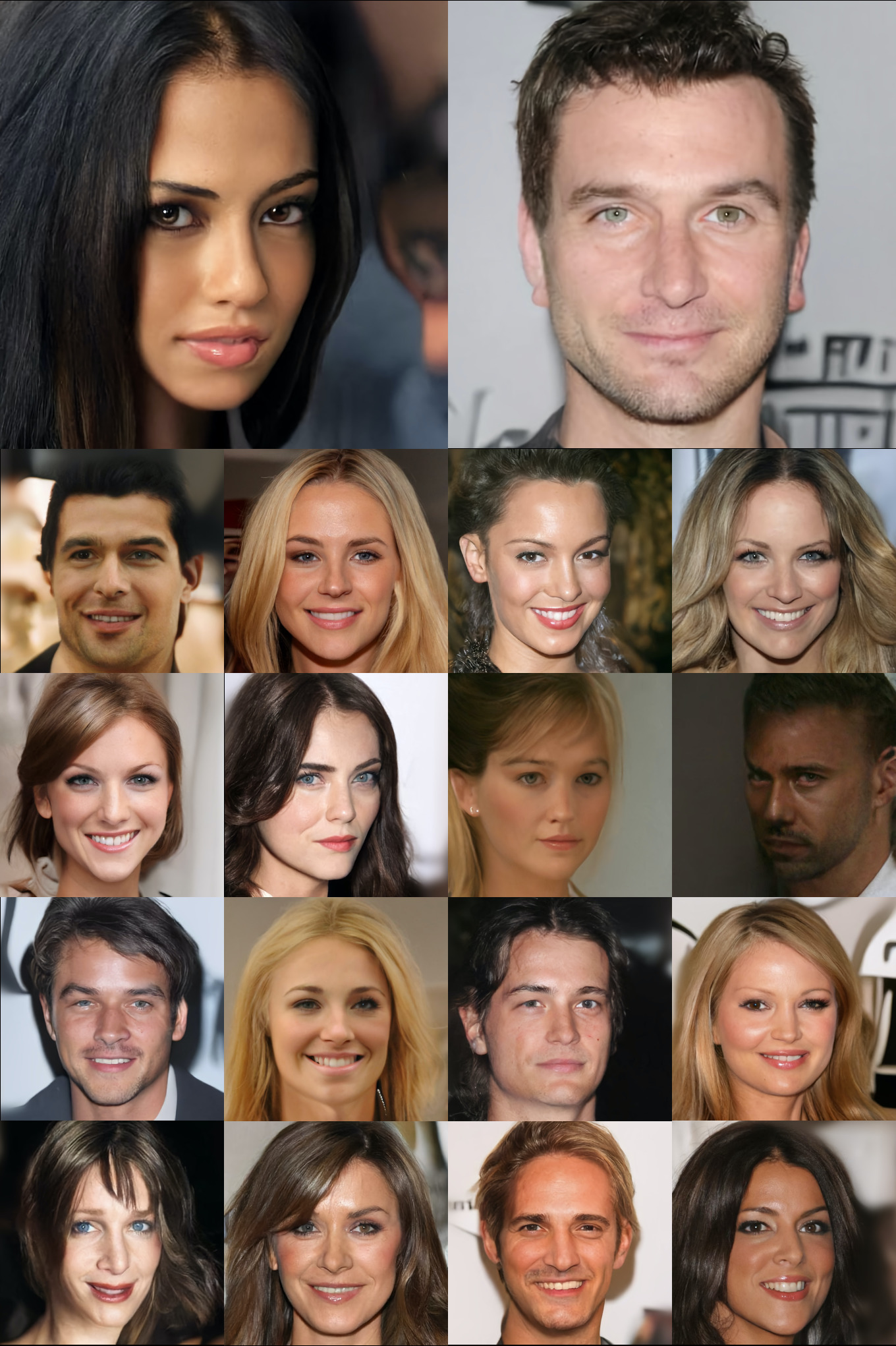
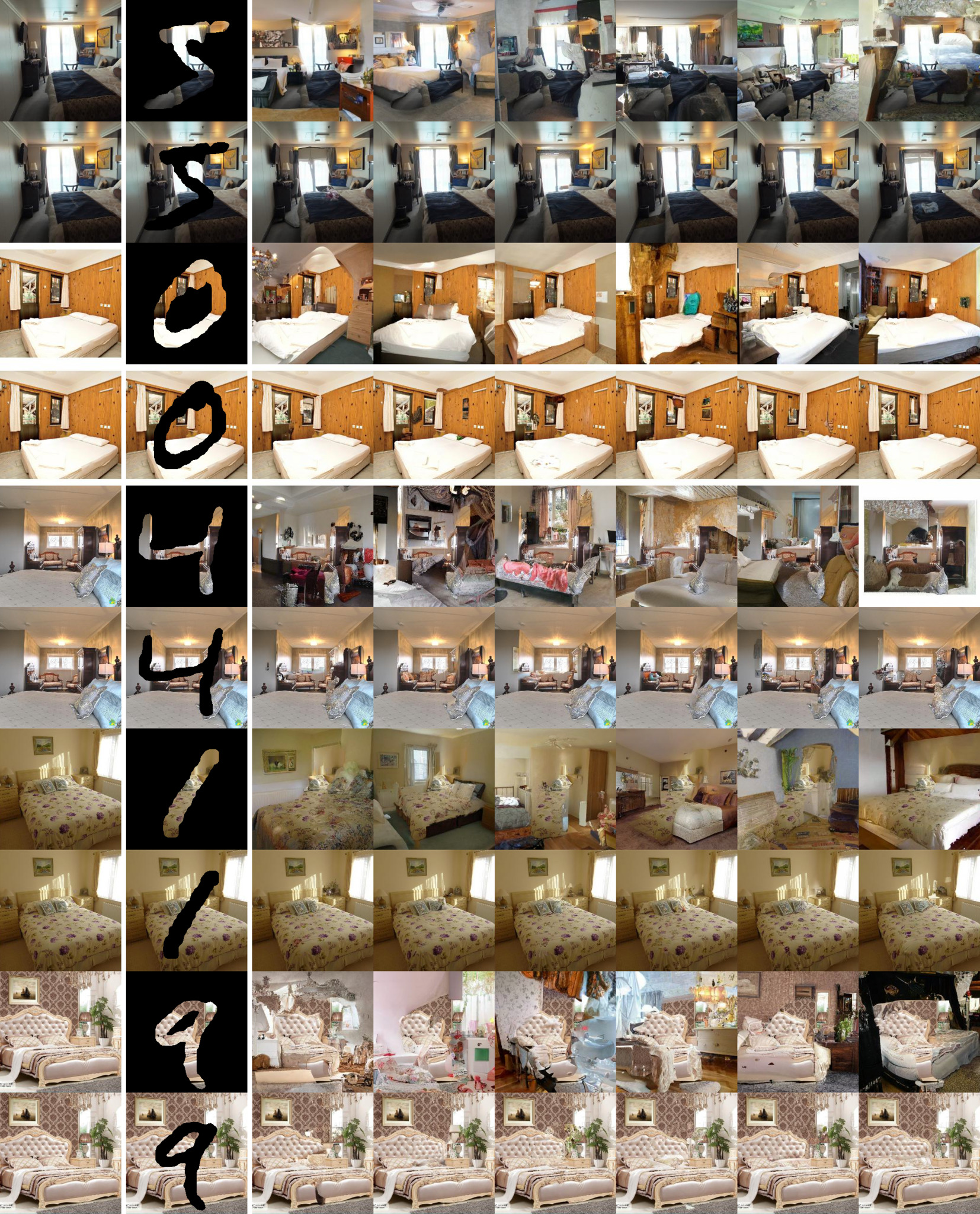
Verification
Claims the paper makes
78 Own interpretation · 40 Own result · 14 Sources not found · 14 No basis given · 5 Partly supported · 4 Supported · 4 No full text of the sources · 3 Not checked yet · 2 Own method · 1 Not supported · accuracy not yet measured
At least one cited source doesn’t support this claim or points to a different paper, and none confirmed it — see the verdicts below.
In the paper
“Unlike most current invertible models, our encoding is uniquely identifiable, meaning that with sufficient training data, model capacity, and optimization accuracy, the encoding for an input is uniquely determined by the data distribution (Roeder et al., 2020).”
§ 4 SOLVING THE REVERSE SDE > 4.3 PROBABILITY FLOW AND CONNECTION TO NEURAL ODES
What the sources say
- Disputedcites Roeder et al., 2020 sourceExperimental — accuracy not yet measured
The paper supports an asymptotic identifiability result, but not a uniquely determined encoding. Section 3.2 (p. 4) defines identifiability only up to an invertible linear transformation, and the Introduction (p. 1) describes distinct representation functions learned from the same data distribution. (LLM, conf=0.90)
Checked by a reasoning model — may be wrong.
plaindirect- Asserted: passes — The authors put it forward as true.
- Checkable: passes — It can be checked against evidence.
- Load-bearing: unclear — It is unclear whether the paper’s conclusions depend on it.
- Based: passes — The paper gives a reason why it holds.
- Disputed
The cited sources support only part of this claim — read each source’s verdict below.
In the paper
“Although DDPM (Ho et al., 2020) was recently reported to achieve higher sample quality than SMLD (Song & Ermon, 2019; 2020), we show that with better architectures and new sampling algorithms allowed by our framework, the latter can catch up”
What the sources say
- Not matchedcites Ho et al., 2020
Couldn’t be matched to a paper in Crossref, so it can’t be checked.
- Not matchedcites Song & Ermon, 2019
Couldn’t be matched to a paper in Crossref, so it can’t be checked.
- Supportedcites Song & Ermon, 2020 source
The Introduction (p. 1) describes improved score-based models and Langevin-dynamics sampling, supporting the citation’s identification of the SMLD line of work. The statement that SMLD can catch up to DDPM is introduced as the citing authors’ own result (“we show”), not attributed to this source; this paper does not establish a DDPM comparison. (LLM, conf=0.82)
plaindirect- Asserted: passes — The authors put it forward as true.
- Checkable: passes — It can be checked against evidence.
- Load-bearing: passes — The paper’s conclusions depend on it.
- Based: passes — The paper gives a reason why it holds.
- Not matched
The cited sources support only part of this claim — read each source’s verdict below.
In the paper
“Crucially, the reverse-time SDE depends only on the time-dependent gradient field (a.k.a., score) of the perturbed data distribution.”
- Also stated in: § 1 INTRODUCTION · plain
“Crucially, this reverse process satisfies a reverse-time SDE (Anderson, 1982), which can be derived from the forward SDE given the score of the marginal probability densities as a function of time.”
What the sources say
- Partly supportedcites Anderson, 1982 sourceExperimental — accuracy not yet measured
The theorem in Section 3 (eqs. 3.11–3.12) makes the reverse-time drift depend on the time-dependent density and its spatial derivative, consistent with the score being relevant. But its formula also includes the forward drift and diffusion coefficient, so the reverse-time SDE does not depend only on the score. The copy provides no page number for this passage. (LLM, conf=0.88)
plaindirect- Asserted: passes — The authors put it forward as true.
- Checkable: passes — It can be checked against evidence.
- Load-bearing: passes — The paper’s conclusions depend on it.
- Based: passes — The paper gives a reason why it holds.
- Also stated in: § 1 INTRODUCTION · plain
The cited sources support only part of this claim — read each source’s verdict below.
In the paper
“When the score function is approximated by the time-dependent score-based model, which is typically a neural network, this is an example of a neural ODE (Chen et al., 2018).”
§ 4 SOLVING THE REVERSE SDE > 4.3 PROBABILITY FLOW AND CONNECTION TO NEURAL ODES
What the sources say
- Partly supportedcites Chen et al., 2018 sourceExperimental — accuracy not yet measured
The Introduction (p. 1) defines a neural ODE as continuous dynamics specified by a neural network, supporting the general classification. Our copy does not discuss score functions or establish that approximating one with a time-dependent score-based model yields an ODE, so it does not support that specific application. (LLM, conf=0.84)
plaindirect- Asserted: passes — The authors put it forward as true.
- Checkable: passes — It can be checked against evidence.
- Load-bearing: unclear — It is unclear whether the paper’s conclusions depend on it.
- Based: passes — The paper gives a reason why it holds.
- Partly supported
Every source the paper cites for this claim was checked and supports it.
In the paper
“A remarkable result from Anderson (1982) states that the reverse of a diffusion process is also a diffusion process, running backwards in time and given by the reverse-time SDE:”
§ 3 SCORE-BASED GENERATIVE MODELING WITH SDES > 3.2 GENERATING SAMPLES BY REVERSING THE SDE
What the sources say
- Supportedcites Anderson, 1982 source
The Introduction states that, for a wide variety of diffusion processes, a forward-time representation generates a reverse-time representation. Section 3 defines that representation as a reverse-time stochastic differential equation. The paper notes regularity restrictions, so the result is not stated for every diffusion process. (LLM, conf=0.90)
boosteddirect- Asserted: passes — The authors put it forward as true.
- Checkable: passes — It can be checked against evidence.
- Load-bearing: passes — The paper’s conclusions depend on it.
- Based: passes — The paper gives a reason why it holds.
- Supported
Every source the paper cites for this claim was checked and supports it.
In the paper
“As noted by Jolicoeur-Martineau et al. (2020), FIDs can be significantly worse without removing this noise.”
§ 0 100 200 300 > 0.00 0.25 0.50 0.75 1.00
What the sources say
- Supportedcites Jolicoeur-Martineau et al., 2020 source
Section 4 says denoising is critical to the FID score even when its effect is not visible to the human eye. The Section 6.1 ablation study reports an improvement in FID from denoising in every comparison, supporting the claim that leaving the noise in generated samples can substantially worsen FID. (LLM, conf=0.93)
plaindirect- Asserted: passes — The authors put it forward as true.
- Checkable: passes — It can be checked against evidence.
- Load-bearing: passes — The paper’s conclusions depend on it.
- Based: passes — The paper gives a reason why it holds.
- Supported
The cited sources support only part of this claim — read each source’s verdict below.
In the paper
“For both SMLD and DDPM models, the generated samples typically contain small noise that is hard to detect by humans.”
§ 0 100 200 300 > 0.00 0.25 0.50 0.75 1.00
What the sources say
- Partly supportedcites Jolicoeur-Martineau et al., 2020 sourceExperimental — accuracy not yet measured
Section 4 reports that denoising final Langevin samples substantially improves FID even though the change cannot be perceived by the human eye. This supports the claim for the paper’s score-matching/Langevin samples, but not its extension to DDPM samples; Section 6.1 says Ho et al. denoised their final sample. (LLM, conf=0.84)
plain- Asserted: passes — The authors put it forward as true.
- Checkable: passes — It can be checked against evidence.
- Load-bearing: passes — The paper’s conclusions depend on it.
- Based: passes — The paper gives a reason why it holds.
- Partly supported
A result the paper reports from its own data — it cites no other source for it, so there is none to check. The quote shows it is in the paper.
In the paper
“demonstrate high fidelity generation of 1024ˆ 1024 images for the first time from a score-based generative model.”
boosted- Asserted: passes — The authors put it forward as true.
- Checkable: passes — It can be checked against evidence.
- Load-bearing: passes — The paper’s conclusions depend on it.
- Based: passes — The paper gives a reason why it holds.
The paper states this without a source or data behind it here, so there is nothing to check it against. The quote shows it is in the paper.
In the paper
“Combined with multiple architectural improvements, we achieve record-breaking performance for unconditional image generation on CIFAR-10 with an Inception score of 9.89 and FID of 2.20”
- Also stated in: § 1 INTRODUCTION · plain
“with better architectures and new sampling algorithms allowed by our framework, the latter can catch up—it achieves new state-of-the-art Inception score (9.89) and FID score (2.20) on CIFAR-10”
plaindirect- Asserted: passes — The authors put it forward as true.
- Checkable: passes — It can be checked against evidence.
- Load-bearing: passes — The paper’s conclusions depend on it.
- Based: passes — The paper gives a reason why it holds.
- Also stated in: § 1 INTRODUCTION · plain
A result the paper reports from its own data — it cites no other source for it, so there is none to check. The quote shows it is in the paper.
In the paper
“a competitive likelihood of 2.99 bits/dim”
- Also stated in: § 1 INTRODUCTION · plain
“we propose a new SDE under our framework that achieves a likelihood value of 2.99 bits/dim on uniformly dequantized CIFAR-10 images”
plain- Asserted: passes — The authors put it forward as true.
- Checkable: passes — It can be checked against evidence.
- Load-bearing: passes — The paper’s conclusions depend on it.
- Based: passes — The paper gives a reason why it holds.
- Also stated in: § 1 INTRODUCTION · plain
- It may state two separate claims as one. 40
- Probably not a substantial claim. 25
Every source the paper cites for this claim was checked and supports it.
In the paper
“Crucially, this reverse process satisfies a reverse-time SDE (Anderson, 1982), which can be derived from the forward SDE given the score of the marginal probability densities as a function of time.”
What the sources say
- Supportedcites Anderson, 1982 source
The theorem in Section 3, equations (3.11)–(3.12), constructs a reverse-time SDE from the forward process and gives its drift in terms of the time-dependent marginal density and diffusion coefficients. Section 5, equations (5.6)–(5.7), also derives the reverse-time equation using that density. The density-dependent term is the score term when the diffusion coefficient is independent of the state. (LLM, conf=0.91)
plaindirect- Asserted: passes — The authors put it forward as true.
- Checkable: passes — It can be checked against evidence.
- Load-bearing: passes — The paper’s conclusions depend on it.
- Based: passes — The paper gives a reason why it holds.
It may state two separate claims as one.
- Supported
Every source the paper cites for this claim was checked and supports it.
In the paper
“The bits/dim values in Table 2 are computed with atol=1e-5 and rtol=1e-5, same as Grathwohl et al. (2018).”
§ 2 log > 0.0 0.2 0.4 0.6 0.8 1.0
What the sources say
- Supportedcites Grathwohl et al. (2018) source
Appendix C (page not provided) says FFJORD set both atol and rtol to the same tolerance and used 10^-5 for most experiments. That supports the cited comparison of solver tolerances; the paper specifies different settings for its tabular experiments. The citing paper’s own Table 2 values cannot be checked against this source. (LLM, conf=0.89)
plain- Asserted: passes — The authors put it forward as true.
- Checkable: passes — It can be checked against evidence.
- Load-bearing: fails — The paper’s conclusions may not depend on it.
- Based: passes — The paper gives a reason why it holds.
Probably not a substantial claim. The paper’s conclusions may not depend on it.
- Supported
The cited sources support only part of this claim — read each source’s verdict below.
In the paper
“a task that was previously only achievable by some GAN models and VQ-VAE-2 (Razavi et al., 2019).”
What the sources say
- Partly supportedcites Razavi et al., 2019 sourceExperimental — accuracy not yet measured
Section 5.1 (pp. 6–7) reports that VQ-VAE-2 generated 1024 × 1024 face images, but the dataset was FFHQ, not CelebA-HQ. The Related Works section (p. 5) discusses high-resolution GANs and other approaches; it does not establish that only GAN models and VQ-VAE-2 could perform the claimed task. (LLM, conf=0.88)
plain- Asserted: passes — The authors put it forward as true.
- Checkable: passes — It can be checked against evidence.
- Load-bearing: fails — The paper’s conclusions may not depend on it.
- Based: passes — The paper gives a reason why it holds.
Probably not a substantial claim. The paper’s conclusions may not depend on it.
- Partly supported
The paper states this without a source or data behind it here, so there is nothing to check it against. The quote shows it is in the paper.
In the paper
“In addition, we propose a new SDE under our framework that achieves a likelihood value of 2.99 bits/dim on uniformly dequantized CIFAR-10 images, setting a new record on this task.”
plaindirect- Asserted: passes — The authors put it forward as true.
- Checkable: passes — It can be checked against evidence.
- Load-bearing: passes — The paper’s conclusions depend on it.
- Based: passes — The paper gives a reason why it holds.
It may state two separate claims as one.
A result the paper reports from its own data — it cites no other source for it, so there is none to check. The quote shows it is in the paper.
In the paper
“Our best model for likelihoods, DDPM++ cont. (deep, sub-VP), similarly doubles the network depth and achieves a log-likelihood of 2.99 bits/dim with the continuous objective in Eq. (7).”
§ 100 101 102 103 > 4.4 ARCHITECTURE IMPROVEMENTS
plaindirect- Asserted: passes — The authors put it forward as true.
- Checkable: passes — It can be checked against evidence.
- Load-bearing: passes — The paper’s conclusions depend on it.
- Based: passes — The paper gives a reason why it holds.
It may state two separate claims as one.
The paper states this without a source or data behind it here, so there is nothing to check it against. The quote shows it is in the paper.
In the paper
“although samples across different ε look visually the same to human eyes.”
§ 2 log > 0.0 0.2 0.4 0.6 0.8 1.0
plain- Asserted: passes — The authors put it forward as true.
- Checkable: passes — It can be checked against evidence.
- Load-bearing: fails — The paper’s conclusions may not depend on it.
- Based: passes — The paper gives a reason why it holds.
Probably not a substantial claim. The paper’s conclusions may not depend on it.
A result the paper reports from its own data — it cites no other source for it, so there is none to check. The quote shows it is in the paper.
In the paper
“As shown in Table 3, VE SDEs typically provide better sample quality than VP/sub-VP SDEs, but we also empirically observe that their likelihoods are worse than VP/sub-VP SDE counterparts.”
§ 100 101 102 103 > 4.4 ARCHITECTURE IMPROVEMENTS
plaincorrelational- Asserted: passes — The authors put it forward as true.
- Checkable: passes — It can be checked against evidence.
- Load-bearing: passes — The paper’s conclusions depend on it.
- Based: passes — The paper gives a reason why it holds.
It may state two separate claims as one.
A result the paper reports from its own data — it cites no other source for it, so there is none to check. The quote shows it is in the paper.
In the paper
“For all predictors, adding one corrector step for each predictor step (PC1000) doubles computation but always improves sample quality (against P1000).”
§ 4 SOLVING THE REVERSE SDE > 4.2 PREDICTOR-CORRECTOR SAMPLERS
plaindirect- Asserted: passes — The authors put it forward as true.
- Checkable: passes — It can be checked against evidence.
- Load-bearing: unclear — It is unclear whether the paper’s conclusions depend on it.
- Based: passes — The paper gives a reason why it holds.
It may state two separate claims as one.
In the paper
“For the same DDPM model in Ho et al. (2020), we obtain better bits/dim than ELBO, since our likelihoods are exact”
§ 4 SOLVING THE REVERSE SDE > 4.3 PROBABILITY FLOW AND CONNECTION TO NEURAL ODES
What the sources say
- Not matchedcites Ho et al. (2020)
Couldn’t be matched to a paper in Crossref, so it can’t be checked.
plaindirect- Asserted: passes — The authors put it forward as true.
- Checkable: passes — It can be checked against evidence.
- Load-bearing: passes — The paper’s conclusions depend on it.
- Based: passes — The paper gives a reason why it holds.
It may state two separate claims as one.
- Not matched
A result the paper reports from its own data — it cites no other source for it, so there is none to check. The quote shows it is in the paper.
In the paper
“By switching to the continuous training objective in Eq. (7), and increasing the network depth, we can further improve sample quality for all models.”
§ 100 101 102 103 > 4.4 ARCHITECTURE IMPROVEMENTS
plaindirect- Asserted: passes — The authors put it forward as true.
- Checkable: passes — It can be checked against evidence.
- Load-bearing: unclear — It is unclear whether the paper’s conclusions depend on it.
- Based: passes — The paper gives a reason why it holds.
It may state two separate claims as one.
A result the paper reports from its own data — it cites no other source for it, so there is none to check. The quote shows it is in the paper.
In the paper
“We observe that our reverse diffusion sampler always outperform ancestral sampling, and corrector-only methods (C2000) perform worse than other competitors (P2000, PC1000) with the same computation”
§ 4 SOLVING THE REVERSE SDE > 4.2 PREDICTOR-CORRECTOR SAMPLERS
plaindirect- Asserted: passes — The authors put it forward as true.
- Checkable: passes — It can be checked against evidence.
- Load-bearing: unclear — It is unclear whether the paper’s conclusions depend on it.
- Based: passes — The paper gives a reason why it holds.
It may state two separate claims as one.
A result the paper reports from its own data — it cites no other source for it, so there is none to check. The quote shows it is in the paper.
In the paper
“For sampling, it is important to use an appropriate ε for better Inception scores and FIDs, although samples across different ε look visually the same to human eyes.”
§ 2 log > 0.0 0.2 0.4 0.6 0.8 1.0
plaindirect- Asserted: passes — The authors put it forward as true.
- Checkable: passes — It can be checked against evidence.
- Load-bearing: fails — The paper’s conclusions may not depend on it.
- Based: passes — The paper gives a reason why it holds.
Probably not a substantial claim. The paper’s conclusions may not depend on it.
A result the paper reports from its own data — it cites no other source for it, so there is none to check. The quote shows it is in the paper.
In the paper
“Our best model for sample quality, NCSN++ cont. (deep, VE), doubles the network depth and sets new records for both inception score and FID on unconditional generation for CIFAR-10.”
§ 100 101 102 103 > 4.4 ARCHITECTURE IMPROVEMENTS
plaindirect- Asserted: passes — The authors put it forward as true.
- Checkable: passes — It can be checked against evidence.
- Load-bearing: passes — The paper’s conclusions depend on it.
- Based: passes — The paper gives a reason why it holds.
It may state two separate claims as one.
In the paper
“Using a black-box ODE solver (Dormand & Prince, 1980) not only produces high quality samples (Table 2, details in Appendix D.4), but also allows us to explicitly trade-off accuracy for efficiency. With a larger error tolerance, the number of function evaluations can be reduced by over 90% without affecting the visual quality of samples (Fig. 3).”
What the sources say
- Not checked — no full text of the sourcecites Dormand & Prince, 1980 source
plaindirect- Asserted: passes — The authors put it forward as true.
- Checkable: passes — It can be checked against evidence.
- Load-bearing: passes — The paper’s conclusions depend on it.
- Based: passes — The paper gives a reason why it holds.
It may state two separate claims as one.
A result the paper reports from its own data — it cites no other source for it, so there is none to check. The quote shows it is in the paper.
In the paper
“Our optimal architecture for the VE SDE, named NCSN++, achieves an FID of 2.45 on CIFAR-10 with PC samplers, while our optimal architecture for the VP SDE, called DDPM++, achieves 2.78.”
§ 100 101 102 103 > 4.4 ARCHITECTURE IMPROVEMENTS
plain- Asserted: passes — The authors put it forward as true.
- Checkable: passes — It can be checked against evidence.
- Load-bearing: passes — The paper’s conclusions depend on it.
- Based: passes — The paper gives a reason why it holds.
It may state two separate claims as one.
The paper states this without a source or data behind it here, so there is nothing to check it against. The quote shows it is in the paper.
In the paper
“Our endeavor gives rise to new state-of-the-art sample quality on CIFAR-10, new state-of-the-art likelihood on uniformly dequantized CIFAR-10, and enables the first high-fidelity image samples of resolution 1024ˆ 1024 from score-based generative models.”
§ 0 100 200 300 > 3.06 ˘ .03
plaindirect- Asserted: passes — The authors put it forward as true.
- Checkable: passes — It can be checked against evidence.
- Load-bearing: passes — The paper’s conclusions depend on it.
- Based: passes — The paper gives a reason why it holds.
It may state two separate claims as one.
A result the paper reports from its own data — it cites no other source for it, so there is none to check. The quote shows it is in the paper.
In the paper
“We observe that different interpolation methods result in performance differences but maintain the general trend of predictor-corrector methods performing on par or better than predictor-only or corrector-only samplers.”
§ 0 100 200 300 > 3.06 ˘ .03
plaincorrelational- Asserted: passes — The authors put it forward as true.
- Checkable: passes — It can be checked against evidence.
- Load-bearing: unclear — It is unclear whether the paper’s conclusions depend on it.
- Based: passes — The paper gives a reason why it holds.
It may state two separate claims as one.
A result the paper reports from its own data — it cites no other source for it, so there is none to check. The quote shows it is in the paper.
In the paper
“The basic NCSN++ model with 4 residual blocks per resolution achieves an FID of 2.45 on CIFAR-10, whereas the basic DDPM++ model achieves an FID of 2.78.”
plain- Asserted: passes — The authors put it forward as true.
- Checkable: passes — It can be checked against evidence.
- Load-bearing: unclear — It is unclear whether the paper’s conclusions depend on it.
- Based: passes — The paper gives a reason why it holds.
It may state two separate claims as one.
A result the paper reports from its own data — it cites no other source for it, so there is none to check. The quote shows it is in the paper.
In the paper
“For progressive growing, it is not clear which combination of configurations consistently performs the best, but the results are typically better than when no progressive growing architecture is used.”
hedgedconditional- Asserted: passes — The authors put it forward as true.
- Checkable: passes — It can be checked against evidence.
- Load-bearing: unclear — It is unclear whether the paper’s conclusions depend on it.
- Based: passes — The paper gives a reason why it holds.
It may state two separate claims as one.
A result the paper reports from its own data — it cites no other source for it, so there is none to check. The quote shows it is in the paper.
In the paper
“The NCSN++ architecture worked decently well for VP SDEs, ranked 4th place over all 144 possible configurations.”
plain- Asserted: passes — The authors put it forward as true.
- Checkable: passes — It can be checked against evidence.
- Load-bearing: unclear — It is unclear whether the paper’s conclusions depend on it.
- Based: passes — The paper gives a reason why it holds.
It may state two separate claims as one.
A result the paper reports from its own data — it cites no other source for it, so there is none to check. The quote shows it is in the paper.
In the paper
“Its FID score is 2.41, same for both VP and sub-VP SDEs.”
plain- Asserted: passes — The authors put it forward as true.
- Checkable: passes — It can be checked against evidence.
- Load-bearing: unclear — It is unclear whether the paper’s conclusions depend on it.
- Based: passes — The paper gives a reason why it holds.
It may state two separate claims as one.
A conclusion the paper draws from its own results — it cites no other source for it, so there is none to check. The quote shows it is in the paper.
In the paper
“We can therefore approximate the reverse-time SDE by training a time-dependent neural network to estimate the scores, and then produce samples using numerical SDE solvers.”
plaindirect- Asserted: passes — The authors put it forward as true.
- Checkable: passes — It can be checked against evidence.
- Load-bearing: passes — The paper’s conclusions depend on it.
- Based: passes — The paper gives a reason why it holds.
It may state two separate claims as one.
A conclusion the paper draws from its own results — it cites no other source for it, so there is none to check. The quote shows it is in the paper.
In the paper
“This enables applications such as class-conditional generation, image inpainting, colorization and other inverse problems, all achievable using a single unconditional score-based model without re-training.”
plaindirect- Asserted: passes — The authors put it forward as true.
- Checkable: passes — It can be checked against evidence.
- Load-bearing: passes — The paper’s conclusions depend on it.
- Based: passes — The paper gives a reason why it holds.
It may state two separate claims as one.
A conclusion the paper draws from its own results — it cites no other source for it, so there is none to check. The quote shows it is in the paper.
In the paper
“We also derive an equivalent neural ODE that samples from the same distribution as the SDE, but additionally enables exact likelihood computation, and improved sampling efficiency.”
plaindirect- Asserted: passes — The authors put it forward as true.
- Checkable: passes — It can be checked against evidence.
- Load-bearing: passes — The paper’s conclusions depend on it.
- Based: passes — The paper gives a reason why it holds.
It may state two separate claims as one.
None of the sources cited for this claim have been checked yet.
In the paper
“we propose two special methods not viable for general SDEs: (i) Predictor-Corrector (PC) samplers that combine numerical SDE solvers with score-based MCMC approaches, such as Langevin MCMC (Parisi, 1981) and HMC (Neal et al., 2011); and (ii) deterministic samplers based on the probability flow ordinary differential equation (ODE).”
What the sources say
- Not checked — no full text of the sourcecites Parisi, 1981 source
- Not matchedcites Neal et al., 2011
Couldn’t be matched to a paper in Crossref, so it can’t be checked.
plain- Asserted: passes — The authors put it forward as true.
- Checkable: passes — It can be checked against evidence.
- Load-bearing: passes — The paper’s conclusions depend on it.
- Based: passes — The paper gives a reason why it holds.
It may state two separate claims as one.
A conclusion the paper draws from its own results — it cites no other source for it, so there is none to check. The quote shows it is in the paper.
In the paper
“The latter allows for fast adaptive sampling via black-box ODE solvers, flexible data manipulation via latent codes, a uniquely identifiable encoding, and notably, exact likelihood computation.”
plaindirect- Asserted: passes — The authors put it forward as true.
- Checkable: passes — It can be checked against evidence.
- Load-bearing: passes — The paper’s conclusions depend on it.
- Based: unclear — It is unclear why the paper says it holds.
It may state two separate claims as one.
None of the sources cited for this claim could be matched to a paper in Crossref, so there is nothing to check it against.
In the paper
“Denoising diffusion probabilistic modeling (DDPM) (Sohl-Dickstein et al., 2015; Ho et al., 2020) trains a sequence of probabilistic models to reverse each step of the noise corruption, using knowledge of the functional form of the reverse distributions to make training tractable.”
What the sources say
- Not matchedcites Sohl-Dickstein et al., 2015
Couldn’t be matched to a paper in Crossref, so it can’t be checked.
- Not matchedcites Ho et al., 2020
Couldn’t be matched to a paper in Crossref, so it can’t be checked.
plaindirect- Asserted: passes — The authors put it forward as true.
- Checkable: passes — It can be checked against evidence.
- Load-bearing: fails — The paper’s conclusions may not depend on it.
- Based: passes — The paper gives a reason why it holds.
Probably not a substantial claim. The paper’s conclusions may not depend on it.
- Not matched
A conclusion the paper draws from its own results — it cites no other source for it, so there is none to check. The quote shows it is in the paper.
In the paper
“The former unifies and improves over existing sampling methods for score-based models.”
plaindirect- Asserted: passes — The authors put it forward as true.
- Checkable: passes — It can be checked against evidence.
- Load-bearing: passes — The paper’s conclusions depend on it.
- Based: unclear — It is unclear why the paper says it holds.
It may state two separate claims as one.
A conclusion the paper draws from its own results — it cites no other source for it, so there is none to check. The quote shows it is in the paper.
In the paper
“We can employ any general-purpose SDE solver to integrate the reverse-time SDE for sampling.”
plaindirect- Asserted: passes — The authors put it forward as true.
- Checkable: passes — It can be checked against evidence.
- Load-bearing: passes — The paper’s conclusions depend on it.
- Based: fails — The paper may give no reason why it holds.
Probably not a substantial claim. The paper may give no reason why it holds.
A conclusion the paper draws from its own results — it cites no other source for it, so there is none to check. The quote shows it is in the paper.
In the paper
“By leveraging advances in score-based generative modeling, we can accurately estimate these scores with neural networks, and use numerical SDE solvers to generate samples.”
plaindirect- Asserted: passes — The authors put it forward as true.
- Checkable: passes — It can be checked against evidence.
- Load-bearing: passes — The paper’s conclusions depend on it.
- Based: passes — The paper gives a reason why it holds.
It may state two separate claims as one.
In the paper
“Score matching with Langevin dynamics (SMLD) (Song & Ermon, 2019) estimates the score (i.e., the gradient of the log probability density with respect to data) at each noise scale, and then uses Langevin dynamics to sample from a sequence of decreasing noise scales during generation.”
What the sources say
- Not matchedcites Song & Ermon, 2019
Couldn’t be matched to a paper in Crossref, so it can’t be checked.
plaindirect- Asserted: passes — The authors put it forward as true.
- Checkable: passes — It can be checked against evidence.
- Load-bearing: fails — The paper’s conclusions may not depend on it.
- Based: passes — The paper gives a reason why it holds.
Probably not a substantial claim. The paper’s conclusions may not depend on it. It may state two separate claims as one.
- Not matched
A conclusion the paper draws from its own results — it cites no other source for it, so there is none to check. The quote shows it is in the paper.
In the paper
“We can modulate the generation process by conditioning on information not available during training, because the conditional reverse-time SDE can be efficiently estimated from unconditional scores.”
plaindirect- Asserted: passes — The authors put it forward as true.
- Checkable: passes — It can be checked against evidence.
- Load-bearing: passes — The paper’s conclusions depend on it.
- Based: unclear — It is unclear why the paper says it holds.
It may state two separate claims as one.
A conclusion the paper draws from its own results — it cites no other source for it, so there is none to check. The quote shows it is in the paper.
In the paper
“This process progressively diffuses a data point into random noise, and is given by a prescribed SDE that does not depend on the data and has no trainable parameters.”
plaindirect- Asserted: passes — The authors put it forward as true.
- Checkable: passes — It can be checked against evidence.
- Load-bearing: passes — The paper’s conclusions depend on it.
- Based: passes — The paper gives a reason why it holds.
It may state two separate claims as one.
The paper states this without a source or data behind it here, so there is nothing to check it against. The quote shows it is in the paper.
In the paper
“When the drift and diffusion coefficient of an SDE are not affine, it can be difficult to compute the transition kernel p0tpxptq | xp0qq in closed form.”
plainconditional- Asserted: passes — The authors put it forward as true.
- Checkable: passes — It can be checked against evidence.
- Load-bearing: passes — The paper’s conclusions depend on it.
- Based: fails — The paper may give no reason why it holds.
Probably not a substantial claim. The paper may give no reason why it holds.
What the paper did — it cites no source for this, so there is none to check. The quote shows it is in the paper.
In the paper
“Therefore, same as the VE SDE, we restrict computation to t P rε, 1s for a small ε ą 0.”
§ 2 log > 0.0 0.2 0.4 0.6 0.8 1.0
plain- Asserted: passes — The authors put it forward as true.
- Checkable: passes — It can be checked against evidence.
- Load-bearing: fails — The paper’s conclusions may not depend on it.
- Based: passes — The paper gives a reason why it holds.
Probably not a substantial claim. The paper’s conclusions may not depend on it.
In the paper
“For example, when using sliced score matching (Song et al., 2019a), our training objective Eq. (7) becomes”
What the sources say
- Not matchedcites Song et al., 2019a
Couldn’t be matched to a paper in Crossref, so it can’t be checked.
plaindirect- Asserted: passes — The authors put it forward as true.
- Checkable: passes — It can be checked against evidence.
- Load-bearing: fails — The paper’s conclusions may not depend on it.
- Based: passes — The paper gives a reason why it holds.
Probably not a substantial claim. The paper’s conclusions may not depend on it.
- Not matched
A conclusion the paper draws from its own results — it cites no other source for it, so there is none to check. The quote shows it is in the paper.
In the paper
“By integrating Eq. (13), we can encode any datapoint xp0q into a latent space xpT q. Decoding can be achieved by integrating a corresponding ODE for the reverse-time SDE.”
§ 4 SOLVING THE REVERSE SDE > 4.3 PROBABILITY FLOW AND CONNECTION TO NEURAL ODES
plaindirect- Asserted: passes — The authors put it forward as true.
- Checkable: passes — It can be checked against evidence.
- Load-bearing: passes — The paper’s conclusions depend on it.
- Based: passes — The paper gives a reason why it holds.
It may state two separate claims as one.
A conclusion the paper draws from its own results — it cites no other source for it, so there is none to check. The quote shows it is in the paper.
In the paper
“The noise perturbations used in SMLD and DDPM can be regarded as discretizations of two different SDEs.”
- Also stated in: § 3.4 EXAMPLES: VE, VP SDES AND BEYOND · plain
“Therefore, the noise perturbations used in SMLD and DDPM correspond to discretizations of SDEs Eqs. (9) and (11).”
§ 3 SCORE-BASED GENERATIVE MODELING WITH SDES > 3.4 EXAMPLES: VE, VP SDES AND BEYOND
plaindirect- Asserted: passes — The authors put it forward as true.
- Checkable: passes — It can be checked against evidence.
- Load-bearing: passes — The paper’s conclusions depend on it.
- Based: passes — The paper gives a reason why it holds.
It may state two separate claims as one.
- Also stated in: § 3.4 EXAMPLES: VE, VP SDES AND BEYOND · plain
In the paper
“The SDE has a unique strong solution as long as the coefficients are globally Lipschitz in both state and time (Øksendal, 2003).”
§ 3 SCORE-BASED GENERATIVE MODELING WITH SDES > 3.1 PERTURBING DATA WITH SDES
What the sources say
- Not checked — no full text of the sourcecites Øksendal, 2003 source
plaindirect- Asserted: passes — The authors put it forward as true.
- Checkable: passes — It can be checked against evidence.
- Load-bearing: fails — The paper’s conclusions may not depend on it.
- Based: passes — The paper gives a reason why it holds.
Probably not a substantial claim. The paper’s conclusions may not depend on it.
In the paper
“Leveraging the connection to neural ODEs, we can compute the density defined by Eq. (13) via the instantaneous change of variables formula (Chen et al., 2018). This allows us to compute the exact likelihood on any input data (details in Appendix D.2).”
§ 4 SOLVING THE REVERSE SDE > 4.3 PROBABILITY FLOW AND CONNECTION TO NEURAL ODES
What the sources say
- Not matchedcites Chen et al., 2018
Couldn’t be matched to a paper in Crossref, so it can’t be checked.
plaindirect- Asserted: passes — The authors put it forward as true.
- Checkable: passes — It can be checked against evidence.
- Load-bearing: passes — The paper’s conclusions depend on it.
- Based: passes — The paper gives a reason why it holds.
It may state two separate claims as one.
- Not matched
What the paper did — it cites no source for this, so there is none to check. The quote shows it is in the paper.
In the paper
“As a sanity check for our SDE generalizations to SMLD and DDPM, we compare the perturbation kernels of SDEs and original discrete Markov chains in Fig. 5.”
§ 2 log > 0.0 0.2 0.4 0.6 0.8 1.0
plaincorrelational- Asserted: passes — The authors put it forward as true.
- Checkable: passes — It can be checked against evidence.
- Load-bearing: fails — The paper’s conclusions may not depend on it.
- Based: passes — The paper gives a reason why it holds.
Probably not a substantial claim. The paper’s conclusions may not depend on it.
A conclusion the paper draws from its own results — it cites no other source for it, so there is none to check. The quote shows it is in the paper.
In the paper
“In Appendix I.4, we provide a broadly applicable method for obtaining such an estimate without the need of training auxiliary models.”
plain- Asserted: passes — The authors put it forward as true.
- Checkable: passes — It can be checked against evidence.
- Load-bearing: fails — The paper’s conclusions may not depend on it.
- Based: passes — The paper gives a reason why it holds.
Probably not a substantial claim. The paper’s conclusions may not depend on it.
The paper states this without a source or data behind it here, so there is nothing to check it against. The quote shows it is in the paper.
In the paper
“Perturbing data with multiple noise scales is key to the success of previous methods.”
plaindirect- Asserted: passes — The authors put it forward as true.
- Checkable: passes — It can be checked against evidence.
- Load-bearing: passes — The paper’s conclusions depend on it.
- Based: fails — The paper may give no reason why it holds.
Probably not a substantial claim. The paper may give no reason why it holds.
A conclusion the paper draws from its own results — it cites no other source for it, so there is none to check. The quote shows it is in the paper.
In the paper
“To overcome this difficulty, we can replace denoising score matching in Eq. (7) with other efficient variants of score matching that do not require computing ∇xptq log p0tpxptq | xp0qq.”
plain- Asserted: passes — The authors put it forward as true.
- Checkable: passes — It can be checked against evidence.
- Load-bearing: fails — The paper’s conclusions may not depend on it.
- Based: passes — The paper gives a reason why it holds.
Probably not a substantial claim. The paper’s conclusions may not depend on it.
A conclusion the paper draws from its own results — it cites no other source for it, so there is none to check. The quote shows it is in the paper.
In the paper
“Our work enables a better understanding of existing approaches, new sampling algorithms, exact likelihood computation, uniquely identifiable encoding, latent code manipulation, and brings new conditional generation abilities to the family of score-based generative models.”
plaindirect- Asserted: passes — The authors put it forward as true.
- Checkable: fails — It may be too vague to check against evidence.
- Load-bearing: passes — The paper’s conclusions depend on it.
- Based: fails — The paper may give no reason why it holds.
Probably not a substantial claim. It may be too vague to check against evidence. The paper may give no reason why it holds.
In the paper
“Therefore, the original ancestral sampler of Eq. (4) is essentially a different discretization to the same reverse-time SDE. This unifies the sampling method in Ho et al. (2020) as a numerical solver to the reverse-time VP SDE in our continuous framework.”
§ 0 100 200 300 > 0.00 0.25 0.50 0.75 1.00
What the sources say
- Not matchedcites Ho et al., 2020
Couldn’t be matched to a paper in Crossref, so it can’t be checked.
plaincorrelational- Asserted: passes — The authors put it forward as true.
- Checkable: passes — It can be checked against evidence.
- Load-bearing: passes — The paper’s conclusions depend on it.
- Based: passes — The paper gives a reason why it holds.
It may state two separate claims as one.
- Not matched
In the paper
“Therefore, their perturbation kernels p0tpxptq | xp0qq are all Gaussian and can be computed with Eqs. (5.50) and (5.51) in Särkkä & Solin (2019):”
What the sources say
- Not matchedcites Särkkä & Solin (2019)
Couldn’t be matched to a paper in Crossref, so it can’t be checked.
plain- Asserted: passes — The authors put it forward as true.
- Checkable: passes — It can be checked against evidence.
- Load-bearing: unclear — It is unclear whether the paper’s conclusions depend on it.
- Based: passes — The paper gives a reason why it holds.
It may state two separate claims as one.
- Not matched
A conclusion the paper draws from its own results — it cites no other source for it, so there is none to check. The quote shows it is in the paper.
In the paper
“Since VE, VP and sub-VP SDEs all have affine drift coefficients, their perturbation kernels p0tpxptq | xp0qq are all Gaussian and can be computed in closed-forms, as discussed in Section 3.3.”
§ 3 SCORE-BASED GENERATIVE MODELING WITH SDES > 3.4 EXAMPLES: VE, VP SDES AND BEYOND
plaindirect- Asserted: passes — The authors put it forward as true.
- Checkable: passes — It can be checked against evidence.
- Load-bearing: passes — The paper’s conclusions depend on it.
- Based: passes — The paper gives a reason why it holds.
It may state two separate claims as one.
A conclusion the paper draws from its own results — it cites no other source for it, so there is none to check. The quote shows it is in the paper.
In the paper
“Our work enables a better understanding of existing approaches, new sampling algorithms, exact likelihood computation, uniquely identifiable encoding, latent code manipulation, and brings new conditional generation abilities to the family of score-based generative models.”
plaindirect- Asserted: passes — The authors put it forward as true.
- Checkable: passes — It can be checked against evidence.
- Load-bearing: passes — The paper’s conclusions depend on it.
- Based: fails — The paper may give no reason why it holds.
Probably not a substantial claim. The paper may give no reason why it holds.
A conclusion the paper draws from its own results — it cites no other source for it, so there is none to check. The quote shows it is in the paper.
In the paper
“Additionally, the breadth of samplers one can use when given access to score functions introduces a number of hyper-parameters.”
plaindirect- Asserted: passes — The authors put it forward as true.
- Checkable: passes — It can be checked against evidence.
- Load-bearing: fails — The paper’s conclusions may not depend on it.
- Based: fails — The paper may give no reason why it holds.
Probably not a substantial claim. The paper’s conclusions may not depend on it. The paper may give no reason why it holds.
A conclusion the paper draws from its own results — it cites no other source for it, so there is none to check. The quote shows it is in the paper.
In the paper
“We can always simulate the SDE to sample from p0tpxptq | xp0qq, and solve Eq. (19) to train the time-dependent score-based model sθpx, tq.”
plaindirect- Asserted: passes — The authors put it forward as true.
- Checkable: passes — It can be checked against evidence.
- Load-bearing: passes — The paper’s conclusions depend on it.
- Based: fails — The paper may give no reason why it holds.
Probably not a substantial claim. The paper may give no reason why it holds. It may state two separate claims as one.
In the paper
“Like Eq. (1), Eq. (3) is also a weighted sum of denoising score matching objectives, which implies that the optimal model, sθ˚px̃, iq, matches the score of the perturbed data distribution, ∇x log pαipxq.”
§ 2 BACKGROUND > 2.2 DENOISING DIFFUSION PROBABILISTIC MODELS (DDPM)
What the sources say
- Not matchedcites Ho et al., 2020
Couldn’t be matched to a paper in Crossref, so it can’t be checked.
plaindirect- Asserted: passes — The authors put it forward as true.
- Checkable: passes — It can be checked against evidence.
- Load-bearing: unclear — It is unclear whether the paper’s conclusions depend on it.
- Based: passes — The paper gives a reason why it holds.
It may state two separate claims as one.
- Not matched
A conclusion the paper draws from its own results — it cites no other source for it, so there is none to check. The quote shows it is in the paper.
In the paper
“VE, VP and sub-VP SDEs all have affine drift coefficients.”
plain- Asserted: passes — The authors put it forward as true.
- Checkable: passes — It can be checked against evidence.
- Load-bearing: passes — The paper’s conclusions depend on it.
- Based: passes — The paper gives a reason why it holds.
It may state two separate claims as one.
A conclusion the paper draws from its own results — it cites no other source for it, so there is none to check. The quote shows it is in the paper.
In the paper
“This is because the discretization strategy of the original DDPM method does not match the variance of the continuous process well when t Ñ 0, which significantly hurts FID scores.”
plaindirect- Asserted: passes — The authors put it forward as true.
- Checkable: passes — It can be checked against evidence.
- Load-bearing: passes — The paper’s conclusions depend on it.
- Based: unclear — It is unclear why the paper says it holds.
It may state two separate claims as one.
A conclusion the paper draws from its own results — it cites no other source for it, so there is none to check. The quote shows it is in the paper.
In the paper
“Colorization is a special case of imputation, except that the known data dimensions are coupled.”
plain- Asserted: passes — The authors put it forward as true.
- Checkable: passes — It can be checked against evidence.
- Load-bearing: fails — The paper’s conclusions may not depend on it.
- Based: passes — The paper gives a reason why it holds.
Probably not a substantial claim. The paper’s conclusions may not depend on it.
A conclusion the paper draws from its own results — it cites no other source for it, so there is none to check. The quote shows it is in the paper.
In the paper
“Because the transformations are all orthogonal matrices, the standard Wiener process wptq will still be a standard Wiener process in the transformed space, allowing us to build an SDE and use the same imputation method in Appendix I.2.”
§ 10 2 10 1 100 101 > 0.577 ´0.816 0
plaindirect- Asserted: passes — The authors put it forward as true.
- Checkable: passes — It can be checked against evidence.
- Load-bearing: unclear — It is unclear whether the paper’s conclusions depend on it.
- Based: passes — The paper gives a reason why it holds.
It may state two separate claims as one.
A conclusion the paper draws from its own results — it cites no other source for it, so there is none to check. The quote shows it is in the paper.
In the paper
“We can decouple these data dimensions by using an orthogonal linear transformation to map the gray-scale image to a separate channel in a different space, and then perform imputation to complete the other channels before transforming everything back to the original image space.”
plaindirect- Asserted: passes — The authors put it forward as true.
- Checkable: passes — It can be checked against evidence.
- Load-bearing: fails — The paper’s conclusions may not depend on it.
- Based: passes — The paper gives a reason why it holds.
Probably not a substantial claim. The paper’s conclusions may not depend on it. It may state two separate claims as one.
A conclusion the paper draws from its own results — it cites no other source for it, so there is none to check. The quote shows it is in the paper.
In the paper
“Although these samples are not perfect (e.g., there are visible flaws on facial symmetry), we believe these results are encouraging and can demonstrate the scalability of our approach.”
plain- Asserted: passes — The authors put it forward as true.
- Checkable: passes — It can be checked against evidence.
- Load-bearing: fails — The paper’s conclusions may not depend on it.
- Based: passes — The paper gives a reason why it holds.
Probably not a substantial claim. The paper’s conclusions may not depend on it. It may state two separate claims as one.
A conclusion the paper draws from its own results — it cites no other source for it, so there is none to check. The quote shows it is in the paper.
In the paper
“∇x log ptpxptq | yq”
plain- Asserted: fails — The authors may not put it forward as true.
- Checkable: passes — It can be checked against evidence.
- Load-bearing: fails — The paper’s conclusions may not depend on it.
- Based: fails — The paper may give no reason why it holds.
Probably not a substantial claim. The authors may not put it forward as true. The paper’s conclusions may not depend on it. The paper may give no reason why it holds.
A conclusion the paper draws from its own results — it cites no other source for it, so there is none to check. The quote shows it is in the paper.
In the paper
“All sampling methods we have discussed so far can be applied to the conditional reverse-time SDE for sample generation.”
plain- Asserted: passes — The authors put it forward as true.
- Checkable: passes — It can be checked against evidence.
- Load-bearing: fails — The paper’s conclusions may not depend on it.
- Based: passes — The paper gives a reason why it holds.
Probably not a substantial claim. The paper’s conclusions may not depend on it.
A conclusion the paper draws from its own results — it cites no other source for it, so there is none to check. The quote shows it is in the paper.
In the paper
“Imputation is a special case of conditional sampling.”
plain- Asserted: passes — The authors put it forward as true.
- Checkable: passes — It can be checked against evidence.
- Load-bearing: fails — The paper’s conclusions may not depend on it.
- Based: fails — The paper may give no reason why it holds.
Probably not a substantial claim. The paper’s conclusions may not depend on it. The paper may give no reason why it holds.
The authors state this as an assumption.
For ease of presentation, the diffusion coefficient is assumed to be a scalar and not to depend on x.
“For ease of presentation we assume the diffusion coefficient is a scalar (instead of a dˆ d matrix) and does not depend on x, but our theory can be generalized to hold in those cases (see Appendix A).”
The authors state this as an assumption.
The discretization schedule of time is fixed beforehand.
“We assume the discretization schedule of time is fixed beforehand, and thus we absorb the dependency on ∆t into the notations of fi and Gi.”
The paper relies on this without support.
In colorization, the known data dimensions are coupled.
“Colorization is a special case of imputation, except that the known data dimensions are coupled.”
The authors state this as an assumption.
p(y(t)|y) is tractable.
“• ppyptq | yq is tractable. We can often derive this distribution from the interaction between the forward process and the SDE, like in the case of image imputation and colorization.”
The authors state this as an assumption.
pt(x(t)|y(t),y) ≈ pt(x(t)|y(t)).
“• ptpxptq | yptq,yq « ptpxptq | yptqq. For small t, yptq is almost the same as y so the approximation holds. For large t, y becomes further away from xptq in the Markov chain, and thus have smaller impact on xptq. Moreover, the approximation error for large t matter less for the final sample, since it is used early in the sampling process.”
Claims other papers make about this one
Each is checked against this paper’s own text: does it say what the citing paper says it does?
The source backs part of the claim, not all of it — or backs it for a different population, condition or comparison.
In the citing paper
“Song et al. [60] found that further changes to the UNet architecture improved performance on the CIFAR-10 [31] and CelebA-64 [34] datasets.”
From Diffusion Models Beat GANs on Image Synthesis (2021) · cites this paper as [60]
Experimental — accuracy not yet measuredThe cited source says what the claim attributes to it.
In the citing paper
“An intriguing feature of diffusion models is that unconditional models can be conditioned at test-time [15, 82, 85].”
From High-Resolution Image Synthesis with Latent Diffusion Models (2022) · cites this paper as [85]
The cited source says what the claim attributes to it.
In the citing paper
“This class of models already holds the state-of-the-art [60] on CIFAR-10 [31]”
From Diffusion Models Beat GANs on Image Synthesis (2021) · cites this paper as [60]
The cited source says what the claim attributes to it.
In the citing paper
“In particular, we can train a classifier pφ(y|xt, t) on noisy images xt, and then use gradients ∇xt log pφ(y|xt, t) to guide the diffusion sampling process towards an arbitrary class label y.”
From Diffusion Models Beat GANs on Image Synthesis (2021) · cites this paper as [60]
The cited source says what the claim attributes to it.
In the citing paper
“Sohl-Dickstein et al. [56] and Song et al. [60] show one way to achieve this, wherein a pre-trained diffusion model can be conditioned using the gradients of a classifier.”
From Diffusion Models Beat GANs on Image Synthesis (2021) · cites this paper as [60]
The cited source says what the claim attributes to it.
In the citing paper
“To this end, we use a score-based conditioning trick adapted from Song et al. [60]”
From Diffusion Models Beat GANs on Image Synthesis (2021) · cites this paper as [60]
The check wasn’t confident either way, so it gives no verdict — never disputed.
In the citing paper
“Continuous visual tokenizers, often including Autoencoder (AE) and Variational Autoencoder (VAE), compress visual data into a continuous latent space where diffusion-based models can be efficiently trained on (Ho et al., 2020; Lipman et al., 2022; Song et al., 2020).”
From Cosmos World Foundation Model Platform for Physical AI (2025) · cites this paper as Song et al., 2020
Experimental — accuracy not yet measured
Self-check
Percentages, sums and reported differences re-computed from the paper’s own numbers.
Each contradiction between two passages listed here was confirmed by an independent check.
Rated minor: it would not touch a result — a value no result rests on, a p-value that stays on the same side of the significance level, or a conflict that is clerical, resolved elsewhere in the paper, or outside its own findings.
In the paper
§ 0 100 200 300 > 0.00 0.25 0.50 0.75 1.00
“where sθpxi, iq is to estimate z{σi.”
§ 2 BACKGROUND > 2.1 DENOISING SCORE MATCHING WITH LANGEVIN DYNAMICS (SMLD)
“Given sufficient data and model capacity, the optimal score-based model sθ˚px, σq matches ∇x log pσpxq almost everywhere for σ P tσiuNi"1.”
Citations
Cites
Learning Multiple Layers of Features from Tiny Images
Krizhevsky, A. (2024) · doi:10.57702/zp44cu3g · Cited by 23,889
GAN(Generative Adversarial Nets)
淳司, 柴. (2017) · Journal of Japan Society for Fuzzy Theory and Intelligent Informatics · doi:10.3156/jsoft.29.5_177_2 · Cited by 20,507
A Style-Based Generator Architecture for Generative Adversarial Networks
Karras, T., Laine, S., & Aila, T. (2019) · 2019 IEEE/CVF Conference on Computer Vision and Pattern Recognition (CVPR) · doi:10.1109/cvpr.2019.00453 · Cited by 11,714
Deep Learning Face Attributes in the Wild
Liu, Z., Luo, P., Wang, X., & Tang, X. (2015) · 2015 IEEE International Conference on Computer Vision (ICCV) · doi:10.1109/iccv.2015.425 · Cited by 7,747
Zagoruyko, S., & Komodakis, N. (2016) · Procedings of the British Machine Vision Conference 2016 · doi:10.5244/c.30.87 · Cited by 7,244
Analyzing and Improving the Image Quality of StyleGAN
Karras, T., Laine, S., Aittala, M., Hellsten, J., Lehtinen, J., & Aila, T. (2020) · 2020 IEEE/CVF Conference on Computer Vision and Pattern Recognition (CVPR) · doi:10.1109/cvpr42600.2020.00813 · Cited by 6,332
Numerical solution of stochastic differential equations
Kloeden, P. E. 1., & Platen, E. (2016) · doi:10.5194/gmd-2016-45-rc1 · Cited by 5,119
Large Scale GAN Training for High Fidelity Natural Image Synthesis
Brock, A., Donahue, J., & Simonyan, K. (2018) · arXiv · doi:10.48550/arxiv.1809.11096 · Cited by 3,717
A family of embedded Runge-Kutta formulae
Dormand, J. R., & Prince, P. J. (1980) · Journal of Computational and Applied Mathematics · doi:10.1016/0771-050x(80)90013-3 · Cited by 3,634
Stochastic Differential Equations
Øksendal, B. (2003) · Universitext · doi:10.1007/978-3-642-14394-6_5 · Cited by 3,081
Research works printed but not linked: 6
- Ian Goodfellow, Jean Pouget-Abadie, Mehdi Mirza, Bing Xu, David Warde-Farley, Sherjil Ozair, Aaron Courville, and Yoshua Bengio. Generative adversarial nets. In Advances in neural informa- tion processing systems, pp. 2672–2680, 2014.
- Anirudh Goyal Alias Parth Goyal, Nan Rosemary Ke, Surya Ganguli, and Yoshua Bengio. Variational walkback: Learning a transition operator as a stochastic recurrent net. In Advances in Neural Information Processing Systems, pp. 4392–4402, 2017.
- Jonathan Ho, Xi Chen, Aravind Srinivas, Yan Duan, and Pieter Abbeel. Flow++: Improving flow- based generative models with variational dequantization and architecture design. In International Conference on Machine Learning, pp. 2722–2730, 2019.
- Tero Karras, Timo Aila, Samuli Laine, and Jaakko Lehtinen. Progressive growing of gans for improved quality, stability, and variation. In International Conference on Learning Representations, 2018.
- Durk P Kingma and Prafulla Dhariwal. Glow: Generative flow with invertible 1x1 convolutions. In Advances in Neural Information Processing Systems, pp. 10215–10224, 2018.
- Yang Song, Chenlin Meng, and Stefano Ermon. Mintnet: Building invertible neural networks with masked convolutions. In Advances in Neural Information Processing Systems, pp. 11002–11012, 2019b.
Cited by
Sorted by citations
High-Resolution Image Synthesis with Latent Diffusion Models
Rombach, R., Blattmann, A., Lorenz, D., Esser, P., & Ommer, B. (2022) · 2022 IEEE/CVF Conference on Computer Vision and Pattern Recognition (CVPR) · doi:10.1109/cvpr52688.2022.01042 · Cited by 20,302
Diffusion Models Beat GANs on Image Synthesis
Dhariwal, P., & Nichol, A. (2021) · arXiv · doi:10.48550/arxiv.2105.05233 · Cited by 3,362
Denoising Diffusion Implicit Models
Song, J., Meng, C., & Ermon, S. (2020) · arXiv · doi:10.48550/arxiv.2010.02502 · Cited by 2,507
Self-citationDiffusion Models in Vision: A Survey
Croitoru, F.-A., Hondru, V., Ionescu, R. T., & Shah, M. (2023) · IEEE Transactions on Pattern Analysis and Machine Intelligence · doi:10.1109/tpami.2023.3261988 · Cited by 2,189
Image Super-Resolution Via Iterative Refinement
Saharia, C., Ho, J., Chan, W., Salimans, T., Fleet, D. J., & Norouzi, M. (2022) · IEEE Transactions on Pattern Analysis and Machine Intelligence · doi:10.1109/tpami.2022.3204461 · Cited by 1,829
RePaint: Inpainting using Denoising Diffusion Probabilistic Models
Lugmayr, A., Danelljan, M., Romero, A., Yu, F., Timofte, R., & Van Gool, L. (2022) · 2022 IEEE/CVF Conference on Computer Vision and Pattern Recognition (CVPR) · doi:10.1109/cvpr52688.2022.01117 · Cited by 1,778
GLIDE: Towards Photorealistic Image Generation and Editing with Text-Guided Diffusion Models
Nichol, A., Dhariwal, P., Ramesh, A., Shyam, P., Mishkin, P., McGrew, B., Sutskever, I., & Chen, M. (2021) · arXiv · doi:10.48550/arxiv.2112.10741 · Cited by 1,357
A Comprehensive Survey of Continual Learning: Theory, Method and Application
Wang, L., Zhang, X., Su, H., & Zhu, J. (2024) · IEEE Transactions on Pattern Analysis and Machine Intelligence · doi:10.1109/tpami.2024.3367329 · Cited by 1,113
“Here, we discuss some attractive intersections of continual learning with other topics of the broad AI community: Diffusion Model [315] is a rising state-of-the-art generative model, which constructs a Markov chain of discrete steps to progressively add random noise for the input and learns to…”
BackgroundDiffusion models in medical imaging: A comprehensive survey
Kazerouni, A., Aghdam, E. K., Heidari, M., Azad, R., Fayyaz, M., Hacihaliloglu, I., & Merhof, D. (2023) · Medical Image Analysis · doi:10.1016/j.media.2023.102846 · Cited by 1,006
Imagic: Text-Based Real Image Editing with Diffusion Models
Kawar, B., Zada, S., Lang, O., Tov, O., Chang, H., Dekel, T., Mosseri, I., & Irani, M. (2023) · IEEE Computer Society Conference on Computer Vision and Pattern Recognition/Proceedings - IEEE Computer Society Conference on Computer Vision and Pattern Recognition/Proceedings · doi:10.1109/cvpr52729.2023.00582 · Cited by 991
DPM-Solver++: Fast Solver for Guided Sampling of Diffusion Probabilistic Models
Lu, C., Zhou, Y., Bao, F., Chen, J., Li, C., & Zhu, J. (2025) · Machine Intelligence Research · doi:10.1007/s11633-025-1562-4 · Cited by 1,008
Bond-Taylor, S., Leach, A., Long, Y., & Willcocks, C. G. (2021) · IEEE Transactions on Pattern Analysis and Machine Intelligence · doi:10.1109/tpami.2021.3116668 · Cited by 842
A Survey on Generative Diffusion Models
Cao, H., Tan, C., Gao, Z., Xu, Y., Chen, G., Heng, P., & Li, S. Z. (2024) · IEEE Transactions on Knowledge and Data Engineering · doi:10.1109/tkde.2024.3361474 · Cited by 834
Point-E: A System for Generating 3D Point Clouds from Complex PromptsPreprint
Nichol, A., Jun, H., Dhariwal, P., Mishkin, P., & Chen, M. I.-C. (2022) · arXiv (Cornell University) · doi:10.48550/arxiv.2212.08751 · Cited by 853
Latent Consistency Models: Synthesizing High-Resolution Images with Few-Step InferencePreprint
Luo, S., Tan, Y., Huang, L., Li, J., & Zhao, H. (2023) · arXiv (Cornell University) · doi:10.48550/arxiv.2310.04378 · Cited by 774
High-Resolution Image Synthesis with Latent Diffusion Models
Rombach, R., Blattmann, A., Lorenz, D., Esser, P., & Ommer, B. (2021) · arXiv · doi:10.48550/arxiv.2112.10752 · Cited by 737
Align Your Latents: High-Resolution Video Synthesis with Latent Diffusion Models
Blattmann, A., Rombach, R., Ling, H., Dockhorn, T., Kim, S. W., Fidler, S., & Kreis, K. (2023) · 2023 IEEE/CVF Conference on Computer Vision and Pattern Recognition (CVPR) · doi:10.1109/cvpr52729.2023.02161 · Cited by 724
Sora: A Review on Background, Technology, Limitations, and Opportunities of Large Vision ModelsPreprint
Liu, Y., Zhang, K., Li, Y., Yan, Z., Gao, C., Chen, R., Yuan, Z., Huang, Y., Sun, H., Gao, J., et al. (2024) · arXiv (Cornell University) · doi:10.48550/arxiv.2402.17177 · Cited by 698
DiffusionDet: Diffusion Model for Object Detection
Chen, S., Sun, P., Song, Y., & Luo, P. (2023) · 2023 IEEE/CVF International Conference on Computer Vision (ICCV) · doi:10.1109/iccv51070.2023.01816 · Cited by 657
Self-citationText2Video-Zero: Text-to-Image Diffusion Models are Zero-Shot Video Generators
Khachatryan, L., Movsisyan, A., Tadevosyan, V., Henschel, R. D., Wang, Z., Navasardyan, S., & Shi, H. (2023) · IEEE/CVF International Conference on Computer Vision (ICCV) · doi:10.1109/iccv51070.2023.01462 · Cited by 620
Shap-E: Generating Conditional 3D Implicit FunctionsPreprint
Jun, H., & Nichol, A. (2023) · arXiv (Cornell University) · doi:10.48550/arxiv.2305.02463 · Cited by 706
Exploiting Diffusion Prior for Real-World Image Super-Resolution
Wang, J., Yue, Z., Zhou, S., Chan, K. C. K., & Loy, C. C. (2024) · International Journal of Computer Vision · doi:10.1007/s11263-024-02168-7 · Cited by 608
Unsupervised Medical Image Translation With Adversarial Diffusion Models
Özbey, M., Dalmaz, O., Dar, S. U. H., Bedel, H. A., Öztürk, Ş., Güngör, A., & Çukur, T. (2023) · IEEE Transactions on Medical Imaging · doi:10.1109/tmi.2023.3290149 · Cited by 590
DiffusionCLIP: Text-Guided Diffusion Models for Robust Image Manipulation
Kim, G., Kwon, T., & Ye, J. C. (2022) · 2022 IEEE/CVF Conference on Computer Vision and Pattern Recognition (CVPR) · doi:10.1109/cvpr52688.2022.00246 · Cited by 570
ImageReward: Learning and Evaluating Human Preferences for Text-to-Image Generation
Xu, J., Liu, X., Wu, Y., Tong, Y., Li, Q., Ding, M., Tang, J., & Dong, Y. (2023) · neural information processing systems · doi:10.52202/075280-0700 · Cited by 555
Flow-GRPO: Training Flow Matching Models via Online RL
Liu, J., Liu, G., Liang, J., Li, Y., Liu, J., Wang, X., Wan, P., ZHANG, D., & Ouyang, W. (2025) · neural information processing systems · doi:10.52202/085713-1362 · Cited by 536
RAFT: Reward rAnked FineTuning for Generative Foundation Model AlignmentPreprint
Dong, H., Xiong, W. H., Goyal, D., Zhang, Y., Chow, W., Pan, R., Diao, S., Zhang, J., Shum, K., & Zhang, T. (2023) · arXiv (Cornell University) · doi:10.48550/arxiv.2304.06767 · Cited by 537
Restoring Vision in Adverse Weather Conditions With Patch-Based Denoising Diffusion Models
Özdenizci, O., & Legenstein, R. A. (2023) · IEEE Transactions on Pattern Analysis and Machine Intelligence · doi:10.1109/tpami.2023.3238179 · Cited by 525
Structure and Content-Guided Video Synthesis with Diffusion Models
Esser, P., Chiu, J., Atighehchian, P., Granskog, J., & Germanidis, A. (2023) · IEEE/CVF International Conference on Computer Vision (ICCV) · doi:10.1109/iccv51070.2023.00675 · Cited by 526
A generative model for inorganic materials design
Zeni, C., Pinsler, R., Zügner, D., Fowler, A., Horton, M., Fu, X., Wang, Z., Shysheya, A., Crabbé, J., Ueda, S., et al. (2025) · Nature · doi:10.1038/s41586-025-08628-5 · Cited by 518
Structure-based drug design with equivariant diffusion models
Schneuing, A., Harris, C. B., Du, Y., Didi, K., Jamasb, A. R., Igashov, I., Du, W., Gomes, C. P., Blundell, T. L., Lió, P., et al. (2024) · Nature Computational Science · doi:10.1038/s43588-024-00737-x · Cited by 529
Latent Video Diffusion Models for High-Fidelity Long Video GenerationPreprint
He, Y., Yang, T., Zhang, Y., Shan, Y., & Chen, Q. (2022) · arXiv (Cornell University) · doi:10.48550/arxiv.2211.13221 · Cited by 497
Score-based diffusion models for accelerated MRI
Chung, H., & Ye, J. C. (2022) · Medical Image Analysis · doi:10.1016/j.media.2022.102479 · Cited by 488
Bengesi, S., El-Sayed, H., Sarker, M. K., Houkpati, Y., Irungu, J., & Oladunni, T. (2024) · IEEE Access · doi:10.1109/access.2024.3397775 · Cited by 470
Zero-shot Image-to-Image Translation
Parmar, G., Singh, K. K., Zhang, R., Li, Y., Lu, J., & Zhu, J.-Y. (2023) · ACM SIGGRAPH Conference (SIGGRAPH) · doi:10.1145/3588432.3591513 · Cited by 466
Paint by Example: Exemplar-based Image Editing with Diffusion Models
Yang, B., Gu, S., Zhang, B., Zhang, T., Chen, X., Sun, X., Chen, D., & Wen, F. (2023) · IEEE Computer Society Conference on Computer Vision and Pattern Recognition/Proceedings - IEEE Computer Society Conference on Computer Vision and Pattern Recognition/Proceedings · doi:10.1109/cvpr52729.2023.01763 · Cited by 459
SDXL: Improving Latent Diffusion Models for High-Resolution Image Synthesis
Podell, D., English, Z., Lacey, K., Blattmann, A., Dockhorn, T., Müller, J., Penna, J., & Rombach, R. (2023) · arXiv · doi:10.48550/arxiv.2307.01952 · Cited by 455
Understanding Diffusion Models: A Unified PerspectivePreprint
Luo, C. (2022) · arXiv (Cornell University) · doi:10.48550/arxiv.2208.11970 · Cited by 455
DanceGRPO: Unleashing GRPO on Visual GenerationPreprint
Xue, Z., Wu, J., Gao, Y. B., Kong, F., Zhu, L., Chen, M., Liu, Z., Liu, W., Guo, Q., Huang, W., et al. (2025) · arXiv (Cornell University) · doi:10.48550/arxiv.2505.07818 · Cited by 456
Open-Vocabulary Panoptic Segmentation with Text-to-Image Diffusion Models
Xu, J., Liu, S., Vahdat, A., Byeon, W., Wang, X., & Mello, S. D. (2023) · IEEE Computer Society Conference on Computer Vision and Pattern Recognition/Proceedings - IEEE Computer Society Conference on Computer Vision and Pattern Recognition/Proceedings · doi:10.1109/cvpr52729.2023.00289 · Cited by 461
Structured Denoising Diffusion Models in Discrete State-SpacesPreprint
Austin, J., Johnson, D. D., Ho, J., Tarlow, D., & van den Berg, R. (2021) · arXiv (Cornell University) · doi:10.48550/arxiv.2107.03006 · Cited by 452
Score Jacobian Chaining: Lifting Pretrained 2D Diffusion Models for 3D Generation
Wang, H., Du, X., Li, J., Yeh, R. A., & Shakhnarovich, G. (2023) · IEEE Computer Society Conference on Computer Vision and Pattern Recognition/Proceedings - IEEE Computer Society Conference on Computer Vision and Pattern Recognition/Proceedings · doi:10.1109/cvpr52729.2023.01214 · Cited by 446
Illuminating protein space with a programmable generative model
Ingraham, J. B., Baranov, M., Costello, Z., Barber, K. W., Wang, W., Ismail, A., Frappier, V., Lord, D. M., Ng-Thow-Hing, C., Van Vlack, E. R., et al. (2023) · Nature · doi:10.1038/s41586-023-06728-8 · Cited by 444
Probabilistic weather forecasting with machine learning
Price, I., Sanchez-Gonzalez, A., Alet, F., Andersson, T. R., El-Kadi, A., Masters, D., Ewalds, T., Stott, J., Mohamed, S., Battaglia, P., et al. (2025) · Nature · doi:10.1038/s41586-024-08252-9 · Cited by 434
On Distillation of Guided Diffusion Models
Meng, C., Rombach, R., Gao, R., Kingma, D. P., Ermon, S., Ho, J., & Salimans, T. (2023) · IEEE Computer Society Conference on Computer Vision and Pattern Recognition/Proceedings - IEEE Computer Society Conference on Computer Vision and Pattern Recognition/Proceedings · doi:10.1109/cvpr52729.2023.01374 · Cited by 445
Self-citationDDFM: Denoising Diffusion Model for Multi-Modality Image Fusion
Zhao, Z., Bai, H., Zhu, Y., Zhang, J., Xu, S., Zhang, Y., Zhang, K., Meng, D., Timofte, R., & Van Gool, L. (2023) · 2023 IEEE/CVF International Conference on Computer Vision (ICCV) · doi:10.1109/iccv51070.2023.00742 · Cited by 431
LaVie: High-Quality Video Generation with Cascaded Latent Diffusion Models
Wang, Y., Chen, X., Ma, X., Zhou, S., Huang, Z., Yang, C., Yang, C., He, Y., Yu, J., Yang, P., et al. (2024) · International Journal of Computer Vision · doi:10.1007/s11263-024-02295-1 · Cited by 436
VideoCrafter2: Overcoming Data Limitations for High-Quality Video Diffusion Models
Chen, H., Zhang, Y., Cun, X., Xia, M., Wang, X., Weng, C., & Shan, Y. (2024) · IEEE Computer Society Conference on Computer Vision and Pattern Recognition/Proceedings - IEEE Computer Society Conference on Computer Vision and Pattern Recognition/Proceedings · doi:10.1109/cvpr52733.2024.00698 · Cited by 425
F5-TTS: A Fairytaler that Fakes Fluent and Faithful Speech with Flow Matching
Chen, Y., Niu, Z., Ma, Z., Deng, K., Wang, C., JianZhao, J., Yu, K., & Chen, X. (2025) · Proceedings of the conference - Association for Computational Linguistics. Meeting · doi:10.18653/v1/2025.acl-long.313 · Cited by 408
One-Step Diffusion with Distribution Matching Distillation
Yin, T., Gharbi, M., Zhang, R., Shechtman, E., Durand, F., Freeman, W. T., & Park, T. (2024) · IEEE Computer Society Conference on Computer Vision and Pattern Recognition/Proceedings - IEEE Computer Society Conference on Computer Vision and Pattern Recognition/Proceedings · doi:10.1109/cvpr52733.2024.00632 · Cited by 395
All are Worth Words: A ViT Backbone for Diffusion Models
Bao, F., Nie, S., Xue, K., Cao, Y., Li, C., Su, H., & Zhu, J. (2023) · IEEE Computer Society Conference on Computer Vision and Pattern Recognition/Proceedings - IEEE Computer Society Conference on Computer Vision and Pattern Recognition/Proceedings · doi:10.1109/cvpr52729.2023.02171 · Cited by 379
Knowledge Distillation in Iterative Generative Models for Improved Sampling SpeedPreprint
Luhman, E., & Luhman, T. (2021) · arXiv (Cornell University) · doi:10.48550/arxiv.2101.02388 · Cited by 387
Stochastic Trajectory Prediction via Motion Indeterminacy Diffusion
Gu, T., Chen, G., Li, J., Lin, C., Rao, Y., Zhou, J., & Lu, J. (2022) · IEEE Computer Society Conference on Computer Vision and Pattern Recognition/Proceedings - IEEE Computer Society Conference on Computer Vision and Pattern Recognition/Proceedings · doi:10.1109/cvpr52688.2022.01660 · Cited by 359
High-resolution image reconstruction with latent diffusion models from human brain activity
Takagi, Y., & Nishimoto, S. (2023) · IEEE Computer Society Conference on Computer Vision and Pattern Recognition/Proceedings - IEEE Computer Society Conference on Computer Vision and Pattern Recognition/Proceedings · doi:10.1109/cvpr52729.2023.01389 · Cited by 362
Machine Learning for Synthetic Data Generation: A ReviewPreprint
Lu, Y., Chen, L., Zhang, Y., Shen, M., Wang, H., Wang, X., Rechem, C. V., Fu, T., & Wei, W. (2023) · arXiv (Cornell University) · doi:10.48550/arxiv.2302.04062 · Cited by 352
Diffusion Model Alignment Using Direct Preference Optimization
Wallace, B., Dang, M., Rafailov, R., Zhou, L., Lou, A., Purushwalkam, S., Ermon, S., Xiong, C., Joty, S., & Naik, N. (2024) · IEEE Computer Society Conference on Computer Vision and Pattern Recognition/Proceedings - IEEE Computer Society Conference on Computer Vision and Pattern Recognition/Proceedings · doi:10.1109/cvpr52733.2024.00786 · Cited by 359
Self-citationAudioLDM 2: Learning Holistic Audio Generation With Self-Supervised Pretraining
Liu, H., Yuan, Y., Liu, X., Mei, X., Kong, Q., Tian, Q., Wang, Y.-P., Wang, W., Wang, Y., & Plumbley, M. D. (2024) · IEEE/ACM Transactions on Audio Speech and Language Processing · doi:10.1109/taslp.2024.3399607 · Cited by 352
Diffusion Autoencoders: Toward a Meaningful and Decodable Representation
Preechakul, K., Chatthee, N., Wizadwongsa, S., & Suwajanakorn, S. (2022) · 2022 IEEE/CVF Conference on Computer Vision and Pattern Recognition (CVPR) · doi:10.1109/cvpr52688.2022.01036 · Cited by 338
Scalable emulation of protein equilibrium ensembles with generative deep learning
Lewis, S., Hempel, T., Jiménez-Luna, J., Gastegger, M., Xie, Y., Foong, A. Y. K., Satorras, V. G., Abdin, O., Veeling, B. S., Zaporozhets, I., et al. (2025) · Science · doi:10.1126/science.adv9817 · Cited by 390
Deep Learning Approaches for Data Augmentation in Medical Imaging: A Review
Kebaili, A., Lapuyade‐Lahorgue, J., & Ruan, S. (2023) · Journal of Imaging · doi:10.3390/jimaging9040081 · Cited by 334
IDQL: Implicit Q-Learning as an Actor-Critic Method with Diffusion PoliciesPreprint
Hansen-Estruch, P., Kostrikov, I., Janner, M., Kuba, J. G., & Levine, S. (2023) · arXiv (Cornell University) · doi:10.48550/arxiv.2304.10573 · Cited by 325
Generative Diffusion Prior for Unified Image Restoration and Enhancement
Fei, B., Lyu, Z., Pan, L., Zhang, J., Yang, W., Luo, T., Zhang, B., & Dai, B. (2023) · IEEE Computer Society Conference on Computer Vision and Pattern Recognition/Proceedings - IEEE Computer Society Conference on Computer Vision and Pattern Recognition/Proceedings · doi:10.1109/cvpr52729.2023.00958 · Cited by 327
Chung, H., Sim, B., & Ye, J. C. (2022) · IEEE Computer Society Conference on Computer Vision and Pattern Recognition/Proceedings - IEEE Computer Society Conference on Computer Vision and Pattern Recognition/Proceedings · doi:10.1109/cvpr52688.2022.01209 · Cited by 329
Causal Machine Learning: A Survey and Open Problems
Kaddour, J., Lynch, A., Liu, Q., Kusner, M. J., & Silva, R. (2025) · Foundations and Trends® in Optimization · doi:10.1561/2400000052 · Cited by 323
Simple and Effective Masked Diffusion Language Models
Sahoo, S., Arriola, M., Schiff, Y., Gokaslan, A., Marroquin, E., Chiu, J., Rush, A. M., & Kuleshov, V. (2024) · neural information processing systems · doi:10.52202/079017-4135 · Cited by 322
BBDM: Image-to-Image Translation with Brownian Bridge Diffusion Models
Li, B., Xue, K., Liu, B., & Lai, Y. (2023) · IEEE Computer Society Conference on Computer Vision and Pattern Recognition/Proceedings - IEEE Computer Society Conference on Computer Vision and Pattern Recognition/Proceedings · doi:10.1109/cvpr52729.2023.00194 · Cited by 324
Speech Enhancement and Dereverberation With Diffusion-Based Generative Models
Richter, J., Welker, S., Lemercier, J.-M., Lay, B., & Gerkmann, T. (2023) · IEEE/ACM Transactions on Audio Speech and Language Processing · doi:10.1109/taslp.2023.3285241 · Cited by 313
Machine learning for antimicrobial peptide identification and design
Wan, F., Wong, F. J., Collins, J. J., & de la Fuente‐Núñez, C. (2024) · Nature Reviews Bioengineering · doi:10.1038/s44222-024-00152-x · Cited by 317
PhysDiff: Physics-Guided Human Motion Diffusion Model
Yuan, Y., Song, J., Iqbal, U., Vahdat, A., & Kautz, J. (2023) · IEEE/CVF International Conference on Computer Vision (ICCV) · doi:10.1109/iccv51070.2023.01467 · Cited by 311
Dif-Fusion: Toward High Color Fidelity in Infrared and Visible Image Fusion With Diffusion Models
Yue, J., Fang, L., Xia, S., Deng, Y., & Ma, J. (2023) · IEEE Transactions on Image Processing · doi:10.1109/tip.2023.3322046 · Cited by 304
Pre-training Molecular Graph Representation with 3D GeometryPreprint
Liu, S., Wang, H., Li, Z., Lasenby, J., Guo, H., & Tang, J. (2021) · arXiv (Cornell University) · doi:10.48550/arxiv.2110.07728 · Cited by 304
Du, H., Zhang, R., Liu, Y., Wang, J., Lin, Y., Li, Z., Niyato, D. T., Kang, J., Xiong, Z., Cui, S. R., et al. (2024) · IEEE Communications Surveys & Tutorials · doi:10.1109/comst.2024.3400011 · Cited by 315
Fast Sampling of Diffusion Models with Exponential IntegratorPreprint
Zhang, Q., & Chen, Y. (2022) · arXiv (Cornell University) · doi:10.48550/arxiv.2204.13902 · Cited by 302
SVDiff: Compact Parameter Space for Diffusion Fine-Tuning
Han, L., Li, Y., Zhang, H., Milanfar, P., Metaxas, D., & Yang, F. (2023) · IEEE/CVF International Conference on Computer Vision (ICCV) · doi:10.1109/iccv51070.2023.00673 · Cited by 302
Self-Supervised Learning for Time Series Analysis: Taxonomy, Progress, and Prospects
Zhang, K., Wen, Q., Zhang, C., Cai, R., Jin, M., Liu, Y., Zhang, J. Y., Liang, Y., Pang, G., Song, D., et al. (2024) · IEEE Transactions on Pattern Analysis and Machine Intelligence · doi:10.1109/tpami.2024.3387317 · Cited by 295
“For score SDEs, the diffusion operation is processed according to the stochastic differential equation (SDE) [97]: where f ( x , t ) and g ( t ) are diffusion function and drift function of the SDE, respectively, and w is a standard Wiener process.”
BackgroundMethodProceedings of the 32nd ACM International Conference on Multimedia
Pan, Q., Zhao, Z. W., Wang, Z., Long, S., Wu, Y., Ji, W., Liang, H., & Liang, R. (2024) · doi:10.1145/3664647 · Cited by 290
FastComposer: Tuning-Free Multi-subject Image Generation with Localized Attention
Xiao, G., Yin, T., Freeman, W. T., Durand, F., & Han, S. (2024) · International Journal of Computer Vision · doi:10.1007/s11263-024-02227-z · Cited by 297
Tevet, G., Raab, S., Gordon, B., Shafir, Y., Cohen-Or, D., & Bermano, A. H. (2022) · arXiv · doi:10.48550/arxiv.2209.14916 · Cited by 290
Denoising Diffusion Models for Plug-and-Play Image Restoration
Zhu, Y., Zhang, K., Liang, J., Cao, J., Wen, B., Timofte, R., & Gool, L. V. (2023) · IEEE/CVF Conference on Computer Vision and Pattern Recognition Workshops (CVPRW) · doi:10.1109/cvprw59228.2023.00129 · Cited by 294
LLaDA 1.5: Variance-Reduced Preference Optimization for Large Language Diffusion Models
Zhu, F., Wang, R., Nie, S., Zhang, X., Wu, C., Zhou, J., Lin, Y., Chen, J., & Lin, Y. (2026) · Proceedings of the conference - Association for Computational Linguistics. Meeting · doi:10.18653/v1/2026.acl-long.524 · Cited by 286
MAGI-1: Autoregressive Video Generation at ScalePreprint
Ai, S., Teng, H., Jia, H., Sun, L., Li, L., Li, M., Tang, M., Han, S., Zhang, T., Zhang, W. Q., et al. (2025) · arXiv (Cornell University) · doi:10.48550/arxiv.2505.13211 · Cited by 286
Adaptive diffusion priors for accelerated MRI reconstruction
Güngör, A., Dar, S. U. H., Öztürk, Ş., Korkmaz, Y., Bedel, H. A., Elmas, G., Özbey, M., & Çukur, T. (2023) · Medical Image Analysis · doi:10.1016/j.media.2023.102872 · Cited by 277
More Control for Free! Image Synthesis with Semantic Diffusion Guidance
Liu, X., Park, D. H., Azadi, S., Zhang, G., Chopikyan, A., Hu, Y., Shi, H., Rohrbach, A., & Darrell, T. (2023) · IEEE Winter Conference on Applications of Computer Vision · doi:10.1109/wacv56688.2023.00037 · Cited by 274
SeeSR: Towards Semantics-Aware Real-World Image Super-Resolution
Wu, R., Yang, T., Sun, L., Zhang, Z., Li, S., & Zhang, L. (2024) · IEEE Computer Society Conference on Computer Vision and Pattern Recognition/Proceedings - IEEE Computer Society Conference on Computer Vision and Pattern Recognition/Proceedings · doi:10.1109/cvpr52733.2024.02405 · Cited by 279
Diffusion Model-Based Image Editing: A Survey
Huang, Y., Huang, J., Liu, Y., Yan, M., Lv, J., Liu, J., Xiong, W., Zhang, H., Cao, L., & Chen, S. (2025) · IEEE Transactions on Pattern Analysis and Machine Intelligence · doi:10.1109/tpami.2025.3541625 · Cited by 278
DiffSinger: Singing Voice Synthesis via Shallow Diffusion Mechanism
Liu, J., Li, C., Ren, Y., Chen, F., & Zhao, Z. (2022) · Proceedings of the AAAI Conference on Artificial Intelligence · doi:10.1609/aaai.v36i10.21350 · Cited by 266
Drag Your GAN: Interactive Point-based Manipulation on the Generative Image Manifold
Pan, X., Tewari, A., Leimkühler, T., Liu, L., Meka, A., & Theobalt, C. (2023) · ACM SIGGRAPH Conference (SIGGRAPH) · doi:10.1145/3588432.3591500 · Cited by 264
RODIN: A Generative Model for Sculpting 3D Digital Avatars Using Diffusion
Wang, T., Zhang, B., Zhang, T., Gu, S., Bao, J., Baltrušaitis, T., Shen, J., Chen, D., Wen, F., Chen, Q., et al. (2023) · IEEE Computer Society Conference on Computer Vision and Pattern Recognition/Proceedings - IEEE Computer Society Conference on Computer Vision and Pattern Recognition/Proceedings · doi:10.1109/cvpr52729.2023.00443 · Cited by 258
Diffusion Probabilistic Modeling for Video Generation
Yang, R., Srivastava, P. K., & Mandt, S. (2023) · Entropy · doi:10.3390/e25101469 · Cited by 261
Protein structure generation via folding diffusion
Wu, K., Yang, K., van den Berg, R., Alamdari, S., Zou, J., Lu, A. X., & Amini, A. P. (2024) · Nature Communications · doi:10.1038/s41467-024-45051-2 · Cited by 265
The Stable Signature: Rooting Watermarks in Latent Diffusion Models
Fernandez, P., Couairon, G., Jégou, H., Douze, M., & Furon, T. (2023) · 2023 IEEE/CVF International Conference on Computer Vision (ICCV) · doi:10.1109/iccv51070.2023.02053 · Cited by 251
Residual corrective diffusion modeling for km-scale atmospheric downscaling
Mardani, M., Brenowitz, N., Cohen, Y., Pathak, J., Chen, C.-Y., Liu, C.-C., Vahdat, A., Nabian, M. A., Ge, T., Subramaniam, A., et al. (2025) · Communications Earth & Environment · doi:10.1038/s43247-025-02042-5 · Cited by 273
DeepCache: Accelerating Diffusion Models for Free
Ma, X., Fang, G., & Wang, X. (2024) · IEEE Computer Society Conference on Computer Vision and Pattern Recognition/Proceedings - IEEE Computer Society Conference on Computer Vision and Pattern Recognition/Proceedings · doi:10.1109/cvpr52733.2024.01492 · Cited by 248
Analytic-DPM: an Analytic Estimate of the Optimal Reverse Variance in Diffusion Probabilistic ModelsPreprint
Bao, F., Li, C., Zhu, J. J., & Zhang, B. (2022) · arXiv (Cornell University) · doi:10.48550/arxiv.2201.06503 · Cited by 255
Xu, H., Omitaomu, O. A., Sabri, S., Sisi Zlatanova, B., Li, X., & Song, Y. (2024) · Urban Informatics · doi:10.1007/s44212-024-00060-w · Cited by 253
Self-citationUnleashing Text-to-Image Diffusion Models for Visual Perception
Zhao, W., Rao, Y., Liu, Z., Liu, B., Zhou, J., & Lu, J. (2023) · IEEE/CVF International Conference on Computer Vision (ICCV) · doi:10.1109/iccv51070.2023.00527 · Cited by 249
LucidDreamer: Towards High-Fidelity Text-to-3D Generation via Interval Score Matching
Liang, Y., Yang, X., Lin, J., Li, H., Xu, X., & Chen, Y.-C. (2024) · IEEE Computer Society Conference on Computer Vision and Pattern Recognition/Proceedings - IEEE Computer Society Conference on Computer Vision and Pattern Recognition/Proceedings · doi:10.1109/cvpr52733.2024.00623 · Cited by 244
RealFusion 360° Reconstruction of Any Object from a Single Image
Melas-Kyriazi, L., Laina, I., Rupprecht, C., & Vedaldi, A. (2023) · IEEE Computer Society Conference on Computer Vision and Pattern Recognition/Proceedings - IEEE Computer Society Conference on Computer Vision and Pattern Recognition/Proceedings · doi:10.1109/cvpr52729.2023.00816 · Cited by 241
Gotta Go Fast When Generating Data with Score-Based ModelsPreprint
Jolicoeur‐Martineau, A., Li, K., Piché-Taillefer, R., Kachman, T., & Mitliagkas, I. (2021) · arXiv (Cornell University) · doi:10.48550/arxiv.2105.14080 · Cited by 249
Metadata
- Authors
- Song, Y., Sohl-Dickstein, J., Kingma, D. P., Kumar, A., Ermon, S., & Poole, B.
- Affiliations
- Stanford University (US)
- Google (United States) (US)
- Venue
- arXiv
- Publisher
- arXiv
- Published
- 2020
- ISSN
- 2331-8422 (ISSN-L)
- arXiv
- 2011.13456
- OpenAlex
- W3110257065
- Semantic Scholar
- 633e2fbfc0b21e959a244100937c5853afca4853
- Cited by
- 1,953
- References
- 48
- Citations by year
- 2026: 51 · 2025: 576 · 2024: 858 · 2023: 385 · 2022: 56 · 2021: 25 · 2020: 1
- Type
- posted content
- Language
- en
- Open access
- green
- arxiv.org
- Locations
- arXiv (Cornell University) (submittedVersion)
- arXiv (Cornell University)
- Topics
- Physical Sciences › Computer Science › Computer Vision and Pattern Recognition › Generative Adversarial Networks and Image Synthesis
- Physical Sciences › Computer Science › Artificial Intelligence › Adversarial Robustness in Machine Learning
- Physical Sciences › Physics and Astronomy › Statistical and Nonlinear Physics › Model Reduction and Neural Networks
- Keywords
- stochastic differential equations, score estimation, diffusion probabilistic models, neural ordinary differential equations, exact likelihood, inverse problems, image generation, image inpainting, image colorization
About these checks
Registry, retraction, Cites and statistics results are computed, not judged, with one exception: a printed reference that no index lists is read once by a model before it counts as a citation error. Claims are extracted by a model and kept only when their quote appears verbatim in the text; each cited source is then checked, with a model’s help, for whether it says what the claim relies on. Those verdicts can be wrong — read the claim’s quote and the cited source before relying on one.
A language model drew the claims from the paper on 2026-11-08, under version 3 of the claim definition (model deepseek-v4.1-flash, prompt extract-v3).
A second model labelled each claim on 2026-11-08 (model jev-1.13-20260917, definition revision gold-guideline-v0.2).
Cited sources are checked with a language model’s help (gpt-6-sol).
Statistics and arithmetic are recomputed, not judged.
Confidence bands are shown only for fields calibrated on our annotated test set. None is calibrated yet, so no band is shown.
What counts as a claim ›How we measure confidence ›How we check this ›
Are you an author, or do you see a problem with this page? Request a review
