

The DOI matches its DataCite record; 7 of the 7 references it cites were found in a registry or an index.
Gradient-based Adversarial Attacks against Text Transformers
Abstract
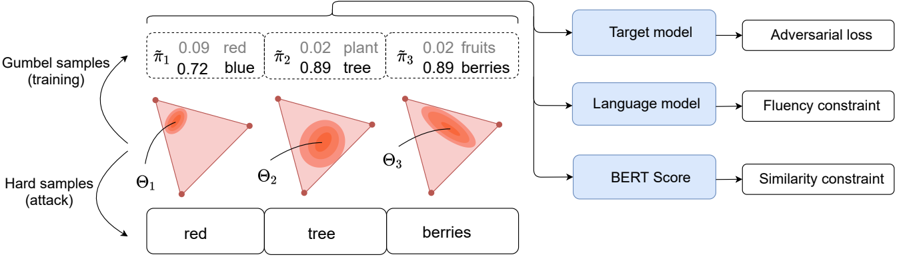
We propose the first general-purpose gradient-based attack against transformer models. Instead of searching for a single adversarial example, we search for a distribution of adversarial examples parameterized by a continuous-valued matrix, hence enabling gradient-based optimization. We empirically demonstrate that our white-box attack attains state-of-the-art attack performance on a variety of natural language tasks. Furthermore, we show that a powerful black-box transfer attack, enabled by sampling from the adversarial distribution, matches or exceeds existing methods, while only requiring hard-label outputs.
Overview
The claims and statistics of this paper haven’t been checked yet.
Run the check — free, no account needed. It reads the open-access text and checks the sources it cites.
Integrity signals
Registry
Cites
Statistics
Figures
Verification
Claims the paper makes
The claims and statistics of this paper haven’t been checked yet.
Run the check — free, no account needed. It reads the open-access text and checks the sources it cites.
Claims other papers make about this one
Each is checked against this paper’s own text: does it say what the citing paper says it does?
In the citing paper
“These fall into two categories: manually constructed prompts requiring greater complexity (Liu et al., 2024), and methods to algorithmically generate prompts and automatically optimise their construction (Shin et al., 2020;Guo et al., 2021).”
From Generative AI and intellectual property: a systematic literature review of possible issues and mitigations (2026) · cites this paper as Guo et al., 2021
Self-check
Percentages, sums and reported differences re-computed from the paper’s own numbers.
The self-check needs the paper’s full text.
Citations
Cites
BERT: Pre-training of Deep Bidirectional Transformers for Language Understanding
Devlin, J., Chang, M.-W., Lee, K., & Toutanova, K. (2019) · Proceedings of the 2019 Conference of the North American Chapter of the Association for Computational Linguistics: Human Language Technologies, Volume 1 (Long and Short Papers) · doi:10.18653/v1/n19-1423 · Cited by 54,325
Intriguing properties of neural networks
Szegedy, C., Zaremba, W., Sutskever, I., Bruna, J., Erhan, D., Goodfellow, I., & Fergus, R. (2013) · arXiv · doi:10.48550/arxiv.1312.6199 · Cited by 8,143
A Broad-Coverage Challenge Corpus for Sentence Understanding through Inference
Williams, A., Nangia, N., & Bowman, S. (2018) · Proceedings of the 2018 Conference of the North American Chapter of the Association for Computational Linguistics: Human Language Technologies, Volume 1 (Long Papers) · doi:10.18653/v1/n18-1101 · Cited by 3,342
BERTScore: Evaluating Text Generation with BERT
Zhang, T., Kishore, V., Wu, F., Weinberger, K. Q., & Artzi, Y. (2019) · arXiv · doi:10.48550/arxiv.1904.09675 · Cited by 2,865
Cross-lingual Language Model Pretraining
Lample, G., & Conneau, A. (2019) · arXiv · doi:10.48550/arxiv.1901.07291 · Cited by 1,586
Cer, D., Yang, Y., Kong, S.-Y., Hua, N., Limtiaco, N., John, R. S., Constant, N., Guajardo-Cespedes, M., Yuan, S., Tar, C., et al. (2018) · arXiv · doi:10.48550/arxiv.1803.11175 · Cited by 1,267
Black-Box Generation of Adversarial Text Sequences to Evade Deep Learning Classifiers
Gao, J., Lanchantin, J., Soffa, M. L., & Qi, Y. (2018) · 2018 IEEE Security and Privacy Workshops (SPW) · doi:10.1109/spw.2018.00016 · Cited by 693
Research works printed but not linked: 30
- Moustafa Alzantot, Yash Sharma, Ahmed Elgohary, Bo-Jhang Ho, Mani Srivastava, and Kai-Wei Chang. 2018. Generating natural language adversarial ex- amples. arXiv preprint arXiv:1804.07998. · arXiv
- Battista Biggio, Igino Corona, Davide Maiorca, Blaine Nelson, Nedim Šrndić, Pavel Laskov, Giorgio Giac- into, and Fabio Roli. 2013. Evasion attacks against machine learning at test time. In Joint European conference on machine learning and knowledge dis- covery in databases, pages 387-402. Springer.
- Nicholas Carlini and David Wagner. 2017. Towards evaluating the robustness of neural networks. In 2017 ieee symposium on security and privacy (sp), pages 39-57. IEEE.
- Nicholas Carlini and David Wagner. 2018. Audio ad- versarial examples: Targeted attacks on speech-to- text. In 2018 IEEE Security and Privacy Workshops (SPW), pages 1-7. IEEE.
- Hanjun Dai, Hui Li, Tian Tian, Xin Huang, Lin Wang, Jun Zhu, and Le Song. 2018. Adversarial attack on graph structured data. In International conference on machine learning, pages 1115-1124. PMLR.
- Javid Ebrahimi, Anyi Rao, Daniel Lowd, and De- jing Dou. 2017. Hotflip: White-box adversarial examples for text classification. arXiv preprint arXiv:1712.06751. · arXiv
- Siddhant Garg and Goutham Ramakrishnan. 2020. BAE: BERT-based adversarial examples for text classification. In Proceedings of the 2020 Confer- ence on Empirical Methods in Natural Language Processing (EMNLP), pages 6174-6181, Online. As- sociation for Computational Linguistics. · DOI
- Eric Jang, Shixiang Gu, and Ben Poole. 2016. Categor- ical reparameterization with gumbel-softmax. arXiv preprint arXiv:1611.01144. · arXiv
- Di Jin, Zhijing Jin, Joey Tianyi Zhou, and Peter Szolovits. 2020. Is bert really robust? a strong base- line for natural language attack on text classification and entailment. In Proceedings of the AAAI con- ference on artificial intelligence, volume 34, pages 8018-8025.
- Diederik P Kingma and Jimmy Ba. 2014. Adam: A method for stochastic optimization. arXiv preprint arXiv:1412.6980. · arXiv
- Zhenzhong Lan, Mingda Chen, Sebastian Goodman, Kevin Gimpel, Piyush Sharma, and Radu Soricut. 2019. Albert: A lite bert for self-supervised learn- ing of language representations. arXiv preprint arXiv:1909.11942. · arXiv
- Dianqi Li, Yizhe Zhang, Hao Peng, Liqun Chen, Chris Brockett, Ming-Ting Sun, and Bill Dolan. 2020a. Contextualized perturbation for textual adversarial attack. arXiv preprint arXiv:2009.07502. · arXiv
- Jinfeng Li, Shouling Ji, Tianyu Du, Bo Li, and Ting Wang. 2018. Textbugger: Generating adversarial text against real-world applications. arXiv preprint arXiv:1812.05271. · arXiv
- Linyang Li, Ruotian Ma, Qipeng Guo, Xiangyang Xue, and Xipeng Qiu. 2020b. BERT-ATTACK: Adver- sarial attack against BERT using BERT. In Proceed- ings of the 2020 Conference on Empirical Methods in Natural Language Processing (EMNLP), pages 6193-6202, Online. Association for Computational Linguistics. · DOI
- Yinhan Liu, Myle Ott, Naman Goyal, Jingfei Du, Man- dar Joshi, Danqi Chen, Omer Levy, Mike Lewis, Luke Zettlemoyer, and Veselin Stoyanov. 2019. Roberta: A robustly optimized bert pretraining ap- proach. arXiv preprint arXiv:1907.11692. · arXiv
- Andrew Maas, Raymond E Daly, Peter T Pham, Dan Huang, Andrew Y Ng, and Christopher Potts. 2011. Learning word vectors for sentiment analysis. In Proceedings of the 49th annual meeting of the as- sociation for computational linguistics: Human lan- guage technologies, pages 142-150.
- Aleksander Madry, Aleksandar Makelov, Ludwig Schmidt, Dimitris Tsipras, and Adrian Vladu. 2017. Towards deep learning models resistant to adversar- ial attacks. arXiv preprint arXiv:1706.06083. · arXiv
- Tomas Mikolov, Ilya Sutskever, Kai Chen, Greg Cor- rado, and Jeffrey Dean. 2013. Distributed represen- tations of words and phrases and their composition- ality. arXiv preprint arXiv:1310.4546. · arXiv
- John Morris, Eli Lifland, Jack Lanchantin, Yangfeng Ji, and Yanjun Qi. 2020a. Reevaluating adversar- ial examples in natural language. In Findings of the Association for Computational Linguistics: EMNLP 2020, pages 3829-3839, Online. Association for Computational Linguistics. · DOI
- John X Morris, Eli Lifland, Jin Yong Yoo, and Yan- jun Qi. 2020b. Textattack: A framework for adver- sarial attacks in natural language processing. arXiv preprint arXiv:2005.05909. · arXiv
- Jeffrey Pennington, Richard Socher, and Christopher D Manning. 2014. Glove: Global vectors for word rep- resentation. In Proceedings of the 2014 conference on empirical methods in natural language process- ing (EMNLP), pages 1532-1543.
- Alec Radford, Jeffrey Wu, Rewon Child, David Luan, Dario Amodei, and Ilya Sutskever. 2019. Language models are unsupervised multitask learners. OpenAI blog, 1(8):9.
- Shuhuai Ren, Yihe Deng, Kun He, and Wanxiang Che. 2019. Generating natural language adversarial ex- amples through probability weighted word saliency. In Proceedings of the 57th Annual Meeting of the Association for Computational Linguistics, pages 1085-1097, Florence, Italy. Association for Compu- tational Linguistics. · DOI
- Suranjana Samanta and Sameep Mehta. 2017. Towards crafting text adversarial samples. arXiv preprint arXiv:1707.02812. · arXiv
- Liwei Song, Xinwei Yu, Hsuan-Tung Peng, and Karthik Narasimhan. 2020. Universal adversarial attacks with natural triggers for text classification. arXiv preprint arXiv:2005.00174. · arXiv
- Eric Wallace, Shi Feng, Nikhil Kandpal, Matt Gardner, and Sameer Singh. 2019. Universal adversarial trig- gers for attacking and analyzing nlp. arXiv preprint arXiv:1908.07125. · arXiv
- Zhilin Yang, Zihang Dai, Yiming Yang, Jaime Car- bonell, Ruslan Salakhutdinov, and Quoc V Le. 2019. Xlnet: Generalized autoregressive pretrain- ing for language understanding. arXiv preprint arXiv:1906.08237. · arXiv
- Yuan Zang, Fanchao Qi, Chenghao Yang, Zhiyuan Liu, Meng Zhang, Qun Liu, and Maosong Sun. 2020. Word-level textual adversarial attacking as combina- torial optimization. In Proceedings of the 58th An- nual Meeting of the Association for Computational Linguistics, pages 6066-6080, Online. Association for Computational Linguistics. · DOI
- Xiang Zhang, Junbo Zhao, and Yann LeCun. 2015. Character-level convolutional networks for text clas- sification. arXiv preprint arXiv:1509.01626. · arXiv
- Daniel Zügner, Amir Akbarnejad, and Stephan Gün- nemann. 2018. Adversarial attacks on neural net- works for graph data. In Proceedings of the 24th ACM SIGKDD International Conference on Knowl- edge Discovery & Data Mining, pages 2847-2856.
Cited by
Zeng, Y., Lin, H., Zhang, J., Yang, D., Jia, R., & Shi, W. (2024) · arXiv · doi:10.48550/arxiv.2401.06373 · Cited by 174
Arnaudo, A., Coppola, R., Morisio, M., Vetrò, A., Borghi, M., Raso, R., & Khan, B. (2026) · PeerJ Computer Science · doi:10.7717/peerj-cs.3928 · Cited by 2
Universal and Transferable Adversarial Attacks on Aligned Language Models
Zou, A., Wang, Z., Carlini, N., Nasr, M., Kolter, J. Z., & Fredrikson, M. (2023) · arXiv · doi:10.48550/arxiv.2307.15043 · Cited by 197
Metadata
- Authors
- Guo, C., Sablayrolles, A., Jégou, H., & Kiela, D.
- Venue
- arXiv
- Publisher
- arXiv
- Published
- 2021
- arXiv
- 2104.13733
- References
- 7
- Type
- Preprint
About these checks
Registry, retraction, Cites and statistics results are computed, not judged, with one exception: a printed reference that no index lists is read once by a model before it counts as a citation error. Claims are extracted by a model and kept only when their quote appears verbatim in the text; each cited source is then checked, with a model’s help, for whether it says what the claim relies on. Those verdicts can be wrong — read the claim’s quote and the cited source before relying on one.
Statistics and arithmetic are recomputed, not judged.
Confidence bands are shown only for fields calibrated on our annotated test set. None is calibrated yet, so no band is shown.
What counts as a claim ›How we measure confidence ›How we check this ›
Are you an author, or do you see a problem with this page? Request a review
