

Detection, Analysis, and Prediction of Research Topics with Scientific Knowledge Graphs
Open accessThe DOI matches its DataCite record; 84 of the 87 references it cites were found in a registry or an index; none of the 33 sources its claims cite is checked for support yet.
Abstract
Analysing research trends and predicting their impact on academia and industry is crucial to gain a deeper understanding of the advances in a research field and to inform critical decisions about research funding and technology adoption. In the last years, we saw the emergence of several publicly-available and large-scale Scientific Knowledge Graphs fostering the development of many data-driven approaches for performing quantitative analyses of research trends. This chapter presents an innovative framework for detecting, analysing, and forecasting research topics based on a large-scale knowledge graph characterising research articles according to the research topics from the Computer Science Ontology. We discuss the advantages of a solution based on a formal representation of topics and describe how it was applied to produce bibliometric studies and innovative tools for analysing and predicting research dynamics.
Overview
CoChat Summary
TL;DR
This chapter presents a framework for detecting, analysing, and predicting research topics by annotating scientific knowledge graphs with topics from the Computer Science Ontology (CSO). It describes ontology-based topic detection, bibliometric trend analyses, and forecasting methods (Augur, ResearchFlow forecaster, TTF), drawing on prior work and large-scale resources such as MAG and AIDA.
Key findings
- AIDA Knowledge Graph describes 21 million publications and 8 million patents with CSO topics; 5.1 million publications and 5.6 million patents are characterised by affiliation type and 66 industrial sectors. Among documents with GRID IDs, 69.8% of publications are academic and 15.3% industrial, while 84% of patents are industrial and 2.3% academic; collaborative efforts are 2.6% of publications and 0.2% of patents.
- ResearchFlow found that 89.8% of topics first emerged in academic publications, 3.0% in industrial publications, 7.2% in industrial patents, and none in academic patents; academic publications preceded industrial publications by 5.6±5.6 years, industrial publications preceded industrial patents by 1.0±5.8 years, and academic publications preceded industrial patents by 6.7±7.4 years.
- The ResearchFlow forecaster’s LSTM achieved the highest average F1 (73.7%) across 17 feature combinations; using all four time series (RA-RI-PA-PI) yielded F1=84.6%, versus 75.2% using only company patents, and separating academia/industry improved performance (RA-RI 80.7% vs R 68.2%).
- Augur, evaluated on a gold standard of 1,408 emerging trends (2000–2011), outperformed Fast Greedy, Leading Eigenvector, Fuzzy C-Means, and Clique Percolation Method in precision and recall across all years; TTF’s Random Forest obtained precision 74.4% and recall 47.7%, outperforming Logistic Regression, Decision Tree, Gradient Boosting, SVM, and a simple neural network.
Methods
- Design: The chapter presents an ontology-based framework for topic detection, analysis, and prediction, reusing and reorganising prior research works; it formalises scientific knowledge graphs and uses CSO and the CSO Classifier to annotate documents.
- Data/resources: Microsoft Academic Graph (>250 million publications as of January 2021), CSO (14 thousand semantic topics and 159 thousand relations), AIDA (21M publications, 8M patents), ResearchFlow forecaster gold standard (9,776 labelled samples), Augur gold standard (1,408 emerging trends), and TTF inputs (16M papers from 1990–2013, 1,118 technologies, 173 CSO topics).
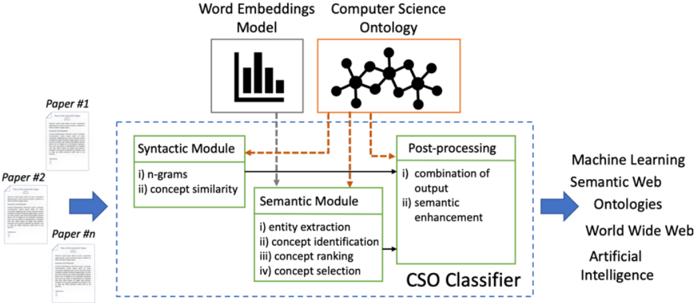
- Analysis: Topic detection uses syntactic, semantic, and post-processing modules; trend analysis uses bibliometric time series; forecasting uses machine learning classifiers (LR, RF, AB, CNN, LSTM) with 10-fold cross-validation, Random Forest for TTF, and Advanced Clique Percolation for Augur.
Limitations
- Stated: MAG does not redistribute publications’ full texts, limiting full-scale NLP applications; predicting research trends is hampered by limited availability of gold standards; forecasting new research topics remains an open challenge.
- Stated/evident: The chapter is a synthesis that “leverage[s] and reorganise[s]” previous research works, and several experiments/tables were previously reported (e.g., Augur and TTF), so it does not present wholly new independent validation.
- Evident: MAG provisioning has costs and technical requirements (around $100 per download for bandwidth plus cloud parking), which may limit reproducibility for some researchers.
Model-written summary. Check it against the paper before relying on it.
Integrity signals
Registry
Cites
Statistics
Figures
Verification
Claims the paper makes
0 Valid · 0 Not valid · 24 Not checked · 37 Own results and interpretations
A result the paper reports from its own data — it cites no other source for it, so there is none to check. The quote shows it is in the paper.
In the paper
“Our results showed that 89.8% of the topics first emerged in academic publications, 3.0% in industrial publications, 7.2% in industrial patents, and none in academic patents.”
§ Detection, Analysis, and Prediction of Research Topics with Scientific Knowledge Graphs > 4.2 ResearchFlow: analysing trends across academia and industry
plain- Asserted: passes — The authors put it forward as true.
- Checkable: passes — It can be checked against evidence.
- Load-bearing: unclear — It is unclear whether the paper’s conclusions depend on it.
- Based: passes — The paper gives a reason why it holds.
A result the paper reports from its own data — it cites no other source for it, so there is none to check. The quote shows it is in the paper.
In the paper
“On average, publications from academia preceded publications from industry by 5.6±5.6 years, and in turn, the latter preceded patents from industry by 1.0±5.8years.”
§ Detection, Analysis, and Prediction of Research Topics with Scientific Knowledge Graphs > 4.2 ResearchFlow: analysing trends across academia and industry
plainstates an association- Asserted: passes — The authors put it forward as true.
- Checkable: passes — It can be checked against evidence.
- Load-bearing: passes — The paper’s conclusions depend on it.
- Based: passes — The paper gives a reason why it holds.
A result the paper reports from its own data — it cites no other source for it, so there is none to check. The quote shows it is in the paper.
In the paper
“5.1 million publications and 5.6 million patents are further characterised according to the type of the author's affiliation (e.g., academia, industry) and 66 industrial sectors (e.g., automotive, financial, energy, electronics) organised in a two-level taxonomy.”
§ Detection, Analysis, and Prediction of Research Topics with Scientific Knowledge Graphs > 3.3 The Academia/Industry DynAmics Knowledge Graph
plain- Asserted: passes — The authors put it forward as true.
- Checkable: passes — It can be checked against evidence.
- Load-bearing: unclear — It is unclear whether the paper’s conclusions depend on it.
- Based: passes — The paper gives a reason why it holds.
29 more claims
Create a free account to see all 61 claims and every source verdict.
- It may state two separate claims as one. 19
- Probably not a substantial claim. 16
Self-check
Percentages, sums and reported differences re-computed from the paper’s own numbers.
Each contradiction between two passages listed here was confirmed by an independent check.
Rated minor: it would not touch a result — a value no result rests on, a p-value that stays on the same side of the significance level, or a conflict that is clerical, resolved elsewhere in the paper, or outside its own findings.
In the paper
§ Detection, Analysis, and Prediction of Research Topics with Scientific Knowledge Graphs > 5.1 Predicting the emergence of research topics
“Augur outperformed the alternative approaches in terms of both precision and recall in all years.”
§ Detection, Analysis, and Prediction of Research Topics with Scientific Knowledge Graphs > 6 Conclusion
“2000 0.21 0.07 0.14 0.02 0.96 0.01 0.05 0.00 0.78 0.70”
Rated minor: it would not touch a result — a value no result rests on, a p-value that stays on the same side of the significance level, or a conflict that is clerical, resolved elsewhere in the paper, or outside its own findings.
In the paper
§ Detection, Analysis, and Prediction of Research Topics with Scientific Knowledge Graphs > 5 Research Trends Prediction
“In this section, we explore two approaches that use our framework for predicting research trends.”
§ Detection, Analysis, and Prediction of Research Topics with Scientific Knowledge Graphs > 5 Research Trends Prediction
“In Section 5.3, we introduce the Technology-Topic Framework (TTF) [52], a novel methodology that takes advantage of a semantically enhanced technology-topic model for predicting the technologies that will be adopted by a research community.”
Citations
Cites
(2003) · Journal of Machine Learning Research · doi:10.5555/944919.944937 · Cited by 32,337
Blei, D. M., Ng, A. Y., & Jordan, M. I. (2002) · Advances in Neural Information Processing Systems 14 · doi:10.7551/mitpress/1120.003.0082 · Cited by 12,223
Griffiths, T. L., & Steyvers, M. (2004) · Proceedings of the National Academy of Sciences · doi:10.1073/pnas.0307752101 · Cited by 6,049
Guidelines for conducting systematic mapping studies in software engineering: An update
Petersen, K., Vakkalanka, S., & Kuzniarz, L. (2015) · Information and Software Technology · doi:10.1016/j.infsof.2015.03.007 · Cited by 2,669
DBpedia: A Nucleus for a Web of Open Data
Auer, S., Bizer, C., Kobilarov, G., Lehmann, J., Cyganiak, R., & Ives, Z. (2007) · Lecture Notes in Computer Science · doi:10.1007/978-3-540-76298-0_52 · Cited by 2,454
ArnetMiner: extraction and mining of academic social networks
Tang, J., Zhang, J., Yao, L., Li, J., Zhang, L., & Su, Z. (2008) · Proceedings of the 14th ACM SIGKDD international conference on Knowledge discovery and data mining · doi:10.1145/1401890.1402008 · Cited by 2,231 · cited 5×
“Some examples include Microsoft Academic Graph (MAG) 4 [82], AMiner [76], ScholarlyData 5 [50], PID Graph 6 [25], SciGraph 7 , Open Research Knowledge Graph 8 [31], OpenCitations 9 [61], and OpenAIRE research graph 10 [46].”
InfluentialHogan, A., Blomqvist, E., Cochez, M., D’amato, C., Melo, G. D., Gutierrez, C., Kirrane, S., Gayo, J. E. L., Navigli, R., Neumaier, S., et al. (2022) · ACM Computing Surveys · doi:10.1145/3447772 · Cited by 1,904
Bornmann, L., & Mutz, R. (2015) · Journal of the Association for Information Science and Technology · doi:10.1002/asi.23329 · Cited by 1,576
Finding a "Kneedle" in a Haystack: Detecting Knee Points in System Behavior
Satopaa, V., Albrecht, J., Irwin, D., & Raghavan, B. (2011) · 2011 31st International Conference on Distributed Computing Systems Workshops · doi:10.1109/icdcsw.2011.20 · Cited by 1,274
Mapping the backbone of science
Boyack, K. W., Klavans, R., & Börner, K. (2005) · Scientometrics · doi:10.1007/s11192-005-0255-6 · Cited by 937
Visser, M., van Eck, N. J., & Waltman, L. (2021) · Quantitative Science Studies · doi:10.1162/qss_a_00112 · Cited by 865 · cited 1×
“We decided to adopt MAG because it is the most extensive datasets of scholarly data publicly available [81], containing more than 250 million publications as of January 2021.”
Method© Kitchenham, 2004 Procedures for Performing Systematic Reviews
Kitchenham, B. A. (n.d.) · Cited by 667
An Overview of Microsoft Academic Service (MAS) and Applications
Sinha, A., Shen, Z., Song, Y., Ma, H., Eide, D., Hsu, B.-J. (., & Wang, K. (2015) · Proceedings of the 24th International Conference on World Wide Web · doi:10.1145/2740908.2742839 · Cited by 658
van Raan, A. F. J. (2004) · Scientometrics · doi:10.1023/b:scie.0000018543.82441.f1 · Cited by 579
Cimiano, P., & Völker, J. (2005) · Lecture Notes in Computer Science · doi:10.1007/11428817_21 · Cited by 534
Systematic Reviews: Constructing a Search Strategy and Searching for Evidence
Aromataris, E., & Riitano, D. (2014) · AJN, American Journal of Nursing · doi:10.1097/01.naj.0000446779.99522.f6 · Cited by 523
Microsoft Academic Graph: When experts are not enough
Wang, K., Shen, Z., Huang, C., Wu, C.-H., Dong, Y., & Kanakia, A. (2020) · Quantitative Science Studies · doi:10.1162/qss_a_00021 · Cited by 509
Open Research Knowledge Graph: Next Generation Infrastructure for Semantic Scholarly Knowledge
Jaradeh, M. Y., Oelen, A., Farfar, K. E., Prinz, M., D'Souza, J., Kismihók, G., Stocker, M., & Auer, S. (2019) · Proceedings of the 10th International Conference on Knowledge Capture · doi:10.1145/3360901.3364435 · Cited by 212
The Computer Science Ontology: A Large-Scale Taxonomy of Research Areas
Salatino, A. A., Thanapalasingam, T., Mannocci, A., Osborne, F., & Motta, E. (2018) · Lecture notes in computer science · doi:10.1007/978-3-030-00668-6_12 · Cited by 193
Self-citationAutomatic taxonomy construction from keywords
Liu, X., Song, Y., Liu, S., & Wang, H. (2012) · ACM SIGKDD Conference on Knowledge Discovery and Data Mining (KDD) · doi:10.1145/2339530.2339754 · Cited by 183
Semantic Web Machine Reading with FRED
Gangemi, A., Presutti, V., Reforgiato Recupero, D., Nuzzolese, A. G., Draicchio, F., & Mongiovì, M. (2017) · Semantic Web · doi:10.3233/sw-160240 · Cited by 171
Detecting topic evolution in scientific literature: how can citations help?
He, Q., Chen, B., Pei, J., Qiu, B., Mitra, P., & Giles, L. (2009) · Proceedings of the 18th ACM conference on Information and knowledge management · doi:10.1145/1645953.1646076 · Cited by 170
Creation of a highly detailed, dynamic, global model and map of science
Boyack, K. W., & Klavans, R. (2014) · Journal of the Association for Information Science and Technology · doi:10.1002/asi.22990 · Cited by 168
OpenCitations, an infrastructure organization for open scholarship
Peroni, S., & Shotton, D. (2020) · Quantitative Science Studies · doi:10.1162/qss_a_00023 · Cited by 154 · cited 1×
“Graph (MAG)4 [82], AMiner [76], ScholarlyData5 [50], PID Graph6 [25], SciGraph7, Open Research Knowledge Graph8 [31], OpenCitations9 [61], and OpenAIRE research graph10 [46].”
Does deep learning help topic extraction? A kernel k-means clustering method with word embedding
Zhang, Y., Lü, J., Liu, F., Liu, Q., Porter, A. L., Chen, H., & Zhang, G. (2018) · Journal of Informetrics · doi:10.1016/j.joi.2018.09.004 · Cited by 129
LODifier: Generating Linked Data from Unstructured Text
Augenstein, I., Padó, S., & Rudolph, S. (2012) · Lecture notes in computer science · doi:10.1007/978-3-642-30284-8_21 · Cited by 127
Bibliometric trend analysis on global graphene research
Lv, P. H., Wang, G., Wan, Y., Liu, J., Liu, Q. J., & Ma, F. (2011) · Scientometrics · doi:10.1007/s11192-011-0386-x · Cited by 125
Leydesdorff, L., Rafols, I., & Chen, C. (2013) · Journal of the American Society for Information Science and Technology · doi:10.1002/asi.22946 · Cited by 124
Systematic literature reviews in software engineering
Wohlin, C., & Prikladnicki, R. (2013) · Information and Software Technology · doi:10.1016/j.infsof.2013.02.002 · Cited by 120
Topic and Trend Detection in Text Collections Using Latent Dirichlet Allocation
Bolelli, L., Ertekin, Ş., & Giles, C. L. (2009) · Lecture notes in computer science · doi:10.1007/978-3-642-00958-7_84 · Cited by 117
Dessì, D., Osborne, F., Reforgiato Recupero, D., Buscaldi, D., & Motta, E. (2021) · Future Generation Computer Systems · doi:10.1016/j.future.2020.10.026 · Cited by 107
Self-citationThe CSO Classifier: Ontology-Driven Detection of Research Topics in Scholarly Articles
Salatino, A. A., Osborne, F., Thanapalasingam, T., & Motta, E. (2019) · Lecture notes in computer science · doi:10.1007/978-3-030-30760-8_26 · Cited by 104
Self-citationExploring the computing literature using temporal graph visualization
Erten, C., Harding, P. J., Kobourov, S., Wampler, K., & Yee, G. V. (2004) · Proceedings of SPIE, the International Society for Optical Engineering/Proceedings of SPIE · doi:10.1117/12.539245 · Cited by 92
Exploring Scholarly Data with Rexplore
Osborne, F., Motta, E., & Mulholland, P. (2013) · Lecture notes in computer science · doi:10.1007/978-3-642-41335-3_29 · Cited by 91
Self-citationAI-KG: An Automatically Generated Knowledge Graph of Artificial Intelligence
Dessì, D., Osborne, F., Reforgiato Recupero, D., Buscaldi, D., Motta, E., & Sack, H. (2020) · Lecture Notes in Computer Science · doi:10.1007/978-3-030-62466-8_9 · Cited by 90
Self-citationThe Computer Science Ontology: A Comprehensive Automatically-Generated Taxonomy of Research Areas
Salatino, A. A., Thanapalasingam, T., Mannocci, A., Birukou, A., Osborne, F., & Motta, E. (2019) · Data Intelligence · doi:10.1162/dint_a_00055 · Cited by 82
Self-citationA comparison of methods for detecting hot topics
Tseng, Y., Lin, Y.-I., Lee, Y.-Y., Hung, W.-C., & Lee, C.-H. (2009) · Scientometrics · doi:10.1007/s11192-009-1885-x · Cited by 79
Klink-2: Integrating Multiple Web Sources to Generate Semantic Topic Networks
Osborne, F., & Motta, E. (2015) · Lecture notes in computer science · doi:10.1007/978-3-319-25007-6_24 · Cited by 77
Self-citationThe evolution of IJHCS and CHI: A quantitative analysis
Mannocci, A., Osborne, F., & Motta, E. (2019) · International Journal of Human-Computer Studies · doi:10.1016/j.ijhcs.2019.05.009 · Cited by 72
Self-citationDetecting research topics via the correlation between graphs and texts
Jo, Y., Lagoze, C., & Giles, C. L. (2007) · ACM SIGKDD Conference on Knowledge Discovery and Data Mining (KDD) · doi:10.1145/1281192.1281234 · Cited by 72
AUGUR: Forecasting the Emergence of New Research Topics
Salatino, A. A., Osborne, F., & Motta, E. (2018) · ACM/IEEE Joint Conference on Digital Libraries · doi:10.1145/3197026.3197052 · Cited by 69
Self-citationTrans4E: Link prediction on scholarly knowledge graphs
Nayyeri, M., Cil, G. M., Vahdati, S., Osborne, F., Rahman, M., Angioni, S., Salatino, A., Recupero, D. R., Vassilyeva, N., Motta, E., et al. (2021) · Neurocomputing · doi:10.1016/j.neucom.2021.02.100 · Cited by 61
Self-citationManghi, P., Atzori, C., Bardi, A., Schirrwagen, J., Dimitropoulos, H., Bruzzo, S. L., Foufoulas, I., Löhden, A., Bäcker, A., Mannocci, A., et al. (2019) · Zenodo (CERN European Organization for Nuclear Research) · doi:10.5281/zenodo.3516917 · Cited by 60
Self-citationAnalysis of patent documents with weighted association rules
Altuntaş, S., Dereli, T., & Kusiak, A. (2014) · Technological Forecasting and Social Change · doi:10.1016/j.techfore.2014.09.012 · Cited by 56
Forecasting trends of development of psychology from a bibliometric perspective
Krampen, G., von Eye, A., & Schui, G. (2011) · Scientometrics · doi:10.1007/s11192-011-0357-2 · Cited by 55
Petrucci, G., Ghidini, C., & Rospocher, M. (2016) · Lecture notes in computer science · doi:10.1007/978-3-319-49004-5_31 · Cited by 51
Research Articles in Simplified HTML: a Web-first format for HTML-based scholarly articles
Peroni, S., Osborne, F., Iorio, A. D., Nuzzolese, A. G., Poggi, F., Vitali, F., & Motta, E. (2017) · PeerJ Computer Science · doi:10.7717/peerj-cs.132 · Cited by 50
Self-citationLarge Scale Subject Category Classification of Scholarly Papers With Deep Attentive Neural Networks
Kandimalla, B., Rohatgi, S., Wu, J. F., & Giles, C. L. (2021) · Frontiers in Research Metrics and Analytics · doi:10.3389/frma.2020.600382 · Cited by 48
Conference Linked Data: The ScholarlyData Project
Nuzzolese, A. G., Gentile, A. L., Valentina Presutti, A., & Aldo Gangemi, A. (2016) · Lecture notes in computer science · doi:10.1007/978-3-319-46547-0_16 · Cited by 45
Fenner, M. H., & Aryani, A. (2019) · DataCite API · doi:10.5438/jwvf-8a66 · Cited by 45
Mai, F., Galke, L. P. A., & Scherp, A. (2018) · ACM/IEEE Joint Conference on Digital Libraries · doi:10.1145/3197026.3197039 · Cited by 42
Ontology-Based Recommendation of Editorial Products
Thanapalasingam, T., Osborne, F., Birukou, A., & Motta, E. (2018) · Lecture notes in computer science · doi:10.1007/978-3-030-00668-6_21 · Cited by 41
Self-citationAnalyzing Structural & Temporal Characteristics of Keyword System in Academic Research Articles
Duvvuru, A., Radhakrishnan, S., More, D., Kamarthi, S. V., & Sultornsanee, S. (2013) · Procedia Computer Science · doi:10.1016/j.procs.2013.09.300 · Cited by 41
Automatic Classification of Springer Nature Proceedings with Smart Topic Miner
Osborne, F., Salatino, A. A., Birukou, A., & Motta, E. (2016) · Lecture notes in computer science · doi:10.1007/978-3-319-46547-0_33 · Cited by 38
Self-citationConceptScope: Organizing and Visualizing Knowledge in Documents based on Domain Ontology
Zhang, X., Chandrasegaran, S. K., & Ma, K.-L. (2021) · CHI Conference on Human Factors in Computing Systems · doi:10.1145/3411764.3445396 · Cited by 31
How are topics born? Understanding the research dynamics preceding the emergence of new areas
Salatino, A. A., Osborne, F., & Motta, E. (2017) · PeerJ Computer Science · doi:10.7717/peerj-cs.119 · Cited by 31
Self-citationImproving Editorial Workflow and Metadata Quality at Springer Nature
Salatino, A. A., Osborne, F., Birukou, A., & Motta, E. (2019) · Lecture notes in computer science · doi:10.1007/978-3-030-30796-7_31 · Cited by 30
Self-citationPragmatic Ontology Evolution: Reconciling User Requirements and Application Performance
Osborne, F., & Motta, E. (2018) · Lecture notes in computer science · doi:10.1007/978-3-030-00671-6_29 · Cited by 28
Self-citationIntegrating Knowledge Graphs for Analysing Academia and Industry Dynamics
Angioni, S., Salatino, A. A., Osborne, F., Recupero, D. R., & Motta, E. (2020) · Communications in computer and information science · doi:10.1007/978-3-030-55814-7_18 · Cited by 27
Self-citationIdentifying Diachronic Topic-Based Research Communities by Clustering Shared Research Trajectories
Osborne, F., Scavo, G., & Motta, E. (2014) · Lecture notes in computer science · doi:10.1007/978-3-319-07443-6_9 · Cited by 26
Self-citationDecker, S. L. (2007) · Cited by 24
A decade of Semantic Web research through the lenses of a mixed methods approach
Kirrane, S., Sabou, M., Fernández, J. D., Osborne, F., Robin, C., Buitelaar, P., Motta, E., & Polleres, A. (2020) · Semantic Web · doi:10.3233/sw-200371 · Cited by 23
Self-citationResearchFlow: Understanding the Knowledge Flow Between Academia and Industry
Salatino, A. A., Osborne, F., & Motta, E. (2020) · Lecture notes in computer science · doi:10.1007/978-3-030-61244-3_16 · Cited by 22
Self-citationLikavec, S., Osborne, F., & Cena, F. (2015) · International Journal on Semantic Web and Information Systems · doi:10.4018/ijswis.2015100101 · Cited by 22
Self-citationReducing the effort for systematic reviews in software engineering
Osborne, F., Muccini, H., Lago, P., & Motta, E. (2019) · Data Science · doi:10.3233/ds-190019 · Cited by 21
Self-citationClassifying Research Papers with the Computer Science Ontology
Salatino, A. A., Thanapalasingam, T., Mannocci, A., Osborne, F., & Motta, E. (2018) · Open Research Online (The Open University) · Cited by 21
Self-citationWatatani, K., Xie, Z., Nakatsuji, N., & Sengoku, S. (2013) · Regenerative Medicine · doi:10.2217/rme.13.51 · Cited by 20
Classifying Scientific Publications with BERT - Is Self-attention a Feature Selection Method?
García-Silva, A., & Gómez-Pérez, J. M. (2021) · Lecture notes in computer science · doi:10.1007/978-3-030-72113-8_11 · Cited by 19
Cano-Basave, A. E., Osborne, F., & Salatino, A. A. (2016) · Lecture notes in computer science · doi:10.1007/978-3-319-49004-5_4 · Cited by 19
Self-citationAnisotropic propagation of user interests in ontology-based user models
Cena, F., Likavec, S., & Osborne, F. (2013) · Information Sciences · doi:10.1016/j.ins.2013.07.006 · Cited by 18
Self-citationForecasting the Spreading of Technologies in Research Communities
Osborne, F., Mannocci, A., & Motta, E. (2017) · International Conference on Knowledge Capture · doi:10.1145/3148011.3148030 · Cited by 16
Self-citationA Bimodal Network Approach to Model Topic DynamicsPreprint
Di, L., Guerzoni, M., Nuccio, M., & Siragusa, G. (2017) · RePEc: Research Papers in Economics · doi:10.48550/arxiv.1709.09373 · Cited by 16
VeTo: Expert Set Expansion in Academia
Vergoulis, T., Chatzopoulos, S., Dalamagas, T., & Tryfonopoulos, C. (2020) · Lecture notes in computer science · doi:10.1007/978-3-030-54956-5_4 · Cited by 16
Semantic-Enhanced Recommendation of Video Lectures
Borges, M. V. M., & dos Reis, J. C. (2019) · IEEE International Conference on Advanced Learning Technologies (ICALT) · doi:10.1109/icalt.2019.00013 · Cited by 16
OpenAIRE’s DOIBoost - Boosting Crossref for Research
Bruzzo, S. L., Manghi, P., & Mannocci, A. (2019) · Communications in computer and information science · doi:10.1007/978-3-030-11226-4_11 · Cited by 14
Self-citationAn Advanced Analysis of Cloud Computing Concepts Based on the Computer Science Ontology
Lula, P., Dospinescu, O., Homocianu, D., & Sireteanu, N.-A. (2021) · Computers, materials & continua/Computers, materials & continua (Print) · doi:10.32604/cmc.2021.013771 · Cited by 13
ArtSim: Improved Estimation of Current Impact for Recent Articles
Chatzopoulos, S., Vergoulis, T., Kanellos, I., Dalamagas, T., & Tryfonopoulos, C. (2020) · Communications in computer and information science · doi:10.1007/978-3-030-55814-7_27 · Cited by 13
A Hybrid Semantic Approach to Building Dynamic Maps of Research Communities
Osborne, F., Scavo, G., & Motta, E. (2014) · Lecture notes in computer science · doi:10.1007/978-3-319-13704-9_28 · Cited by 12
Self-citationFrom Automatic Keyword Detection to Ontology-Based Topic Modeling
Beck, M. B., Rizvi, S. T. R., Dengel, A. R., & Ahmed, S. (2020) · Lecture notes in computer science · doi:10.1007/978-3-030-57058-3_32 · Cited by 12
TechMiner: Extracting Technologies from Academic Publications
Osborne, F., de Ribaupierre, H., & Motta, E. (2016) · Lecture notes in computer science · doi:10.1007/978-3-319-49004-5_30 · Cited by 11
Self-citationArtificial neural network approach for technology life cycle construction on patent data
Ramadhan, M. H., Malik, V. I., & Sjafrizal, T. (2018) · IEEE International Conference on Industrial Engineering and Applications (ICIEA) · doi:10.1109/iea.2018.8387152 · Cited by 10
ScholarLensViz: A Visualization Framework for Transparency in Semantic User Profiles
Löffler, F., Wesp, V., Babalou, S., Kahn, P., Lachmann, R., Sateli, B., Witte, R., & König‐Ries, B. (2020) · International Semantic Web Conference · Cited by 10
Widodo, A., Fanany, M. I., & Budi, I. D. (2011) · International Conference on Digital Information Management · doi:10.1109/icdim.2011.6093365 · Cited by 6
The AIDA Dashboard: Analysing Conferences with Semantic Technologies.
Angioni, S., Salatino, A. A., Osborne, F., Recupero, D. R., & Motta, E. (2020) · Open Research Online - ORO (The Open University) · Cited by 5
Self-citationUsing Domain Ontologies for Text Classification. A Use Case to Classify Computer Science Papers
Chicaiza, J. A., & Reátegui, R. (2020) · Communications in computer and information science · doi:10.1007/978-3-030-65384-2_13 · Cited by 5
Hogan, A., Blomqvist, E., Cochez, M., d'Amato, C., de Melo, G., Gutierrez, C., Gayo, J. E. L., Kirrane, S., Neumaier, S., Polleres, A., et al. (2020) · arXiv · doi:10.48550/arxiv.2003.02320
Manghi, P., Atzori, C., Bardi, A., Baglioni, M., Schirrwagen, J., Dimitropoulos, H., Bruzzo, S. L., Foufoulas, I., Löhden, A., Bäcker, A., et al. (2020) · Zenodo · doi:10.5281/zenodo.4279381
Self-citation
Cited by
Ulloa, D. S. (2026) · SSRN Electronic Journal · doi:10.2139/ssrn.7257319 · Cited by 1
Metadata
- Authors
- Salatino, A., Mannocci, A., & Osborne, F.
- Affiliations
- The Open University (GB)
- Istituto di Scienza e Tecnologie dell'Informazione "Alessandro Faedo" (IT)
- Venue
- arXiv
- Publisher
- arXiv
- Published
- 2021
- ISSN
- 2331-8422 (ISSN-L)
- arXiv
- 2106.12875
- OpenAlex
- W4287113770
- Cited by
- 1
- References
- 81
- Citations by year
- 2026: 1
- Type
- posted content
- Language
- en
- Open access
- green
- arxiv.org
- Licence
- Locations
- arXiv (Cornell University) (submittedVersion, cc-by)
- arXiv (Cornell University) (cc-by)
- Topics
- Social Sciences › Library and Information Sciences › scientometrics and bibliometrics research
- Physical Sciences › Computer Science › Artificial Intelligence › Semantic Web and Ontologies
- Physical Sciences › Computer Science › Information Systems › Recommender Systems and Techniques
- Keywords
- scientific knowledge graphs, research trends, computer science ontology, bibliometric analysis, research funding, technology adoption, research dynamics
About these checks
Registry, retraction, Cites and statistics results are computed, not judged, with one exception: a printed reference that no index lists is read once by a model before it counts as a citation error. Claims are extracted by a model and kept only when their quote appears verbatim in the text; each cited source is then checked, with a model’s help, for whether it says what the claim relies on. Those verdicts can be wrong — read the claim’s quote and the cited source before relying on one.
A language model drew the claims from the paper on 2026-11-23, under version 3 of the claim definition (model deepseek-v4.1-flash, prompt extract-v3).
A second model labelled each claim on 2026-11-23 (model jev-1.13-20260917, definition revision gold-guideline-v0.2).
Statistics and arithmetic are recomputed, not judged.
Confidence bands are shown only for fields calibrated on our annotated test set. None is calibrated yet, so no band is shown.
What counts as a claim ›How we measure confidence ›How we check this ›
Are you an author, or do you see a problem with this page? Request a review
Data sources
Bibliographic data: Semantic Scholar, OpenAlex, Crossref.
Contains information from the Semantic Scholar Academic Graph Datasets, made available under the ODC Attribution License (ODC-BY 1.0).
Semantic Scholar’s data is described in: Kinney, R., et al. (2023). The Semantic Scholar Open Data Platform. arXiv:2301.10140.
