

The DOI matches its DataCite record; 1 of the 1 references it cites were found in a registry or an index.
Uncertainty Quantification with Pre-trained Language Models: A Large-Scale Empirical Analysis
Abstract
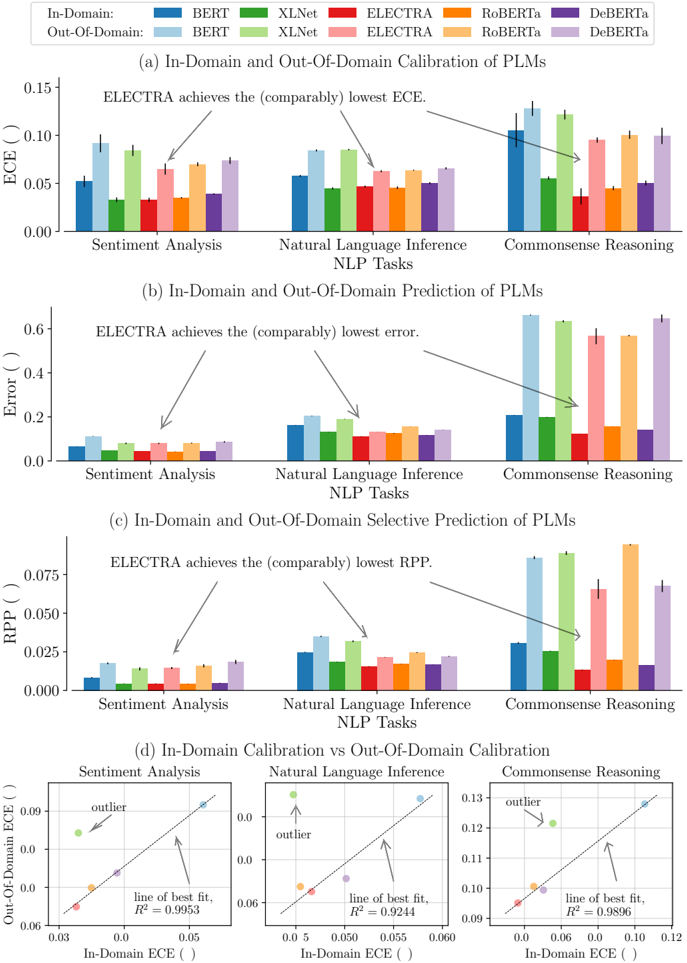
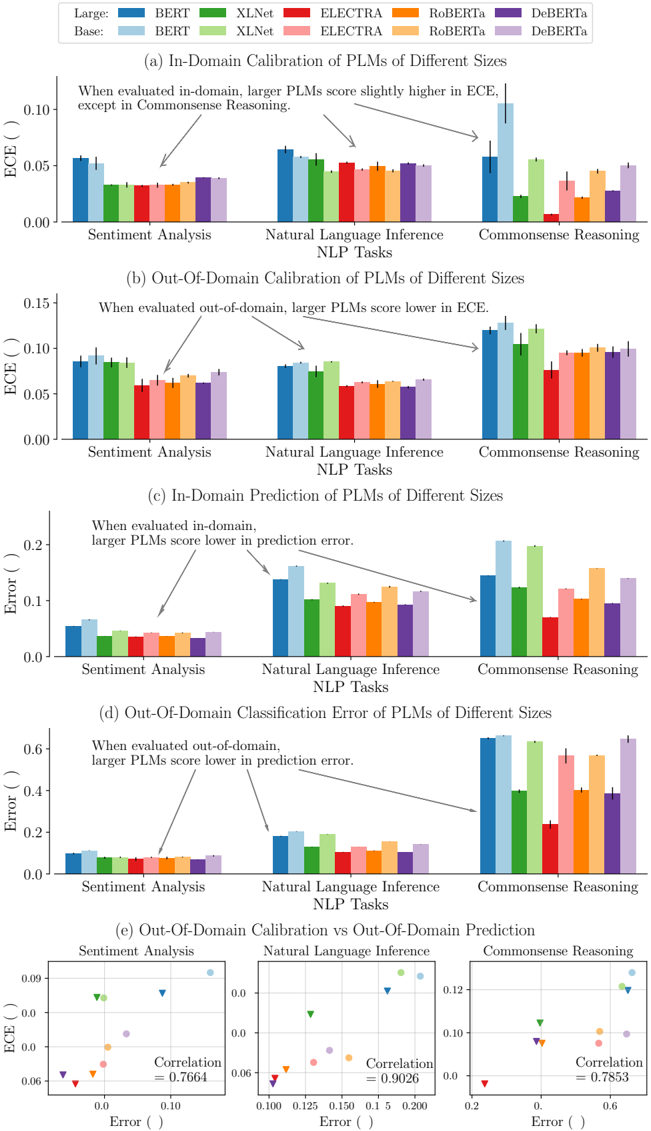
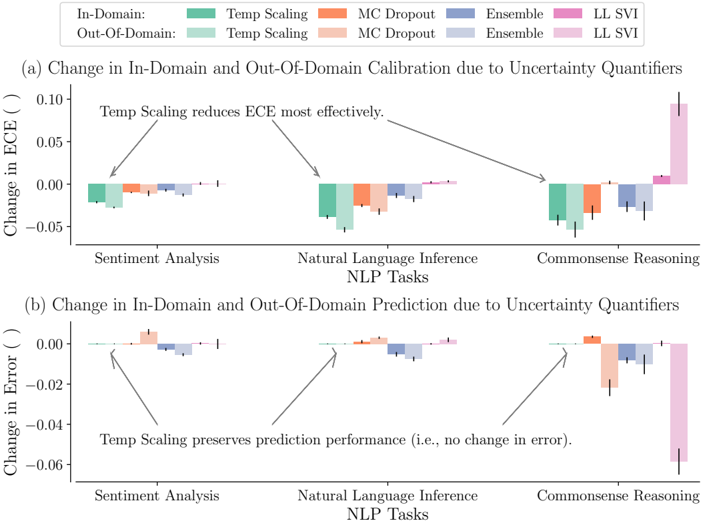
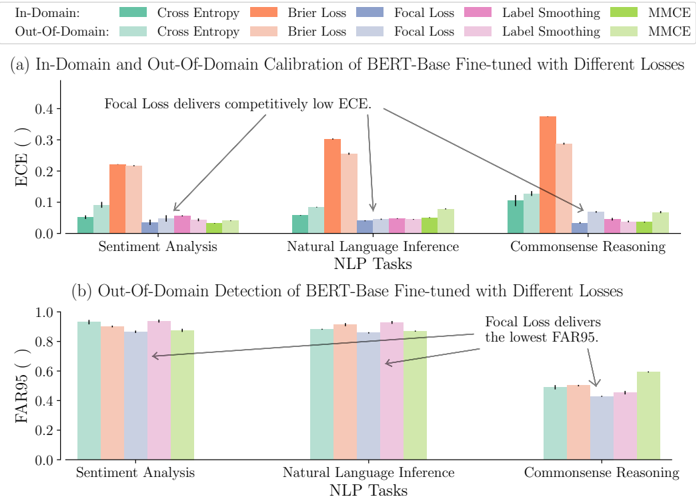
Pre-trained language models (PLMs) have gained increasing popularity due to their compelling prediction performance in diverse natural language processing (NLP) tasks. When formulating a PLM-based prediction pipeline for NLP tasks, it is also crucial for the pipeline to minimize the calibration error, especially in safety-critical applications. That is, the pipeline should reliably indicate when we can trust its predictions. In particular, there are various considerations behind the pipeline: (1) the choice and (2) the size of PLM, (3) the choice of uncertainty quantifier, (4) the choice of fine-tuning loss, and many more. Although prior work has looked into some of these considerations, they usually draw conclusions based on a limited scope of empirical studies. There still lacks a holistic analysis on how to compose a well-calibrated PLM-based prediction pipeline. To fill this void, we compare a wide range of popular options for each consideration based on three prevalent NLP classification tasks and the setting of domain shift. In response, we recommend the following: (1) use ELECTRA for PLM encoding, (2) use larger PLMs if possible, (3) use Temp Scaling as the uncertainty quantifier, and (4) use Focal Loss for fine-tuning.
Overview
The claims and statistics of this paper haven’t been checked yet.
Run the check — free, no account needed. It reads the open-access text and checks the sources it cites.
Integrity signals
Registry
Cites
Statistics
Figures
Verification
Claims the paper makes
The claims and statistics of this paper haven’t been checked yet.
Run the check — free, no account needed. It reads the open-access text and checks the sources it cites.
Claims other papers make about this one
Each is checked against this paper’s own text: does it say what the citing paper says it does?
In the citing paper
“calculating the uncertainty of outputs could be instrumental in recognizing situations where the model may produce highly random results [12].”
From Generative AI in EU law: Liability, privacy, intellectual property, and cybersecurity (2024) · cites this paper as [12]
Self-check
Percentages, sums and reported differences re-computed from the paper’s own numbers.
The self-check needs the paper’s full text.
Citations
Cites
Verification of forecasts expressed in terms of probability
BRIER, G. W. (1950) · Monthly Weather Review · doi:10.1175/1520-0493(1950)078%3c0001:vofeit%3e2.0.co;2 · cited 2×
“Brier Loss (Brier et al., 1950) is the squared difference between predictive distributions and one-hot ground-truth vectors.”
Research works printed but not linked: 61
- Moloud Abdar, Farhad Pourpanah, Sadiq Hussain, Dana Rezazadegan, Li Liu, Mohammad Ghavamzadeh, Paul Fieguth, Xiaochun Cao, Abbas Khosravi, U Ra- jendra Acharya, et al. 2021. A review of uncertainty quantification in deep learning: Techniques, applica- tions and challenges. Information Fusion.
- Ahmed Alaa and Mihaela Van Der Schaar. 2020a. Dis- criminative jackknife: Quantifying uncertainty in deep learning via higher-order influence functions. In ICML.
- Ahmed Alaa and Mihaela Van Der Schaar. 2020b. Fre- quentist uncertainty in recurrent neural networks via blockwise influence functions. In ICML.
- Javier Antoran, Umang Bhatt, Tameem Adel, Adrian Weller, and José Miguel Hernández-Lobato. 2021. Getting a CLUE: A method for explaining uncer- tainty estimates. In ICLR.
- Charles Blundell, Julien Cornebise, Koray Kavukcuoglu, and Daan Wierstra. 2015. Weight uncertainty in neural network. In ICML.
- Samuel Bowman, Gabor Angeli, Christopher Potts, and Christopher D Manning. 2015. A large annotated corpus for learning natural language inference. In EMNLP.
- Youngseog Chung, Willie Neiswanger, Ian Char, and Jeff Schneider. 2021. Beyond pinball loss: Quantile methods for calibrated uncertainty quantification. In NeurIPS.
- Kevin Clark, Minh-Thang Luong, Quoc V. Le, and Christopher D. Manning. 2020. ELECTRA: Pre- training text encoders as discriminators rather than generators. In ICLR.
- Peng Cui, Wenbo Hu, and Jun Zhu. 2020. Calibrated reliable regression using maximum mean discrepancy. In NeurIPS.
- Soham Dan and Dan Roth. 2021. On the effects of transformer size on in-and out-of-domain calibration. In EMNLP (Findings).
- Stefan Depeweg, Jose-Miguel Hernandez-Lobato, Fi- nale Doshi-Velez, and Steffen Udluft. 2018. Decom- position of uncertainty in bayesian deep learning for efficient and risk-sensitive learning. In ICML.
- Shrey Desai and Greg Durrett. 2020. Calibration of pre-trained transformers. In EMNLP.
- Jacob Devlin, Ming-Wei Chang, Kenton Lee, and Kristina Toutanova. 2019. Bert: Pre-training of deep bidirectional transformers for language understand- ing. In NAACL.
- Yarin Gal and Zoubin Ghahramani. 2016. Dropout as a bayesian approximation: Representing model uncertainty in deep learning. In ICML.
- Siddhant Garg, Thuy Vu, and Alessandro Moschitti. 2020. Tanda: Transfer and adapt pre-trained trans- former models for answer sentence selection. In AAAI.
- I.J. Good. 1952. Rational decisions. Journal of the Royal Statistical Society. Series B (Methodological).
- Priya Goyal, Piotr Dollár, Ross Girshick, Pieter No- ordhuis, Lukasz Wesolowski, Aapo Kyrola, Andrew Tulloch, Yangqing Jia, and Kaiming He. 2017. Ac- curate, large minibatch sgd: Training imagenet in 1 hour. arXiv preprint arXiv:1706.02677. · arXiv
- Chuan Guo, Geoff Pleiss, Yu Sun, and Kilian Q Wein- berger. 2017. On calibration of modern neural net- works. In ICML.
- Pengcheng He, Xiaodong Liu, Jianfeng Gao, and Weizhu Chen. 2020. Deberta: Decoding-enhanced bert with disentangled attention. In ICLR.
- Dan Hendrycks, Xiaoyuan Liu, Eric Wallace, Adam Dziedzic, Rishabh Krishnan, and Dawn Song. 2020. Pretrained transformers improve out-of-distribution robustness. In ACL.
- Xiaoqian Jiang, Melanie Osl, Jihoon Kim, and Lucila Ohno-Machado. 2012. Calibrating predictive model estimates to support personalized medicine. Journal of the American Medical Informatics Association.
- Alex Kendall and Yarin Gal. 2017. What uncertainties do we need in bayesian deep learning for computer vision? In NeurIPS.
- Lingkai Kong, Haoming Jiang, Yuchen Zhuang, Jie Lyu, Tuo Zhao, and Chao Zhang. 2020. Cali- brated language model fine-tuning for in-and out- of-distribution data. In EMNLP.
- Ranganath Krishnan and Omesh Tickoo. 2020. Improv- ing model calibration with accuracy versus uncer- tainty optimization. In NeurIPS.
- Volodymyr Kuleshov, Nathan Fenner, and Stefano Er- mon. 2018. Accurate uncertainties for deep learning using calibrated regression. In ICML.
- Balaji Lakshminarayanan, Alexander Pritzel, and Charles Blundell. 2017. Simple and scalable pre- dictive uncertainty estimation using deep ensembles. In NeurIPS.
- Dan Ley, Umang Bhatt, and Adrian Weller. 2022. Di- verse, global and amortised counterfactual explana- tions for uncertainty estimates. In AAAI.
- Nut Limsopatham. 2021. Effectively leveraging bert for legal document classification. In EMNLP Workshop.
- Yinhan Liu, Myle Ott, Naman Goyal, Jingfei Du, Man- dar Joshi, Danqi Chen, Omer Levy, Mike Lewis, Luke Zettlemoyer, and Veselin Stoyanov. 2019. Roberta: A robustly optimized bert pretraining ap- proach. arXiv preprint arXiv:1907.11692. · arXiv
- Ilya Loshchilov and Frank Hutter. 2018. Decoupled weight decay regularization. In ICLR.
- Andrew Maas, Raymond E Daly, Peter T Pham, Dan Huang, Andrew Y Ng, and Christopher Potts. 2011. Learning word vectors for sentiment analysis. In ACL.
- Bonan Min, Hayley Ross, Elior Sulem, Amir Pouran Ben Veyseh, Thien Huu Nguyen, Oscar Sainz, Eneko Agirre, Ilana Heinz, and Dan Roth. 2021. Re- cent advances in natural language processing via large pre-trained language models: A survey. arXiv preprint arXiv:2111.01243. · arXiv
- Matthias Minderer, Josip Djolonga, Rob Romijnders, Frances Hubis, Xiaohua Zhai, Neil Houlsby, Dustin Tran, and Mario Lucic. 2021. Revisiting the calibra- tion of modern neural networks. In NeurIPS.
- Jishnu Mukhoti, Viveka Kulharia, Amartya Sanyal, Stu- art Golodetz, Philip Torr, and Puneet Dokania. 2020. Calibrating deep neural networks using focal loss. In NeurIPS.
- Rafael Müller, Simon Kornblith, and Geoffrey E Hinton. 2019. When does label smoothing help? In NeurIPS.
- Myle Ott, Michael Auli, David Grangier, and Marc'Aurelio Ranzato. 2018. Analyzing uncertainty in neural machine translation. In ICML.
- Yaniv Ovadia, Emily Fertig, Jie Ren, Zachary Nado, David Sculley, Sebastian Nowozin, Joshua Dillon, Balaji Lakshminarayanan, and Jasper Snoek. 2019. Can you trust your model's uncertainty? evaluat- ing predictive uncertainty under dataset shift. In NeurIPS.
- Yao Qin, Xuezhi Wang, Alex Beutel, and Ed Chi. 2021. Improving calibration through the relationship with adversarial robustness. In NeurIPS.
- Adrian E Raftery, Tilmann Gneiting, Fadoua Bal- abdaoui, and Michael Polakowski. 2005. Using bayesian model averaging to calibrate forecast en- sembles. Monthly weather review.
- Pranav Rajpurkar, Robin Jia, and Percy Liang. 2018. Know what you don't know: Unanswerable questions for squad. In ACL.
- Pranav Rajpurkar, Jian Zhang, Konstantin Lopyrev, and Percy Liang. 2016. Squad: 100,000+ questions for machine comprehension of text. In EMNLP.
- Neeraj Varshney, Swaroop Mishra, and Chitta Baral. 2022a. Investigating selective prediction approaches across several tasks in iid, ood, and adversarial set- tings. In ACL (Findings).
- Neeraj Varshney, Swaroop Mishra, and Chitta Baral. 2022b. Towards improving selective prediction abil- ity of nlp systems. In ACL Workshop.
- Ashish Vaswani, Noam Shazeer, Niki Parmar, Jakob Uszkoreit, Llion Jones, Aidan N Gomez, Łukasz Kaiser, and Illia Polosukhin. 2017. Attention is all you need. In NeurIPS.
- Yoav Wald, Amir Feder, Daniel Greenfeld, and Uri Shalit. 2021. On calibration and out-of-domain gen- eralization. In NeurIPS.
- Alex Wang, Yada Pruksachatkun, Nikita Nangia, Aman- preet Singh, Julian Michael, Felix Hill, Omer Levy, and Samuel Bowman. 2019a. Superglue: A stickier benchmark for general-purpose language understand- ing systems. In NeurIPS.
- Alex Wang, Amanpreet Singh, Julian Michael, Felix Hill, Omer Levy, and Samuel R Bowman. 2019b. Glue: A multi-task benchmark and analysis platform for natural language understanding. In ICLR.
- Xiangpeng Wei, Heng Yu, Yue Hu, Rongxiang Weng, Luxi Xing, and Weihua Luo. 2020. Uncertainty- aware semantic augmentation for neural machine translation. In EMNLP.
- Adina Williams, Nikita Nangia, and Samuel Bowman. 2018. A broad-coverage challenge corpus for sen- tence understanding through inference. In NAACL.
- Thomas Wolf, Lysandre Debut, Victor Sanh, Julien Chaumond, Clement Delangue, Anthony Moi, Pier- ric Cistac, Tim Rault, Rémi Louf, Morgan Funtowicz, et al. 2020. Transformers: State-of-the-art natural language processing. In EMNLP.
- Yuxin Xiao, Zecheng Zhang, Yuning Mao, Carl Yang, and Jiawei Han. 2022. Sais: Supervising and aug- menting intermediate steps for document-level rela- tion extraction. In NAACL.
- Ji Xin, Raphael Tang, Yaoliang Yu, and Jimmy Lin. 2021. The art of abstention: Selective prediction and error regularization for natural language processing. In ACL.
- Huiqin Yang and Carl Thompson. 2010. Nurses' risk assessment judgements: A confidence calibration study. Journal of Advanced Nursing.
- Zhilin Yang, Zihang Dai, Yiming Yang, Jaime Car- bonell, Russ R Salakhutdinov, and Quoc V Le. 2019. Xlnet: Generalized autoregressive pretraining for lan- guage understanding. In NeurIPS.
- Wonjin Yoon, Jinhyuk Lee, Donghyeon Kim, Minbyul Jeong, and Jaewoo Kang. 2019. Pre-trained language model for biomedical question answering. In ECML- PKDD.
- Rowan Zellers, Yonatan Bisk, Roy Schwartz, and Yejin Choi. 2018. Swag: A large-scale adversarial dataset for grounded commonsense inference. In EMNLP.
- Rowan Zellers, Ari Holtzman, Yonatan Bisk, Ali Farhadi, and Yejin Choi. 2019. Hellaswag: Can a machine really finish your sentence? In ACL.
- Taolin Zhang, Zerui Cai, Chengyu Wang, Minghui Qiu, Bite Yang, and Xiaofeng He. 2021. Smedbert: A knowledge-enhanced pre-trained language model with structured semantics for medical text mining. In ACL.
- Xiang Zhang, Junbo Zhao, and Yann LeCun. 2015. Character-level convolutional networks for text clas- sification. In NeurIPS.
- Wenxuan Zhou, Kevin Huang, Tengyu Ma, and Jing Huang. 2021. Document-level relation extraction with adaptive thresholding and localized context pool- ing. In AAAI.
- Yikai Zhou, Baosong Yang, Derek F Wong, Yu Wan, and Lidia S Chao. 2020. Uncertainty-aware curricu- lum learning for neural machine translation. In ACL.
Cited by
Generative AI in EU law: Liability, privacy, intellectual property, and cybersecurity
Novelli, C., Casolari, F., Hacker, P., Spedicato, G., & Floridi, L. (2024) · Computer Law & Security Review · doi:10.1016/j.clsr.2024.106066 · Cited by 124
A Close Look into the Calibration of Pre-trained Language Models
Chen, Y., Yuan, L., Cui, G., Liu, Z., & Ji, H. (2023) · Proceedings of the 61st Annual Meeting of the Association for Computational Linguistics (Volume 1: Long Papers) · doi:10.18653/v1/2023.acl-long.75 · Cited by 22
R-U-SURE? Uncertainty-Aware Code Suggestions By Maximizing Utility Across Random User Intents
Johnson, D. D., Tarlow, D., & Walder, C. (2023) · arXiv · doi:10.48550/arxiv.2303.00732 · Cited by 3
Metadata
- Authors
- Xiao, Y., Liang, P. P., Bhatt, U., Neiswanger, W., Salakhutdinov, R., & Morency, L.-P.
- Venue
- arXiv
- Publisher
- arXiv
- Published
- 2022
- arXiv
- 2210.04714
- References
- 1
- Type
- Preprint
About these checks
Registry, retraction, Cites and statistics results are computed, not judged, with one exception: a printed reference that no index lists is read once by a model before it counts as a citation error. Claims are extracted by a model and kept only when their quote appears verbatim in the text; each cited source is then checked, with a model’s help, for whether it says what the claim relies on. Those verdicts can be wrong — read the claim’s quote and the cited source before relying on one.
Statistics and arithmetic are recomputed, not judged.
Confidence bands are shown only for fields calibrated on our annotated test set. None is calibrated yet, so no band is shown.
What counts as a claim ›How we measure confidence ›How we check this ›
Are you an author, or do you see a problem with this page? Request a review
Data sources
Bibliographic data: Semantic Scholar, OpenAlex, Crossref.
Contains information from the Semantic Scholar Academic Graph Datasets, made available under the ODC Attribution License (ODC-BY 1.0).
Semantic Scholar’s data is described in: Kinney, R., et al. (2023). The Semantic Scholar Open Data Platform. arXiv:2301.10140.
