

Physics-Informed Graph Neural Networks for Robust AC-Optimal Power Flow
Open accessThe DOI matches its DataCite record; 34 of the 34 references it cites were found in a registry or an index; none of the 22 sources its claims cite is checked for support yet.
Abstract
We present PINCO, an unsupervised learning framework that integrates Graph Neural Networks with physics-informed neural networks for AC optimal power flow (AC-OPF) solutions. Unlike state-of-the-art unsupervised methods that require prescreened datasets containing only feasible instances, our approach operates on unfiltered data, including ill-conditioned cases. The framework addresses two critical gaps in the literature: (1) robustness to topology changes up to N-2 contingencies, and (2) detecting optimal power flow instances that are infeasible without relying on traditional solvers for data filtering. PINCO embeds physical laws into the learning process via augmented Lagrangian multipliers. In addition, it introduces a clustering branch with learnable centroids that automatically separate feasible from infeasible solutions based on constraint-violation patterns. We evaluate the framework across systems of varying complexity, including the IEEE 30-bus, IEEE 57-bus, and Swiss transmission networks, demonstrating scalability and robustness under diverse loading conditions and topology variations. Benchmarking against DeepOPF-FT and the IPOPT solver shows that PINCO achieves comparable constraint satisfaction while delivering two to three orders of magnitude computational speedup compared to IPOPT and lower operational costs across all configurations.
Overview
CoChat Summary
TL;DR
PINCO is an unsupervised physics-informed graph neural network with hard constraints for AC-OPF, tested on IEEE 9-, 24-, 30-, and 118-bus systems. It produces feasible solutions with zero inequality constraint violations and inference two orders of magnitude faster than MIPS, at modest cost increases.
Key findings
- PINCO achieved zero inequality constraint violations across all tests; as a single-loading solver, equality losses were 0.003 vs 0.002 MW (IEEE9), 0.040 vs 6.500 MW (IEEE24), 0.018 vs 0.015 MW (IEEE30), and 0.067 vs 20.000 MW (IEEE118), with relative cost differences 1.10%, 0.63%, 4.90%, and 1.20% respectively (Table 1).
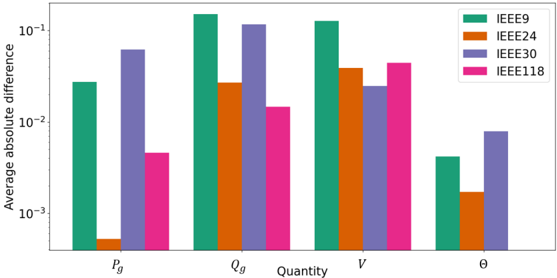
- For multiple loading conditions (500 samples, 90–110% of reference demand), PINCO equality losses were 0.030 vs 0.001 MW (IEEE9), 4.300 vs 6.500 MW (IEEE24), 0.690 vs 0.020 MW (IEEE30), and 16.000 vs 20.000 MW (IEEE118); cost differences were 0.010%, 0.880%, 0.800%, and 1.100% (Table 2). The text reports around a 0.8% average cost increase across all test cases.
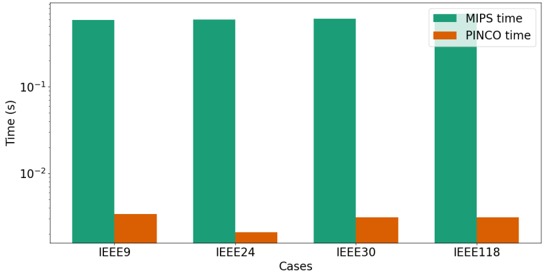
- PINCO generalizes to unseen loading conditions as a universal function approximator and can act as both a solver and a hybrid universal function approximator; inference is two orders of magnitude faster than MIPS.
- It adapts to different power systems with minimal hyperparameter changes, including systems with multiple generators per bus via artificial node splitting.
Methods
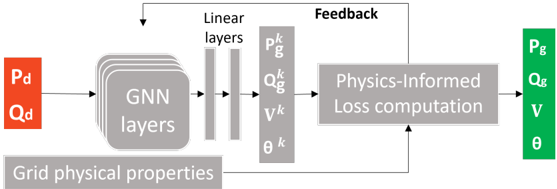
- PINCO combines a GNN with hPINN hard-constraint physics-informed learning; it is trained unsupervised using the AC-OPF objective and equality/inequality constraints as loss, with MATPOWER/MIPS as the reference solver.
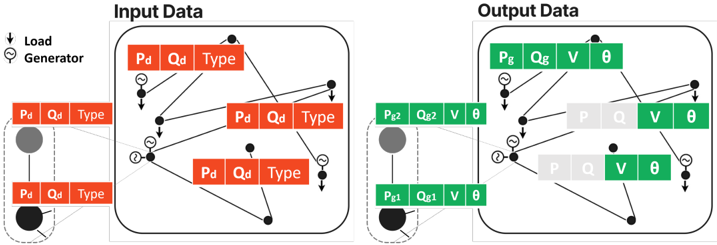
- The power grid is modeled as a graph: buses as nodes, branches as edges; inputs include active/reactive demand and node type; outputs include P_g, Q_g, V, and θ with masking; multiple generators per bus are handled by adding artificial nodes (four node types).
- Experiments use IEEE 9-, 24-, 30-, and 118-bus systems; single default demand and multiple loading conditions (500 samples uniformly around 90–110% reference, split 80/10/10); metrics include equality loss, cost, and limit violations; training is on ETH Euler CPU.
Limitations
- The paper states training is computationally expensive, lasting 10 to 24 hours depending on grid size; equality-constraint satisfaction under multiple demand scenarios needs refinement; hyperparameter tuning warrants further investigation.
- Evident from results: PINCO’s solutions are slightly more expensive than MIPS in single-loading cases (positive cost differences), and for multiple loading conditions its equality loss is higher by an order of magnitude for IEEE9 and IEEE30, though better for IEEE24 and IEEE118.
- Evident from text: phase-angle comparisons for IEEE118 were omitted because there is no reference/slack bus, allowing arbitrary phase-angle shifts.
Model-written summary. Check it against the paper before relying on it.
Integrity signals
Registry
Cites
Statistics
Figures
Verification
Claims the paper makes
0 Valid · 1 Not valid · 17 Not checked · 28 Own results and interpretations
A result the paper states — it cites no source for it, so there is none to check. The quote shows it is in the paper.
In the paper
“In the more complex IEEE24 and IEEE118 cases, it is noteworthy that the equality loss for MIPS is unexpectedly high.”
§ PHYSICS-INFORMED GNN FOR NON-LINEAR CON-STRAINED OPTIMIZATION: PINCO A SOLVER FOR THE AC-OPTIMAL POWER FLOW > 4.1 PINCO AS A SOLVER FOR A SINGLE LOADING CONDITION
plain- Asserted: passes — The authors put it forward as true.
- Checkable: passes — It can be checked against evidence.
- Load-bearing: passes — The paper’s conclusions depend on it.
- Based: passes — The paper gives a reason why it holds.
A result the paper reports from its own data — it cites no other source for it, so there is none to check. The quote shows it is in the paper.
In the paper
“While the equality loss is higher by an order of magnitude for simpler cases like IEEE9 and IEEE30, PINCO achieves better equality losses for the more complex IEEE24 and IEEE118 cases, as seen also in the previous Section 4.1.”
§ PHYSICS-INFORMED GNN FOR NON-LINEAR CON-STRAINED OPTIMIZATION: PINCO A SOLVER FOR THE AC-OPTIMAL POWER FLOW > 4.2 PINCO AS UNIVERSAL FUNCTION APPROXIMATOR ON MULTIPLE LOADING CONDITIONS
plainstates a cause- Asserted: passes — The authors put it forward as true.
- Checkable: passes — It can be checked against evidence.
- Load-bearing: passes — The paper’s conclusions depend on it.
- Based: passes — The paper gives a reason why it holds.
A result the paper reports from its own data — it cites no other source for it, so there is none to check. The quote shows it is in the paper.
In the paper
“While the equality loss is higher by an order of magnitude for simpler cases like IEEE9 and IEEE30, PINCO achieves better equality losses for the more complex IEEE24 and IEEE118 cases, as seen also in the previous Section 4.1.”
§ PHYSICS-INFORMED GNN FOR NON-LINEAR CON-STRAINED OPTIMIZATION: PINCO A SOLVER FOR THE AC-OPTIMAL POWER FLOW > 4.2 PINCO AS UNIVERSAL FUNCTION APPROXIMATOR ON MULTIPLE LOADING CONDITIONS
plainstates an association- Asserted: passes — The authors put it forward as true.
- Checkable: passes — It can be checked against evidence.
- Load-bearing: unclear — It is unclear whether the paper’s conclusions depend on it.
- Based: passes — The paper gives a reason why it holds.
A result the paper reports from its own data — it cites no other source for it, so there is none to check. The quote shows it is in the paper.
In the paper
“Our method in the inference phase is two orders of magnitude faster than MIPS.”
- Also stated in: § 6 CONCLUSIONS · plain
“However, the method's computational advantage in the inference phase, being two orders of magnitude faster than traditional solvers, makes it a highly competitive alternative.”
§ PHYSICS-INFORMED GNN FOR NON-LINEAR CON-STRAINED OPTIMIZATION: PINCO A SOLVER FOR THE AC-OPTIMAL POWER FLOW > 4.2 PINCO AS UNIVERSAL FUNCTION APPROXIMATOR ON MULTIPLE LOADING CONDITIONS
plain- Asserted: passes — The authors put it forward as true.
- Checkable: passes — It can be checked against evidence.
- Load-bearing: passes — The paper’s conclusions depend on it.
- Based: passes — The paper gives a reason why it holds.
- Also stated in: § 6 CONCLUSIONS · plain
A result the paper reports from its own data — it cites no other source for it, so there is none to check. The quote shows it is in the paper.
In the paper
“Our approach consistently achieves solutions with zero inequality constraint violations, rendering the need for an inequality violation-based metric unnecessary.”
- Also stated in: § 6 CONCLUSIONS · boosted
“Across all tests, the PINCO demonstrates zero inequality constraint violations, highlighting its effectiveness in handling hard constraints.”
§ PHYSICS-INFORMED GNN FOR NON-LINEAR CON-STRAINED OPTIMIZATION: PINCO A SOLVER FOR THE AC-OPTIMAL POWER FLOW > 4 RESULTS
boosted- Asserted: passes — The authors put it forward as true.
- Checkable: passes — It can be checked against evidence.
- Load-bearing: passes — The paper’s conclusions depend on it.
- Based: passes — The paper gives a reason why it holds.
- Also stated in: § 6 CONCLUSIONS · boosted
21 more claims
Create a free account to see all 46 claims and to verify the 20 references still open.
- The quote only partly states this claim. 2
- It may state two separate claims as one. 14
- Probably not a substantial claim. 5
Self-check
Percentages, sums and reported differences re-computed from the paper’s own numbers.
Each contradiction between two passages listed here was confirmed by an independent check.
Rated minor: it would not touch a result — a value no result rests on, a p-value that stays on the same side of the significance level, or a conflict that is clerical, resolved elsewhere in the paper, or outside its own findings.
In the paper
§ PHYSICS-INFORMED GNN FOR NON-LINEAR CON-STRAINED OPTIMIZATION: PINCO A SOLVER FOR THE AC-OPTIMAL POWER FLOW > 3 EXPERIMENTS ON THE IEEE BENCHMARKS
“The IEEE 24-bus case Texas A&M University Engineering (2022b) has 32 generator units, with some buses containing up to 6 generators.After applying the node-splitting model (as explained in Section 3.1), this effectively becomes a 56-bus system with transformers and parallel lines, making it a small but intricate system ideal for demonstrating the model's robustness.”
§ PHYSICS-INFORMED GNN FOR NON-LINEAR CON-STRAINED OPTIMIZATION: PINCO A SOLVER FOR THE AC-OPTIMAL POWER FLOW > 3.1 DATASET STRUCTURE
“To address this, we add an additional node for each extra generator.These nodes are 'artificial,' as they do not correspond to an actual bus on the grid.For example, a bus with two generators, as shown in Figure 2, would be split into two distinct nodes, each linked to its own generator and connected via artificial lines.”
Citations
Cites
Raissi, M., Perdikaris, P., & Karniadakis, G. E. (2019) · Journal of Computational Physics · doi:10.1016/j.jcp.2018.10.045 · Cited by 20,384
The graph neural network model
Scarselli, F., Gori, M., Tsoi, A. C., Hagenbuchner, M., & Monfardini, G. (2009) · IEEE Transactions on Neural Networks · doi:10.1109/tnn.2008.2005605 · Cited by 9,582
Neural Message Passing for Quantum Chemistry
Gilmer, J., Schoenholz, S. S., Riley, P. F., Vinyals, O., & Dahl, G. E. (2017) · arXiv (Cornell University) · doi:10.48550/arxiv.1704.01212 · Cited by 3,440
Physics-informed neural networks (PINNs) for fluid mechanics: a review
Cai, S., Mao, Z., Wang, Z., Yin, M., & Karniadakis, G. E. (2021) · Acta Mechanica Sinica · doi:10.1007/s10409-021-01148-1 · Cited by 2,084
Graph neural network for traffic forecasting: A survey
Jiang, W., & Luo, J. (2022) · Expert Systems with Applications · doi:10.1016/j.eswa.2022.117921 · Cited by 1,316
Physics-Informed Neural Networks for Heat Transfer Problems
Cai, S., Wang, Z., Wang, S., Perdikaris, P., & Karniadakis, G. E. (2021) · Journal of Heat Transfer · doi:10.1115/1.4050542 · Cited by 1,312
Physics-Informed Neural Networks with Hard Constraints for Inverse Design
Lu, L., Pestourie, R., Yao, W., Wang, Z., Verdugo, F., & Johnson, S. G. (2021) · SIAM Journal on Scientific Computing · doi:10.1137/21m1397908 · Cited by 771
Masked Label Prediction: Unified Message Passing Model for Semi-Supervised Classification
Shi, Y., Huang, Z., Feng, S., Zhong, H., Wang, W., & Sun, Y. (2021) · Proceedings of the Thirtieth International Joint Conference on Artificial Intelligence · doi:10.24963/ijcai.2021/214 · Cited by 751
Applications of Physics-Informed Neural Networks in Power Systems - A Review
Huang, B., & Wang, J. (2023) · IEEE Transactions on Power Systems · doi:10.1109/tpwrs.2022.3162473 · Cited by 619
State-of-the-art, challenges, and future trends in security constrained optimal power flow
Capitanescu, F., Ramos, J. L. M., Panciatici, P., Kirschen, D. S., Marano‐Marcolini, A., Platbrood, L., & Wehenkel, L. A. (2011) · Electric Power Systems Research · doi:10.1016/j.epsr.2011.04.003 · Cited by 619
Research works printed but not linked: 1
- Kyri Baker. Solutions of dc opf are never ac feasible, 2020. URL https://arxiv.org/abs/ 1912.00319.
Cited by
Graph reinforcement learning for power grids: A comprehensive survey
Hassouna, M., Holzhüter, C., Lytaev, P., Thomas, J., Sick, B., & Scholz, C. (2026) · Energy and AI · doi:10.1016/j.egyai.2025.100671 · Cited by 36
GENCO — A Unified Neural Solver Embedded in a Development Framework for Steady-state Grid AnalysisPreprint
Puech, A., Mazzonelli, M., Govindasamy, T. R., Mngomezulu, M., Maeso-García, H., Tolhurst, T., Darvishi-Bayazi, M.-J., Moeini, A., Simumba, N., Cintas, C., et al. (2026) · SSRN Electronic Journal · doi:10.2139/ssrn.7447878 · Cited by 12
Self-citationWen, A., Wen, B., Li, J., & Xu, J. (2026) · Applied System Innovation · doi:10.3390/asi9010018 · Cited by 10
A hybrid GNN-LSE method for fast, robust, and physically-consistent AC power flow
Shamseldein, M. (2025) · Electric Power Systems Research · doi:10.1016/j.epsr.2025.112380 · Cited by 10
A Comprehensive Guideline for Hybrid Modeling of Engineered Microbial Processes
Cheng, Z., Xia, W., Zhu, J.-J., Cao, J., Ren, Z. J., & Yuan, H. (2025) · Water Research · doi:10.1016/j.watres.2025.124559 · Cited by 8
Flow-Aware GNN for Transmission Network Reconfiguration via Substation Breaker OptimizationPreprint
Meng, D., Haider, R., & Hentenryck, P. V. (2025) · arXiv · doi:10.48550/arxiv.2508.01951 · Cited by 6
Dai, Y., Chen, S., Wang, Z., Jia, X., Xie, Y., Kumar, V., & Yu, R. (2026) · International Joint Conference on Artificial Intelligence · doi:10.24963/ijcai.2026/868 · Cited by 5
Graph Neural Network Surrogates for Energy System Modeling
Pjetri, G., Mohapatra, A., Baecker, B. R., Hock, M., & Hamacher, T. (2025) · IEEE PES Innovative Smart Grid Technologies Europe · doi:10.1109/isgteurope64741.2025.11305443 · Cited by 3
On the Universality and Complexity of GNN for Solving Second-order Cone Programs
Li, R., Liang, E., & Chen, M. (2026) · International Conference on Learning Representations · Cited by 2
Physics-Aware Distillation of a Grid Foundation Model for Real-Time Edge InferencePreprint
Sănduleac, V. A., Puthanpurayil, S. R. R., Khan, N., & Teodorescu, R. (2026) · arXiv · doi:10.48550/arxiv.2610.21833 · Cited by 1
Bohigas-Daranas, F., Latif-Martínez, H., Prieto‐Araujo, E., Gomis‐Bellmunt, O., & Barlet‐Ros, P. (2026) · arXiv · doi:10.48550/arxiv.2609.16738 · Cited by 1
Towards Systematic Generalization for Power Grid Optimization Problems
Memon, Z., Li, Y., Jin, H., Kim, K., & Zhao, L. (2026) · ACM SIGKDD Conference on Knowledge Discovery and Data Mining (KDD) · doi:10.1145/3770855.3819020 · Cited by 1
Zhu, H., Zhang, Z., Zhang, Z., Wang, H., Ergu, E., Cai, Y., & Zhao, Y. (2026) · Sustainable Energy Grids and Networks · doi:10.1016/j.segan.2026.102302 · Cited by 1
GNN-DRL Optimization Scheduling Method for Damaged Equipment Maintenance Tasks
Jiang, M., Jiang, T., Guo, L., & Liu, S. (2025) · Applied Sciences · doi:10.3390/app152211914 · Cited by 1
Bai, F., Yang, D., Wang, J., Li, J., & Lei, Y. (2026) · Scientific Reports · doi:10.1038/s41598-026-75401-7 · Cited by 1
Liu, D., Xu, S., Jin, Y., Honglei, Y. A. O., & Liu, Q. (2026) · PLoS ONE · doi:10.1371/journal.pone.0359953
A Three-Stage Unsupervised Online Physics-Informed Neural Network for Microgrid Optimal Power FlowPreprint
Giri, A., & Hu, Y. (2026) · arXiv · doi:10.48550/arxiv.2611.14716
Metadata
- Authors
- Varbella, A., Briens, D., Gjorgiev, B., D'Inverno, G. A., Donti, P. L., & Sansavini, G.
- Affiliations
- ETH Zurich (CH)
- Venue
- arXiv
- Publisher
- arXiv
- Published
- 2024
- ISSN
- 2331-8422 (ISSN-L)
- arXiv
- 2410.04818
- OpenAlex
- W4403323733
- Cited by
- 17
- References
- 32
- Citations by year
- 2026: 12 · 2025: 5
- Type
- posted content
- Language
- en
- Open access
- green
- arxiv.org
- Licence
- Locations
- arXiv (submittedVersion, cc-by)
- Topics
- Physical Sciences › Engineering › Electrical and Electronic Engineering › Optimal Power Flow Distribution
- Physical Sciences › Engineering › Electrical and Electronic Engineering › Electric Power System Optimization
- Physical Sciences › Engineering › Electrical and Electronic Engineering › Power System Optimization and Stability
- Keywords
- AC optimal power flow, physics-informed neural networks, graph neural networks, unsupervised learning, augmented Lagrangian multiplier, constraint violation
About these checks
Registry, retraction, Cites and statistics results are computed, not judged, with one exception: a printed reference that no index lists is read once by a model before it counts as a citation error. Claims are extracted by a model and kept only when their quote appears verbatim in the text; each cited source is then checked, with a model’s help, for whether it says what the claim relies on. Those verdicts can be wrong — read the claim’s quote and the cited source before relying on one.
A language model drew the claims from the paper on 2026-11-25, under version 3 of the claim definition (model deepseek-v4.1-flash, prompt extract-v3).
A second model labelled each claim on 2026-11-25 (model jev-1.13-20260917, definition revision gold-guideline-v0.2).
Statistics and arithmetic are recomputed, not judged.
Confidence bands are shown only for fields calibrated on our annotated test set. None is calibrated yet, so no band is shown.
What counts as a claim ›How we measure confidence ›How we check this ›
Are you an author, or do you see a problem with this page? Request a review
Data sources
Bibliographic data: Semantic Scholar, OpenAlex, Crossref.
Contains information from the Semantic Scholar Academic Graph Datasets, made available under the ODC Attribution License (ODC-BY 1.0).
Semantic Scholar’s data is described in: Kinney, R., et al. (2023). The Semantic Scholar Open Data Platform. arXiv:2301.10140.
