

The DOI matches its DataCite record; 7 of the 7 references it cites were found in a registry or an index; none of the 73 sources its claims cite is checked for support yet.
A Comprehensive Survey of Retrieval-Augmented Generation (RAG): Evolution, Current Landscape and Future Directions
Open accessAbstract
This paper presents a comprehensive study of Retrieval-Augmented Generation (RAG), tracing its evolution from foundational concepts to the current state of the art. RAG combines retrieval mechanisms with generative language models to enhance the accuracy of outputs, addressing key limitations of LLMs. The study explores the basic architecture of RAG, focusing on how retrieval and generation are integrated to handle knowledge-intensive tasks. A detailed review of the significant technological advancements in RAG is provided, including key innovations in retrieval-augmented language models and applications across various domains such as question-answering, summarization, and knowledge-based tasks. Recent research breakthroughs are discussed, highlighting novel methods for improving retrieval efficiency. Furthermore, the paper examines ongoing challenges such as scalability, bias, and ethical concerns in deployment. Future research directions are proposed, focusing on improving the robustness of RAG models, expanding the scope of application of RAG models, and addressing societal implications. This survey aims to serve as a foundational resource for researchers and practitioners in understanding the potential of RAG and its trajectory in natural language processing.
Overview
CoChat Summary
TL;DR
This survey traces Retrieval-Augmented Generation (RAG) from foundational retrieval and generation models to current architectures, applications, and recent research advances. It also outlines persistent challenges—scalability, retrieval quality, bias, coherence, and transparency—and proposes future directions including multimodal integration, personalization, and cross-lingual support.
Key findings
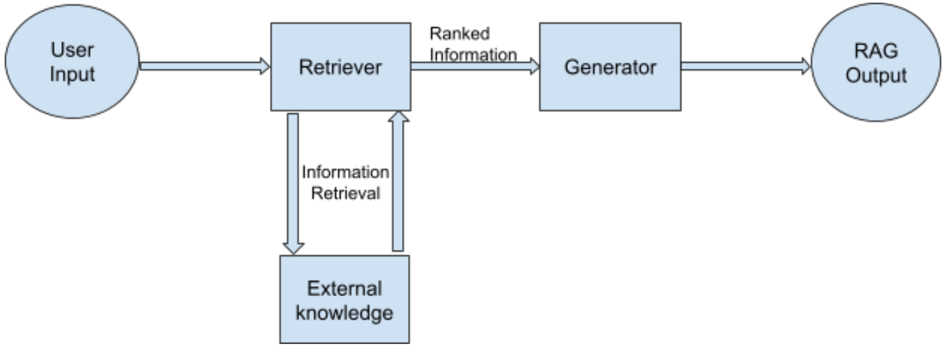
- RAG combines a retriever, such as BM25 or Dense Passage Retrieval (DPR), with a generator, such as T5 or BART, to ground generated text in external knowledge and reduce hallucinations.
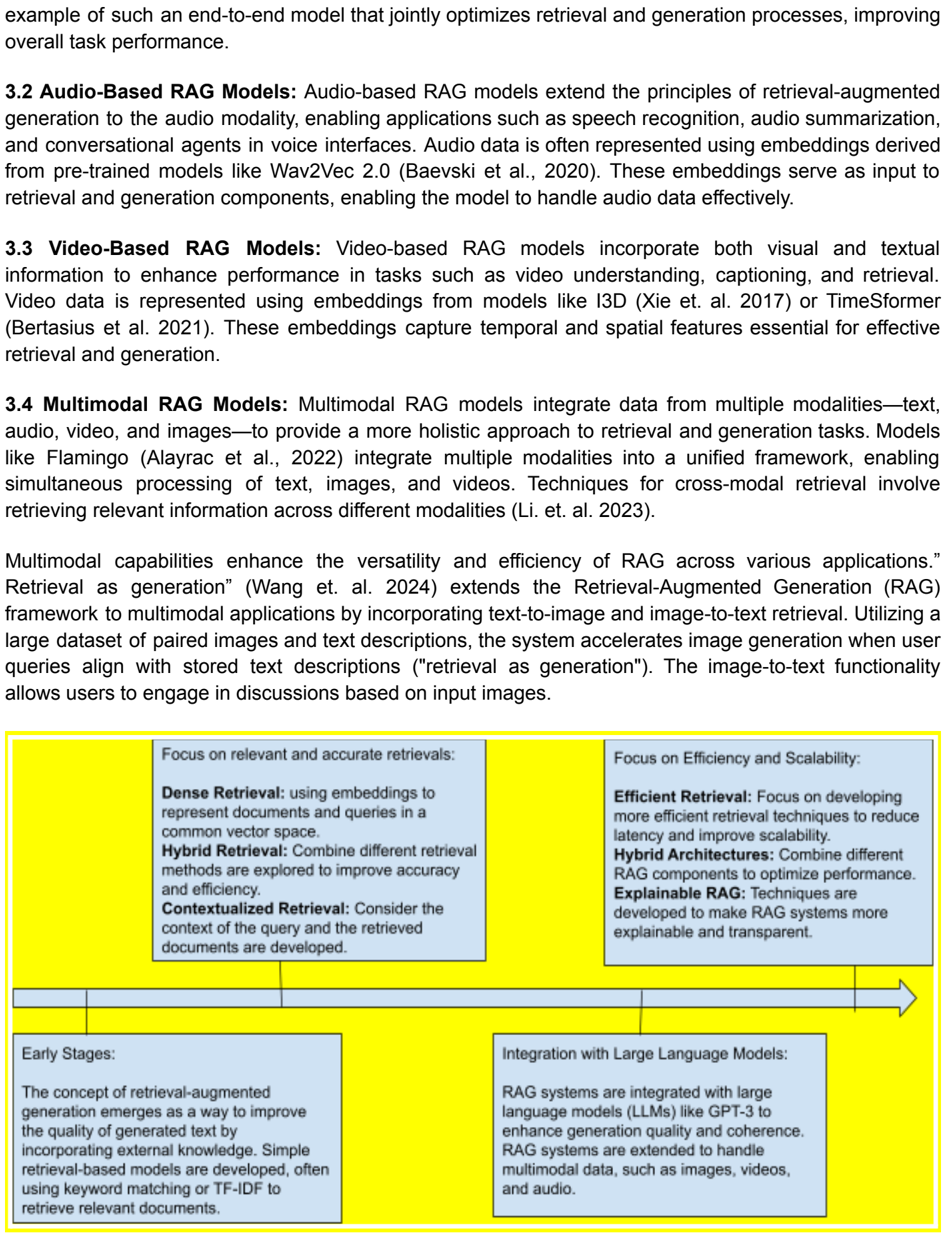
- The paper traces an evolution from retrieval-only or generation-only systems to hybrid models like DrQA, REALM, and RAG, with REALM jointly training retrieval and generation and RAG using dense passage retrieval plus BART.
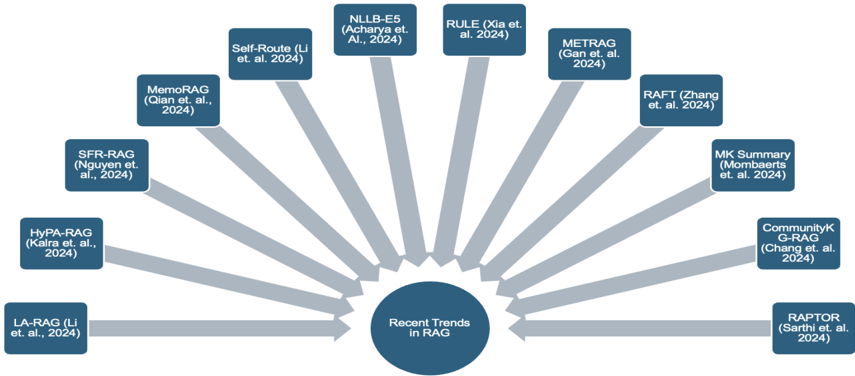
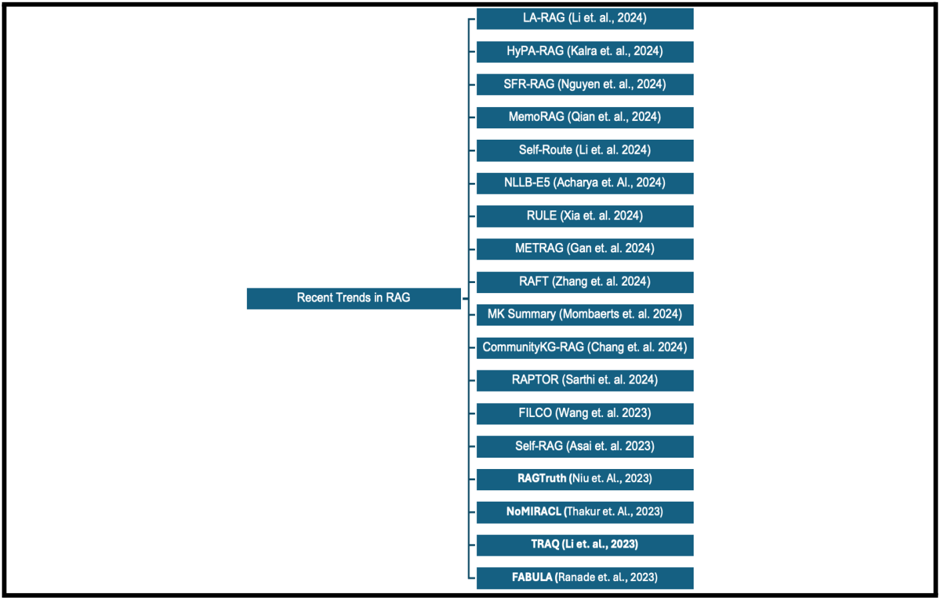
- Recent advances include Self-RAG, RAFT, FILCO, RAPTOR, HyPA-RAG, MemoRAG, and NLLB-E5; RAPTOR is reported to improve accuracy on the QuALITY benchmark by 20% when paired with GPT-4.
- The survey identifies ongoing challenges in scalability and efficiency, retrieval quality and relevance, bias and fairness, coherence, and interpretability and transparency.
Methods
- Design: a comprehensive survey/narrative review of RAG, covering its evolution, core components, modalities, recent advancements, challenges, and future research directions.
- Data or sample: no primary dataset, experimental sample, or empirical evaluation is reported; the paper synthesizes prior literature and cited systems.
- Main analysis: thematic review and qualitative synthesis of RAG architectures, applications, and recent research; no formal systematic review protocol or meta-analysis is stated.
Limitations
- Paper-stated limitations of RAG include scalability and efficiency, retrieval quality and relevance, bias and fairness, coherence between retrieved passages and generated text, and interpretability/transparency.
- Evident from the text: as a narrative survey, it does not report a systematic search strategy, inclusion/exclusion criteria, or quantitative synthesis across studies.
- Evident from the text: the survey does not present its own benchmark results or primary evaluation, so claims about performance rely on cited works.
Model-written summary. Check it against the paper before relying on it.
Integrity signals
Registry
Cites
Statistics
Figures
Verification
Claims the paper makes
0 Valid · 1 Not valid · 62 Not checked · 27 Own results and interpretations
A conclusion the paper draws from its own results — it cites no other source for it, so there is none to check. The quote shows it is in the paper.
In the paper
“The reliance on dense vector representations, such as those used in DPR, can sometimes lead to irrelevant or off-topic documents being retrieved.”
§ A Comprehensive Survey of Retrieval-Augmented Generation (RAG): Evolution, Current Landscape and Future Directions > 1.6 Challenges and Limitations of RAG
plainstates a possible cause- Asserted: passes — The authors put it forward as true.
- Checkable: passes — It can be checked against evidence.
- Load-bearing: unclear — It is unclear whether the paper’s conclusions depend on it.
- Based: passes — The paper gives a reason why it holds.
In the paper
“In conversational AI, RAG models have enhanced the capabilities of dialogue systems by ensuring that responses are both coherent and grounded in factual information (Roller et al., 2020).”
§ A Comprehensive Survey of Retrieval-Augmented Generation (RAG): Evolution, Current Landscape and Future Directions > 1.4 Importance of Factually Grounded Language Generation
What the sources say
- Not matchedcites Roller et al., 2020
Couldn’t be matched to a paper in Crossref, so it can’t be checked.
plainstates a cause- Asserted: passes — The authors put it forward as true.
- Checkable: passes — It can be checked against evidence.
- Load-bearing: unclear — It is unclear whether the paper’s conclusions depend on it.
- Based: passes — The paper gives a reason why it holds.
- Not matched
In the paper
“Studies have demonstrated that BART-based RAG models achieve state-of-the-art results in various knowledge-intensive tasks, including dialogue generation and news summarization.”
§ A Comprehensive Survey of Retrieval-Augmented Generation (RAG): Evolution, Current Landscape and Future Directions > 2.3.2 BART
What the sources say
- Not matchedcites Lewis et al. 2020
Couldn’t be matched to a paper in Crossref, so it can’t be checked.
boosted- Asserted: passes — The authors put it forward as true.
- Checkable: passes — It can be checked against evidence.
- Load-bearing: unclear — It is unclear whether the paper’s conclusions depend on it.
- Based: passes — The paper gives a reason why it holds.
- Not matched
A conclusion the paper draws from its own results — it cites no other source for it, so there is none to check. The quote shows it is in the paper.
In the paper
“The retrieval mechanism, while powerful, can still struggle with retrieving the most relevant documents, particularly when dealing with ambiguous queries or niche knowledge domains.”
§ A Comprehensive Survey of Retrieval-Augmented Generation (RAG): Evolution, Current Landscape and Future Directions > 1.6 Challenges and Limitations of RAG
plainstates a possible cause- Asserted: passes — The authors put it forward as true.
- Checkable: passes — It can be checked against evidence.
- Load-bearing: passes — The paper’s conclusions depend on it.
- Based: passes — The paper gives a reason why it holds.
In the paper
“Additionally, the computational overhead of RAG models is a concern, as they require both a retrieval and a generation step for each query.This dual process can be resource-intensive, particularly for large-scale applications (Borgeaud et al. 2021).”
§ A Comprehensive Survey of Retrieval-Augmented Generation (RAG): Evolution, Current Landscape and Future Directions > 1.6 Challenges and Limitations of RAG
What the sources say
- Not matchedcites Borgeaud et al. 2021
Couldn’t be matched to a paper in Crossref, so it can’t be checked.
plainstates a cause- Asserted: passes — The authors put it forward as true.
- Checkable: passes — It can be checked against evidence.
- Load-bearing: unclear — It is unclear whether the paper’s conclusions depend on it.
- Based: passes — The paper gives a reason why it holds.
- Not matched
31 more claims
Create a free account to see all 90 claims and to verify the 11 references still open.
- Probably not a substantial claim. 22
- It may state two separate claims as one. 43
Self-check
Percentages, sums and reported differences re-computed from the paper’s own numbers.
Each contradiction between two passages listed here was confirmed by an independent check.
Rated minor: it would not touch a result — a value no result rests on, a p-value that stays on the same side of the significance level, or a conflict that is clerical, resolved elsewhere in the paper, or outside its own findings.
In the paper
§ A Comprehensive Survey of Retrieval-Augmented Generation (RAG): Evolution, Current Landscape and Future Directions > 2.3.1 T5 (Text-to-Text Transfer Transformer)
“T5 (Text-to-Text Transfer Transformer) (Raffel et al. 2020)”
§ A Comprehensive Survey of Retrieval-Augmented Generation (RAG): Evolution, Current Landscape and Future Directions > References
“41. Raffel, C., Shazeer, N., Roberts, A., Lee, K., Narang, S., Matena, M., Zhou, Y., Li, W., & Liu, P. J. (2019). Exploring the Limits of Transfer Learning with a Unified Text-to-Text Transformer.”
Rated minor: it would not touch a result — a value no result rests on, a p-value that stays on the same side of the significance level, or a conflict that is clerical, resolved elsewhere in the paper, or outside its own findings.
In the paper
§ A Comprehensive Survey of Retrieval-Augmented Generation (RAG): Evolution, Current Landscape and Future Directions > References
“20. Guu, J., Lee, K., & Pasupat, P. (2020). Retrieval-augmented generation for knowledge-intensive NLP tasks.”
§ A Comprehensive Survey of Retrieval-Augmented Generation (RAG): Evolution, Current Landscape and Future Directions > References
“28. Lewis, P., Perez, E., Piktus, A., Petroni, F., Karpukhin, V., Goyal, N., ... & Riedel, S. (2020). Retrieval-augmented generation for knowledge-intensive NLP tasks.”
Rated minor: it would not touch a result — a value no result rests on, a p-value that stays on the same side of the significance level, or a conflict that is clerical, resolved elsewhere in the paper, or outside its own findings.
In the paper
§ A Comprehensive Survey of Retrieval-Augmented Generation (RAG): Evolution, Current Landscape and Future Directions > 1.2 Overview of Retrieval-Augmented Generation (RAG)
“conversational agents (Liu et al. 2021)”
§ A Comprehensive Survey of Retrieval-Augmented Generation (RAG): Evolution, Current Landscape and Future Directions > References
“34. Liu, Z., Wang, H., Niu, Z., Wu, H., Che, W., & Liu, T. (2020). Towards Conversational Recommendation over Multi-Type Dialogs.”
Citations
Cites
Language Models are Few-Shot Learners
Brown, T. B., Mann, B., Ryder, N., Subbiah, M., Kaplan, J., Dhariwal, P., Neelakantan, A., Shyam, P., Sastry, G., Askell, A., et al. (2020) · arXiv · doi:10.48550/arxiv.2005.14165 · Cited by 23,372
Survey of Hallucination in Natural Language Generation
Ji, Z., Lee, N., Frieske, R., Yu, T., Su, D., Xu, Y., Ishii, E., Bang, Y. J., Madotto, A., & Fung, P. (2023) · ACM Computing Surveys · doi:10.1145/3571730 · Cited by 5,025
Dense passage retrieval for open-domain question answering
Karpukhin, V., Oguz, B., Min, S., Lewis, P., Wu, L., Edunov, S., Chen, D., & Yih, W.-T. (2020) · Proceedings of the 2020 Conference on Empirical Methods in Natural Language Processing (EMNLP) · doi:10.18653/v1/2020.emnlp-main.550 · Cited by 3,575
REALM: Retrieval-Augmented Language Model Pre-Training
Guu, K., Lee, K., Tung, Z., Pasupat, P., & Chang, M.-W. (2020) · arXiv · doi:10.48550/arxiv.2002.08909 · Cited by 574
REPLUG: Retrieval-Augmented Black-Box Language Models
Shi, W., Min, S., Yasunaga, M., Seo, M., James, R., Lewis, M., Zettlemoyer, L., & Yih, W.-T. (2024) · Proceedings of the 2024 Conference of the North American Chapter of the Association for Computational Linguistics: Human Language Technologies (Volume 1: Long Papers) · doi:10.18653/v1/2024.naacl-long.463 · Cited by 209
Asai, A., Wu, Z., Wang, Y., Sil, A., & Hajishirzi, H. (2023) · arXiv (Cornell University) · doi:10.48550/arxiv.2310.11511 · Cited by 101
FABULA: Intelligence Report Generation Using Retrieval-Augmented Narrative Construction
Ranade, P., & Joshi, A. (2023) · Proceedings of the International Conference on Advances in Social Networks Analysis and Mining · doi:10.1145/3625007.3627505 · Cited by 11
Research works printed but not linked: 56
- Acharya, A., Murthy, R., Kumar, V., & Sen, J. (2024). NLLB-E5: A Scalable Multilingual Retrieval Model. ArXiv. /abs/2409.05401
- Alayrac, J., Donahue, J., Luc, P., Miech, A., Barr, I., Hasson, Y., Lenc, K., Mensch, A., Millican, K., Reynolds, M., Ring, R., Rutherford, E., Cabi, S., Han, T., Gong, Z., Samangooei, S., Monteiro, M., Menick, J., Borgeaud, S., . . . Simonyan, K. (2022). Flamingo: A Visual Language Model for Few-Shot Learning. ArXiv. /abs/2204.14198
- Baevski, A., Zhou, H., Mohamed, A., & Auli, M. (2020). Wav2vec 2.0: A Framework for Self-Supervised Learning of Speech Representations. ArXiv. /abs/2006.11477
- Bertasius, G., Wang, H., & Torresani, L. (2021). Is Space-Time Attention All You Need for Video Understanding? ArXiv. /abs/2102.05095
- Binns, R. (2018). Fairness in machine learning: Lessons from political philosophy. Proceedings of the 2018 Conference on Fairness, Accountability, and Transparency (pp. 149-159).
- Borgeaud, S., Mensch, A., Hoffmann, J., Cai, T., Rutherford, E., Millican, K., Driessche, G. V., Lespiau, J., Damoc, B., Clark, A., Casas, D. D., Guy, A., Menick, J., Ring, R., Hennigan, T., Huang, S., Maggiore, L., Jones, C., Cassirer, A., . . . Sifre, L. (2021). Improving language models by retrieving from trillions of tokens. ArXiv. /abs/2112.04426
- Chang, R., & Zhang, J. (2024). CommunityKG-RAG: Leveraging Community Structures in Knowledge Graphs for Advanced Retrieval-Augmented Generation in Fact-Checking. ArXiv. /abs/2408.08535
- Chen, D., Fisch, A., Weston, J., & Bordes, A. (2017). Reading Wikipedia to answer open-domain questions. In Proceedings of the 55th Annual Meeting of the Association for Computational Linguistics (Volume 1: Long Papers) (pp. 1870-1879).
- Chen, W., Hu, H., Chen, X., Verga, P., & Cohen, W. W. (2022). MuRAG: Multimodal Retrieval-Augmented Generator for Open Question Answering over Images and Text. ArXiv. /abs/2210.02928
- Chirkova, N., Rau, D., Déjean, H., Formal, T., Clinchant, S., & Nikoulina, V. (2024). Retrieval-augmented generation in multilingual settings. ArXiv. /abs/2407.01463
- Dai, Z., & Callan, J. (2019). Context-Aware Sentence/Passage Term Importance Estimation For First Stage Retrieval. ArXiv. /abs/1910.10687
- Devlin, J., Chang, M. W., Lee, K., & Toutanova, K. (2019). BERT: Pre-training of deep bidirectional transformers for language understanding. In Proceedings of the 2019 Conference of the North American Chapter of the Association for Computational Linguistics: Human Language Technologies (pp. 4171-4186).
- Devlin, J., Chang, M., Lee, K., & Toutanova, K. (2018). BERT: Pre-training of Deep Bidirectional Transformers for Language Understanding. ArXiv. /abs/1810.04805
- Gan, C., Yang, D., Hu, B., Zhang, H., Li, S., Liu, Z., Shen, Y., Ju, L., Zhang, Z., Gu, J., Liang, L., & Zhou, J. (2024). Similarity is Not All You Need: Endowing Retrieval Augmented Generation with Multi Layered Thoughts. ArXiv. /abs/2405.19893
- Gatt, A., & Krahmer, & E. (2018). Survey of the state of the art in natural language generation: Core tasks, applications, and evaluation. Journal of Artificial Intelligence Research, 61, 65-170.
- Gupta, S., & Ranjan, R. (2024). Evaluation of LLMs Biases Towards Elite Universities: A Persona-Based Exploration. ArXiv. /abs/2407.12801
- Gupta, S., Ranjan, R., & Singh, S. N. (2024). Comprehensive Study on Sentiment Analysis: From Rule-based to modern LLM based system. ArXiv. /abs/2409.09989
- Guu, K., Lee, K., Tung, Z., Pasupat, P., & Chang, M. (2020). REALM: Retrieval-augmented language model pre-training. In Proceedings of the 37th International Conference on Machine Learning (pp. 3929-3938).
- Han, S., Pool, J., Tran, J., & Dally, W. J. (2015). Learning both weights and connections for efficient neural network. In Advances in Neural Information Processing Systems (pp. 1135-1143).
- Izacard, G., & Grave, E. (2021). Leveraging passage retrieval with generative models for open domain question answering. In Proceedings of the 16th Conference of the European Chapter of the Association for Computational Linguistics: Main Volume (pp. 874-880).
- Kalra, R., Wu, Z., Gulley, A., Hilliard, A., Guan, X., Koshiyama, A., & Treleaven, P. (2024). HyPA-RAG: A Hybrid Parameter Adaptive Retrieval-Augmented Generation System for AI Legal and Policy Applications. ArXiv. /abs/2409.09046
- Karpukhin, V., Oguz, B., Min, S., Lewis, P., Wu, L., Edunov, S., Chen, D. & Yih, W. T. (2020). Dense passage retrieval for open-domain question answering. In Proceedings of the 2020 Conference on Empirical Methods in Natural Language Processing (EMNLP) (pp. 6769-6781).
- Lewis, P., Perez, E., Piktus, A., Petroni, F., Karpukhin, V., Goyal, N., ... & Riedel, S. (2020). Retrieval-augmented generation for knowledge-intensive NLP tasks. In Proceedings of the 34th International Conference on Neural Information Processing System ( pp. 9459-9474).
- Li, C., Liu, Z., Xiao, S., & Shao, Y. (2023). Making Large Language Models A Better Foundation For Dense Retrieval. ArXiv. /abs/2312.15503
- Li, F., Zhu, L., Wang, T., Li, J., Zhang, Z., & Shen, H. T. (2023). Cross-Modal Retrieval: A Systematic Review of Methods and Future Directions. ArXiv. /abs/2308.14263
- Li, S., Shang, H., Wei, D., Guo, J., Li, Z., He, X., Zhang, M., & Yang, H. (2024). LA-RAG:Enhancing LLM-based ASR Accuracy with Retrieval-Augmented Generation. ArXiv. /abs/2409.08597
- Li, S., Park, S., Lee, I., & Bastani, O. (2023). TRAQ: Trustworthy Retrieval Augmented Question Answering via Conformal Prediction. ArXiv. /abs/2307.04642
- Li, Z., Li, C., Zhang, M., Mei, Q., & Bendersky, M. (2024). Retrieval Augmented Generation or Long-Context LLMs? A Comprehensive Study and Hybrid Approach. ArXiv. /abs/2407.16833
- Liu, Z., Wang, H., Niu, Z., Wu, H., Che, W., & Liu, T. (2020). Towards Conversational Recommendation over Multi-Type Dialogs. ArXiv. /abs/2005.03954
- Mallen, A., Asai, A., Zhong, V., Das, R., Khashabi, D., & Hajishirzi, H. (2022). When Not to Trust Language Models: Investigating Effectiveness of Parametric and Non-Parametric Memories. ArXiv. /abs/2212.10511
- Mombaerts, L., Ding, T., Banerjee, A., Felice, F., Taws, J., & Borogovac, T. (2024). Meta Knowledge for Retrieval Augmented Large Language Models. ArXiv. /abs/2408.09017
- Nguyen, X., Pandit, S., Purushwalkam, S., Xu, A., Chen, H., Ming, Y., Ke, Z., Savarese, S., Xong, C., & Joty, S. (2024). SFR-RAG: Towards Contextually Faithful LLMs. ArXiv. /abs/2409.09916
- Niu, C., Wu, Y., Zhu, J., Xu, S., Shum, K., Zhong, R., Song, J., & Zhang, T. (2023). RAGTruth: A Hallucination Corpus for Developing Trustworthy Retrieval-Augmented Language Models. ArXiv. /abs/2401.00396
- Qian, H., Zhang, P., Liu, Z., Mao, K., & Dou, Z. (2024). MemoRAG: Moving towards Next-Gen RAG Via Memory-Inspired Knowledge Discovery. ArXiv. /abs/2409.05591
- Radford, A., Wu, J., Child, R., Luan, D., Amodei, D., & Sutskever, I. (2019). Language models are unsupervised multitask learners. OpenAI Blog, 1(8), 9.
- Raffel, C., Shazeer, N., Roberts, A., Lee, K., Narang, S., Matena, M., Zhou, Y., Li, W., & Liu, P. J. (2019). Exploring the Limits of Transfer Learning with a Unified Text-to-Text Transformer. ArXiv. /abs/1910.10683
- Ranjan, R., Gupta, S., & Singh, S. N. (2024). A Comprehensive Survey of Bias in LLMs: Current Landscape and Future Directions. ArXiv. /abs/2409.16430
- Ravuru, C., Sakhinana, S. S., & Runkana, V. (2024). Agentic Retrieval-Augmented Generation for Time Series Analysis. ArXiv. /abs/2408.14484
- Robertson, S.G., & Zaragoza,H., (2009). The Probabilistic Relevance Framework: BM25 and Beyond, Foundations and Trends in Information Retrieval, 3(4), pp. 333-389.
- Roller, S., Dinan, E., Goyal, N., Ju, D., Williamson, M., Liu, Y., Xu, J., Ott, M., Shuster, K., Smith, E. M., Boureau, Y., & Weston, J. (2020). Recipes for building an open-domain chatbot. ArXiv. /abs/2004.13637
- Salton, G., Wong, A., & Yang, C. S. (1975). A vector space model for automatic indexing. Communications of the ACM, 18(11), 613-620.
- Sanh, V., Debut, L., Chaumond, J., & Wolf, T. (2019). DistilBERT, a distilled version of BERT: Smaller, faster, cheaper and lighter. ArXiv. /abs/1910.01108
- Sarthi, P., Abdullah, S., Tuli, A., Khanna, S., Goldie, A., & Manning, C. D. (2024). RAPTOR: Recursive Abstractive Processing for Tree-Organized Retrieval. ArXiv. /abs/2401.18059
- Shrestha, R., Zou, Y., Chen, Q., Li, Z., Xie, Y., & Deng, S. (2024). FairRAG: Fair Human Generation via Fair Retrieval Augmentation. ArXiv. /abs/2403.19964
- Sutskever, I., Vinyals, O., & Le, Q. V. (2014). Sequence to sequence learning with neural networks. In Advances in Neural Information Processing Systems (pp. 3104-3112).
- Thakur, N., Bonifacio, L., Zhang, X., Ogundepo, O., Kamalloo, E., Li, X., Liu, Q., Chen, B., Rezagholizadeh, M., & Lin, J. (2023). NoMIRACL: Knowing When You Don't Know for Robust Multilingual Retrieval-Augmented Generation. ArXiv. /abs/2312.11361
- Thakur, N., Reimers, N., Ruckl'e, A., Srivastava, A., & Gurevych, I. (2021). BEIR: A Heterogenous Benchmark for Zero-shot Evaluation of Information Retrieval Models. ArXiv, abs/2104.08663. · arXiv
- Vaswani, A., Shazeer, N., Parmar, N., Uszkoreit, J., Jones, L., Gomez, A. N., Kaiser, Ł., & Polosukhin, I. (2017). Attention is all you need. In Advances in Neural Information Processing Systems (pp. 5998-6008).
- Wang, X., Wang, Z., Gao, X., Zhang, F., Wu, Y., Xu, Z., Shi, T., Wang, Z., Li, S., Qian, Q., Yin, R., Lv, C., Zheng, X., & Huang, X. (2024). Searching for Best Practices in Retrieval-Augmented Generation. ArXiv. /abs/2407.01219
- Wang, Z., Araki, J., Jiang, Z., Parvez, M. R., & Neubig, G. (2023). Learning to Filter Context for Retrieval-Augmented Generation. ArXiv. /abs/2311.08377
- Xia, P., Zhu, K., Li, H., Zhu, H., Li, Y., Li, G., Zhang, L., & Yao, H. (2024). RULE: Reliable Multimodal RAG for Factuality in Medical Vision Language Models. ArXiv. /abs/2407.05131
- Xie, S., Sun, C., Huang, J., Tu, Z., & Murphy, K. (2017). Rethinking Spatiotemporal Feature Learning: Speed-Accuracy Trade-offs in Video Classification. ArXiv. /abs/1712.04851
- Xiong, L., Xiong, C., Li, Y., Tang, K., Liu, J., Bennett, P., Ahmed, J., & Overwijk, A. (2020). Approximate Nearest Neighbor Negative Contrastive Learning for Dense Text Retrieval. ArXiv. /abs/2007.00808
- Yasunaga, M., Aghajanyan, A., Shi, W., James, R., Leskovec, J., Liang, P., Lewis, M., Zettlemoyer, L., & Yih, W. (2022). Retrieval-Augmented Multimodal Language Modeling. ArXiv. /abs/2211.12561
- Zhang, T., Patil, S. G., Jain, N., Shen, S., Zaharia, M., Stoica, I., & Gonzalez, J. E. (2024). RAFT: Adapting Language Model to Domain Specific RAG. ArXiv. /abs/2403.10131
- Zhu, Y., Ren, C., Xie, S., Liu, S., Ji, H., Wang, Z., Sun, T., He, L., Li, Z., Zhu, X., & Pan, C. (2024). REALM: RAG-Driven Enhancement of Multimodal Electronic Health Records Analysis via Large Language Models. ArXiv. /abs/2402.07016
Cited by
Items 301–343 of 343
Karuka, R. T. T., & Nguyen, V. (2026) · Machine Learning Engineering · doi:10.1088/3049-4761/aea41f
Bridging the Semantic-Utility Gap in Multimodal RAG via Generator-in-the-Loop AlignmentPreprint
Chang, Z.-L., Han, D.-J., Hosseinalipour, S., Chiang, M., & Brinton, C. G. (2026) · arXiv (Cornell University) · doi:10.48550/arxiv.2609.08188
Pandya, K. (2026) · INTERNATIONAL JOURNAL OF RESEARCH AND ANALYTICAL REVIEWS · doi:10.56975/ijrar.v13i3.340073
Embedding Model Evaluation in Legal RAG Systems for Automobile Law Question Answering
Yelala, N. R. (2025) · TRAP@NCI (National College of Ireland)
Hamzabegović, J., Džanić, A., & Durakovic, K. (2026) · IJEEC - INTERNATIONAL JOURNAL OF ELECTRICAL ENGINEERING AND COMPUTING · doi:10.7251/ijeec2601037h
A Survey of Retrieval-Augmented Language Models for Knowledge-Intensive Text Applications
Manekar, M. S. (2026) · International Journal of Modern Computer Science and IT Innovations · doi:10.55640/ijmcsit-v03i09-06
Olabanjo, O. A., Wusu, A. S., & Afisi, O. T. (2026) · Scientific Reports · doi:10.1038/s41598-026-69728-4
The Immutable Past: Formalizing State Mutability and Conflict Resolution in Mutable RAGPreprint
HaddadPajouh, H., & AmiriTabat, A. (2026) · arXiv (Cornell University) · doi:10.48550/arxiv.2609.16073
Shimizu, Y., & Aoyama, K. (2026) · Procedia Computer Science · doi:10.1016/j.procs.2026.08.185
Exploring Retrieval Augmented Generation Approaches for Natural Language Question Understanding
Kowalski, C., Robrecht, A. S., Emmerling, V., & Kopp, S. (2026) · Annual Meeting of the Special Interest Group on Discourse and Dialogue · doi:10.18653/v1/2026.sigdial-1.34
Toy, M. (2026) · Springer eBooks · doi:10.1007/978-3-032-21830-8_4
Shirbhate, P. M. (2026) · INTERANTIONAL JOURNAL OF SCIENTIFIC RESEARCH IN ENGINEERING AND MANAGEMENT · doi:10.55041/ijsrem67512
Saputri, D. N., Suroyo, H., Abdillah, L. A., & Putra, M. S. (2026) · Jurnal Indonesia Manajemen Informatika dan Komunikasi · doi:10.63447/jimik.v7i3.2111
Systematic Technical Survey on LLMOps: Lifecycle, Tools, Challenges, and Emerging Practices
Özer, F. (2025) · UEF eRepo (University of Eastern Finland)
Demystifying LLM Serving Pipeline: From Prompt to Response
Kumar, R. (2025) · Journal of Computer Science and Technology Studies · doi:10.32996/jcsts.2025.7.12.37
Apenas Quatro Parâmetros: Uma Proposta Metodológica que Busca Traduzir o Pensamento Humano.
Macedo, J. P. D. O., Barreto, G., & Miguel, P. V. D. O. (2025) · Anais do ... Simpósio Brasileiro de Automação Inteligente/Simpósio Brasileiro de Automação Inteligente
E. Siva Krushna¹, Y. K. S. N. H. (2026) · International Journal of Engineering Research and Science & Technology
Sosa, M. A. P. (2026) · Repositorio Digital (Escuela Politécnica Nacional)
Alandihallaj, M. A., & Hein, A. M. (2026) · IEEE Access · doi:10.1109/access.2026.3739981
Retrieval-Based In-Context Learning: A Domain Adaptation FrameworkPreprint
Zhu, Y., Deng, N., Li, Y., Shi, N., & Scott, C. D. (2026) · arXiv (Cornell University) · doi:10.48550/arxiv.2610.05717
Pattnaik, S., & Pinsky, E. (2026) · Lecture notes of the Institute for Computer Sciences, Social Informatics and Telecommunications Engineering · doi:10.1007/978-3-032-33123-6_6
Learning from Imperfect Data: Invariance, Adaptation and Generalization
Zhu, Y. (2026) · Deep Blue (University of Michigan) · doi:10.7302/dspace/30516
Ma’ruf, M. F., Fauzi, A., Setiawan, A. G., Oktaviani, D. S., Sihamita, D., Handoko, L., Aisiyah, R. N., Rivai, A. K., & Mardiyanto (2026) · Abdi Jurnal Publikasi
RANCANG BANGUN QUESTION ANSWERING SYSTEM LAYANAN INFORMASI AKADEMIK BERBASIS RAG
Setiawan, M. S. A. (2026) · Prosiding Seminar Nasional Indonesia
An Expert-Curated Benchmark for Frontier and Local LLMs Querying a Biomedical Knowledge GraphPreprint
Medagbe, J. F. P., Kilyungi, M., Isaac, A., Kabua, A., Lisso, F., Wambua, S., Williams, R. L., & Prins, P. (2026) · bioRxiv (Cold Spring Harbor Laboratory) · doi:10.64898/2026.10.04.756532
Ilahi, S., Bamini, J., Ponnuru, A., Singh, N., Mittal, V. K., & Arivazhagan, D. (2026) · International Journal of Computer Information Systems and Industrial Management Applications · doi:10.70917/ijcisim-2026-5942
Multi-hop Natural Language Question Answering on Graphs by Using LLMs
Bozorgi, E., & Kochut, K. J. (2026) · Communications in computer and information science · doi:10.1007/978-3-032-28469-3_5
Chang, S.-Y. (2026) · Marine Engineering · doi:10.5988/jime.61.425
EchoWeave: Designing an AI-Driven Conversational Agent System for Product Design Research Interviews
Chen, X., Zhang, L., Xu, L., Bao, L., García, C., & Sareh, P. (2026) · International Journal of Human-Computer Interaction · doi:10.1080/10447318.2026.2744496
Hu, R., Xue, C., & Liu, G. (2026) · SAE technical papers on CD-ROM/SAE technical paper series · doi:10.4271/2026-99-2933
Hysenaj, M. (2025) · International Scientific Conference ITEMA. Recent Advances in Information Technology, Tourism, Economics, Management and Agriculture · doi:10.31410/itema.2025.1
CareerX: A Retrieval-Augmented Generation Framework for Personalized AI-Driven Career Guidance
Fathima Hana Fathima Hana, K., Muhammed Sinan, T., Rifa, & Sarhan Qadir, K. V. M. (2026) · Zenodo (CERN European Organization for Nuclear Research) · doi:10.5281/zenodo.19396672
An LLM-assisted real-time simulation framework for demand-responsive transport operations
Kim, J., Choi, M., Lee, S.-W., & Seo, K.-M. (2026) · PLoS ONE · doi:10.1371/journal.pone.0360420
Петрова, Е. (2026) · Экономический вестник · doi:10.66621/2949-4648-2026-5-4-95-103
Enhancing Small Language Models in RAG via Triplet-Guided In-Context Distillation
Tambovtsev, I., Molchanova, M. A., Mikhailova, A., Korotkov, A., Sgibnev, I., Vizilter, I., & Savchenko, A. (2026) · doi:10.18653/2026.groundlm-1.72
Beyond Chatbots: Building More Reliable and Context-Aware AI Conversational Agents
Sunil, P. K. M. B. S. S., & Bhadake, D. H. B. J. P. L. S. (2026) · International Journal of Advanced Research in Science Communication and Technology · doi:10.48175/ijarsct-40370
Hanh, N. D., & Thu, D. H. L. T. (2026) · Journal of Military Science and Technology · doi:10.54939/1859-1043.j.mst.114.2026.175-182
Liang, S. (2026) · Lecture notes in computer science · doi:10.1007/978-981-92-3586-5_38
Methods and architecture approaches review for retrieval optimization in RAG systems
Кувічка, М. Є. (2026) · Електронний архів наукових та освітніх матеріалів КПІ ім. Ігоря Сікорського (КПІ ім. Ігоря Сікорського)
НАДТОЧИЙ, М., & Balagura, D. (2026) · Radiotekhnika · doi:10.30837/rt.2026.3.226.05
Pulti, S. (2025) · Sciences du Nord Nature Science and Technology · doi:10.71238/snnst.v2i02.184
Hartanto, E., & Astriani, M. S. (2026) · Equivalent Jurnal Ilmiah Sosial Teknik · doi:10.59261/jequi.v8i5.472
BG-RAG: Concept-Mediated Bipartite Graphs for Scalable RAG
Gao, H., Ding, Y., Han, S., & Jiang, Z. (2026) · International Joint Conference on Natural Language Processing and Conference of the Asia-Pacific Chapter of the Association for Computational Linguistics (IJCNLP-AACL) · doi:10.18653/2026.aacl-short.58
Metadata
- Authors
- Gupta, S., Ranjan, R., & Singh, S. N.
- Venue
- arXiv
- Publisher
- arXiv
- Published
- 2024
- ISSN
- 2331-8422 (ISSN-L)
- arXiv
- 2410.12837
- OpenAlex
- W4403578737
- Cited by
- 342
- References
- 7
- Citations by year
- 2026: 200 · 2025: 141 · 2024: 1
- Type
- posted content
- Language
- en
- Open access
- green
- arxiv.org
- Licence
- Locations
- arXiv (Cornell University) (submittedVersion, cc-by-nc-nd)
- arXiv (Cornell University) (cc-by-nc-nd)
- Topics
- Physical Sciences › Computer Science › Artificial Intelligence › Topic Modeling
- Physical Sciences › Computer Science › Information Systems › Information Retrieval and Search Behavior
- Physical Sciences › Computer Science › Computer Vision and Pattern Recognition › Multimodal Machine Learning Applications
- Keywords
- retrieval-augmented generation, retrieval-augmented language models, generative language models, question answering, text summarization, retrieval efficiency, scalability, bias, ethical considerations, robustness
About these checks
Registry, retraction, Cites and statistics results are computed, not judged, with one exception: a printed reference that no index lists is read once by a model before it counts as a citation error. Claims are extracted by a model and kept only when their quote appears verbatim in the text; each cited source is then checked, with a model’s help, for whether it says what the claim relies on. Those verdicts can be wrong — read the claim’s quote and the cited source before relying on one.
A language model drew the claims from the paper on 2026-11-14, under version 3 of the claim definition (model deepseek-v4.1-flash, prompt extract-v3).
A second model labelled each claim on 2026-11-14 (model jev-1.13-20260917, definition revision gold-guideline-v0.2).
Statistics and arithmetic are recomputed, not judged.
Confidence bands are shown only for fields calibrated on our annotated test set. None is calibrated yet, so no band is shown.
What counts as a claim ›How we measure confidence ›How we check this ›
Are you an author, or do you see a problem with this page? Request a review
Data sources
Bibliographic data: Semantic Scholar, OpenAlex, Crossref.
Contains information from the Semantic Scholar Academic Graph Datasets, made available under the ODC Attribution License (ODC-BY 1.0).
Semantic Scholar’s data is described in: Kinney, R., et al. (2023). The Semantic Scholar Open Data Platform. arXiv:2301.10140.
