

Game-theoretic LLM: Agent Workflow for Negotiation Games
Open accessThe DOI matches its DataCite record; 78 of the 78 references it cites were found in a registry or an index; none of the 9 sources its claims cite is checked for support yet.
Abstract
This paper investigates the rationality of large language models (LLMs) in strategic decision-making contexts, specifically within the framework of game theory. We evaluate several state-of-the-art LLMs across a spectrum of complete-information and incomplete-information games. Our findings reveal that LLMs frequently deviate from rational strategies, particularly as the complexity of the game increases with larger payoff matrices or deeper sequential trees. To address these limitations, we design multiple game-theoretic workflows that guide the reasoning and decision-making processes of LLMs. These workflows aim to enhance the models' ability to compute Nash Equilibria and make rational choices, even under conditions of uncertainty and incomplete information. Experimental results demonstrate that the adoption of these workflows significantly improves the rationality and robustness of LLMs in game-theoretic tasks. Specifically, with the workflow, LLMs exhibit marked improvements in identifying optimal strategies, achieving near-optimal allocations in negotiation scenarios, and reducing susceptibility to exploitation during negotiations. Furthermore, we explore the meta-strategic considerations of whether it is rational for agents to adopt such workflows, recognizing that the decision to use or forgo the workflow constitutes a game-theoretic issue in itself. Our research contributes to a deeper understanding of LLMs' decision-making capabilities in strategic contexts and provides insights into enhancing their rationality through structured workflows. The findings have implications for the development of more robust and strategically sound AI agents capable of navigating complex interactive environments. Code and data supporting this study are available at \url{https://github.com/Wenyueh/game_theory}.
Overview
CoChat Summary
TL;DR
This paper evaluates whether LLMs play game-theoretic games rationally and proposes game-theory-inspired workflows to improve their strategic decision-making. It finds that LLMs often deviate from Nash equilibrium, especially in complex games, but workflows substantially improve rationality and negotiation outcomes, while also creating a meta-strategic dilemma about whether to adopt the workflow.
Key findings
- Without workflows, LLMs frequently fail to reach Nash equilibria in complete-information games; average Nash-equilibrium rates were 0.45 (Sonnet), 0.32 (GPT-4o), 0.59 (Opus), and 0.78 (o1), with similar Pareto-optimal Nash rates. With workflows and no negotiation, averages rose to 0.76, 0.69, 0.71, and 0.81; with workflows plus 4 negotiation rounds, averages were 0.73, 0.78, 0.83, and 0.88.
- In the incomplete-information “Deal or No Deal” setting, raw LLM-vs-LLM negotiation produced a 95.45% agreement rate for Claude-3.5 Sonnet, average total reward 11.11 versus best possible 12.48 and human 6.64, with 70.45% Pareto-optimal and 70.45% envy-free outcomes. With both agents using the workflow, agreement was 100% across models; Opus achieved total reward 12.31, GPT-4o 12.18, and Sonnet 12.11, with near-perfect envy freeness (GPT-4o 100%, Sonnet 97.72%).
- When only one agent used the workflow, the non-workflow agent often obtained higher individual reward, indicating the workflow can be exploited. The decision to adopt the workflow itself becomes a game: for Claude-3.5 Sonnet, “not use” was dominant and the Nash equilibrium was both not using it (payoffs 5.55, 5.57) versus both using it (5.82, 6.16); for GPT-4o and Opus, using the workflow was dominant and Nash/Pareto optimal.
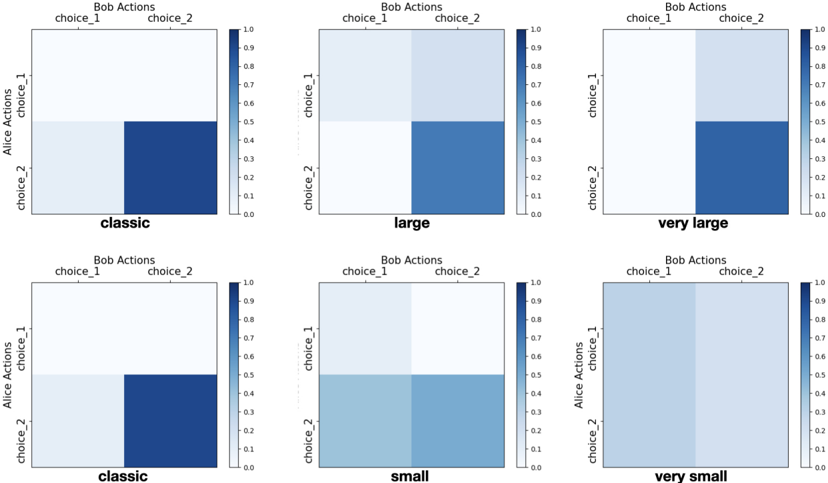
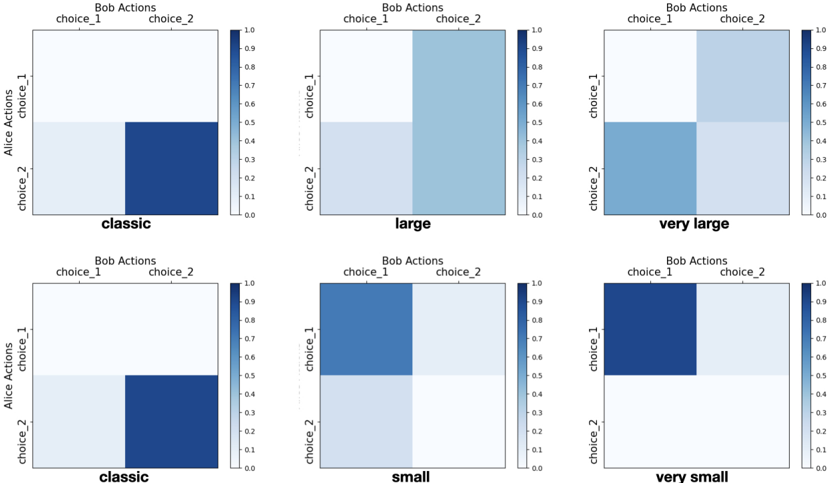
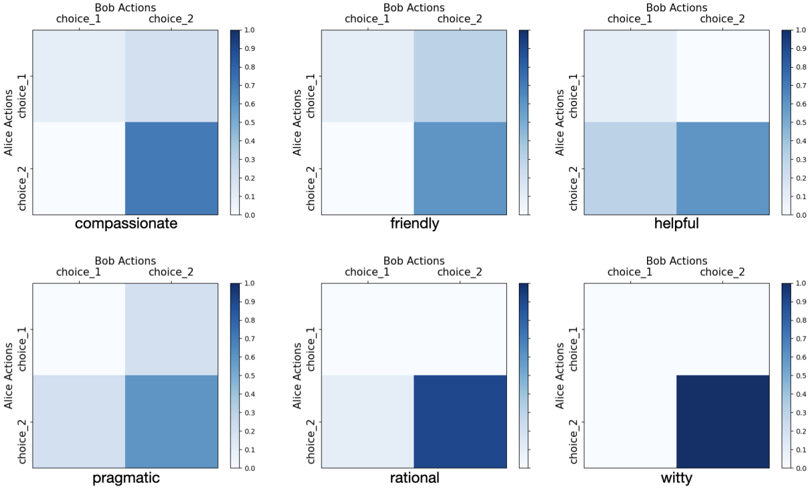
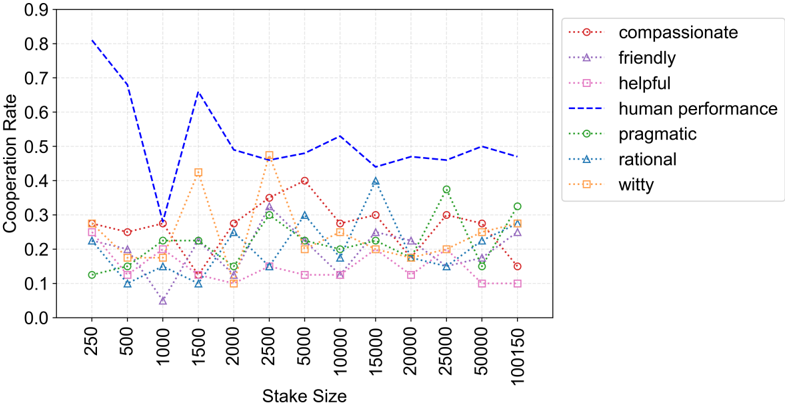
- LLM rationality was fragile: payoff perturbations that preserved Nash equilibria changed action distributions; assigned personalities affected rationality; negotiation sometimes undermined rational choices, including in Prisoner’s Dilemma; prompt engineering effects diminished with more negotiation rounds; and in a Golden Balls comparison, LLM cooperation was largely insensitive to jackpot size and generally lower than the human 53% cooperation rate.
Methods
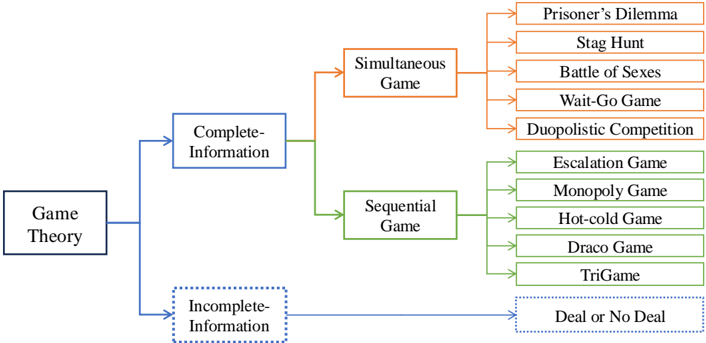
- Evaluated Claude-3.5 Sonnet, Claude-3 Opus, GPT-4o, and o1 on 10 classic complete-information games (5 simultaneous, 5 sequential), with 10 trials per scenario and temperature 1.0 for Sonnet/Opus/GPT-4o and default for o1; measured Nash-equilibrium and Pareto-optimal Nash-equilibrium achievement.
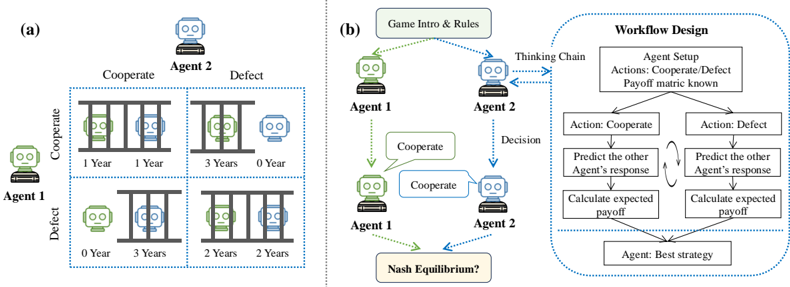
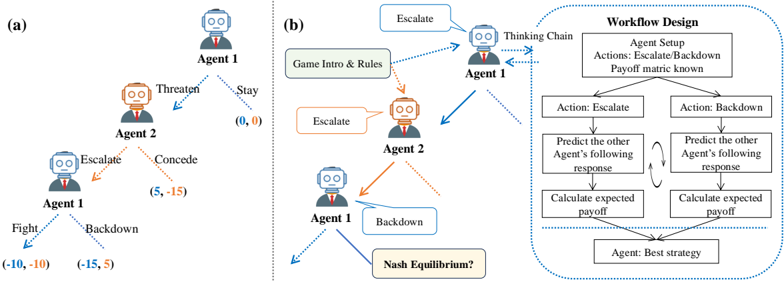
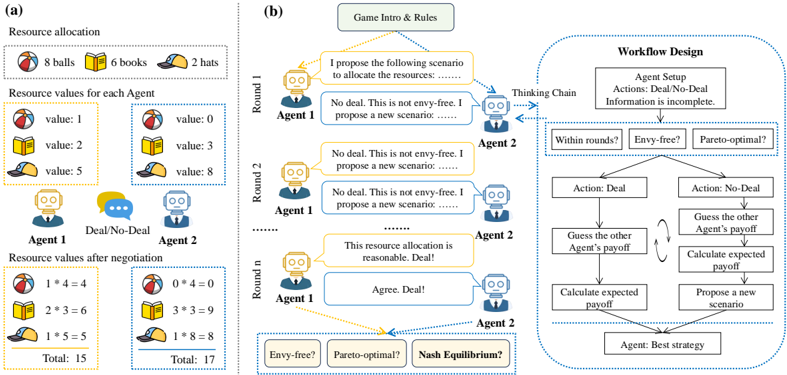
- Designed workflows using dominant-strategy/best-response search for simultaneous games, backward induction for sequential games, and a Bayesian belief-updating negotiation algorithm for incomplete-information resource allocation with envy-freeness and Pareto-optimality criteria.
- For incomplete-information negotiation, used the “Deal or No Deal” dataset (over 5,800 human-human dialogues; 1,052 test dialogues) and selected the top-50 most difficult datapoints with an envy-free allocation, of which 44 were used; metrics included negotiation rounds, agreement, agent score, Pareto optimality, envy freeness, and total reward.
Limitations
- The paper states that o1 was excluded from workflow experiments due to prohibitively high computational cost, and its inaccessible intermediate chain-of-thought made performance drops hard to diagnose. It also states that the workflow does not eliminate all computational limitations, as the Escalation Game still suffered numerical computation errors.
- The paper states that the Bayesian update assumes opponent rationality and can be unrobust to deception; that negotiation can divert agents from workflow-derived Nash equilibria; that engineered prompts did not genuinely enhance rationality; and that the human-vs-LLM irrationality comparison is preliminary and not exhaustive.
- Evident from the text: the incomplete-information evaluation uses a selected difficult subset rather than the full test set, focuses on two-player resource allocation, and reports sensitivity to temperature, so generality across broader populations, games, and model settings is not established.
Model-written summary. Check it against the paper before relying on it.
Integrity signals
Registry
Cites
Statistics
Figures
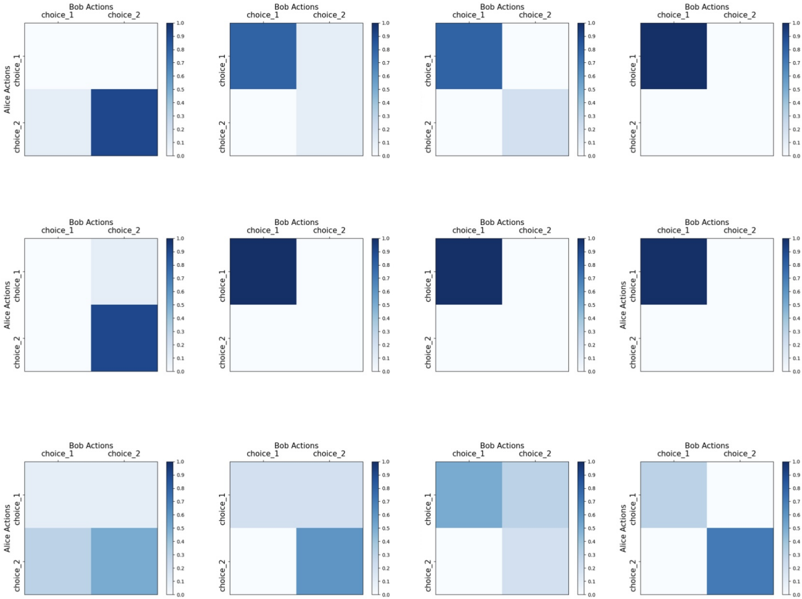
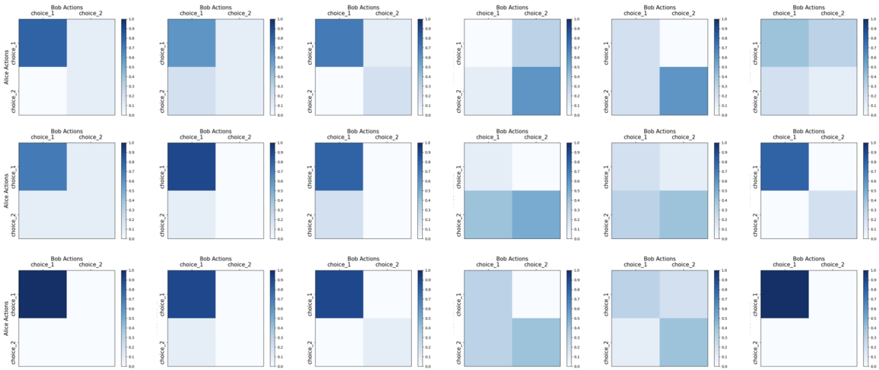
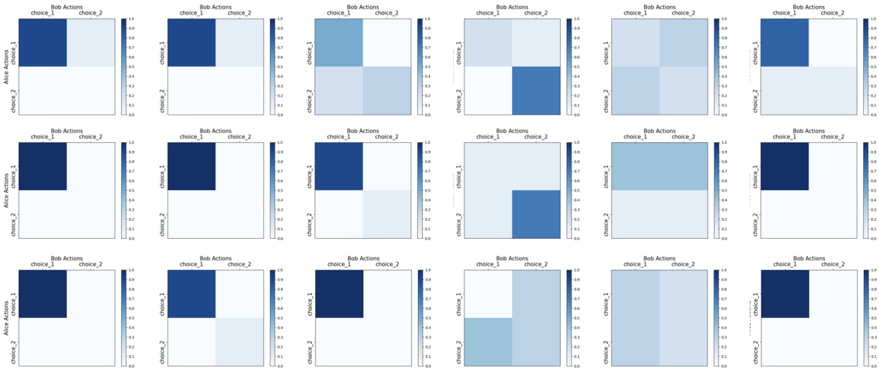
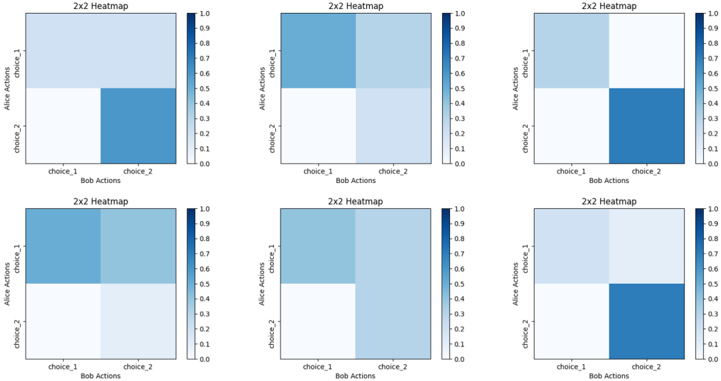
Verification
Claims the paper makes
0 Valid · 10 Not valid · 5 Not checked · 164 Own results and interpretations
A result the paper reports from its own data — it cites no other source for it, so there is none to check. The quote shows it is in the paper.
In the paper
“Among the LLM-based agents, Claude-3.5Sonnet demonstrates the best super-human performance.”
§ Game-theoretic LLM: Agent Workflow for Negotiation Games > 5.5.1 Both Agents without Workflow
boosted- Asserted: passes — The authors put it forward as true.
- Checkable: passes — It can be checked against evidence.
- Load-bearing: unclear — It is unclear whether the paper’s conclusions depend on it.
- Based: passes — The paper gives a reason why it holds.
A result the paper states — it cites no source for it, so there is none to check. The quote shows it is in the paper.
In the paper
“In coordination games such as the Stag Hunt, Battle of the Sexes, and Wait-Go Game, negotiation is a fundamental component of decision-making, making the improvement in performance through negotiation an intuitive result.”
§ Game-theoretic LLM: Agent Workflow for Negotiation Games > Games
plainstates a cause- Asserted: passes — The authors put it forward as true.
- Checkable: passes — It can be checked against evidence.
- Load-bearing: passes — The paper’s conclusions depend on it.
- Based: passes — The paper gives a reason why it holds.
A result the paper states — it cites no source for it, so there is none to check. The quote shows it is in the paper.
In the paper
“However, it is important to observe that the performance of model o1 declines considerably in this context.”
§ Game-theoretic LLM: Agent Workflow for Negotiation Games > 4.5 Experiments for Classic Game Theory with Workflow
plainstates a cause- Asserted: passes — The authors put it forward as true.
- Checkable: passes — It can be checked against evidence.
- Load-bearing: unclear — It is unclear whether the paper’s conclusions depend on it.
- Based: passes — The paper gives a reason why it holds.
A result the paper reports from its own data — it cites no other source for it, so there is none to check. The quote shows it is in the paper.
In the paper
“As shown in Table 10, for these 44 datapoints, it is always possible to find pareto optimal and envy free allocations that maximize the total reward for both players.”
§ Game-theoretic LLM: Agent Workflow for Negotiation Games > 5.5.1 Both Agents without Workflow
plain- Asserted: passes — The authors put it forward as true.
- Checkable: passes — It can be checked against evidence.
- Load-bearing: unclear — It is unclear whether the paper’s conclusions depend on it.
- Based: passes — The paper gives a reason why it holds.
A result the paper states — it cites no source for it, so there is none to check. The quote shows it is in the paper.
In the paper
“However, certain challenges persist, such as in the Escalation Game, where numerical computation errors hinder deriving the Nash Equilibrium following the workflow.”
§ Game-theoretic LLM: Agent Workflow for Negotiation Games > Games
plainstates a cause- Asserted: passes — The authors put it forward as true.
- Checkable: passes — It can be checked against evidence.
- Load-bearing: unclear — It is unclear whether the paper’s conclusions depend on it.
- Based: passes — The paper gives a reason why it holds.
107 more claims
Create a free account to see all 179 claims and every source verdict.
- It may state two separate claims as one. 51
- Probably not a substantial claim. 19
- The quote only partly states this claim. 2
Self-check
Percentages, sums and reported differences re-computed from the paper’s own numbers.
Each contradiction between two passages listed here was confirmed by an independent check.
Rated major: it would touch a result — a value a result rests on, reported and recomputed p-values on opposite sides of the significance level, two passages that conflict with no sign which is right, or a cited work retracted before this paper was published.
In the paper
“If both agents were to use the workflow, they would receive higher individual payoffs -5.82 forAlice and 6.16 for Bob -and a higher combined total reward of 12.48”
§ Game-theoretic LLM: Agent Workflow for Negotiation Games > Models Sonnet GPT-4o Opus
Reported 12.48 · recomputed 11.98
Rated major: it would touch a result — a value a result rests on, reported and recomputed p-values on opposite sides of the significance level, two passages that conflict with no sign which is right, or a cited work retracted before this paper was published.
In the paper
§ Game-theoretic LLM: Agent Workflow for Negotiation Games > 5.5.1 Both Agents without Workflow
“Also notice that all LLMs can performance better than human baseline.”
§ Game-theoretic LLM: Agent Workflow for Negotiation Games > Development of Meta-Strategy:
“| Human | 2.86 | 0.6817 | 3.32 | 3.39 | 0.4317 0.4545 | 6.64 | | Sonnet | 7.07 | 0.9545 | 5.55 | 5.57 | 0.7045 0.7045 | 11.11 | | o1 | 3.86 | 0.7500 | 4.39 | 4.43 | 0.4545 0.4772 | 8.82 | | GPT-4o | 18.45 | 0.6363 | 2.80 | 4.38 | 0.4091 0.3864 | 7.14 | | Opus | 4.37 | 0.4772 | 2.68 | 3.02 | 0.3636 0.2727 | 5.70 |”
Rated minor: it would not touch a result — a value no result rests on, a p-value that stays on the same side of the significance level, or a conflict that is clerical, resolved elsewhere in the paper, or outside its own findings.
In the paper
“| average | 0.76 | 0.69 | 0.71 0.81 | 0.76 | 0.69 | 0.71 | 0.81 | |”
§ Game-theoretic LLM: Agent Workflow for Negotiation Games > Development of Meta-Strategy:
Reported 0.69 · recomputed 0.75
Rated minor: it would not touch a result — a value no result rests on, a p-value that stays on the same side of the significance level, or a conflict that is clerical, resolved elsewhere in the paper, or outside its own findings.
In the paper
§ Game-theoretic LLM: Agent Workflow for Negotiation Games > Performance of Valuation Estimation
“Notice that for all the three models, their estimations of the opponent's valuation are exactly the same”
§ Game-theoretic LLM: Agent Workflow for Negotiation Games > Development of Meta-Strategy:
“| Sonnet | 0.9545 | 0.3766 | 0.7033 | | GPT-4o | 0.9545 | 0.3515 | 0.6980 | | Opus | 0.7954 | 0.2737 | 0.6947 |”
Rated minor: it would not touch a result — a value no result rests on, a p-value that stays on the same side of the significance level, or a conflict that is clerical, resolved elsewhere in the paper, or outside its own findings.
In the paper
§ Game-theoretic LLM: Agent Workflow for Negotiation Games > Models Sonnet GPT-4o Opus
“4.86,4.572.80,4.38Table 19”
§ Game-theoretic LLM: Agent Workflow for Negotiation Games > Development of Meta-Strategy:
“| Opus | 4.37 | 0.4772 | 2.68 | 3.02 | 0.3636 0.2727 | 5.70 |”
1 more finding
Create a free account to see every finding of this check.
Citations
Cites
Tree of Thoughts: Deliberate Problem Solving with Large Language Models
Yao, S., Yu, D., Zhao, J., Shafran, I., Griffiths, T. L., Cao, Y., & Narasimhan, K. (2023) · arXiv · doi:10.48550/arxiv.2305.10601 · Cited by 7,650 · cited 1×
“Definition 2 (Incomplete-information Game) An incomplete information game is a strategic game where there exists at least one player i ≤ n who does not have complete information about the payoff functions or action sets of other players j ≤ n .”
BackgroundChain-Of-Thought Prompting Elicits Reasoning in Large Language Models
Wei, J., Wang, X., Schuurmans, D., Bosma, M., Ichter, B., Xia, F., Chi, E., Le, Q. V., & Zhou, D. (2022) · Advances in Neural Information Processing Systems 35 · doi:10.52202/068431-1800 · Cited by 4,505
Self-citationSWE-agent: Agent-Computer Interfaces Enable Automated Software Engineering
Yang, J., Jimenez, C. E., Wettig, A., Lieret, K., Yao, S., Narasimhan, K., & Press, O. (2024) · arXiv · doi:10.48550/arxiv.2405.15793 · Cited by 3,708
Conversation and Cooperation in Social Dilemmas: A Meta-Analysis of Experiments from 1958 to 1992
SALLY, D. (1995) · Rationality and Society · doi:10.1177/1043463195007001004 · Cited by 1,126
The Rise and Potential of Large Language Model Based Agents: A Survey
Xi, Z., Chen, W., Guo, X., He, W., Ding, Y., Hong, B., Zhang, M., Wang, J., Jin, S., Zhou, E., et al. (2023) · arXiv · doi:10.48550/arxiv.2309.07864 · Cited by 972 · cited 2×
“Large Language Models (LLMs), such as GPT-4 and Claude, have achieved remarkable progress in natural language understanding and generation [1, 2, 3], driving advancements in fields ranging from conversational AI [4, 5] to content creation [6, 7] and agentic task delegation [8, 9, 10].”
BackgroundSelf-citationThe rise and potential of large language model based agents: a survey
Xi, Z., Chen, W., Guo, X., He, W., Ding, Y., Hong, B., Zhang, M., Wang, J., Jin, S., Zhou, E., et al. (2025) · Science China Information Sciences · doi:10.1007/s11432-024-4222-0 · Cited by 970
Self-citationDemystifying LLM-Based Software Engineering Agents
Xia, C. S., Deng, Y., Dunn, S., & Zhang, L. (2025) · Proceedings of the ACM on Software Engineering · doi:10.1145/3715754 · Cited by 849
Fairness Versus Reason in the Ultimatum Game
Nowak, M. A., Page, K. M., & Sigmund, K. (2000) · Science · doi:10.1126/science.289.5485.1773 · Cited by 817
Theory of Games and Economic Behavior (60th Anniversary Commemorative Edition)
von Neumann, J., & Morgenstern, O. (2007) · Princeton University Press eBooks · doi:10.1515/9781400829460 · Cited by 700
Dawes, R. M., & Thaler, R. H. (1988) · Journal of Economic Perspectives · doi:10.1257/jep.2.3.187 · Cited by 621
Research works printed but not linked: 4
- Nian Li, Chen Gao, Mingyu Li, Yong Li, and Qingmin Liao. Econagent: large language model-empowered agents for simulating macroeconomic activities. In Proceedings of the 62nd Annual Meeting of the Association for Computational Linguistics (Volume 1: Long Papers), pages 15523-15536, 2024.
- Drew Fudenberg and Jean Tirole. Game theory. MIT press, 1991.
- Yingqiang Ge, Wenyue Hua, Kai Mei, Jianchao Ji, Juntao Tan, Shuyuan Xu, Zelong Li, and Yongfeng Zhang. OpenAGI: When LLM meets domain experts. In Thirty-seventh Conference on Neural Information Processing Systems, 2023.
- Xinyi Li, Sai Wang, Siqi Zeng, Yu Wu, and Yi Yang. A survey on llm-based multi-agent systems: workflow, infrastructure, and challenges. Vicinagearth, 1(1):9, 2024.
Cited by
Foundation models and intelligent decision-making: Progress, challenges, and perspectives
Huang, J., Xu, Y., Wang, Q., Wang, Q., Liang, X., Wang, F., Zhang, Z., Wei, W., Zhang, B., Huang, L., et al. (2025) · The Innovation · doi:10.1016/j.xinn.2025.100948 · Cited by 192
Emergent social conventions and collective bias in LLM populations
Ashery, A. F., Aiello, L. M., & Baronchelli, A. (2025) · Science Advances · doi:10.1126/sciadv.adu9368 · Cited by 81
TextArenaPreprint
Guertler, L., Cheng, B., Yu, S., Liu, B., Choshen, L., & Tan, C. (2025) · arXiv (Cornell University) · doi:10.48550/arxiv.2504.11442 · Cited by 90
Virtual Agent EconomiesPreprint
Tomašev, N., Franklin, M., Leibo, J. Z., Jacobs, J., Cunningham, W. A., Gabriel, I., & Osindero, S. (2025) · arXiv (Cornell University) · doi:10.48550/arxiv.2509.10147 · Cited by 61
TwinMarket: A Scalable Behavioral and Social Simulation for Financial Markets
Yang, Y., Zhang, Y., Wu, M., Zhang, K., Zhang, Y., Yu, H., Hu, Y., & Wang, B. (2025) · neural information processing systems · doi:10.52202/085713-2132 · Cited by 86
Self-citationGame Theory Meets Large Language Models: A Systematic Survey with Taxonomy and New FrontiersPreprint
Sun, H., Wu, Y.-S., Wang, P., Chen, W., Cheng, Y.-K., Deng, X.-T., & Chu, X. (2025) · arXiv.org · doi:10.48550/arxiv.2502.09053 · Cited by 13
LLM Strategic Reasoning: Agentic Study through Behavioral Game Theory
Jia, J., Yuan, Z., Pan, J., McNamara, P., & Chen, D. (2025) · Neural Information Processing Systems · doi:10.52202/085713-1955 · Cited by 25
GLEE: A Unified Framework and Benchmark for Language-based Economic EnvironmentsPreprint
Shapira, E., Madmon, O., Reinman, I., Amouyal, S. J., Reichart, R., & Tennenholtz, M. (2024) · arXiv (Cornell University) · doi:10.48550/arxiv.2410.05254 · Cited by 38
Agentic World Modeling: Foundations, Capabilities, Laws, and BeyondPreprint
Chu, M., Zhang, X. B., Lin, K. Q., Kong, L., Zhang, J., Tu, T., Ma, W., Huang, Z., Yang, S., Huang, W. P., et al. (2026) · arXiv (Cornell University) · doi:10.48550/arxiv.2604.22748 · Cited by 32
Self-citationHALO: Hierarchical Autonomous Logic-Oriented Orchestration for Multi-Agent LLM SystemsPreprint
Hou, Z., Tang, J., & Wang, Y. (2025) · arXiv (Cornell University) · doi:10.48550/arxiv.2505.13516 · Cited by 31
Comparing AI and human decision-making mechanisms in daily collaborative experiments
Wang, L., Jiang, Z., Hu, C., Zhao, J., Zhu, Z., Chen, X. M., Wang, Z., Liu, T., He, G., Yin, Y., et al. (2025) · iScience · doi:10.1016/j.isci.2025.112711 · Cited by 29
TMGBench: A Systematic Game Benchmark for Evaluating Strategic Reasoning Abilities of LLMsPreprint
Wang, H., Feng, X., Li, L., Guo, Y., Qin, Z., Sui, D., & Kong, L. (2024) · arXiv (Cornell University) · doi:10.48550/arxiv.2410.10479 · Cited by 34
Self-citationSPIN-Bench: How Well Do LLMs Plan Strategically and Reason Socially?Preprint
Yao, J., Wang, K., Hsieh, R., Zhou, H., Zou, T., Cheng, Z., Wang, Z., & Viswanath, P. (2025) · arXiv (Cornell University) · doi:10.48550/arxiv.2503.12349 · Cited by 28
A Survey on Large Language Model-Based Social Agents in Game-Theoretic Scenarios
Feng, X., Dou, L., Li, E., Wang, Q., Wang, H., Yu, G., Ma, C., & Kong, L. (2025) · Transactions on machine learning research · doi:10.48550/arxiv.2412.03920 · Cited by 30
LLM-PySC2: Starcraft II learning environment for Large Language Models
Li, Z., Ni, Y., Qi, R., Lu, C., Jiang, L., Xu, X., Liu, X., Li, P., Guo, Y., Ma, Z., et al. (2025) · neural information processing systems · doi:10.52202/085713-4250 · Cited by 27
Self-citationLiu, B., Li, X., Zhang, J., Wang, J., He, T., Hong, S., Liu, H., Zhang, S., Song, K., Zhu, K., et al. (2025) · arXiv · doi:10.48550/arxiv.2504.01990 · Cited by 16
Self-citationFAIRGAME: A Framework for AI Agents Bias Recognition Using Game Theory
Buscemi, A., Proverbio, D., Stefano, A. D., Han, T. A., Castignani, G., & Lió, P. (2025) · Frontiers in artificial intelligence and applications · doi:10.3233/faia251300 · Cited by 24
Shapley-Coop: Credit Assignment for Emergent Cooperation in Self-Interested LLM Agents
Hua, Y., Chen, H., Wang, S., Li, W., Wang, X., & Luo, J. (2025) · neural information processing systems · doi:10.52202/085713-2965 · Cited by 23
Self-citationBeyond Nash Equilibrium: Bounded Rationality of LLMs and humans in Strategic Decision-makingPreprint
Zheng, K., Zhou, J., & Wang, H. (2025) · arXiv (Cornell University) · doi:10.48550/arxiv.2506.09390 · Cited by 19
Financial Stability Implications of Generative AI: Taming the Animal Spirits
Hansen, A. L., & Lee, S. J. (2025) · Finance and Economics Discussion Series · doi:10.17016/feds.2025.090 · Cited by 24
Kwon, D., Hae, J., Clift, E., Shamsoddini, D., Gratch, J. S., & Lucas, G. (2025) · Conference on Empirical Methods in Natural Language Processing (EMNLP) · doi:10.18653/v1/2025.emnlp-main.821 · Cited by 21
Game-Theoretic Lens on LLM-based Multi-Agent SystemsPreprint
Hao, J.-N., Ding, H., Xu, Y.-J., Sun, T.-Z., Chen, R., Zhang, W.-B., Zhang, G., & Li, S.-G. (2026) · arXiv.org · doi:10.48550/arxiv.2601.15047 · Cited by 4
Distributive Fairness in Large Language Models: Evaluating Alignment with Human Values
Hosseini, H., & Khanna, S. (2025) · neural information processing systems · doi:10.52202/085713-2898 · Cited by 20
TERMS-Bench: Diagnosing LLM Negotiation Agents Beyond Deal RatePreprint
Zhang, E., Zhang, F., Pappu, A., El, B., Blanchet, J., Athey, S. C., Liu, J., & Zou, J. (2026) · arXiv (Cornell University) · doi:10.48550/arxiv.2605.13909 · Cited by 11
Zhang, H., Farzanullah, M., Ghassemi, M., Sediq, A. B., Afana, A., & Erol‐Kantarci, M. (2025) · IEEE Communications Surveys & Tutorials · doi:10.1109/comst.2025.3648785 · Cited by 16
Wei, K., Paskov, P., Dev, S., Byun, M., Reuel, A., Roberts-Gaal, X., Calcott, R., Coxon, E., & Deshpande, C. (2025) · SSRN Electronic Journal · doi:10.2139/ssrn.5285900 · Cited by 20
TextAtari: 100K Frames Game Playing with Language AgentsPreprint
Li, W., Li, W., Shen, C., Sheng, J., Huang, Z., Wu, D., Hua, Y., Yin, W., Wang, X., Zha, H., et al. (2025) · arXiv (Cornell University) · doi:10.48550/arxiv.2506.04098 · Cited by 8
Self-citationVerbalized Bayesian PersuasionPreprint
Li, W., Yue, L., Wang, X., Jin, B., Zha, H., & Wang, B. (2025) · arXiv (Cornell University) · doi:10.48550/arxiv.2502.01587 · Cited by 10
Self-citationHARBOR: Exploring Persona Dynamics in Multi-Agent CompetitionPreprint
Jiang, K.-N., Xiong, L., & Liu, F. (2025) · IJCNLP-AACL · doi:10.48550/arxiv.2502.12149 · Cited by 7
Zhang, W., Liu, T., Song, M., Li, X., & Liu, T. (2025) · arXiv (Cornell University) · doi:10.48550/arxiv.2502.15538 · Cited by 8
Automated Vehicles Should be Connected with Natural LanguagePreprint
Gao, X., Wu, K., Zhang, H., Tian, K., Zhou, Y., & Tu, Z. (2025) · arXiv (Cornell University) · doi:10.48550/arxiv.2507.01059 · Cited by 8
Karabag, M. O., Sobotka, J., & Topcu, U. (2026) · Adaptive Agents and Multi-Agents Systems · doi:10.65109/ahjh3784 · Cited by 7
Dynamic Strategy Adaptation in Multi-Agent Environments with Large Language ModelsPreprint
Mallampati, S., Shelim, R., Saad, W., & Ramakrishnan, N. (2025) · arXiv (Cornell University) · doi:10.48550/arxiv.2507.02002 · Cited by 9
Liu, D., Zhao, H., Tang, W. J., & Yang, W. (2025) · Computer Animation and Virtual Worlds · doi:10.1002/cav.70052 · Cited by 5
Zhu, S., Sun, J., Nian, Y., South, T., Pentland, A., & Pei, J. (2025) · arXiv · doi:10.48550/arxiv.2506.00073 · Cited by 4
“5) [ Hurst et al., 2024], DeepSeek series (DeepSeek-v3 [Liu et al., 2024] and DeepSeek-R1 [Guo et al., 2025]), and Qwen2.”
Cirulli, D., Cimini, G., & Palermo, G. (2025) · arXiv (Cornell University) · doi:10.48550/arxiv.2506.21620 · Cited by 4
Learning Game-Playing Agents with Generative Code OptimizationPreprint
Kuang, Z.-Y., Rong, R., Yuan, Y., & Nie, A. (2025) · arXiv.org · doi:10.48550/arxiv.2508.19506 · Cited by 14
Zhang, W., Liu, T., Song, M., Li, X., & Liu, T. (2025) · Proceedings of the conference - Association for Computational Linguistics. Meeting · doi:10.18653/v1/2025.acl-long.1203 · Cited by 17
AI Agents: From Concept to Code to Commerce
Ishida, T., Murakami, Y., Lin, D., & Lhaksmana, K. M. (2025) · International Conference on Information and Communicatiaon Technology · doi:10.1109/icoict66265.2025.11193130 · Cited by 5
Yadav, N., Lan, Y., Dong, S., Mai, H. H., Achananuparp, P., Jiang, J., & Lim, E. (2026) · International Joint Conference on Natural Language Processing and Conference of the Asia-Pacific Chapter of the Association for Computational Linguistics (IJCNLP-AACL) · doi:10.48550/arxiv.2505.24255 · Cited by 4
Zhou, Y., Wang, S., Dong, X., Jin, X., Chen, Y., Min, Y., Yang, K., Ren, X., Liu, D., & Zhang, L. (2025) · arXiv (Cornell University) · doi:10.48550/arxiv.2506.00577 · Cited by 4
Competition and Cooperation of LLM Agents in GamesPreprint
Yao, J., Chen, C., & Zhang, B. (2026) · arXiv (Cornell University) · doi:10.48550/arxiv.2604.00487 · Cited by 3
Cerebrum (AIOS SDK): A Platform for Agent Development, Deployment, Distribution, and Discovery
Rama, B., Mei, K., & Zhang, Y. (2025) · Conference of the North American Chapter of the Association for Computational Linguistics: Human Language Technologies (NAACL-HLT) · doi:10.18653/v1/2025.naacl-demo.14 · Cited by 8
Self-citationHARBOR: Exploring Persona Dynamics in Multi-Agent Competition
Jiang, K., Xiong, L., & Liu, F. (2025) · International Joint Conference on Natural Language Processing and Conference of the Asia-Pacific Chapter of the Association for Computational Linguistics (IJCNLP-AACL) · doi:10.18653/v1/2025.ijcnlp-long.141 · Cited by 2
Strategic Generative AI for Machine Learning in Economic Environments
Madmon, O., & Tennenholtz, M. (2026) · ACM AI Letters · doi:10.1145/3799994 · Cited by 2
MERIT Feedback Elicits Better Bargaining in LLM Negotiators
Oh, J., Aghazada, M., Shin, Y., Yun, S.-Y., & Kim, T. (2026) · Proceedings of the conference - Association for Computational Linguistics. Meeting · doi:10.18653/v1/2026.acl-long.1155 · Cited by 4
Cerebrum (AIOS SDK): A Platform for Agent Development, Deployment, Distribution, and DiscoveryPreprint
Rama, B., Mei, K., & Zhang, Y. (2025) · arXiv (Cornell University) · doi:10.48550/arxiv.2503.11444 · Cited by 2
Self-citationSocially-Weighted Alignment: A Game-Theoretic Framework for Multi-Agent LLM SystemsPreprint
Mumcu, F., & Yılmaz, Y. (2026) · arXiv (Cornell University) · doi:10.48550/arxiv.2602.14471 · Cited by 3
Reasonably reasoning AI agents can avoid game-theoretic failures in zero-shot, provablyPreprint
Kang, E. H. (2026) · arXiv (Cornell University) · doi:10.48550/arxiv.2603.18563 · Cited by 2
Yao, Y., Zou, C., & Hawkins, R. (2026) · arXiv (Cornell University) · doi:10.48550/arxiv.2605.01750 · Cited by 2
Counterparty Modeling is Not Strategy: The Limits of LLM NegotiatorsPreprint
Cosentino, R., Shekkizhar, S., Earle, A. C., & Savarese, S. (2026) · arXiv (Cornell University) · doi:10.48550/arxiv.2605.16575 · Cited by 2
Evaluating Large Language Models in a Complex Hidden Role GamePreprint
Bauer, N. (2026) · arXiv (Cornell University) · doi:10.48550/arxiv.2605.22826 · Cited by 2
Bhattacharya, A., Svedas, G., Lyskov, A., Strasser, M., & Canonico, L. B. (2025) · Proceedings of the Human Factors and Ergonomics Society Annual Meeting · doi:10.1177/10711813251372102 · Cited by 4
Li, H., Li, Z., Huang, W., & Guo, X. (2025) · IEEE International Conference on Information, Communication and Networks (ICICN) · doi:10.1109/icicn67355.2025.11430449 · Cited by 1
AI4Reading: Chinese Audiobook Interpretation System Based on Multi-Agent Collaboration
Huang, M., Qiang, J., Zhu, Y., Zhang, C., Zhao, X., & Yu, K. (2025) · Proceedings of the conference - Association for Computational Linguistics. Meeting · doi:10.18653/v1/2025.acl-demo.21 · Cited by 1
LLM backed autonomous agents in multi-issue multilateral negotiationsPreprint
Kang, C., & Yairi, T. (2025) · Research Square · doi:10.21203/rs.3.rs-6660357/v1 · Cited by 1
Agents Require Metacognitive and Strategic Reasoning to Succeed in the Coming Labor MarketsPreprint
Zhang, S., Liu, T., & van der Schaar, M. (2025) · arXiv (Cornell University) · doi:10.48550/arxiv.2505.20120 · Cited by 2
When AI Democratizes Exploitation: LLM-Assisted Strategic Manipulation of Fair Division AlgorithmsPreprint
Verma, P., & Unnikrishnan, B. (2025) · arXiv (Cornell University) · doi:10.48550/arxiv.2511.14722 · Cited by 2
GIFT: Games as Informal Training for Generalizable LLMsPreprint
Lyu, N., Xu, B., Tian, X., Meng, W., Yuan, Y., Zhang, Y., Huang, Z., Chua, T., & Shen, H. (2026) · arXiv (Cornell University) · doi:10.48550/arxiv.2601.05633 · Cited by 1
Self-citationLiu, X., Wang, D., Feng, Z., & Mehta, A. (2026) · arXiv (Cornell University) · doi:10.48550/arxiv.2602.19309 · Cited by 3
Wu, Y., & Deng, X. (2026) · arXiv (Cornell University) · doi:10.48550/arxiv.2603.20299 · Cited by 1
Preference Reasoning under Indeterminacy in Large Language ModelsPreprint
Hosseini, H., Khanna, S., & Wang, X. (2026) · arXiv (Cornell University) · doi:10.48550/arxiv.2608.18631 · Cited by 1
Self-citationMagentic Marketplace: An Open-Source Environment for Studying Agentic Markets
Bansal, G., Hua, W., Huang, Z., Fourney, A., Swearngin, A., Epperson, W., Payne, T., Hofman, J. M., Lucier, B., Singh, C., et al. (2025) · arXiv · doi:10.48550/arxiv.2510.25779
Self-citationCorrupted by Reasoning: Reasoning Language Models Become Free-Riders in Public Goods Games
Piedrahita, D. G., Yang, Y., Sachan, M., Ramponi, G., Schölkopf, B., & Jin, Z. (2025) · arXiv · doi:10.48550/arxiv.2506.23276
Enhancing Control of Large Language Model-based AI Systems Through Declarative Memory
Omri, S., Abdelkader, M., & Hamdi, M. (2025) · International Wireless Communications and Mobile Computing Conference (IWCMC) · doi:10.1109/iwcmc65282.2025.11059638
ToMPO: Training LLM Strategic Decision Making from a Multi-Agent PerspectivePreprint
Zhang, Y., Chen, Z., Kong, F., Huang, Y., & Feng, X. (2025) · arXiv (Cornell University) · doi:10.48550/arxiv.2509.21134 · Cited by 1
Self-citationAgentmandering: A Game-Theoretic Framework for Fair Redistricting via Large Language Model AgentsPreprint
Li, H., Chen, H., Gong, R., Wang, J., & Jiang, H. (2025) · AAAI Publications (The Association for the Advancement of Artificial Intelligence (AAAI)) · doi:10.48550/arxiv.2511.04076
AI4Reading: Chinese Audiobook Interpretation System Based on Multi-Agent CollaborationPreprint
Huang, M., Qiang, J., Zhu, Y. Q., Zhang, C., Zhao, X., & Yu, K. (2025) · arXiv (Cornell University) · doi:10.48550/arxiv.2512.23300
Accelerating Language Model Workflows with Prompt Choreography
Bai, T., & Eisner, J. M. (2026) · Transactions of the Association for Computational Linguistics · doi:10.1162/tacl.a.643
Agentmandering: A Game-Theoretic Framework for Fair Redistricting via Large Language Model Agents
Li, H., Chen, H., Gong, R., Juanjuan, W., & Jiang, H. (2026) · Proceedings of the AAAI Conference on Artificial Intelligence · doi:10.1609/aaai.v40i45.41231
Prompt Sensitivity to Context in LLM Multi-Agent Decision-Making: a Prisoner’s Dilemma Case Study
Nanni, G. (2026) · AMS Degree Thesis (University of Bologna)
BLAST: Blockchain-based LLM-powered Agentic Spectrum TradingPreprint
Abognah, A., & Basir, O. (2026) · arXiv (Cornell University) · doi:10.48550/arxiv.2604.12127
GARL: Game-Theoretic Reinforcement Learning for Multi-Agent Strategic PrioritisationPreprint
Ye, Y., Zhang, Y., Xie, H., Huang, Y., & Liu, Z. (2026) · arXiv (Cornell University) · doi:10.48550/arxiv.2606.05002
Self-citationGray, Z., Peasley, D., Hafızoğlu, F. M., & Sen, S. (2026) · Research Square · doi:10.21203/rs.3.rs-9000725/v1
LinguaGame: A Linguistically Grounded Game-Theoretic Paradigm for Multi-Agent Dialogue Generation
Ye, Y., Zhang, Y., Ma, Y. R., Xie, H., Zhu, H., & Liu, Z. (2026) · Findings of the Association for Computational Linguistics: ACL (Findings of ACL) · doi:10.18653/v1/2026.findings-acl.1028 · Cited by 1
Self-citationBreaking the Impasse: Dual-Scale Evolutionary Policy Training for Social Language Agents
Wang, M., Luo, R., Wang, Y., Liu, Z., Tan, Y., Tan, T., Xu, N., Wang, L., & Mao, W. (2026) · Proceedings of the conference - Association for Computational Linguistics. Meeting · doi:10.18653/v1/2026.acl-long.2096 · Cited by 1
Datamart-Agent: LLM-Driven Game-Theoretic Agent for Data Marketplace Modeling
Wu, P., Chen, P. Q., Li, X., Fan, W., & Li, Q. (2026) · Findings of the Association for Computational Linguistics: ACL (Findings of ACL) · doi:10.18653/v1/2026.findings-acl.1628 · Cited by 3
Can LLM Agents Price Competitively? A Dynamic Multi-Attribute Auction Benchmark for Agentic CommercePreprint
Ahmed, S., Cai, Y., Minaei, M., & Rachuri, R. (2026) · arXiv (Cornell University) · doi:10.48550/arxiv.2608.00102 · Cited by 2
Albayaydh, W. S., & Zhao, R. (2026) · SSRN Electronic Journal · doi:10.2139/ssrn.7187898
Artificial Social Intelligence
Tennenholtz, M., & Madmon, O. (2026) · ACM SIGKDD Conference on Knowledge Discovery and Data Mining (KDD) · doi:10.1145/3770855.3818663
Hybrid (Rule-Based + Gen AI) Chatbot: Automating Negotiations
Tenorio, K. G., Becker‐Peth, M., & de Vries, J. (2026) · Lecture notes in computer science · doi:10.1007/978-3-032-26717-7_24
TradeVerse: A Longitudinal Benchmark of Political Negotiation in International TradePreprint
Banerjee, D., & Dasgupta, A. (2026) · arXiv (Cornell University) · doi:10.48550/arxiv.2608.06549
Hua, W., Huang, Z., Payne, T., Yousefi, S., Amershi, S., & Celikyilmaz, A. (2026) · arXiv (Cornell University) · doi:10.48550/arxiv.2608.13787
Self-citationMachine Common Sense: A Grand Challenge in Artificial Intelligence
Kejriwal, M. (2026) · ACM eBooks · doi:10.1145/3789270.3789272
Kejriwal, M. (2026) · ACM eBooks · doi:10.1145/3789270.3789276
Commonsense Knowledge versus Reasoning
Kejriwal, M. (2026) · ACM eBooks · doi:10.1145/3789270.3789275
Kejriwal, M. (2026) · ACM eBooks · doi:10.1145/3789270.3789277
Kejriwal, M. (2026) · ACM eBooks · doi:10.1145/3789270.3789274
(2026) · ACM eBooks · doi:10.1145/3789270.3789271
Multi-disciplinary Perspectives on Defining Common Sense
Kejriwal, M. (2026) · ACM eBooks · doi:10.1145/3789270.3789273
(2026) · ACM eBooks · doi:10.1145/3789270.3844419
Common Sense in Large Language Models
Kejriwal, M. (2026) · ACM eBooks · doi:10.1145/3789270
Kejriwal, M. (2026) · ACM eBooks · doi:10.1145/3789270.3789279
(2026) · ACM eBooks · doi:10.1145/3789270.3844418
Kejriwal, M. (2026) · ACM eBooks · doi:10.1145/3789270.3789278
Do AI Trading Agents Herd? Experimental Evidence and Financial Stability ImplicationsPreprint
Hansen, A. L., & Lee, S. J. (2026) · SSRN Electronic Journal · doi:10.2139/ssrn.7482799 · Cited by 1
Fan, J.-J., Rao, J.-Y., Wei, L.-D., Li, G.-J., Yuan, J.-X., & Qi, Y. (2026) · Expert systems with applications · doi:10.1016/j.eswa.2026.134549
Huang, Z., Chen, S., Zhao, J., Xu, W., & Wang, T. (2026) · arXiv (Cornell University) · doi:10.48550/arxiv.2609.34714
Game-Theoretic Solvers with Bayesian Opponent Modeling and Moral Rhetoric Framing for GLEEPreprint
Arnold, H. (2026) · arXiv (Cornell University) · doi:10.48550/arxiv.2610.37397
Renegotiable Options Fail to Prevent Hold-Up Between Two Profit-Maximizing Frontier LLM AgentsPreprint
Yao, J., Yang, Z., Zhou, Y., Chen, Y., Liu, J., Wen, J., & Wang, Z. (2026) · arXiv (Cornell University) · doi:10.48550/arxiv.2610.40961
Metadata
- Authors
- Hua, W., Liu, O., Li, L., Amayuelas, A., Chen, J., Jiang, L., Jin, M., Fan, L., Sun, F., Wang, W., Wang, X., & Zhang, Y.
- Affiliations
- Rutgers, The State University of New Jersey (US)
- University of Southern California (US)
- University of South Florida (US)
- University of California, Santa Barbara (US)
- Harvard University (US)
- Institute of Computing Technology (CN)
- Venue
- arXiv
- Publisher
- arXiv
- Published
- 2024
- ISSN
- 2331-8422 (ISSN-L)
- arXiv
- 2411.05990
- OpenAlex
- W4404400455
- Cited by
- 101
- References
- 45
- Citations by year
- 2026: 50 · 2025: 48 · 2024: 3
- Type
- posted content
- Language
- en
- Open access
- green
- arxiv.org
- Licence
- Locations
- arXiv (Cornell University) (submittedVersion, cc-by)
- arXiv (Cornell University) (cc-by)
- Topics
- Social Sciences › Decision Sciences › Management Science and Operations Research › Game Theory and Applications
- Physical Sciences › Computer Science › Artificial Intelligence › Multi-Agent Systems and Negotiation
- Physical Sciences › Computer Science › Artificial Intelligence › Artificial Intelligence in Games
- Keywords
- large language models, game-theoretic reasoning, negotiation games, Nash equilibrium, strategic decision-making, incomplete information games, complete information games, meta-strategies
About these checks
Registry, retraction, Cites and statistics results are computed, not judged, with one exception: a printed reference that no index lists is read once by a model before it counts as a citation error. Claims are extracted by a model and kept only when their quote appears verbatim in the text; each cited source is then checked, with a model’s help, for whether it says what the claim relies on. Those verdicts can be wrong — read the claim’s quote and the cited source before relying on one.
A language model drew the claims from the paper on 2026-11-14, under version 3 of the claim definition (model deepseek-v4.1-flash, prompt extract-v3).
A second model labelled each claim on 2026-11-14 (model jev-1.13-20260917, definition revision gold-guideline-v0.2).
Statistics and arithmetic are recomputed, not judged.
Confidence bands are shown only for fields calibrated on our annotated test set. None is calibrated yet, so no band is shown.
What counts as a claim ›How we measure confidence ›How we check this ›
Are you an author, or do you see a problem with this page? Request a review
Data sources
Bibliographic data: Semantic Scholar, OpenAlex, Crossref.
Contains information from the Semantic Scholar Academic Graph Datasets, made available under the ODC Attribution License (ODC-BY 1.0).
Semantic Scholar’s data is described in: Kinney, R., et al. (2023). The Semantic Scholar Open Data Platform. arXiv:2301.10140.
