

The DOI matches its DataCite record; 42 of the 42 references it cites were found in a registry or an index; none of the 153 sources its claims cite is checked for support yet.
What Needs Attention? Prioritizing Drivers of Developers' Trust and Adoption of Generative AI
Open accessAbstract
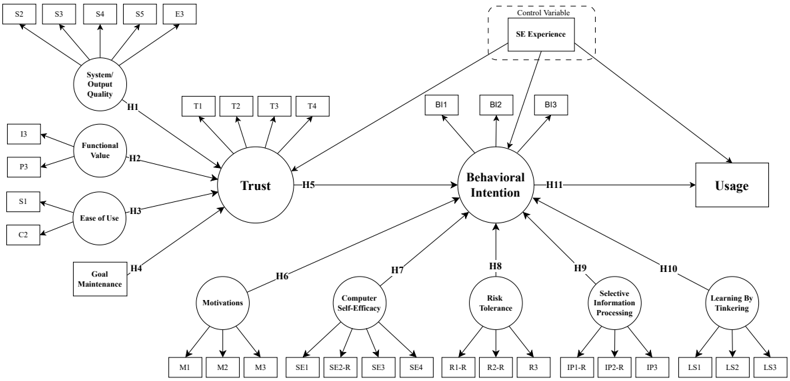
Generative AI (genAI) tools promise productivity gains, yet miscalibrated trust and usage friction still hinder adoption. Moreover, genAI can be exclusionary, failing to adequately support diverse users. One such aspect of diversity is cognitive diversity, which leads to diverging interaction styles (e.g., a risk-averse developer may gate genAI outputs behind tests/review; a risk-tolerant one may prototype directly/fix issues post-hoc). When an individual's cognitive styles are unsupported, it creates additional usability barriers. Thus, to design tools that developers trust and use, we must first understand which factors shape their trust and intentions to use genAI at work? We developed a theoretical model of developers' trust and adoption of genAI through a large-scale survey (N = 238) conducted at GitHub and Microsoft. Using Partial Least Squares-Structural Equation Modeling (PLS-SEM), we found aspects related to genAI's system/output quality (e.g., presentation, safety/security, performance), functional value (e.g., educational/practical benefits), and goal maintenance (ability to sustain alignment with task goals) significantly influence trust, which, alongside developers' cognitive styles (i.e., risk tolerance, technophilic motivations, computer self-efficacy), affect adoption. An Importance-Performance Matrix Analysis (IPMA) identified high-importance factors where genAI underperforms, revealing targets for design improvement. We bolster these findings by qualitatively analyzing developers' reported challenges and risks of genAI use to uncover why these gaps persist in development contexts. We offer practical guidance for designing genAI tools that support effective, trustworthy, and inclusive developer-AI interactions.
Overview
CoChat Summary
TL;DR
This mixed-methods study models developers’ trust in and adoption of generative AI using survey data from 238 developers at GitHub and Microsoft. It finds that system/output quality, functional value, and goal maintenance shape trust, while trust and cognitive styles predict adoption; IPMA identifies goal maintenance and system/output quality as high-importance but underperforming areas.
Key findings
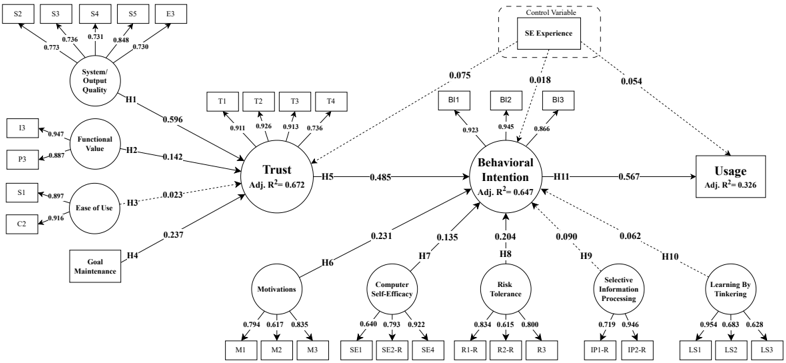
- Trust was significantly associated with System/Output Quality (H1: B=0.60, p=0.000, f²=0.46), Functional Value (H2: B=0.14, p=0.029, f²=0.17), and Goal Maintenance (H4: B=0.24, p=0.002, f²=0.19); Ease of Use was not supported (H3: p=0.588).
- Behavioral intention was significantly associated with Trust (H5: B=0.49, p=0.000), Technophilic Motivations (H6: B=0.23, p=0.005), Computer Self-Efficacy (H7: B=0.14, p=0.012), and Risk Tolerance (H8: B=0.20, p=0.001); Selective Information Processing (H9: p=0.065) and Learning by Tinkering (H10: p=0.331) were not supported. Behavioral intention predicted Usage (H11: B=0.57, p=0.000). Model R² was 0.68 for Trust, 0.66 for Behavioral Intention, and 0.33 for Usage.
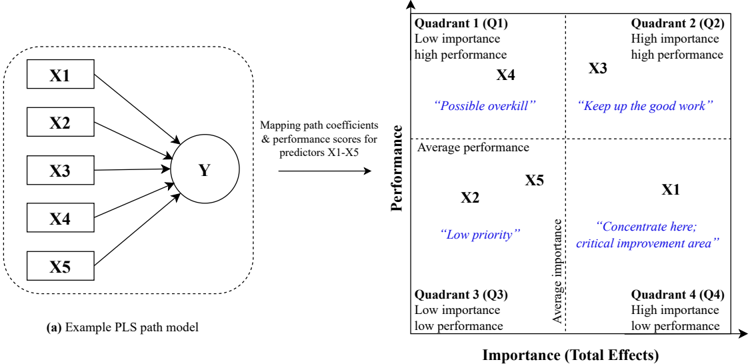
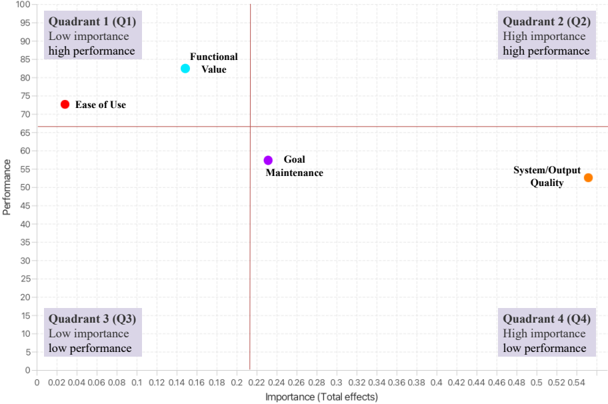
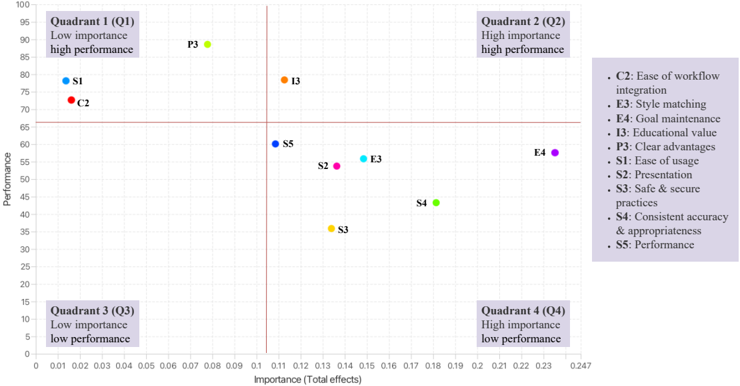
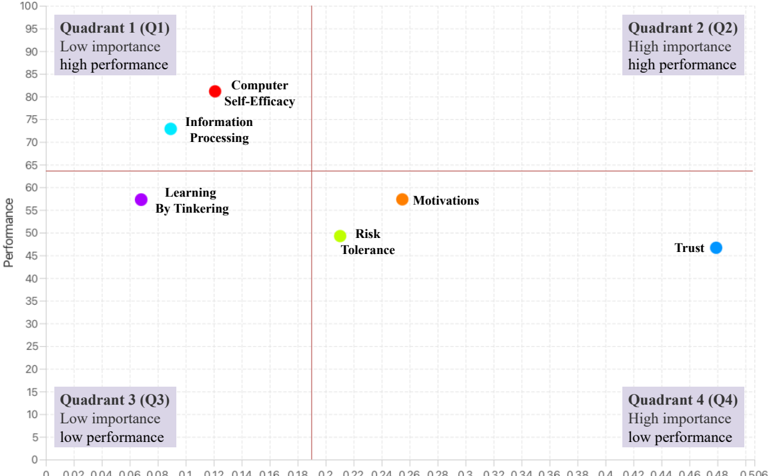
- IPMA for trust placed System/Output Quality and Goal Maintenance in Quadrant 4 (high importance, low performance); indicator-level deficits included Goal Maintenance (E4), consistent accuracy/appropriateness (S4), style matching (E3), presentation (S2), safe/secure practices (S3), and performance (S5). For behavioral intentions, Trust, Risk Tolerance, and Technophilic Motivations fell in Quadrant 4.
- Qualitative analysis explained gaps through misalignment with task objectives, verification burden, high prompting/modification effort, contextual inaccuracy, style mismatches, poor feedback affordances, privacy/security concerns, and weak error handling; risk tolerance was tied to concerns about genAI-induced technical debt, and technophilic motivation faded with accuracy/performance gaps and interaction friction.
Methods
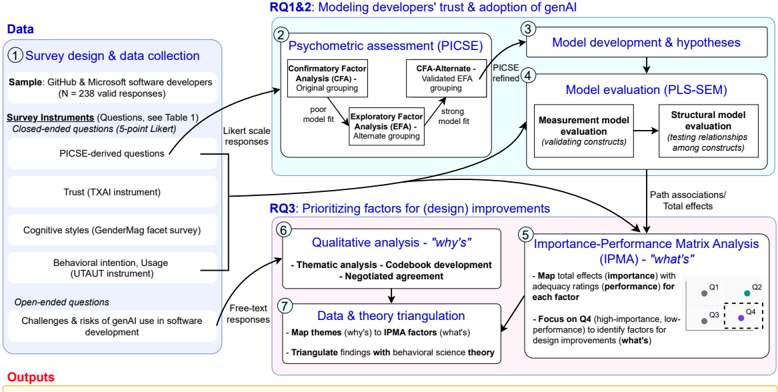
- Concurrent embedded mixed-methods design with a dominant quantitative strand. Survey administered at GitHub Inc. and Microsoft; 343 responses received, 238 valid after exclusions. Instruments included TXAI for trust, PICSE-derived questions, GenderMag facet survey for cognitive styles, and UTAUT for behavioral intention/usage; closed-ended items used 5-point Likert scales.
- PLS-SEM in SmartPLS 4 with measurement and structural model evaluation, bootstrapping with 5,000 subsamples; power analysis indicated minimum sample size of 95. IPMA compared each factor’s importance (total effect) with performance (mean latent scores).
- Qualitative reflexive thematic analysis of free-text responses: 228 challenge responses and 221 risk responses received; 386 retained after exclusions (206 challenges, 180 risks), then mapped to IPMA results and triangulated with behavioral-science theory.
Limitations
- Stated: cross-sectional design tests associations, not causal relationships; self-selection bias is possible; the model cannot capture an exhaustive list of factors; trust is context-dependent; data came from a single anonymous survey round without follow-up; findings rely on self-reported perceptions; sample from GitHub and Microsoft may limit generalizability to smaller organizations, open-source contributors, or non-corporate settings; the study aims for theoretical rather than statistical generalizability.
- Evident from the text: the sample was mostly men (78.2%) and from North America (54.2%); genAI familiarity and gender were excluded as controls due to skewed distributions; the study is tool-agnostic and does not provide longitudinal evidence on how trust and adoption evolve.
Model-written summary. Check it against the paper before relying on it.
Integrity signals
Registry
Cites
Statistics
Figures
Verification
Claims the paper makes
0 Valid · 1 Not valid · 93 Not checked · 166 Own results and interpretations
A result the paper reports from its own data — it cites no other source for it, so there is none to check. The quote shows it is in the paper.
In the paper
“We bolster these findings by qualitatively analyzing developers' reported challenges and risks of genAI use to uncover why these gaps persist in development contexts.”
plainstates a cause- Asserted: passes — The authors put it forward as true.
- Checkable: passes — It can be checked against evidence.
- Load-bearing: passes — The paper’s conclusions depend on it.
- Based: passes — The paper gives a reason why it holds.
- Rests on an assumption not shown here.
A result the paper reports from its own data — it cites no other source for it, so there is none to check. The quote shows it is in the paper.
In the paper
“which, alongside developers' cognitive styles (i.e., risk tolerance, technophilic motivations, computer self-efficacy), affect adoption.”
- Also stated in: § 1 INTRODUCTION · p. 2 · plain
“Further, trust and developers' cognitive styles, such as their diverse attitudes towards risk (averse vs. tolerant), computer self-efficacy (low vs. high efficacy in using emerging tools), and motivations to use technology (task-focused vs. technophilic), are associated with genAI's adoption and reported usage in work.”
plainstates an associationn = 238- Asserted: passes — The authors put it forward as true.
- Checkable: passes — It can be checked against evidence.
- Load-bearing: passes — The paper’s conclusions depend on it.
- Based: passes — The paper gives a reason why it holds.
- Also stated in: § 1 INTRODUCTION · p. 2 · plain
A result the paper reports from its own data — it cites no other source for it, so there is none to check. The quote shows it is in the paper.
In the paper
“Wedeveloped a theoretical model of developers' trust and adoption of genAI through a large-scale survey (N = 238) conducted at GitHub and Microsoft.”
- Also stated in: § 1 INTRODUCTION · p. 2 · plain
“We evaluated the model using Partial Least Squares-Structural Equation Modeling (PLS-SEM) on survey data from developers (N = 238) at two major tech organizations: GitHub Inc. and Microsoft.”
plainn = 238- Asserted: passes — The authors put it forward as true.
- Checkable: passes — It can be checked against evidence.
- Load-bearing: passes — The paper’s conclusions depend on it.
- Based: passes — The paper gives a reason why it holds.
- Also stated in: § 1 INTRODUCTION · p. 2 · plain
A result the paper reports from its own data — it cites no other source for it, so there is none to check. The quote shows it is in the paper.
In the paper
“An Importance-Performance Matrix Analysis (IPMA) identified high-importance factors where genAI underperforms, revealing targets for design improvement.”
- Also stated in: § 1 INTRODUCTION · p. 2 · plain
“This surfaces high-influence, lowperformance areas-the specific genAI aspects that most warrant design investment (the 'what's' ).”
plainn = 238- Asserted: passes — The authors put it forward as true.
- Checkable: passes — It can be checked against evidence.
- Load-bearing: passes — The paper’s conclusions depend on it.
- Based: passes — The paper gives a reason why it holds.
- Also stated in: § 1 INTRODUCTION · p. 2 · plain
A result the paper reports from its own data — it cites no other source for it, so there is none to check. The quote shows it is in the paper.
In the paper
“Using Partial Least Squares-Structural Equation Modeling (PLS-SEM), we found aspects related to genAI's system/output quality (e.g., presentation, safety/security, performance), functional value (e.g., educational/practical benefits), and goal maintenance (ability to sustain alignment with task goals) significantly influence trust”
plainstates a causen = 238- Asserted: passes — The authors put it forward as true.
- Checkable: passes — It can be checked against evidence.
- Load-bearing: passes — The paper’s conclusions depend on it.
- Based: passes — The paper gives a reason why it holds.
99 more claims
Create a free account to see all 260 claims and to verify the 152 references still open.
- It may state two separate claims as one. 103
- Probably not a substantial claim. 84
- The quote only partly states this claim. 5
Self-check
Percentages, sums and reported differences re-computed from the paper’s own numbers.
Each contradiction between two passages listed here was confirmed by an independent check.
Rated minor: it would not touch a result — a value no result rests on, a p-value that stays on the same side of the significance level, or a conflict that is clerical, resolved elsewhere in the paper, or outside its own findings.
In the paper
§ 4.3 Model evaluation and results · p. 13
“The acceptable range for these values is between .7 and .9 [56]. As shown in Table 5, all constructs satisfied these criteria, confirming the reliability of its indicators.”
§ 4.3 Model evaluation and results · p. 12
“| Behavioral intention | 0.827 | 0.831 | 0.920 | 0.851 |”
Citations
Cites
Podsakoff, P. M., MacKenzie, S. B., Lee, J.-Y., & Podsakoff, N. P. (2003) · Journal of Applied Psychology · doi:10.1037/0021-9010.88.5.879 · Cited by 82,194
A new criterion for assessing discriminant validity in variance-based structural equation modeling
Henseler, J., Ringle, C. M., & Sarstedt, M. (2015) · Journal of the Academy of Marketing Science · doi:10.1007/s11747-014-0403-8 · Cited by 38,459
Statistical power analyses using G∗Power 3.1: tests for correlation and regression analyses
Faul, F., Erdfelder, E., Buchner, A., & Lang, A.-G. (2009) · Behavior Research Methods · doi:10.3758/brm.41.4.1149 · Cited by 37,615
When to Use and How to Report the Results of PLS-SEM
Hair, J. F., Risher, J. J., Sarstedt, M., & Ringle, C. M. (2019) · European Business Review · doi:10.1108/ebr-11-2018-0203 · Cited by 27,541
A Beginner's Guide to Structural Equation Modeling
Schumacker, R. E., & Lomax, R. G. (2004) · doi:10.4324/9781410610904 · Cited by 6,235
Why we buy what we buy: A theory of consumption values
Sheth, J. N., Newman, B. I., & Gross, B. L. (1991) · Journal of Business Research · doi:10.1016/0148-2963(91)90050-8 · Cited by 4,930
The American Customer Satisfaction Index: Nature, Purpose, and Findings
Fornell, C., Johnson, M. D., Anderson, E. W., Cha, J., & Bryant, B. E. (1996) · Journal of Marketing · doi:10.2307/1251898 · Cited by 4,736
Conceptual and design thinking for thematic analysis.
Braun, V., & Clarke, V. (2022) · Qualitative Psychology · doi:10.1037/qup0000196 · Cited by 4,502
Importance-Performance Analysis
Martilla, J. A., & James, J. C. (1977) · Journal of Marketing · doi:10.1177/002224297704100112 · Cited by 4,284
The Predictive Validity of Multiple-Item versus Single-Item Measures of the Same Constructs
Bergkvist, L., & Rossiter, J. R. (2007) · Journal of Marketing Research · doi:10.1509/jmkr.44.2.175 · Cited by 3,107
Research works printed but not linked: 91
- [3][3] Arshin Adib-Moghaddam. 2023. Is Artificial Intelligence Racist?: The Ethics of AI and the Future of Humanity . Bloomsbury Publishing. -
- [4][4] Saleema Amershi, Dan Weld, Mihaela Vorvoreanu, Adam Fourney, Besmira Nushi, Penny Collisson, Jina Suh, Shamsi Iqbal, Paul N Bennett, Kori Inkpen, et al. 2019. Guidelines for human-AI interaction. In 2019 CHI Conference on Human Factors in Computing Systems . 1-13. -
- [5][5] Andrew Anderson, Tianyi Li, Mihaela Vorvoreanu, and Margaret Burnett. 2021. Diverse Humans and Human-AI Interaction: What Cognitive Style Disaggregation Reveals. arXiv preprint arXiv:2108.00588 (2021). - · arXiv
- [9][9] Albert Bandura. 1997. Self-efficacy the exercise of control. New York: H. Freeman & Co. Student Success 333 (1997), 48461. -
- [12][12] Laura Beckwith and Margaret Burnett. 2004. Gender: An important factor in end-user programming environments?. In 2004 IEEE symposium on visual languages-human centric computing . IEEE, 107-114. -
- [13][13] Alan F Blackwell. 2002. First steps in programming: A rationale for attention investment models. In Proceedings IEEE 2002 Symposia on Human Centric Computing Languages and Environments . IEEE, 2-10. -
- [14][14] Jayson G Boubin, Christina F Rusnock, and Jason M Bindewald. 2017. Quantifying compliance and reliance trust behaviors to influence trust in human-automation teams. Human Factors and Ergonomics Society Annual Meeting 61, 1 (2017), 750-754. -
- [15][15] Josiah D Boucher, Gillian Smith, and Yunus Doğan Telliel. 2024. Is resistance futile?: Early career game developers, generative ai, and ethical skepticism. In Proceedings of the 2024 CHI Conference on Human Factors in Computing Systems . 1-13. -
- [16][16] Virginia Braun and Victoria Clark. 2006. Using thematic analysis in psychology. Qualitative research in psychology 3, 2 (2006), 77-101. -
- [18][18] Adam Brown, Sarah D'Angelo, Ambar Murillo, Ciera Jaspan, and Collin Green. 2024. Identifying the factors that influence trust in AI code completion. In Proceedings of the 1st ACM International Conference on AI-Powered Software . 1-9. -
- [20][20] Jenna Butler, Jina Suh, Sankeerti Haniyur, and Constance Hadley. 2025. Dear Diary: A randomized controlled trial of Generative AI coding tools in the workplace. In 2025 IEEE/ACM 47th International Conference on Software Engineering: Software Engineering in Practice (ICSE-SEIP) . IEEE, 319-329. -
- [21][21] James P Byrnes, David C Miller, and William D Schafer. 1999. Gender differences in risk taking: A meta-analysis. Psychological bulletin 125, 3 (1999), 367. -
- [25][25] Valerie Chen, Q Vera Liao, Jennifer Wortman Vaughan, and Gagan Bansal. 2023. Understanding the role of human intuition on reliance in human-AI decision-making with explanations. Proceedings of the ACM on Human-computer Interaction 7, CSCW2 (2023), 1-32. -
- [26][26] Ruijia Cheng, Ruotong Wang, Thomas Zimmermann, and Denae Ford. 2023. 'It would work for me too': How Online Communities Shape Software Developers' Trust in AI-Powered Code Generation Tools. ACM Transactions on Interactive Intelligent Systems (2023). -
- [27][27] Wynne W Chin et al. 1998. The partial least squares approach to structural equation modeling. Modern methods for business research 295, 2 (1998), 295-336. -
- [28][28] Rudrajit Choudhuri, Carmen Badea, Christian Bird, Jenna Butler, Rob DeLine, and Brian Houck. 2025. AI Where It Matters: Where, Why, and How Developers Want AI Support in Daily Work. arXiv preprint arXiv:2510.00762 (2025). - · arXiv
- [29][29] Rudrajit Choudhuri, Dylan Liu, Igor Steinmacher, Marco Gerosa, and Anita Sarma. 2024. How far are we? the triumphs and trials of generative ai in learning software engineering. In Proceedings of the IEEE/ACM 46th international conference on software engineering . 1-13. -
- [31][31] Wing S Chow and Lai Sheung Chan. 2008. Social network, social trust and shared goals in organizational knowledge sharing. Information & management 45, 7 (2008), 458-465. -
- [32][32] Jacob Cohen. 2013. Statistical power analysis for the behavioral sciences . Routledge. -
- [33][33] Deborah R Compeau and Christopher A Higgins. 1995. Computer self-efficacy: Development of a measure and initial test. MIS quarterly (1995), 189-211. -
- [36][36] Mihaly Csikszentmihalyi and Mihaly Csikzentmihaly. 1990. Flow: The psychology of optimal experience . Vol. 1990. Harper & Row New York. -
- [38][38] Edward L Deci and Richard M Ryan. 2012. Self-determination theory. Handbook of theories of social psychology 1, 20 (2012), 416-436. -
- [41][41] Virginia Eubanks. 2018. Automating inequality: How high-tech tools profile, police, and punish the poor . St. Martin's Press. -
- [47][47] David Gefen, Elena Karahanna, and Detmar W Straub. 2003. Trust and TAM in online shopping: An integrated model. MIS quarterly (2003), 51-90. -
- [49][49] Ella Glikson and Anita Williams Woolley. 2020. Human trust in artificial intelligence: Review of empirical research. Academy of management annals 14, 2 (2020), 627-660. -
- [51][51] Ben Green and Yiling Chen. 2019. Disparate interactions: An algorithm-in-the-loop analysis of fairness in risk assessments. In Conference on fairness, accountability, and transparency . 90-99. -
- [52][52] Thomas Green and Alan Blackwell. 1998. Cognitive dimensions of information artefacts: a tutorial. In Bcs hci conference , Vol. 98. Springer Sheffield, UK, 1-75. -
- [53][53] Wolfgang L Grichting. 1994. The meaning of 'I Don't Know' in opinion surveys: Indifference versus ignorance. Aust Psychol 29, 1 (1994). -
- [54][54] Lars Grønholdt, Anne Martensen, Stig Jørgensen, and Peter Jensen. 2015. Customer experience management and business performance. International journal of quality and service sciences 7, 1 (2015), 90-106. -
- [58][58] Md Montaser Hamid, Fatima Moussaoui, Jimena Noa Guevara, Andrew Anderson, and Margaret Burnett. 2024. Improving User Mental Models of XAI Systems with Inclusive Design Approaches. arXiv preprint arXiv:2404.13217 (2024). - · arXiv
- [59][59] Donna Harrington. 2009. Confirmatory factor analysis . Oxford university press. -
- [61][61] Jörg Henseler, Geoffrey Hubona, and Pauline Ash Ray. 2016. Using PLS path modeling in new technology research: updated guidelines. Industrial management & data systems 116, 1 (2016), 2-20. -
- [63][63] Claudia Hock, Christian M Ringle, and Marko Sarstedt. 2010. Management of multi-purpose stadiums: Importance and performance measurement of service interfaces. International journal of services technology and management 14, 2-3 (2010), 188-207. -
- [64][64] Kevin Anthony Hoff and Masooda Bashir. 2015. Trust in automation: Integrating empirical evidence on factors that influence trust. Human factors 57, 3 (2015), 407-434. -
- [67][67] Md Naimul Hoque, Tasfia Mashiat, Bhavya Ghai, Cecilia D Shelton, Fanny Chevalier, Kari Kraus, and Niklas Elmqvist. 2024. The HaLLMark effect: Supporting provenance and transparent use of large language models in writing with interactive visualization. In Proceedings of the 2024 CHI Conference on Human Factors in Computing Systems . 1-15. -
- [69][69] Matt C Howard. 2016. A review of exploratory factor analysis decisions and overview of current practices: What we are doing and how can we improve? International journal of human-computer interaction 32, 1 (2016), 51-62. -
- [70][70] Li-tze Hu and Peter M Bentler. 1999. Cutoff criteria for fit indexes in covariance structure analysis: Conventional criteria versus new alternatives. Structural equation modeling: a multidisciplinary journal 6, 1 (1999), 1-55. -
- [71][71] Edwin Hutchins. 2020. The distributed cognition perspective on human interaction. In Roots of human sociality . Routledge, 375-398. -
- [72][72] Alon Jacovi, Ana Marasović, Tim Miller, and Yoav Goldberg. 2021. Formalizing trust in artificial intelligence: Prerequisites, causes and goals of human trust in AI. In Proceedings of the 2021 ACM conference on fairness, accountability, and transparency . 624-635. -
- [74][74] Jiun-Yin Jian, Ann M Bisantz, and Colin G Drury. 2000. Foundations for an empirically determined scale of trust in automated systems. International journal of cognitive ergonomics 4, 1 (2000), 53-71. -
- [78][78] Barbara A Kitchenham and Shari L Pfleeger. 2008. Personal opinion surveys. In Guide to advanced empirical software engineering . Springer, 63-92. -
- [79][79] Amy J Ko, Robert DeLine, and Gina Venolia. 2007. Information needs in collocated software development teams. In 29th International Conference on Software Engineering (ICSE'07) . IEEE, 344-353. -
- [80][80] Rafal Kocielnik, Saleema Amershi, and Paul N Bennett. 2019. Will you accept an imperfect ai? exploring designs for adjusting end-user expectations of ai systems. In Proceedings of the 2019 CHI conference on human factors in computing systems . 1-14. -
- [81][81] Ned Kock. 2014. Advanced mediating effects tests, multi-group analyses, and measurement model assessments in PLS-based SEM. International Journal of e-Collaboration 10, 1 (2014). -
- [82][82] Ned Kock. 2015. Common method bias in PLS-SEM: A full collinearity assessment approach. International Journal of - e-Collaboration (ijec) 11, 4 (2015), 1-10. -
- [83][83] Joseph Lawrance, Christopher Bogart, Margaret Burnett, Rachel Bellamy, Kyle Rector, and Scott D Fleming. 2010. How programmers debug, revisited: An information foraging theory perspective. IEEE Transactions on Software Engineering 39, 2 (2010), 197-215. -
- [84][84] Hao-Ping Lee, Advait Sarkar, Lev Tankelevitch, Ian Drosos, Sean Rintel, Richard Banks, and Nicholas Wilson. 2025. The impact of generative AI on critical thinking: Self-reported reductions in cognitive effort and confidence effects from a survey of knowledge workers. In Proceedings of the 2025 CHI conference on human factors in computing systems . 1-22. -
- [85][85] John D Lee and Katrina A See. 2004. Trust in automation: Designing for appropriate reliance. Human factors 46, 1 (2004), 50-80. -
- [86][86] Tianyi Li, Mihaela Vorvoreanu, Derek DeBellis, and Saleema Amershi. 2023. Assessing human-AI interaction early through factorial surveys: a study on the guidelines for human-AI interaction. ACM Transactions on Computer-Human Interaction 30, 5 (2023), 1-45. -
- [88][88] Jenny T Liang, Chenyang Yang, and Brad A Myers. 2024. A large-scale survey on the usability of ai programming assistants: Successes and challenges. In Proceedings of the 46th IEEE/ACM International Conference on Software Engineering . 1-13. -
- [90][90] Michael Xieyang Liu, Advait Sarkar, Carina Negreanu, Benjamin Zorn, Jack Williams, Neil Toronto, and Andrew D Gordon. 2023. 'What it wants me to say': Bridging the abstraction gap between end-user programmers and codegenerating large language models. In Proceedings of the 2023 CHI Conference on Human Factors in Computing Systems . 1-31. -
- [92][92] Maria Madsen and Shirley Gregor. 2000. Measuring human-computer trust. In 11th australasian conference on information systems , Vol. 53. Citeseer, 6-8. -
- [93][93] Georgios Makridis, Georgios Fatouros, Athanasios Kiourtis, Dimitrios Kotios, Vasileios Koukos, Dimosthenis Kyriazis, and Jonh Soldatos. 2023. Towards a unified multidimensional explainability metric: Evaluating trustworthiness in ai models. In 2023 19th International Conference on Distributed Computing in Smart Systems and the Internet of Things (DCOSS-IoT) . IEEE, 504-511. -
- [95][95] Nora McDonald, Sarita Schoenebeck, and Andrea Forte. 2019. Reliability and inter-rater reliability in qualitative research: Norms and guidelines for CSCW and HCI practice. Proceedings of the ACM on human-computer interaction 3, CSCW (2019), 1-23. -
- [97][97] D Harrison McKnight, Vivek Choudhury, and Charles Kacmar. 2002. Developing and validating trust measures for e-commerce: An integrative typology. Information systems research 13, 3 (2002), 334-359. -
- [99][99] Samuel Messick. 1984. The nature of cognitive styles: Problems and promise in educational practice. Educational psychologist 19, 2 (1984), 59-74. -
- [101][101] Emerson Murphy-Hill, Alberto Elizondo, Ambar Murillo, Marian Harbach, Bogdan Vasilescu, Delphine Carlson, and Florian Dessloch. 2024. GenderMag Improves Discoverability in the Field, Especially for Women. In 2024 IEEE/ACM 46th International Conference on Software Engineering (ICSE) . IEEE Computer Society, 2333-2344. -
- [102][102] Donald A Norman. 1999. Affordance, conventions, and design. interactions 6, 3 (1999), 38-43. -
- [105][105] Heather Lynn O'Brien. 2010. The influence of hedonic and utilitarian motivations on user engagement: The case of online shopping experiences. Interacting with computers 22, 5 (2010), 344-352. -
- [106][106] Elise Paradis, Kate Grey, Quinn Madison, Daye Nam, Andrew Macvean, Vahid Meimand, Nan Zhang, Ben FerrariChurch, and Satish Chandra. 2025. How much does AI impact development speed? An enterprise-based randomized controlled trial. In 2025 IEEE/ACM 47th International Conference on Software Engineering: Software Engineering in Practice (ICSE-SEIP) . IEEE, 618-629. -
- [107][107] Raja Parasuraman and Dietrich H Manzey. 2010. Complacency and bias in human use of automation: An attentional integration. Human factors 52, 3 (2010), 381-410. -
- [108][108] Hammond Pearce, Baleegh Ahmad, Benjamin Tan, Brendan Dolan-Gavitt, and Ramesh Karri. 2022. Asleep at the keyboard? assessing the security of GitHub copilot's code contributions. In 2022 IEEE Symposium on Security and Privacy (SP) . IEEE, 754-768. -
- [113][113] Tenko Raykov and George A Marcoulides. 2011. Introduction to psychometric theory . Routledge. -
- [114][114] Richard Riding and Indra Cheema. 1991. Cognitive styles-an overview and integration. Educational psychology 11, 3-4 (1991), 193-215. -
- [115][115] Christian M Ringle and Marko Sarstedt. 2016. Gain more insight from your PLS-SEM results: The importanceperformance map analysis. Industrial management & data systems 116, 9 (2016), 1865-1886. -
- [116][116] Daniel Russo. 2024. Navigating the complexity of generative AI adoption in software engineering. ACM Transactions on Software Engineering and Methodology (2024). -
- [117][117] Daniel Russo and Klaas-Jan Stol. 2021. PLS-SEM for Software Engineering Research: An Introduction and Survey. ACM Comput Surv 54, 4 (2021). -
- [119][119] Marko Sarstedt, Christian M Ringle, and Joseph F Hair. 2017. Treating unobserved heterogeneity in PLS-SEM: A multi-method approach. In Partial least squares path modeling . Springer, 197-217. -
- [122][122] Abigail Sellen and Eric Horvitz. 2023. The rise of the AI Co-Pilot: Lessons for design from aviation and beyond. Commun. ACM (2023). -
- [124][124] Galit Shmueli, Soumya Ray, Juan Manuel Velasquez Estrada, and Suneel Babu Chatla. 2016. The elephant in the room: Predictive performance of PLS models. Journal of business Research 69, 10 (2016), 4552-4564. -
- [126][126] Jonathan Sillito, Gail C Murphy, and Kris De Volder. 2008. Asking and answering questions during a programming change task. IEEE Transactions on Software Engineering 34, 4 (2008), 434-451. -
- [128][128] Robert J Sternberg and Elena L Grigorenko. 1997. Are cognitive styles still in style? American psychologist 52, 7 (1997), 700. -
- [129][129] Klaas-Jan Stol and Brian Fitzgerald. 2018. The ABC of software engineering research. ACM TOSEM 27, 3 (2018). -
- [131][131] Hari Subramonyam, Roy Pea, Christopher Pondoc, Maneesh Agrawala, and Colleen Seifert. 2024. Bridging the gulf of envisioning: Cognitive challenges in prompt based interactions with llms. In Proceedings of the 2024 CHI Conference on Human Factors in Computing Systems . 1-19. -
- [132][132] Sangho Suh, Bryan Min, Srishti Palani, and Haijun Xia. 2023. Sensecape: Enabling multilevel exploration and sensemaking with large language models. In Proceedings of the 36th annual ACM symposium on user interface software and technology . 1-18. -
- [133][133] Lev Tankelevitch, Viktor Kewenig, Auste Simkute, Ava Elizabeth Scott, Advait Sarkar, Abigail Sellen, and Sean Rintel. 2024. The metacognitive demands and opportunities of generative AI. In CHI Conference on Human Factors in Computing Systems . 1-24. -
- [134][134] Bianca Trinkenreich, Klaas-Jan Stol, Anita Sarma, Daniel M German, Marco A Gerosa, and Igor Steinmacher. 2023. Do i belong? modeling sense of virtual community among linux kernel contributors. In 2023 IEEE/ACM 45th International Conference on Software Engineering (ICSE) . IEEE, 319-331. -
- [136][136] Lisa van der Werff, Alison Legood, Finian Buckley, Antoinette Weibel, and David de Cremer. 2019. Trust motivation: The self-regulatory processes underlying trust decisions. Organizational Psychology Review 9, 2-3 (2019), 99-123. -
- [137][137] Viswanath Venkatesh and Fred D Davis. 2000. A theoretical extension of the technology acceptance model: Four longitudinal field studies. Management science 46, 2 (2000), 186-204. -
- [138][138] Viswanath Venkatesh, Michael G Morris, Gordon B Davis, and Fred D Davis. 2003. User acceptance of information technology: Toward a unified view. MIS quarterly (2003), 425-478. -
- [139][139] Viswanath Venkatesh, James YL Thong, and Xin Xu. 2012. Consumer acceptance and use of information technology: extending the unified theory of acceptance and use of technology. MIS quarterly (2012), 157-178. -
- [141][141] Iris Vessey and Dennis Galletta. 1991. Cognitive fit: An empirical study of information acquisition. Information systems research 2, 1 (1991), 63-84. -
- [142][142] Mihaela Vorvoreanu, Lingyi Zhang, Yun-Han Huang, Claudia Hilderbrand, Zoe Steine-Hanson, and Margaret Burnett. 2019. From gender biases to gender-inclusive design: An empirical investigation. In Proceedings of the 2019 CHI Conference on human factors in computing systems . 1-14. -
- [144][144] Weiyu Wang and Keng Siau. 2019. Artificial intelligence, machine learning, automation, robotics, future of work and future of humanity: A review and research agenda. Journal of Database Management (JDM) 30, 1 (2019), 61-79. -
- [146][146] Justin D Weisz, Michael Muller, Steven I Ross, Fernando Martinez, Stephanie Houde, Mayank Agarwal, Kartik Talamadupula, and John T Richards. 2022. Better together? an evaluation of AI-supported code translation. In 27th International conference on intelligent user interfaces . 369-391. -
- [147][147] Allan Wigfield and Jacquelynne S Eccles. 2000. Expectancy-value theory of achievement motivation. Contemporary educational psychology 25, 1 (2000), 68-81. -
- [148][148] Magdalena Wischnewski, Nicole Krämer, and Emmanuel Müller. 2023. Measuring and understanding trust calibrations for automated systems: a survey of the state-of-the-art and future directions. In Proceedings of the 2023 CHI Conference on Human Factors in Computing Systems . 1-16. -
- [149][149] Herman A Witkin and Donald R Goodenough. 1977. Field dependence revisited. ETS Research Bulletin Series 1977, 2 (1977), i-53. -
- [151][151] Shundan Xiao, Jim Witschey, and Emerson Murphy-Hill. 2014. Social influences on secure development tool adoption: why security tools spread. In 17th ACM conference on Computer supported cooperative work & social computing . 1095-1106. -
- [152][152] Kun Yu, Shlomo Berkovsky, Ronnie Taib, Jianlong Zhou, and Fang Chen. 2019. Do i trust my machine teammate? an investigation from perception to decision. In Proceedings of the 24th International Conference on Intelligent User Interfaces . 460-468. -
- [153][153] Albert Ziegler, Eirini Kalliamvakou, X Alice Li, Andrew Rice, Devon Rifkin, Shawn Simister, Ganesh Sittampalam, and Edward Aftandilian. 2024. Measuring GitHub Copilot's Impact on Productivity. Commun. ACM (2024).
Cited by
"Maybe We Need Some More Examples:" Individual and Team Drivers of Developer GenAI Tool Use
Miller, C., Choudhuri, R., Ulloa, M., Haniyur, S., DeLine, R. A., Storey, M.-A., Murphy-Hill, E. R., Bird, C., & Butler, J. (2026) · ACM/IEEE International Conference on Software Engineering: Companion Proceedings (ICSE-Companion) · doi:10.1145/3744916.3773155 · Cited by 15
Self-citationThinking less, trusting more: genAI’s impacts on students’ cognitive habits
Choudhuri, R., Sanchez, C., Burnett, M., & Sarma, A. (2026) · Information and Software Technology · doi:10.1016/j.infsof.2026.108346 · Cited by 10
Self-citationTo Copilot and Beyond: 22 AI Systems Developers Want Built
Choudhuri, R., Bird, C., Badea, C., & Sarma, A. (2026) · IEEE International Conference on Software Maintenance (ICSM) · doi:10.48550/arxiv.2604.07830 · Cited by 9
Self-citationCynthia, S. T., Das, J. K., & Roy, B. (2026) · International Conference on Mining Software Repositories (MSR) · doi:10.1145/3793302.3793377 · Cited by 8
Prompting in Practice: Investigating Software Practitioners' Use of Generative AI ToolsPreprint
Otten, D., Stalnaker, T., Wintersgill, N., Chaparro, O., & Poshyvanyk, D. (2025) · arXiv (Cornell University) · doi:10.48550/arxiv.2510.06000 · Cited by 7
Metadata
- Authors
- Choudhuri, R., Trinkenreich, B., Pandita, R., Kalliamvakou, E., Steinmacher, I., Gerosa, M., Sanchez, C., & Sarma, A.
- Affiliations
- Oregon State University (US)
- Colorado State University (US)
- Northern Arizona University (US)
- ORCID
- Venue
- arXiv
- Publisher
- arXiv
- Published
- 2025
- ISSN
- 1049-331X (ISSN-L)
- arXiv
- 2505.17418
- OpenAlex
- W4416338498
- Cited by
- 14
- References
- 41
- Citations by year
- 2026: 13 · 2025: 1
- FWCI
- 31.56
- Type
- journal article
- Language
- en
- Open access
- green
- arxiv.org
- Licence
- Locations
- ACM Transactions on Software Engineering and Methodology (publishedVersion)
- arXiv (Cornell University) (submittedVersion, cc-by)
- arXiv (Cornell University) (cc-by)
- Funders
- National Science Foundation (2303042, 2247929, 2235601, 2303043, 2236198)
- Topics
- Social Sciences › Decision Sciences › Information Systems and Management › Technology Adoption and User Behaviour
- Physical Sciences › Computer Science › Information Systems › Software Engineering Techniques and Practices
- Physical Sciences › Computer Science › Information Systems › Software Engineering Research
- Keywords
- generative AI, developer trust, artificial intelligence adoption, cognitive style, risk tolerance, computer self-efficacy, AI tool design, goal maintenance, individual differences, importance-performance matrix
About these checks
Registry, retraction, Cites and statistics results are computed, not judged, with one exception: a printed reference that no index lists is read once by a model before it counts as a citation error. Claims are extracted by a model and kept only when their quote appears verbatim in the text; each cited source is then checked, with a model’s help, for whether it says what the claim relies on. Those verdicts can be wrong — read the claim’s quote and the cited source before relying on one.
A language model drew the claims from the paper on 2026-11-14, under version 3 of the claim definition (model deepseek-v4.1-flash, prompt extract-v3).
A second model labelled each claim on 2026-11-14 (model jev-1.13-20260917, definition revision gold-guideline-v0.2).
Statistics and arithmetic are recomputed, not judged.
Confidence bands are shown only for fields calibrated on our annotated test set. None is calibrated yet, so no band is shown.
What counts as a claim ›How we measure confidence ›How we check this ›
Are you an author, or do you see a problem with this page? Request a review
How to cite
Cite CoChat for the checks on this page, and the paper for its own findings.
- This page
- CoChat. (2026). Citation check: What Needs Attention? Prioritizing Drivers of Developers' Trust and Adoption of Generative AI. https://app.cochat.ai/papers/10.48550/arxiv.2505.17418
- The paper
- Choudhuri, R., Trinkenreich, B., Pandita, R., Kalliamvakou, E., Steinmacher, I., Gerosa, M., Sanchez, C., & Sarma, A. (2025). What Needs Attention? Prioritizing Drivers of Developers' Trust and Adoption of Generative AI. arXiv. https://doi.org/10.48550/arxiv.2505.17418
Data sources
Bibliographic data: Semantic Scholar, OpenAlex, Crossref.
Contains information from the Semantic Scholar Academic Graph Datasets, made available under the ODC Attribution License (ODC-BY 1.0).
Semantic Scholar’s data is described in: Kinney, R., et al. (2023). The Semantic Scholar Open Data Platform. arXiv:2301.10140.
