

The DOI matches its DataCite record; 28 of the 28 references it cites were found in a registry or an index; none of the 43 sources its claims cite is checked for support yet.
Generative AI and Organizational Structure in the Knowledge Economy
Open accessAbstract
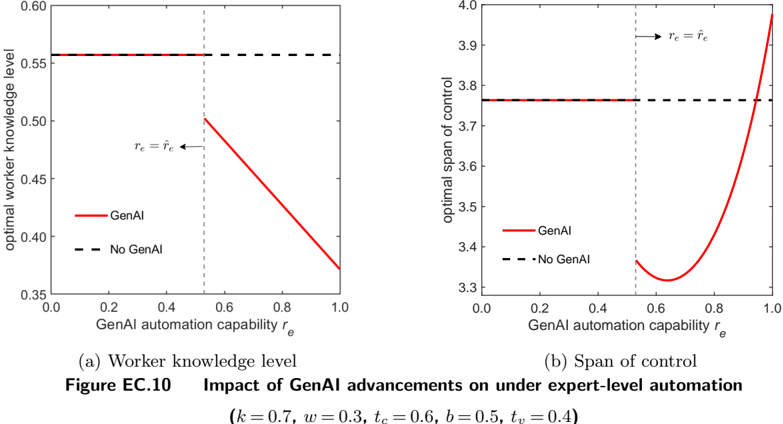
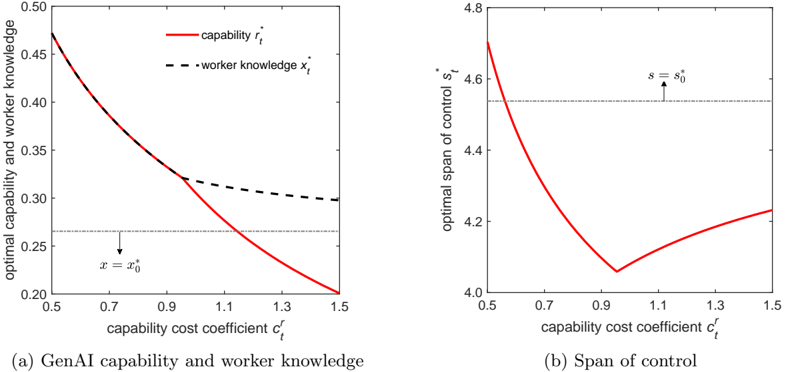
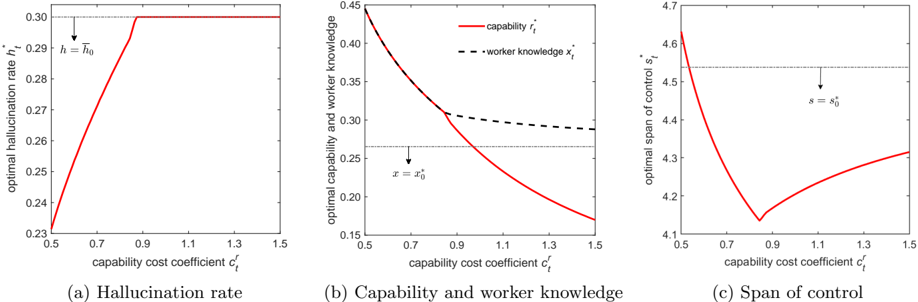
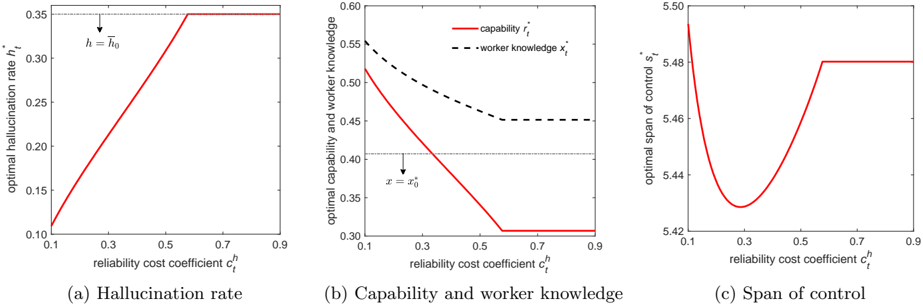
Generative AI (GenAI) is rapidly transforming knowledge work, yet its implications for organizational hierarchies remain poorly understood. Unlike earlier automation technologies, GenAI can both perform tasks autonomously and assist human workers, while its intrinsic fallibility, the tendency to produce confident but incorrect outputs, demands continuous human oversight. We develop a theoretical model to study how GenAI reshapes workforce composition and organizational structure in knowledge-based hierarchies. Our analysis highlights two deployment dimensions, namely mode (automation vs.\ augmentation) and location (worker vs.\ expert layer), which generate a 2X2 design space whose organizational implications are not predicted by traditional technology adoption theories. We obtain three main findings. First, GenAI's effect on entry-level skill requirements is critically mode-dependent. Worker-level automation leads firms to hire fewer but more skilled workers who validate AI outputs and limit costly escalation to experts. Worker-level augmentation, by contrast, expands workers' effective capability, allowing firms to relax entry-level knowledge requirements while sustaining performance. The decline in junior employment documented in recent studies therefore reflects deployment choices favoring automation over augmentation, not an inevitable consequence of GenAI itself. Second, expert-level deployment uniformly lowers entry-level skill requirements, regardless of whether GenAI automates or augments. By expanding experts' capacity to support downstream workers, it enables organizations to employ a broader base of less specialized workers, thereby broadening entry-level access to knowledge work. Third, organizational structure evolves non-monotonically as GenAI improves: across all four deployment architectures, the span of control initially contracts before eventually expanding.
Overview
CoChat Summary
TL;DR
The paper develops a formal knowledge-hierarchy model showing that GenAI’s organizational effects depend on deployment mode (automation vs. augmentation) and location (worker vs. expert layer), not adoption intensity alone. It predicts mode-dependent entry-level skill effects, uniform expert-level deskilling, and a non-monotonic span of control that first contracts and then expands as GenAI improves.
Key findings
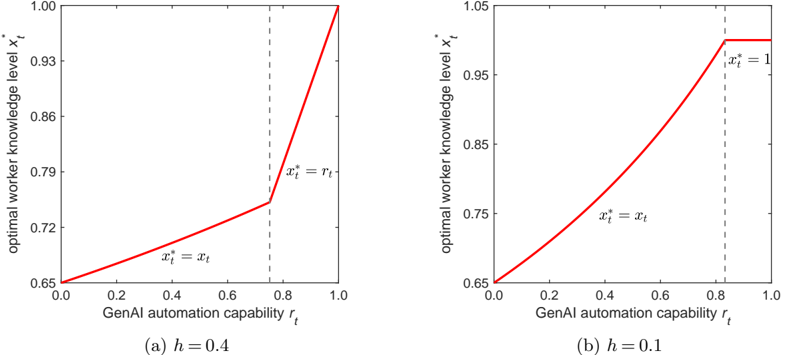
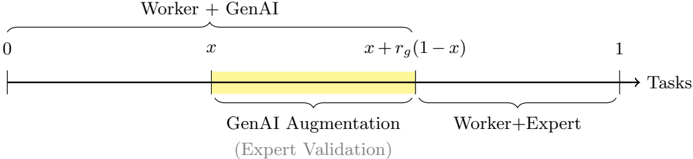
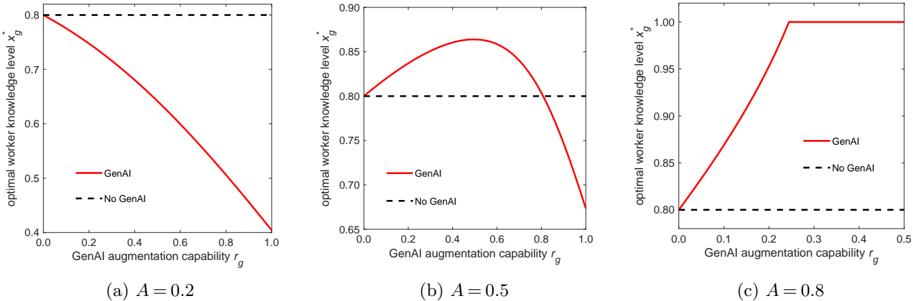
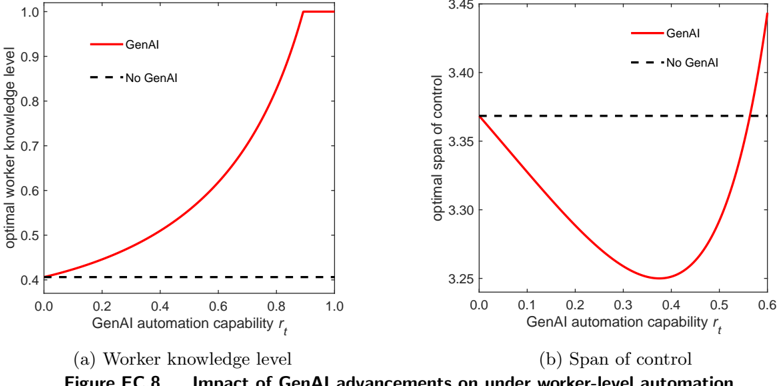
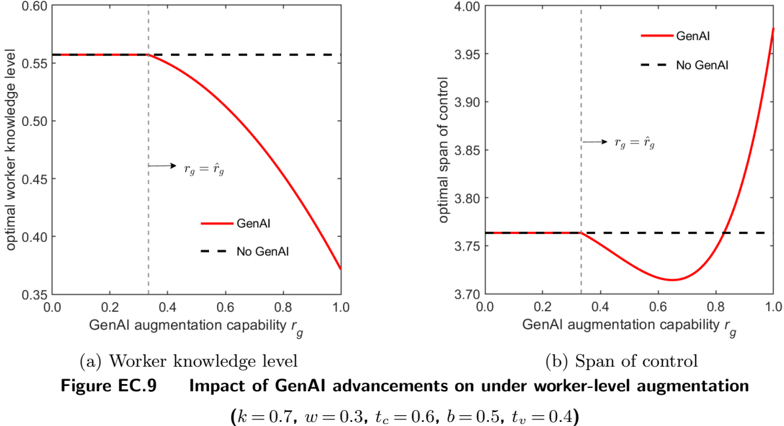
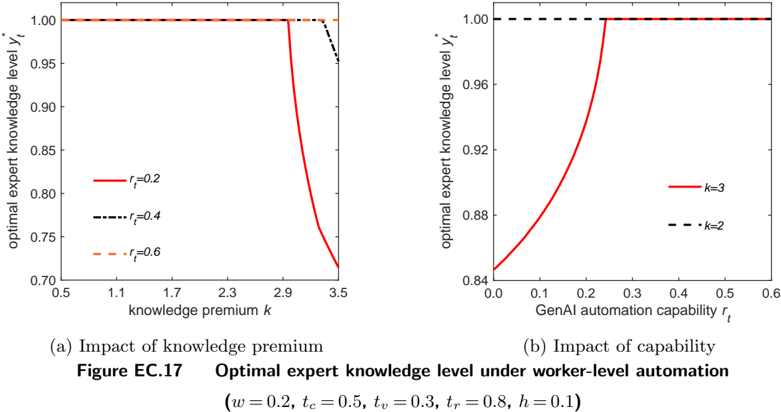
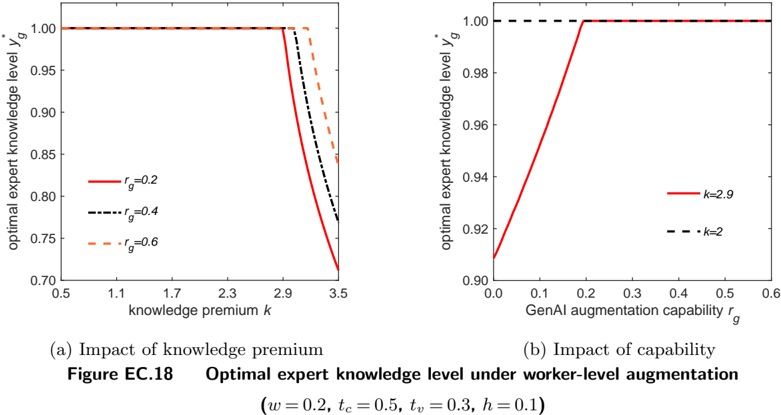
- Worker-level automation upskills entry-level labor: \(x^*_t > x^*_0\), so firms hire fewer but more knowledgeable juniors to validate AI outputs and limit costly escalation. Worker-level augmentation deskills: \(x^*_g < x^*_0\), letting firms relax entry-level knowledge requirements. The paper cites Brynjolfsson et al. (2025a) reporting roughly 13% early-career employment decline in the most AI-exposed occupations and Hosseini and Lichtinger (2025) reporting roughly 9–10% junior employment reduction within six quarters, interpreting these as consistent with automation-tilted deployment rather than an inevitable GenAI effect.
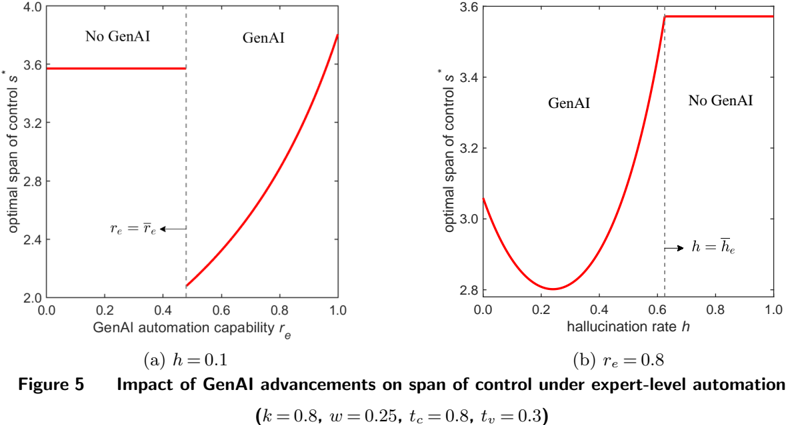
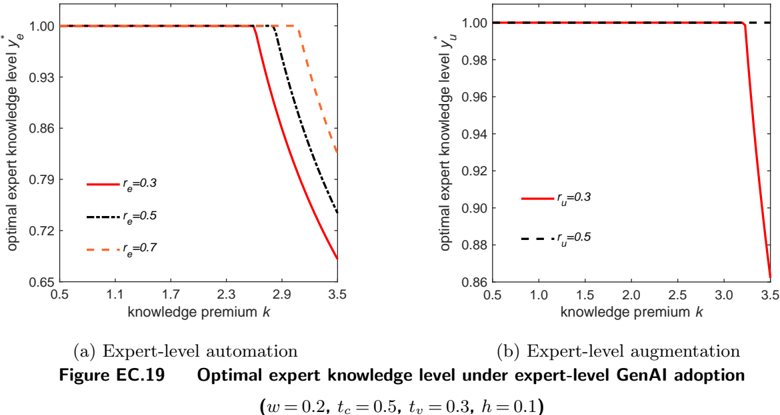
- Expert-level deployment uniformly lowers entry-level skill requirements regardless of mode: \(x^*_e < x^*_0\) under expert-level automation and \(x^*_u < x^*_0\) under expert-level augmentation. Expert-level automation also exhibits post-adoption capability insensitivity: \(x^*_e\) is independent of GenAI’s automation capability \(r_e\).
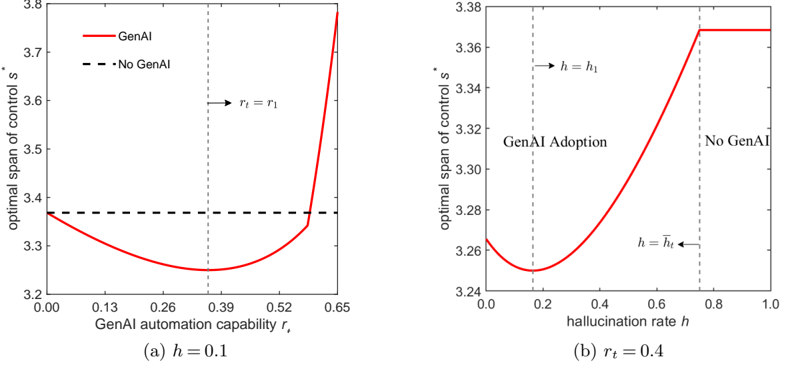
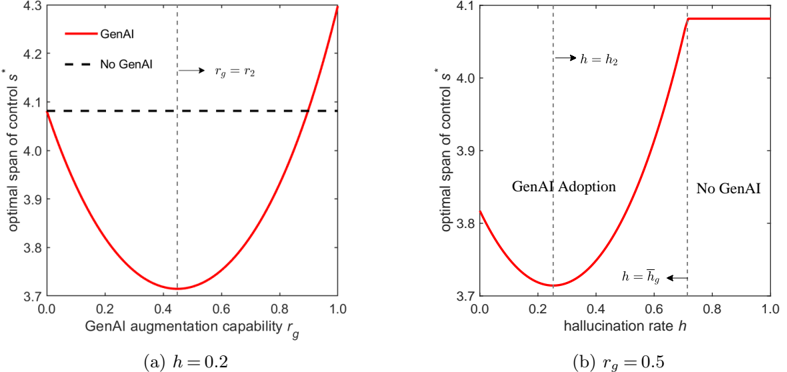
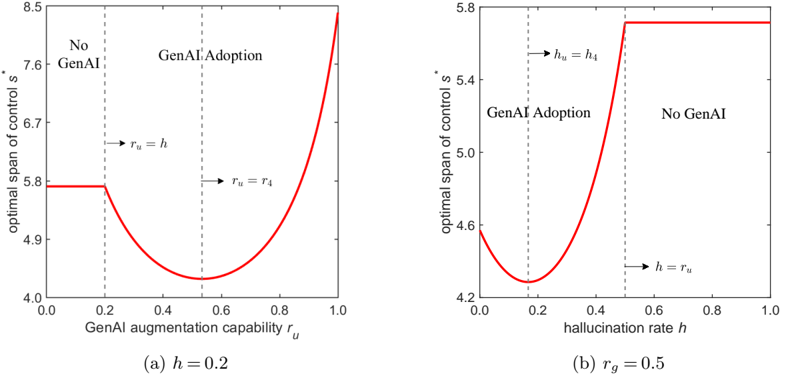
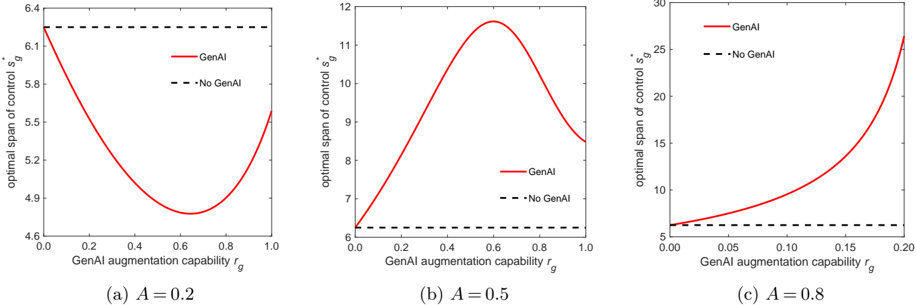
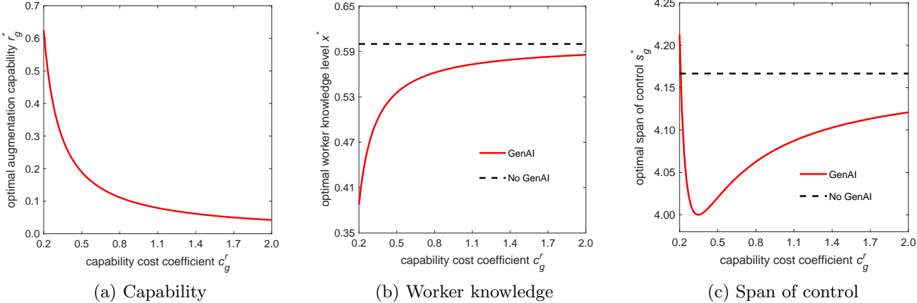
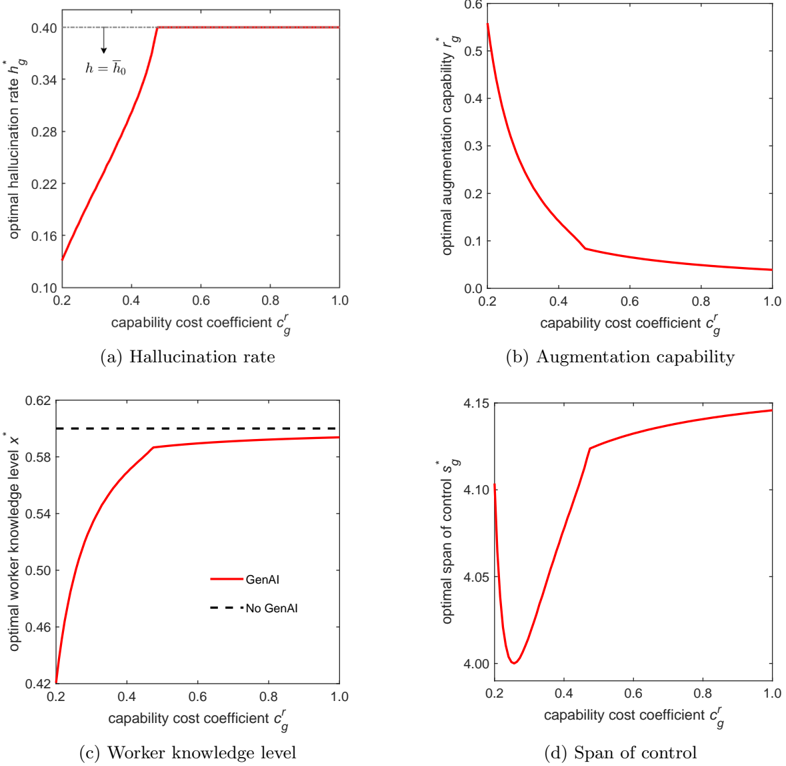
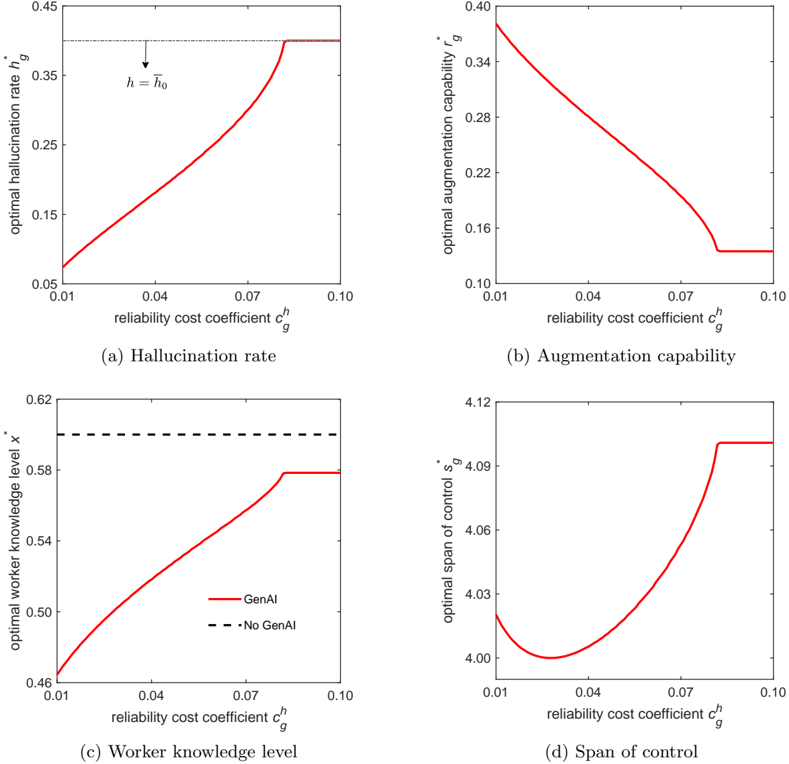
- Across all four deployment architectures, the span of control evolves non-monotonically as GenAI advances: it initially contracts and later expands. This implies demand for senior expertise may remain stable or even rise during early-to-intermediate deployment stages. Under sufficiently capable and reliable worker-level automation, the hierarchy can collapse to a single layer with fully knowledgeable workers (\(x^*_t = 1\)).
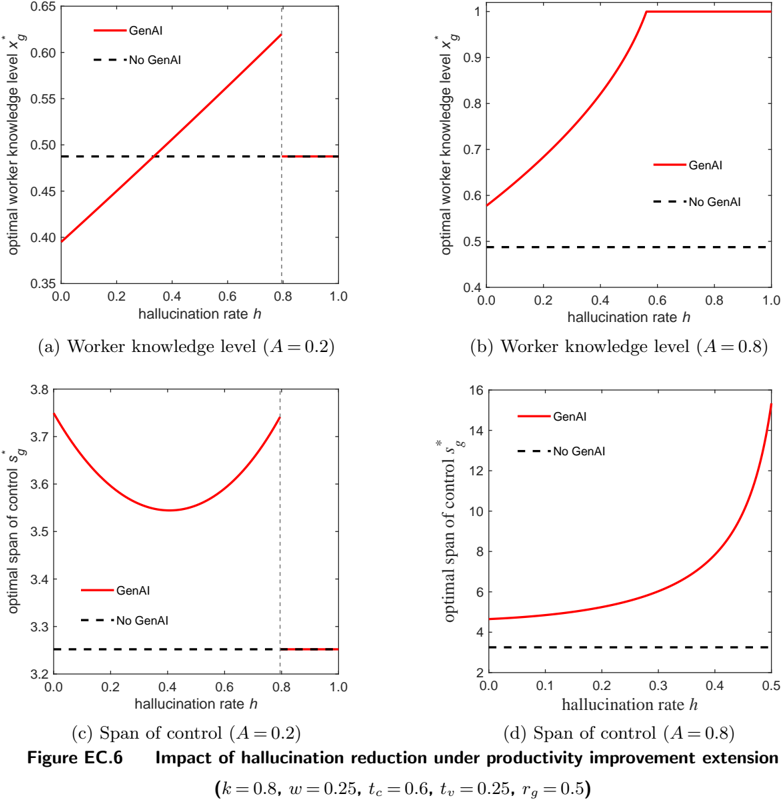
- Adoption conditions differ by architecture: worker-level automation is adopted iff \(h < h_t\); worker-level augmentation iff \(h < h_g = 1 - t_v/t_c\); expert-level automation iff \(h < h_e\) and \(r_e > r_e\); expert-level augmentation iff \(h < r_u\).
Methods
- Formal analytical model building on Garicano (2000): a two-layer knowledge-based hierarchy with junior workers and senior experts, problems uniformly distributed on \([0,1]\), worker knowledge \(x\), expert complete knowledge in the baseline, wage \(w + \frac{1}{2}kx^2\), communication cost \(t_c\), and span of control \(s = 1/n\).
- GenAI is modeled with capability \(r\), hallucination rate \(h\), validation time \(t_v\), and rework time \(t_r\). The paper analyzes a \(2 \times 2\) design space of deployment mode (automation vs. augmentation) and location (worker vs. expert layer), deriving lemmas and propositions for four architectures; proofs are in Appendix F.
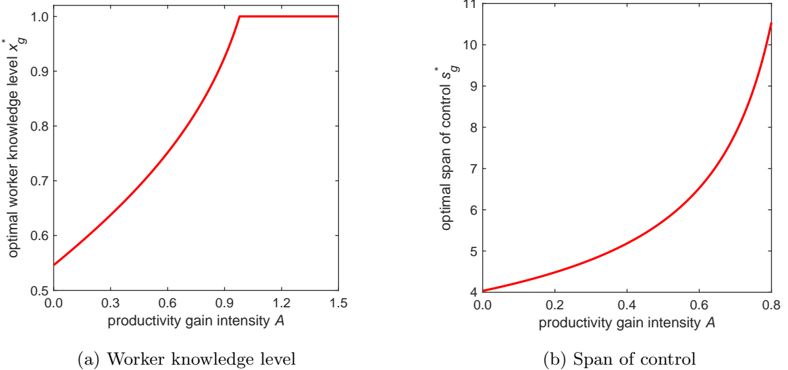
- Robustness appendices relax key assumptions: capability–reliability coupling \(h = b(1-r)\), endogenous deployment costs, endogenous expert knowledge, and a productivity-gain extension. Numerical illustrations use parameter values such as \(k=0.8\), \(w=0.25\), \(t_c=0.8\), \(t_v=0.5\), \(t_r=0.8\) in Figure 2. No empirical data are collected.
Limitations
- Stated: the model’s predictions are sharpest in industries with verifiable correctness and high error costs, such as software engineering, legal services, and financial analysis; in creative industries where hallucination may be interpreted as creativity and validation is subjective, the strict upskilling/deskilling dynamics may be less pronounced.
- Stated future research: extending to multi-tier hierarchies, incorporating dynamics such as learning curves, path dependence, and transition costs, embedding the single-firm analysis in competitive labor-market equilibrium, and integrating worker agency, strategic skill investment, technology resistance, and automation complacency.
- Evident from the text: the baseline is a partial-equilibrium, single-firm, two-layer model with exogenous capability and hallucination rate and no direct monetary adoption costs in the main text; these are relaxed in appendices, but the paper remains theoretical and does not empirically test its predictions.
Model-written summary. Check it against the paper before relying on it.
Integrity signals
Registry
Cites
Statistics
Figures


Verification
Claims the paper makes
0 Valid · 8 Not valid · 33 Not checked · 250 Own results and interpretations
A result the paper states — it cites no source for it, so there is none to check. The quote shows it is in the paper.
In the paper
“increases in hallucination rate h”
plainstates a cause- Asserted: passes — The authors put it forward as true.
- Checkable: passes — It can be checked against evidence.
- Load-bearing: passes — The paper’s conclusions depend on it.
- Based: passes — The paper gives a reason why it holds.
A result the paper states — it cites no source for it, so there is none to check. The quote shows it is in the paper.
In the paper
“The firm reduces the knowledge requirement for frontline workers, implying a deskilling effect ( x ∗ e < x ∗ 0 ).”
plainstates a cause- Asserted: passes — The authors put it forward as true.
- Checkable: passes — It can be checked against evidence.
- Load-bearing: passes — The paper’s conclusions depend on it.
- Based: passes — The paper gives a reason why it holds.
A result the paper states — it cites no source for it, so there is none to check. The quote shows it is in the paper.
In the paper
“which decreases in GenAI's augmentation capability r u”
plainstates a cause- Asserted: passes — The authors put it forward as true.
- Checkable: passes — It can be checked against evidence.
- Load-bearing: passes — The paper’s conclusions depend on it.
- Based: passes — The paper gives a reason why it holds.
A result the paper states — it cites no source for it, so there is none to check. The quote shows it is in the paper.
In the paper
“Proposition 5. The optimal worker knowledge level under expert-level automation is x ∗ e = ( k +2 w )( t v + ht c ) 2 k .”
plainstates a cause- Asserted: passes — The authors put it forward as true.
- Checkable: passes — It can be checked against evidence.
- Load-bearing: passes — The paper’s conclusions depend on it.
- Based: passes — The paper gives a reason why it holds.
- Rests on 3 assumptions not shown here.
A result the paper states — it cites no source for it, so there is none to check. The quote shows it is in the paper.
In the paper
“Taken together, expert-level adoption yields a clean first-order prediction: it uniformly reduces entry-level skill requirements, broadening access to knowledge work regardless of deployment mode.”
boostedstates a cause- Asserted: passes — The authors put it forward as true.
- Checkable: passes — It can be checked against evidence.
- Load-bearing: passes — The paper’s conclusions depend on it.
- Based: passes — The paper gives a reason why it holds.
162 more claims
Create a free account to see all 291 claims and to verify the 16 references still open.
- It may state two separate claims as one. 107
- Probably not a substantial claim. 28
- The quote only partly states this claim. 4
Self-check
Percentages, sums and reported differences re-computed from the paper’s own numbers.
Each contradiction between two passages listed here was confirmed by an independent check.
Rated minor: it would not touch a result — a value no result rests on, a p-value that stays on the same side of the significance level, or a conflict that is clerical, resolved elsewhere in the paper, or outside its own findings.
In the paper
§ C.4. Expert-Level Augmentation · p. 47
“across all modes, the span of control exhibits a first-decreasing-then-increasing pattern, reflecting the shifting dominance between direct efficiency gains and indirect skill adjustments.”
§ C.2. Worker-Level Augmentation · p. 44
“For t c ≤ k k +2 w , the span of control ˆ s ∗ g increases in GenAI's augmentation capability r g on (ˆ r g , 1) .”
Citations
Cites
The Skill Content of Recent Technological Change: An Empirical Exploration
Autor, D. H., Levy, F., & Murnane, R. J. (2003) · The Quarterly Journal of Economics · doi:10.1162/003355303322552801 · Cited by 6,205
Changes in Relative Wages, 1963-1987: Supply and Demand Factors
Katz, L. F., & Murphy, K. M. (1992) · The Quarterly Journal of Economics · doi:10.2307/2118323 · Cited by 4,793
Skills, Tasks and Technologies: Implications for Employment and Earnings
Acemoglu, D., & Autor, D. (2011) · Handbook of Labor Economics · doi:10.1016/s0169-7218(11)02410-5 · Cited by 3,799
Automation and New Tasks: How Technology Displaces and Reinstates Labor
Acemoglu, D., & Restrepo, P. (2019) · Journal of Economic Perspectives · doi:10.1257/jep.33.2.3 · Cited by 2,612
Lousy and Lovely Jobs: The Rising Polarization of Work in Britain
Goos, M., & Manning, A. (2007) · Review of Economics and Statistics · doi:10.1162/rest.89.1.118 · Cited by 2,285
Experimental evidence on the productivity effects of generative artificial intelligence
Noy, S., & Zhang, W. (2023) · Science · doi:10.1126/science.adh2586 · Cited by 2,150
Powell, W. W., & Snellman, K. (2004) · Annual Review of Sociology · doi:10.1146/annurev.soc.29.010202.100037 · Cited by 1,922
Computing inequality: have computers changed the labor market?
Autor, D. H., Katz, L. F., & Krueger, A. B. (1998) · The Quarterly Journal of Economics · doi:10.1162/003355398555874 · Cited by 1,830
Sparks of Artificial General Intelligence: Early experiments with GPT-4
Bubeck, S., Chandrasekaran, V., Eldan, R., Gehrke, J., Horvitz, E., Kamar, E., Lee, P., Lee, Y. T., Li, Y., Lundberg, S., et al. (2023) · arXiv · doi:10.48550/arxiv.2303.12712 · Cited by 1,526
Hierarchies and the Organization of Knowledge in Production
Garicano, L. (2000) · Journal of Political Economy · doi:10.1086/317671 · Cited by 1,194
Cited by
Sarkar, A. (2026) · Organizational Dynamics · doi:10.1016/j.orgdyn.2025.101202 · Cited by 13
The Economics of AI Foundation Models: Openness, Competition, and GovernancePreprint
Xu, F., Wang, X., Chen, W., & Xie, K. (2024) · SSRN Electronic Journal · doi:10.2139/ssrn.4999355 · Cited by 10
Self-citationManaging the Human Fallback: Skill Investment Under Improving AI and Worker MobilityPreprint
Singh, S., Ghosh, N., & Dai, T. (2026) · arXiv (Cornell University) · doi:10.48550/arxiv.2606.29111 · Cited by 6
When LLM Agents Negotiate: Private Information and Dynamic Bargaining in Supply ChainsPreprint
Liang, C., & Xu, F. (2026) · SSRN Electronic Journal · doi:10.2139/ssrn.7199381 · Cited by 5
Self-citationRole of artificial intelligence in financial leasing: Assessing bias and real-time value
Zhang, W., Yang, F., Wang, Z., Bi, C., & Wang, D. (2026) · International Journal of Production Economics · doi:10.1016/j.ijpe.2026.109910 · Cited by 3
Metadata
- Authors
- Xu, F., Hou, J., Chen, W., & Xie, K.
- Affiliations
- University of Connecticut (US)
- Fudan University (CN)
- Corresponding author
- Xu, Fasheng
- Venue
- arXiv
- Publisher
- arXiv
- Published
- 2025
- ISSN
- 1556-5068 (ISSN-L)
- arXiv
- 2506.00532
- OpenAlex
- W4411445854
- Cited by
- 22
- References
- 27
- Citations by year
- 2026: 21
- Type
- posted content
- Language
- en
- Open access
- green
- arxiv.org
- Locations
- SSRN Electronic Journal (submittedVersion)
- RePEc: Research Papers in Economics (submittedVersion)
- arXiv (Cornell University) (submittedVersion)
- arXiv (Cornell University)
- Topics
- Social Sciences › Decision Sciences › Management Science and Operations Research › Impact of AI and Big Data on Business and Society
- Social Sciences › Business, Management and Accounting › Organizational Behavior and Human Resource Management › Corporate Management and Leadership
- Physical Sciences › Computer Science › Artificial Intelligence › Artificial Intelligence Applications
- Keywords
- generative AI, organizational structure, knowledge economy, hallucinations, human-in-the-loop validation, deskilling, span of control, managerial workload, artificial intelligence adoption, productivity, future of work, organizational hierarchy
About these checks
Registry, retraction, Cites and statistics results are computed, not judged, with one exception: a printed reference that no index lists is read once by a model before it counts as a citation error. Claims are extracted by a model and kept only when their quote appears verbatim in the text; each cited source is then checked, with a model’s help, for whether it says what the claim relies on. Those verdicts can be wrong — read the claim’s quote and the cited source before relying on one.
A language model drew the claims from the paper on 2026-11-14, under version 3 of the claim definition (model deepseek-v4.1-flash, prompt extract-v3).
A second model labelled each claim on 2026-11-14 (model jev-1.13-20260917, definition revision gold-guideline-v0.2).
Statistics and arithmetic are recomputed, not judged.
Confidence bands are shown only for fields calibrated on our annotated test set. None is calibrated yet, so no band is shown.
What counts as a claim ›How we measure confidence ›How we check this ›
Are you an author, or do you see a problem with this page? Request a review
Data sources
Bibliographic data: Semantic Scholar, OpenAlex, Crossref.
Contains information from the Semantic Scholar Academic Graph Datasets, made available under the ODC Attribution License (ODC-BY 1.0).
Semantic Scholar’s data is described in: Kinney, R., et al. (2023). The Semantic Scholar Open Data Platform. arXiv:2301.10140.
