

CHURRO: Making History Readable with an Open-Weight Large Vision-Language Model for High-Accuracy, Low-Cost Historical Text Recognition
Open accessThe DOI matches its DataCite record; 33 of the 45 references it cites were found in a registry or an index; none of the 53 sources its claims cite is checked for support yet.
Abstract
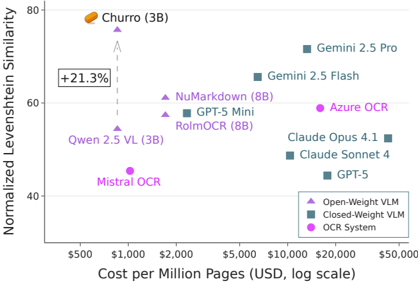
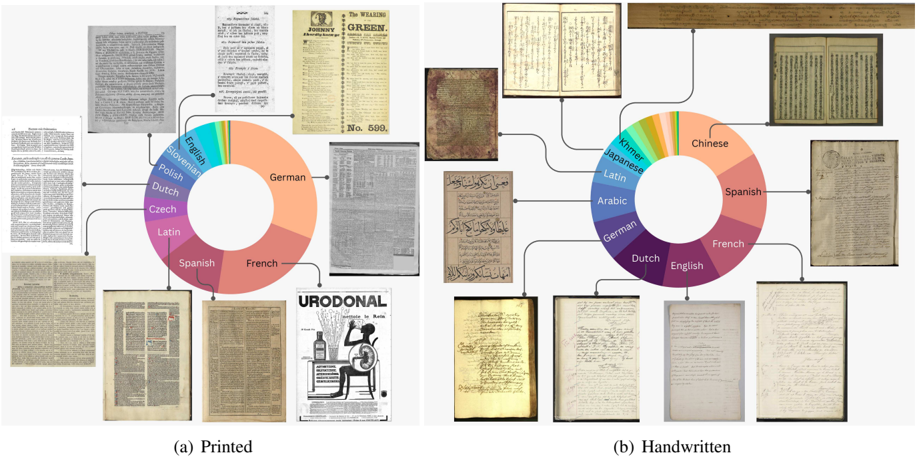
Accurate text recognition for historical documents can greatly advance the study and preservation of cultural heritage. Existing vision-language models (VLMs), however, are designed for modern, standardized texts and are not equipped to read the diverse languages and scripts, irregular layouts, and frequent degradation found in historical materials. This paper presents CHURRO, a 3B-parameter open-weight VLM specialized for historical text recognition. The model is trained on CHURRO-DS, the largest historical text recognition dataset to date. CHURRO-DS unifies 155 historical corpora comprising 99,491 pages, spanning 22 centuries of textual heritage across 46 language clusters, including historical variants and dead languages. We evaluate several open-weight and closed VLMs and optical character recognition (OCR) systems on CHURRO-DS and find that CHURRO outperforms all other VLMs. On the CHURRO-DS test set, CHURRO achieves 82.3% (printed) and 70.1% (handwritten) normalized Levenshtein similarity, surpassing the second-best model, Gemini 2.5 Pro, by 1.4% and 6.5%, respectively, while being 15.5 times more cost-effective. By releasing the model and dataset, we aim to enable community-driven research to improve the readability of historical texts and accelerate scholarship.
Overview
CoChat Summary
TL;DR
CHURRO is a 3B open-weight vision-language model fine-tuned on CHURRO-DS, a unified historical text recognition dataset of 155 corpora and 99,491 pages spanning 22 centuries, 46 language clusters, and 14 scripts. It achieves 82.3% printed and 70.1% handwritten normalized Levenshtein similarity, outperforming Gemini 2.5 Pro by 1.4% and 6.5% while being 15.5 times more cost-effective.
Key findings
- CHURRO-DS unifies 155 historical corpora comprising 99,491 pages, spanning 22 centuries, 46 language clusters, and 14 scripts; it contains 97,151 training samples and 1,170 samples each for validation and test, with 29 of 46 language clusters appearing in validation/test.
- CHURRO achieves 82.3% (printed) and 70.1% (handwritten) normalized Levenshtein similarity, surpassing the second-best model, Gemini 2.5 Pro, by 1.4% and 6.5%, respectively, while being 15.5 times more cost-effective. Fine-tuning improves Qwen 2.5 VL (3B) by 14.5% on printed and 27.2% on handwritten documents.
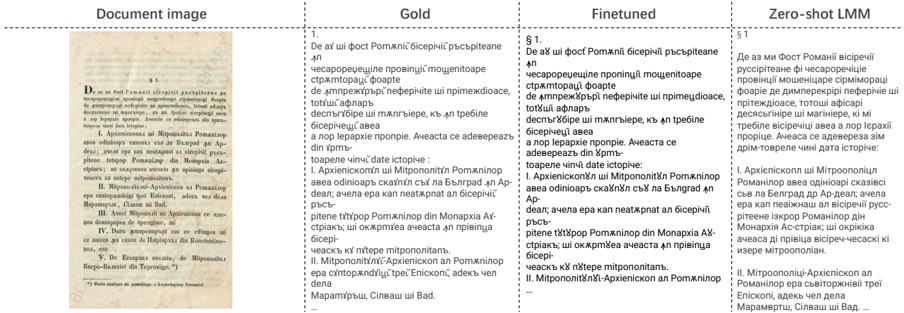
- Zero-shot best commercial model Gemini 2.5 Pro reaches 80.9% printed and 63.6% handwritten; best open-weight VLMs reach 72.7% printed (NuMarkdown) and 54.5% handwritten (Qwen 2.5 VL 72B); Azure OCR reaches 71.9% printed and 47.7% handwritten.
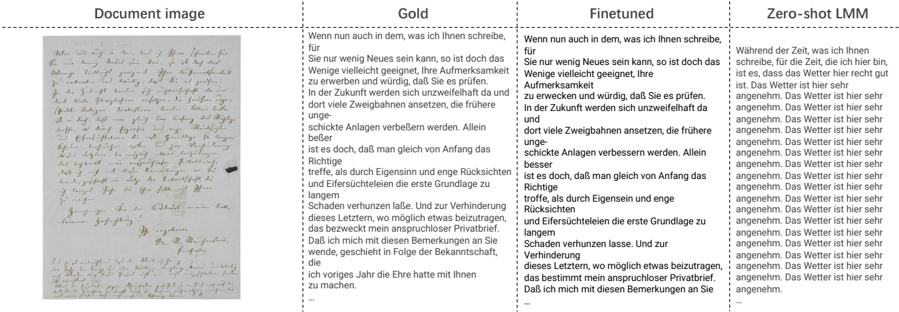
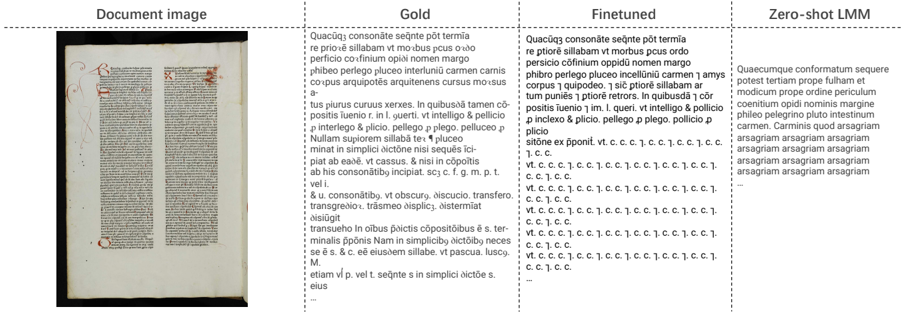
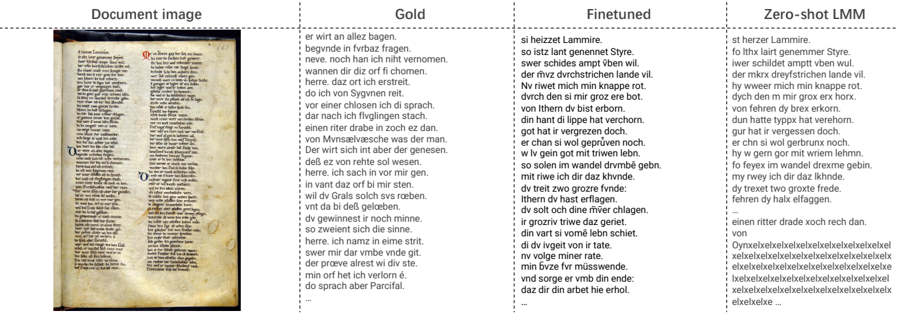
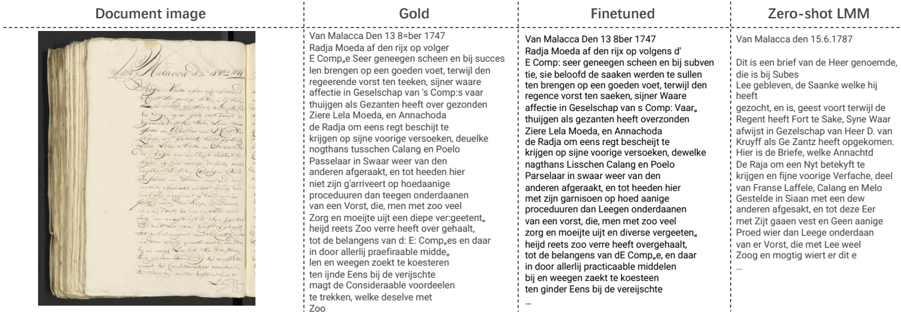
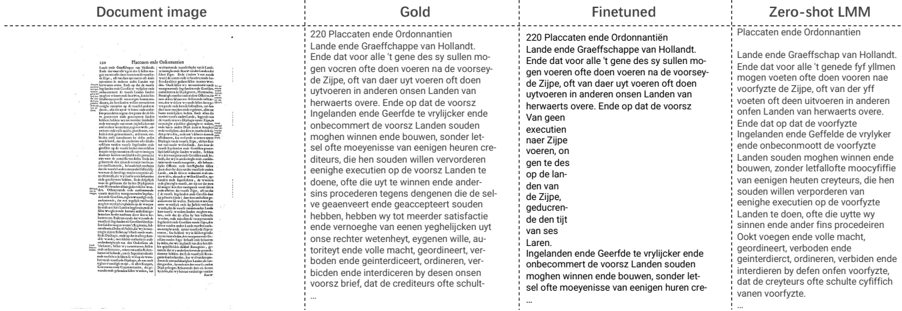
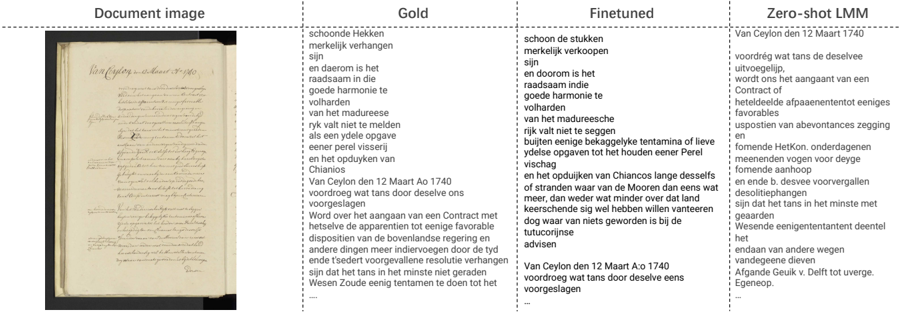
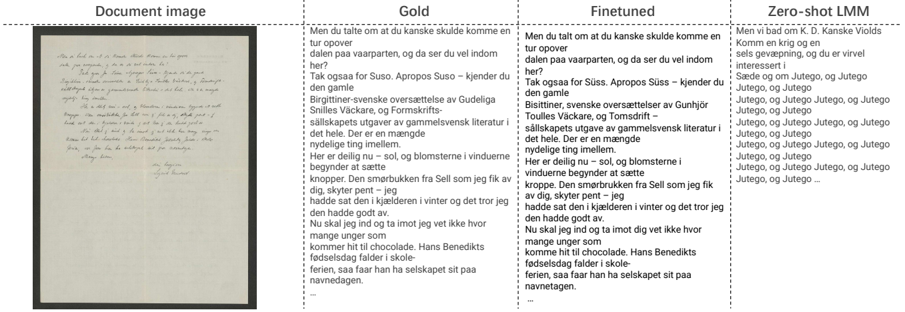
- In error analysis of 50 predictions, zero-shot Qwen 2.5 VL (3B) had major reading-order errors in 42% and major hallucinations in 36%; CHURRO had 16% reading-order errors and no hallucinations. Historical Chinese is hardest, with even the oracle ensemble at only 14.4% on printed Chinese; handwritten Sanskrit, Khmer, and Hebrew oracle scores are 26.1%, 32.9%, and 59.1%.
Methods
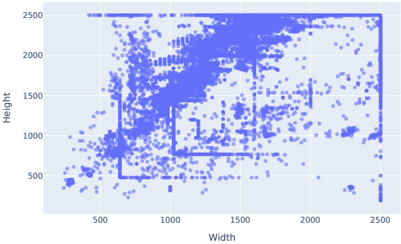
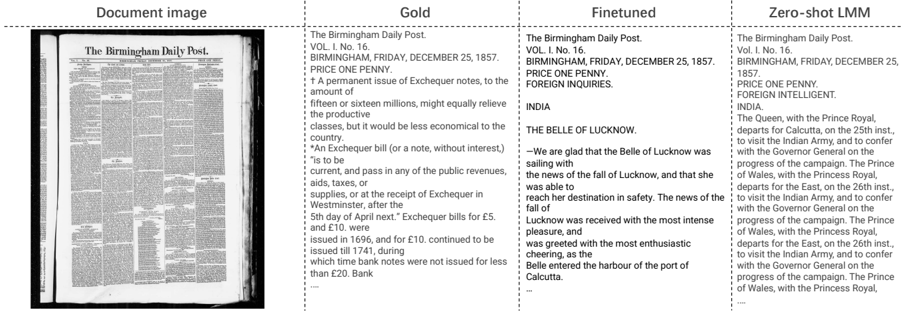
- Dataset curation: selected corpora predating the mid-20th century with research-use licenses and human-annotated page-level gold text; standardized ALTO XML, PAGE XML, JSON, and plain text into one reading-order string per page; used diplomatic transcription; added language/script metadata; removed pages under 30 tokens and about 15,000 near-duplicates via Min-Hash; resized large images to fit within 2500×2500 pixels.
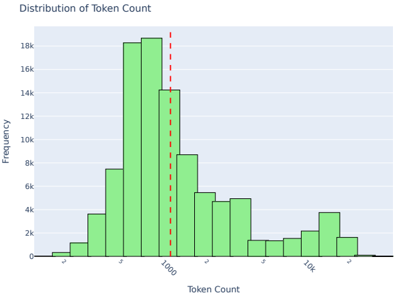
- Model training: fine-tuned Qwen 2.5 VL (3B) for 5 epochs on 32 NVIDIA H100 GPUs with effective batch size 128, learning rate 5×10⁻⁵, cosine schedule, about 25 hours; limited inputs to 5,120 image patches of 28×28 pixels; total computation about 6,000 GPU-hours.
- Evaluation: benchmarked open-weight and closed VLMs plus OCR systems on the CHURRO-DS test set in zero-shot and fine-tuned settings; computed character-level normalized Levenshtein similarity per example and averaged separately for printed and handwritten subsets; applied same normalization to all predictions and additional Arabic diacritics/hamza normalization with PyArabic; used temperature 0 and max generation of 20,000 tokens for non-reasoning models and 40,000 for reasoning models.
Limitations
- The paper states CHURRO-DS still underrepresents some languages, reflecting scarcity of annotated historical datasets for lower-resource languages, and currently includes no languages native to the African continent. It also states only standard supervised fine-tuning was explored, with future work needed on more advanced training methods.
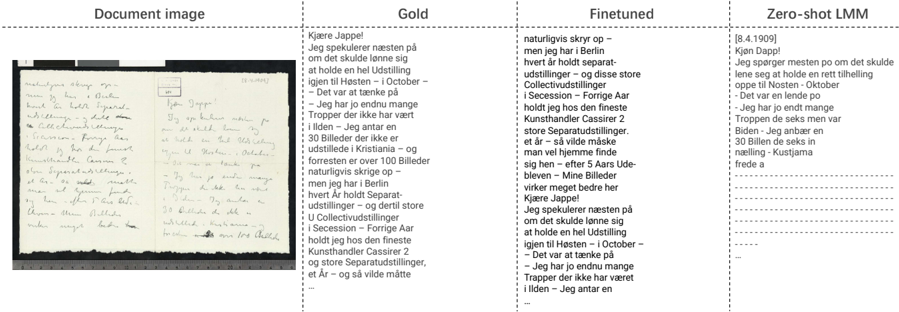
- Evident from the text: some language clusters have very few training examples (e.g., printed Chinese has 6, handwritten Portuguese has 12), and 17 of 46 language clusters appear only in training, not validation/test. The paper also reports gold-standard annotation omissions in 2 of 50 error-analysis examples, remaining CHURRO reading-order errors (e.g., a Danish postcard), repetitive degeneration on a Latin manuscript, and low performance on Chinese, Sanskrit, Khmer, and Hebrew.
Model-written summary. Check it against the paper before relying on it.
Integrity signals
Registry
Cites
Statistics
Figures
Verification
Claims the paper makes
0 Valid · 4 Not valid · 41 Not checked · 126 Own results and interpretations
A result the paper reports from its own data — it cites no other source for it, so there is none to check. The quote shows it is in the paper.
In the paper
“Relative to Azure OCR alone, the hybrid system improves notably for Bengali and Romanian.”
§ CHURRO: Making History Readable with an Open-Weight Large Vision-Language Model for High-Accuracy, Low-Cost Historical Text Recognition > 4.3 Evaluation Results on Printed Documents
plainstates a cause- Asserted: passes — The authors put it forward as true.
- Checkable: passes — It can be checked against evidence.
- Load-bearing: unclear — It is unclear whether the paper’s conclusions depend on it.
- Based: passes — The paper gives a reason why it holds.
A result the paper reports from its own data — it cites no other source for it, so there is none to check. The quote shows it is in the paper.
In the paper
“CHURRO outperforms all other VLMs.”
§ CHURRO: Making History Readable with an Open-Weight Large Vision-Language Model for High-Accuracy, Low-Cost Historical Text Recognition > Abstract
plain- Asserted: passes — The authors put it forward as true.
- Checkable: passes — It can be checked against evidence.
- Load-bearing: passes — The paper’s conclusions depend on it.
- Based: passes — The paper gives a reason why it holds.
A result the paper reports from its own data — it cites no other source for it, so there is none to check. The quote shows it is in the paper.
In the paper
“improving upon the original Qwen 2.5 VL (3B) by 27.2%.”
§ CHURRO: Making History Readable with an Open-Weight Large Vision-Language Model for High-Accuracy, Low-Cost Historical Text Recognition > 4.4 Evaluation Results on Handwritten Texts
plainstates a cause- Asserted: passes — The authors put it forward as true.
- Checkable: passes — It can be checked against evidence.
- Load-bearing: passes — The paper’s conclusions depend on it.
- Based: passes — The paper gives a reason why it holds.
A result the paper reports from its own data — it cites no other source for it, so there is none to check. The quote shows it is in the paper.
In the paper
“70.1% (handwritten) normalized Levenshtein similarity”
§ CHURRO: Making History Readable with an Open-Weight Large Vision-Language Model for High-Accuracy, Low-Cost Historical Text Recognition > Abstract
plain- Asserted: passes — The authors put it forward as true.
- Checkable: passes — It can be checked against evidence.
- Load-bearing: passes — The paper’s conclusions depend on it.
- Based: passes — The paper gives a reason why it holds.
A result the paper reports from its own data — it cites no other source for it, so there is none to check. The quote shows it is in the paper.
In the paper
“Manual checks indicate that more than 98% of reading orders are accurate.”
§ CHURRO: Making History Readable with an Open-Weight Large Vision-Language Model for High-Accuracy, Low-Cost Historical Text Recognition > 3.2 Dataset Curation
hedged- Asserted: passes — The authors put it forward as true.
- Checkable: passes — It can be checked against evidence.
- Load-bearing: unclear — It is unclear whether the paper’s conclusions depend on it.
- Based: passes — The paper gives a reason why it holds.
77 more claims
Create a free account to see all 171 claims and to verify the 13 references still open.
- It may state two separate claims as one. 34
- Probably not a substantial claim. 62
- The quote only partly states this claim. 2
Self-check
Percentages, sums and reported differences re-computed from the paper’s own numbers.
Each contradiction between two passages listed here was confirmed by an independent check.
Rated minor: it would not touch a result — a value no result rests on, a p-value that stays on the same side of the significance level, or a conflict that is clerical, resolved elsewhere in the paper, or outside its own findings.
In the paper
§ CHURRO: Making History Readable with an Open-Weight Large Vision-Language Model for High-Accuracy, Low-Cost Historical Text Recognition > 4.1 Experimental Setup
“Nanonets OCR (3B) (Mandal et al., 2025)”
§ CHURRO: Making History Readable with an Open-Weight Large Vision-Language Model for High-Accuracy, Low-Cost Historical Text Recognition > Correspondence during the lifetime of Antoine-Louis Barye Anonymous documentation on Antoine-Louis Barye Documents relating to Barye's activity during his lifetime Biographical documentation on Antoine-Louis Barye Documents relating to the trade and exhibition of Barye's works after his death Iconographic documentation
“Nanonets OCR (4B)”
Rated minor: it would not touch a result — a value no result rests on, a p-value that stays on the same side of the significance level, or a conflict that is clerical, resolved elsewhere in the paper, or outside its own findings.
In the paper
§ CHURRO: Making History Readable with an Open-Weight Large Vision-Language Model for High-Accuracy, Low-Cost Historical Text Recognition > 4.1 Experimental Setup
“MiMo VL (8B)(Xiaomi, 2025)”
§ CHURRO: Making History Readable with an Open-Weight Large Vision-Language Model for High-Accuracy, Low-Cost Historical Text Recognition > Correspondence during the lifetime of Antoine-Louis Barye Anonymous documentation on Antoine-Louis Barye Documents relating to Barye's activity during his lifetime Biographical documentation on Antoine-Louis Barye Documents relating to the trade and exhibition of Barye's works after his death Iconographic documentation
“MiMo VL (7B)”
Rated minor: it would not touch a result — a value no result rests on, a p-value that stays on the same side of the significance level, or a conflict that is clerical, resolved elsewhere in the paper, or outside its own findings.
In the paper
§ CHURRO: Making History Readable with an Open-Weight Large Vision-Language Model for High-Accuracy, Low-Cost Historical Text Recognition > 3.1 Dataset Selection
“1) Documents must originate prior to the mid-20th century.”
§ CHURRO: Making History Readable with an Open-Weight Large Vision-Language Model for High-Accuracy, Low-Cost Historical Text Recognition > References
“Digital Peraire (Chagué and Pérez, 2023) Description: The documents are handwritten, dat- ing from the second half of the 20th century”
Citations
Cites
Learning Transferable Visual Models From Natural Language Supervision
Radford, A., Kim, J. W., Hallacy, C., Ramesh, A., Goh, G., Agarwal, S., Sastry, G., Askell, A., Mishkin, P., Clark, J., et al. (2021) · arXiv · doi:10.48550/arxiv.2103.00020 · Cited by 15,293
Qwen2-VL: Enhancing Vision-Language Model's Perception of the World at Any Resolution
Wang, P., Bai, S., Tan, S., Wang, S., Fan, Z., Bai, J., Chen, K., Liu, X., Wang, J., Ge, W., et al. (2024) · arXiv · doi:10.48550/arxiv.2409.12191 · Cited by 1,302 · cited 2×
“For instance, recent works introduce models capable of page-level OCR but report only limited evalu-ationseither on noisy, LLM-annotated data ( Poz-nanski et al. , 2025) or only in English and Chinese ( Wang et al., 2024a; Yang et al., 2024a).”
Sigmoid Loss for Language Image Pre-Training
Zhai, X., Mustafa, B., Kolesnikov, A., & Beyer, L. (2023) · 2023 IEEE/CVF International Conference on Computer Vision (ICCV) · doi:10.1109/iccv51070.2023.01100 · Cited by 1,127 · cited 1×
“CLIP (Radford et al., 2021) and its successors, such as SigLIP (Zhai et al., 2023), laid the foundation for contrastive pretraining between vision and language.”
Gemini: A Family of Highly Capable Multimodal Models
Gemini Team, Anil, R., Borgeaud, S., Alayrac, J.-B., Yu, J., Soricut, R., Schalkwyk, J., Dai, A. M., Hauth, A., Millican, K., et al. (2023) · arXiv · doi:10.48550/arxiv.2312.11805 · Cited by 990
Self-citationPhi-4-Mini Technical Report: Compact yet Powerful Multimodal Language Models via Mixture-of-LoRAsPreprint
Microsoft, :, Abouelenin, A., Ashfaq, A., Atkinson, A., Awadalla, H. H., Bách, N., Bao, J., Benhaim, A., Cai, M., et al. (2025) · arXiv (Cornell University) · doi:10.48550/arxiv.2503.01743 · Cited by 840
Vision-R1: Incentivizing Reasoning Capability in Multimodal Large Language Models
Huang, W., Jia, B., Zhai, Z., Cao, S., Ye, Z., Zhao, F., Xu, Z., Tang, X., Hu, Y., & Lin, S. (2026) · International Conference on Learning Representations · doi:10.48550/arxiv.2503.06749 · Cited by 814
Intern VL: Scaling up Vision Foundation Models and Aligning for Generic Visual-Linguistic Tasks
Chen, Z., Wu, J., Wang, W., Su, W., Chen, G., Xing, S., Zhong, M., Zhang, Q., Zhu, X., Lu, L., et al. (2024) · 2024 IEEE/CVF Conference on Computer Vision and Pattern Recognition (CVPR) · doi:10.1109/cvpr52733.2024.02283 · Cited by 734 · cited 3×
“Instruction-tuned open-weight VLMs like LLaVA (Liu et al., 2023a), LLaVA-Next (Liu et al., 2024a), InternVL (Chen et al., 2024), and Qwen-VL (Bai et al., 2023) have demonstrated strong performance in reasoning and fine-grained text understanding.”
InfluentialMMBench: Is Your Multi-modal Model an All-Around Player?
Liu, Y., Duan, H., Zhang, Y., Li, B., Zhang, S., Zhao, W., Yuan, Y., Wang, J., He, C., Liu, Z., et al. (2025) · Lecture Notes in Computer Science · doi:10.1007/978-3-031-72658-3_13 · Cited by 668
MMBench: Is Your Multi-modal Model an All-around Player?
Liu, Y., Duan, H., Zhang, Y., Li, B., Zhang, S., Zhao, W., Yuan, Y., Wang, J., He, C., Liu, Z., et al. (2023) · arXiv · doi:10.48550/arxiv.2307.06281 · Cited by 487
Evaluation of deep convolutional nets for document image classification and retrieval
Harley, A. W., Ufkes, A., & Derpanis, K. G. (2015) · 2015 13th International Conference on Document Analysis and Recognition (ICDAR) · doi:10.1109/icdar.2015.7333910 · Cited by 394
Zhang, P., Dong, X., Wang, B., Cao, Y., Xu, C., Ouyang, L., Zhao, Z., Duan, H., Zhang, S., Ding, S., et al. (2023) · arXiv (Cornell University) · doi:10.48550/arxiv.2309.15112 · Cited by 389
Gemma: Open Models Based on Gemini Research and Technology
Gemma Team, Mesnard, T., Hardin, C., Dadashi, R., Bhupatiraju, S., Pathak, S., Sifre, L., Rivière, M., Kale, M. S., Love, J., et al. (2024) · arXiv · doi:10.48550/arxiv.2403.08295 · Cited by 284
Fu, L., Kuang, Z.-B., Song, J., Huang, M.-X., Yang, B., Li, Y.-Z., Zhu, L., Luo, Q.-D., Wang, X.-Y., Lu, H., et al. (2024) · Neural Information Processing Systems · doi:10.48550/arxiv.2501.00321 · Cited by 218
DocBank: A Benchmark Dataset for Document Layout Analysis
Li, M., Xu, Y., Cui, L., Huang, S., Wei, F., Li, Z., & Zhou, M. (2020) · Proceedings of the 28th International Conference on Computational Linguistics · doi:10.18653/v1/2020.coling-main.82 · Cited by 217
Qwen, :, Yang, A., Yang, B., Zhang, B., Hui, B., Zheng, B., Yu, B., Li, C., Liu, D., et al. (2024) · arXiv · doi:10.48550/arxiv.2412.15115 · Cited by 128
Kahle, P., Colutto, S., Hackl, G., & Muhlberger, G. (2017) · 2017 14th IAPR International Conference on Document Analysis and Recognition (ICDAR) · doi:10.1109/icdar.2017.307 · Cited by 108
Sulaiman, A., Omar, K., & Nasrudin, M. F. (2019) · Journal of Imaging · doi:10.3390/jimaging5040048 · Cited by 100
OCR4all—An Open-Source Tool Providing a (Semi-)Automatic OCR Workflow for Historical Printings
Reul, C., Christ, D., Hartelt, A., Balbach, N., Wehner, M., Springmann, U., Wick, C., Grundig, C., Büttner, A., & Puppe, F. (2019) · Applied Sciences · doi:10.3390/app9224853 · Cited by 92
A survey of OCR evaluation tools and metrics
Neudecker, C., Baierer, K., Gerber, M., Clausner, C., Antonacopoulos, A., & Pletschacher, S. (2021) · The 6th International Workshop on Historical Document Imaging and Processing · doi:10.1145/3476887.3476888 · Cited by 81
Yang, H., Jin, L., Huang, W., Yang, Z., Lai, S., & Sun, J. (2018) · IEEE Access · doi:10.1109/access.2018.2840218 · Cited by 68
Granite Vision: a lightweight, open-source multimodal model for enterprise IntelligencePreprint
Granite Vision Team, Karlinsky, L., Arbelle, A., Daniels, A., Nassar, A., Alfassy, A., Wu, B., Schwartz, E., Joshi, D., Kondic, J., et al. (2025) · arXiv (Cornell University) · doi:10.48550/arxiv.2502.09927 · Cited by 55
American Stories: A Large-Scale Structured Text Dataset of Historical U.S. Newspapers
Dell, M., Carlson, J., Bryan, T., Silcock, E., Arora, A., Shen, Z., D’Amico-Wong, L., Le, Q., Querubín, P., & Heldring, L. (2023) · neural information processing systems · doi:10.52202/075280-3540 · Cited by 52
OpenAI, :, Jaech, A., Kalai, A., Lerer, A., Richardson, A., El-Kishky, A., Low, A., Helyar, A., Madry, A., et al. (2024) · arXiv · Cited by 50
ICDAR 2019 Historical Document Reading Challenge on Large Structured Chinese Family Records
Saini, R., Dobson, D., Morrey, J., Liwicki, M., & Liwicki, F. (2019) · IAPR International Conference on Document Analysis and Recognition (ICDAR) · doi:10.1109/icdar.2019.00241 · Cited by 40
OmniDocBench: Benchmarking Diverse PDF Document Parsing with Comprehensive Annotations
Ouyang, L., Qu, Y., Zhou, H., Zhu, J., Zhang, R., Lin, Q., Wang, B., Zhao, Z., Jiang, M., Zhao, X., et al. (2024) · arXiv · doi:10.48550/arxiv.2412.07626 · Cited by 38
Do, T., Tran, D. P., Vo, A., & Kim, D. (2025) · Proceedings of the AAAI Conference on Artificial Intelligence · doi:10.1609/aaai.v39i27.35012 · Cited by 33
A Benchmark and Dataset for Post-OCR text correction in Sanskrit
Maheshwari, A., Singh, N. K., Krishna, A., & Ramakrishnan, G. (2022) · Findings of the Association for Computational Linguistics: EMNLP (Findings of EMNLP) · doi:10.18653/v1/2022.findings-emnlp.466 · Cited by 32
A New Khmer Palm Leaf Manuscript Dataset for Document Analysis and Recognition: SleukRith Set
Valy, D., Verleysen, M., Chhun, S., & Burie, J.-C. (2017) · Proceedings of the 4th International Workshop on Historical Document Imaging and Processing · doi:10.1145/3151509.3151510 · Cited by 29
CCpdf: Building a High Quality Corpus for Visually Rich Documents from Web Crawl Data
Turski, M., Stanisławek, T., Kaczmarek, K., Dyda, P., & Graliński, F. (2023) · Lecture notes in computer science · doi:10.1007/978-3-031-41682-8_22 · Cited by 26
The “ScribbleLens” Dutch Historical Handwriting Corpus
Dolfing, H. J. G. A., Bellegarda, J., Chorowski, J., Marxer, R., & Laurent, A. (2020) · 2020 17th International Conference on Frontiers in Handwriting Recognition (ICFHR) · doi:10.1109/icfhr2020.2020.00023 · Cited by 12
Schmidt, T., Kamlah, J., & Weil, S. (2024) · Data in Brief · doi:10.1016/j.dib.2024.110274 · Cited by 3
Ground Truth Model for Pracalit for Sanskrit and Newar MSS 16th to 19th C.
O’Neill, A. J. (2022) · University Library Heidelberg · doi:10.11588/data/wi9184 · Cited by 2
Clérice, T., Chagué, A., & Vlachou-Efstathiou, M. (2022) · Zenodo (CERN European Organization for Nuclear Research) · doi:10.5281/zenodo.7013436 · Cited by 1
Cheng, L., Frankemölle, J., Axelsson, A., & Vats, E. (2024) · Proceedings of the 8th Joint SIGHUM Workshop on Computational Linguistics for Cultural Heritage, Social Sciences, Humanities and Literature (LaTeCH-CLfL 2024) · doi:10.18653/v1/2024.latechclfl-1.12 · Cited by 1
Ground Truth data for printed Malayalam
Tübingen University Library (2023) · University Library Heidelberg · doi:10.11588/data/l2krzo · Cited by 1
Making Sense of Abbreviation in Late Middle English Literary Manuscripts
Rogos-Hebda, J. (2025) · The New Middle Ages · doi:10.1007/978-3-031-68613-9_8
Yang, Z., Tang, J., Li, Z., et al. (2024) · arXiv · doi:10.48550/arxiv.2412.02210
ICDAR2019 Competition on Recognition of Early Indian Printed Documents – REID2019
Clausner, C., Antonacopoulos, A., Derrick, T., & Pletschacher, S. (2019) · 2019 International Conference on Document Analysis and Recognition (ICDAR) · doi:10.1109/icdar.2019.00246
ICFHR 2018 Competition on Recognition of Historical Arabic Scientific Manuscripts – RASM2018
Clausner, C., Antonacopoulos, A., Mcgregor, N., & Wilson-Nunn, D. (2018) · 2018 16th International Conference on Frontiers in Handwriting Recognition (ICFHR) · doi:10.1109/icfhr-2018.2018.00088
NomNaOCR: The First Dataset for Optical Character Recognition on Han-Nom Script
Dang, H.-Q., Nguyen, D.-A., Pham, P.-P., Nguyen, N.-T., Chau, T., Ngo, D.-V., Nguyen, T.-H., Phan, C.-T., Trinh, T.-H., Nguyen, M.-T., et al. (2022) · 2022 RIVF International Conference on Computing and Communication Technologies (RIVF) · doi:10.1109/rivf55975.2022.10013842
BH2M: The Barcelona Historical, Handwritten Marriages Database
Fernandez-Mota, D., Almazan, J., Cirera, N., Fornes, A., & Llados, J. (2014) · 2014 22nd International Conference on Pattern Recognition · doi:10.1109/icpr.2014.53
Do, T., Tran, D. P., Vo, A., & Kim, D. (2024) · arXiv · doi:10.48550/arxiv.2410.13305
Transcribing Medieval Manuscripts for Machine Learning
Guéville, E., & Wrisley, D. J. (2022) · arXiv · doi:10.48550/arxiv.2207.07726
M5HisDoc: A Large-scale Multi-style Chinese Historical Document Analysis Benchmark
Shi, Y., Liu, C., Peng, D., Jian, C., Huang, J., & Jin, L. (2023) · Advances in Neural Information Processing Systems 36 · doi:10.52202/075280-3431
RASAM – A Dataset for the Recognition and Analysis of Scripts in Arabic Maghrebi
Vidal-Gorène, C., Lucas, N., Salah, C., Decours-Perez, A., & Dupin, B. (2021) · Lecture Notes in Computer Science · doi:10.1007/978-3-030-86198-8_19
Research works printed but not linked: 39
- 2023. Aldicam-2023: Diachronic and interactive lin- guistic atlas of the community of madrid. https: //aldicam.corpuscodea.es/consultas.php. Accessed: 2025-05-18. 2025. Osman agha dataset: Images and transcription from british library ms. or. 3213 and kreutel's 1980 edition. Based on London, British Library, MS. Or. 3213 and Richard F. Kreutel's 1980 transcription: *Die Autobiographie des Dolmetschers Osman Aga aus Temeschwar*, The E. J. W. Gibb Memorial Trust, Cambridge.
- Lien Ceard, Fanny Lebreton, and Cécile Sajdak. 2022. Projet correspondance berlioz. Created as part of a transcription project of the active correspondence from Hector Berlioz to his sister Nanci Berlioz, by students of the TNAH master's program at the École nationale des chartes. Center for Open Data in the Humanities. 2019. Japanese classics dataset (collection of the national museum of japanese literature, etc.). Center for Open Data in the Humanities (CODH) and National Institute for Japanese Language and Linguis- tics (NINJAL). 2025. Modern magazine ocr training dataset. · doi:10.20676/00000415
- Alix Chagué. 2021. Tapuscorpus. If you use this soft- ware, please cite it as above. · doi:10.5072/zenodo.977649
- Wei-Lin Chiang, Lianmin Zheng, Ying Sheng, Anas- tasios Nikolas Angelopoulos, Tianle Li, Dacheng Li, Banghua Zhu, Hao Zhang, Michael I. Jordan, Joseph E. Gonzalez, and Ion Stoica. 2024. Chat- bot arena: An open platform for evaluating llms by human preference. In Forty-first International Con- ference on Machine Learning, ICML 2024, Vienna, Austria, July 21-27, 2024. OpenReview.net. Floriane Chiffoleau. 2021. dahncorpus. · doi:10.5281/zenodo.5911868
- Christian Clausner, Apostolos Antonacopoulos, Tom Derrick, and Stefan Pletschacher. 2017. Icdar2017 competition on recognition of early indian printed documents -reid2017. In 2017 14th IAPR Interna- tional Conference on Document Analysis and Recog- nition (ICDAR), volume 01, pages 1411-1416. · doi:10.1109/icdar.2017.230
- Andreas Wagner David Glück, Cindy Rico Carmona. 2018. Edition guidelines. https://www.salamanc a.school/guidelines.html.
- Senka Drobac, Pekka Kauppinen, and Krister Lindén. 2017. OCR and post-correction of historical Finnish texts. In Proceedings of the 21st Nordic Conference on Computational Linguistics, pages 70-76, Gothen- burg, Sweden. Association for Computational Lin- guistics.
- Marc Frincu, Simina Frincu, and Marius E. Penteliuc. 2023. Challenges and solutions in transliterating 19th century Romanian texts from the transitional to the Latin script. In Proceedings of the 4th Conference on Language, Data and Knowledge, pages 226-231, Vienna, Austria.
- Kioumars Ghereghlou, editor. 2018. Persian Text, vol- ume 98, pages 1-372. American Oriental Society. Accessed 20 May 2025. · doi:10.2307/j.ctv9b2vrs.5
- Romain Karpinski, Devashish Lohani, and Abdel Be- laid. 2018. Metrics for complete evaluation of ocr performance. In Proceedings of the 22nd Interna- tional Conference on Image Processing, Computer Vision, and Pattern Recognition (IPCV), Las Vegas, United States. HAL Id: hal-01981731.
- Majeed Kassis, Alaa Abdalhaleem, Ahmad Droby, Reem Alaasam, and Jihad El-Sana. 2017. Vml-hd: The historical arabic documents dataset for recog- nition systems. In 1st International Workshop on Arabic Script Analysis and Recognition. IEEE.
- Benjamin Kiessling, Robin Tissot, Peter Stokes, and Daniel Stökl Ben Ezra. 2019. escriptorium: An open source platform for historical document analysis. In 2019 International Conference on Document Analy- sis and Recognition Workshops (ICDARW), volume 2, pages 19-19. · DOI
- LECTAUREP, Aurélia Rostaing, Marc Durand, and Alix Chagué. 2021. Notaires de paris -répertoires: Ground truth for various parisian registries of notary deeds (french 19th and 20th centuries). Released on 2021-12-07. · doi:10.5072/zenodo.977691
- Kenton Lee, Mandar Joshi, Iulia Raluca Turc, Hexi- ang Hu, Fangyu Liu, Julian Martin Eisenschlos, Ur- vashi Khandelwal, Peter Shaw, Ming-Wei Chang, and Kristina Toutanova. 2023. Pix2struct: Screen- shot parsing as pretraining for visual language under- standing. In International Conference on Machine Learning, ICML 2023, 23-29 July 2023, Honolulu, Hawaii, USA, volume 202 of Proceedings of Machine Learning Research, pages 18893-18912.
- PMLR.
- David Lewis, Gady Agam, Shlomo Argamon, Ophir Frieder, David Grossman, and Jefferson Heard. 2006. Building a test collection for complex document in- formation processing. In Proceedings of the 29th annual international ACM SIGIR conference on Re- search and development in information retrieval, pages 665-666.
- Haotian Liu, Chunyuan Li, Qingyang Wu, and Yong Jae Lee. 2023a. Visual instruction tuning. In Advances in Neural Information Processing Systems 36: An- nual Conference on Neural Information Processing Systems 2023, NeurIPS 2023, New Orleans, LA, USA, December 10 -16, 2023.
- Yuliang Liu, Zhang Li, Mingxin Huang, Biao Yang, Wenwen Yu, Chunyuan Li, Xu-Cheng Yin, Cheng- Lin Liu, Lianwen Jin, and Xiang Bai. 2024b. Ocr- bench: on the hidden mystery of ocr in large multi- modal models. Science China Information Sciences, 67(12):220102.
- Ayush Maheshwari, Nikhil Singh, Amrith Krishna, and Ganesh Ramakrishnan. 2022b. A benchmark and dataset for post-OCR text correction in Sanskrit. In Findings of the Association for Computational Linguistics: EMNLP 2022, pages 6258-6265, Abu Dhabi, United Arab Emirates. Association for Com- putational Linguistics. · DOI
- Minesh Mathew, Dimosthenis Karatzas, and CV Jawa- har. 2021. Docvqa: A dataset for vqa on document images. In Proceedings of the IEEE/CVF winter con- ference on applications of computer vision, pages 2200-2209.
- Nicole Merkel-Hilf. 2022. Ground truth data for printed devanagari. · doi:10.11588/data/egokei
- Lucas Noëmie, Clément Salah, and Chahan Vidal- Gorène. 2022. New Results for the Text Recogni- tion of Arabic Maghribī Manuscripts -Managing an Under-resourced Script. Working paper or preprint.
- Vít Novotný, Kristýna Seidlová, Tereza Vrabcová, and Aleš Horák. 2021. When tesseract brings friends: Layout analysis, language identification, and super- resolution in the optical character recognition of me- dieval texts. In Proceedings of Recent Advances in Slavonic Natural Language Processing, RASLAN 2021, pages 91-100. Tribun EU. Numind. 2025. NuMarkdown-8B-Thinking. Model page. NVIDIA. 2025. Llama-3.1-Nemotron-Nano-VL-8B- V1. Model page.
- Sarah Oberbichler, Emanuela Boroş, Antoine Doucet, Jani Marjanen, Eva Pfanzelter, Juha Rautiainen, Hannu Toivonen, and Mikko Tolonen. 2022. Inte- grated interdisciplinary workflows for research on historical newspapers: Perspectives from humanities scholars, computer scientists, and librarians. Jour- nal of the Association for Information Science and Technology, 73(2):225-239.
- Alexander James O'Neill and Nathan Hill. 2022. Text recognition for nepalese manuscripts in pracalit script. Journal of Open Humanities Data. · doi:10.5334/johd.90
- Werner Pantke, Martin Dennhardt, Daniel Fecker, Volker Märgner, and Tim Fingscheidt. 2014. An his- torical handwritten arabic dataset for segmentation- free word spotting -hadara80p. In 2014 14th In- ternational Conference on Frontiers in Handwriting Recognition, pages 15-20. · doi:10.1109/icfhr.2014.11
- Christos Papadopoulos, Stefan Pletschacher, Christian Clausner, and Apostolos Antonacopoulos. 2013. The impact dataset of historical document images. In Proceedings of the 2nd International Workshop on Historical Document Imaging and Processing, HIP '13, page 123-130, New York, NY, USA. Association for Computing Machinery. · DOI
- Paraskevi Platanou, John Pavlopoulos, and Georgios Papaioannou. 2022. Handwritten paleographic greek text recognition dataset (century-based). This dataset is part of the work: Platanou, P., Pavlopoulos, J., and Papaioannou, G. (2022). Handwritten Paleo- graphic Greek Text Recognition: A Century-Based Approach. In *Proceedings of the Thirteenth Lan- guage Resources and Evaluation Conference*, pp. 6585-6589, Marseille, France: ELRA.
- Stefan Pletschacher and Apostolos Antonacopoulos. 2010. The PAGE (Page Analysis and Ground-Truth Elements) Format Framework. In 2010 20th Inter- national Conference on Pattern Recognition, pages 257-260. IEEE.
- Irina Rabaev, Berat Kurar Bakarat, and Jihad El-Sana. 2019. The pinkas dataset. · doi:10.1109/icdar.2019.00122_dataset
- Matteo Romanello, Najem-Meyer Sven, and Bruce Robertson. 2021. Optical Character Recognition of 19th Century Classical Commentaries: The Current State of Affairs. In The 6th International Workshop on Historical Document Imaging and Processing (HIP '21), Lausanne. Association for Computing Ma- chinery. · doi:10.1145/3476887.3476911
- C.A. Romein, Michel de Gruijter, and Sara Floor Veld- hoen. 2020. The datafication of early modern ordi- nances. DH Benelux Journal, 2.
- Verónica Romero, Alejandro H. Toselli, Enrique Vidal, Joan Andreu Sánchez, Carlos Alonso, and Lourdes Marqués. 2019. Modern vs diplomatic transcripts for historical handwritten text recognition. In New Trends in Image Analysis and Processing -ICIAP 2019: ICIAP International Workshops, BioFor, Pa- tReCH, e-BADLE, DeepRetail, and Industrial Ses- sion, Trento, Italy, September 9-10, 2019, Revised Selected Papers, page 103-114, Berlin, Heidelberg. Springer-Verlag. · doi:10.1007/978-3-030-30754-7_11
- Phillip Ströbel and Simon Clematide. 2019. Improv- ing ocr of black letter in historical newspapers: The unreasonable effectiveness of htr models on low- resolution images. In Proceedings of the Digital Humanities 2019, (DH2019). Accepted.
- Tübingen University Library. 2023. Ground truth data for printed malayalam. · DOI
- Zirui Wang, Mengzhou Xia, Luxi He, Howard Chen, Yitao Liu, Richard Zhu, Kaiqu Liang, Xindi Wu, Hao- tian Liu, Sadhika Malladi, Alexis Chevalier, Sanjeev Arora, and Danqi Chen. 2024b. Charxiv: Charting gaps in realistic chart understanding in multimodal llms. In Advances in Neural Information Process- ing Systems 38: Annual Conference on Neural In- formation Processing Systems 2024, NeurIPS 2024, Vancouver, BC, Canada, December 10 -15, 2024.
- Maurice Weber, Carlo Siebenschuh, Rory Butler, Anton Alexandrov, Valdemar Thanner, Georgios Tsolakis, Haris Jabbar, Ian T. Foster, Bo Li, Rick Stevens, and Ce Zhang. 2023. Wordscape: a pipeline to extract multilingual, visually rich documents with layout annotations from web crawl data. In Advances in Neural Information Processing Systems 36: Annual Conference on Neural Information Processing Sys- tems 2023, NeurIPS 2023, New Orleans, LA, USA, December 10 -16, 2023.
- Kaining Ying, Fanqing Meng, Jin Wang, Zhiqian Li, Han Lin, Yue Yang, Hao Zhang, Wenbo Zhang, Yuqi Lin, Shuo Liu, Jiayi Lei, Quanfeng Lu, Runjian Chen, Peng Xu, Renrui Zhang, Haozhe Zhang, Peng Gao, Yali Wang, Yu Qiao, and 3 others. 2024. Mmt-bench: A comprehensive multimodal benchmark for evaluat- ing large vision-language models towards multitask AGI. In Forty-first International Conference on Ma- chine Learning, ICML 2024, Vienna, Austria, July 21-27, 2024. OpenReview.net.
- Xu Zhong, Jianbin Tang, and Antonio Jimeno Yepes. 2019. Publaynet: largest dataset ever for document layout analysis. In 2019 International conference on document analysis and recognition (ICDAR), pages 1015-1022. IEEE.
Cited by
PreScience: A Dataset and Benchmark for Scientific ForecastingPreprint
Ajith, A., Singh, A., DeYoung, J., Kunievsky, N., Kozlowski, A. C., Tafjord, O., Evans, J. A., Weld, D. S., Hope, T., & Downey, D. (2026) · arXiv (Cornell University) · doi:10.48550/arxiv.2602.20459 · Cited by 15
Gardella, M., Mari{ñ}o, C., Belzarena, D., Ram{í}rez, I., Randall, G., & Morel, J. (2026) · arXiv (Cornell University) · doi:10.48550/arxiv.2607.24077 · Cited by 4
Vidal-Gorène, C., & Kindt, B. (2026) · Language Resources and Evaluation Conference (LREC) · doi:10.63317/2gvtaxwvjtc7
Cargnelutti, M., Brobston, C., English, E., Sadow, J., Bailey, K., Leppert, G., Watson, A., Chapel, J., & Zittrain, J. (2026) · arXiv (Cornell University) · doi:10.48550/arxiv.2608.18972
The Color Line: Measurement and Consequences of Racial ClassificationPreprint
Martínez, J. J. (2026) · SSRN Electronic Journal · doi:10.2139/ssrn.7637138
Metadata
- Authors
- Semnani, S. J., Zhang, H., He, X., Tekgürler, M., & Lam, M. S.
- Affiliations
- Stanford University (US)
- ORCID
- Lam, Monica S.
- Venue
- arXiv
- Publisher
- arXiv
- Published
- 2025
- ISSN
- 2331-8422 (ISSN-L)
- arXiv
- 2509.19768
- OpenAlex
- W7083329071
- Cited by
- 5
- References
- 6
- Citations by year
- 2026: 5
- Type
- posted content
- Language
- en
- Open access
- green
- arxiv.org
- Licence
- cc-by-nc-nd
- arxiv.org/licenses/nonexclusive-distrib/1.0/
- Locations
- arXiv (Cornell University) (submittedVersion, cc-by-nc-nd)
- arXiv (Cornell University)
- Funders
- Alfred P. Sloan Foundation
- Brown Institute for Media Innovation
- Topics
- Physical Sciences › Computer Science › Computer Vision and Pattern Recognition › Handwritten Text Recognition Techniques
- Social Sciences › Arts and Humanities › Literature and Literary Theory › Digital Humanities and Scholarship
- Physical Sciences › Computer Science › Artificial Intelligence › Topic Modeling
- Keywords
- historical text recognition, vision-language models, open-weight models, historical documents, cultural heritage preservation, optical character recognition, handwritten text, multilingual text, dead languages, historical scripts
About these checks
Registry, retraction, Cites and statistics results are computed, not judged, with one exception: a printed reference that no index lists is read once by a model before it counts as a citation error. Claims are extracted by a model and kept only when their quote appears verbatim in the text; each cited source is then checked, with a model’s help, for whether it says what the claim relies on. Those verdicts can be wrong — read the claim’s quote and the cited source before relying on one.
A language model drew the claims from the paper on 2026-11-16, under version 3 of the claim definition (model deepseek-v4.1-flash, prompt extract-v3).
A second model labelled each claim on 2026-11-16 (model jev-1.13-20260917, definition revision gold-guideline-v0.2).
Statistics and arithmetic are recomputed, not judged.
Confidence bands are shown only for fields calibrated on our annotated test set. None is calibrated yet, so no band is shown.
What counts as a claim ›How we measure confidence ›How we check this ›
Are you an author, or do you see a problem with this page? Request a review
Data sources
Bibliographic data: Semantic Scholar, OpenAlex, Crossref.
Contains information from the Semantic Scholar Academic Graph Datasets, made available under the ODC Attribution License (ODC-BY 1.0).
Semantic Scholar’s data is described in: Kinney, R., et al. (2023). The Semantic Scholar Open Data Platform. arXiv:2301.10140.
