

NIRVANA: A Comprehensive Dataset for Reproducing How Students Use Generative AI for Essay Writing
Open accessThe DOI matches its DataCite record; 49 of the 49 references it cites were found in a registry or an index; none of the 10 sources its claims cite is checked for support yet.
Abstract
With the rapid adoption of AI writing assistants in education, educators and researchers need empirical evidence to understand the impact on student writing and inform effective pedagogical design. Despite widespread use, we lack systematic understanding of how students engage with these tools during authentic writing tasks: when they seek assistance, what they ask, and how they incorporate AI-generated content into their essays. This gap limits evidence-based policy development and rigorous evaluation of generative AI's learning effects. To address this gap, we introduce NIRVANA, a dataset capturing how university students use generative AI while writing an analytical essay. The dataset includes 77 students who completed an essay task with access to ChatGPT, recording keystroke-level writing behavior, full ChatGPT conversation histories, and all text copied from ChatGPT, enabling a complete reconstruction of the writing process and revealing how AI assistance shapes student work. Our analysis identifies key behavioral patterns, including variation in ChatGPT query frequency and its relationship to essay characteristics such as length and readability. We identify four writing profiles based on students' contribution and revision patterns: Lead Authors, Collaborators, Drafters, and Vibe Writers. To support deeper investigation, we developed a replay interface that reconstructs the writing process; qualitative analysis of sampled replays demonstrates how this tool enables systematic examination of student-AI interactions.
Overview
CoChat Summary
TL;DR
NIRVANA is a dataset of 77 U.S. college students writing an analytical essay with an embedded in-house ChatGPT (GPT-3.5-turbo), capturing keystroke-level writing, full ChatGPT conversations, and copy/paste events. The paper reports exploratory quantitative patterns and four writer profiles, plus a replay interface for qualitative process analysis.
Key findings
- Across 77 participants, essays averaged 382 words (σ = 235; median = 344), task time averaged 22.5 minutes (σ = 15.10; median = 20.6), ChatGPT queries averaged 4.51 (σ = 5.11; median = 2; skew = 2.24), and Dale-Chall grade level averaged 9.96 (σ = 1.34; median = 10.07).
- Query count was positively correlated with word count (ρ = 0.485, p < 0.001), time taken (ρ = 0.493, p < 0.001), and Dale-Chall readability (ρ = 0.380, p < 0.001); no significant correlations were found with perceived ownership or the Creativity Support Index.
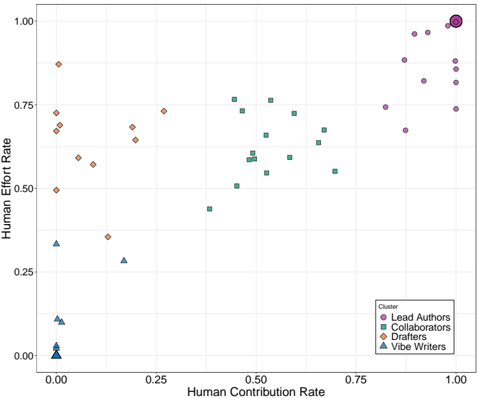
- K-means clustering on Human Contribution Ratio (HCR) and Human Edit Ratio (HER) yielded four profiles: Lead Authors (n = 37; HCR = 0.98, HER = 0.95), Collaborators (n = 15; HCR = 0.53, HER = 0.62), Vibe Writers (n = 14; HCR = 0.01, HER = 0.06), and Drafters (n = 11; HCR = 0.09, HER = 0.64).
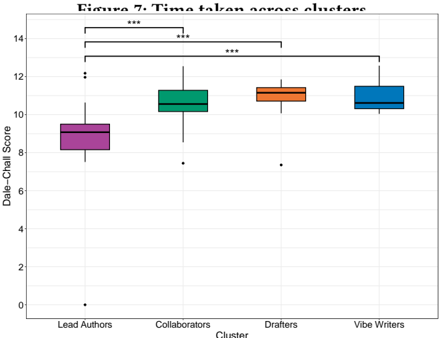
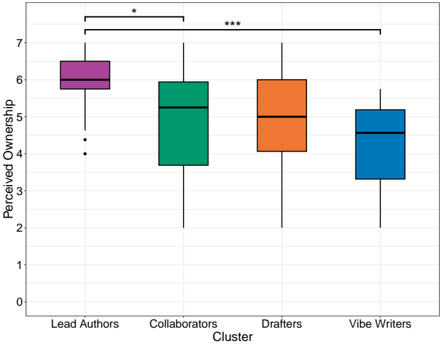
- Cluster differences were significant for query count, H(3) = 9.016, p = 0.0277 (Lead Authors vs Collaborators p = 0.0141); time spent, H(3) = 11.69, p = 0.009 (Vibe Writers shorter than Lead Authors, Collaborators, and Drafters); Dale-Chall, H(3) = 32.26, p < 0.001 (Lead Authors lower than the other three groups); and perceived ownership, H(3) = 23.80, p < 0.001 (Lead Authors higher than Collaborators and Vibe Writers); CSI showed no significant differences.
Methods
- A custom writing environment combined a text editor with an in-house ChatGPT interface using the OpenAI API and GPT-3.5-turbo; it logged keystrokes, cursor movements, insertions, deletions, copy-paste actions, and ChatGPT queries/responses with timestamps.
- 77 U.S. college students were recruited via university mailing lists and Prolific; they completed pre/post surveys (TAM, SEWS, Perceived Ownership, CSI) and an ACT-style argumentative essay prompt about automation replacing human labor, advised to spend approximately 30 minutes.
- Analyses included descriptive statistics, Spearman rank correlations between query count and writing outcomes, HCR/HER metrics, K-means clustering with silhouette/elbow selection (K = 4), Kruskal-Wallis tests with Dunn’s post hoc Bonferroni correction, and qualitative replay case studies.
Limitations
- The paper states: a single ACT-style argumentative prompt limits generalizability; GPT-3.5-turbo may differ from more advanced models; the ~30-minute task does not capture longitudinal writing; the task was not graded and had no real academic stakes; recruitment via mailing lists and Prolific introduces self-selection bias; findings are exploratory and correlational, not causal.
- The paper also states metric limitations: HCR overlooks structure and ideas when ChatGPT is used for revision, HER does not capture cognitive effort in planning, ideation, comprehending AI content, or deciding whether to incorporate it, and clustering may miss conceptual AI use (e.g., P26 was classified as a Collaborator but qualitatively resembled an editor of AI-generated content).
- Evident from the text: the sample is limited to U.S. college students and one essay genre, and the study did not assess overall writing quality beyond readability metrics or trace semantic provenance of AI-generated ideas.
Model-written summary. Check it against the paper before relying on it.
Integrity signals
Registry
Cites
Statistics
Figures






Verification
Claims the paper makes
0 Valid · 0 Not valid · 8 Not checked · 108 Own results and interpretations
A result the paper reports from its own data — it cites no other source for it, so there is none to check. The quote shows it is in the paper.
In the paper
“No significant correlations were found between query count and the post-task survey measures (PO and CSI).”
§ NIRVANA: A Comprehensive Dataset for Reproducing How Students Use Generative AI for Essay Writing > 5.1 Query Count and Writing Experience
plain- Asserted: passes — The authors put it forward as true.
- Checkable: passes — It can be checked against evidence.
- Load-bearing: unclear — It is unclear whether the paper’s conclusions depend on it.
- Based: passes — The paper gives a reason why it holds.
A result the paper reports from its own data — it cites no other source for it, so there is none to check. The quote shows it is in the paper.
In the paper
“No significant differences were found for CSI.”
§ NIRVANA: A Comprehensive Dataset for Reproducing How Students Use Generative AI for Essay Writing > 5.4 Behavioral and Perceptual Differences Across Writer Clusters
plain- Asserted: passes — The authors put it forward as true.
- Checkable: passes — It can be checked against evidence.
- Load-bearing: unclear — It is unclear whether the paper’s conclusions depend on it.
- Based: passes — The paper gives a reason why it holds.
A result the paper reports from its own data — it cites no other source for it, so there is none to check. The quote shows it is in the paper.
In the paper
“A similar pattern was observed for readability as measured by the Dale-Chall score (𝜌 = 0.380, 𝑝 < 0.001), with higher query counts associated with essays that are more difficult to read (see Figure 3b).”
§ NIRVANA: A Comprehensive Dataset for Reproducing How Students Use Generative AI for Essay Writing > 5.1 Query Count and Writing Experience
plainstates an association- Asserted: passes — The authors put it forward as true.
- Checkable: passes — It can be checked against evidence.
- Load-bearing: unclear — It is unclear whether the paper’s conclusions depend on it.
- Based: passes — The paper gives a reason why it holds.
- Rests on an assumption not shown here.
A result the paper reports from its own data — it cites no other source for it, so there is none to check. The quote shows it is in the paper.
In the paper
“Notably, 26 included no AI-generated words at all, suggesting they used ChatGPT primarily for idea generation, information search, or not at all.”
§ NIRVANA: A Comprehensive Dataset for Reproducing How Students Use Generative AI for Essay Writing > 5.3 Clustering Writer's Profile Based on Contribution and Edit
plainn = 26- Asserted: passes — The authors put it forward as true.
- Checkable: passes — It can be checked against evidence.
- Load-bearing: unclear — It is unclear whether the paper’s conclusions depend on it.
- Based: passes — The paper gives a reason why it holds.
- Rests on an assumption not shown here.
A result the paper reports from its own data — it cites no other source for it, so there is none to check. The quote shows it is in the paper.
In the paper
“We identify four writing profiles based on students' contribution and revision patterns: Lead Authors, Collaborators, Drafters, and Vibe Writers.”
§ NIRVANA: A Comprehensive Dataset for Reproducing How Students Use Generative AI for Essay Writing > Abstract
plain- Asserted: passes — The authors put it forward as true.
- Checkable: passes — It can be checked against evidence.
- Load-bearing: passes — The paper’s conclusions depend on it.
- Based: passes — The paper gives a reason why it holds.
32 more claims
Create a free account to see all 116 claims and every source verdict.
- It may state two separate claims as one. 52
- Probably not a substantial claim. 42
- The quote only partly states this claim. 3
Self-check
Percentages, sums and reported differences re-computed from the paper’s own numbers.
Each contradiction between two passages listed here was confirmed by an independent check.
Rated minor: it would not touch a result — a value no result rests on, a p-value that stays on the same side of the significance level, or a conflict that is clerical, resolved elsewhere in the paper, or outside its own findings.
In the paper
§ NIRVANA: A Comprehensive Dataset for Reproducing How Students Use Generative AI for Essay Writing > 5.3 Clustering Writer's Profile Based on Contribution and Edit
“Figure 5: Five Clusters of Participants based on HCR and HER.”
§ NIRVANA: A Comprehensive Dataset for Reproducing How Students Use Generative AI for Essay Writing > 5.3 Clustering Writer's Profile Based on Contribution and Edit
“The resulting clusters were visualized by plotting HCR against HER and characterized according to their relative magnitudes; mean HCR and HER values are reported in Table 1.”
Rated minor: it would not touch a result — a value no result rests on, a p-value that stays on the same side of the significance level, or a conflict that is clerical, resolved elsewhere in the paper, or outside its own findings.
In the paper
§ NIRVANA: A Comprehensive Dataset for Reproducing How Students Use Generative AI for Essay Writing > 3.4 Study Procedure and Task Information
“The prompt, adapted from an American College Testing (ACT) essay [1], addressed the issue of automation replacing human labor and presented three perspectives.”
§ NIRVANA: A Comprehensive Dataset for Reproducing How Students Use Generative AI for Essay Writing > References
“1. 2025. Jisuanke/CodeMirror-Record. https://github.com/Jisuanke/CodeMirror- Record original-date: 2019-05-08T13:32:58Z.”
Cited works that were retracted
Works this paper cites that were later retracted, from the retraction notices publishers deposit. Major when the notice came out before this paper was published.
A note, not an issue: for example, a cited work that was retracted only after this paper was published, which its authors could not have known.
In the paper
“Jin Wang and Wenxiang Fan. 2025. The effect of ChatGPT on students' learning performance, learning perception, and higher-order thinking: insights from a meta-analysis. Humanities and Social Sciences Communications 12, 1 (May 2025), 621. doi:10.1057/s41599-025-04787-y”
Cited work 10.1057/s41599-025-04787-y · retracted 2026-04-22 · notice 10.1057/s41599-026-07310-z · this paper published 2026
Citations
Cites
1 retracted
Wang, J., & Fan, W. (2025) · Humanities and Social Sciences Communications · doi:10.1057/s41599-025-04787-y · Cited by 322
RetractedPerceived usefulness, perceived ease of use, and user acceptance of information technology
Davis, F. D. (1989) · MIS Quarterly · doi:10.2307/249008 · Cited by 68,483
Chatting and cheating: Ensuring academic integrity in the era of ChatGPT
Cotton, D. R. E., Cotton, P. A., & Shipway, J. R. (2024) · Innovations in Education and Teaching International · doi:10.1080/14703297.2023.2190148 · Cited by 3,087
Thorndike, R. L. (1953) · Psychometrika · doi:10.1007/bf02289263 · Cited by 2,051
Artificial intelligence in higher education: the state of the field
Crompton, H., & Burke, D. (2023) · International Journal of Educational Technology in Higher Education · doi:10.1186/s41239-023-00392-8 · Cited by 2,010
A cognitive process theory of writing
Flower, L., & Hayes, J. R. (1981) · College Composition & Communication · doi:10.58680/ccc198115885 · Cited by 1,025
Psychological Ownership: Theoretical Extensions, Measurement, and Relation to Work Outcomes
Avey, J. B., Avolio, B. J., Crossley, C. D., & Luthans, F. (2009) · Journal of Organizational Behavior · doi:10.1002/job.583 · Cited by 920
A FORMULA FOR PREDICTING READABILITY
Dale, E., & Chall, J. S. (1948) · Cited by 775
ChatGPT and the rise of generative AI: Threat to academic integrity?
Eke, D. O. (2023) · Journal of Responsible Technology · doi:10.1016/j.jrt.2023.100060 · Cited by 532
The measurement of readability: useful information for communicators
Klare, G. R. (2000) · ACM Journal of Computer Documentation · doi:10.1145/344599.344630 · Cited by 504
Cited by
Rahma, Sartika, D., & Arif, N. (2026) · IDEAS Journal on English Language Teaching and Learning Linguistics and Literature · doi:10.24256/ideas.v14i2.12511
Metadata
- Authors
- Jelson, A., Manesh, D., Lee, S., Jang, A., Dunlap, D., Maddox, T., Kim, Y.-H., & Lee, S. W.
- Affiliations
- Virginia Tech (US)
- George Mason University (US)
- NAVER Cloud (South Korea) (KR)
- Venue
- arXiv
- Publisher
- arXiv
- Published
- 2026
- ISSN
- 2331-8422 (ISSN-L)
- arXiv
- 2604.07344
- OpenAlex
- W7152541924
- Semantic Scholar
- d8076fc06ed387b59c4a74b74410949d8776155d
- Cited by
- 1
- References
- 46
- Citations by year
- 2026: 1
- Type
- posted content
- Language
- en
- Open access
- green
- arxiv.org
- Licence
- Locations
- arXiv (Cornell University) (submittedVersion, cc-by)
- arXiv (Cornell University) (cc-by)
- Topics
- Social Sciences › Education › Artificial Intelligence in Education
- Physical Sciences › Computer Science › Computer Science Applications › Online Learning and Analytics
- Social Sciences › Education › Academic integrity and plagiarism
- Keywords
- generative AI in education, AI writing tools, ChatGPT, student essay writing, student-AI interaction, query frequency, readability, university students
About these checks
Registry, retraction, Cites and statistics results are computed, not judged, with one exception: a printed reference that no index lists is read once by a model before it counts as a citation error. Claims are extracted by a model and kept only when their quote appears verbatim in the text; each cited source is then checked, with a model’s help, for whether it says what the claim relies on. Those verdicts can be wrong — read the claim’s quote and the cited source before relying on one.
A language model drew the claims from the paper on 2026-11-18, under version 3 of the claim definition (model deepseek-v4.1-flash, prompt extract-v3).
A second model labelled each claim on 2026-11-18 (model jev-1.13-20260917, definition revision gold-guideline-v0.2).
Statistics and arithmetic are recomputed, not judged.
Confidence bands are shown only for fields calibrated on our annotated test set. None is calibrated yet, so no band is shown.
What counts as a claim ›How we measure confidence ›How we check this ›
Are you an author, or do you see a problem with this page? Request a review
How to cite
Cite CoChat for the checks on this page, and the paper for its own findings.
- This page
- CoChat. (2026). Citation check: NIRVANA: A Comprehensive Dataset for Reproducing How Students Use Generative AI for Essay Writing. https://app.cochat.ai/papers/10.48550/arxiv.2604.07344
- The paper
- Jelson, A., Manesh, D., Lee, S., Jang, A., Dunlap, D., Maddox, T., Kim, Y.-H., & Lee, S. W. (2026). NIRVANA: A Comprehensive Dataset for Reproducing How Students Use Generative AI for Essay Writing. arXiv. https://doi.org/10.48550/arxiv.2604.07344
Data sources
Bibliographic data: Semantic Scholar, OpenAlex, Crossref.
Contains information from the Semantic Scholar Academic Graph Datasets, made available under the ODC Attribution License (ODC-BY 1.0).
Semantic Scholar’s data is described in: Kinney, R., et al. (2023). The Semantic Scholar Open Data Platform. arXiv:2301.10140.
