

The DOI matches its DataCite record; 29 of the 29 references it cites were found in a registry or an index; none of the 43 sources its claims cite is checked for support yet.
Understanding Generative AI-mediated User Engagement with Academic Library Resources
Open accessAbstract
This study empirically analyzed generative AI as an emerging discovery pathway to academic library resources. Utilizing web analytics from August 2023 to October 2025, the research identifies a significant increase in AI-mediated traffic, particularly following the integration of linked citation features. Referral analysis identified ChatGPT, Perplexity, and Gemini as the primary platforms driving this traffic. A substantial portion of users reached the institutional repository, primarily accessing electronic theses and dissertations. This pattern suggests that AI retrieval mechanisms effectively surface resources with structured metadata and stable permalinks that are Open Access and freely available. The results illustrate how AI ecosystems currently expose library resources and underscore the need for continued analysis and a strategic response to the evolving AI landscape.
Overview
CoChat Summary
TL;DR
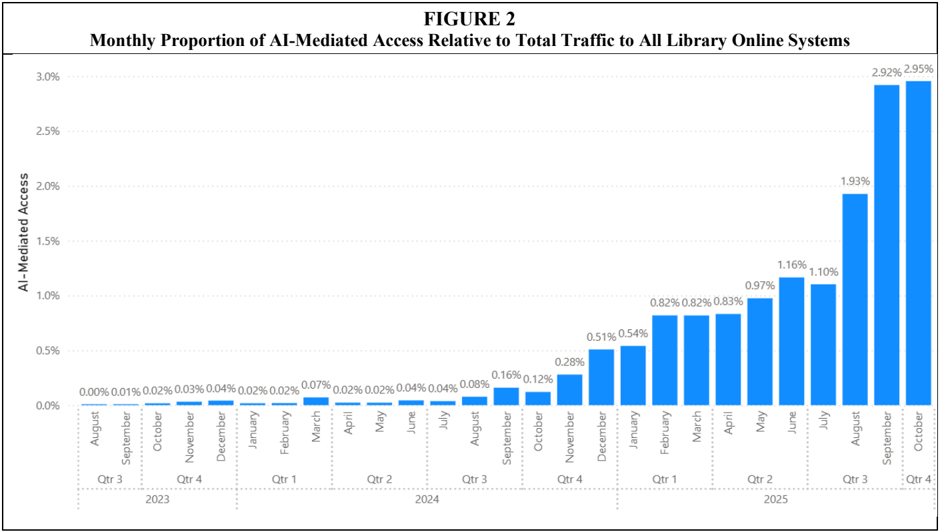
This exploratory case study uses Google Analytics (GA4) data from Drexel University Libraries (Aug 1, 2023–Oct 31, 2025) to show that generative AI platforms, especially ChatGPT, increasingly refer users to library resources, with traffic concentrated in the institutional repository and electronic theses/dissertations. AI-mediated visits remain a minority of total traffic but show a steady upward trend and transactional, item-focused engagement.
Key findings
- GA4 referral data identified 20 distinct generative AI platforms; first AI-mediated access appeared Aug 25, 2023 from Perplexity. ChatGPT became predominant; after OpenAI’s “Sources” feature in late Oct 2024 and GPT-5 release in Aug 2025, ChatGPT-mediated traffic rose 78% in Sept 2025 vs Aug and 47% in Oct 2025 vs previous month. In Oct 2025, ChatGPT had 85% of AI-mediated traffic to the library website, Perplexity 8%, Gemini 6%, Copilot 1%.
- AI-mediated access reached all seven library systems but was uneven: Research Repository (Esploro) received 2,997 AI-mediated users out of 159,940 repository visitors; Library Guides 688 of 94,937; core library website 290 of 138,356; Virtual Reference 29, Scheduling 17, Digital Exhibit 7. Research Repository received referrals from 18 distinct AI platforms and Library Guides from 11; Discovery Service (Primo) received comparatively little.
- Content-level analysis of 3,451 unique landing pages and 9,753 AI-referral sessions found Research Repository accounted for 75% of referrals (7,303 sessions), Library Guides 12%, core website 7%, Discovery Service 4%. Within Research Repository, dissertations/theses dominated at 4,098 sessions (56.1%), followed by journal articles at 1,430 (19.6%).
- Engagement differed by source: ChatGPT referrals to Research Repository had 2,396 users, 21.82 sec average engagement time, 0.42 bounce rate, and 1.86 views per active user, similar to search-engine referrals (Google: 33.57 sec, 0.26 bounce, 2.57 views; Google Scholar: 23.98 sec, 0.46 bounce, 1.40 views). Institutional platforms showed stronger engagement (Drexel Discovery Service: 71.70 sec, 0.39 bounce, 7.13 views; Drexel Learn: 127.20 sec, 0.24 bounce, 9.47 views).
Methods
- Exploratory case study of Drexel University Libraries using GA4 web analytics from Aug 1, 2023 through Oct 31, 2025 across seven library-managed systems: core website (Sitecore), Discovery Service (Ex Libris Primo), Research Repository (Ex Libris Esploro), Library Guides (Springshare), Virtual Reference (Springshare), Room & Event Scheduling (Springshare), and Digital Exhibits (Omeka).
- AI-mediated traffic was identified from the GA4 “session source” dimension by direct matching against known AI domains (e.g., chatgpt.com, perplexity.ai, gemini.google.com/app, copilot.microsoft.com) and pattern-based filtering for domains ending in “.ai” or containing AI-related identifiers. Generative AI platforms were defined as LLM-based tools that generate new content; AI-powered research tools or AI-enhanced discovery systems that augment retrieval were excluded.
- Primary unit was “total users”; sessions were used for content-level analysis. Key dimensions were session source, page path, and hostname. Analysis had three phases: monthly trend analysis, system-level distribution analysis, and content-level analysis; data processing in Microsoft Excel and comparative analysis/visualization in Microsoft Power BI.
Limitations
- Stated: referral tracking is technically inconsistent and likely yields a conservative estimate; mobile/desktop apps may not transmit referral data like browser sessions, and platforms began transmitting identifiable referral signals at different times, affecting longitudinal trends.
- Stated: AI sources were classified only as LLM-based generative platforms, excluding AI-powered research tools and embedded AI features in traditional discovery systems; less prominent or newly emerging services may have been omitted. GA4 metrics are subject to automated activity; prioritizing user-level data reduces bot inflation but residual non-human noise may remain.
- Stated: single-institution case study at Drexel University Libraries, so findings reflect a specific digital architecture and metadata environment; variations in SEO, repository structures, and metadata richness could produce different visibility patterns elsewhere. Correlations between platform updates and traffic spikes do not establish causality, as seasonal academic cycles or internal literacy initiatives may be variables. Evident from text: the quantitative GA4 design cannot capture user experience or motivations behind visits; the paper calls for future qualitative interviews or usability tests.
Model-written summary. Check it against the paper before relying on it.
Integrity signals
Registry
Cites
Statistics
Figures


Verification
Claims the paper makes
0 Valid · 1 Not valid · 34 Not checked · 105 Own results and interpretations
A result the paper reports from its own data — it cites no other source for it, so there is none to check. The quote shows it is in the paper.
In the paper
“Library Guides followed, accounting for 1,217 sessions overall.”
§ AI-mediated user engagement 1 Understanding Generative AI-mediated User Engagement with Academic Library Resources > Content-level patterns of AI-mediated access
plain- Asserted: passes — The authors put it forward as true.
- Checkable: passes — It can be checked against evidence.
- Load-bearing: unclear — It is unclear whether the paper’s conclusions depend on it.
- Based: passes — The paper gives a reason why it holds.
A result the paper reports from its own data — it cites no other source for it, so there is none to check. The quote shows it is in the paper.
In the paper
“A substantial portion of users reached the institutional repository, primarily accessing electronic theses and dissertations.”
§ AI-mediated user engagement 1 Understanding Generative AI-mediated User Engagement with Academic Library Resources > Abstract
plain- Asserted: passes — The authors put it forward as true.
- Checkable: passes — It can be checked against evidence.
- Load-bearing: passes — The paper’s conclusions depend on it.
- Based: passes — The paper gives a reason why it holds.
A result the paper states — it cites no source for it, so there is none to check. The quote shows it is in the paper.
In the paper
“Following the launch of GPT-5, referrals via ChatGPT increased substantially.”
§ AI-mediated user engagement 1 Understanding Generative AI-mediated User Engagement with Academic Library Resources > Emergence and Growth of AI-Mediated Access
plainstates a cause- Asserted: passes — The authors put it forward as true.
- Checkable: passes — It can be checked against evidence.
- Load-bearing: unclear — It is unclear whether the paper’s conclusions depend on it.
- Based: passes — The paper gives a reason why it holds.
A result the paper reports from its own data — it cites no other source for it, so there is none to check. The quote shows it is in the paper.
In the paper
“While AI-mediated referrals remain a minority of overall access, the figure shows a steady upward trend in their proportional share, indicating that AI platforms are becoming a more consistent source of referral traffic rather than a transient phenomenon.”
§ AI-mediated user engagement 1 Understanding Generative AI-mediated User Engagement with Academic Library Resources > Emergence and Growth of AI-Mediated Access
hedgedstates an association- Asserted: passes — The authors put it forward as true.
- Checkable: passes — It can be checked against evidence.
- Load-bearing: passes — The paper’s conclusions depend on it.
- Based: passes — The paper gives a reason why it holds.
A result the paper reports from its own data — it cites no other source for it, so there is none to check. The quote shows it is in the paper.
In the paper
“Referral analysis identified ChatGPT, Perplexity, and Gemini as the primary platforms driving this traffic.”
§ AI-mediated user engagement 1 Understanding Generative AI-mediated User Engagement with Academic Library Resources > Abstract
plainstates a cause- Asserted: passes — The authors put it forward as true.
- Checkable: passes — It can be checked against evidence.
- Load-bearing: passes — The paper’s conclusions depend on it.
- Based: passes — The paper gives a reason why it holds.
72 more claims
Create a free account to see all 140 claims and to verify the 14 references still open.
- It may state two separate claims as one. 46
- The quote only partly states this claim. 3
- Probably not a substantial claim. 24
Citations
Cites
“ChatGPT seems too good to be true”: College students’ use and perceptions of generative AI
Baek, C., Tate, T., & Warschauer, M. (2024) · Computers and Education: Artificial Intelligence · doi:10.1016/j.caeai.2024.100294 · Cited by 306
Chatterji, A., Cunningham, T., Deming, D., Hitzig, Z., Ong, C., Shan, C. Y., & Wadman, K. (2025) · doi:10.3386/w34255 · Cited by 233
Evaluating AI Literacy in Academic Libraries: A Survey Study with a Focus on U.S. Employees
Lo, L. S. (2024) · College & Research Libraries · doi:10.5860/crl.85.5.635 · Cited by 133
Lo, L. S. (2024) · The Journal of Academic Librarianship · doi:10.1016/j.acalib.2024.102883 · Cited by 82
Nasr, N. R., Tu, C.-H., Werner, J., Bauer, T., Yen, C.-J., & Sujo-Montes, L. (2025) · Education Sciences · doi:10.3390/educsci15091198 · Cited by 75
Yeung, R. S. K., Tian, R., Chiu, D. K. W., & Choi, S. P. M. (2025) · The Journal of Academic Librarianship · doi:10.1016/j.acalib.2025.103082 · Cited by 49
Using ChatGPT-generated essays in library instruction
Johnson, S., Owens, E. E., Menendez, H., & Kim, D. (2024) · The Journal of Academic Librarianship · doi:10.1016/j.acalib.2024.102863 · Cited by 42
Key factors influencing intention to use ChatGPT: An empirical study of U.S. students
Pham, L. K., Klaus, T., & Bateh, J. (2025) · Acta Psychologica · doi:10.1016/j.actpsy.2025.105516 · Cited by 37
Suchánek, P., & Kŕaĺová, M. (2025) · Journal of Innovation & Knowledge · doi:10.1016/j.jik.2025.100781 · Cited by 29
Beyond the Algorithm: Understanding How ChatGPT Handles Complex Library Queries
Yang, S. Q., & Mason, S. (2023) · Internet Reference Services Quarterly · doi:10.1080/10875301.2023.2291441 · Cited by 27
Research works printed but not linked: 2
- Erdelez, S. (1995). Information encountering: An exploration beyond information seeking (Doctoral dissertation, Syracuse University). Syracuse University, School of Information Studies. https://surface.syr.edu/it_etd/38
- Wu, Y. (2025). AI in libraries: Beyond replacement. Computers in Libraries, 45(7), 5-7.
Cited by
Still being checked.
Metadata
- Authors
- Kim, H. M., & Stanislaw, S.
- ORCID
- Stanislaw, Stacy
- Venue
- arXiv
- Publisher
- arXiv
- Published
- 2026
- ISSN
- 2331-8422 (ISSN-L)
- arXiv
- 2607.20328
- OpenAlex
- W7170159840
- Semantic Scholar
- a39437ea2fc857ee8df871d397b69a9e71af9c4a
- Cited by
- 0
- References
- 29
- Type
- posted content
- Language
- en
- Open access
- green
- arxiv.org
- Licence
- Locations
- arXiv (Cornell University) (submittedVersion, cc-by)
- arXiv (Cornell University) (cc-by)
- Topics
- Social Sciences › Library and Information Sciences › Library Science and Information
- Social Sciences › Library and Information Sciences › Web and Library Services
- Physical Sciences › Computer Science › Information Systems › Web visibility and informetrics
- Keywords
- generative AI, academic libraries, user engagement, library discovery, ChatGPT, perplexity, Gemini, institutional repositories, electronic theses and dissertations, open access, web analytics
About these checks
Registry, retraction, Cites and statistics results are computed, not judged, with one exception: a printed reference that no index lists is read once by a model before it counts as a citation error. Claims are extracted by a model and kept only when their quote appears verbatim in the text; each cited source is then checked, with a model’s help, for whether it says what the claim relies on. Those verdicts can be wrong — read the claim’s quote and the cited source before relying on one.
A language model drew the claims from the paper on 2026-11-18, under version 3 of the claim definition (model deepseek-v4.1-flash, prompt extract-v3).
A second model labelled each claim on 2026-11-18 (model jev-1.13-20260917, definition revision gold-guideline-v0.2).
Statistics and arithmetic are recomputed, not judged.
Confidence bands are shown only for fields calibrated on our annotated test set. None is calibrated yet, so no band is shown.
What counts as a claim ›How we measure confidence ›How we check this ›
Are you an author, or do you see a problem with this page? Request a review
How to cite
Cite CoChat for the checks on this page, and the paper for its own findings.
- This page
- CoChat. (2026). Citation check: Understanding Generative AI-mediated User Engagement with Academic Library Resources. https://app.cochat.ai/papers/10.48550/arxiv.2607.20328
- The paper
- Kim, H. M., & Stanislaw, S. (2026). Understanding Generative AI-mediated User Engagement with Academic Library Resources. arXiv. https://doi.org/10.48550/arxiv.2607.20328
Data sources
Bibliographic data: Semantic Scholar, OpenAlex, Crossref.
Contains information from the Semantic Scholar Academic Graph Datasets, made available under the ODC Attribution License (ODC-BY 1.0).
Semantic Scholar’s data is described in: Kinney, R., et al. (2023). The Semantic Scholar Open Data Platform. arXiv:2301.10140.
