

GeoRoute: Geometry-Aware Hybrid Inference for Traffic Future-Frame Prediction
Open accessThe DOI matches its DataCite record; 64 of the 64 references it cites were found in a registry or an index; none of the 20 sources its claims cite is checked for support yet.
Abstract
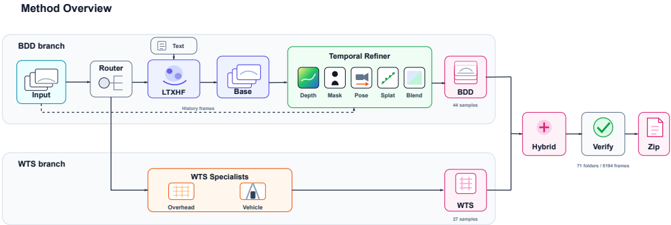
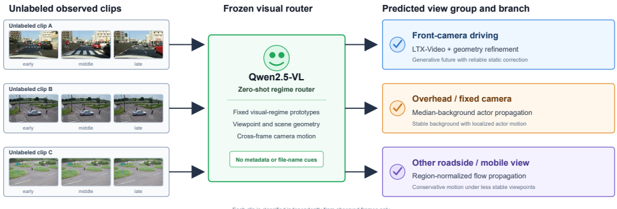
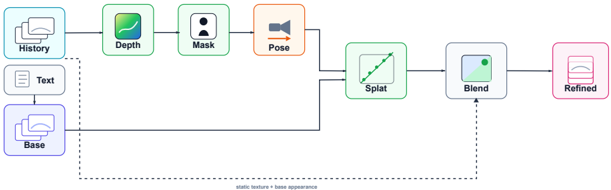
Long-horizon future-frame prediction is important for autonomous driving, traffic surveillance, and intelligent transportation systems, yet remains challenging due to temporal ghosting, geometry drift, and inconsistent object motion. Recent latent video diffusion models have achieved impressive visual quality, but directly applying them to structured traffic scenes often leads to unstable geometry and degraded temporal coherence over extended horizons. We present a training-free inference framework that stabilizes reliable static structure in pretrained video predictions through multi-frame temporal context and view-conditioned routing. For front-camera videos, our method refines generated futures with a multi-frame depth-layered renderer that projects static geometry from observed history frames while preserving dynamic regions from the generative base model. For heterogeneous traffic views, a frozen vision-language model infers a coarse camera group from the observed clip and selects a specialized motion-based predictor. The framework requires neither retraining nor fine-tuning of the underlying video model and can be applied directly to pretrained generators. We validate the proposed framework on the AI City Challenge Track 5 benchmark, where our final system achieves competitive performance among the top-ranked teams. These results demonstrate that geometry-aware inference-time refinement and view-conditioned hybrid inference can improve static-geometry stability and low-…
Overview
CoChat Summary
TL;DR
GeoRoute is a training-free inference framework that stabilizes static structure in pretrained video predictions for traffic future-frame prediction by combining Qwen-assisted view routing, LTX-Video generation, and confidence-aware depth-based point-splatting refinement from observed history frames. It ranks fifth on the AI City Challenge Track 5 full-test leaderboard with a final score of 73.28.
Key findings
- On the AI City Challenge Track 5 full-test leaderboard, the final system ranks 5th with a final score of 73.2843; reported metrics are PSNR 19.7360, SSIM 0.6472, LPIPS 0.2942, CLIP 0.9454, FID 33.6081, and FVD 29.3483. Among the top five teams, it achieves the second-highest PSNR and an SSIM close to the best reported value.
- Cumulative ablation shows the base prediction at final 66.8, PSNR 18.21, SSIM 0.603, LPIPS 0.356, CLIP 0.930, FID 55.7, FVD 37.9; the full routed system reaches final 73.28, PSNR 19.74, SSIM 0.647, LPIPS 0.294, CLIP 0.945, FID 33.61, FVD 29.35.
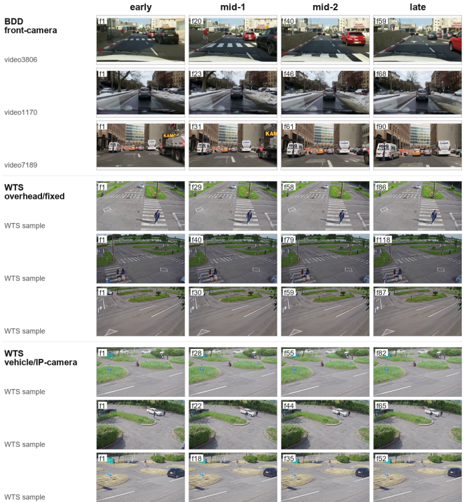
- The test set contains 71 videos and 5194 target frames: 44 front-camera videos, 7 overhead/fixed-camera videos, and 20 vehicle/IP-camera videos; a post-hoc audit against benchmark-provided reference groups found router agreement for all 71 videos.
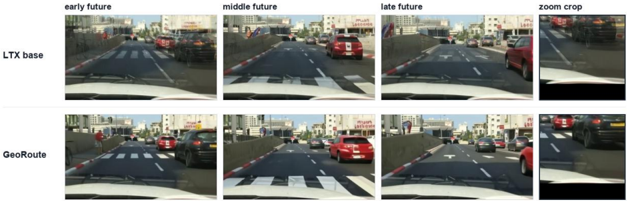
- Qualitative comparisons indicate GeoRoute reduces static-region ghosting near lane markings, road boundaries, and actor-background boundaries while preserving dynamic regions from the LTX-Video base prediction; the method does not re-estimate actor motion.
Methods
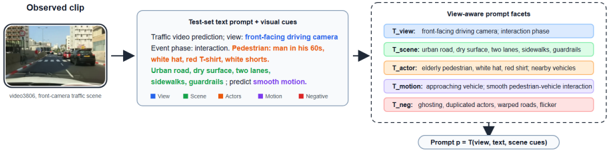
- Training-free inference: a frozen Qwen2.5-VL-7B-Instruct router classifies each observed clip into one of three visual regimes; front-camera driving views use prompt construction, LTX-Video generation, and geometry-aware refinement, overhead/fixed views use median-background actor propagation, and other oblique/mobile views use conservative region-normalized flow propagation.
- Geometry refinement: up to 8 history frames at stride 2 are processed with DPT Hybrid-MiDaS depth and DeepLabV3-ResNet50 actor masks; ORB features on static regions and EPnP-RANSAC estimate camera transforms, rejecting poses with fewer than 20 ORB matches or 12 RANSAC inliers; z-buffer splatting renders a static layer, and confidence-aware blending uses α = 0.75 with confidence factors for coverage, staticness, color agreement exp(−Δ/32), and pose quality.
- Evaluation: AI City Challenge Track 5 long-horizon traffic future-frame prediction, using BDD front-camera videos and WTS traffic views; metrics are PSNR, SSIM, LPIPS, CLIP similarity, FID, and FVD; experiments run on one NVIDIA RTX A6000 GPU with 48GB memory, and full-test inference finishes within one day.
Limitations
- Stated: geometry refinement depends on relative depth, actor masks, and feature-based alignment, so weak texture, reflections, occlusion, or a poor generated base frame can reject or misalign the projection; independently canonicalized monocular depth maps do not guarantee a common translation scale for composed multi-history pseudo-transforms, and confidence gating limits but does not make the reconstruction metric.
- Stated: recent-priority fusion may select a newer but less accurate source over an older well-aligned frame; dynamic-motion errors remain in the base generator, and motion propagation may freeze or distort a clip when its observed behavior does not match the selected regime; the router assumes the three human-defined regimes remain appropriate, with automatic discovery of new regimes left for future work.
- Stated/evident: the remaining gap mainly appears in LPIPS, FID, and FVD, which are more sensitive to perceptual realism and video-level distribution matching, and dynamic actors, disoccluded regions, and newly synthesized content are deliberately preserved from the frozen base generator and remain difficult to correct through static geometry refinement alone; the ablation is described as challenge-server development trends rather than an independent validation-set ablation, and ground-truth future frames for the official test set are not publicly available, so test metrics come from the challenge evaluation server.
Model-written summary. Check it against the paper before relying on it.
Integrity signals
Registry
Cites
Statistics
Figures
Verification
Claims the paper makes
0 Valid · 5 Not valid · 10 Not checked · 57 Own results and interpretations
In the paper
“Table 1 shows that GeoRoute ranks 5th on the official full-test leaderboard with a final score of 73.2843.”
- Also stated in: § 5 Conclusion · plain
“On AI City Challenge Track 5 [36], our system ranks 5th on the official full-test leaderboard with a final score of 73.28.”
§ GeoRoute: Geometry-Aware Hybrid Inference for Traffic Future-Frame Prediction > Algorithm 1 Training-free GeoRoute inference
What the sources say
- Not matchedcites [36]
The reference list we hold has no entry [36].
plain- Asserted: passes — The authors put it forward as true.
- Checkable: passes — It can be checked against evidence.
- Load-bearing: passes — The paper’s conclusions depend on it.
- Based: passes — The paper gives a reason why it holds.
- Also stated in: § 5 Conclusion · plain
A result the paper states — it cites no source for it, so there is none to check. The quote shows it is in the paper.
In the paper
“Vehicle/IP-camera examples also avoid the large global distortions that can arise from unconstrained flow propagation.”
§ GeoRoute: Geometry-Aware Hybrid Inference for Traffic Future-Frame Prediction > 4.4 Qualitative Analysis
plain- Asserted: passes — The authors put it forward as true.
- Checkable: passes — It can be checked against evidence.
- Load-bearing: unclear — It is unclear whether the paper’s conclusions depend on it.
- Based: passes — The paper gives a reason why it holds.
In the paper
“The LTX-Video [14] sequence blends multiple temporal states around nearby vehicles and road structures, producing visible afterimages.”
§ GeoRoute: Geometry-Aware Hybrid Inference for Traffic Future-Frame Prediction > 4.4 Qualitative Analysis
What the sources say
- Not matchedcites [14]
The reference list we hold has no entry [14].
plainstates a cause- Asserted: passes — The authors put it forward as true.
- Checkable: passes — It can be checked against evidence.
- Load-bearing: passes — The paper’s conclusions depend on it.
- Based: passes — The paper gives a reason why it holds.
- Not matched
A result the paper reports from its own data — it cites no other source for it, so there is none to check. The quote shows it is in the paper.
In the paper
“The leaderboard results show competitive overall lowlevel fidelity, while qualitative comparisons support the intended staticstructure effect.”
§ GeoRoute: Geometry-Aware Hybrid Inference for Traffic Future-Frame Prediction > Abstract
plain- Asserted: passes — The authors put it forward as true.
- Checkable: passes — It can be checked against evidence.
- Load-bearing: unclear — It is unclear whether the paper’s conclusions depend on it.
- Based: passes — The paper gives a reason why it holds.
In the paper
“We validate the proposed framework on the AI City Challenge Track 5 benchmark [36], where our final system ranks fifth on the official fulltest leaderboard.”
§ GeoRoute: Geometry-Aware Hybrid Inference for Traffic Future-Frame Prediction > Abstract
What the sources say
- Not matchedcites [36]
The reference list we hold has no entry [36].
plain- Asserted: passes — The authors put it forward as true.
- Checkable: passes — It can be checked against evidence.
- Load-bearing: unclear — It is unclear whether the paper’s conclusions depend on it.
- Based: passes — The paper gives a reason why it holds.
- Not matched
21 more claims
Create a free account to see all 72 claims and every source verdict.
- It may state two separate claims as one. 34
- Probably not a substantial claim. 18
Citations
Cites
Image quality assessment: from error visibility to structural similarity
Wang, Z., Bovik, A. C., Sheikh, H. R., & Simoncelli, E. P. (2004) · IEEE Transactions on Image Processing · doi:10.1109/tip.2003.819861 · Cited by 57,892
Fischler, M. A., & Bolles, R. C. (1981) · Communications of the ACM · doi:10.1145/358669.358692 · Cited by 25,893
The unreasonable effectiveness of deep features as a perceptual metric
Zhang, R., Isola, P., Efros, A. A., Shechtman, E., & Wang, O. (2018) · arXiv · doi:10.48550/arxiv.1801.03924 · Cited by 24,812
High-Resolution Image Synthesis with Latent Diffusion Models
Rombach, R., Blattmann, A., Lorenz, D., Esser, P., & Ommer, B. (2022) · 2022 IEEE/CVF Conference on Computer Vision and Pattern Recognition (CVPR) · doi:10.1109/cvpr52688.2022.01042 · Cited by 20,302
Learning Transferable Visual Models From Natural Language Supervision
Radford, A., Kim, J. W., Hallacy, C., Ramesh, A., Goh, G., Agarwal, S., Sastry, G., Askell, A., Mishkin, P., Clark, J., et al. (2021) · arXiv · doi:10.48550/arxiv.2103.00020 · Cited by 15,293
The Unreasonable Effectiveness of Deep Features as a Perceptual Metric
Zhang, R., Isola, P., Efros, A. A., Shechtman, E., & Wang, O. (2018) · 2018 IEEE/CVF Conference on Computer Vision and Pattern Recognition · doi:10.1109/cvpr.2018.00068 · Cited by 14,623
ORB: An efficient alternative to SIFT or SURF
Rublee, E., Rabaud, V., Konolige, K., & Bradski, G. (2011) · 2011 International Conference on Computer Vision · doi:10.1109/iccv.2011.6126544 · Cited by 11,037
GANs Trained by a Two Time-Scale Update Rule Converge to a Local Nash Equilibrium
Heusel, M., Ramsauer, H., Unterthiner, T., Nessler, B., & Hochreiter, S. (2017) · arXiv · doi:10.48550/arxiv.1706.08500 · Cited by 8,365
Rethinking Atrous Convolution for Semantic Image Segmentation
Chen, L.-C., Papandreou, G., Schroff, F., & Adam, H. (2017) · arXiv · doi:10.48550/arxiv.1706.05587 · Cited by 7,517
EPnP: An Accurate O(n) Solution to the PnP Problem
Lepetit, V., Moreno-Noguer, F., & Fua, P. (2009) · International Journal of Computer Vision · doi:10.1007/s11263-008-0152-6 · Cited by 3,298
Two-Frame Motion Estimation Based on Polynomial Expansion
Farnebäck, G. (2003) · Lecture Notes in Computer Science · doi:10.1007/3-540-45103-x_50 · Cited by 2,971
Towards Robust Monocular Depth Estimation: Mixing Datasets for Zero-Shot Cross-Dataset TransferPreprint
Ranftl, R., Lasinger, K., Hafner, D., Schindler, K., & Koltun, V. (2019) · IEEE Transactions on Pattern Analysis and Machine Intelligence · doi:10.48550/arxiv.1907.01341 · Cited by 2,947
(2020) · doi:10.1007/978-3-030-58536-5_24 · Cited by 2,824
BDD100K: A Diverse Driving Dataset for Heterogeneous Multitask Learning
Yu, F., Chen, H., Wang, X., Xian, W., Chen, Y., Liu, F., Madhavan, V., & Darrell, T. (2020) · 2020 IEEE/CVF Conference on Computer Vision and Pattern Recognition (CVPR) · doi:10.1109/cvpr42600.2020.00271 · Cited by 2,641
Vision Transformers for Dense Prediction
Ranftl, R., Bochkovskiy, A., & Koltun, V. (2021) · 2021 IEEE/CVF International Conference on Computer Vision (ICCV) · doi:10.1109/iccv48922.2021.01196 · Cited by 2,373
Improved adaptive Gaussian mixture model for background subtraction
Zivkovic, Z. (2004) · Proceedings of the 17th International Conference on Pattern Recognition, 2004. ICPR 2004. · doi:10.1109/icpr.2004.1333992 · Cited by 1,951
Unsupervised Learning of Video Representations using LSTMs
Srivastava, N., Mansimov, E., & Salakhutdinov, R. (2015) · arXiv · doi:10.48550/arxiv.1502.04681 · Cited by 1,861
Towards Robust Monocular Depth Estimation: Mixing Datasets for Zero-Shot Cross-Dataset Transfer
Ranftl, R., Lasinger, K., Hafner, D., Schindler, K., & Koltun, V. (2022) · IEEE Transactions on Pattern Analysis and Machine Intelligence · doi:10.1109/tpami.2020.3019967 · Cited by 1,618
Video Frame Synthesis Using Deep Voxel Flow
Liu, Z., Yeh, R. A., Tang, X., Liu, Y., & Agarwala, A. (2017) · 2017 IEEE International Conference on Computer Vision (ICCV) · doi:10.1109/iccv.2017.478 · Cited by 743
High-Resolution Image Synthesis with Latent Diffusion Models
Rombach, R., Blattmann, A., Lorenz, D., Esser, P., & Ommer, B. (2021) · arXiv · doi:10.48550/arxiv.2112.10752 · Cited by 737
Align Your Latents: High-Resolution Video Synthesis with Latent Diffusion Models
Blattmann, A., Rombach, R., Ling, H., Dockhorn, T., Kim, S. W., Fidler, S., & Kreis, K. (2023) · 2023 IEEE/CVF Conference on Computer Vision and Pattern Recognition (CVPR) · doi:10.1109/cvpr52729.2023.02161 · Cited by 724
MCVD: Masked Conditional Video Diffusion for Prediction, Generation, and InterpolationPreprint
Voleti, V. S., Jolicoeur-Martineau, A., & Pal, C. (2022) · arXiv.org · doi:10.48550/arxiv.2205.09853 · Cited by 452
TokenFlow: Consistent Diffusion Features for Consistent Video Editing
Geyer, M., Bar-Tal, O., Bagon, S., & Dekel, T. (2023) · International Conference on Learning Representations · doi:10.48550/arxiv.2307.10373 · Cited by 451
SynSin: End-to-End View Synthesis From a Single Image
Wiles, O., Gkioxari, G., Szeliski, R., & Johnson, J. (2020) · 2020 IEEE/CVF Conference on Computer Vision and Pattern Recognition (CVPR) · doi:10.1109/cvpr42600.2020.00749 · Cited by 418
MasaCtrl: Tuning-Free Mutual Self-Attention Control for Consistent Image Synthesis and Editing
Cao, M., Wang, X., Qi, Z., Shan, Y., Qie, X., & Zheng, Y. (2023) · 2023 IEEE/CVF International Conference on Computer Vision (ICCV) · doi:10.1109/iccv51070.2023.02062 · Cited by 413
SimVP: Simpler yet Better Video Prediction
Gao, Z., Tan, C., Wu, L., & Li, S. Z. (2022) · 2022 IEEE/CVF Conference on Computer Vision and Pattern Recognition (CVPR) · doi:10.1109/cvpr52688.2022.00317 · Cited by 403
Text2Video-Zero: Text-to-Image Diffusion Models are Zero-Shot Video Generators
Khachatryan, L., Movsisyan, A., Tadevosyan, V., Henschel, R., Wang, Z., Navasardyan, S., & Shi, H. (2023) · 2023 IEEE/CVF International Conference on Computer Vision (ICCV) · doi:10.1109/iccv51070.2023.01462 · Cited by 384
Softmax Splatting for Video Frame Interpolation
Niklaus, S., & Liu, F. (2020) · 2020 IEEE/CVF Conference on Computer Vision and Pattern Recognition (CVPR) · doi:10.1109/cvpr42600.2020.00548 · Cited by 381
Deep Predictive Coding Networks for Video Prediction and Unsupervised Learning
Lotter, W. E., Kreiman, G., & Cox, D. (2016) · arXiv (Cornell University) · doi:10.48550/arxiv.1605.08104 · Cited by 368
Prompt-to-Prompt Image Editing with Cross Attention Control
Hertz, A., Mokady, R., Tenenbaum, J., Aberman, K., Pritch, Y., & Cohen‐Or, D. (2022) · arXiv (Cornell University) · doi:10.48550/arxiv.2208.01626 · Cited by 360
Rerender A Video: Zero-Shot Text-Guided Video-to-Video Translation
Yang, S., Zhou, Y., Liu, Z., & Loy, C. C. (2023) · SIGGRAPH Asia Conference Papers · doi:10.1145/3610548.3618160 · Cited by 357
Dual Motion GAN for Future-Flow Embedded Video Prediction
Liang, X., Lee, L., Dai, W., & Xing, E. P. (2017) · 2017 IEEE International Conference on Computer Vision (ICCV) · doi:10.1109/iccv.2017.194 · Cited by 328
Ho, J., Salimans, T., Gritsenko, A., Chan, W., Norouzi, M., & Fleet, D. J. (2022) · arXiv · doi:10.48550/arxiv.2204.03458 · Cited by 301
3D Photography Using Context-Aware Layered Depth Inpainting
Shih, M.-L., Su, S.-Y., Kopf, J., & Huang, J.-B. (2020) · 2020 IEEE/CVF Conference on Computer Vision and Pattern Recognition (CVPR) · doi:10.1109/cvpr42600.2020.00805 · Cited by 280
Stochastic Video Generation with a Learned Prior
Denton, E., & Fergus, R. (2018) · arXiv (Cornell University) · doi:10.48550/arxiv.1802.07687 · Cited by 278
VideoCrafter2: Overcoming Data Limitations for High-Quality Video Diffusion Models
Chen, H., Zhang, Y., Cun, X., Xia, M., Wang, X., Weng, C., & Shan, Y. (2024) · 2024 IEEE/CVF Conference on Computer Vision and Pattern Recognition (CVPR) · doi:10.1109/cvpr52733.2024.00698 · Cited by 230
FateZero: Fusing Attentions for Zero-shot Text-based Video Editing
Qi, C., Cun, X., Zhang, Y., Lei, C., Wang, X., Shan, Y., & Chen, Q. (2023) · 2023 IEEE/CVF International Conference on Computer Vision (ICCV) · doi:10.1109/iccv51070.2023.01460 · Cited by 224
Towards Accurate Generative Models of Video: A New Metric & Challenges
Unterthiner, T., van Steenkiste, S., Kurach, K., Marinier, R., Michalski, M., & Gelly, S. (2018) · arXiv · doi:10.48550/arxiv.1812.01717 · Cited by 204
BDD100K: A Diverse Driving Dataset for Heterogeneous Multitask Learning
Yu, F., Chen, H., Wang, X., Xian, W., Chen, Y., Liu, F., Madhavan, V., & Darrell, T. (2018) · arXiv · doi:10.48550/arxiv.1805.04687 · Cited by 204
Pix2Video: Video Editing using Image Diffusion
Ceylan, D., Huang, C.-H. P., & Mitra, N. J. (2023) · arXiv · doi:10.48550/arxiv.2303.12688 · Cited by 171
Pix2Video: Video Editing using Image Diffusion
Ceylan, D., Huang, C.-H. P., & Mitra, N. J. (2023) · 2023 IEEE/CVF International Conference on Computer Vision (ICCV) · doi:10.1109/iccv51070.2023.02121 · Cited by 170
VidToMe: Video Token Merging for Zero-Shot Video Editing
Li, X., Ma, C., Yang, X., & Yang, M. (2024) · IEEE Computer Society Conference on Computer Vision and Pattern Recognition/Proceedings - IEEE Computer Society Conference on Computer Vision and Pattern Recognition/Proceedings · doi:10.1109/cvpr52733.2024.00715 · Cited by 167
AnimateDiff: Animate Your Personalized Text-to-Image Diffusion Models without Specific Tuning
Guo, Y., Yang, C., Rao, A., Liang, Z., Wang, Y., Qiao, Y., Agrawala, M., Lin, D., & Dai, B. (2023) · arXiv · doi:10.48550/arxiv.2307.04725 · Cited by 119
FlowVid: Taming Imperfect Optical Flows for Consistent Video-to-Video Synthesis
Liang, F., Wu, B., Wang, J., Yu, L., Li, K., Zhao, Y., Misra, I., Huang, J., Zhang, P., Vajda, P., et al. (2024) · IEEE Computer Society Conference on Computer Vision and Pattern Recognition/Proceedings - IEEE Computer Society Conference on Computer Vision and Pattern Recognition/Proceedings · doi:10.1109/cvpr52733.2024.00784 · Cited by 118
Stable Video Diffusion: Scaling Latent Video Diffusion Models to Large Datasets
Blattmann, A., Dockhorn, T., Kulal, S., Mendelevitch, D., Kilian, M., Lorenz, D., Levi, Y., English, Z., Voleti, V., Letts, A., et al. (2023) · arXiv · doi:10.48550/arxiv.2311.15127 · Cited by 105
Bai, S., Chen, K., Liu, X., Wang, J., Ge, W., Song, S., Dang, K., Wang, P., Wang, S., Tang, J., et al. (2025) · arXiv · doi:10.48550/arxiv.2502.13923 · Cited by 94
WTS: A Pedestrian-Centric Traffic Video Dataset for Fine-Grained Spatial-Temporal Understanding
Kong, Q., Kawana, Y., Saini, R., Kumar, A., Pan, J., Gu, T., Ozao, Y., Opra, B., Sato, Y., & Kobori, N. (2024) · Lecture notes in computer science · doi:10.1007/978-3-031-73116-7_1 · Cited by 48
3D Photography using Context-aware Layered Depth InpaintingPreprint
Shih, M.-L., Su, S.-Y., Kopf, J., et al. (2020) · arXiv (Cornell University) · doi:10.48550/arxiv.2004.04727 · Cited by 19
HunyuanVideo: A Systematic Framework For Large Video Generative Models
Kong, W., Tian, Q., Zhang, Z., Min, R., Dai, Z., Zhou, J., Xiong, J., Li, X., Wu, B., Zhang, J., et al. (2024) · arXiv · doi:10.48550/arxiv.2412.03603 · Cited by 10
LTX-Video: Realtime Video Latent Diffusion
HaCohen, Y., Chiprut, N., Brazowski, B., Shalem, D., Moshe, D., Richardson, E., Levin, E., Shiran, G., Zabari, N., Gordon, O., et al. (2025) · arXiv · doi:10.48550/arxiv.2501.00103 · Cited by 4
VideoCrafter2: Overcoming Data Limitations for High-Quality Video Diffusion ModelsPreprint
Chen, H., Zhang, Y., Cun, X., Xia, M., Wang, X., Weng, C., & Shan, Y. (2024) · arXiv (Cornell University) · doi:10.48550/arxiv.2401.09047 · Cited by 2
Softmax Splatting for Video Frame InterpolationPreprint
Niklaus, S., & Liu, F. (2020) · arXiv (Cornell University) · doi:10.48550/arxiv.2003.05534 · Cited by 1
Learning to Generate Long-term Future via Hierarchical Prediction
Villegas, R., Yang, J., Zou, Y., Sohn, S., Lin, X., & Lee, H. (2017) · arXiv · doi:10.48550/arxiv.1704.05831
Rerender A Video: Zero-Shot Text-Guided Video-to-Video Translation
Yang, S., Zhou, Y., Liu, Z., et al. (2023) · arXiv · doi:10.48550/arxiv.2306.07954
FateZero: Fusing Attentions for Zero-shot Text-based Video Editing
Qi, C., Cun, X., Zhang, Y., et al. (2023) · arXiv · doi:10.48550/arxiv.2303.09535
Align your Latents: High-Resolution Video Synthesis with Latent Diffusion Models
Blattmann, A., Rombach, R., Ling, H., et al. (2023) · arXiv · doi:10.48550/arxiv.2304.08818
MasaCtrl: Tuning-Free Mutual Self-Attention Control for Consistent Image Synthesis and Editing
Cao, M., Wang, X., Qi, Z., Shan, Y., Qie, X., & Zheng, Y. (2023) · arXiv · doi:10.48550/arxiv.2304.08465
SimVP: Simpler yet Better Video Prediction
Gao, Z., Tan, C., Wu, L., & Li, S. Z. (2022) · arXiv · doi:10.48550/arxiv.2206.05099
WTS: A Pedestrian-Centric Traffic Video Dataset for Fine-grained Spatial-Temporal Understanding
Kong, Q., Kawana, Y., Saini, R., Kumar, A., Pan, J., Gu, T., Ozao, Y., Opra, B., Anastasiu, D. C., Sato, Y., et al. (2024) · arXiv · doi:10.48550/arxiv.2407.15350
FlowVid: Taming Imperfect Optical Flows for Consistent Video-to-Video Synthesis
Liang, F., Wu, B., Wang, J., Yu, L., Li, K., Zhao, Y., Misra, I., Huang, J.-B., Zhang, P., Vajda, P., et al. (2023) · arXiv · doi:10.48550/arxiv.2312.17681
Dual Motion GAN for Future-Flow Embedded Video Prediction
Liang, X., Lee, L., Dai, W., & Xing, E. P. (2017) · arXiv · doi:10.48550/arxiv.1708.00284
Video Frame Synthesis using Deep Voxel Flow
Liu, Z., Yeh, R. A., Tang, X., Liu, Y., & Agarwala, A. (2017) · arXiv · doi:10.48550/arxiv.1702.02463
Vision Transformers for Dense Prediction
Ranftl, R., Bochkovskiy, A., & Koltun, V. (2021) · arXiv · doi:10.48550/arxiv.2103.13413
RAFT: Recurrent All-Pairs Field Transforms for Optical Flow
Teed, Z., & Deng, J. (2020) · arXiv · doi:10.48550/arxiv.2003.12039
Research works printed but not linked: 1
- Tang, Z., Wang, S., Anastasiu, D.C., Chang, M.C., et al.: The 10th AI City Chal- lenge. In: ECCV Workshops. Malmö, Sweden (2026)
Cited by
The 10th AI City ChallengePreprint
Tang, Z., Wang, S., Anastasiu, D. C., Chang, M., Sharma, A., Kong, Q., Gochoo, M., Hsieh, J.-W., Kornuta, T., Zheng, Z., et al. (2026) · arXiv (Cornell University) · doi:10.48550/arxiv.2608.17044 · Cited by 7
Metadata
- Authors
- Le, K. M., Pham, H. D. T., Danh, L. T., Le, N.-T., Ngo, H. A., Tran, P. H. V., Le, S. N. M., Nghia, N. T., Cam, T. T. T., Nguyen, H. M. N., & Nguyen, C. T.
- Affiliations
- Vietnamese-German University (VN)
- University of Information Technology (VN)
- Venue
- arXiv
- Publisher
- arXiv
- Published
- 2026
- ISSN
- 2331-8422 (ISSN-L)
- arXiv
- 2608.09493v1
- OpenAlex
- W7202177092
- Cited by
- 1
- References
- 45
- Citations by year
- 2026: 1
- Type
- posted content
- Language
- en
- Open access
- green
- arxiv.org
- Licence
- Locations
- arXiv (Cornell University) (submittedVersion, cc-by-nc-sa)
- arXiv (Cornell University) (cc-by-nc-sa)
- Topics
- Physical Sciences › Computer Science › Computer Vision and Pattern Recognition › Generative Adversarial Networks and Image Synthesis
- Physical Sciences › Engineering › Automotive Engineering › Autonomous Vehicle Technology and Safety
- Physical Sciences › Computer Science › Computer Vision and Pattern Recognition › Advanced Vision and Imaging
- Keywords
- video diffusion models, training-free inference, autonomous driving, traffic monitoring
About these checks
Registry, retraction, Cites and statistics results are computed, not judged, with one exception: a printed reference that no index lists is read once by a model before it counts as a citation error. Claims are extracted by a model and kept only when their quote appears verbatim in the text; each cited source is then checked, with a model’s help, for whether it says what the claim relies on. Those verdicts can be wrong — read the claim’s quote and the cited source before relying on one.
A language model drew the claims from the paper on 2026-11-23, under version 3 of the claim definition (model deepseek-v4.1-flash, prompt extract-v3).
A second model labelled each claim on 2026-11-23 (model jev-1.13-20260917, definition revision gold-guideline-v0.2).
Statistics and arithmetic are recomputed, not judged.
Confidence bands are shown only for fields calibrated on our annotated test set. None is calibrated yet, so no band is shown.
What counts as a claim ›How we measure confidence ›How we check this ›
Are you an author, or do you see a problem with this page? Request a review
Data sources
Bibliographic data: Semantic Scholar, OpenAlex, Crossref.
Contains information from the Semantic Scholar Academic Graph Datasets, made available under the ODC Attribution License (ODC-BY 1.0).
Semantic Scholar’s data is described in: Kinney, R., et al. (2023). The Semantic Scholar Open Data Platform. arXiv:2301.10140.
